
Advance Access publication 2016 May 13
A spectroscopic study of the globular Cluster NGC 4147
S. Villanova,
1‹L. Monaco,
2‹C. Moni Bidin
3‹and P. Assmann
4,1 1Departamento de Astronomia, Universidad de Concepci´on, Casilla 160, Chile2Departamento de Ciencias Fisicas, Universidad Andres Bello, Republica 220, Santiago, Chile 3Instituto de Astronomia, Universidad Catolica del Norte, Av. Angamos 0610, Antofagasta, Chile 4NAOC, Chinese Academy of Sciences, 20A Datun Rd, Chaoyang District, 100012 Beijing, China
Accepted 2016 May 10. Received 2016 May 10; in original form 2016 February 1
A B S T R A C T
We present the abundance analysis for a sample of 18 red giant branch stars in the metal-poor globular cluster NGC 4147 based on medium- and high-resolution spectra. This is the first extensive spectroscopic study of this cluster. We derive abundances of C, N, O, Na, Mg, Al, Si, Ca, Ti, Cr, Fe, Ni, Y, Ba, and Eu. We find a metallicity of [Fe/H]= −1.84±0.02 and anα-enhancement of+0.38±0.05 (errors on the mean), typical of halo globular clusters in this metallicity regime. A significant spread is observed in the abundances of light elements C, N, O, Na, and Al. In particular, we found an Na–O anticorrelation and Na–Al correlation. The cluster contains only∼15 per cent of stars that belong to the first generation (Na-poor and O-rich). This implies that it suffered a severe mass-loss during its lifetime. Its [Ca/Fe] and [Ti/Fe] mean values agree better with the Galactic halo trend than with the trend of extragalactic environments at the cluster metallicity. This possibly suggests that NGC 4147 is a genuine Galactic object at odd with what claimed by some author that proposed the cluster to be member of the Sagittarius dwarf galaxy. An antirelation between the lights-process element Y and Na may also be present.
Key words: stars: abundances – globular clusters: individual: NGC4147.
1 I N T R O D U C T I O N
Galactic globular clusters (GGCs) are known to host star-to-star variations as far as chemical abundances are concerned. More specifically, Carretta et al. (2009b) showed that all GGCs studied up to now have at least a spread (or anticorrelation) in the content of their light-elements O and Na. The only confirmed exception is Ruprecht 106, where Villanova et al. (2013) found that stars share a homogenous chemical composition. This spread is probably due to the early evolution of each cluster, when a second generation of stars (Na-rich and O-poor) was born from gas polluted by ejecta of evolved stars of the first generation (Na-poor and O-rich). This is the so called multiple-population phenomenon.
Carretta et al. (2009b) showed also that most of the stars currently found in a globular cluster (GC) belong to the second generation (∼60/80 per cent). This is at odds with theory, which says that first-generation stars must have been much more numerous than what we observe nowadays in order to produce enough ejecta to form the second (D’Ercole et al.2008). This contradiction can be partially explained if we assume that ejecta were collected preferentially in the centre of the cluster due to the gravitational potential. Because
E-mail:[email protected].(SV);[email protected](LM);
[email protected](CMB)
of this, the second generation was formed in the centre and was much less affected by the violent relaxation and the gas expulsion phase during the protocluster period (Khalaj & Baumgardt2015) or by Galactic tidal disruption than the first, which lost most of its members (Caloi & D’Antona2011).
On the other hand, Caloi & D’Antona (2011) suggested the pos-sibility of the existence of clusters that retained almost all the first generation and so only a small fraction of the stars would belong to the second. An example of such a cluster is Terzan 8, where Carretta et al. (2014) found that almost all stars belong to the first generation.
Here we present an opposite case, the GC NGC 4147. This object has a horizontal branch (HB) that is mainly populated in the blue part. However, it shows also the presence of a red tail. According to Caloi & D’Antona (2011), this indicates that almost all its stars should belong to the second generation, with a fraction of first-generation objects that should be very small, probably smaller than all the other GGCs studied up to now. In order to verify this state-ment, we obtained spectroscopic data in the red giant branch (RGB) region with the aim of measuring their light-element content. We take advantage of these data also to perform a full chemical anal-ysis of the cluster both to study the chemical trend of its multiple-populations and to compare it with different environments. This is because NGC 4147, based on the projection on the sky of the theoretical orbit of the Sagittarius dwarf spheroidal galaxy
computed by Ibata & Lewis (1998), was suggested to be a possible former member of the galaxy (Bellazzini, Ferraro & Ibata2003a), like NGC 5053 and NGC 5634, recently studied by Sbordone et al. (2015). Bellazzini et al. (2003b) also found evidence for the pres-ence of Sgr tidal stream stars in the background of NGC 4147 using 2MASS data.
Law & Majewski (2010), on the other hand, used the spatial and kinematic data available for stars associated with the Sgr tidal stream to construct numerical model of the tidal disruption of the galaxy. These authors considered the association of NGC 4147 to Sgr as still possible, but with a low statistical confidence.
In Section 2, we describe data reduction and in Section 3 the methodology we used to obtain the chemical abundances. In Section 4, we present our results including a comparison with different environments (Galactic and extragalactic). Finally in Section 5, we give a summary of our findings.
2 O B S E RVAT I O N S , DATA R E D U C T I O N , A N D A B U N DA N C E A N A LY S I S
Our data set consists of medium- and high-resolution spectra col-lected at the GIRAFFE (mounted at the VLT-UT2 telescope) and MIKE (mounted at the Magellan-Clay telescope) spectrograph, respectively.1 Targets were selected from the Stetson, Catelan & Smith (2005) photometry. Three targets were in common between the two data sets.
We observed with GIRAFFE, a total of 17 RGB stars with mag-nitude betweenV=15.6 and 18.0. We used the set-up HR12, that gives a spectral coverage between 5820 and 6140 Å with a res-olution of R= 18 700. The signal-to-noise (S/N) is between 25 and 70 at 6000 Å. Data were reduced using the dedicated pipeline (seehttp://www.eso.org/sci/software/pipelines/). Data reduction in-cludes bias subtraction, flat-field correction, wavelength calibration, sky subtraction, and spectral rectification.
MIKE was used to observe six RGB stars withV magnitude between 14.7 and 15.6. The spectrograph cover a wide spectral range, from the ultraviolet to the near-infrared, with a resolution of R = 32 000 (using a slit of 0.7 arcsec). The S/N of the spectra is between 70 and 90 at 6000 Å. Data were reduced usingIRAF,2 including bias subtraction, flat-field correction, wavelength calibra-tion, scattered-light and sky subtraccalibra-tion, and spectral rectification.
Radial velocities were measured by theFXCORpackage inIRAF, using a synthetic spectrum as a template. Stars with very different radial velocity with respect to the median value were rejected as non-member. We rejected also two GIRAFFE targets with a radial velocity similar to that of the cluster but with higher metallicities ([Fe/H]∼ −1.60). These two stars have low S/N and we could use only one out of the three iron lines available to measure [Fe/H] (see next section). So the disagreement in metallicity is probably due to the combination of the two factors. We end up with a sample of 12 GIRAFFE and 6 MIKE targets. The mean radial velocity we obtained is 179.9±0.5 km s−1. Peterson, Olszewski & Aaronson (1986) and Pryor et al. (1988) give 183.5±1.3 and 183.2±0.9 instead. However the first is based on one star only, while the second
1Observations were taken with ESO telescopes at the La Silla-Paranal Ob-servatory under programme ID 083.D-0530, and with LCO telescopes at the Magellan observatory under programme ID CN2011B-039.
2
IRAFis distributed by the National Optical Astronomy Observatory, which is operated by the Association of Universities for Research in Astronomy, Inc., under cooperative agreement with the National Science Foundation.
does not give any detail on the radial velocity measurements they perform so we cannot suggest any reason for this discrepancy. If we compare the mean radial velocity obtained with the two instru-ments, we get 179.4±0.5 for GIRAFFE, and 180.7±1.0 for MIKE (errors on the mean). The two values well agree within 1σ. Table1
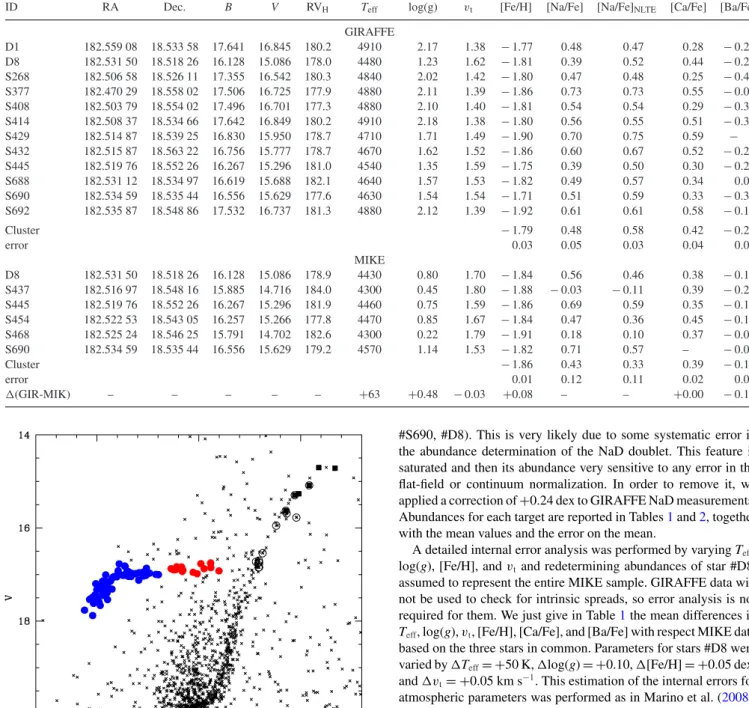
lists the basic parameters of the retained stars: ID (from Stetson et al.2005), J2000.0 coordinates (RA & Dec. in degrees),Band Vmagnitudes, heliocentric radial velocity RVH(km s−1),Teff(K), log(g), microturbulence velocityvt(km s−1), plus [Fe/H], [Na/Fe], [Ca/Fe], and [Ba/Fe] abundances. The determination of the atmospheric parameters and abundances is discussed in the next sec-tion. In Fig.1we report, on the top of the cluster colour–magnitude diagram (CMD), the MIKE targets as black filled squares, and with open black circles the GIRAFFE targets.
3 A B U N DA N C E A N A LY S I S
Atmospheric parameters were obtained in the following way. First, Teffwas derived from theB−Vcolour using the relation of Ramirez & Melendez (2005). The reddening we adopted (E(B−V)=0.02) was obtained from Harris (1996, 2010 edition). Surface gravities (log(g)) were obtained from the canonical equation:
log ityL/Lwas obtained from the absolute magnitude MVassuming an apparent distance modulus of (m–M)V=16.49 (Harris1996). The bolometric correction (BC) was derived by adopting the relation BC–Tefffrom Alonso, Arribas & Martinez-Roger (1999). Finally, microturbulence velocity (vt) was obtained from the relation of Marino et al. (2008).
Atmospheric models were calculated usingATLAS9 (Kurucz1970) assuming our estimations ofTeff, log(g), andvt, and the [Fe/H] value from Harris (1996)([Fe/H]= −1.80).
The local thermodynamic equilibrium (LTE) programme MOOG (Sneden1973) was used for the abundance analysis. For MIKE data,Teff, log(g), and vt were re-adjusted and new atmospheric models calculated in an interactive way in order to remove trends in excitation potential and equivalent width versus abundance for Teff and vt, respectively, and to satisfy the ionization equi-librium for log(g). 30/40 FeI and 8/10 FeII (depending on the S/N of the spectrum) were used for the latter purpose. The [Fe/H] value of the model was changed at each iteration according to the output of the abundance analysis.
Table 1. Parameters for the observed stars including FeI, NaI, CaIand BaIIabundances. Reported errors are errors on the mean.
ID RA Dec. B V RVH Teff log(g) vt [Fe/H] [Na/Fe] [Na/Fe]NLTE [Ca/Fe] [Ba/Fe]
GIRAFFE
D1 182.559 08 18.533 58 17.641 16.845 180.2 4910 2.17 1.38 −1.77 0.48 0.47 0.28 −0.22
D8 182.531 50 18.518 26 16.128 15.086 178.0 4480 1.23 1.62 −1.81 0.39 0.52 0.44 −0.23
S268 182.506 58 18.526 11 17.355 16.542 180.3 4840 2.02 1.42 −1.80 0.47 0.48 0.25 −0.41 S377 182.470 29 18.558 02 17.506 16.725 177.9 4880 2.11 1.39 −1.86 0.73 0.73 0.55 −0.04 S408 182.503 79 18.554 02 17.496 16.701 177.3 4880 2.10 1.40 −1.81 0.54 0.54 0.29 −0.31 S414 182.508 37 18.534 66 17.642 16.849 180.2 4910 2.18 1.38 −1.80 0.56 0.55 0.51 −0.34
S429 182.514 87 18.539 25 16.830 15.950 178.7 4710 1.71 1.49 −1.90 0.70 0.75 0.59 −
S432 182.515 87 18.563 22 16.756 15.777 178.7 4670 1.62 1.52 −1.86 0.60 0.67 0.52 −0.20 S445 182.519 76 18.552 26 16.267 15.296 181.0 4540 1.35 1.59 −1.75 0.39 0.50 0.30 −0.23
S688 182.531 12 18.534 97 16.619 15.688 182.1 4640 1.57 1.53 −1.82 0.49 0.57 0.34 0.03
S690 182.534 59 18.535 44 16.556 15.629 177.6 4630 1.54 1.54 −1.71 0.51 0.59 0.33 −0.31 S692 182.535 87 18.548 86 17.532 16.737 181.3 4880 2.12 1.39 −1.92 0.61 0.61 0.58 −0.12
Cluster −1.79 0.48 0.58 0.42 −0.22
error 0.03 0.05 0.03 0.04 0.04
MIKE
D8 182.531 50 18.518 26 16.128 15.086 178.9 4430 0.80 1.70 −1.84 0.56 0.46 0.38 −0.19
S437 182.516 97 18.548 16 15.885 14.716 184.0 4300 0.45 1.80 −1.88 −0.03 −0.11 0.39 −0.22 S445 182.519 76 18.552 26 16.267 15.296 181.9 4460 0.75 1.59 −1.86 0.69 0.59 0.35 −0.17 S454 182.522 53 18.543 05 16.257 15.266 177.8 4470 0.85 1.67 −1.84 0.47 0.36 0.45 −0.15 S468 182.525 24 18.546 25 15.791 14.702 182.6 4300 0.22 1.79 −1.91 0.18 0.10 0.37 −0.04
S690 182.534 59 18.535 44 16.556 15.629 179.2 4570 1.14 1.53 −1.82 0.71 0.57 – −0.05
Cluster −1.86 0.43 0.33 0.39 −0.14
error 0.01 0.12 0.11 0.02 0.03
(GIR-MIK) – – – – – +63 +0.48 −0.03 +0.08 – – +0.00 −0.12
Figure 1. VversusB−VCMD of NGC 4147. Open black circles indicate GIRAFFE targets, while filled black circles indicate MIKE targets. HB stars were divided in first-generation (filled red circles) and second-generation (filled blue circles) objects. See the text for more details.
by the INSPEC3data base. After the NLTE correction, we found a small offset of 0.24 dex between Na abundances of the two data sets, that we could estimate using the three stars in common (#S445,
3Version 1.0 (Karin Lind et al.;http://inspect.coolstars19.com/index.php?n
=Main.HomePage).
#S690, #D8). This is very likely due to some systematic error in the abundance determination of the NaD doublet. This feature is saturated and then its abundance very sensitive to any error in the flat-field or continuum normalization. In order to remove it, we applied a correction of+0.24 dex to GIRAFFE NaD measurements. Abundances for each target are reported in Tables1and2, together with the mean values and the error on the mean.
A detailed internal error analysis was performed by varyingTeff, log(g), [Fe/H], andvtand redetermining abundances of star #D8, assumed to represent the entire MIKE sample. GIRAFFE data will not be used to check for intrinsic spreads, so error analysis is not required for them. We just give in Table1the mean differences in Teff, log(g),vt, [Fe/H], [Ca/Fe], and [Ba/Fe] with respect MIKE data based on the three stars in common. Parameters for stars #D8 were varied byTeff= +50 K,log(g)= +0.10,[Fe/H]= +0.05 dex, andvt= +0.05 km s−1. This estimation of the internal errors for atmospheric parameters was performed as in Marino et al. (2008). Results are shown in Table3, including the error due to the noise of the spectra. This error was obtained for elements whose abundance was obtained by EQWs, as the errors on the mean given byMOOG, and for elements whose abundance was obtained by spectrum-synthesis, as the error given by the fitting procedure.σtotis the squared sum of the single errors, whileσobsis the mean observed dispersion of MIKE data.
As a cross check of our abundance analysis, we plot in Figs2
Table 2. Chemical abundances of MIKE stars. The abundance for Ti is the mean of those obtained from the neutral and singly ionized species. Reported errors are errors on the mean.
ID (CI/Fe) (NI/Fe) (OI/Fe) (CNO/Fe) (MgI/Fe) (AlI/Fe) (SiI/Fe) (Ti/Fe) (CrI/Fe) (NiI/Fe) (YII/Fe) (EuII/Fe)
D8 −0.72 0.86 −0.13 0.07 0.38 0.95 0.44 0.30 −0.16 0.03 −0.22 0.45
S437 −0.24 0.21 0.30 0.21 0.47 0.25 0.47 0.31 −0.11 −0.06 −0.01 0.38
S445 −0.64 0.75 −0.27 −0.04 0.38 1.03 0.44 0.25 −0.18 −0.08 −0.33 0.33
S454 −0.26 0.60 0.17 0.17 0.50 0.91 – 0.33 −0.23 −0.07 −0.35 0.37
S468 −0.53 0.54 0.26 0.20 0.46 0.27 0.49 0.27 −0.14 −0.07 −0.11 0.27
S690 −0.61 0.80 0.06 0.14 0.34 1.01 – 0.25 – −0.05 −0.43 0.42
Cluster −0.50 0.63 0.07 0.12 0.42 0.74 0.46 0.28 −0.16 −0.05 −0.24 0.37
error 0.08 0.10 0.09 0.04 0.03 0.15 0.01 0.01 0.02 0.02 0.06 0.03
Table 3. Estimated errors on abundances due to errors on atmospheric parameters and to spectral noise compared with the observed errors for stars #D8. The last column gives the observed dispersion of MIKE data.
ID Teff=50 K log(g)=0.10 vt=0.05 km s−1 [Fe/H]=0.05 S/N σtot σobs ([C/Fe]) 0.02 0.02 0.05 0.04 0.02 0.07 0.20±0.06 ([N/Fe]) 0.05 0.02 0.05 0.03 0.02 0.08 0.23±0.07 ([O/Fe]) 0.05 0.06 0.05 0.02 0.02 0.10 0.23±0.07 ([Na/Fe]) 0.02 0.01 0.00 0.01 0.05 0.06 0.30±0.09 ([Mg/Fe]) 0.03 0.01 0.00 0.01 0.05 0.06 0.06±0.02 ([Al/Fe]) 0.02 0.00 0.02 0.01 0.05 0.06 0.39±0.11 ([Si/Fe]) 0.05 0.01 0.02 0.01 0.05 0.07 0.02±0.01 ([Ca/Fe]) 0.00 0.00 0.00 0.00 0.04 0.04 0.04±0.01 ([Ti/Fe]) 0.03 0.00 0.00 0.01 0.03 0.04 0.03±0.01 ([Cr/Fe]) 0.03 0.00 0.00 0.00 0.03 0.04 0.05±0.01 ([Fe/H]) 0.05 0.01 0.02 0.01 0.01 0.05 0.03±0.01 ([Ni/Fe]) 0.00 0.00 0.00 0.00 0.02 0.02 0.04±0.01 ([Y/Fe]) 0.07 0.04 0.03 0.00 0.04 0.09 0.16±0.05 ([Ba/Fe]) 0.03 0.05 0.03 0.03 0.01 0.07 0.07±0.02 ([Eu/Fe]) 0.05 0.03 0.03 0.02 0.02 0.07 0.04±0.01
Figure 2. [Fe/H] versusTeff(upper panel) and [Na/Fe] versusTeff(lower panel) relations for our sample. GIRAFFE targets are reported as black circles, while MIKE targets are reported as red circles. Error adopted are those from Table3. For both relations, we indicated the mean value with a continuous black line and the±1σinterval with two dashed lines. For the [Na/Fe] versusTeffrelation, we considered only targets hotter than 4400 K. See the text for more details.
Figure 4. Spectra of the #D8 (black squares) and #S437 (red squares) targets around the Na double at 568 nm. Blue lines are the best-fitting synthetic spectra with Na abundances taken from Table1. The green line is a synthetic spectrum calculated for the atmospheric parameters of #S437 but with the Na content of #D8.
If we move to Na instead, we see a different situation. First of all, we considered only stars with temperature hotter than 4400 K. Again a linear fit gives a slopes with a significance below 1σ and all stars are spread around the mean value with no sign of any trend. However, the two coldest targets show an Na content much lower than that of their hotter companions. If we extrapolate the fit to the temperature of the two coldest stars, we find a difference with respect to the fit of∼0.50 dex, that is significant at a level of∼4σ. This is because they are first-generation stars with an intrinsic low Na, while all the other targets are second-generation stars with high Na. In order to show visually the large difference in Na content of the two coldest stars with respect to the rest of the sample we plot in Fig.4, the spectra of the Na-rich #D8 (black squares) and the Na-poor #S437 (red squares) target around the Na double at 568 nm. Blue lines are the best-fitting synthetic spectra with Na abundances taken from Table1. The green line is a synthetic spectrum calculated for the atmospheric parameters of #S437 but with the Na content of #D8. It is clear from this comparison that the #S437 strong Na under abundance is real and not due, for instance, to the low S/N or to an ill-estimated stellar effective temperature.
4 R E S U LT S
4.1 Iron-peak elements
The iron content we obtained from GIRAFFE data is
[Fe/H]GIRAFFE= −1.82±0.02
while from MIKE data is
[Fe/H]MIKE= −1.86±0.01.
Reported errors are errors on the mean. The difference be-tween the two data sets is of 0.04 dex, that correspond to 1.8σ.
Figure 5. [Cr/Fe] and [Ni/Fe] trends as a function of [Fe/H] for different environments (see the text). Open black circles indicate MIKE targets, while the filled black circle is the mean abundance of NGC 4147.
The agreement is satisfactory. Finally, we can give a value for the iron content of the cluster that is the mean of the two data sets:
[Fe/H]= −1.84±0.02.
This value well agrees with Ivans (2009), that give [Fe/H]= −1.7±0.1, and with Harris (1996) that give [Fe/H]= −1.80. The measured iron dispersion in Table3well agrees with the dispersion due to measurement errors so we can rule out any intrinsic Fe abundance spread.
The chemical abundances for the iron-peak elements Cr and Ni are listed in Table 2. The value is subsolar for Cr, while Ni is basically solar-scaled. Fig.5(as well as the following plots) shows the mean (black filled circle) and star by star (black empty cir-cles) elemental abundances of the cluster compared with a vari-ety of galactic and extragalactic objects. We have included val-ues from GGCs (Carretta et al.2009b; Villanova, Geisler & Pi-otto2010; Villanova & Geisler2011, red filled squares); Disc and halo stars (Fulbright2000; Reddy et al.2003; Cayrel et al.2004; Simmerer2004; Barklem et al.2005; Reddy, Lambert & Allende Prieto2006; Francois et al.2007, grey filled squares) and extra-galactic objects such as Magellanic Clouds (Johnson, Ivans & Stet-son2006; Pompeia et al.2008; Mucciarelli et al.2008,2009, blue filled squares), Draco, Sextans, Ursa Minor and Sagittarius dwarf galaxy and the ultrafaint dwarf spheroidals Bo¨otes I and Hercules (Shetrone, Cote & Sargent2001; Monaco et al.2005; Sbordone et al.2007; Koch et al. 2008; Ishigaki et al.2014, green filled squares).
Figure 6. Left panel: [Na/Fe] versus [O/Fe] as obtained for MIKE targets. The cluster shows the typical Na-O anti-correlation of GGCs. The blue line is the Carretta et al. (2009a) dilution model for the cluster. Right panel: The Na distribution of GIRAFFE (black) and MIKE (red) targets. See the text for more details.
4.2 Light elements
Light elements C, N, O, Na and Al have an observed spread that well exceeds the observational uncertainties (see Table3). The only exception is Mg that seems to be homogeneous within the errors.
Very interesting is the analysis of the Na and O distributions. In Fig.6, we show the Na–O anticorrelation of MIKE data on the left-hand panel, while in the right-hand panel we report the Na distribution based on the GIRAFFE and MIKE data. We fitted the Carretta et al. (2009a) dilution model (blue line) to the Na–O an-ticorrelation. According to this fit, the cluster is composed by a first generation of stars with [Na/Fe]∼ +0.0 and [O/Fe]∼ +0.3 and second generation with [Na/Fe]∼ +0.5 and [O/Fe]∼ −0.2. This is in common with all but one of the GCs studied up to now. The difference appears when we count the number of stars for each population. If we combine together the two data sets and consider all the stars with [Na/Fe]<0.30 as first generation, we end up with the result that that second-generation stars in the cluster represent ∼90 per cent of the total, leaving room only for a∼10 per cent to the first generation. The Poissonian error related with the two esti-mations is 20 and 10 per cent, respectively. This result is confirmed by Fig.1. Here, we selected tentatively the HB progeny of the first generation as red filled circles, and the HB progeny of the second generation as blue filled circles. If we compare the relative number of stars, we obtain that second-generation stars in the cluster repre-sent 80±10 per cent of the total. However, we point out that this number is a lower limits because we left out blue HB stars evolved off the blue HB zero age sequence, and at the same time red HB stars suffer a contamination from the field. So our best estimation is that∼85 per cent of the stars in NGC 4147 belong to the second generation. If Caloi & D’Antona (2011) or Khalaj & Baumgardt (2015) are right, we have here a cluster that suffered an extreme loss of its first generation.
In Fig.7, we show the correlation between Na and Al, another elements usually but not always involved in the light-element spread
Figure 7. [Na/Fe] versus [Al/Fe] as obtained for MIKE targets (filled black circles). The cluster shows the typical Na-Al correlation of GGCs (red squares). See the text for more details.
Figure 8. [Mg/Fe] and [Al/Fe] trends as a function of [Fe/H] for different environments (see the text). Open black circles indicate MIKE targets, while the filled black circle is the mean abundance of NGC 4147.
(Villanova & Geisler2011). The cluster shows a clear correlation that matches that found in the other GGCs. In addition the two first-generation stars ([Na/Fe]∼0.0, [Al/Fe]∼0.2) well agrees with the bulk of Galactic objects while very few extragalactics targets occupy this region. In the figure, we report also the slope and its error. The significance of the relation of∼7σ.
Figure 9. [Si/Fe], [Ca/Fe] and [Ti/Fe] trends as a function of [Fe/H] for different environments (see the text). Open black circles indicate MIKE targets, while the filled black circle is the mean abundance of NGC 4147. Milky Way stars, they follow two separate trends. Almost all stars above [Fe/H]∼ −1.7 have [Al/Fe]≥0, while all stars below [Fe/H] ∼ −1.7 have [Al/Fe] well below 0 with a mean value of∼ −0.8. This result is not totally new, because Gehren et al. (2006, Fig.5) found the same behaviour using [Al/Mg] versus [Fe/H] instead of [Al/Fe] versus [Fe/H] as we do. The surprise arises when we add GGC and extragalactic dwarfs because in both classes of objects stars below [Fe/H]∼ −1.7 have [Al/Fe]≥0. This could suggest a different formation history of GCC stars with respect the halo field. In any case, NGC 4147 follow the GCC trend.
4.3 αelements
Theαelements Si, Ca, and Ti are overabundant compared to the Sun. This is a common feature among almost every GGC as well as among similarly metal-poor field stars in the Milky Way and in outer galaxies. The calcium content we obtained from GIRAFFE data is
[Ca/Fe]GIRAFFE= +0.42±0.04
while from MIKE data is
[Ca/Fe]MIKE= +0.39±0.02.
Reported errors are errors on the mean. The difference be-tween the two data sets is of 0.03 dex, within 1σ. The agreement is satisfactory. Based on Mg, Si, Ca, and Ti abundances of MIKE stars, we derive for the cluster a meanαelement abundance of
[α/Fe]= +0.39±0.04
Fig. 9 shows theα-element abundance of the cluster (MIKE data only), compared with the trend as a function of the metallicity for GGCs, disc and halo stars and extragalactic objects. Theα elements in NGC 4147 follows the same trend as GGCs and are fully compatible with halo field stars. Again NGC 4147 falls in a region where both Galactic and extragalactic objects overlap.
Figure 10. [Y/Fe], [Ba/Fe] and [Eu/Fe] trends as a function of [Fe/H] for different environments (see the text). Open black circles indicate MIKE targets, while the filled black circle is the mean abundance of NGC 4147. However if we look carefully at the Ca trend, we notice that at the metallicity of the cluster the mean Ca abundance for halo stars is higher than that for dwarf galaxies. The difference is of∼0.3 dex. This is true also for Ti. NGC 4147 stars have
[Ca/Fe]= +0.40±0.02
and
[Ti/Fe]= +0.28±0.02.
(reported errors are errors on the mean) that must be compared with the mean values for the halo ([Ca/Fe]∼0.3, [Ti/Fe]∼0.3) and for the Dwarf galaxies ([Ca/Fe]∼ 0.1, [Ti/Fe]∼0.1). So, according to itsα-element content, NGC 4147 seems more likely to be a genuine Galactic cluster, although some other clusters like M54 and Arp2, that belong to the Sagittarius galaxy, have anα -element content similar to NGC 4147 ([Ca/Fe]= +0.32 and [Ca/Fe] = +0.46, respectively; Mottini, Wallerstein & McWilliam2008; Carretta et al.2010).
4.4 Heavy elements
Figure 11. [Ba/Y] and [Eu/Y] trends as a function of [Fe/H] for different environments (see the text). Open black circles indicate MIKE targets, while the filled black circle is the mean abundance of NGC 4147.
Figure 12. [Y/Fe] versus [Na/Fe] as obtained for MIKE targets (filled black circles). The cluster shows a possible Y–Na anticorrelation. See the text for more details.
[Eu/Y] ratios, where again NGC 4147 agrees both with the Galactic and the extragalactic trends
Ba and Eu show an observed spread that is comparable to that expected from the errors (see Table3), while for Y the observed spread is significantly larger. To check this behaviour, we show in Fig.12the abundance ratios of [Y/Fe] as a function of [Na/Fe]. The two first-generation stars ([Na/Fe]∼0.0) well agrees with the bulk of Galactic objects while most of the extragalactic stars have lower Na and Y content. This support our identification of NGC 4147 as a Galactic cluster. What is more interesting is the anticorrelation
between Y and Na with Y that decreases while Na increases. In the plot, we reported the slope a of the linear fit to NGC 4147 stars (black line) together with its error. The significance of the fit is larger than 4σ.
Only a handful of metal-poor GCs show a potential star-to-star dispersion in neutron-capture elements (Kacharov, Koch & McWilliam2013; Worley et al.2013). Marino et al. (2009) found a wide range of abundances values fors-process elements, Y, Zr and Ba, in M22. They also identified a bimodality among these elements. However, none of the elements show a correlation with Na, O and Al.
Our result implies that the second Na-rich generation was formed by material where Y was destroyed. This is at odd with current models that describe the multiple population phenomenon in GCs, which postulate AGB stars as major polluters (Ventura & D’Antona
2009). In fact, AGB stars also produce lights-process elements like Y (Cristallo et al.2015). The amount of lights-element produced depends a lot on the mass of the AGB star, but in no case a Y destruction is predicted. For this reason, we checked for possible blending not considered in our line-list. For example, a blend with a CN or CH line could mimic a [Y/Fe] spread even if Y is constant just because C and N vary. However, the result of this check was negative. We underline also that the fact that the two Y-rich first-generation stars are also the two coldest objects in our sample. We have no first-generation stars in the temperature range of the second-generation targets, so we cannot totally rule out a possible temperature effect on our Y abundance determination. In spite of that, we leave open the possibility that the [Y/Fe] versus [Na/Fe] trend we found is real waiting for future studies.
5 S U M M A RY
In this paper, we present the first detailed chemical abundances of 15 elements in six red giant radial velocity members of NGC 4147 observed using the high-resolution MIKE spectrograph, mounted at the Magellan-Clay telescope, and Fe and Na abundances in 12 red giant radial velocity members observed using the medium res-olution GIRAFFE spectrograph, installed at the VLT-UT2 tele-scope. Chemical abundances have been computed using plane-parallel atmospheric-models and LTE approximation. Equivalent width method has been used when possible. Otherwise we applied the spectrum-synthesis method. We obtained the following results.
(i) We found a mean metallicity of [Fe/H]= −1.84±0.02, that well agree with previous literature data. As far as other iron-peak elements are concerned, Cr is subsolar while Ni is solar-scaled, in agreement with halo and dwarf galaxies environment at the cluster metallicity.
(ii) NGC 4147 shows the typical Na–O anticorrelation common to almost all the other GGCs. However, the cluster contains only ∼15 per cent of first-generation stars. This implies that it suffered a severe mass-loss, maybe the most extreme among all the GGCs. Na is also correlated with Al as found in many GGCs. Mg follows the Galactic trend, while Al is much more enhanced with respect to halo stars sharing this behaviours with all the other GGCs.
(iii) NGC 4147 has the typicalα-enhancement of the halo. Its Ca and Ti abundances agree better with the halo than with the mean Ca and Ti content of extragalactic environments at the cluster metallicity. This is true also if we consider the behaviour of [Na/Fe] versus [Al/Fe] and [Y/Fe] versus [Na/Fe].
While Ba and Eu are homogeneous, Y possibly shows a spread and an anticorrelation with Na.
AC K N OW L E D G E M E N T S
SV and CMB acknowledge the support provided by Fondecyt Regular 1130721 and 1150060, respectively. PA acknowledges the support provided by the Chinese Academy of Sciences President’s International Fellowship Initiative, Grant no. 2014FFJB0018, and by the Programa de Astronomia, Fondo China-Conicyt 2Conv. CAS15020.
R E F E R E N C E S
Alonso A., Arribas S., Martinez-Roger C., 1999, A&AS, 140, 261 Barklem P. S. et al., 2005, A&A, 439, 129
Bellazzini M., Ferraro F. R., Ibata R., 2003a, AJ, 125, 188
Bellazzini M., Ibata R., Ferraro F. R., Testa V., 2003b, A&A, 405, 577 Caloi V., D’Antona F., 2011, MNRAS, 417, 228
Carretta E. et al., 2009a, A&A, 505, 117 Carretta E. et al., 2009b, A&A, 505, 139 Carretta E. et al., 2010, A&A, 520, 95
Carretta E., Bragaglia A., Gratton R. G., D’Orazi V., Lucatello S., Sollima A., 2014, A&A, 561, 87
Cayrel R. et al., 2004, A&A, 416, 1117
Cristallo S., Straniero O., Piersanti L., Gobrecht D., 2015, ApJS, 219, 40 D’Ercole A., Vesperini E., D’Antona F., McMillan S. L. W., Recchi S., 2008,
MNRAS, 391, 825
Francois P. et al., 2007, A&A, 476, 935 Fulbright J. P., 2000, AJ, 120, 1841
Gehren T., Shi J. R., Zhang H. W., Zhao G., Korn A. J., 2006, A&A, 451, 1065
Harris W. E., 1996, AJ, 112, 1487
Ibata R. A., Lewis G. F., 1998, ApJ, 500, 575
Ishigaki M. N., Aoki W., Arimoto N., Okamoto S., 2014, A&A, 562, 146 Ivans I. I., 2009, BAAS, 213, 341.06
Johnson J. A., Ivans I. I., Stetson P. B., 2006, ApJ, 640, 801 Kacharov N., Koch A., McWilliam A., 2013, A&A, 554, 81 Khalaj P., Baumgardt H., 2015, MNRAS, 452, 924
Koch A., McWilliam A., Grebel E. K., Zucker D. B., Belokurov V., 2008, ApJ, 688, 13
Kurucz R. L., 1970, SAO Special Report, 309 Law D. R., Majewski S. R., 2010, ApJ, 718, 1128
Marino A. F., Villanova S., Piotto G., Milone A. P., Momany Y., Bedin L. R., Medling A. M., 2008, A&A, 490, 625
Marino A. F., Milone A. P., Piotto G., Villanova S., Bedin L. R., Bellini A., Renzini A., 2009, A&A, 505, 1099
Monaco L., Bellazzini M., Bonifacio P., Ferraro F. R., Marconi G., Pancino E., Sbordone L., Zaggia S., 2005, A&A, 441, 141
Mottini M., Wallerstein G., McWilliam A., 2008, AJ, 136, 614 Mucciarelli A., Carretta E., Origlia L., Ferraro F. R., 2008, AJ, 136, 375 Mucciarelli A., Origlia L., Ferraro F. R., Pancino E., 2009, ApJ, 695, 134 Peterson R. C., Olszewski E. W., Aaronson M., 1986, ApJ, 307, 139 Pompeia L. et al., 2008, A&A, 480, 379
Pryor C., McClure R. D., Fletcher J. M., Hesser J. E., 1988, in Grindlay J. E., Philip A. G. D., eds, Proc. IAU Symp. 126, The Harlow-Shapley Sym-posium on Globular Cluster Systems in Galaxies. Kluwer, Dordrecht, p. 661
Ramirez I., Melendez J., 2005, ApJ, 626, 446
Reddy B. E., Tomkin J., Lambert D. L., Allende Prieto C., 2003, MNRAS, 340, 304
Reddy B. E., Lambert D. L., Allende Prieto C., 2006, MNRAS, 367, 1329 Sbordone L., Bonifacio P., Buonanno R., Marconi G., Monaco L., Zaggia
S., 2007, A&A, 465, 815
Sbordone L. et al., 2015, A&A, 579, 104
Shetrone M. D., Cote P., Sargent W. L. W., 2001, ApJ, 548, 592 Simmerer J., 2004, BAAS, 205, 7705
Sneden C., 1973, ApJ, 184, 839
Stetson P. B., Catelan M., Smith H. A., 2005, PASP, 117, 1325 Ventura P., D’Antona F., 2009, A&A, 499, 835
Villanova S., Geisler D., 2011, A&A, 535, 31 Villanova S., Geisler D., Piotto G., 2010, ApJ, 722, 18
Villanova S., Geisler D., Carraro G., Moni Bidin C., Mu˜noz C., 2013, ApJ, 778, 186
Worley C. C., Hill V., Sobeck J., Carretta E., 2013, A&A, 553, 47
![Figure 2. [Fe/H] versus T eff (upper panel) and [Na/Fe] versus T eff (lower panel) relations for our sample](https://thumb-us.123doks.com/thumbv2/123dok_es/3661477.636494/4.892.74.663.327.960/figure-versus-upper-panel-versus-lower-relations-sample.webp)
![Figure 5. [Cr/Fe] and [Ni/Fe] trends as a function of [Fe/H] for different environments (see the text)](https://thumb-us.123doks.com/thumbv2/123dok_es/3661477.636494/5.892.69.432.83.445/figure-cr-fe-trends-function-different-environments-text.webp)
![Figure 8. [Mg/Fe] and [Al/Fe] trends as a function of [Fe/H] for different environments (see the text)](https://thumb-us.123doks.com/thumbv2/123dok_es/3661477.636494/6.892.457.819.523.874/figure-mg-fe-trends-function-different-environments-text.webp)
![Figure 9. [Si/Fe], [Ca/Fe] and [Ti/Fe] trends as a function of [Fe/H] for different environments (see the text)](https://thumb-us.123doks.com/thumbv2/123dok_es/3661477.636494/7.892.459.822.82.444/figure-si-fe-trends-function-different-environments-text.webp)
![Figure 12. [Y/Fe] versus [Na/Fe] as obtained for MIKE targets (filled black circles). The cluster shows a possible Y–Na anticorrelation](https://thumb-us.123doks.com/thumbv2/123dok_es/3661477.636494/8.892.65.425.503.864/figure-versus-obtained-targets-circles-cluster-possible-anticorrelation.webp)
