
Overview of Cooperative Learning and The Implication of its Implementation in the Classroom
70
0
0
Texto completo
(2)
(3) Vº Bº de la tutora.
(4) Index 1. Introduction…………………………………………………………………………....1 2. Justification…………………………………………………………………………….3 3. Theoretical Background…………………………………………………………...…..4 3.1 What is cooperative learning? .................................................................................4 3.2 Groups in cooperative learning…………………………………………………….5 3.2.1. Types of groups…….……………………………………………….……..5. 3.2.2. Group phases……………………………………………….……………..10. 3.2.3. Selection of members forming a group……………………….…….…….11. 3.2.4. Quantity of members in a group………………………………………….14. 3.2.5. Roles assignation…………………………………………………………16. 3.3 Essential………………………………………………………….……………….19 3.3.1. Allocated leadership………………………………………………….…..19. 3.3.2. Individual and group evaluation…………………………..……….……..21. 3.3.3. Social abilities…………………………………………….………..……..21. 3.3.4. Equal opportunities………………………………………..…………...…22. 3.3.5. Individual and group responsibility………………………………...…….22. 3.3.6. Face to face stimulating interaction………………………….………...…23. 3.3.7. Positive interdependence ………………………………..………….....…23. 3.4 Classroom organization…………………………………………….........…..……23 3.5 Cooperative learning models…………………………………………………..…24 4. Cooperative learning implementation using learning together ……………..……….26 4.1 Introduction……………………………………………………………..….....….26 4.2 Course context………………………………………………………………..…..26 4.3 Session preparation……………………………………..………………………...28 4.4 Implementation of Cooperative Learning……………….………………………..32 4.5 Drawbacks……………………………………………….…………………....….36 4.6 Conclusion………………………………………………………………………..37 5. Cooperative learning proposal using jigsaw……………………………...…………38 6. Conclusion………………………………………………………………...………….47 7. Bibliography……………………………………………………………………...…..50 8. Appendixes………………………………………………………………………...…52. 1.
(5)
(6) 1. Introduction Social interactions happen inside the class thanks to the process of teaching and learning. These interactions occur among students themselves and between students and teachers. However, in a traditional classroom (teacher speaking classroom), the most promoted interaction is the students – teachers one. This interaction is necessary for the students to learn, but the problem arises when the other type of interaction is left aside (Pujolàs Maset, 2008). Students do not work together as much as they work individually, answering teachers’ questions or making the activities demanded. This can lead students to a certain degree of competition inside the class. Competition is not only caused by the interactions, but also by the organization of the furniture of the classroom: tables are separated in individual rows and teachers have their tables on the front of the classroom to control the class. Students can only speak among them when the teacher asks them to do it; if not, that relationship or interaction among students is broken during lessons. Silence is asked most of the time during a traditional lesson, because students are supposed to work individually (Pujolàs Maset, 2008). This type of teaching is not responding to the demands of the current society. We live in a multicultural and diverse society, where homogeneity is not dominant, where interactions among people of different cultures are proliferating. As a consequence, education must pay attention to diversity, and that can be done by introducing cooperative learning in the schools. (Diaz-Aguado Jalón, 2003) It has been recently added to the organic law of education the demand of a development of the competencies needed to interact with others, to solve problems, to cooperate and to work in groups. Thus, cooperative learning in classrooms could be a way to respond to this demand collected in the educational law (Torrego & Negro, 2012). The purpose of this essay is to create a design of cooperative learning using two different models (learning together model and jigsaw model) to promote inclusion on a specific type of students who lack communicational skills and who have problems of exclusion inside their classroom. One of those designs was implemented inside that precise classroom; thus, there 1.
(7) will be a description of the results it implied and of the points that could have been improved during its implementation. The proposal on the other hand, is suggested as an alternative way to promote inclusion, and to enhance the academic results of those students which were actually low. Thereafter, the need of portray what cooperative is and how it can be planned and implemented in the classroom arises. That is why at the beginning of the essay an overlook on cooperative learning characteristics will be done, previously than showing the implementation of the learning together model and the proposal of the jigsaw model which are based on those theories. These designs, as opposite to the traditional classroom teacher-centred, respond to the needs stated on the organic law of education because thanks to them students will be able to interact, will work in groups and will acquire the skills to communicate, to solve problems and to be more tolerant and respectful.. 2.
(8) 2. Justification The Spanish educational system has problems of exclusion and of academic failure, which may be caused by the lack of cooperation and the students’ lost feeling of belonging to the educational institution. (Torrego & Negro, 2012) As said before in the introduction, a large variety of students are congregated inside the classroom, so if they are gathered in groups, ones can learn from the abilities of the others. This is why cooperative learning can serve; that is where the importance of cooperative learning arises. Cooperative learning is effective in terms of inclusion, the promotion of tolerance and the development of communicational skills. Furthermore it helps students being more responsible and autonomous (Pujolas Maset, 2008), which makes it perfect for a classroom in which exclusion and diversity of ethnical groups is present. It is a very complete methodological technique which merges academic and social skills together, and it also responds to current social and educational needs. The idea of making a design of cooperative learning models emanated from the observation of a second year of secondary school classroom in which I saw serious problems of inclusion, respect, demotivation and academic failure. A s a consequence, the design of a cooperative learning model was made in order to see if it was effective; to check if students evolved primarily in terms of social and communicative skills, and secondary if there was a betterment in students’ academic results. In addition to this design already implemented, a proposal of a different model of cooperative learning (the jigsaw model) will be done in order to demonstrate that one same topic can be developed with different cooperative learning approaches, adapting the needs of the students and the teacher. Jigsaw model concentrates more on academic results than the learning together, so it would be a righteous choice to be implemented in a classroom like that. All in all, this essay is intended to highlight the positive effects that cooperative learning has for nowadays education, and to show two alternatives to its implementation inside the classroom.. 3.
(9) 3. Theoretical background. 3.1 What is cooperative learning? Cooperation in general means working in common to reach a goal in which everybody gets compensation. Thus, cooperative learning is a didactic methodology by which individual students work in reduced groups in order to maximize their own learning and the learning of the rest of the members participating in the group. (Johnson & Johnson, Holubec, 2006) Cooperative learning has no limits in terms of appropriateness in applying it to any subject or topic, whereas competitive and individualistic learning have limitations in relation to this. Cooperative learning is very versatile, it can be implemented in any type of classroom because it would work no matter what the type of students are, the age of the students, the subject, the school… Moreover, it can be used from minutes to hours or if necessary, it can even last for a whole academic year during lessons. (Johnson & Johnson, Holubec, 2006) It is easy to confuse cooperative learning with collaborative learning because both of them have many similarities, yet their differences are clear. While collaborative learning is unstructured, cooperative learning has a clear structure and the students forming the group have a specific role assigned. The aim from the collaborative learning dissents from the aim of the cooperative learning because the aim of the first one is to make students solve a specific problem (usually an abstract one) that has multiple solutions, while the aim of cooperative learning is to make students develop their social and academic skills. In collaborative learning there is no need of positive interdependence while in cooperative learning that is an essential condition. (Furlotte, 2013) Having clear the concept of cooperative learning is the first essential step for cooperative learning to be implemented in a classroom. The rest of the steps would be described along the following sections of this essay.. 4.
(10) 3.2 Groups in cooperative learning. 3.2.1 Types of groups Cooperation as said before implies individuals working in groups to reach the same goal. It could be compare to the teamwork of sportspeople. Subsequently, groups in cooperative learning should make up a team. The aim of the creation of these groups is to reach the level of a team in terms of teamwork. Thus, a definition of what being a team implies is needed to understand how cooperative learning should function. A team is one of the different forms of assembling people in relation to their collaboration and the mutual development: a) Isolated individuals: people without any connection among them, without any knowledge about each other, it is just people gathered together without any configuration. b) Grouping: people sharing physical space and some general goals. c) Group: people sharing physical space, specific goals, there is interaction among them, it has some set up rules, it has a definite structure and its members have functional roles. d) Team: it has all the characteristics of a group plus the ability to solve conflicts. A team is the most complete type of assembling people; (Torrego & Negro, 2012) There is another way to classify groups taking into account the degree of cooperation among the members. According to Johnson, Johnson and Holubec (2006) there are: pseudo learning groups, traditional classroom learning groups, cooperative learning groups and high performance cooperative learning groups. a) Pseudo-learning groups: This is similar to what Torrego & Negro (2012) called isolated individuals in their classification of groups. In this type of group students are competing instead of collaborating. They do not want to work together. Besides, they see each other as rivals because they think they are evaluated individually. This is not useful at all in academic terms. They would learn more if they worked individually than if they do it in this type of groups.. 5.
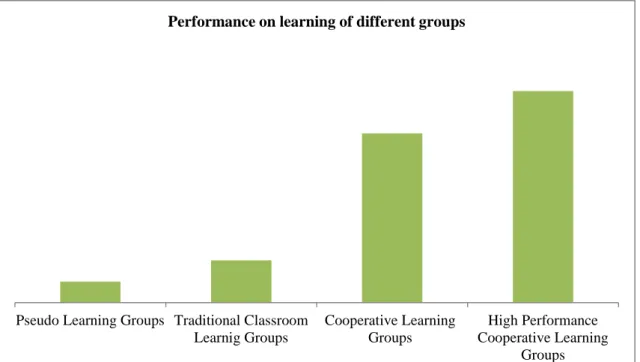
(11) b) Traditional classroom learning groups: Students are willing to work in groups, but tasks do not imply working ensemble. In these groups their inclination to help is scarce, they merely exchange information. During the length of these group formation some students may take advantage of others, letting the more responsible ones do the task requested. Consequently, the sum of their work is superior to the one of some members. However, hardworking students would work better individually.. c) Cooperative learning groups: Students in these groups are conscious that their output depends on the collective efforts of the group members. They have five characteristics: The first is to maximize the learning of all the members forming the group. This motivates them and encourages them to make an effort, so that their output together is higher than the individual output of each of them. Students have clear the idea that if one of them fails, the rest does the same. The second characteristic is that all members in the group assume their own responsibility and makes responsible the rest of the members, and they also pursue to make a good job. Thirdly, they help each other not only academically but also personally; they promote each other’s outputs. The fourth characteristic is that they learn ways to establish interpersonal relationships which are supposed to be used to coordinate their work. Finally, students analyse degree of effectiveness of their achievement of their goals, and how each one is contributing to it.. d) High performance cooperative groups: It is like the previous group, but its outputs are unexpected in the sense that they exceed the expectations. What differentiates them from the previous group is that they have a higher level of compromise with the group and with the achievement of the goals.. 6.
(12) Performance on learning of different groups. Pseudo Learning Groups Traditional Classroom Learnig Groups. Cooperative Learning Groups. High Performance Cooperative Learning Groups. Figure 1. Performance on learning of different groups (figure adapted from Torrego & Negro, p 107, 2012). Figure 1 shows the degree of performance depending on the group formed. As can be seen in the graphic, both types of cooperative learning groups are the ones giving the best academic results. After seeing the classifications of groups in terms of performance, it shall be explained the three different types of groups can be created in relation to their usage or implementation in the classroom: a) Formal cooperative learning groups: Students work together from one hour to weeks. Any subject and any topic can be adapted to be carried out with formal cooperative learning. In this type of groups each member should achieve the assigned task and assure that the rest of the members get to finish their own learning task. In these formal groups, teachers specify the objectives of the lesson, take some previous decisions (such as what is the task, how to organize furniture, who will be the members of the group…), explain the task and the positive interdependence expected to the students, supervise students’ performances during lessons, be a support for the students, help students evaluate the degree of effectiveness of their group, and evaluate their learning.. 7.
(13) This grouping guarantees active participation from the students in terms of explaining contents, summarizing and organizing materials.. (Johnson, Johnson & Holubec,. 2006). b) Informal cooperative learning groups: These groups do not remain together for weeks as the formal ones do; in this case, students can be together for as much as one hour. The usage of this type of groups can be integrated in a master class in order to make students focus on materials; to let them practise and reach a cognitive learning, to create expectations about a topic, and it can also be used to finish a master class. It usually consists on make students speak for few minutes. The put in practice of this type of groups guarantees the same active participation as the formal one: students must organize, summarize and/or explain the contents given. (Johnson, Johnson & Holubec, 2006) Students retain information thanks to working with the materials given by the teacher and their dialogues with their peers. These ones do not require any previous organization on the hand of the teacher; groups are made on the fly.. c) Cooperative base groups: They are used during long periods of time, they can even last the whole academic year. Their members are permanent and they have different abilities or different life perspectives. That is, these groups are heterogeneous. The aim of the members on cooperative base groups is to bring support and help to the rest of the members, and to reach the same goal, which is to improve academic output. Cooperative base groups let students initiate a responsible and durable relation with the rest of the members which would lead them to motivate each other in the achievement of their tasks. Thanks to this type of groups students are able to learn how to establish healthy social relations and to reach high academic results. (Johnson, Johnson & Holubec, 2006) Another group is added by Pere Pujolas in his book Aprender juntos alumnos diferentes (2004), this additional group is called the experts’ group. This kind of group is sporadic, and unites one student of each cooperative base group into a single group, to make them experts in a specific technique or knowledge, so that they later on widespread what they have learnt inside this experts’ group to their base group.. 8.
(14) Vigotsky’s “zone of proximal development theory”, reinforces the theories of Johnson, Johnson & Holubec (2006), and Torrego & Negro (2012) about working in groups. According to Vigotsky’s “zone of proximal development theory”, there are some tasks that must be completed in order to reach cognitive development. The lower level of cognitive development is the one that the child can reach when working independently with his own capabilities; this is called actual developmental level. With the assistance of an expert student another student can reach the upper level of cognitive development, also called the potential developmental level. (Diaz-Aguado Jalón, 2003) That is why heterogeneous groups, in which one high levelled student and a lower levelled student work together, are efficient. The higher levelled student reviews and broadens his knowledge while the lower levelled student builds his knowledge. In relation to this, it has been demonstrated that students learn better when they have to explain what they have learnt to another student, because they must organize their ideas and translate them into words in order to help another student understand them. Moreover, with this process they also recognise their level of knowledge or lack of knowledge about the topic they are learning. (Pujolas Maset, 2008, p 12-13) This leads us to the idea mentioned above that cooperative learning groups are able to analyse and evaluate their efficiency and their performance. Another reason why students should work in groups instead of working individually is because they sometimes do not dare to ask their doubts to their teacher, so their problems very often remain unsolved. However, if they have another student (seen as an equal) supporting them, it is easier for them to ask; they do not feel uncomfortable asking their peers. (DiazAguado Jalón, 2003) Furthermore, as Torrego & Negro (2012) said, teams are able to solve any conflict appearing inside the group. Teams, or to be more precise, cooperative learning groups, have to confront conflicts and be able to solve them. Thus, conflicts should be seen as a positive element in terms of learning. It has been demonstrated by many researches, such as the ones made by Blatt and Kohlberg with teenagers, or the ones made by Doise, Mugny and Perret Clermont in lower courses, that students reach a higher level of knowledge when they have discussed about a topic. Students do not usually question the statements made by teachers, but they dare to doubt about their equals’ opinions or statements, which leads them to reasoning, to the. 9.
(15) acquirement of knowledge and to the acquisition of negotiation and communicative skills. (Diaz-Aguado Jalón, 2003) One more benefit about working in heterogeneous groups is the learning of life values such as respect and tolerance and solidarity towards the others. Tolerance is promoted when cooperative learning groups are implemented in a classroom. Many books talking about inclusion mention cooperative learning as a tool to solve problems of exclusion. Some of these books can be Educación intercultural y aprendizaje cooperativo by Diaz –Aguado Jalón, and Aprender juntos alumnos diferentes by Pere Pujolás. Inside these books, authors seek to encourage the usage of cooperative learning in classrooms with students of different abilities or different cultures. They base their ideas on different researches that ratify cooperative learning as one of the best ways to solve problems of exclusion in school.. 3.2.2 Quantity of members in a group When talking about the quantity of members participating in a group, there is no fixed number. It will depend on the context of the classroom, on its students, on the objectives, on the materials… Nevertheless, they usually oscillate from two to four. Usually the less number of students, the best for their learning. What a teacher should take into account when selecting the number of students is the following: a) When the number of students increases so do the abilities and the capabilities. The number of perspectives and the resources contributing to the success of the group also increase.. b) In a numerous group the number of interrelations is very high, so students must be able to let others speak, to listen, to reach agreements, to make sure that everyone in the group contributes to the task. Students in large groups must have the skills to manage a variety of interpersonal relationships.. c) Again, when increasing the dimensions of the group, intimacy is reduced. Thus, the result is a less united group, and individual responsibilities are lowered.. 10.
(16) d) The number of students forming a group can also depend on the time. If there is short time to do a task, it is better to do it in pairs instead of large groups. This is because students organize quicker themselves if they are only two participating than if they are four. Furthermore, with a short period of time students will be able to intervene more if they are two than if they are more.. e) The risk of having a student faking his work is reduced when groups are formed by few people. Students’ work is more visible in small groups. Sometimes when the group is large some students do not work and take advantage of what other members do. f) In small groups, not only students’ work is more visible, but also the problems arising among them. So it is easier for the teacher to act, and help them solve problems when the groups are reduced.. (Johnson, Johnson & Holubec, 2006) 3.2.3 Selection of members forming a group Teachers’ previous steps to start cooperative learning also include the selection of the members forming the groups. We already have orientation about the number, the duration and the types of groups, so now it will be shown the ways a teacher can select the members of the groups: a) Random distribution In this type of distribution students are distributed spontaneously. There is a variety of ways to do it:. . Mathematical method: each student has a mathematical problem, they have to solve it and look for other students who have the same answer as him. All the students with the same answers will form a group.. . Provinces and capitals: the class is divided into two groups, one group has to prepare names of a province in some cards, and then the other group has to prepare names of 11.
(17) capitals of a same area in other cards. Cards are handed random among students. It is usually done to make groups of two. But it can be modified to make larger groups (up to four) . Historical characters: the teacher prepares cards with historical characters. They are given to the students, and students must find other characters that correspond to the historical period in which his or her character lived. It also can be modified as the previous one, characters can coincide in their origins, in their occupations… All depends on the imagination of the teacher.. . Literary characters: in each card is written a literary character belonging to books that the students have read along the course. They have to find the rest of the characters of the book to which their character belongs.. . Personal preferences: students write their own preference about a specific topic given by the teacher and the students with same preferences will form a group. Any personal preference can be used: sports, food, drinks…. There are many ways to distribute students randomly, the ones that are going to be mentioned are those that Johnson and Johnson and Holubec include in their book El aprendizaje cooperativo en el aula (2006). There is one form to distribute students that Johnson, Johnson and Holubec do not mention; it is the one to which Andre Audette (2017) refers to as the most commonly used way to distribute students in one of his posts on the university website: proximity-based groups. As the name suggests, it consists on joining students which are close in terms of space. It does not take too much time to do it, and it is more silent than other ways to gather students. That may be the reason why it is commonly used by teachers. As she says, this is probably the most used one because it is quick and may be the best way not to make the class very noisy.. 12.
(18) b) Teacher selected groups The teacher selects the members of each group according to the purposes he or she has; which lets him, for example, avoid including more than one idle student in the same groups, or students with disruptive behaviour. Johnson and Johnson and Holubec (2006) make reference to one type of teacher selection whose purpose is the inclusion of isolated students. To realize which students are the isolated ones, the teacher asks students to write the names of two people which they would want to work with. Hence, the less named students would be the more isolated ones. They are the ones in risk of exclusion; therefore, they are the ones needing the teacher’s help. After the detection of the isolated students, they are going to be grouped with the most popular ones. It is a way to help these isolated students establish positive relationships with the rest of the students, and to help them not to feel rejected. c) Stratified distribution In these groups two students with a great difference in specific characteristics must be together. For example if it is taken into account their academic performance, the highest levelled student will be mixed with the lowest levelled student and other two medium students. This must be repeatedly done until you have all of the students grouped. However, when forming these groups there are three recommendations to be followed: Students must not be grouped with their intimate friends or enemies; students in a same group must not be of the same genre; and students must represent the ethnic composition of the class, hence, they must not belong to the same ethnical group if there are a variety of ethnical groups in the whole class. When doing this, the teacher must hide the real reasons why he or she has made the groups this way. This is because if students discover that some of them are selected because of their lower level and others because of their ethnical group, students may begin having prejudices, or may feel that they are inferior or superior to others. That is why the reasons must be covered with an explanation focused on the roles they are supposed to perform, instead of focusing on the personal characteristics. (Johnson, Johnson & Holubec, 2006) Therefore, in this type of grouping the teacher is the one managing the groups, consciously with a specific purpose. 13.
(19) Even though Johnson, Johnson & Holubec (2006) do not include it inside the teacher selected groups, it is in reality a distribution made by the teacher, because he is the one taking into account the specific conditions that the groups have to follow. d) Students selected groups Johnson, Johnson & Holubec (2006) do not recommend using this distribution very often. This is because they are usually homogeneous, it reduces the possibility of establishing new relations, they tend to choose their friends… This can lead to a real situation of exclusion when some students are never chosen to be part of a group. The class environment is then fulfilled with discomfort, which is not appropriate to start cooperative learning activities. 3.2.4 Group phases The next step to follow after groups are conformed is the description of the phases by which each group will pass through during the cooperative learning lessons. The phase classification selected for this essay is Torrego & Negro’s one (2012) because it does not only includes the phases, but also the actions that must be performed in each of them. According to their classification, there are 4 phases: formation-orientation; establishment of rules and resolution of conflicts; effective group performance; and finalisation. a) Formation – orientation It is the first phase by which a group will pass through. It happens at the beginning of the academic year, when no one knows each other, and they are not even a group, but what Torrego & Negro (2012) call a “grouping”. Along this phase, students start knowing each other and their teacher. In addition, they begin learning their responsibilities and abilities inside the group, the rules that must be followed… Teacher, for its part, must focus on explaining the expectations of the tasks and the expectations inside the group performances. The important issue about this stage is to create a comfortable atmosphere for the groups. Among the recommended activities to do during this first phase are presentation activities, knowledge activities, activities promoting trust…. 14.
(20) b) Establishment of rules and resolution of conflicts Along this second phase, dissatisfaction comes to light. Students had the expectations established by the teacher, and they realize they are not reaching them. As a consequence, arguments and conflicts appear in the group. Thus, the role of the teacher during this period is to be facilitator; he or she must give the students tools to solve their problems and conflicts. During this phase there is an evolution, and their feeling of disappointment is lowered as their work progresses. The recommended activities during this second stage are those related to organization, rulemaking, developmental cooperative activities… At the end of this phase students should have different ways to approach to conflicts, and be motivated to continue with their task.. c) Effective group performance It is the productive phase. Students are now acting as a cooperative group. Each student has clear objectives and roles, and each one of them is willingly involved in the task. Hence, a good level of performance is reached and the atmosphere is collaborative. During this phase the activities that must be included are those of the cooperative methods. That is, role-playing activities, brainstorming tasks, analysis of data… This phase is the core phase of the cooperative learning process. The teacher during this phase is to help students develop their social abilities and to help them reinforce cooperation.. d) Finalisation During this phase a final balance of the performance of the group is made. The teacher must give positive aspects of the groups even though they may have negative aspects too. The teacher must treat mistakes as opportunities to learn, and also he or she must know how to transmit it to the students. Along this phase, activities which imply expressing feelings and evaluating the work done are necessary. Activities of future expectations can also be added to these ones.. Even though the classification is clear, groups in the classroom may fluctuate from one phase to the previous one if they do not reach the objectives proposed. This means that it is not a 15.
(21) lineal event; or at least, not always every phase happens in the order proposed above. Groups are unpredictable and sometimes they can make steps back, that is why teachers must be alert and closely observe each group. 3.2.5 Roles assignation When working in groups, some students do not know how to take part in their group, or do not know exactly what they can do. This can be solved by the assignation of roles. If a teacher assigns a role to each member of a group, everyone in the group will be able to participate and will have clear what to do inside the group. Thus, assigning roles reduces the lack of participation (Johnson, Johnson & Holubec, 2006). Moreover the appearance of a dominant student is less probable too. In order to reach this, students must have rotation in their roles. This means that a same student must pass through the performance of different roles so that everyone feels included (Coggeshall, 2010). This is especially important when a role resembling the teacher’s one is included in the group roles. If one student is always performing a role similar to that of the teacher, this student may end up feeling superior to the rest, and the rest may end up feeling inferior; this would be unfair, and it cannot happen in cooperative learning groups. Also, with assigned roles students learn how to use the basic group techniques (Johnson, Johnson & Holubec, 2006); they are able to monitor their own work (Coggeshall, 2010). If roles are complementary, interdependence is created (Johnson, Johnson, & Holubec, 2006). This interdependence, as will be shown later, is one of the essential parts of cooperative learning. Roles can be assigned taking into account different facts such as the context of the classroom, the experience of the students working in them, the personal and academic characteristics of students, the objectives of the teacher… (Pujolàs, 2004) Moreover, the roles can vary depending on the task students are asked to complete. The roles may not be the same for some students making an activity of investigation, than the roles that students making an activity for the development of social skills would have (Coggeshall, 2010).. 16.
(22) A closer view to some roles will be shown, having the reference of the roles classification and description that Johnson, Johnson & Holubec, (2006) have made according to the function of each of them: a) Roles helping the conformation of the group: . Supervisor of voice tone: tries to keep a low voice tone.. . Supervisor of noise: makes sure that everyone in the group moves along the classroom without making too much noise. . Supervisor of turns: tries that everyone respects their speaking turn, and makes sure that every voice is heard.. b) Roles helping the functioning of the group: . The one in charge of explaining ideas or procedures: transmits the ideas and opinions of the members of the group. . The one in charge of registering: registers an takes notes of what is being done. . The one in charge of encouraging participation: makes sure that everyone in the group is taking part in the task. . Observer: registers the frequency of adequate attitudes. . Guiding: revises instructions, helps having clear the objectives, states the timing of each part and suggest effective procedures to do the task. . Supporter: offers support, consults and praises the members’ ideas.. . The one in charge of paraphrasing: reformulates what the members say to clarify their ideas or points of views.. c) Roles to help students formulate their knowledge and integrate it to what they are learning: . Summarizer: the one writing the conclusions that the group have reached, trying to do it as complete and as accurate as possible. . Corrector: corrects any mistake made by the rest of the members, and adds information omitted is necessary.. . Verifier of comprehension: makes sure that everyone in the group is able to reach the conclusions of the group. It is in charge of explaining the necessary steps to reach the conclusions.. 17.
(23) . Researcher: gets sources for the group and communicates to the teacher and the rest of the groups to get information.. . Analyser: it is the one in charge to link what the students are doing with the previous knowledge and materials they have seen in class.. . Respondent: gives different possible answers to the ones already said by the rest of the members.. d) Roles to encourage students’ thoughts and improve their reasoning: . Ideas criticiser: criticizes and questions members’ ideas, but does not enter in personal criticism.. . Fundaments criticiser: asks students to give some reasoning for their ideas or responses. . Amplifier: adds new ideas or conclusions adding consequences to the ideas proposed.. . Inquisitor: by asking questions tries to get deeper on the explanations of the ideas to improve their comprehension. . Option giver: adds new options to the ones existing in the group. Goes beyond the first answer. . Reality verifier: verifies if the work done is valid taking into account the instructions and common sense.. . Integrator: tries to ensemble all the connected ideas given by the members of the group into only one.. This is a general classification but it is not the only one. As it has said before, there are lots of roles that can be assigned to students taking into account different facts. But this particular classification may help as a basis to formulate other more specific roles inside the groups, and it can be applied to every kind of group. It does not matter what type of subject or activity the group is doing, these roles that have been presented above may work out in all of them. (Pujolàs, 2004) The teacher is the one in charge to select the roles that fit best to the purpose of the task; roles can be combined as wanted. After, knowing the roles that can be included in the groups and the student who will perform each role, the teacher must present them to the students.. 18.
(24) In order to do that, Johnson, Johnson & Holubec (2006) recommend the teacher to use an analogy with a football team: Students know the roles each player must perform; thus, they would be able to understand that they are going to have roles inside their group to make the group function as a football team does with its players. Roles are introduced gradually to the students. Johnson, Johnson & Holubec (2006) have proven that the following steps to introduce roles gradually work: . Step 1: make students work together without roles assigned so that they get used to work together. . Step 2: assign simple roles at the beginning (assign them roles of helping the conformation of the group). . Step 3: rotate roles several times. . Step 4: introduce gradually more complex roles. . Step 5: eliminate simple roles inside the group and assign all students roles helping the functioning of the group. . Step 5: finally, add roles of formulation and of encouragement, which do not appear naturally in a group. To help students perform their roles, cards including the roles and their description, and some helpful expressions they should use can be handed to students, so that they have a visual support of what they are expected to do.. 3.3 Essential conditions of cooperative learning Cooperative learning, as it has been stated before, does not only consist on making students work together; hence, some conditions are required for cooperative learning to happen. 3.3.1 Positive interdependence The first and probably the most essential condition is positive interdependence. It occurs when students understand that they are bind together in a way that they all must reach success, and that if one of them does not reach it, none of them has reached success neither. They depend on each other. If one does not learn anything, the whole group has failed. 19.
(25) Consequently, the members of the group help each other, so that everyone can learn inside the group. (Torrego & Negro, 2012) If students do not reach positive interdependence they are still on a previous phase than the cooperative learning group; they would be forming a pseudo-group or a traditional group, but not yet a cooperative learning one. (Johnson, Johnson and Holubec, 2006) The concept of positive interdependence is opposite to the concept of negative interdependence which happens when competitive and individualistic activities are done in a lesson. It is not easy to reach the point of positive interdependence in groups, but if the teacher motivates students, and seeks for the conditions and resources for positive interdependence to happen, students will help each other effectively. (Torrego & Negro, 2012) Johnson, Johnson & Holubec, (2006) state that positive interdependence can happen in different aspects: positive interdependence as regards objectives, positive interdependence related to roles, positive interdependence in relation to materials… La Prova (2017) briefly explains what these interdependences mean: . Objectives interdependence: it occurs when all members of a group work together towards a common result. In itself this interdependence does not create a real situation of cooperation.. . Materials interdependence: it happens when the members of a group need to share and use the same resource, thus, they depend on each other to use it.. . Roles interdependence appears when different functioning roles have been assigned to the students.. . Tasks interdependence: it arises when each member has an operation to do, and cannot be done without the previous work of another member, their operations are linked being in series.. . Reward interdependence: it arises when the whole group receives a collective reward because of the work done.. . Evaluation interdependence: it appears when all the students are evaluated taking into account the results of each of them. Therefore, individual results affect the general evaluation of the whole group.. 20.
(26) Johnson, Johnson and Holubec, add a group interdependence which consists on relating groups among them. That is, when a group has finished the task, has to seek another group in order to explain their results if the aimed group has also finished, or help a group that has not finished, showing them strategies or resources used by them to fulfil the task. Along with the positive interdependence it has been previously mentioned the existence of negative interdependence. However, these two are not the only types of interdependence; there is a third type: the absence of interdependence. It occurs less often than the other two, but it still happens. It appears when students do not react at all at what the rest of the members are doing inside the group. There is lack of interest among them. If in the negative interdependence students competed among each other, in this one they ignore each other. Some students are motivated in competitive (negative interdependence) contexts, but in general, more students learn when cooperative learning is performed, that is why its use is more efficient than other types of learning (La Prova, 2017).. 3.3.2 Face to face stimulating interaction Students when working in cooperative learning groups must encourage each other to reach their objectives. They can encourage each other by helping each other, exchanging information and motivating themselves. They demand efforts among themselves; all these elements appear because there is trust inside the group. As a consequence, their self-esteem is improved (Pujolàs, 2004). Their interactions, should be as said in the title of the condition, face to face interactions. The groups have to be composed of maximum five students to provide all members the possibility to interact with the rest (Johnson, Johnson & Holubec 2006).. 3.3.3 Individual and group responsibility Each student has a responsibility inside the group, and all of them have the responsibility to make the group function in order to reach the result required. According to Johnson, Johnson & Holubec (2006), positive interdependence is directly related to individual responsibility.. 21.
(27) Students realize that if they do not collaborate they will not reach their own goal, nor will the group. To make the individual responsibility visible to the students, teaches have to tell each student its level of performance, and then to the whole group, so that everyone knows at which point of contribution are they inside the group, and how can they improve their performance either individual or group performance (Johnson, Johnson & Holubec 2006). 3.3.4 Social abilities Working in groups entails continuous interactions among the members of the group, as well as the appearance of conflicts which students must resolve. This is why social abilities are a very important part of cooperative learning. Their interactions must be effective; students need to develop their social skills in order to do that. Teachers’ role is essential here. The teacher must be attentive to the social abilities of students so that he can provide them the necessary tools to develop them (La Prova, 2017). Cooperative learning itself brings a context to socialization; it is an effective tool to help them develop social skills. Subsequently, it can be used to promote inclusion in the classroom (La Prova, 2017). Authors like Diaz-Aguado Jalón (2003) or Pujolàs (2004, 2008), talk in their books about how to avoid exclusion using cooperative learning. 3.3.5 Equal opportunities In heterogeneous cooperative groups, students have different abilities and different needs; thus, the teacher must assign students tasks according to their personal capabilities. This will help them feel comfortable, and they will do a better performance than if the tasks are not adapted; in this case, students may not able to reach their aim because it could be extremely high for them, or the aim may be lower than their capabilities and they are not motivated because it does not suppose a challenge for them. This is why personalization in education is an essential factor (Pujolás, 2004).. 22.
(28) 3.3.6 Individual and group evaluation When a task has been finished, students have to evaluate their performance and see which are their strengths and their weaknesses, and which of their actions have been useful and which not. The importance of this evaluation lies on the fact that it will help improve the weaknesses and promote the strengths in future cooperative learning activities. It favours metacognitive consciousness of students’ resources and limits, and it is essential for the maintenance of individual competencies (La Prova, 2017).. 3.3.7 Allocated leadership Students should alternate leadership in terms of task leadership and relational environment leadership (Johnson, Johnson & Holubec, 2006). As a consequence, each of them is at least once in charge of the leadership inside the group. According to La Prova (2017), authors attribute different degrees of importance to this point, but her point is clear: it is essential because it assures that cooperative learning is efficient.. 3.4 Classroom organization Each methodology has a specific furniture distribution that promotes learning. It is not the same how furniture is ordered in cooperative learning than in a competitive or individualistic one. The distribution of the furniture is important because it helps improving students’ output; it establishes the expectations that the teacher has in respect to the activities and students’ behaviour; it affects the way students and teachers relate to each other; if affects the opportunities that students have to contact with other students and establish relationships; if the space is divided correctly, students will feel comfortable, and it avoids the apparition of some conflicts. (Johnson, Johnson & Holubec, 2006). In cooperative learning, students have to be grouped around tables so that each member can see the faces of the rest of the members. In addition, they have to share space so that they are close enough to hear each other, and to feel intimacy. As regards to teachers’ position, they 23.
(29) must be where all of the students are able to see them without making a special effort. In addition, groups shall be separated enough so that one group does not disturb another group, and in a way that everyone has easy access to the entrance or exit of the class, and easy access to materials too (Johnson, Johnson & Holubec, 2006). Pujolas (2004) adds, that the tables shall be perpendicular to the blackboard, not random distributed through the class, so that everyone can look at the blackboard when necessary. In the case that the formation of groups is going to change, the furniture disposition must be adequate so that everyone can move along and change from one chair to another without making too much noise (Johnson, Johnson & Holubec, 2006). Therefore, the classroom must be flexible, so that the teacher changes its disposition when needed. Johnson, Johnson & Holubec (2006) recommend changing positions inside a group so that no one is too much time at the bottom of the class. If a student stays long at the bottom of the class, he or she will participate less than the rest of the members; that is why staying for too long there should be avoided. As regards to visual elements, Johnson, Johnson & Holubec (2006) state that the teacher should use striking elements all over the class to delimitate areas or state the names of the groups, or show where materials are kept. Teachers can use lines along the floor, signs on the walls, different colours and even the lights.. 3.5 Cooperative learning models There are different procedures to implement cooperative learning in the classroom, the most used ones according to Diaz - Aguado Jalón (2003) are the following: . Teams-Games-Tournament, TGT: it was created by De Vries and Slavin. Students in heterogeneous groups get prepared for a tournament. They will compete with other members that have their same level in turns. For example: each medium levelled student of each group is put together with the rest of the medium levelled students of the other groups and have to answer the teacher’s questions. Their points will be added to those of their group.. 24.
(30) . Team Assisted Individualization, TAI: created by Slavin, Leavey and Madden. It adapts learning to students of extremely different levels of performance. Each student in the group has a set of units with activities adapted to their level of performance. Every unit, students of the same group make a selection of activities individually. Then, students select a pair to correct the answers of each other using answer sheets. If students score 80 % or more, then another student will proceed to the evaluation of the unit. Individual marks are added to the group marks (which are taken by different group activities the whole group carries out).. . Jigsaw: it was created by Aronson. Students in heterogeneous groups are given different sections of a unit. Then the students that have the same sections are joined together in groups of experts. Next, they will be put back together to their first group and will have to explain their part to the rest of the group. The teacher will evaluate them individually, asking questions about the whole unit. There is a variation of this model, in this case created by Slavin, which consists on evaluating the whole group instead of individuals. Thus, the marks are added to a group mark. It is called Jigsaw II. It has been demonstrated that Jigsaw improves academic results and that it is useful for inclusion.. . Learning together: created by Johnson and Johnson. In heterogeneous groups, activities are planned so that they need to create interdependence, for example sharing materials, or making each member develop one section and then put them all together… Then the teacher will evaluate the group work, basing himself on previously announced objectives. It is the most general method. After many researches, it is said to be effective in terms of social relationships improvement and academic results.. . Student Teams Achievement Divisions, STAD: created by Slavin, it is similar to TGT, but in this one, tournaments are substituted by individual exams. There is a variation of STAD in which the students who have achieved better marks than they did previously, their team training is recognized giving the team an extra point.. 25.
(31) . Group Investigation, GI: by Sharan and Sharan. Students select the members of the teams and the topic they are going to work in. Students must distribute the tasks among them and elaborate a final report. The teacher must be a guide. All of them, students and teacher, finally evaluate the performance of the groups.. 4. Cooperative learning implementation using learning together. 4.1 Introduction It has been previously stated in points 1 and 2 of this essay that the idea of designing a cooperative learning lesson came up from the awareness of lack of communicative skills, and problems of inclusion of a specific second year of secondary education classroom. With this design and its implementation, it was wanted to corroborate if cooperative learning could really improve social relationships, which were not healthy inside this specific course. Therefore, with this design, students were supposed to augment their relations with other students, to heighten their respect and tolerance towards the rest of the students. Secondly, the implementation was also intended to check if all the students participated and assumed responsibilities, because the only responsibility given to them in class was to do their homework. Finally, it was carried out to enhance students efforts and to make them communicate orally with each other in English, as well as to let them overcome the different conflicts that can arise from a group activity.. 4.2 Course context In order to understand the design and the put in practice of the learning together cooperative learning model, we need a context about the school, the students and the teacher of the classroom in which the cooperative plan was carried through. This second year secondary course belonged to a charter school situated in a neighbourhood of a medium – low social class in Valladolid. It was a mixed, bilingual school, with students of different races, countries and with mixed abilities students too. 26.
(32) This course was composed by twenty two students. They were observed by me during their English and Classical Culture (delivered in English language) lessons for one month. In the course of this period of observation, enough information was assembled to make the design of the cooperative learning model. The lessons delivered in this specific course were teacher-centred. The teacher followed the textbook along the English classes, and he collected different articles for his Classical Culture lessons in order to read them in class. As regards to the students, almost half of them were distracted meanwhile the teacher was delivering the lesson; some of them were looking and talking to each other, while others adopted a disruptive behaviour. Besides, some of them did not participate in the activities that the teacher proposed. Among them, there were clear patterns of unhealthy relationships which caused constant discussions, which at the same time cooled the whole classroom atmosphere because the teacher solved it by sanctioning both students, without giving the choice of dialoguing. In terms of academic results, students’ performances were not good, nothing surprising because of the information that it has just been mentioned above. It must be said, that some students had potential and despite the problems arising in the lessons, they were attentive and able to obtain high-grade results. As a consequence to all of these contravening facts, the conclusion that was reached was that the methodology followed with these students did not cover their necessities in terms of socialization nor in terms of academic results, even though students’ performance on the last was better than their social skills. Opposite to the conventional way these students were used to be taught, there is the cooperative learning methodology. Cooperative learning is student-centred and could cover up each students’ needs better than a traditional teacher-centred classroom does. In this particular course, the personalization of the education was needed, because of the very different characteristics of the students mentioned before, and that will be described in detail later. Moreover, cooperative learning was appropriate because researches made by DiazAguado Jalón (2003) and Pujolàs (2004), previously mentioned, state that cooperative learning is one of the best ways to solve problems of exclusion, which were happening inside this course. 27.
(33) Talking about diversity in the classroom, it can be said that students were highly varied. In terms of students’ level of English, there was a very high levelled student, three very low levelled students, and the rest had more or less same level. When talking about social skills, there were two twin girls who never communicated to other members of the class, and one girl that was not integrated in the group yet, because she was new in the school. As regards to ethnic groups, there was one Colombian boy, who was one of the lower levelled students, and a gipsy girl who had medium-low level of English. These last students were also disruptive students, and so was another student who had an extremely low level of English. Thus, cooperative learning was the methodology selected by me to teach them during my period of teaching practise. As it has been said before, it was done to prove if cooperative learning was effective not only for the fulfilment of the curriculum but also for the improvement of the class environment and the development of social skills of the students.. 4.3 Session preparation The unit delivered was named Going Green from the book New English in Use by Burlington books; it is a unit about recycling (full unit scanned in appendix 1). To put students in readiness before making a substantial cooperative learning activity, we started the lessons giving some explanations of grammar and vocabulary. From the very beginning I made them work in pairs, in informal cooperative groups, (that is, pairs lasting one activity or half of the lesson), so that they could compare their answers, make choices, etc., It is a way for them to get used to speaking in English, because they would need it when applying the cooperative learning methodology. These pairs were distributed randomly, on the go, almost always using what Andre Audette (2017) calls proximity-based-groups (previously explained in the selection of members forming a group section). Sometimes I made them move from chair, but most of the times when working in pairs they had to do the activity with the student next to them. This is what some authors like La Prova (2017), recommend when starting using cooperative learning. They must trust in their peers, overcome their shyness and start interacting with the rest of the members of the class, before being included in bigger groups. It is also supported by Johnson, Johnson & Holubec (2006) (as seen in the section quantity of members in a 28.
(34) group), who state that in short activities working in pairs is more effective. Working in pairs, students will know their peers, it also will help them overcome some prejudices they could have, and reciprocal trust will be created. (La Prova, 2017) Hence, a positive atmosphere among students and teacher is created before implementing cooperative learning itself. First, I had to prepare and think about the topic, the arrangement of the groups, the type of cooperative learning model, the organization of the class, the number of sessions needed and the materials they would use, in order to implement it in class lately. The type of cooperative learning that I selected was the one proposed by D. W Johnson, R. T Johnson and Holubec in 1996 called learning together. I considered learning together the best choice for this class, because it is one of the most studied and effective ones in terms of development of social skills. As it is more general than the rest it was easily adapted to the task I had in mind. It focuses on the characteristic of interdependence, which is essential to promote relationships among students, which, for me, was the main aim of the implementation of cooperative learning in this class. An additional reason for this choice is that the evaluation of this model consists on group evaluation, which avoids competition among students that can be caused by individual evaluation. Group evaluation also helps them become a team, to support each other inside the group. The type of interdependence that would be promoted during the activity is the roles and material interdependence. This means that each student is going to have a specific role inside the group and that they will have to share the same material, (dictionary and textbook) to do the task. The idea was to create a hypothetical green week, in which each group had one day of the week to display their work. They would only think, plan and report their idea to their teacher and me because there was not time to put it into practice and display it to the whole school due to the fact that there were no more hours available in the school schedule. Succeeding the selection of the activity arrives the formation of the groups. Groups were consciously made, combining people of different abilities: heterogeneous groups. As seen before, mixed abilities groups are called stratified groups. They are also formal cooperative. 29.
(35) groups, because (as it has been stated in previous sections) students remain together for more than one lesson (in this case three lessons). As recommended by Johnson, Johnson & Holubec (2006), I ensured that students were not together with their friends and I mixed the genders and the ethnical groups. The period of observation of my internship helped me too much concerning the creation of groups, because I knew how they related among themselves; I knew who were the excluded students, who were the advanced levelled ones and who were the low levelled ones. According to Vigotsky’s Zone of Proximal Development theory (previously mentioned on 3.2.1 section), when high and low levelled students are combined they both learn better. Consequently, I tried to balance each group, mixing high levelled students with lower levelled ones, to see how they could learn from each other, to see a positive interaction among them. I made five groups: three groups of four people and two groups of five people, because too many groups would not let me observe all of them, and because (as mentioned in quantity of members in a group section of this essay) numerous groups amplify the possibilities of interaction among students, which is one of the main aims of this implementation. The formation of the heterogeneous groups was the following: . On group1: the highest levelled student with the lowest levelled student (who was usually distracted and usually rejected to participate), along with another low levelled student and a medium one.. . On group 2: I put the twins (medium level but low participation) together with the most extrovert student and another medium levelled student.. . On group 3: I put one of the lower levelled students (the Colombian boy) along with two of the high levelled students, another one who is usually distracted and a medium levelled student.. . On group 4: I put the girl with problems of socialization with other two high levelled girls, a low levelled student and a medium-low levelled student. Inside this group there were three girls and a boy, because I thought that she will be more supported by girls than by boys.. . On group 5: I put two high levelled students with a medium levelled student and with the gipsy girl who was a low levelled student.. After knowing the members of each group, I selected the activities each group had to do: 30.
(36) . Group number one had to find solutions for the waste the school produced, and had to present it on Monday.. . Group number two had to organize an exposition about sculptures made with recyclable objects, for Thursday.. . Group number three had to create a manner to ease the way to school for students, so that they do not come each one in a different car; and they had to present it on Tuesday.. . Group number four had to think about the ways school could save energy and reduce contamination to present it on Wednesday.. . Group number 5 had to create a final ball for Friday, including recycling some way.. The activities were distributed randomly, without following any pattern, because groups were more or less composed by the same mixed types of students each. In each group of four, the roles that were handed were the following: . Facilitator: these were given to the students who paid more attention in class; they were in charge of control how the group works, and to suggest new ideas. This role is an adaptation of the guiding role, belonging to the group of roles which help functioning.. . Secretary: delivered to the ones who were the most distracted ones. It was a way to make them participate in a more or less compulsory way, so that they have something to do, a responsibility. Their job is to write down the notes. It is an adaptation of the registering role, which also helps the functioning of the group.. . Spokesman: this was given to the ones who never participated in class, not because of lack of acknowledgement, but because they did not want to participate or be heard or just because they were shy. Their role was to present their work to the whole class. It corresponds to the functioning role of explaining ideas and procedures to the rest of the groups and class. I decided to give these roles to them because they needed to overcome their problems of socialization or participation.. . Data Collector: given to the lower levelled students. He or she had to go into the books and find information to give it to the rest of the group. I thought it would be easy for them to look for information and read it to the rest of the members. It fits their level and they still have a responsibility inside the group.. 31.
(37) For the two groups of 5 students a role was added: . Time keeper: the one who had to make the group stay focused and to alert about the time they have left. This role was given to students with medium level. It corresponds to the general roles of the one who encourages participation, embedded on the roles that help the functioning of the group.. As regards to the organization of the class: each group will have four tables put together drawing a square so that each student can see other students’ faces. Among the tables there was enough space for them not to bother each other and to let the tutor and I pass through them without disturbing. As Pujolàs (2004) recommends, tables were perpendicular to the blackboard, so that everyone could see it when I gave any explanation. Students will have to make the activity orally, although they could write down their notes and ideas. They will only be asked to make a presentation; they do not need to write a report, but to orally report what they have done. This was the last step of the session preparation, the next one was to put all this into practice and see the results. 4.4 Implementation of Cooperative Learning I delivered the papers with the names of the members of the group, with the roles assigned to each member along with its explanation and with a steps guide for them to work during the next three sessions (see appendix 2). As it has been stated before in the roles assignation section, it is a support for them to have clear their roles and objectives. Once the papers were delivered, I explained it aloud until I ensured everyone had understood, and then I let them do their job. During the working sessions, the tutor and I were observing students’ behaviour and the development of the activities. Some of the problems we found when they were working were this interesting: 1. They were speaking more Spanish than English 2. They tried to rearrange the roles as they wanted 32.
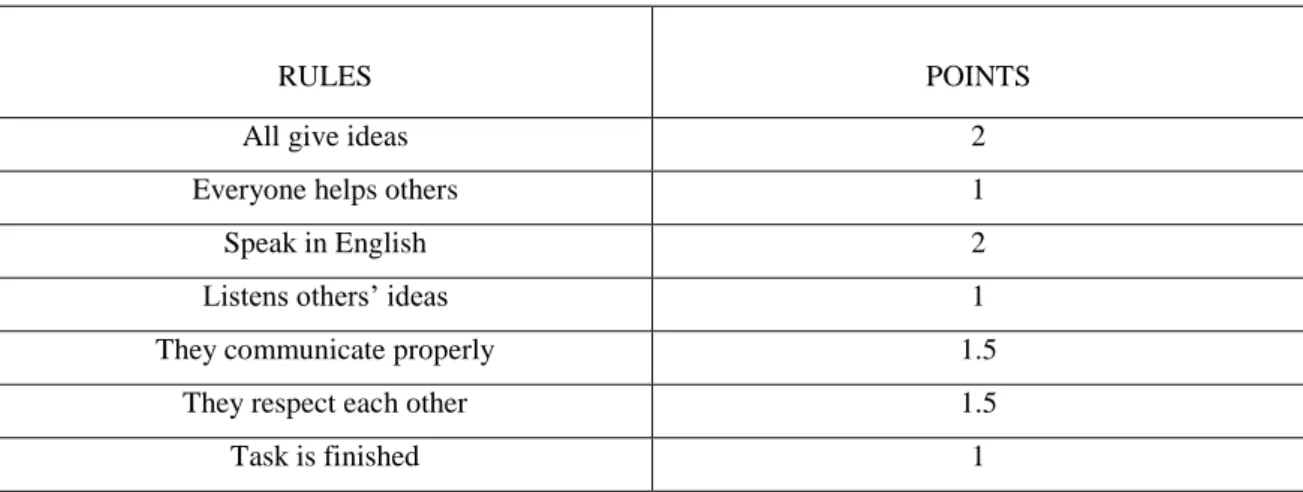
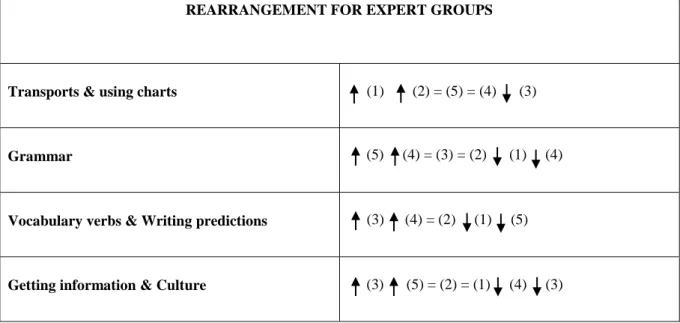
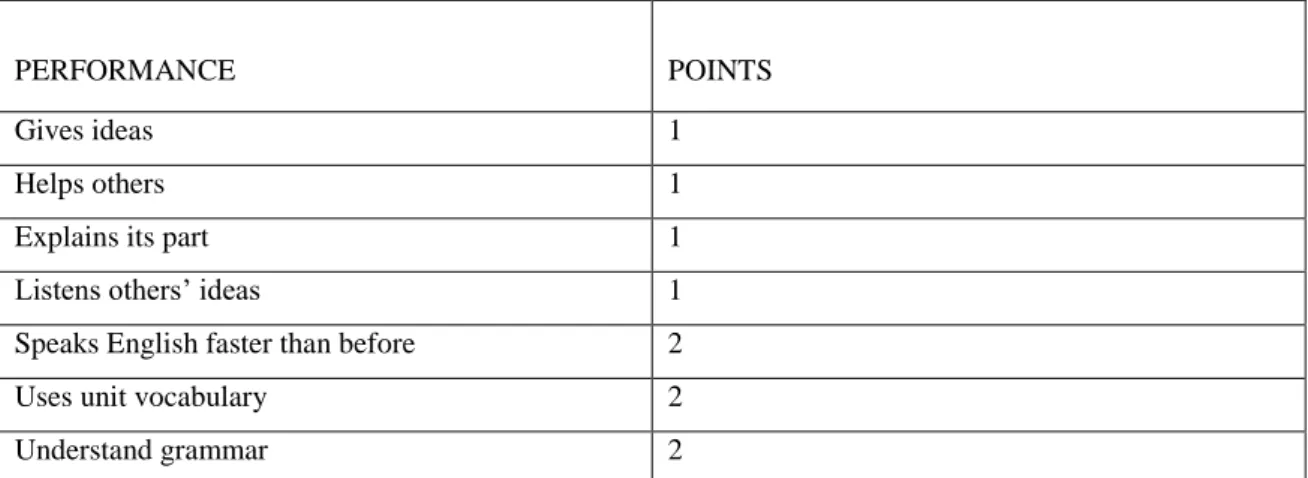
(38) 3. They may have needed a technological support to look for information 4. They doubted in their decisions The first problem was expected, these students had never been immersed in a complete English lesson, nor were they used to speaking English, because their work at class was centred on writing. However, we as teachers tried to encourage them to speak in English by telling them we will take it into account in their evaluation, and they really tried to do it. Just one of the groups rearranged their roles assigned. It was group number 3. They did it because one of the lower levelled students (the Colombian boy) was not able to perform the role of secretary according to himself and the rest of the group. These students had problems in phase 2: establishment of rules and resolution of conflicts (see group phases section); they were frustrated because one of them could not perform the task properly, thus, they had a conflict which were not able to solve. However, as I was closely watching all the groups, I realized that they all tried to ease their work eliminating him from the activity, and I could not let that happen. Thus, I decided to rearrange the roles, telling them that everyone had to participate, that it was one of the main aims of the activity; so I proposed him to be spokesperson instead of secretary, and after a short debate, they all agreed. Afterwards, the group worked together, and he performed his part as well as the rest did theirs. They did not know how to solve the conflict and instead of giving him another role, he was left with nothing to do inside the group. Thanks to the change of the roles made, all the students helped him to understand what they all were doing. They were able to change from phase two to phase three (effective group performance), and they learnt how to solve the conflict, and learnt negotiating skills. When talking about the resources, they had a dictionary per group, and a textbook available, so that they could search for any vocabulary they needed. However, maybe it would have been better to let them use some kind of technological device, so that they could check grammatical structures, and look for some ideas to create their work. This is not completely necessary but it would have eased their work. We observed that they did not trust in the ideas they were handling, and that is why they kept calling us (teachers) to check if their ideas were good or not. In this case we were two teachers, but classes are usually delivered by just one teacher, so it could be difficult to deal with all of them if there was just one teacher.. 33.
Figure

+5



Documento similar
This doctoral thesis provides a health overview for the Palestinian population in regard to factors relating to quality of life and the prevalence of depression in patients
Our results here also indicate that the orders of integration are higher than 1 but smaller than 2 and thus, the standard approach of taking first differences does not lead to
In the “big picture” perspective of the recent years that we have described in Brazil, Spain, Portugal and Puerto Rico there are some similarities and important differences,
In this sense the grouping of students with similar learning behavior could significantly help in the e-learning personalization, by the fact that the teacher can
Keywords: iPSCs; induced pluripotent stem cells; clinics; clinical trial; drug screening; personalized medicine; regenerative medicine.. The Evolution of
In addition to the different successions and conceptions of computational thinking, in order to be able to work effectively in the classroom and carry out an adequate
Astrometric and photometric star cata- logues derived from the ESA HIPPARCOS Space Astrometry Mission.
The photometry of the 236 238 objects detected in the reference images was grouped into the reference catalog (Table 3) 5 , which contains the object identifier, the right
