
The use of vocabulary self collection strategy to enhance self directed vocabulary learning of A1 EFL students
121
0
0
Texto completo
(2) Running head: IMPROVING THIRD GRADERS’ SELF-DIRECTED VOCABULARY LEARNING THROUGH THE USE OF VOCABULARY SELF- COLLECTION STRATEGY. The Use of Vocabulary Self-Collection Strategy to Enhance Self-Directed Vocabulary Learning of A1 EFL Students Angy Yiseth Restrepo Reyes Universidad de La Sabana Chía, Colombia. This research report is the result of my own work and includes nothing that was done in collaboration with others. Name: Angy Yiseth Restrepo Reyes Signature:.
(3) Running head: IMPROVING THIRD GRADERS’ SELF-DIRECTED VOCABULARY LEARNING THROUGH THE USE OF VOCABULARY SELF- COLLECTION STRATEGY. The Use of Vocabulary Self-Collection Strategy to Enhance Self-Directed Vocabulary Learning of A1 EFL Students. Angy Yiseth Restrepo Reyes. Research report submitted in partial fulfillment of the requirements for the degree of Master in English Language Teaching for Self-directed Learning (Online Program). Directed by: Prof. Claudia Lucía Acero Department of Foreign Languages and Cultures Universidad de La Sabana Chía, Colombia August, 2016.
(4) IMPROVING THIRD GRADERS’ SELF-DIRECTED VOCABULARY LEARNING THROUGH THE USE OF VOCABULARY SELF- COLLECTION STRATEGY. iii. Acknowledgements. First and foremost I offer my sincerest gratitude to God for allowing me to reach this goal. I also thank my parents, my daughter and husband for the unceasing encouragement, support, attention and best wishes. I would like to acknowledge with much appreciation all of the Department faculty members for their help and support. Special thanks to 3 “anonymous” reviewers, for their so-called insights and comments. I would like to express my deepest gratitude to my advisor, M.A Claudia Lucía Acero Ríos, for her supervision and patience, for sharing her expertise, and for her sincere and valuable guidance and encouragement extended to me. I am also immensely grateful to the principal of the institution for providing me with all the necessary facilities for the research. Finally, I am also grateful to one and all, who directly or indirectly participate in this venture and who made this thesis possible and an unforgettable experience for me..
(5) IMPROVING THIRD GRADERS’ SELF-DIRECTED VOCABULARY LEARNING THROUGH THE USE OF VOCABULARY SELF- COLLECTION STRATEGY. iv. Declaration. I hereby declare that my research report entitled: The Use of Vocabulary Self-Collection Strategy to Enhance Self-Directed Vocabulary Learning of A1 EFL Students. . is the result of my own work and includes nothing which is the outcome of any work done in collaboration except as declared and specified in the text;. . is neither substantially the same as nor contains substantial portions of any similar work submitted or that is being concurrently submitted for any degree or diploma or other qualification at the Universidad de La Sabana or any other university or similar institution except as declared and specified in the text;. . complies with the word limits and other requirements stipulated by the Research. . Subcommittee of the Department of Languages and Cultures;. . has been submitted by or on the required submission date.. Date: August, 2016. (Digital) Signature: Name: Angy Yiseth Restrepo Reyes.
(6) IMPROVING THIRD GRADERS’ SELF-DIRECTED VOCABULARY LEARNING THROUGH THE USE OF VOCABULARY SELF- COLLECTION STRATEGY. vii. Abstract Considering that vocabulary learning is an essential part of foreign language learning that demands different alternatives to address learners' needs, this study examines the outcomes of an action research about how adapting and implementing the self-collection strategy influences students' self-directed vocabulary learning in a group of 23 English A1 elementary learners from a private school in Bogotá, Colombia. Participants completed eight sessions during two months and a half. During these sessions, data were gathered by the use of an initial survey, teacher and learners´ journals, a pre and a post-test and a learners ‘questionnaire. The quantitative and qualitative data analysis revealed the effectiveness of the proposed strategy in fostering self-directed vocabulary learning. Results also led to the conclusion that the use of self-collection strategy was helpful and provided significant outcomes since the students initiated a process of reflection about their responsibility to learn vocabulary independently. Henceforth, implementing the Vocabulary Self-collection strategy became a powerful tool to increase students’ vocabulary and contributed to raising the awareness on the part of the teachers to implement, adopt and adapt methodologies on how to help participants to become independent learners and how that could assist them in learning vocabulary in a self-directed way. Key words and expressions: Self-directed learning (SDL); Self-directed vocabulary learning (SDVL); Vocabulary self-collection strategy (VSS)..
(7) IMPROVING THIRD GRADERS’ SELF-DIRECTED VOCABULARY LEARNING THROUGH THE USE OF VOCABULARY SELF- COLLECTION STRATEGY. viii. Resumen Teniendo en cuenta el aprendizaje de vocabulario como una parte esencial del aprendizaje de lenguas extranjeras que exige diferentes alternativas para hacer frente a las necesidades de los alumnos. Este estudio examina los resultados de una investigación-acción sobre cómo adaptar e implementar la estrategia de auto-recolección influye en el aprendizaje auto dirigido de vocabulario de un grupo de 23 estudiantes de primaria con nivel A1 de Inglés de una escuela privada en Bogotá, Colombia. Los participantes completaron ocho sesiones durante dos meses y medio para un total de 21 horas. Durante estas sesiones los datos fueron recogidos a través de una encuesta inicial, los diarios de campo del maestro y los estudiantes, un pre-post test y un cuestionario. El análisis cuantitativo y cualitativo reveló la eficacia de la estrategia propuesta para fomentar el aprendizaje auto dirigido de vocabulario. Los resultados también llevaron a la conclusión de que el uso de la estrategia de auto-colección ha sido útil y proporciona resultados significativos ya que los estudiantes iniciaron un proceso de reflexión sobre su responsabilidad de aprender el vocabulario de forma independiente. A partir de entonces, la aplicación de la estrategia de vocabulario auto-recolección se convirtió en una herramienta poderosa para aumentar el vocabulario de los alumnos y contribuyó a la sensibilización por parte de los maestros para implementar, adoptar y adaptar las metodologías sobre cómo ayudar a los estudiantes a convertirse en aprendices independientes y cómo eso podría ayudar en el aprendizaje de vocabulario de una manera auto dirigida. Palabras y expresiones clave: Aprendizaje auto-dirigido (AAD); aprendizaje auto dirigido vocabulario (AADV); estrategia de auto-colección de vocabulario (EACV)..
(8) IMPROVING THIRD GRADERS’ SELF-DIRECTED VOCABULARY LEARNING THROUGH THE USE OF VOCABULARY SELF- COLLECTION STRATEGY. ix. Table of Contents. Acknowledgements ................................................................................................................... iii Declaration................................................................................................................................ iv Abstract ................................................................................................................................... vii Table of Contents ...................................................................................................................... ix List of Figures .............................................................................................................................x Table of Tables ...........................................................................................................................x List of Appendices .................................................................................................................... xi List of Abbreviations................................................................................................................ xii Chapter One: Introduction ......................................................................................................... 13 1.1 Statement of the Problem ................................................................................................. 15 1.2 Research Question............................................................................................................ 23 1.3 Research Objectives ......................................................................................................... 24 1.4 Rationale .......................................................................................................................... 25 Chapter Two: Theoretical Framework ....................................................................................... 27 2.1 Vocabulary Learning Strategies (VLS) ............................................................................. 27 2.1.1 Taxonomies of Vocabulary Learning Strategies ......................................................... 29 2.2 Vocabulary Self-Collection Strategy (VSS) ...................................................................... 31 2.3 Self-Directed Learning (SDL) .......................................................................................... 32 2.3.1 Self-Directed Vocabulary Learning (SDVL)………………………….………………33.
(9) IMPROVING THIRD GRADERS’ SELF-DIRECTED VOCABULARY LEARNING THROUGH THE USE OF VOCABULARY SELF- COLLECTION STRATEGY. x. 2.4 Previous Studies ............................................................................................................... 35 Chapter Three: Research Design ............................................................................................... 43 3.1 Type of study ................................................................................................................... 43 3.2 Context ............................................................................................................................ 45 3.3 Participants ...................................................................................................................... 47 3.4 The researcher’s role ........................................................................................................ 48 3.5 Data collection instruments .............................................................................................. 49 3.5.1 Diagnosis Survey. ...................................................................................................... 49 3.5.2 Pre and Post Test........................................................................................................ 50 3.5.3 Learner´s Questionnaire. ............................................................................................ 51 3.5.4 Teacher and learners' Journals. ................................................................................... 52 3.6 Data collection Procedures ............................................................................................... 53 3.7 Instruments and Procedures Reliability and Validity ........................................................ 55 3.8 Ethical Considerations...................................................................................................... 59 Chapter Four: Pedagogical Intervention and Implementation ..................................................... 61 4.1 Strategy introduction ……………………………………………………………………...50 4.2 Strategy modeling ………………………………………………………………………... 51 4.3 Words nomination ………...……………………………………………………………... 51 4.4 Word Knowledge…………..……………………………………………………………... 53 Chapter Five: Results and Data Analysis ................................................................................... 67 5.1 Data Management and Procedures of Data Analysis ......................................................... 67 5.2 Quantitative analysis ........................................................................................................ 69 5.3 Qualitative analysis .......................................................................................................... 75.
(10) IMPROVING THIRD GRADERS’ SELF-DIRECTED VOCABULARY LEARNING THROUGH THE USE OF VOCABULARY SELF- COLLECTION STRATEGY. xi. 5.3.1 Vocabulary learning engagement. .............................................................................. 76 5.3.2 Fosterage of self-direction. ......................................................................................... 80 5.4 Qualitative and quantitative analysis ................................................................................ 84 Chapter Six: Conclusions and Pedagogical Implications, Limitations and Further Research ...... 86 6.1 Conclusions ..................................................................................................................... 86 6.2 Pedagogical Implications ................................................................................................. 88 6.3 Limitations ....................................................................................................................... 89 6.4 Further research ............................................................................................................... 90 References ................................................................................................................................ 92 Appendices ............................................................................................................................... 98 Evidences ................................................................................................................................ 116.
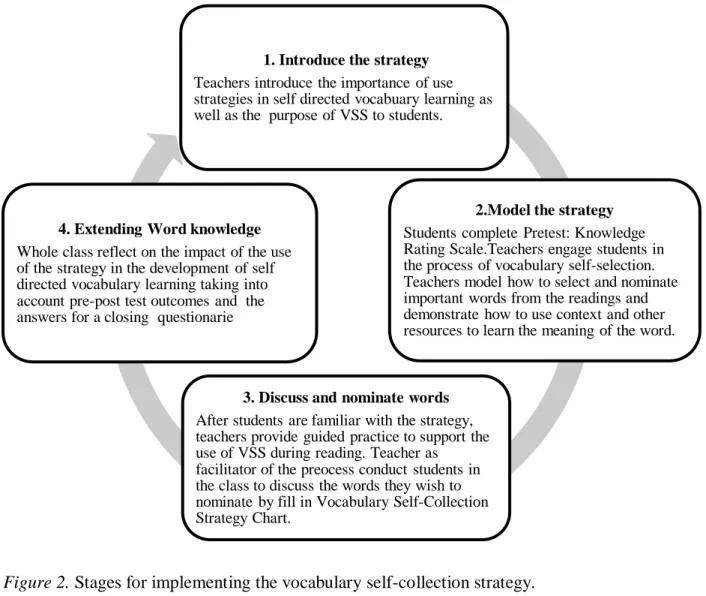
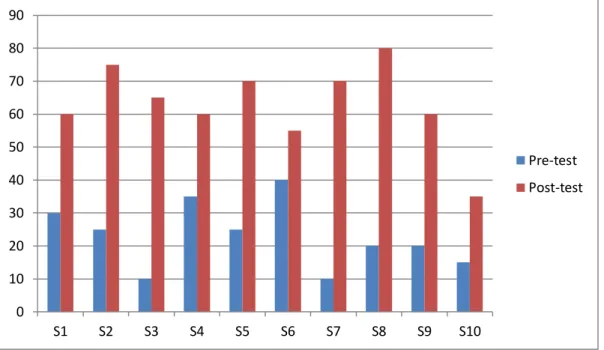
(11) IMPROVING THIRD GRADERS’ SELF-DIRECTED VOCABULARY LEARNING THROUGH THE USE OF VOCABULARY SELF- COLLECTION STRATEGY. x. List of Figures Figure 1. Scheme of Action Research adapted from Kemmis and McTaggart (2004)……….......44 Figure 2. Stages for implementing the vocabulary self-collection strategy...................................66 Figure 3. Learners´ vocabulary pre- knowledge......................................................................70 Figure 4. Outcomes of the pre and posttests...............................................................................71 Figure 5. Vocabulary Knowledge Rating Scale Post-test..........................................................73 Table of Tables Table 1 Competence tests results...................................................................................................18 Table 2 Taxonomy of Vocabulary Learning Strategies by Nation (2001)....................................30 Table 3 Data collection procedures................................................................................................54 Table 4 Triangulation Matrix.........................................................................................................59 Table 5 Collecting and Analyzing Data….....................................................................................68 Table 6 Statistical Measurements……………..............................................................................72 Table 7 Increase of words per student after intervention...............................................................74 Table 8 Data analysis Category and Subcategories.......................................................................75.
(12) IMPROVING THIRD GRADERS’ SELF-DIRECTED VOCABULARY LEARNING THROUGH THE USE OF VOCABULARY SELF- COLLECTION STRATEGY. xi. List of Appendices Appendix A Consent Letters….………….....................................................................................98 Appendix B Project Timeline......................................................................................................100 Appendix C Co -Assessment format............................................................................................101 Appendix D Needs Analysis Tool…….......................................................................................102 Appendix E Pre and Post Test….................................................................................................105 Appendix F Teacher´s Journal………………………………………………………………...106 Appendix G Learner´s Journal…………………….....................................................................107 Appendix H Learner´s Questionnaire ….....................................................................................108 Appendix I Lesson Plan Sample…..............................................................................................109 Appendix J Weekly Class Vocabulary List Format.....................................................................112 Appendix K Open Coding Sample....…………..........................................................................113 Appendix L Reading Plan Stories Sample...................................................................................114.
(13) IMPROVING THIRD GRADERS’ SELF-DIRECTED VOCABULARY LEARNING THROUGH THE USE OF VOCABULARY SELF- COLLECTION STRATEGY. List of Abbreviations Abbreviations. Meaning. APA. American Psychological Association. AR. Action Research. CEFR. Common European Framework of Reference for Languages. EFL. English as a Foreign Language. FL. Foreign Learners. ICELT. In-service Certificate in English Language Teaching. ICFES. Colombian Institute for Promotion of Higher Education. IEP. Institutional Educational Project. MEN. Ministerio de Educación Nacional (The Colombian Ministry of Education). PNB. Programa Nacional de Bilingüismo (National Bilingual Program). SD. Self-Direction. SDL. Self- Directed Learning. SDVL. Self- Directed Vocabulary Learning. VSS. Vocabulary Self-Collection strategy. YLE. Young Learners English. xii.
(14) IMPROVING THIRD GRADERS’ SELF-DIRECTED VOCABULARY LEARNING THROUGH THE USE OF VOCABULARY SELF- COLLECTION STRATEGY. 13. Chapter One: Introduction “Words, so innocent and powerless as they are, standing in a dictionary; how potent for good and evil they become in the hands of one who knows how to choose and combine them.” -Nathaniel Hawthorn, The Custom House, 1864, p.184 During the last decade, English language teaching and learning have attained more importance due to the worldwide expansion of English as a global language. Crystal (1997) declares “English is a language which has repeatedly found itself in the right place at the right time, it has supported globalization, and globalization has consolidated it as the global language” (p.78). The growth of the English language worldwide has been established through economic and political power, technology development and a growing use of information and communications. Consequently, English has played a major role in news, music, advertisement, business, engineering, economics, education, health, and social life all around the world. In Colombia, English language teaching and learning have gained relevance through national government policies, which are focused on developing several plans and laws to provide quality education regarding the foreign language learning and teaching processes. Initially, the Article 22, in the Ley General de Educación 115/1994 (Colombian General Education Law), states as one of its main objectives the acquisition of elements of conversation and reading in at least one foreign language. It means acquisition of communicative competence, making it the starting point for the creation of regulations regarding the teaching and learning of foreign languages in Colombia..
(15) IMPROVING THIRD GRADERS’ SELF-DIRECTED VOCABULARY LEARNING THROUGH THE USE OF VOCABULARY SELF- COLLECTION STRATEGY. 14. Later on, in 2003, The Colombian Ministry of Education, MEN1 introduced the Programa Nacional de Bilingüismo –PNB2- (National Bilingual Program in English). This program aimed to offer all students in the country the possibility of becoming bilingual in English and Spanish by 2019 in order to improve human capital and economic development by increasing involvement in the largely English-speaking global economy. It also targeted:. To have citizens who are capable of communicating in English, inserting the country within processes of universal communication, global economy and cultural openness, through the adopting of internationally comparable standards to generate positive changes in educators and students’ attitudes towards foreign language teaching and learning process to face the new global demands. (De Mejía, 2011, p. 8).. A third initiative took place in 2006, the MEN also introduced a document entitled “Estándares Básicos de Competencias en Lenguas Extranjeras: Inglés. Formar en lenguas extranjeras: ¡el reto!” (Basic Standards for Competences in Foreign Languages: English. Teach in Foreign Languages: the Challenge!)3. The Standards stated that the evaluation of English language skills should adhere to the Common European Framework of Reference for Languages (CEFR4); it became as sufficiently researched, adaptable, flexible and complete 1. Ministerio de Educación Nacional (MEN) is the national executive ministry of the Government of Colombia responsible for overseeing the instruction and education of the Colombian people, similar to education ministries in other countries. Official site: http://www.mineducacion.gov.co/1621/w3-channel.html 2 PNB program was designed to be implemented from 2004 to 2019. In 2012, it was renamed the Foreign Languages Competencies Development Programme (Proyecto de Fortalecimiento al Desarrollo de Competencias en Lenguas Extranjeras, PFDCLE) in order to make it more inclusive: as Colombia has over 60 indigenous languages, along with Creole and Spanish, some of the population is already bilingual. (Herazo, 2012, p.6). 3 MEN 2006b. Estándares básicos de competencias en lenguas extranjeras: Inglés. [Basic standards of competences in foreign languages: English.] Bogotá: MEN 4 CEFR stands for the Common European Framework of Reference for Languages, designed in 2001 as a way to provide common criteria in Europe about what learners are expected to learn and the skills they would need to communicate in a second language..
(16) IMPROVING THIRD GRADERS’ SELF-DIRECTED VOCABULARY LEARNING THROUGH THE USE OF VOCABULARY SELF- COLLECTION STRATEGY. 15. guidelines for the learning, teaching and assessment of the foreign language, focused on supporting performance levels which further contribute to help Colombian students to meet the demands of the globalized world. Hence, educational institutions from all levels and contexts took on the challenge of bilingual education for Colombian students with the purpose to find strategies which would facilitate the achievement of the national goals by adopting a plan to improve their pedagogical and administrative components and increasing the quality in English language teaching and learning process. Interested by these current circumstances and sustained by a systematic review of the government policies, official documents and specialized literature produced locally and abroad, the teacher-researcher of the study The Use of Self-Collection Strategy to Enhance Self-Directed Vocabulary Learning of A1 EFL Students decided to define the best strategy in order to face the mentioned requirements and to scaffold the quality in the language teaching and learning process specifically in relation to the effects of adapting the Vocabulary Self-Collection Strategy to improve self-directed vocabulary learning in a group of third grade elementary students in an EFL context in a Colombian private school. 1.1 Statement of the Problem English teaching in private schools is also government mandated; at “Colegio de La Enseñanza” (hereinafter referred to as the La Enseñanza School) there are general guidelines, in its 2013 institutional document called Proyecto Educativo Institucional, (PEI, initials in Spanish)5, which explain how to achieve the goals set in the General Education Law 1994, Article 22. Traditionally, English classes at already stated school have had a strong teacher-centered 5. According to Decree 1860 of 1994 , Article 14 every school must develop and implement , with the participation of the educational community , an institutional project that expresses the way it has been decided to achieve the goals of education as defined by law , taking into account social, economic and cultural conditions of their environment. It must respond to students, local community, region and country ´needs, and to be concrete, achievable and measurable..
(17) IMPROVING THIRD GRADERS’ SELF-DIRECTED VOCABULARY LEARNING THROUGH THE USE OF VOCABULARY SELF- COLLECTION STRATEGY. 16. methodology and a grammatical focus. However, there have been some changes in the teaching approach, based on the National bilingual program policies and the language standards of the Ministry of Education (2006), which seek to improve the quality of education in Colombia. The school is interested in providing academic quality to create the conditions to develop communicative competences in English rather than mastery of language. For such effect the institutional bilingual program was formulated to ensure that the students in the school acquire basic knowledge of English as a foreign language, according to Common European Framework of Reference for Languages (CEFR) and become more competent citizens of the world. In fact, the English program in the school has been strengthened and consolidated through three strategic lines of action: 1) re-organization of the English curriculum and application of the basic standards of English competences from preschool to high school, 2) definition of a solid and consistent evaluation system which takes into account the English level of both the students and language teachers, and 3) strategic alliances with different organizations like Coninglés: English Consultants in 2012, International House in 2013, and most recently Cambridge University in 2014-2015. All in all to support the process of developing a reliable bilingual program by means of the improvement of training plans to promote teachers formation on better pedagogical practices, and students´ exercise on the Cambridge Young Learners English Tests (YLE 6). The goal was that starting from 2012, 100% of the students of eleventh grade reach as minimum B1 level (intermediate) according to CEFR in the English test administered by the Colombian Institute for Promotion of Higher Education ( ICFES7).. 6. Acronym of Young Learners English (University of Cambridge; Cambridge, England, UK) ICFES is an acronym for Instituto Colombiano para el Fomento de la Educación Superior ("Colombian Institute for the Promotion of Higher Education"). It is a Colombian organization that manages and evaluates the education and Institutes (Schools and Facilities) in Colombia. The institute's mission is the improving of quality of education in Colombia. 7.
(18) IMPROVING THIRD GRADERS’ SELF-DIRECTED VOCABULARY LEARNING THROUGH THE USE OF VOCABULARY SELF- COLLECTION STRATEGY. 17. In spite of the efforts made by the school in teacher training and the improvement of the curriculum, the results of the internal and external examinations such as the reading competence tests and the Cambridge English Young Learners Test, as the most important tools of English language examinations specially designed for elementary students, used to exalt students’ achievement, build their confidence and show parents the progress they were making, indicate that learners’ performance did not fulfill the necessary level, as required by the Colombian Ministry of Education in the Basic Standards of Foreign Language Competence: English. For instance, after the implementation of the Cambridge University YLE mock tests and most specifically in Cambridge Starters Test8; the findings presented to the institution in the first term reported by International House in 20159 established that 3rd graders at “La Enseñanza” school could not understand and use familiar everyday expressions or words to build sentences in English at a very basic level. Accordingly, outcomes showed that most of them were not placed in level A110 as expected. As a matter of fact, out of the 46 3rd graders, the 65 % were classified as “Low Starters”, 20 % as learners in the process to understand and use simple expressions of communication, basic instructions or read and write simple words and sentences; and only 15 % reached the necessary level. Same situation was observed in the internal 5-question multiple choice tests examination or competence test administered at the end of the first and second academic term in 2015; the results described by 8. Cambridge English: Starters Test is the first of three Cambridge English: Young Learners (YLE) tests for children. The tests focus on listening, speaking, reading and writing. There is no pass or fail. All children receive an award which shows how many shields they have received as an indication of how well they have done in each paper. The maximum score is five shields for each part of the test. A result of one shield (out of five) for a test paper means a child can improve a lot in that skill. A result of five shields (out of five) for a test paper means a child did very well in that skill and answered most questions correctly. Children who achieve total of 10 to 11 shields or above are ready to start preparing for the next exam level. 9 Informe MOCKS Colegio La Enseñanza YLE 16 de Abril del 2015. 10 According to the Common European Framework of Reference (Council of Europe, 2002), an A1 user level can understand the main points of clear standard language; it is able to produce simple connected text on topics which are familiar or which it has a vested interest and can describe experiences, events, desires and ambitions briefly give reasons and explanations for opinions and plans..
(19) IMPROVING THIRD GRADERS’ SELF-DIRECTED VOCABULARY LEARNING THROUGH THE USE OF VOCABULARY SELF- COLLECTION STRATEGY the academic coordination office in its biannual academic outcomes report dated on June 2015, indicated that only about 13% of the population, it means 6 students from a total of 46 third graders, were placed on the highest scores with 5 correct answers, while 7, 15% were placed on 0 correct answers, 3, 6,5% were placed on 1 correct answers, 22 out of 46, 48% of the population were placed on 2 points out of 5 possible, 5, 11% were placed on 3 correct answers, and 3, 6,5% were placed on 4 correct answers as shown on Table 1. Table 1 Competence tests results Scores. Absolute. Percentage. Frequency 0. 7. 15%. 1. 3. 6,5%. 2. 22. 48%. 3. 5. 11%. 4. 3. 6,5%. 5. 6. 13%. Total. 46. 100%. Note. The maximum score is 5. To conclude, 80.5 % of total population analyzed failed the competence test with 0-3 correct answers out of 5 possible; and only 19.5 % approved the test with 4 to 5 right answers. With such low performance outcomes, the teacher- researcher concluded that these results were a direct consequence of the learners´ low knowledge of vocabulary, which affected the students’ language performance. Most of them did not know the meaning of many of the words they encountered in an oral, written or listening text. Hence, the study researcher was challenged to find an appealing and accurate learning strategy to equip learners with the necessary skills to help them overcome their vocabulary limitations successfully. In doing so,. 18.
(20) IMPROVING THIRD GRADERS’ SELF-DIRECTED VOCABULARY LEARNING THROUGH THE USE OF VOCABULARY SELF- COLLECTION STRATEGY the researcher conducted a preliminary observation and analysis carried out at exercise after finishing the second term (bimonthly terms), in 2015 academic year, the objective was to observe the development of English class and students’ performance, by means of a selfevaluation and an unstructured observation with entries in a teacher´s journal. (Appendices C -D) The first month unstructured observation involved two groups of 23 students from third A and B grade; the researcher diagnosed two groups with 46 beginner learners in total, it was aimed to allow the researcher to note down relevant information regarding the initial research interest: vocabulary learning. With the design of a self-evaluation format, the researcher wanted to identify strengths and weaknesses after the development of the proposed activities for English classes. The aforementioned self-evaluation format was an attempt to find accurate ways to overcome general difficulties with the teaching and learning processes, it also intended to let students be active participants in their learning. It consisted on a set of 5 items list in which they had the opportunity to score themselves from 1 to 10. The addition of all marks provided a general vision of participant s’ performance and the possible difficulties to overcome. It also includes lines for additional comments (Appendix C). In the diagnosis data gathered based on the researcher’s unstructured observation, there was evidence of the lack of vocabulary to communicate successfully when performing basic speaking tasks as the ones required to A1 learners by Colombian Ministry of Education in the Basic Standards of Foreign Language Competence: English, such as introducing themselves, asking for and giving information, or describing a picture. As shown in the following entries, the researcher realized the need of a strategy to help learners overcome their language learning limitations:. 19.
(21) IMPROVING THIRD GRADERS’ SELF-DIRECTED VOCABULARY LEARNING THROUGH THE USE OF VOCABULARY SELF- COLLECTION STRATEGY “Learners were not able to introduce themselves or ask and answer questions about themselves or their partners’ personal information, it is important to provide opportunities to gain confidence inside the group” (Teacher's journal. Entry 2. July 23rd, 2015) “They (students) enjoyed working in groups because they can share their knowledge and gain support from their partners, they also use the dictionary a lot to find unknown words to describe the pictures around the classroom” (Teacher's journal, Entry 4. August 19th, 2015) By means of self-evaluation, students were able to identify their strengths and weaknesses during the English learning process. These weaknesses were not only related to their level of proficiency but also to various elements of the learning process including their personal involvement with the class, the independent practice taking place out of the classroom and even features of the lessons they struggled with. It was noticeable the one of the main obstacles students had when they wanted to communicate in English was vocabulary; 35 of them, which represents 76.6 % out of 46 the 100% , indicated to have difficulties with the use of vocabulary for expressing their ideas; they exhibited having a poor range of vocabulary use. Indeed, when they were challenged to communicate their own ideas spontaneously, their vocabulary was restricted to basic vocabulary repertories with repeated use of elemental words supported in some cases with their first language, which directly affected their performance in English language tasks. Meanwhile, when they encountered an unfamiliar word, they were directed to the glossary or a dictionary, or were given a quick oral definition because English instruction time was not enough to increase their vocabulary, since classes had been focused on listening, reading, writing and speaking skills. It was not surprising that this limited exposure did not result in long-term vocabulary learning. Consequently, responsibility of vocabulary learning relied on student’s autonomous work; these facts encouraged learners to raise awareness about their difficulties in terms of vocabulary as shown in Excerpts 1 - 3:. 20.
(22) IMPROVING THIRD GRADERS’ SELF-DIRECTED VOCABULARY LEARNING THROUGH THE USE OF VOCABULARY SELF- COLLECTION STRATEGY Excerpt 1. “Pienso que me fue mal en éste primer periodo y sobretodo en la evaluación por competencias porque no logre entender muchas de las palabras que había en la lectura y por eso no pude contestar las preguntas” “I think I went badly during the first term. Even in competence test because I couldn't understand most of the words included in the reading passage, for that reason I couldn't answer the questions” (Student 1 self- evaluation comments July 27th, 2015; Author´s translation) Excerpt 2. “A veces presto mucha atención a lo que la profesora habla en inglés durante las clases y cuando nos explica las actividades, pero por más que me concentro no entiendo muchas de sus palabras y quedo como perdida de lo que tengo que hacer” “Sometimes, I pay much attention to what the teacher says in English during class and when she explains activities, but even though I focus on it, I do not understand many words and I remain lost what I have to do” (Student 5 self- evaluation comments July 27th, 2015; Author´s translation) Excerpt 3. “Disfruto mucho de mi clase de inglés es muy divertida, pero la mayoría de las veces me demoro en terminar las actividades porque tengo que buscar muchas de las palabras en el diccionario o preguntar a los que si son buenos en la materia para que me expliquen lo que no entiendo” “I enjoy my English class, it is fun, but most of the times it takes me lot of time to finish the activities because I have to find many words in the dictionary or ask for clarification to my partners” (Student 7 self- evaluation comments July 27th, 2015; Author´s translation) Within above mentioned situation the teacher-researcher decided to design a needs analysis instrument to be applied at the beginning of the third academic term in 2015 in order to better understand students´ needs and establish how self-directed vocabulary learning could be improved through this research. The instrument, a 30-item survey which was adapted from the one used by Sanchez (2013) in her research study conducted in a Colombian state school and related to vocabulary learning entitled: “The Influence of Self-monitoring on Vocabulary. 21.
(23) IMPROVING THIRD GRADERS’ SELF-DIRECTED VOCABULARY LEARNING THROUGH THE USE OF VOCABULARY SELF- COLLECTION STRATEGY Learning and Self-efficacy in an A1 Teenage Group of Colombian State School Students”. The survey was an attempt to gather information on participants’ routines, strategies or merely activities to learn vocabulary in English. It also inquired about the possible self-directed learning strategies students could use to learn vocabulary. According to the needs analysis tool which was applied to just to 23 third graders out of the initial 46 due to the researcher´s convenience, the 85% of participants were constantly engaged with English learning process whether at home or at school by means of class assignments, homework or extra English classes. However, they conveyed a lack of necessary vocabulary to communicate since their focus relies only on grammar. The rest of them, only 15% affirmed to know different strategies to handle lack of vocabulary when facing communicative tasks. Actually, it was found students lack of interest and of knowledge about vocabulary learning strategies. As a matter of fact, their answers related to the strategies employed to understand unknown vocabulary hinted to asking for clarification of the word or no particular use of strategies, which suggested lack of control, awareness and passive roles in their vocabulary learning process, affecting students’ development of required levels for success lifelong learning. Moreover, when most of teachers prompted learners to produce sentences spontaneously, their vocabulary limited to the words learnt in previous years – words that describe body parts, animals, colors and other simple topics introduced – and the repeated use of common words supported in occasions with their first language, lack of word consciousness was evident as well as the need to implement strategies to improve self-directed vocabulary learning. Hence, learners seemed not to learn, recall or make use of new vocabulary easily. As a matter of fact, when these learners were asked about the strategies employed to understand. 22.
(24) IMPROVING THIRD GRADERS’ SELF-DIRECTED VOCABULARY LEARNING THROUGH THE USE OF VOCABULARY SELF- COLLECTION STRATEGY. 23. unknown vocabulary, their responses hinted to no particular use of strategies. This suggested a lack of awareness of the strategies available to help them learn new vocabulary. The above elements also adduced a significant lack of control of learners related to their vocabulary learning. Similarly, during the implementation of the reading plan selected for the 2015 academic year: Storyfun for Starters11. The students were not able to comprehend short and simple texts. They expressed during class discussion that the texts were difficult to understand because they did not know the words and the available strategies to foster vocabulary learning. Nonetheless, after informal observation of learners in the classroom and through discussions with other third grade teachers and the English department chair (who also taught third graders), it was detected that although being widely exposed to English through different sources, especially reading – as was formerly described – these learners exhibited having a poor range of vocabulary use. Results also showed a lot of information regarding English language learning and self-directed work. However, this research only focused towards training elementary students in vocabulary learning as means for gaining autonomy when dealing with unknown vocabulary as an important aspect in first, second and third grades, in order to accomplish the improvements of the institutional bilingualism program, the acquisition and consolidation of the English language to be a structured-on-time, accurate and enriching process. 1.2 Research Question. 11. The book contains ten fully-illustrated stories followed by fun activities and exam-style questions designed to check students’ understanding, and practice the grammar, vocabulary, and skills needed at the starter level. It also includes unit-by-unit wordlists that provide an easy reference for vocabulary learning and provides practice for the Cambridge Young Learners English (YLE) Tests..
(25) IMPROVING THIRD GRADERS’ SELF-DIRECTED VOCABULARY LEARNING THROUGH THE USE OF VOCABULARY SELF- COLLECTION STRATEGY. 24. Considering the aforementioned particularities of the context and the importance of vocabulary learning strategies in developing student’s communicative competence, the researcher of the study decided to research on how to help students master vocabulary learning and support them to take a more active and autonomous attitude in their process to overcome their difficulties. After reflecting on diverse approaches, methodologies and strategies to achieve this purpose and tackle learners’ difficulties in vocabulary learning, it was determined that introducing learners to vocabulary learning by adapting Vocabulary Self-Collection Strategy (VSS) could facilitate the students’ self-directed vocabulary knowledge since self‐selection of vocabulary enriches students’ motivation and accomplishment in learning words. Thus, the research question that led this study was: To what extent does the implementation of Vocabulary Self-Collection Strategy improve Selfdirected vocabulary learning in a group of A1 third graders in a private school in Colombia? 1.3 Research Objectives The research aimed at (1) describing the procedures and outcomes on adapting and implementing the self-collection strategy influences elementary students' self-directed vocabulary learning; (2) analyzing to what extent engaging students in a self-directed practice through the use of self-collection strategy would influence their vocabulary learning; (3) examining the effects of using the Vocabulary Self-Collection Strategy to develop Selfdirected Vocabulary learning. The aforementioned research aims were based on observations conducted during the first month needs analysis stage, which suggested that participants faced difficulties in expressing themselves within oral communicative tasks due to the lack of vocabulary. Although it had.
(26) IMPROVING THIRD GRADERS’ SELF-DIRECTED VOCABULARY LEARNING THROUGH THE USE OF VOCABULARY SELF- COLLECTION STRATEGY. 25. been observed that learners were always open to reflect upon their learning process, there was neither observable evidences of a defined reflection nor of specific courses of action taken by the learners involved. Based on these results, it was decided that the students could benefit from the implementation and adaptation of VSS as a meaningful strategy to foster their limitations in terms of vocabulary learning. 1.4 Rationale Successful communication in English is closely related with vocabulary teaching and learning process, it represents one of the greatest challenges for teachers and learners. According to Wilkins (as cited in Alfaki, 2015, p. 1) “without grammar very little can be conveyed, without vocabulary nothing can be conveyed”. As has been explained; without a sufficient vocabulary, learners cannot express their own ideas or understand others, then effective communication will be difficult, on the contrary if students enrich their vocabulary, they will communicate accurately. That is why learning vocabulary is an essential part in developing communicative competence in English language learning and it is significant for students to develop their own vocabulary learning strategies. In Colombia, some English teachers such as, Cárdenas (2009), Sánchez (2013), Charria (2014), Trujillo, Álvarez, Zamudio and Morales (2015), Diaz (2015), Restrepo Ramos (2015) have been keen in searching for effective approaches to enhance vocabulary learning, Trujillo et al.(2015) settled that improving vocabulary increases the students’ confidence to express their ideas in English. Besides focusing on the vocabulary learning, this study directed its attention to guide teachers not only in developing their students' vocabulary but also in giving them effective and realistic strategies to learn vocabulary autonomously. Henceforth, adapting the Vocabulary Self-collection strategy became a powerful help to increase students connections between.
(27) IMPROVING THIRD GRADERS’ SELF-DIRECTED VOCABULARY LEARNING THROUGH THE USE OF VOCABULARY SELF- COLLECTION STRATEGY. 26. unfamiliar words and their meanings. Even though it was initially implemented with secondary school students by Haggard in 1986, the vocabulary self-collection strategy became also suitable to elementary students as well. It supported the positive effects not only for the third grade learners involved in this study, but also for teachers who may extend their understanding on the knowledge regarding the use of self-collection strategy for teaching and learning vocabulary. To sum up, it seems almost impossible to overstate the power of words; they have changed and will continue to change the course of the world around us, in the words of Hawthorne (1864), “words are the greatest tools for succeeding in whole life” (p.184). Thus, it was relevant to foster students’ vocabulary self-directed learning strategies by giving its significance not only for academic purposes but for effective communication skills in different contexts in a local and global educational EFL community..
(28) IMPROVING THIRD GRADERS’ SELF-DIRECTED VOCABULARY LEARNING THROUGH THE USE OF VOCABULARY SELF- COLLECTION STRATEGY. 27. Chapter Two: Theoretical Framework Since the main purpose of the study was to describe the impact on how adapting and implementing the Vocabulary Self-Collection –Strategy (VSS) influences students' selfdirected vocabulary learning of A1 EFL students, this chapter offers a comprehensive overview of the main constructs considered, as well as the research studies carried out related to vocabulary learning, especially those related to VSS use for learning vocabulary and some more have done regarding self-directed vocabulary development. This section critically examines why this strategy was selected and how this strategy was previously implemented with the purpose to observe the results of similar experiences in different contexts. The constructs considered were: Vocabulary Learning Strategies (VLS), Vocabulary Self-Collection Strategy (VSS), Self-Directed Learning (SDL) and Self-Directed Vocabulary Learning (SDVL). 2.1 Vocabulary Learning Strategies (VLS) According to Schmitt (2008) “One aspect of vocabulary learning that most of students, teachers, material writers, and researchers agree on is the fact that learning and increasing vocabulary is an essential part of mastering a foreign language” (p. 329). However, the best means of teaching and learning vocabulary is still uncertain, mainly because it depends on a wide variety of factors such as the limited amount of time that teacher can spend in class for learning and practicing new words, which leads on the learners the greater responsibility of learn words by themselves and so it is perhaps not surprising that teachers and learners have often been unsure of the best way to pursue it, especially as guide textbooks, institutions and its curriculums have been inattentive in providing clear explanations and guidelines..
(29) IMPROVING THIRD GRADERS’ SELF-DIRECTED VOCABULARY LEARNING THROUGH THE USE OF VOCABULARY SELF- COLLECTION STRATEGY. 28. Research has shown that teaching and learning vocabulary should aim at equipping learners with strategies necessary to facilitate their vocabulary knowledge. To this end, teachers are recommended to train their students in different vocabulary learning strategies to face new age challenges for education in which learning autonomously outside the classroom is a key to acquiring new words. Cameron (2001) defines VLS as “the actions that learners take to help themselves improve their vocabulary” (p. 48). O'Malley and Chamot (1990) explain that “vocabulary learning strategies should be accessible to foreign language students as tools to help them learn independently and become more competent learners and communicators in the target language, to eventually take on responsibility for their own vocabulary learning” (p. 6 ). Thus, the research study considered VLS as the knowledge needed to further ensure that the vocabulary learning process went autonomously beyond classes. In other words, training students on vocabulary strategies cannot only help them to identify what works and what does not, and to make decisions regarding the strategies that could enhance vocabulary learning but also can direct them to achieve a measurable level of autonomy that can support them be more selfdirected learners by developing their own vocabulary learning strategies. Ghazal (2009) claimed: Vocabulary learning is one of the major challenges foreign language learners face during the process of learning a language. One way to allay the burden is to assist students in becoming independent learners during the process of L2 vocabulary learning. This could be achieved by instructing learners to apply vocabulary learning strategies as efficiently as possible. (p. 84)..
(30) IMPROVING THIRD GRADERS’ SELF-DIRECTED VOCABULARY LEARNING THROUGH THE USE OF VOCABULARY SELF- COLLECTION STRATEGY. 29. In general terms, this research project outlined VLSs as a way to empower language learners to be more self-directed, regulated, and autonomous and as a method to help language learners to discover and consolidate the meaning of the words more effectively. 2.1.1 Taxonomies of Vocabulary Learning Strategies Even though several classifications of vocabulary learning strategies have been proposed, according to the purposes of the study, this project considered for the pedagogical intervention Nation's (2001) taxonomy of strategies, which is a theoretically-oriented taxonomy. It was developed based on the significance attributed to VLSs to provide learners with more opportunities for reasoning out their own process of learning as well as enough independent practice to feel confident and proficient in using VLSs and gain greater overall self-direction in vocabulary learning. The strategies in Nation's taxonomy are organized around three general categories, ‘planning’, ‘source’ and ‘processes’, each of which is divided into a subgroup of strategies. The first category, planning, involves selecting words and deciding on where, how, and how often to focus attention on the vocabulary item. The subgroup of strategies in the category are choosing words, choosing aspects of word knowledge and choosing strategies as well as planning repetition. The second category in Nation’s taxonomy, source, includes all the aspects involved in knowing a word: analyzing the word, consulting a reference word in L1 and L2 form itself, from the context, from a reference source like dictionaries and glossaries and from analogies and connections with other languages, or from chatting in order to find information about the word. The third category is processes, which includes collecting the word and establishing word knowledge through three subcategories: noticing, retrieving and generating strategies. (Ghazal, 2009, p. 17) Table 2 displays a brief summary regarding Nation’s taxonomy of VLS..
(31) IMPROVING THIRD GRADERS’ SELF-DIRECTED VOCABULARY LEARNING THROUGH THE USE OF VOCABULARY SELF- COLLECTION STRATEGY Table 2 Taxonomy of Vocabulary Learning Strategies by Nation (2001), Ghazal (2009, p. 17) General Strategy Categories. Planning: choosing what to focus on and when to focus on it. Sources: finding information about words. Processes: establishing knowledge. Type of Strategies Choosing words Choosing the aspects of word knowledge Choosing strategies Planning repetition Analyzing the word Using the context Consulting a reference word in L1 and L2 Using parallels in L1 and L2 Noticing Retrieving Generating. From Nation’s notions, the teacher-researcher decided to look for an applicable strategy which comprised some of the categories and subcategories included in the taxonomy, and in doing so, the research study focused on the opportunity for teachers to train students in Vocabulary Self-Collection Strategy (VSS) which embraces the general strategy categories of Nation´s taxonomy as well as choosing, chatting and collecting subgroup of strategies. It is important to note that, in VLS models, the use of VSS refers to the possibilities to support participants in becoming more efficient and independent learners as well as to foster their motivation to learn new words on their own. This study opened students’ minds to the words around them and raised word consciousness. Hence, the teacher helped learners to generate their. own list of words to be explored and learned and trained them on how to use their individual prior knowledge and interests to learn vocabulary.. 30.
(32) IMPROVING THIRD GRADERS’ SELF-DIRECTED VOCABULARY LEARNING THROUGH THE USE OF VOCABULARY SELF- COLLECTION STRATEGY 2.2 Vocabulary Self-Collection Strategy (VSS) Lots of researchers have argued that Vocabulary self-collection is a way of opening students’ minds to the wealth of words they encounter in learning a language that surrounds them each day. For instance, Martin (as cited in Putri, 2012, p.29) defines “VSS as an interactive-learning instructional strategy that promotes word awareness; it helps them to learn vocabulary words and allow them to have an active role in their teaching and learning process”. According to Haggard (1986), the use of VSS, “helps students increase their vocabulary so that they can become better readers, promotes the long-term acquisition of language in an academic setting and helps them, to be able to learn a few key terms in depth rather than knowing much more superficially” (p. 4). The use of VSS claims to empower students to be more responsible in making decisions about their own vocabulary learning. It requires teachers to consider the usefulness of leading learners into self-direction which lead them to a lifelong learning. To shed light over a broader view Fatonah (2015) states that recent research suggests that Self-selection of vocabulary enhances students’ motivation and achievement in learning words. For this research report, the VSS was recognized as an approach in which learners should discover and construct new word knowledge, working by themselves. In such a way, VSS in the study implicates allowing students to select the words they were interested in, discuss their reasons for choosing words, analyzing the word, and agree upon words for a classroom collection establishing word knowledge. The introduction of VSS can be traced back to the 80s with Haggard’s research study: “The Vocabulary Self-Collection Strategy: Using Student Interest and World Knowledge to Enhance Vocabulary Growth” in 1986 and since then it has been adapted and implemented for. 31.
(33) IMPROVING THIRD GRADERS’ SELF-DIRECTED VOCABULARY LEARNING THROUGH THE USE OF VOCABULARY SELF- COLLECTION STRATEGY different school grade levels and contexts. The role of VSS has been recognized in vocabulary learning by researchers in the field such as Gregersen, 2001; Harmon, Hedrick, Wood, & Gress, 2005; Ruddell & Shearer, 2011; Putri, 2012; Juwita & Sunaryo, 2013; Fatonah, 2015 later on described in detail. This study contemplated some of them due to its interesting findings regarding the use of VSS as a remarkable scheme that helped English teachers trigger a sense of self-directedness in their students’ vocabulary learning as well as to increase their motivation to find an effective way for learning vocabulary independently as well as successfully. 2.3 Self-Directed Learning (SDL) Self –Directed Learning (SDL) has become a valuable approach for educators as it is focused on the learner’s learning process, it clarifies the procedures that support the fact that students take control over their own learning. Knowles (1975) defines SDL as a “process in which individuals take an active role and initiative in identifying their learning needs, setting learning goals, recognizing available resources for learning, selecting and applying appropriate learning strategies, and assessing learning outcomes” (p.18). Knowles’ definition involves three key areas that constitute SDL: 1) self-management, 2) self-monitoring, and 3) selfmotivation. Self-management refers to the capacity of the students to manage their own time, effort and the resources they need to develop their tasks and face their difficulties to continuously improve and increase their capabilities, and to take greater responsibility in make learning more meaningful to become successful learners. Self-monitoring appears as part of the realm of the cognitive responsibilities within the learning process (Pilling-Cormik & Garrison, 2007 as cited in Prieto, 2015, p. 13). In other words, self-directed learners must enhance their ability. 32.
(34) IMPROVING THIRD GRADERS’ SELF-DIRECTED VOCABULARY LEARNING THROUGH THE USE OF VOCABULARY SELF- COLLECTION STRATEGY to reflect on their own knowledge and skills analyzing its effectiveness, assess what the learning process requires by setting accurate expectations and challenging goals, including planning, monitoring and evaluating progress, strengths and weaknesses, and modifying strategies as needed. Self-motivation relates to intrinsic and extrinsic factors that stimulate students to acquire transform and use knowledge as an essential aspect of continuing selfdirection in learning. SDL has acquired an important role in vocabulary learning due to the limited quantity of time that teacher and students can spend during classes for learning vocabulary. As stated by Al-Shawwa, (2010), “learners are forced to become autonomous and make conscious effort to learn vocabulary outside of the classroom simply because exposure to the target language is limited in classes.” (p.1). Since students cannot learn all language vocabulary during class, a huge amount of remaining work on vocabulary learning is left to students’ out-of-class time; they have to find other ways to acquire vocabulary by themselves in order to be and engaged with their learning making a conscious effort to learn vocabulary outside of the classroom. In sum, for the purpose of this study SDL is understood as a way to foster vocabulary knowledge and support students in becoming independent learners during vocabulary learning. Accordingly, it incorporates practices that lead to autonomy development providing learners with the necessary tools to become more independent and take charge of their own vocabulary learning, it means to become self-directed vocabulary learners. 2.3.1 Self-Directed Vocabulary Learning (SDVL) Vocabulary has been the object of large amount of research study in modern times, especially on issues related to acquisition and learning, it is one of the main components in Teaching English as a Foreign Language. Since English language learners need a larger. 33.
(35) IMPROVING THIRD GRADERS’ SELF-DIRECTED VOCABULARY LEARNING THROUGH THE USE OF VOCABULARY SELF- COLLECTION STRATEGY exposure to the language in which vocabulary knowledge is a key indicator of overall language ability and significantly relevant to the development of all language learning skills. Jing Wu (2015) declares “vocabulary usually represents one of the biggest challenges in EFL learning” (p.27) without enough vocabulary effective communication will be difficult. Students cannot understand others or express their own ideas, thus, vocabulary is the key to communication. However, the term has a variety of meanings; for example, online Oxford Dictionary (1989) defines vocabulary as “the body of words used in a particular language” Likewise, in the online Longman dictionary (1995), vocabulary is defined as “all the words that someone knows, learns or uses.” Hatch and Brown (1995) consider “vocabulary, as a list or set of words for a particular language that an individual speaker of a language might use” (p. 127). Within this research, the term vocabulary was associated with the definition of SDVL. Self-directed vocabulary learning implies an individual‘s commitment to achieving learning goals in terms of vocabulary. Blachowicz and Fisher (2001) assert that “self-directed vocabulary learning takes place when students have some degree of control over their own learning” (p. 26) from this view, this research defined SDVL as an approach aimed to help learners to have an active role and to be dynamic participants in their own vocabulary learning process. When the learners begin to be more interested in the autonomous vocabulary learning, they change their habits to improve their communication skills, take initiative and develop self- motivation to learn. They also play a noticeable part in developing their language acquisition so they become lifelong learners.. 34.
(36) IMPROVING THIRD GRADERS’ SELF-DIRECTED VOCABULARY LEARNING THROUGH THE USE OF VOCABULARY SELF- COLLECTION STRATEGY 2.4 Previous Studies The ongoing recognition of the importance of vocabulary in language development has increased the research interest in vocabulary learning and teaching. Recent studies, aimed at enhancing vocabulary, have demonstrated the benefits of promoting vocabulary development. This literature review serves as a cluster of two important aims. First of all, it includes some similar and relevant researches related to the main topic of this study, Vocabulary Selfcollection Strategy (VSS), which has been carried out internationally and called the teacherresearcher attention because it shows significant experiences in different contexts that illustrate research on VSS, and allows researcher to have some views concerning the applicability of the strategy. On the other hand, it shows the gap of the current research study, which relied in an area where little exploration has been conducted thus far, the nonexistence of studies related to the use of VSS in the Colombian educational context. Nationally, no published studies have been identified, to date, which examine the use of VSS to promote vocabulary learning. Thus, this section summarizes which other studies have been done regarding vocabulary learning in Colombia. These studies were considered for this research study due to their significant contribution in terms of strategies and methods that help teachers reflect on the best way to design meaningful lessons in order to help students learn vocabulary. A review of the international research studies regarding the use of VSS begins with Haggard (1986), who first introduced the Vocabulary Self-Collection Strategy (VSS) in order to improve the students’ vocabulary mastery and help high school students learn vocabulary words. The objective of Haggard´s study was to use students’ interest and world knowledge to enhance vocabulary growth; the investigation analyzed responses of students who recorded. 35.
(37) IMPROVING THIRD GRADERS’ SELF-DIRECTED VOCABULARY LEARNING THROUGH THE USE OF VOCABULARY SELF- COLLECTION STRATEGY their own vocabulary development. The responses indicated that students were most often strongly motivated to learn words, either because they perceived a need to know or because they wanted to learn an unusual or interesting word. The research outcomes in Haggard’s study also illustrated the VSS as a suitable strategy to use students’ prior knowledge and interests to enhance their vocabulary growth. Haggard (1986) described the VSS as “an useful strategy that differs from traditional instruction through its use of student generated word lists and its emphasis on students' personal experience and world knowledge to engage learners in their own learning” (p.69) From Haggard’s findings, researchers have shown a lot of interest in adapting the strategy to different contexts. The first and one of the most interesting examples in which the strategy was adapted and used successfully is a research study conducted by Gregersen (2001); she studied the effectiveness of adapting the strategy to primary school learners in a multicultural second grade classroom in Texas, US. In Gregersen’s study, the findings evidenced a positive effect on students’ knowledge of words, the self-selection of words guaranteed student control over the learning situation. It gave students important experiences that lead to independent word learning skills and also increased in their enthusiasm for learning new words. Although designed for high school students, Gregersen concluded that VSS could be used effectively with primary school learners. The second example is a research study by Harmon, Hedrick, Wood, and Gress (2005) who conducted a research with eighth graders and adult learners in different academic contexts in the United States. The study examined students' decision-making as they self-selected important words from expository texts. They studied the students' reasons for their word selections and compared eight graders’ words with those selected by adult readers. In the. 36.
(38) IMPROVING THIRD GRADERS’ SELF-DIRECTED VOCABULARY LEARNING THROUGH THE USE OF VOCABULARY SELF- COLLECTION STRATEGY outcomes of the study, the authors pointed to VSS as an approach to encourage students to select and study words that they feel are important to learn. They claimed that teachers must “encourage independent learning by allowing students to self-select terms to be studied” (p. 35). The third research study by Ruddell and Shearer (2011) in western, Kentucky, US, considered the use of VSS with junior high school students; they adapted and implemented the strategy with seventh graders in a small Midwestern rural community. Their findings established that VSS could be implemented as the pre-reading or post-reading activities. They found that self –collection strategy had been an effective means for “increasing the depth and breadth of student vocabulary knowledge and for developing students’ ability to be strategic independent word learners” (p.61). They established that the VSS gave significant effect toward students’ reading comprehension. They also determined that VSS could be implemented in writing and speaking skill. Besides that, the teacher can measure the students’ understanding about text by vocabulary. The fourth study by Putri (2012) with sixth grade students in Bungus, Teluk Kabung, Padang City, West Sumatra, Indonesia, suggested VSS as an innovative instructional strategy to improve students’ vocabulary mastery in the EFL class. The results showed in this classroom action research concluded that VSS was an effective technique used to solve students’ practical problems in learning vocabulary. It also supports VSS as an effective means of increasing and developing students’ abilities to be strategic, independent word learners. Moreover, Putri indicated some benefits of using VSS, for instance making connection between the new words and the meaning, encouraging the students’ interest related to the new. 37.
(39) IMPROVING THIRD GRADERS’ SELF-DIRECTED VOCABULARY LEARNING THROUGH THE USE OF VOCABULARY SELF- COLLECTION STRATEGY words, and improving the students’ enthusiasm to learn and find the new words which gave the essential effect to the success of learning. The fifth research is the one conducted by Juwita and Sunaryo (2013) in West Ungaran, Semarang, Central Java, Indonesia. This study was directed to facilitate school students’ vocabulary learning by teaching VSS to figure out the meaning of useful words. They concluded that by implementation of the VSS students can be more active to collect and find the meaning of key words by themselves. According to the authors this strategy was an effective way to help students to learn independently and take part of their own teaching and learning process promoting critical thinking. Likewise, VSS provided a strong framework for teachers to structure vocabulary learning that builds on language interaction, not just for the manifestation of students´ own ideas but comprehension of those of others. The sixth research by Fatonah, (2015) conducted in Kalasan, Indonesia, suggested that VSS was as an instructional strategy to improve learners’ vocabulary mastery in the EFL class. The aim of Fatonah’s action research was to improve the reading comprehension of seventh grade students through the implementation of VSS. The findings evidenced a significant correlation between the use of VSS and students’ reading achievement, he concluded that VSS strategy helped students increase their vocabulary so that they can become better readers and in consequence the implementation of the strategy had a significant impact on the students. On one hand, their interest and attention in joining the class and on the other hand in their ability in reading comprehension. The results of the studies cited above suggest positive evidence for vocabulary learning through VSS. It had been used in different school levels. It had been modified for students in different contexts with successful outcomes as cited before. Therefore, the researcher in the. 38.
(40) IMPROVING THIRD GRADERS’ SELF-DIRECTED VOCABULARY LEARNING THROUGH THE USE OF VOCABULARY SELF- COLLECTION STRATEGY present study decided to adapt and implement the use self-collection strategy with elementary students and focus on how to improve not only vocabulary instruction but self-directed vocabulary learning. This strategy was aimed to offer an effective approach to help students understand the meanings of selected words, use them in conversations and make personal connections with words for authentic tasks. Likewise, it helped researcher to determine the significance of the strategy in helping teachers reflect on the best way to design meaningful lessons using VSS, which directly contributes to teachers’ work in order to attract students’ interest in vocabulary learning and teaching in different educational contexts. As stated above, in Colombia, no published studies have been identified regarding the use of the VSS to foster vocabulary learning or the implementation of the strategy for other different aims; in fact, locally it is a not explored field which increased the researcher´s interest on adapting and implementing it. However, there are many researchers who have worked on vocabulary learning. Most of these studies provided evidence that scaffolding vocabulary learning could be beneficial for raising students’ consciousness, as they became interested in their language learning process. These studies include Cárdenas (2009), “The challenge of effective vocabulary teaching”. Cárdenas’s study attempted to describe the main aspects teachers should consider when planning and developing lessons in terms of vocabulary improvement. Cardenas focused on fundamental elements of vocabulary learning and teaching. She addressed key principles of teaching and learning vocabulary and highlighted some options for handling vocabulary in the classroom. She reported that learners can be their own best teachers. Hence, the importance of teaching them how to self-direct their actions in vocabulary learning and to devise techniques, activities and strategies that guide learners in this process, as well as help them in becoming autonomous learners. Effective vocabulary. 39.
Figure


Documento similar
Also, It has vocabulary, some examples and exercises that will help the learner to understand the topic.. Keywords: EFL,verb
In relation to the learning strategies scales, EMI students have better learning strategies due to metacognitive self- regulation, time study management and effort regulation
The analysis of the students’ discourse on language learning and use during their sojourn abroad will allow us to see to what extent this initial linguistic motivation (for
Subjects were classified into different learner groups according to the two main variables in the design of the study: onset age of foreign language learning and amount of
A Youth Club that is created on the basis of a participation structure that looks after the participatory self-enhancement of the people involved generates a process of learning
The data for learning self-regulation (higher values in this variable mean that the students used more strategies oriented to learning goals) is coming from the
which has been designed to stimulate interest and learning ability of students through the use of technologies that are familiar and particularly attractive
In order to answer research question number 5, that is to say, to what extent students with higher productive vocabulary knowledge acquire more vocabulary than those with
