
Professional associations as contributors to the professional development of ECE teachers (Case from Croatia)
11
0
0
Texto completo
(2) Journal for Educators, Teachers and Trainers, Vol. 10 (2) ISSN 1989 – 9572 http://www.ugr.es/~jett/index.php. Professional associations as contributors to development of ECE teachers (Case from Croatia). the. professional. Asociaciones profesionales como contribuyentes al desarrollo profesional de los docentes de educación infantil (Caso de Croacia) Adrijana Visnjic Jevtic, University of Zagreb, Croatia [email protected]. Abstract This paper is a result of the assumptions of the importance of the professional development of early childhood education (ECE) teachers. Professional development is seen as a developmental process grounded in lifelong learning. While discussing the professional learning community as the optimal support in professional development, the paper discusses the role of professional associations in professional development. Aim of the research was to find teachers’ opinion whether the professional association contribute to their professional development. In order to ensure the best understanding of this problem, a research was conducted with the help of group interviews. Focus group participants were early childhood education teachers (N=6) who are also members of the Association of Preschool Educators “Krijesnice”. The analysis of the results indicated that ECE teachers highly value the need for their professional development. They also emphasize lifelong learning and motivation as prerequisites of professional development. The Association of Preschool Educators is seen as a support in professional development. Resumen Este trabajo está basado en la suposición sobre la importancia del desarrollo profesional de los maestros de educación preescolar. El desarrollo profesional se entiende como aprendizaje a lo largo de la vida. Observando las comunidades profesionales de aprendizaje como el apoyo ideal para el desarrollo profesional, se está investigando el papel de las asociaciones profesionales en el desarrollo profesional. El objetivo de la investigación fue investigar la opinión de los maestros sobre la cuestión si la asociación profesional contribuye a su desarrollo profesional. Para asegurar la mejor comprensión de este problema, se ha llevado a cabo una investigación en forma de la entrevista en grupo. Los participantes del grupo focal fueron los maestros que también son miembros de la Asociación de los maestros de educación preescolar (N=6) “Krijesnice” (“Luciernagas”). El análisis de los resultados demuestra que los maestros en gran medida valoran la necesidad del desarrollo profesional de los maestros. También enfatizan el aprendizaje a lo largo de la vida y la motivación como prerrequisitos del desarrollo profesional. La Asociación de los maestros preescolares se considera como el apoyo al desarrollo personal. Keywords Early childhood education teachers; Learning communities; Lifelong learning; Professional associations; Professional development. Palabras clave Maestros de educación infantil; Comunidades de aprendizaje; Aprendizaje permanente; Asociaciones profesionales; Desarrollo profesional.. Journal for Educators, Teachers and Trainers JETT, Vol. 6 (2); ISSN: 1989-9572. 183.
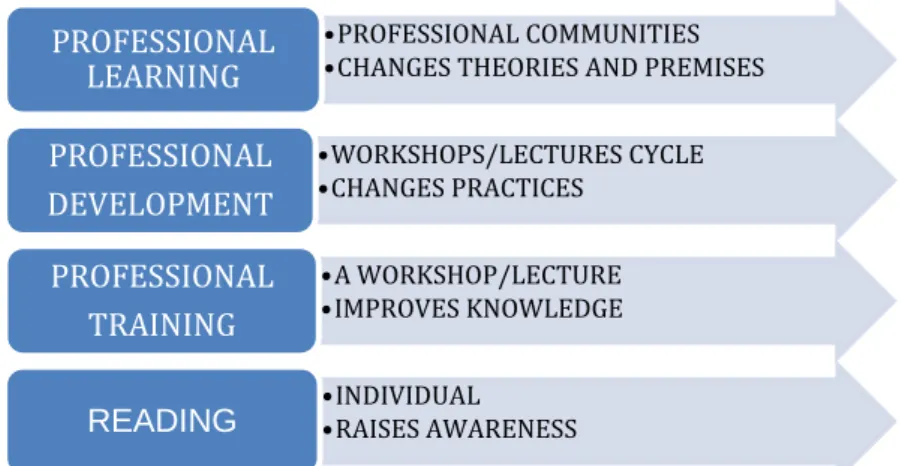
(3) 1. Introduction Current understanding of the educational competence has shown it is evidently a developmental characteristic, therefore it assumes a continuous learning process. Some authors (Hindin & Mueller, 2016; Kim & Taylor, 2016) emphasize lifelong learning as a possible option for improving acquired competences. Since teaching professions, including the early childhood education, are obligated to participate in professional trainings and programs to improve their professional development, it is reasonable to expect lifelong education of the early childhood education professionals. The concept of the professional development of early childhood education (ECE) teachers is determined by the constant interdependence of attitudes, skills and practices, which results in the change of practices (Trust, Krutka & Carpenter, 2016). New knowledge created in this interaction replaces the existing one, so it is necessary to design new modes of professional trainings, which would govern and support professional development. Borko (2004) suggests two approaches of professional development as possible means of enhancing competences: individual, where high intensity professional development programs lead to changes, and group, where learning communities design changes in developing existing competences and learning. Campbell-Barr (2017) criticizes this approach emphasizing that ECE teachers do not need learning but support in their professional development. That view corresponds to Carpenter's (2016) view of professional development, which describes knowledge transfer and constant change of existing practices as a traditional approach which, despite the change of practices, does not contribute to its development. Contemporary approach which contributes to actual, long-lasting changes is always focused on content, interconnected with the curriculum of the educational institution and collective support. Although some contemporary authors (Brown & Englehardt, 2016; Carpenter, 2016; Svanbjörnsdóttir, Macdonald & Frímannsson, 2016) view professional development as a long-lasting process of acquiring knowledge developed in community with professionals, it would be wrong to assume there is no place for the professional development of the individual interests or individual professional qualifications. Despite having the professional responsibility towards their own profession, ECE teachers have their own approach to professional development as well. Although occasional professional training does not lead to permanent changes in one's own practice, it can affect an individual's awareness of the possible direction of professional development. Stewart (2014) adds a new dimension to professional development – professional learning as a mode which leads to changes of theories and premises both in an individual person and professional communities (Figure 1.).. PROFESSIONAL LEARNING. •PROFESSIONAL COMMUNITIES •CHANGES THEORIES AND PREMISES. PROFESSIONAL DEVELOPMENT. •WORKSHOPS/LECTURES CYCLE •CHANGES PRACTICES. PROFESSIONAL TRAINING. •A WORKSHOP/LECTURE •IMPROVES KNOWLEDGE. READING. •INDIVIDUAL •RAISES AWARENESS. Figure 1. Changes in professional development with respect to modes of learning (Stewart, 2014). Although experience can contribute to the advancement of professional competences of ECE teachers, changes in individual practice and theory can be achieved solely by continuous education processes within the already existing professional communities or communities brought together by the same interest. In-service learning within a given context affects the quality of interaction between all participants in the interaction and contributes to the. Journal for Educators, Teachers and Trainers JETT, Vol. 6 (2); ISSN: 1989-9572. 184.
(4) development of competences (Peeters & Vandenbroeck, 2011; Unal & Unal, 2014; Visković & Višnjić Jevtić, 2017).. 2. Professional development of early childhood teachers in Croatia Preschool and early childhood education (ECE) in the Republic of Croatia is intended for children aged 6 months to 6 years and is part of the national education system. Children are taught by ECE teachers who completed undergraduate ECE studies. Recently, ECE graduate studies were founded, but master’s degree (MA) is not a requirement for the profession, rather a choice of each individual educator. Early childhood education is regulated by various documents, the foundation of which is the National Curriculum for Preschool and Early Childhood Education (Nacionalni kurikulum za rani i predškolski odgoj i obrazovanje NKRPOO). The National Curriculum (NKRPOO, 2014) is based on the following four principles: • Flexibility of the early childhood education process. • Partnership of preschool with parents and community. • Ensuring continuity in education and training. • Openness to continuous learning and readiness to improve practices. The improvement of practices starts with a teacher – a reflective practitioner willing to reconsider the practices, both independently and in cooperation with fellow professionals. It is assumed that the development of reflective practices requires the experience which is the result of not only immediate work in education but also the professional development of the ECE teachers. Since the National Curriculum for Preschool and Early Childhood and Education (2014) provides simply guidelines, not strictly defined rules on practices in preschool and early childhood education, it remains unclear what exactly preschool and early childhood education institutions consider an improvement in practices, i.e. to what extent is the improvement actually implemented. In order to regulate education practices in an individual country, it is necessary to adopt certain standards of profession. Standards of the educational profession in the Republic of Croatia were developed through the Qualifications standards and improvement of the quality of study programmes of preschool and primary school teachers project (Krstović, Vujičić & Pejić Papak, 2016). Although the qualifications standards exist, they are still not adopted in practice as in some other countries. Croatian standards are designed as learning outcomes and competences in six areas (game and learning, learning environment, curriculum design, reflection and selfreflection, family and community collaboration, and professional development). Krstović, Vujičić & Pejić Papak (2016) define professional development as a continuous, independent (but also in cooperation with others!) process of developing competences and comprehension of the educational process. According to the Law on Preschool and Early Childhood Education (2013), professional training of ECE teachers is mandatory. Nonetheless, the exact number of hours of the required professional training for ECE teachers is not determined. Some of the institutions start with the total number of hours spent by the ECE teacher in immediate work with children (5.5 hours per day), and account for the additional necessary weekly hours by professional training (2 to 3 hours per week). According to the Regulations on the modes and conditions of professional advancement and promotion of educators and professional associates to higher ranks in preschool education (Pravilnik o načinu i uvjetima napredovanja u struci i promicanju u položajna zvanja odgojitelja i stručnih suradnika u dječjim vrtićima, 1997), ECE teachers in Croatia can advance professionally to the position of the teacher mentor and teacher counselor. The prerequisite for the advancement is the excellence of the individual teacher. Advancement can be seen as part of the professional development. The professional development of the ECE teacher is the personal responsibility of the teacher himself followed by the institution where he works. In the Republic of Croatia, along with the mentioned active participants, the organization of activities contributing to the professional development of the ECE teachers is led by the Education and Teacher Training Agency (ETTA) of the Republic of Croatia. According to the Education and Teacher Training Agency Act (2006),. Journal for Educators, Teachers and Trainers JETT, Vol. 6 (2); ISSN: 1989-9572. 185.
(5) along with other activities, ETTA organizes and conducts professional training for the teaching staff. Although the Education and Teacher Training Agency is not the only institution which organizes professional training for ECE teachers, its role cannot be neglected. ETTA usually organizes one-day professional meetings which usually do not follow contemporary theories of professional development. If Stewart’s (2014) theory of professional development is applied to this issue, it can be concluded that individual activities as well may lead to raising awareness and new insights. Those changes could create professional communities within the institutions and thus ensure the sustainability of professional development. Surely within individual institutions there are already professional learning communities, but they depend on the development plan and curriculum of those institutions. Hadley, Waniganayake & Shepard (2015) emphasize the critical friendship model of learning along with the individual learning and professional learning communities. Although the concept of critical friendship may (falsely) imply a(n) (co-)expert whose role is to find the mistakes (criticize) in the process, another person with different perspective could without a doubt contribute to a better understanding of the practice. The prerequisite for (co-)expert reflection is open communication, willingness to change, appreciation of different opinions and acceptance of different solutions. Professional communities provide ECE teachers with opportunities to develop and improve competences and add a new dimension to the development – support. Hindin & Mueller (2016) point out the need for supportive teachers in understanding the complexity of co-operation with parents. A community based on trust and open communication contributes to finding successful ways in establishing collaborative relationships with parents. Professional development is personal and professional obligation of ECE teachers who view their education practices not only in relation to children but also to their families. Despite the continuity and constant support of the community of experts, research show that the development is an individual trait. Information and strategies which are contrary to personal beliefs of ECE teacher result in the abandonment of new strategies and restoration of established practices (Harwell, 2003).. 3. Professional Associations of ECE teachers in Croatia Taking Early Education and Care (ECEC) into consideration in the context of the education system, it can be concluded that, despite its undisputable importance, it is still not as valued as it should be. Possible contributors to that attitude include its non-obligatory status, working methods and the feminization of the profession. Those views are reflected in all aspects of the ECE profession. Ebbeck & Waniganayake (2003) highlight that the early children education professionals are underpaid, underestimated, exploited, and more inclined to workplace burnout. Research (Tam, 2015) show that professional development contributes to the development of collective professionalism and cooperation. Professional associations could be one of the modes of collective professionalism. In the Republic of Croatia, there are currently 5 ECE teacher associations. The advantage of a larger number of associations is activity in a specific regional context, focused on the actual needs of a particular group of ECE teachers. The regional division can also be seen as the absence of collective professionalism, which then prevents possible changes in the ECE profession. Višnjić Jevtić (2010) states that the activities of professional associations include orientation towards the professional development of ECE teachers, proposing measures to improve professional status and working conditions of ECE teachers, organizing professional training of ECE teachers, participation in planning the education strategies in early childhood education, promotion of the quality of ECE institutions and adoption of professional and ethical codices for ECE teachers. The activity of the existing associations is mostly focused on the professional development of ECE teachers. Associations organize professional trainings – ranging from one-off lectures to modular training. Although they cooperate with Croatian scientific authorities, they increasingly rely on sharing the knowledge of practitioners themselves.. Journal for Educators, Teachers and Trainers JETT, Vol. 6 (2); ISSN: 1989-9572. 186.
(6) Although professional associations cannot fully be identified with professional learning communities, they share some of the features. Hord (2004) highlights the fact that professional learning communities promote supportive and shared leadership, shared values and visions, collective learning, supportive environment, and sharing good practice examples. It is possible to find these characteristics in the activities of professional associations as well. Members of various institutions of early and preschool education distinguish a professional association from a professional learning community. It can be assumed that members have difficulties in collective learning based on reflections due to insufficient knowledge of the context of an individual institution. Though it is possible that all members share the same vision value vis-àvis the profession itself, they probably do not share the same vision of the education work. The Association of Preschool Teachers “Krijesnice” has been operating since 2008. It organizes various professional trainings annually. But so far it has not been able to set up a group of teachers who would systematically re-assess their own practices and change it accordingly. Nonetheless, the most popular professional trainings are those where individual ECE teachers provide examples from their own practice. Although these are usually one-off lectures, they are believed to affect the awareness of the need for permanent professional development.. 4. Objective Aim of the research was to find teachers’ opinion about the role that professional association have in their professional development.. 5. Methodology Focus group research was done in order to gain insight into the ECE teachers’ understanding of professional development and the role a professional association plays in professional development. Although focus groups are not suitable for gaining a complete insight into a particular issue, they contribute to understanding the issue. Gawlik (2018) states that the advantage of such mode of research is mutual stimulation of thinking, which leads to formulation of group opinion. If there is a synergy of opinion, Hyman & Sierra (2016) point out that individuals are more likely to express their attitudes and beliefs within groups because they expect the (co-) experts’ support. Given that there is no research in the Republic of Croatia on the role of professional associations in the professional development of ECE teachers, this research could be the first step for further research. 5.1. Participants and data collection The research conducted in the spring of 2018 included members of the Association of Preschool Teachers “Krijesnice”. It is a professional association founded in 2008 with 358 members who are ECE teachers from the northeast of Croatia, mainly Medjimurje County. The participants in the research were women (N=6) aged 22 to 56 with the membership in “Krijesnice” association between 1 and 10 years (Table 1.). Only one participant has reached the status of teacher mentor. All teachers participated in the research voluntarily. The research was conducted in accordance with the Code of Ethics of the University of Zagreb.. Journal for Educators, Teachers and Trainers JETT, Vol. 6 (2); ISSN: 1989-9572. 187.
(7) Table 1. Participants Participant. Age 22 30 35 38 42. Membership in Association 1 8 10 9 9. PA1 PA2 PA3 PA4 PA5 PA6. Education Bachelor’s degree in ECE Master’s degree in ECE Bachelor’s degree in ECE Bachelor’s degree in ECE Bachelor’s degree in ECE. 56. 10. Bachelor’s degree in ECE. Knowledge is a construct of society, culture, politics or some community which shares the same interests, and as such constitutes a consensus (Kamberelis, Dimitriadis & Welker, 2017). The research results of the focus group are also a result of a consensus and possibly could lead to creating new knowledge. Focus group participants responded to the following research questions: 1. What is professional development? 2. Which are the characteristics of professional development? 3. What is the role of the Association of Preschool Teachers “Krijesnice” in professional development? Although the focus group is established on a common set of attitudes and opinions, the speakers in this research first sought to individually answer the question What is professional development? citing six features of professional development. After that, a common definition of professional development, its characteristics, and the role it plays in professional association were modeled.. 6. Findings and discussion Based on individual reflections on the characteristics of professional development, the agreement between research participants was reached. It identified 6 features determining the professional development of ECE teachers. Focus group defined professional development as a process established on lifelong learning, motivation, teacher’s personality traits and selfactualization (Table 2). This definition corresponds to the definition of Trust, Krutka & Carpenter (2016), who define professional development as a process of changing the practice and creating new knowledge based on the interdependence and co-operation of the participants. In striving to identify the characteristics that contribute most to professional development, research participants have ranked the contribution of the previously mentioned characteristics, deciding that lifelong learning and motivation contribute most and self-actualization least to ECE teachers’ professional development.. Journal for Educators, Teachers and Trainers JETT, Vol. 6 (2); ISSN: 1989-9572. 188.
(8) Table 2. Characteristics of professional development Characteristics Lifelong learning. Motivation Teacher’s personality traits. Self-actualization. Characteristics explained Self-development “keeping up” Professional training Education Reflective practices Action research Children’s welfare Motivation for learning Advancement possibility Enthusiasm Openness (open-mindedness) Knowing “when to take a break” – burn-out syndrome prevention Possibility to present one’s work. It is interesting that the participants easily reached a consensus on all the features with the exception of self-actualization and motivation. Although it could be assumed that the advancement possibility is an integral part of self-actualization, most participants considered the advancement possibility as part of the motivation for professional development of an individual. The participants emphasized that it is external motivation (money) and therefore does not represent professional self-realization. Kennedy (2005) also describes the concept of awardbearing as part of the advancement system of teachers. Motivation for training is not intrinsic, but it is a prerequisite for status progress. This form of training can be analyzed in the context of lifelong learning. It is possible for individuals who conceptualize their development through the advancement system to lose motivation for further training after gaining recognition. Thus, they do not belong to a community focused on lifelong learning. Children’s welfare as a motivating factor for professional development also requires reconsideration. Ebbeck & Waniganayake (2003) emphasize children’s welfare standing out as a basis for exploiting members of the educational profession – teachers are expected to noncritically approach to the expectations of society for the sake of children’s welfare. The participants in this research do not support that approach. Research participants defined lifelong learning as formal education (continuation of education in MA studies) and non-formal education (professional trainings, lectures, workshops, professional literature). Desimone (2009) also states that participation in various activities contributes to ECE teachers’ personal and professional development. When discussing professional training as part of lifelong learning, one of the participants emphasized: PA4: Professional trainings organized by ETTA do not always contribute to professional development. Sometimes it seems that they are organized only to complete the quota of lectures and seminars to be held. Other organizers also have quality trainings, but they are not recognized by the system. For example – associations. The other participant noted that intrinsic motivation is also important for lifelong learning, especially when it comes to professional training, as individuals consider the purpose of professional training to be the completion of required hourly rate. The conclusion reached is that this does not contribute to professional development. Similarly, the study by Visković & Višnjić Jevtić (2018) confirms there is a positive correlation between intrinsic motivation and participation in professional trainings. In discussion on reflective practice as part of lifelong learning, individual participants thought that reflective practice should be considered a separate category of professional development. Eventually, they agreed that reflective practice contributes to learning, and is in itself a mode of learning as well. It is indicative how it is directed at a reflective friend or learning community:. Journal for Educators, Teachers and Trainers JETT, Vol. 6 (2); ISSN: 1989-9572. 189.
(9) PA2: Some teachers think about their own practice, and can analyze it, but they do not know how to raise it to a higher level. That is why co-operation between teachers and common reflection are needed. PA5: It is very difficult to co-operate. In fact, it is very hard to hear that you need to change something because you are convinced it is the best you can do. You rarely get affirmative comments. It is most often criticism. It does not lead to change, rather it leads to self-isolation. Research participants have concluded that ECE teachers rarely have opportunities to expose their practice and thus contribute to their own professional development. They point out that activities which could present their practice to other teachers are at the same time both a challenge and a pleasure. One such event is the presentation of practices organized by the Association of Preschool Teachers “Krijesnice”. Personality traits of the participants are highlighted as a prerequisite for the professional development of each ECE teacher. Particular emphasis is placed on openness (openmindedness) as a feature which enables the acquisition of new knowledge and the acceptance of new learning strategies. Burn-out syndrome is seen by all as a possible barrier in professional development, and it is common in the educational profession (Ebbeck & Waniganayake, 2003; Višnjić Jevtić & Halavuk, 2018). During the discussion on the role of professional associations in ECE teachers’ professional development, all the participants emphasize the Association of Preschool Teachers of “Krijesnice” as an incentive for professional development. PA1: I am inspired and motivated by the Association, i.e. the members. I find the presentation of good practices most useful. I think that is when I think about the practice most and I am encouraged to change my own practice. PA3: While I was working in an unstimulative environment, I started looking for incentives to help me change myself and my practice. When I joined one of the workshops organized by the Association, I knew I wanted to be part of that professional community. PA6: I think a young person, from a small community, needs a sense of belonging. And the Association is perceived exactly like that. It offers the ability to connect with professionals, professional development, professional training, self-actualization. It is possible to conclude that smaller communities experience the need to network, and professional associations allow them to do so. Research (Tam, 2015) shows that networking creates a collaborative culture and a support culture. Support in professional communities leads to greater dedication to work, new ideas, and real-life professional change. Bledsoe & Pilgrim (2016) highlight Social networking as one of the possibilities of professional association. As a Web 2.0 tool, they highlight the availability and the ability to share the various resources which contribute to professional development. One such example of networking is Etwinning portal which provides the possibility of socializing ECE teachers and elementary or highschool teachers independently of their place of residence. Etwinning is a professional teacher community based on joint work, evaluation, planning, training and mutual support, and it meets the requirements of lifelong learning as well. Participants agreed that membership in a professional association is part of their professional identity. They also concluded professional associations should position themselves as professional authorities and take over their members' professional development.. Journal for Educators, Teachers and Trainers JETT, Vol. 6 (2); ISSN: 1989-9572. 190.
(10) 7. Conclusions The results of this research are consistent with similar previously conducted research. The professional development of ECE teachers is the imperative for their professional work. The results show professional development is recognized as an integral part of the profession and that lifelong learning and motivation are extremely important prerequisites for professional development. The research also highlighted the importance of professional learning communities and professional associations. Professional associations are a prerequisite for the professionalization of the educational profession and a factor which could take over the authority in professional issues related to early and preschool education. Taking over autonomy in the ECEC issues requires a high level of knowledge and responsibility. The professional development of ECE teachers could probably result in knowledge, responsibility, autonomy and professional ethics. Given the size of the sample, general conclusions cannot be reached by the results of this research. This research was constructed with a help of a group interview with highly motivated professionals whose reflections show advanced awareness of professional development and the importance of networking. It is possible that repeated research would show different results. Nevertheless, the results can be considered as a basis for more extensive research. Regardless of the possible limits of this research, given the benefits of networking, it is necessary to provide opportunities for networking of community experts.. 8. References Bledsoe, C. & Pilgrim, J. (2016). Creating “Spaces” for Professional Development: Education Organizations’ Use of Facebook. The Journal of Social Media in Society, 5(1), 89 - 110. Borko, H. (2004). Professional Development and Teacher Learning: Mapping the Terrain. Educational Researcher, 33(8), 3 – 15. Brown, C. P. & Englehardt, J. (2016). Conceptions of and early childhood educators’ experiences in early childhood professional development programs: A qualitative metasynthesis. Journal of Early Childhood Teacher Education, 37(3), 216-244. Campbell-Barr, V. (2017). Quality early childhood education and care – the role of attitudes and dispositions in professional development. Early Child Development and Care, 187(1), 4558. Doi: 10.1080/03004430.2016.1150273 Carpenter, J.P. (2016). Unconference Professional Development: Edcamp Participant Perception and Motivation Attendance. Professional Development in Education, 42(1), 78 – 99. Desimone, L. M. (2009). Improving Impact Studies of Teachers’ Professional Development: Toward Better Conceptualizations and Measures. Educational Researcher, 38(3), 181– 199. doi: 10.3102/0013189X08331140 Ebbeck, M. & Waniganayake, M. (2003.). Early childhood professionals: leading today and tomorow. Marickville: Elsevier Australia. Gawlik, K. (2018). Focus groups interviews. In: M. Ciesielska & D. Jemielniak (Eds.) Qualitative Methodologies in Organization Studies Volume II: Methods and Possibilities (pp. 97 126). Cham: Palgrave MacMillan. Hadley, F., Waniganayake, M. & Shepard, W. (2015). Contemporary practice in professional learning and development of early childhood educators in Australia: reflections on what works and why. Professional Development in Education, 41(2), 187202. Doi: 10.1080/19415257.2014.986818 Harwell, S. (2003). Teacher Professional Development: It's not an event, it's a process. Waco: CORD (accessed 25.9.2016. at http://www.cord.org/uploadedfiles/HarwellPaper.pdf) Hindin, A. & Mueller, M. (2016). Assessing and understanding teacher candidates' dispositions toward and knowledge of parent involvement. The Teacher Educator, 51, 9-32. Hord. S. M. (2004). Learning together, leading together: Changing schools through professional learning communities. New York: Teachers College Press. Hyman, M. R. & Sierra, J. J. (2016). Focus Groups Interviews. Business Outlook, 14(7).. Journal for Educators, Teachers and Trainers JETT, Vol. 6 (2); ISSN: 1989-9572. 191.
(11) Kamberelis, G., Dimitriadis, G. & Welker, A. (2017). Focus Group Research and/in Figured Worlds. In: N. K. Denzin & Y. S. Lincoln (Eds.) The SAGE Handbook of Qualitative Research (pp. 1202 - 1239). London, New York, Thousand Oaks: SAGE. Kennedy, A. (2005). Models of Continuing Professional Development: A Framework for Analysis. Journal of In-service Education, 31(2), 235 – 250. Kim, K. J. & Taylor, L. K. (2016). Preservice Teachers' Self-Efficacy in Working with Families: Can an Immersive Course Make a Difference?. Family Involvement in Early Education and Child Care, 1-22. Doi: 10.1108/S0270-402120160000020001 Krstović, J., Vujičić, L. & Pejić Papak, P. (2016). Standardi kvalifikacija i unapređivanje kvalitete studijskih programa odgajatelja i učitelja. Rijeka: Učiteljski fakultet Sveučilišta u Rijeci. Nacionalni kurikulum za rani i predškolski odgoj i obrazovanje (2014). Zagreb: Ministarstvo znanosti, obrazovanja i sporta. Peeters, J. & Vandenbroeck, M. (2011). Childcare practitioners and the process of professionalization. U: L. Miller & C. Cable (Eds.) Professionalization, leadership and management in the early years (pp. 62-76). London, UK: Sage. Pravilnik o načinu i uvjetima napredovanja u struci i promicanju u položajna zvanja odgojitelja i stručnih suradnika u dječjim vrtićima (1997). Narodne novine, 10/97. Stewart, C. (2014). Transforming Professional Development to Professional Learning. Journal of Adult Education, 43 (1), 28-33. Svanbjörnsdóttir, B., Macdonald, A. & Frímannsson, G. (2016). Views of learning and a sense of community among students, paraprofessionals and parents in developing a school culture towards a professional learning community. Professional Development in Education, 42 (4), 589-609. Tam, A. C. F. (2015) The role of a professional learning community in teacher change: a perspective from beliefs and practices. Teachers and Teaching: theory and practice, 21(1), 22-43. Doi: 10.1080/13540602.2014.928122 Trust, T., Krutka, D. G. & Carpenter, J. P. (2016). ‘Together we are better’: Professional learning networks for teachers. Computers in Education, 102, 15-34. Doi: 10.1016/j.compedu.2016.06.007. Unal, Z. & Unal, A. (2014). Perspectives of Preservice and In-Service Teachers on Their Preparation to Work with Parents in Elementary Classrooms. The Educational Forum, 78 (2), 112-126. Visković, I. & Višnjić Jevtić, A. (2018) Professional Development of Kindergarten Teachers in Croatia - a Personal Choice or an Obligation. Early Years, 38(3), 286297. Doi: 10.1080/09575146.2017.1278747 Višnjić Jevtić, A. (2010). Odgojiteljska profesija između zahtjeva vremena i sveučilišnih kompetencija. U: R. Bacalja (Ed.) Perspektive cjeloživotnog obrazovanja učitelja i odgojitelja (pp. 164 – 179). Zadar: Sveučilište u Zadru Odjel za izobrazbu učitelja i odgojitelja Višnjić Jevtić, A. & Halavuk, A. (2018) Early childhood teachers burn-out syndrome – perception of Croatian teachers. Early Years. Doi: 10.1080/09575146.2018.1482260 Zakon o Agenciji za odgoj i obrazovanje [Act on Education and Teacher Training Agency] (2006). Narodne novine 85/2006. Zakon o predškolskom odgoju i naobrazbi [Act on Early Childhood Education] (2013). Narodne novine 94/13.. Journal for Educators, Teachers and Trainers JETT, Vol. 6 (2); ISSN: 1989-9572. 192.
(12)
Figure
Documento similar
It is generally believed the recitation of the seven or the ten reciters of the first, second and third century of Islam are valid and the Muslims are allowed to adopt either of
ABSTRACT Transformation of the Specialized Knowledge of Future Primary Teachers on Fraction Division
From the phenomenology associated with contexts (C.1), for the statement of task T 1.1 , the future teachers use their knowledge of situations of the personal
In the preparation of this report, the Venice Commission has relied on the comments of its rapporteurs; its recently adopted Report on Respect for Democracy, Human Rights and the Rule
In the “big picture” perspective of the recent years that we have described in Brazil, Spain, Portugal and Puerto Rico there are some similarities and important differences,
Based on this information schools were advised to organise groups of teachers (and in the two professional development schools to include in the group also student teachers)
As a response to this situation and to facilitate the informed adjustment of Spanish AESD by ed- ucation managers, teachers, policy-makers, and professional associations, the
In a similar light to Chapter 1, Chapter 5 begins by highlighting the shortcomings of mainstream accounts concerning the origins and development of Catalan nationalism, and
Díaz Soto has raised the point about banning religious garb in the ―public space.‖ He states, ―for example, in most Spanish public Universities, there is a Catholic chapel
