Received 22 Jul 2016|Accepted 16 Sep 2016|Published 14 Nov 2016
Competition among networks highlights the
power of the weak
Jaime Iranzo
1, Javier M. Buldu
´
2,3,4& Jacobo Aguirre
4,5The unpreventable connections between real networked systems have recently called for an examination of percolation, diffusion or synchronization phenomena in multilayer networks. Here we use network science and game theory to explore interactions in networks-of-net-works and model these as a game for gaining importance. We propose a viewpoint where networks choose the connection strategies, in contrast with classical approaches where nodes are the active players. Specifically, we investigate how creating paths between networks leads to different Nash equilibria that determine their structural and dynamical properties. In a wide variety of cases, selecting adequate connections leads to a cooperative solution that allows weak networks to overcome the strongest opponent. Counterintuitively, each weak network can induce a global transition to such cooperative configuration regardless of the actions of the strongest network. This power of the weak reveals a critical dominance of the underdogs in the fate of networks-of-networks.
DOI: 10.1038/ncomms13273 OPEN
1National Center for Biotechnology Information, National Library of Medicine, National Institutes of Health, Bethesda, Maryland 20894, USA.2Laboratory of
S
ocial, biological, physical and technological systems are composed of a diversity of interacting agents, leading network science, a statistical physics understanding of graph theory, to be a genuine tool for investigating theirstructure and dynamics1–3. Within the framework of social
networks4, the topology of the interactions between individuals
has been demonstrated to be crucial in, for example, the
vanishing of the critical threshold in epidemics5,6 or
the efficient and fast propagation of innovation7. In a similar
manner, the topology of a network itself can be influenced by the dynamical processes occurring in it, giving rise to adaptive mechanisms that rule the evolution of the structure of
social networks8.
The emergence of cooperation, defection or altruism can be
investigated by linking game theory to network science9–12.
In this way, the intrinsic heterogeneity of social networks, the majority of them showing power-law distributions in the
number of connections1, has been related in many cases to
the emergence of cooperation, contrary to what is observed
in homogeneous populations13. Furthermore, highly connected
individuals have also been shown to be more prone to collaborate
than scarcely connected ones14. Under this framework, the
understanding of evolutionary games largely benefited from
the methodological tools of network science11. Although
attention was initially focused on the interplay between nodes’
strategies and the structure of the underlying (single) network15,
more recently, coevolutionary rules have also been related to
the emergence of interdependency16and multilayer structures17.
However, what if we are concerned about the interests of a network as a whole instead of its nodes? Does it make sense to consider networks competing or collaborating
with other networks? The fruitful recent literature
about networks-of-networks, or in a more general context about multilayer networks, makes these two questions timely
and extremely relevant18,19. A diversity of dynamical processes
such as percolation20, diffusion21 or synchronization22 have
been recently reinterpreted by assuming that real networks unavoidably interact with other networks, a contact that may be beneficial or detrimental to each of the networks belonging to the
ensemble23.
Here we investigate how m42 networks compete or
cooperate to achieve a relative increase of importance measured as eigenvector centrality, which maximizes their outcome in a variety of dynamical processes. In our competition, networks can vary the way they interact with other networks, evolving in time until they reach a stable situation where all networks refuse to modify their strategy, because any change would lead to a worse result. Importantly, an a priori optimal connection strategy for a given network may not be reachable due to the actions of the competitor networks, which turns the analysis of the final outcome of the networks
into a study of Nash equilibria24 in a network-of-networks.
With this objective in mind, we define a methodology to analyse the competition among networks of any size or topology, demonstrating that several Nash equilibria can coexist, with some of them benefiting the strongest networks and others benefiting the weaker ones.
In particular, we report the existence of a wide regime of the system parameters in which every weak network can induce the rest to cooperate, to escape from a detrimental Nash equilibrium, taking over the final situation of the whole network-of-networks.
Paradoxically, the strong network cannot reverse this
phenomenon. This counter-intuitive asymmetry that promotes the cooperation among weak networks is independent of the network structure or the competition rules and it could be applicable to an extensive number of real systems.
Results
Defining the rules of the competition. As a general rule, we consider that nodes belonging to a network will accept a common strategy, which can be justified in terms of a common benefit or the existence of an imposition within a hierarchical organization (see Supplementary Note 1 for details). The following example, based on real networks, illustrates how different strategies can enhance the outcome of a network. The interaction between members of rural communities in southern India was recently investigated through a series of surveys in the framework of a
microfinance programme25,26. From those data sets (available at
the online version of ref. 25), we constructed the loan networks inside three of those villages (see Fig. 1a), creating a link between
individualsiandjif they were willing to lend to or borrow from
each other a certain amount of money. Local loan networks constructed as explained above provide much information about the financial resilience of a region. If the local authorities of one village promoted the connections to other regions—for example, through the funding of social events—their loan network would be enhanced and the village would become more prepared to face unexpected natural or financial risks (see refs 27–31 and Supplementary Note 1). However, what village is the best to
pp pp pp pp pp pp pp pp pp pp pp pp pp pp pp pp pp pp pp pp pp pp pp pp pp pp pp pp pp pp pp pp pp pp pp pp pp pp pp pp pp pp pp pp pp pp pp pp pp pp pp pp pp pp pp pp pp pp pp pp pp pp pp pp pp pp 18 75 15 9 199 153 138 136 69 6 121 117 98 120 140 148 71 144 79 41 80 139 56 101 82 100 96 89 97 187 13 17 14 186 86 83 90 85 88 5 99 93 104 84 66 87 102 67 103 19 53 51 55 21 74 107 122 74 145 79 78 37 76 148 30 39 52 35 31 43 49 55 53 58 34 92 60 32 150 69 94 73 66 135 33 38 65 123 36 54 124 71 62 118 72 93 68 75 89 183 169 96 264 220 102 208 236 244 171 265 262 276 254 274 172 249 275 176 97 273 271 174 98 242 59 279 252 90 247 239 182 240 251 100 104 237 112 228 226 225 267 234 110 209 266 227 277 148 152 113 185 179 193 150 106 108 141 130 154 191 145 139 137 156 144 198 138 142 149 204 134 115 212 136 120 118 167 188 217 215 238 278 70 257 73 214 219 246 261 210 190 146 192 211 147 201 187 140 218 235 233 231 216 253 250 258 66 196 157 213 159 194 151 205 129 268 121 123 124 114 109 107 128 133 101 99 222 131 126 155 116 197 158 166 135 111 103 105 143 119 117 122 125 270 127 132 272 194 Village B
?
?
?
a b c Village C Village A B B A C C AFigure 1 | Competition for centrality among loan networks.(a) Loan networks of three independent Indian villages, from refs 25,26. Villages A (green), B (blue) and C (red) are named according to the largest eigenvalue of their loan networks, such thatlA4lB4lC(see Supplementary Note 1 for
details about the construction of the networks). Creating connections between villages would lead to a network-of-networks T, whose centrality is distributed among the villages. Inb,c, we show the centrality retained at each village (network) depending on different connection strategies. The radius of each circle is proportional to the centrality accumulated by each network. Networks’ strengths arelA¼4.27,lB¼4.05 andlC¼3.38. When
one connection between villages is allowed (l¼1), two Nash Equilibria coexist: inb, networks B and C connect to A (CA¼0.55,CB¼0.35 and CC¼0.10), but their best strategy is shown inc, that is, to create links
between them, forcing network A to join them (CA¼0.32,CB¼0.49 and CC¼0.19). In summary, the final result of the contest is largely dependent
connect to if more than one option exists? In addition, more importantly, which village would benefit the most from the creation of new financial channels among them?
To address these questions in a general framework we considerm
networks of Ni nodes respectively, where i¼A, B, C,... The
adjacency matricesGiassociated to each networkicontain the full
information about the connections between their nodes
(that is, the specific topology of the networks). The largest
eigenvalue li of Gi is an indicator of the network strength, as
explained in ref. 32; thus, we can order them such thatlA4lBZ...
Zlm. We make use of the eigenvector centrality to determine the
importance acquired by each node, which is directly obtained from
the eigenvectoru1associated with the largest eigenvaluel1of the
adjacency matrix (see ref. 3, Methods and Supplementary Note 2). In our game, every competitor (that is, network) makes use of
up to l undirected links to connect with any of the other
networks. The connector nodes are those with the largest centrality (see Methods). The refusal to connect is an accepted
strategy. Therefore, there are Sm;l¼ððmþml1Þ!1lÞ!! strategies per
competitor and (Sm,l)m possible combinations of actions. The
target of each competitor is to maximize its own eigenvector
centrality, calculated as the total importance (or centrality) Ci
accumulated by all its nodes
Ci¼
P
j2i uT ð Þj
PNT
k¼1
uT ð Þk
ð1Þ
where j are the nodes that belong to network i and uT is the
eigenvector associated with the largest eigenvalue lT of the
adjacency matrix of the network-of-networks T, containing all
nodesNT¼
P
iNi. It is noteworthy that we face a zero-sum game
(PiCi¼1) and the connected system T consists ofm networks
interconnected through a maximum of ml connector links.
Furthermore, such connector links will influence Ci of every
network, but not their strengthli, which is measured when network
iis isolated from the rest and is independent of the contest.
As we assume that networks are able to modify their connector links with the aim of acquiring the highest possible centrality
Ci inside the network-of-networks T, the final configuration of
the system is given by a Nash equilibrium. A Nash equilibrium is the solution of a non-cooperative game involving two or more players, in which each competitor is assumed to know the equilibrium strategies of the other players and no competitor has
anything to gain by changing only their own strategy24,33. From
this general perspective, regardless of the particular rules of the contest, the competition process finishes when a Nash
equilibrium is reached, being Ci the final payoff of each
competitor network.
Figure 1b,c show the competition for centrality in our ‘tale of three villages’. We compute the largest eigenvalue associated with the loan networks within each village and obtain the ranking in
strength: lA4lB4lC. The terminology used to indicate how a
network (that is, a village)i1decides to connect to a networki2is
the following: i1(0) stands for network i1 refusing to connect,
i1-i2 stands fori1 connecting to networki2 and i1#i2 stands
for i1connecting to networki2andi2connecting to networki1.
The arrow - indicates which network decides to create
the connector link, but all links are undirected (that is, bidirectional).
Allowing villages to connect through one link (l¼1), we obtain
two possible Nash equilibria. In one of those, weak villages
establish connections with the strong village, {A(0), B-A,
C-A}, which plainly benefits the latter (Fig. 1b). Nevertheless,
the alternative equilibrium {A-B, B#C} allows weak villages to
overcome their stronger competitor by connecting with each other. In this scenario, the strong network must connect to B to retain part of the centrality of the whole system (Fig. 1c).
Importantly, the selection of adequate connection strategies goes beyond the competition for centrality. In professional networks, for example, the growth of knowledge of an individual can be modelled to be proportional to the knowledge of his/her
acquaintances34, which leads to a final distribution of knowledge
that is given by the first eigenvectoruTof the adjacency matrix.
Translated to a case where independent groups of professionals or researchers can create connections among them, this would indicate that the strategy showed in Fig. 1c would enhance not only the importance of a cluster of professionals, but the relative amount of knowledge acquired by the weakest group compared with the strongest one (see Supplementary Note 1 for several real-world examples dealing with social, technological and biological networks). Furthermore, a wide variety of systems are described by weighted adjacency matrices—transition matrices that include the specificities of the underlying dynamical
process—whose vector uTis related to the equilibrium state of
the system32. Replication-mutation evolutionary dynamics35,
diffusion processes21 or disease spreading36 are only a few
examples where the methodology presented here can be applied with no loss of generality (see Methods).
Competition and cooperation to overcome the strongest. Figure 2 shows a complete numerical description of the
competition amongm¼3 generic scale-free networks A, B and C
of largest eigenvalues lA4lB4lC. For the sake of clarity,
only one connector link is allowed per network (l¼1) and,
therefore, each competitor hasm different connection strategies
(that is, connecting to any of the other m1 networks or
refusing to connect). In the case of three networks, 27 combinations of strategies are possible for each realization— choice of networks—among which only those that verify the conditions to be Nash equilibria are taken as solutions to the contest. Figure 1b,c show that more than one final solution can coexist, which poses two relevant questions: (i) is the coexistence of solutions a general phenomenon? And if this is the case, (ii) does the final outcome of each player vary substantially depending on the solution reached?
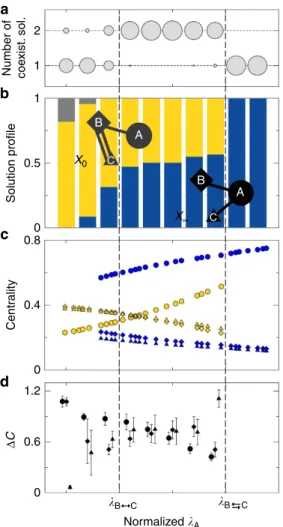
Figure 2a,b address question (i) and show the solution profiles
as the strength of network A (that is,lA) is increased. Figure 2a
shows a scenario that we found to be general: the coexistence of
Nash equilibria, among which two of them, calledX0andXN, are
especially relevant (see Fig. 2b):
X0¼fA!B;B#Cg; ð2Þ
X1¼fA 0ð Þ;B!A;C!Ag: ð3Þ
On the other hand, Fig. 2c shows the centrality for the two existing Nash equilibria as the strength of A is increased for a
particular choice of B and C. For a wide range of values oflA, the
centralities attained by each player strongly depend on the specific solution of the contest, which answers question (ii) and highlights the importance of choosing an adequate connection strategy.
To check the relevance of this result, in Fig. 2d we show the
relative centrality variability (DC), a measure of how much a
player outcome improves by getting to its optimal solution:
DCi¼
max Cð Þ i min Cð Þi
min Cð Þi
; ð4Þ
where the maxima and minima are computed among all
coexisting Nash equilibria. TheDCiof each playeritakes values
infinity (if the worst-case solution leads to zero centrality for that player). All three networks show values of the order of
DCB0.8, which means that the final centrality of each competing
network can vary up to almost twofold depending on the solution reached.
In view of all, we can identify different competition regimes depending on the relative strength between the strong network A and the rest of competitors. For very large strengths of A, that is,
whenlA4lB#C, the only existing Nash equilibrium corresponds
to XN: small networks avoid mutual cooperation and tend to
connect to the largest one, which dominates the contest. A critical
transition occurs atlA¼lB#Cbelow whichXNandX0coexist in
a bistable manner. Interestingly, within this region, cooperation between the weak networks always leads to their best outcome.
Finally, a smoother transition occurs around lABlB2C, being
B2C the network resulting from connecting B and C through a
single link: when the strength of A approaches that of B, mutual cooperation between B and C becomes dominant and equilibrium
XNis no longer possible. At the same time, other Nash equilibria
may appear (grey region of Fig. 2b). See Supplementary Notes 2 and 3 for a full analytical treatment of this phenomenon.
Weak networks can induce migration between equilibria. As explained, in a Nash equilibrium every competitor that may change strategy would decrease its centrality. However, as there are coexisting Nash equilibria, it may be worth assuming a temporal loss of centrality if the final situation leads to an improvement in the outcome. In this way, we study the
potential migration between equilibria X0 and XN in the
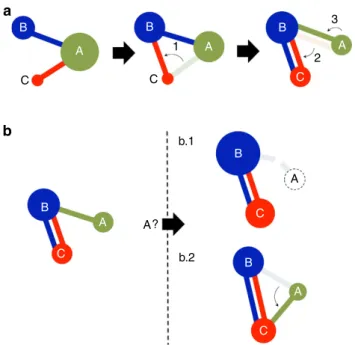
regime in which they coexist (lAolB#C). In Fig. 3a we show that
the migration from XN to X0can be provoked by the weakest
network C individually, whereas Fig. 3b shows that the strong
network cannot trigger the system to migrate fromX0toXN. As
a consequence, when multiple networks compete for centrality, a weak network by itself might escape from a detrimental equilibrium and push the whole system towards a much more beneficial one with the cost of a one-step transient during which its centrality is decreased. On the contrary, this migration-strategy is not accessible to the strong network, resulting in a natural asymmetry in the context of networks-of-networks that benefits the final outcome of weak networks-of-networks and provides them with a flexibility not permitted to the strongest competitors.
Overall consequences on the network-of-networks. Extensive
numerical work yields that the strength lT of the
network-of-networks T following the equilibriumX0is always larger than that
of the solutionXN(that is,lT(X0)4lT(XN), see Supplementary
Note 4). Importantly, an increase of lTis related to enhanced
growth at the equilibrium for a wide range of dynamical
pro-cesses35, a reduction of the critical coupling strength for the
emergence of synchronization (asB1/lT)37or the emergence of a
giant component in percolation phenomena38. Therefore, the
natural tendency towards cooperation among weak networks presented in this work also improves efficiency and growth of the whole system. Going back to the three villages example, the
analysis of the Nash equilibria reveals that the X0 equilibrium
(Fig. 1c) leads to a higher global lTthanXN (Fig. 1b; that is,
lT(X0)¼4.784lT(XN)¼4.57, forl¼1). At the end, this is good
news for all villages, as a higherlTenhances the strength of the
whole ensemble39. It is noteworthy that these results can
be used not only for description but, more importantly, for prescription of how networks can maximize their outcome when interacting with other networks and how the appearance of new interactions among isolated networks influences the structural and dynamical properties of real systems.
Finally, the migration between equilibria described above could have a suggestive counterpart in a wide variety of situations where a relationship based on subjugation to a powerful leader naturally migrated towards a new and more productive model based on cooperation (see refs 40,41 and Supplementary Note 4 for an illustrative historical example).
2
1
1
0
0
0 0.5 X0
X∞ B
A
C
B A
C
0.8
Solution profile
Centr
ality
Δ
C
Number of coe
xist.
sol.
0.4
1.2
0.6
d c b a
B C B C
Normalized A
Figure 2 | Competition for centrality among 3 networks.Each competitor makes use of as much asl¼1 link to connect with the rest of the networks. We modify the size and/or mean degree of network A (that is, the strongest competitor) in order to increase its strength fromlA¼lBto
lAclB#C, where B#C is the network resulting from connecting B and C
through a double link. Thexaxis has been rescaled to allow for comparisons among different realizations. For each choice of B and C, the system is solved for 20 series of A and results are an average of more than 500 sets of A, B and C. (a) Number of coexisting Nash equilibria per realization. The radius of each circle is proportional to the fraction of realizations (no cases with more than two coexisting solutions were found). (b) Relative occurrence of different configurations in the set of solutions, averaged over all realizations: (i) EquilibriumX0¼{A-B, B#C} (yellow), (ii) equilibrium XN¼{A(0), B-A, C-A} (blue) and (iii) other equilibria (grey). In some
exceptional realizations, A-B is substituted by A-C inX0. (c) Centrality
of networks A (circle), B (diamond) and C (triangle) for a particular choice of B and C (lB¼5.25 andlC¼5.2). The results are shown for solutionsX0
andXN(colour code as inb). (d) Relative centrality variabilityDCamong
different Nash equilibria. Data points (error bars) correspond to averages (s.d.) over all realizations whoselAlies in the corresponding X-axis interval.
Discussion
In summary, we propose combining network science and game theory to analyse the election of interconnecting strategies in a zero-sum game where players are not single agents but networks. The creation of paths between interacting networks leads to different Nash equilibria, some of them benefiting the strong competitor and some of them reinforcing the underdogs. Counterintuitively, we showed that transitions between coexisting Nash equilibria are restricted to the weakest competitors, which in practice rule the contest, whereas the strongest network is
unable to change thestatus quoin its own interest.
Importantly, most assumptions of our model can be modified to describe more realistic scenarios without causing qualitative changes (see Supplementary Note 5 for details). When each player is permitted to connect to the rest of networks through
more than one link (that is, l41), the number of strategy
combinations grows as lm(m1) for fixed m. However, the
number of coexisting solutions and the phenomenology observed
are totally equivalent to those obtained forl¼1. The same applies
for random (Erdo¨s–Re´nyi) network topologies, networks of any size and networks with different abilities—that is, when certain
networks can connect through a larger number of connector links (or even more weighted links) than the other competitors.
Furthermore, extending the analysis to mixed Nash equilibria,
where any non-integer distribution of the l connector links is
allowed, does not alter the results and provides a probabilistic nature to the game that broadens its applicability. When more than 3 networks are considered in the contest, new kinds of Nash equilibria arise, but again, we observe the existence of wide regions of the parameter space where weak networks rule the whole network-of-networks. In addition, different definitions of the centrality-based payoffs have been analysed—such as betweenness or closeness centrality—and only those closely related to the eigenvector centrality lead to a rich phenomenology in the number of Nash equilibria and the effect of such equilibria on the payoffs of the competitors.
Finally, in some social and economical networks the connection strategies may be influenced by the individual motivations of the connector nodes, resulting in a potential conflict with the collective interests. As a first step in under-standing such complex scenarios, we introduced a payoff following ref. 42, which includes both individual and collective contributions (see Supplementary Note 6): we conclude that cooperation between the weak networks and their control of the game is a frequent outcome that can appear at relatively small (or even zero) levels of collective incentive, although the quantitative details significantly depend on the topology of the networks.
The robustness of the phenomenology presented here, added to its potential applicability to real cases, makes this ‘power of the weak’ a valuable fact to consider in future modelling of technological, biological or sociological processes on networks.
Methods
Measuring the importance of nodes and networks.We use the eigenvector
centralityxkfor quantifying the importance of a nodekin a network, which can be
obtained as an iterative process that sums the centralities of all neighbours ofk:
xk¼l1X
j
Gkjxj; ð5Þ
wherelis a constant,xkis the eigenvector centrality of nodekandGkjare the
components of the adjacency matrix, which could be both binary or weighted43. In
matrix notation equation (5) readslx¼Gxso thatxcan be expressed as a linear
combination of the eigenvectorsukof the adjacency matrixG, beinglkthe set of
the corresponding eigenvalues. Equation (5) can be regarded as an iterative process
that begins att¼0 with a set of initial conditionsx0. Regardless of the values ofx0,
the value ofx(t) att-Nwill be proportional to the eigenvectoru1associated with
the largest eigenvaluel1. Therefore, the eigenvector centrality is directly obtained
from the eigenvectoru1of the adjacency matrixG, which also holds for weighted
adjacency matrices. As explained in the main text, the centrality accumulated by each network is obtained as the fraction of centrality accumulated by their nodes.
Finally, we usel1as the measure of the network strength, as it is related to a series
of dynamical properties of networks and, in turn, it increases with the number of
nodes, links and the average degree of the network44.
Selection of the specific connector nodes.As explained in ref. 32, the centrality of the connector nodes linking independent networks may be crucial in the final distribution of centrality. The central nodes (C) of a network are those nodes with the largest eigenvector centrality, whereas the peripheral nodes (P) are those nodes with very low centrality (see Supplementary Note 2 for more details). When connecting two networks, the connector nodes allow to distinguish between central–central (CC) connections or peripheral–peripheral (PP) connections. Importantly, when a network-of-networks is broken into disconnected components, the cluster with the largest eigenvalue acquires all centrality, whereas the rest of the (weak) components accumulate zero centrality. PP connections lead to a scenario close to the disconnected case, thus pushing almost the totality of the centrality towards the strong network. Accordingly, any connection strategy based on PP links is practically equivalent to refusing to connect with any other network. For this reason, we have restricted the networks’ strategies to CC connections or no connections (refusal to connect).
Finally, it is worth noting that the rules of the competition allow the
networks to connect through more than one link (for example, in A#B).
For simplicity, throughout the examples studied in this work, we representw
connector links between networks as one link of weightw. However, in certain
systems, links with weight larger than one could have no real meaning. In those
b.1
b.2 A a
b
A B
B
B C
C C
A
A B
A
C
B
A
C
B
A 1
2 3
C
?
Figure 3 | Migration between Nash equilibria.In this example, networks are generated with the Baraba´si–Albert model (lA¼4.07,lB¼3.95 and
lC¼3.63, yieldinglAolB#C¼4.21). To follow how the connection
strategies influence the distribution of centrality, the radius of each circle is proportional to the centrality accumulated by each network. EquilibriumXN
leads toCA¼0.65,CB¼0.21 andCC¼0.14, whileX0leads toCA¼0.28, CB¼0.45 andCC¼0.27. (a) The weakest network C provokes the
migration fromXNtoX0, to drastically improve its centrality (the same
reasoning could be applied to B). Step 1: network C disconnects from the strong network A and connects to the weak network B. Step 2: A does not change its connections because any variation would be detrimental, but B improves its centrality detaching from A and connecting to C. Step 3: A becomes isolated andCA¼0 (becauselAolB#C). It is obliged to connect
to B and the system reaches the Nash equilibriumX0. (b) The strong
network A cannot provoke the migration from equilibriumX0toXNand it is
cases, the second (third, etc.) link between two networks should be built between their second (third, etc.) most central nodes, maintaining the phenomenology qualitatively unchanged.
The adjacency matrix and the dynamical processes.A variety of dynamical processes occurring in a network can be mathematically described as
n(tþ1)¼Mn(t), wheren(t) is a vector whose components are the state of each
node at timet(for example, the population of individuals at each node), andM,
withMijZ0, is a matrix that contains the peculiarities of the dynamical process.
AsMis a primitive matrix, its largest eigenvalue is positive, it verifies that
l14|li|,8i41 and its associated eigenvector is also positive. Therefore, the
dynamics of the whole system is given by
nð Þ¼t Mtnð Þ ¼0 X m
i¼1 nð Þ 0 ui
ð Þltiui; ð6Þ
wheren(0) is the initial condition anduitheith eigenvectors ofM. From
equation (6) we obtain that the system evolves towards an asymptotic state
independent of the initial condition and proportional to the first eigenvectoru1:
lim
t!1 nð Þt
nð Þ 0 u1
ð Þlt
1
¼u1; ð7Þ
whereas its associated eigenvaluel1yields the growth rate at the asymptotic
equilibrium. Ifn(t) is normalized such that |n(t)|¼1 after each iteration,n(t)-u1
whent-Nand there is a correspondence between the eigenvector centrality and
the asymptotic state of the system at equilibrium: both the eigenvector centrality and the asymptotic state of the system are proportional to the eigenvector
associated with the largest eigenvalue of the transition matrixM.
Regarding the phenomenology presented in this work, in case we were concerned about a specific dynamical process, we would replace the adjacency
matrixGby the transition matrixM, obtaining the eigenvector centrality retained
by each network with no loss of generality.
Data availability.All relevant data are available from the authors upon request.
References
1. Newman, M. E. J. The structure and function of complex networks.SIAM Rev.
45,167–256 (2003).
2. Boccaletti, S., Latora, V., Moreno, Y., Chavez, M. & Hwang, D. U. Complex
networks: structure and dynamics.Phys. Rep424,175–308 (2006).
3. Newman, M. E. J.Networks: an introduction(Oxford Univ. Press, 2010).
4. Castellano, C., Fortunato, S. & Loreto, V. Statistical physics of social dynamics.
Rev. Mod. Phys.81,591–646 (2009).
5. Pastor-Satorras, R. & Vespignani, A. Epidemic spreading in scale-free
networks.Phys. Rev. Lett.86,3200–3203 (2001).
6. Castellano, C. & Pastor-Satorras, R. Thresholds for epidemic spreading in
networks.Phys. Rev. Lett.105,218701 (2010).
7. Centola, D. The spread of behavior in an online social network experiment.
Science329,1194–1197 (2010).
8. Gross, T. & Blasius, B. Adaptive coevolutionary networks: a review.J. R. Soc.
Interface5,259–271 (2008).
9. Apicella, C. L., Marlowe, F. W., Fowler, J. H. & Christakis, N. A. Social
networks and cooperation in hunter-gatherers.Nature481,497–501 (2012).
10. Michor, F. & Nowak, M. A. The good, the bad and the lonely.Nature419,
677–679 (2002).
11. Szabo, G. & Fath, G. Evolutionary games on graphs.Phys. Rep.446,97–216
(2007).
12. Dreber, A., Rand, D. G., Fudenberg, D. & Nowak, M. A. Winners don’t punish.
Nature452,348–350 (2008).
13. Santos, F. C., Santos, M. D. & Pacheco, J. M. Social diversity promotes the
emergence of cooperative behavior.Nature454,213–216 (2008).
14. Dall’Asta, L., Marsili, M. & Pin, P. Collaboration in social networks.Proc. Natl
Acad. Sci. USA109,4395–4400 (2012).
15. Perc, M. & Szolnoki, A. Coevolutionary games - a mini review.BioSystems99,
109–125 (2010).
16. Wang, Z., Szolnoki, A. & Perc, M. Self-organization towards optimally
interdependent networks by means of coevolution.New J. Phys.16,033041
(2014).
17. Wang, Z., Wang, L., Szolnoki, A. & Perc, M. Evolutionary games on multilayer
networks: a colloquium.Eur. Phys. J. B88,124 (2015).
18. Kivela¨, M.et al.Multilayer networks.J. Complex Netw.2,203–271 (2014).
19. Boccaletti, S.et al.The structure and dynamics of multilayer networks.Phys.
Rep.544,1–122 (2014).
20. Buldyrev, S. V., Parshani, R., Paul, G., Stanley, H. E. & Havlin, S. Catastrophic
cascade of failures in interdependent networks.Nature464,1025–1028 (2010).
21. Radichi, F. & Arenas, A. Abrupt transition in the structural formation of
interconnected networks.Nat. Phys.9,717–720 (2013).
22. Aguirre, J., Sevilla-Escoboza, R., Gutie´rrez, R., Papo, D. & Buldu´, J. M.
Synchronization of interconnected networks: the role of connector nodes.Phys.
Rev. Lett.112,248701 (2014).
23. Quill, E. When networks network.ScienceNews. 22 September182,18 (2012).
24. Nash, J. Equilibrium points in n-person games.Proc. Natl Acad. Sci. USA36,
48–49 (1950).
25. Jackson, M. O., Rodriguez-Barraquer, T. & Tan, X. Social capital and social
quilts: network patterns of favor exchange.Am. Econ. Rev.102,1857–1897
(2012).
26. Banerjee, A., Chandrasekhar, A. G., Duflo, E. & Jackson, M. O. The diffusion of
microfinance.Science341,1236498 (2013).
27. Hasanov, T., Ozeki, M. & Oka, N. inProceedings of the 15th IEEE/ACIS
International Conference on Software Engineering, Artificial Intelligence, Networking and Parallel/Distributed Computing53–57 (IEEE Computing Society, 2014).
28. Battiston, S.et al.Complexity theory and financial regulation.Science351,
818–819 (2016).
29. Anand, K., Gai, P., Kapadia, S., Brennan, S. & Willison, M. A. Network model
of financial system resilience.J. Econ. Behav. Org.85,219–235 (2013).
30. Minoiu, C. & Reyes, J. A. A network analysis of global banking: 1978-2010.
J. Financial Stability9,168–184 (2013).
31. Acemoglu, D., Ozdaglar, A. & Tahbaz-Salehi, A. Systemic risk and stability in
financial networks.Am. Econ. Rev.105,564–608 (2015).
32. Aguirre, J., Papo, D. & Buldu´, J. M. Successful strategies for competing
networks.Nat. Phys.9,230–234 (2013).
33. Osborne, M. J. & Rubinstein, A.A Course in Game Theory(MIT Press, 1994).
34. Ko¨nig, M. D., Battiston, S., Napoletano, M. & Schweitzer, F. On algebraic graph
theory and the dynamics of innovation networks.Networks Heterogeneous
Media3,201–219 (2008).
35. Aguirre, J., Buldu´, J. M. & Manrubia, S. C. Evolutionary dynamics on networks of selectively neutral genotypes: effects of topology and sequence stability.
Phys. Rev. E80,066112 (2009).
36. Klemm, K., Serrano, M. A., Eguı´luz, V. M. & San Miguel, M. A measure of
individual role in collective dynamics.Sci. Rep.2,292 (2012).
37. Arenas, A., Daz-Guilera, A., Kurths, J., Moreno, Y. & Zhou, C. Synchronization
in complex networks.Phys. Rep.469,93–153 (2008).
38. Bolloba´s, B., Borgs, C., Chayes, J. & Riordan, O. Percolation on dense graph
sequences.Ann. Probab.38,150–183 (2010).
39. Komatsu, T. & Namatame, A. Dynamic diffusion in evolutionary optimised
networks.Int. J. Bio-Inspired Comput.3,384–392 (2011).
40. Duby, G.Le temps des cathe´drales. L’art et la socie´te´ (980–1420)(Gallimard,
1976).
41. de Seta, C. & le Goff, J. (eds)La citta` e le mura(Edizioni Laterza, Roma-Bari,
1989).
42. Grauwin, S., Bertin, E., Lemoy, R. & Jensen, P. Competition between collective
and individual dynamics.Proc. Natl Acad. Sci. USA106,20622–20626 (2009).
43. Newman, M. E. J. Analysis of weighted networks.Phys. Rev. E70,056131
(2004).
44. Restrepo, J. G., Ott, E. & Hunt, B. R. Characterizing the dynamical importance
of network nodes and links.Phys. Rev. Lett.97,094102 (2006).
Acknowledgements
We thank S. Ahnert, A. Arenas, S. Boccaletti, D. Crespo, J. Cuesta, L. Dudbridge, J. Garcia-Ojalvo, S. Manrubia, Y. Moreno, F. Pablo-Martı´, D. Papo, M.A. Porter, F. Puente-Sa´nchez, A. Sa´nchez and A. Sanz for fruitful conversations, and J.F. Nash for being a source of inspiration. J.A. acknowledges financial support from Spanish MINECO (projects FIS2011-27569 and FIS2014-57686), J.I. is supported by intramural funds of the US Department of Health and Human Services (to the National Library of Medicine) and J.M.B. is funded by Spanish MINECO (project FIS2013-41057).
Author contributions
J.A., J.I. and J.M.B. conceived and designed the project. J.I. performed the numerical simulations, J.M.B. analysed the real data sets and J.A. developed the analytical work. J.A., J.I. and J.M.B. wrote the manuscript.
Additional information
Supplementary Informationaccompanies this paper at http://www.nature.com/ naturecommunications
Competing financial interests:The authors declare no competing financial interests.
Reprints and permissioninformation is available online at http://npg.nature.com/ reprintsandpermissions/
How to cite this article:Iranzo, J.et al.Competition among networks highlights
Publisher’s note: Springer Nature remains neutral with regard to jurisdictional claims in published maps and institutional affiliations.
This work is licensed under a Creative Commons Attribution 4.0 International License. The images or other third party material in this article are included in the article’s Creative Commons license, unless indicated otherwise
in the credit line; if the material is not included under the Creative Commons license, users will need to obtain permission from the license holder to reproduce the material. To view a copy of this license, visit http://creativecommons.org/licenses/by/4.0/