Introduction
In the frame of global change, a full understan-ding of the components and dynamics of the
terres-trial C cycle is needed, especially in forest ecosystems, which store a large amount of C, both aboveground (e.g.Körner, 2003) and belowground (e.g.Jobbágy and Jackson, 2000). Accurate assessments of C stocks in different compartments, as well as of C fluxes between these compartments are desired, in order to predict possible changes in C storage after land
Aboveground soil C inputs in the ecotone between Scots pine
and Pyrenean oak in Sierra de Guadarrama
E. Diaz-Pines
1,2*, A. Rubio
1and F. Montes
31 Department of Silviculture and Pasciculture. Universidad Politécnica de Madrid.
Escuela Técnica Superior de Ingenieros de Montes. Ciudad Universitaria, s/n. 28040 Madrid. Spain
2 Institute for Meteorology and Climate Research. Karlsruhe Institute of Technology.
Kreuzeckbahnstrasse, 19. 82467 Garmisch-Partenkirchen. Germany
3 Departamento de Selvicultura y Gestión Forestal. CIFOR-INIA. Ctra. de A Coruña, km 7,5. 28040 Madrid. Spain
Abstract
Aboveground litterfall from Pyrenean oak (Quercus pyrenaicaWilld. a semi-deciduous species), mixed Pyrenean oak-pine and pine (Pinus sylvestrisL.) forest stands was surveyed in two sites in a Mediterranean mountain area during a period of 36 and 29 months, respectively. Separation in different litterfall fractions was performed, and C content of each fraction was measured to calculate the C flux to the soil due to litterfall. Our results showed that litterfall input was higher in pine stands than in Pyrenean oak stands (1.8-2.4 Mg C ha–1year–1at pine plots and 0.9-1.4 Mg C ha–1 year–1at oak plots) and mixed plots showed intermediate values. Needles or leaves contributed about 50% to total litterfall, underpinning the importance of the rest of materials in the soil C input. The seasonal pattern showed a maximum in Pyrenean oak stands in autumn-early winter, while the pine stands had the maximum in summer, which is in consonance with the physiology of fall of broadleaves and coniferous trees in these latitudes , but clearly differs from needle-shed in Central and Northern Europe. A dry-spring year corresponded to a lower leaf fall during the following autumn, and leaf abscission came some weeks earlier than a year with a rainy spring.
Key words: litterfall; Pinus sylvestris; Quercus pyrenaica; ecotone; Mediterranean mountain.
Resumen
Caída de hojarasca en un ecotono Pinus sylvestris L.-Quercus pyrenaica Willd. en la Sierra de Guadarrama
La tasa de caída de hojarasca en parcelas puras de rebollo (Quercus pyrenaicaWilld.), parcelas mixtas de rebollo y pino silvestre y parcelas puras de pino (Pinus sylvestrisL.) fue estudiada en dos localizaciones de montaña medi-terránea durante 36 y 29 meses, respectivamente. Se llevó a cabo una separación de los componentes de la hojarasca, y se determinó el porcentaje de C en cada una de las fracciones, para calcular un flujo de entrada de C al suelo debi-do al desfronde. Nuestros resultadebi-dos muestras que la tasa de caída de hojarasca fue más alta en parcelas de pino que de rebollo, alrededor del doble (1.8-2.4 Mg C ha–1año–1en pino frente a 0.9-1.4 Mg C ha–1año–1en rebollo); las par-celas mixtas mostraron valores intermedios. Las acículas u hojas contribuyeron alrededor del 50% al total de caída de hojarasca. El patrón estacional mostró un máximo de caída de hojarasca de rebollo en otoño y comienzos de invier-no, mientras que en las parcelas de piinvier-no, dicho máximo se produjo en verainvier-no, lo que es congruente con la fisiología de la caída de hojas o acículas en frondosas y coníferas en estas latitudes, pero desmarcándose de los valores obteni-dos en Europa Central y del Norte. Un año con primavera seca coincidió con un desfronde de hojas de rebollo menor; asimismo, la caída de la hoja se adelantó algunas semanas con respecto al año con una primavera lluviosa.
Palabras clave: caída de hojarasca; Pinus sylvestris; Quercus pyrenaica; ecotono; montaña mediterránea.
* Corresponding author: [email protected] Received: 30-11-10. Accepted: 03-08-11.
use changes, disturbances or different management practices.
Inputs of C to the soil are due to root decomposi-tion (belowground input) and litterfall (aboveground input), while soil C outputs are due to soil respiration (Trumbore, 2006). Both types of soil C inputs (abo-veground litterfall and root descomposition) are known to be related in a global scale (Raich and Nadelhoffer, 1989). C and organic matter inputs to the soil are crucial in terms of nutrient recycling and to sustain soil ferti-lity: this flow of C establishes a clear link between ve-getation and soil.
Soil C input rates depend on several factors, which are closely interconnected: higher productivity may lead to higher litterfall rates (Berg et al., 1999), but not necessarily to enhanced root C allocation (Giardina et al., 2003). Reduced forest density through thinning may decrease litterfall rates (Blanco et al., 2006; Roig et al., 2005); however, thinning residues may compen-sate for declining litterfall rates (Jandl et al., 2007). Tree species have a strong effect on litterfall rates (Binkley and Giardina, 1998; Kavvadias et al., 2001; Vesterdal et al., 2008). Latitude, although with limita-tions (Berg et al., 1999) has also an effect, likely related to productivity and climate. Finally, precipitation and soil moisture, temperature (Caritat et al., 2006), and soil fertility (Sariyildiz and Anderson, 2005) may play a important role. Some of these factors can be controlled by forest management, such as tree species selection, and thus, forest measures can be conducted in order to choose the best tree species in terms of C sequestration, including soil C.
Scots pine (Pinus sylvestrisL.) has been intensively monitored in terms of litterfall (Astel et al., 2009; Berg et al., 1999; Blanco et al., 2006; Kouki and Hokkanen, 1992). However, number of studies analysing Scots pine litterfall sharply decreases from Northern to Southern Europe. We consider this to be an important omission, since the Iberian Peninsula is the most south-western limit of the world distribution of this tree species, and findings from this disjoint population could be different than from the rest of its distribution (Díaz-Pinés et al., in press). In the Iberian Peninsula, the ma-jority of studies were carried out in northern Spain Scots pine stands (Blanco et al., 2006; Pausas, 1997; Santa Regina and Tarazona, 2001), and just one recent paper deals with Scots pine litterfall in Central Spain (Martínez-Alonso et al., 2007). The information rela-ted to Pyrenean oak (Quercus pyrenaicaWilld.) is much more scarce, with data from one single location in the
whole Iberian Peninsula (Gallardo et al., 1998), although this tree species covers several hundred thousand hec-tares in the Iberian Peninsula (Ministerio de Medio Ambiente, 1998).
Thus, more knowledge about litterfall patterns in Mediterranean forest lands is needed, where conditions differ from the rest of Europe. Differential behaviour of Mediterranean Scots pine forests was put on evi-dence by Berg et al.(1999) who found a gradient of increasing litterfall with decreasing latitude from Northern Europe to South France. For the Iberian Pe-ninsula, a variety of litterfall rates was found. Knowing the litterfall pattern of different tree species in Medi-terranean ecotonal zones, where the same location may be occupied by different forest types, it is crucial to predict changes after shifts in the tree species distri-butions. These shifts have been already observed in Quercustree species which are displacing Scots pine stands in northern Spain (Galiano et al., 2010).
In this work, we studied (1) litterfall rates; (2) com-position of litterfall and (3) seasonally behaviour of litterfall rates in two ecotones between Scots pine and Pyrenean oak in the Sierra de Guadarrama (Central Spain). The working hypotheses were as follows (1) pines have higher litterfall rates, based on productivity; (2) needles and leaves may be the main contributors of litter-fall and (3) coniferous and broadleaves may have different temporal patterns of litter-fall, since the phenology of the process is different in each tree species.
Material and methods
Site description and experimental design
At each site, we defined a transect located within the ecotone between Pyrenean oak (hereafter, oak) and Scots pine (hereafter, pine) composed by a pure oak plot, a mixed oak- pine plot and a pure pine plot. Pines are about 80 years old, whereas oaks are about 60 years old. Corresponding basal areas are about 15 m2ha–1at
the oak plots and 50-60 m2ha–1at the pine ones. The
mixed plots are composed by 5-10 m2ha–1of oaks and
25-30 m2ha–1of pines. At each plot (with an area of
2,000 m2), seven galvanised steel funnel
litterfall-collectors (1 meter height, 80 cm diameter), with a cotton cloth bag in the bottom, were randomly placed. Litterfall collection started in October 2005 in Valsaín and in March 2006 in Rascafría and stopped in October 2008 for both sites.
Litterfall was periodically collected and transported to the lab. Once in the lab, material was air-dried and separated according to the following fractions: pine needles, oak leaves, pine branches, oak branches, other pine-origin material (mainly bark and inflorescences), other oak-origin material (mainly inflorescences) and other material of unknown origin. Each fraction was weighted and a sub-sample from each fraction was oven-dried (105°C) to constant weight and dry weight of each fraction was calculated. C content was measu-red by means of a of a Total Organic Carbon analyser (TOC-5000, Shimadzu Corporation, Kyoto, Japan) equipped with a solid sample module (SSM-5000, Shimadzu Corporation) (Table 2).
We integrated collected amounts of litterfall in order to get an annual litterfall rate. Litterfall inputs were expressed in Mg C ha–1year–1, as the aim of this study
is focused on the C cycle. Based on previous experien-ce and visual observations, we assumed that no in situ decomposition occurred between litter-fall time and sampling time. For comparison purposes, we defined two «meteorological seasons»: the first one from the beginning of March 2006 to February 2007, and the
second one from March 2007 to February 2008. We established the limit between seasons according to the moment of minimum total litterfall rate.
Meteorological data
Meteorological data were obtained from nearby me-teorological stations: Embalse del Pontón Alto(Valsaín) and El Paular, Rascafría(Rascafría), from the State Meteorological Agency. We obtained maximal and minimal temperature and accumulated precipitation in a daily resolution, covering the whole measurement period. Long series from previous years were also used to characterize climatically both areas. Due to differen-ces in altitude between meteorological stations and experimental plots, a correction was applied: 0.65°C decrease per 100 m of increasing altitude, and a preci-pitation increase of 8% for each increase of 100 m in altitude, (but for summer precipitations when convec-tive regime is predominant) (Gandullo, 1994).
Statistical analyses
Differences in litterfall rates between sites and vegetation types were analysed with a two-ways
repea-Table 1.Mean (± 1 SD) climatic features for the two experimental areas
Valsaín (1998-2009) Rascafría (1984-2009)
MMT MmT MAP MMT MmT MAP
(°C) (°C) (mm) (°C) (°C) (mm)
Spring 14.7 ± 3.3 2.0 ± 2.9 191 ± 50 14.3 ± 3.1 1.2 ± 2.4 220 ± 89
Summer 27.0 ± 1.8 10.2 ± 2.5 60 ± 25 25.4 ± 2.3 7.8 ± 1.5 77 ± 52
Autumn 16.3 ± 5.9 4.2 ± 4.0 195 ± 58 16.2 ± 5.0 2.8 ± 3.2 264 ± 113
Winter 7.4 ± 2.1 –2.9 ± 2.3 159 ± 61 7.9 ± 2.0 –2.9 ± 2.4 337 ± 143
Annual mean 16.3 ± 0.5 3.3 ± 1.5 538 ± 93 16.7 ± 0.7 3.0 ± 1.2 1,060 ± 205
MMT: mean maximum daily temperatures. MmT: mean mimimum daily temperatures. MAP: mean annual precipitation.
Table 2.Carbon percentage of each considered litterfall fraction
Material % C
Pine needle 50.2
Pine branch 49.1
Pine others 48.1
Oak leaf 40.9
Oak branch 45.8
Oak others 45.6
ted measures analysis of variance. Univariate repeated measures analysis of variance was used to identify in which collection dates the differences were significant among vegetation types or sites. Subsequently, post hocTukey tests were performed for vegetation type. Correlations were assessed by Pearson correlation test. Significance level was established at α= 0.05 for all tests.
Results
The f irst meteorological season (March 2006-February 2007) was characterized by a relatively dry spring, followed by a common dry summer and rainy autumn and winter, in the range of the historical data (Table 3). During the second meteorological season (March 2007-February 2008), a very rainy spring was observed in comparison to historical data (Table 1), followed by a very long dry period, which resulted in a lower precipitation amount during the whole year 2007 in comparison to 2006 or to historical data (Table 1, Table 3).
Pine plots exhibited higher litterfall rates than oak plots: mean annual litterfall rates were 0.9-1.4 Mg C ha–1year–1for oak plots and 1.8-2.4 Mg C ha–1year–1
for pine plots. Mixed stands exhibited intermediate
values ranging from 1.5 to 2.1 Mg C ha–1year–1(Fig. 1,
Fig. 2). Considering the whole surveying period, Rascafría showed significantly higher litterfall rates than Valsaín. Comparing each vegetation type, the difference between Rascafría and Valsaín litterfall rates was statistically significant in oak plots (1.4 ± 0.2 vs. 0.9 ± 0.1 Mg C ha–1year–1, p = 0.013) and nearly
signi-ficant in mixed stands (2.1 ± 0.2vs.1.8 ± 0.2 Mg C ha–1
year–1, p=0.08) and in pine stands (2.4 ± 0.3 vs. 1.8 ± 0.1
Mg C ha–1year–1p=0.07). We did not find a significant
interaction effect of site and vegetation (p = 0.57). We found significant correlations between litterfall rates and basal area, when separately considering the two tree species. R2values were high if considering total
litterfall rates or only needle- or leaf-fall, respectively (pine litterfall, R2 = 0.86, p = 0.08; oak litterfall, R2= 0.84,
p = 0.02; needle fall, R2= 0.89, p = 0.008; leaf fall, R2=
0.77, p = 0.01; Fig. 3)
Maximum litterfall occurred in summer for the pine stands, whereas it occurred in autumn-early winter for oak plots. This pattern was similar in the two experi-mental sites (Fig. 1, Fig. 2). The peak in litterfall was due to high needle- and leaf-fall rates for pine and oak plots, respectively. In the case of mixed plots, contri-bution of needles during the summer and of leaves during autumn and winter prolonged high litter-fall
Table 3.Main meteorological features during the surveying period in both sites
Valsaín Rascafría
MMT MmT Prec MMT MmT Prec
(°C) (°C) (mm) (°C) (°C) (mm)
Summer 2005 27.9 12.2 28 27.1 7.8 32
Autumn 2005 16.8 4.5 168 15.8 1.5 260
Winter 2006 5.8 –2.9 183 7.0 –5.7 350
Spring 2006 16.5 3.7 120 15.5 1.2 165
Summer 2006 27.7 11.9 86 26 7.4 102
Autumn 2006 18.4 7.5 197 17.6 3.5 403
Winter 2007 8.1 –1.4 189 8.7 –4.4 348
March 2006-Feb 2007 17.7 5.4 592 17.0 1.9 1,018
Spring 2007 13.4 2.9 251 13.1 0.0 293
Summer 2007 25.1 9.8 44 24.1 5.8 92
Autumn 2007 16.7 3.8 97 17.5 –0.5 108
Winter 2008 9.9 0.01 82 9.7 –4.3 199
March 2007-Feb 2008 16.3 4.2 474 16.1 0.3 692
Spring 2008 13.6 3.4 290 13.5 0.1 430
Summer 2008 25.4 11 92 24.3 5.3 61
Autumn 2008 14.2 4.5 192 14.4 0.5 260
rates from June to December (Fig. 1, Fig. 2). From May to September litterfall rates were significantly higher in pine plots in comparison to oak ones whereas from October to December oak plots exhibited the highest litterfall rates.
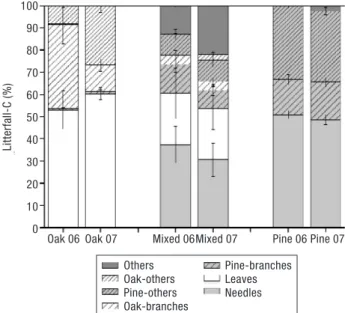
Maximum leaf-fall rate during meteorological year 2006 lasted from the second half of September to the be-ginning of November. In 2007 the maximum leaf-fall was observed between end of October and beginning of December. No differential temporal pattern was observed between meteorological years for litterfall in pine plots. Oak leaves contributed roughly 50% to the total litterfall amounts, and a similar percentage was
obser-ved for pine needles (Fig. 4, Fig. 5). Branches contribu-ted up to 40% in oak stands (Valsaín, meteorological season 2006, Fig. 4e), with a mean percentage of about 20%. In the case of pine plots, other material (mainly reproductive material, such as inflorescences) contri-buted between 30 and 40% to the total litterfall. For oak plots, other materials ranged from 10 to 25% of total litterfall (Fig. 4, Fig. 5).
In the oak plot from Valsaín, oak leaf-litter increa-sed from 0.40 in 2006 to 0.54 Mg C ha–1year–1in 2007
(Table 4, p = 0.07). In the mixed plot from Val-saín, there was a significant increase (p = 0.04) from 0.16 in 2006 to 0.21 Mg C ha–1year–1in 2007 in oak
Figure 1.Cumulative litter fall (mean ± 1 SE) along the surveyed years in Valsaín for pure Pyrenean oak (a), mixed (b) and pure Scots pine (c) stands.
Needles Leaves Branches-Ps Branches-Qp Others - Ps Branches - Qp Others
Feb 06 May 06 Aug 06 Nov 06 Feb 07 May 07 Aug 07 Nov 07 Feb 08 May 08 Aug 08
Litterfall-C
(Mg ha
–1)
Litterfall-C
(Mg ha
–1)
Litterfall-C
(Mg ha
–1)
2.5
2.0
1.5
1.0
0.5
0.0 a)
b)
c)
2.5
2.0
1.5
1.0
0.5
0.0
2.5
2.0
1.5
1.0
0.5
leaf-litter. In Rascafría, we observed a similar increa-se (0.57 in 2006 vs. 0.69 Mg C ha–1year–1in 2007,
p = 0.006). For the mixed plot in Rascafría, the in-crease in oak leaf-litter (0.22 in 2006; 0.27 Mg C ha–1
year–1in 2007) was also signif icant (p = 0.025)
(Ta-ble 4).
Discussion
In several cases, an accurate comparison between our litterfall rates results and others was not possible in terms of C units, since C percentage for each
con-sidered fraction is not included in many papers (Blanco et al., 2006; Martínez-Alonso et al., 2007; Pardo et al., 1997; Pausas, 1997). We found low C percentages in senescence oak leaves (Table 2) and using 50% C —as it is usually made— overestimates C inputs to the soil up to 20%.
Our litterfall-C values are similar to those of other publications of Scots pine forests in Central Spain (Martínez-Alonso et al., 2007), other northern Spanish locations (Blanco et al., 2006; Pausas, 1997) although slightly higher values have been found in these latter areas (Santa Regina and Tarazona, 2001). However, our pine plots exhibited slightly higher litterfall C rates Figure 2.Cumulative litter fall (mean ± 1 SE) along the surveyed years in Rascafría for pure Pyrenean oak (a), mixed (b) and pure Scots pine (c) stands.
Feb 06 May 06 Aug 06 Nov 06 Feb 07 May 07 Aug 07 Nov 07 Feb 08 May 08 Aug 08
Litterfall-C
(Mg ha
–1)
Litterfall-C
(Mg ha
–1)
Litterfall-C
(Mg ha
–1)
2.5
2.0
1.5
1.0
0.5
0.0
2.5
2.0
1.5
1.0
0.5
0.0
2.5
2.0
1.5
1.0
0.5
0.0 a)
b)
c)
than those recently reported in Poland (Astel et al., 2009) but much higher than those compiled by Starr et al.(2005) from Finland (0.5-0.9 Mg C ha–1year–1).
It is noteworthy comparing our values with data from other Mediterranean pines, since the behaviour within the genus Pinusmight by similar in terms of litterfall (Berg et al., 1999). Roig et al.(2005) analysed litterfall of Pinus pinasterAit., under different thinning regimes
in Central Spain, and found needle-fall mean values of approximately 1.6 Mg C ha–1year–1(ranging from
0.6 to 2.9). Michopoulos et al.(2007) found similar values (1.9 Mg C ha–1year–1) in Pinus halepensisMill.
urban forests in Athens, Greece. Also in Greece, Kavvadias et al.(2001) found lower litterfall rates for P. pinaster(0.7 Mg C ha–1year–1) and Pinus nigraArn.
v. pallaciana(1.3 Mg C ha–1year–1), but the
contribu-tion of no-needle litterfall was surprisingly low (less than 5%). Thus, upon the scarce information of genus Pinusin Mediterranean areas, litterfall rates seems to be in a range between 1.5-2 Mg C ha–1, (with our data
fitting in this threshold) far away from values of 3 Mg C ha–1year–1found in semi-arid areas (Pérez-Suárez
et al., 2009) or up to 5 Mg C ha–1year–1in tropical areas
(Smith et al., 1998).
Regarding oak litterfall rates, information is even more limited. The values obtained are below the scarce studies carried out in Spain (Gallardo et al., 1998; Pardo et al., 1997) with this almost endemic tree spe-cies, and slightly lower than results from a recent study of Quercus canariensis Willd., 1.5-1.6 Mg C ha–1year–1
(Aponte et al., 2010). Our values are within the range of some studies made on evergreen Quercus ilexL in Spain (Bellot et al., 1992; Martin et al., 1996), but far below with results from Q. ilex in Central Italy (Bussotti et al., 2003). Our results are also lower than those from deciduous oaks in northern Atlantic Spain (Díaz-Maroto and Vila-Lameiro, 2006).
Figure 4.Mean relative contribution (± 1 SE) of each litter frac-tion to the total litterfall-C in Valsaín for the growing season of 2006 and 2007.
Figure 5.Mean relative contribution (± 1 SE) of each litter frac-tion to the total litterfall-C in Rascafría for the growing season of 2006 and 2007.
100
90
80
70
60
50
40
30
20
10
0
100
90
80
70
60
50
40
30
20
10
0
Litterfall-C
(%)
Litterfall-C
(%)
Oak 06 Oak 07 Mixed 06Mixed 07 Pine 06 Pine 07
Others Oak-others Pine-others Oak-branches
Pine-branches Leaves Needles
Others Oak-others Pine-others Oak-branches
Pine-branches Leaves Needles
Oak 06 Oak 07 Mixed 06 Mixed 07 Pine 06 Pine 07
0 10 20 30 40 50 60 70
0.0 0.5 1.0 1.5 2.0 2.5 3.0
Litterfall-C (Mg ha
–1 year –1)
Basal area (m2 ha–1)
Oak litter-Rascafría Oak litter-Valsaín
Pine litter-Rascafría Pine litter-Valsaín
Mixed stands presented intermediate litterfall rates values, as found with the soil C stocks (Díaz-Pinés et al., in press). We were not able to find any reference in the scientific literature reporting litterfall values for coniferous-broadleaves mixed stands on Mediterra-nean areas. However, our results contrast the study made in a Mexican semi-arid region comparing Pinus cembroidesZucc. and Quercus potosina, Trel. in which the mixed stands showed the highest litterfall values (Pérez-Suárez et al., 2009). In the same work, the pine plot had the highest basal area and, surprisingly, lower litterfall rates.
Productivity is closely related to litterfall rates (Berg et al., 1999). In our case, we found a strong correlation between basal area and litterfall rates (Fig. 3), which reflects the link between aboveground and below-ground C allocation patterns (Raich and Nadelhoffer, 1989). For instance, a significant correlation between litterfall rates and forest floor C stocks, as well as between litterfall rates and soil C stocks in the first cm of the mineral soil has been found (Díaz-Pinés et al., in press), underpinning the importance of litterfall rates as the main soil C input and driver of soil C allocation. Some authors have related the relative contribution of needle to total litterfall to the state of development of the stand (Martínez-Alonso et al., 2007). However, in a summarising study across Europe, no correlation between needle/total litterfall and age was found; but they found a positive correlation between the contribu-tion of needles and the magnitude of litterfall (Berg and Meentemeyer, 2001). It is somewhat surprising that in some studies it is reported that no-needles litter-fall was negligible (Kavvadias et al., 2001; Roig et al., 2005). Oak leaves contributed to about 50% to total oak-derived litterfall, a much lower value than other
studies on Q. pyrenaica(Gallardo et al., 1998), Q. ilex (Rapp et al., 1999) or Quercus roburL. (Díaz-Maroto and Vila-Lameiro, 2006; Hansen et al., 2009; Vesterdal et al., 2008). The only studies with similar relative contribution of leaves to total litterfall were those in which a high proportion of acorns was found (Callaway and Nadkarni, 1991; Díaz-Maroto and Vila-Lameiro, 2006), but that was not our case during the sampling period. Besides leaf and/or needle-fall, there is not much information in the scientific literature regarding other components of litterfall. Lehtonen et al.(2004) analysed the branch-fall in a chronosequence of Scots pine forests in Sweden, and obtained values from 0.04 to 0.1 Mg C ha–1year–1. This is in contrast to our
find-ings, which show much higher values: 0.3-0.4 Mg C ha–1year–1of branches in pine plots; and 0.2-0.3 Mg
C ha–1year–1 in mixed plots, with a relatively lower
Scots pine presence. Thus, branches contributed signi-ficantly to the total litterfall, as well as reproductive organs, and such contribution was consistent across sampling years and experimental sites (roughly, 20% each, Fig. 4, Fig. 5). The ecological importance of re-productive organs or coarse woody debris is high (Montes and Cañellas, 2006) and further research is needed in this direction. Size of the trap may play a role: if the trap is too small (Blanco et al., 2006; Roig et al., 2005), coarse branches may be underestimated, and a key component of the soil C input may be missed. For ins-tance, needle-fall has been proposed as a simple indi-cator of total litterfall (Berg et al., 1999), but more accu-rate estimations are needed, since we consider that needle fall can be only a rough estimator of total litterfall, and heterogeneity of coarse debris is high (Pausas, 1997). Scots pine in Central Spain exhibits the highest needle-fall during summer (Fig. 1, Fig. 2,
Martínez-Table 4.Mean (± 1 SE) oak and pine derived litterfall in the monitored meteorological years
Oak Valsaín Mixed Valsaín Mixed Valsaín Pine Valsaín Oak Rascafría Mixed Rascafría Mixed Rascafría Pine Rascafría Qp litter Qp litter Ps-litter Ps-litter Qp litter Qp litter Ps-litter Ps-litter (leaf litter) (leaf litter) (needle litter) (needle litter) (leaf litter) (leaf litter) (needle litter) (neddle litter)
Season 2006
0.92 ± 0.18 0.20 ± 0.07 1.15 ± 0.30 1.90 ± 0.18 1.06 ± 0.15 0.29 ± 0.06 1.34 ± 0.25 2.04 ± 0.32
(0.40 ± 0.05) (0.16 ± 0.05) (0.72 ± 0.19) (0.96 ± 0.07) (0.57 ± 0.09) (0.22 ± 0.04) (0.79 ± 0.10) (1.05 ± 0.17)
Season 2007
0.88 ± 0.08 0.26 ± 0.09 0.90 ± 0.25 2.24 ± 0.12 1.21 ± 0.14 0.34 ± 0.05 1.33 ± 0.17 2.06 ± 0.20
(0.54 ± 0.05) (0.21 ± 0.07) (0.54 ± 0.11) (1.11 ± 0.06) (0.69 ± 0.09) (0.27 ± 0.04) (0.83 ± 0.08) (1.11 ± 0.09)
Alonso et al., 2007), but some weeks before than stu-dies carried out in northern Spain (Blanco et al., 2006; Pausas, 1997; Santa Regina and Tarazona, 2001) or in Central and Northern Europe (Kouki and Hokkanen, 1992). This differential behaviour of Scots pine in Medi-terranean regions is likely due to summer water stress. However, water deficit appears not to limit tree growth (Cañellas et al., 2000), high litterfall rates or high soil C stocks (Díaz-Pinés et al., in press). Further studies should be carried out to study whether an early needle fall would promote high soil C stocks. Decomposition taking place in late-summer or autumn might improve nutrient cycling and allow for a higher incorporation of organic C to the soil during the mineralization process. Pyrenean oak is a semi-deciduous tree: this oak can maintain its dead leaves on the branches during the winter (Do Amaral, 1990), until the buds from the following year sprout to protect the buds from freezing (Blanco et al., 1997). In the Sierra de Guadarrama, the maximum leaf-fall occurred between September and December. We sampled during two contrasting meteo-rological years: 2006 exhibited a consistent and signi-ficant lower leaf-fall than 2007, and precipitation was much lower in 2006 than in 2007 (Table 3). Relatively scarce water during spring (and also during the former winter) likely contributed to a decrease on leaves pro-duction of Q. pyrenaica. Since oak renews all the leaves every year, this lower leaves production resulted in a lower input of leaves to the soil in 2006 than in 2007. Interestingly, we also observed a delay of some weeks in the maximum leaf fall during 2007. Such trends (different needle-fall amount or different tem-poral pattern between years) were not evident for pine needles fall. Vogt et al.(1986) concluded that broad-leaves tree species were more sensitive to climatic factors than coniferous trees in relation to litterfall, at the global scale. In addition, deeper tap roots from Scots pine may somewhat alleviate water stress during summer. More research is needed to know how and to which extent within-years litterfall heterogeneity and variations of litterfall temporal patterns influence the C cycle in this pine-oak ecotone, since both amount of C inputs and decomposition conditions may vary in the frame of global change.
Acknowledgments
We would like to thank Beatriz Ortiz and the people who worked in the lab performing litterfall separation,
and to forest managers for facilitation of the working environment. Gratitude is shown to the State Agen-cy of Meteorology for providing the meteorological data. This work was partially funded by the Projects AGL2007-64707/FOR and AGL2010-16862 from the Spanish Ministry of Education
References
APONTE C., GARCÍA L.V., MARANON T., GARDES M., 2010. Indirect host effect on ectomycorrhizal fungi: leaf fall and litter quality explain changes in fungal commu-nities on the roots of co-occurring Mediterranean oaks. Soil Biol Biochem 42, 788-796.
ASTEL A., PARZYCH A., TROJANOWSKI J., 2009. Com-parison of litterfall and nutrient return in a Vaccinio uliginosi-Betuletum pubescentis and an Empetro nigri-Pinetum forest ecosystem in northern Poland. Forest Ecol Manag 257, 2331-2341.
BELLOT J., SÁNCHEZ J.R., LLEDÓ M.J., MARTÍNEZ P., ESCARRÉ A., 1992. Litterfall as a measure of primary production in Mediterranean holm-oak forest. Plant Ecol 99-100, 69-76.
BERG B., ALBREKTSON A., BERG M.P., CORTINA J., JOHANSSON M.-B., GALLARDO A., MADEIRA M., PAUSAS J., KRATZ W., VALLEJO V.R., MCCLAUGHERTY C.A., 1999. Amounts of litter fall in some pine forests in a European transect, in particular Scots pine. Ann For Sci 56, 625-639.
BERG B., MEENTEMEYER V., 2001. Litter fall in some European coniferous forests as dependent on climate: a synthesis. Can J Forest Res 31, 292-301.
BINKLEY D., GIARDINA C.P., 1998. Why do tree species affect soils? The warp and the woof of tree-soil interac-tions. Biogeochemistry 42, 89-106.
BLANCO E., CASADO M.A., COSTA M., ESCRIBANO R., GARCÍA M., GÉNOVA M., GÓMEZ Á., GÓMEZ F., MORENO J.C., MORLA C., REGATO P., SAINZ H., 1997. Robledales marcescentes. In: Los bosques ibéricos. Una interpretación geobotánica (Gómez F., ed). Editorial Planeta, Barcelona. pp. 213-266. [In Spanish].
BLANCO J.A., IMBERT J.B., CASTILLO F.J., 2006. Influence of site characteristics and thinning intensity on litterfall production in two Pinus sylvestrisL. forests in the western Pyrenees. Forest Ecol Manag 237, 342-352. BUSSOTTI F., BORGHINI F., CELESTI C., LEONZIO C.,
COZZI A., BETTINI D., FERRETTI M., 2003. Leaf shedding, crown condition and element return in two mixed holm oak forests in Tuscany, central Italy. Forest Ecol Manag 176, 273-285.
CARITAT A., GARCÍA-BERTHOU E., LAPEÑA R., VILAR L., 2006. Litter production in a Quercus suber forest of Montseny (NE Spain) and its relationship to meteorological conditions. Ann For Sci 63, 791-800. DÍAZ-MAROTO I.J., VILA-LAMEIRO P., 2006. Litter
production and composition in natural stands of Quercus roburL. (Galicia, Spain). Pol J Ecol 54, 429-439. DÍAZ-PINÉS E., RUBIO A., VAN MIEGROET H., MONTES
F., BENITO M., in press. Does tree species composition control soil organic matter pools in Mediterranean mountains? Forest Ecol Manag. doi: 10.1016/j.foreco. 2011.02.004.
DO AMARAL J., 1990. Quercus L. In: Flora ibérica (Cas-troviejo S., Laínz M., López González G., Montserrat P., Muñoz Garmendia F., Paiva J., Villar L., eds), Vol. II. Platanaceae - lumbaginaceae (partim). Real Jardín Bo-tánico, CSIC, Madrid. pp. 15-36. [In Spanish].
GALIANO L., MARTÍNEZ-VILALTA J., LLORET F., 2010. Drought-induced multifactor decline of Scots Pine in the Pyrenees and potential vegetation change by the expansion of co-occurring oak species. Ecosystems 13, 978-991.
GALLARDO J.F., MARTÍN A., MORENO G., SANTA REGINA I., 1998. Nutrient cycling in deciduous forest ecosystems of the Sierra de Gata mountains: nutrient supplies to the soil through both litter and throughfall. Ann For Sci 55, 771-784.
GANDULLO J.M., 1994. Climatología y ciencia del sue-lo. Fundación del Conde del Valle de Salazar, Madrid. 404 pp. [In Spanish].
GIARDINA C.P., RYAN M.G., BINKLEY D., FOWNES J.H., 2003. Primary production and carbon allocation in relation to nutrient supply in a tropical experimental forest. Glob Change Biol 9, 1438-1450.
HANSEN K., VESTERDAL L., SCHMIDT I.K., GUNDERSEN P., SEVEL L., BASTRUP-BIRK A., PEDERSEN L.B., BILLE-HANSEN J., 2009. Litterfall and nutrient return in f ive tree species in a common garden experiment. Forest Ecol Manag 257, 2133-2144.
JANDL R., LINDNER M., VESTERDAL L., BAUWENS B., BARITZ R., HAGEDORN F., JOHNSON D.W., MINKKINEN K., BYRNE K.A., 2007. How strongly can forest management influence soil carbon sequestration? Geoderma 137, 253-268.
JOBBÁGY E.G., JACKSON R.B., 2000. The vertical distri-bution of soil organic carbon and its relation to climate and vegetation. Ecol Appl 10, 423-436.
KAVVADIAS V.A., ALIFRAGIS D., TSIONTSIS A., BROFAS G., STAMATELOS G., 2001. Litterfall, litter accumula-tion and litter decomposiaccumula-tion rates in four forest ecosystems in northern Greece. Forest Ecol Manag 144, 113-127. KÖRNER C., 2003. Carbon limitation in trees. J Ecol 91,
4-17.
KOUKI J., HOKKANEN T., 1992. Long-term needle litter-fall of a Scots pine Pinus sylvestrisstand: relation to temperature factors. Oecologia 89, 176-181.
LEHTONEN A., SIEVÄNEN R., MÄKELÄ A., MÄKIPÄÄ R., KORHONEN K.T., HOKKANEN T., 2004. Potential
litterfall of Scots pine branches in southern Finland. Ecol Model 180, 305-315.
MARTÍN A., GALLARDO J.F., SANTA REGINA I., 1996. Aboveground litter production and bioelement potential return in an evergreen oak (Quercus rotundifolia) wood-land near Salamanca (Spain). Ann For Sci 53, 811-818. MARTÍNEZ-ALONSO C., VALLADARES F., CAMARERO
J.J., LÓPEZ ARIAS M., SERRANO M., RODRÍGUEZ J.A., 2007. The uncoupling of secondary growth, cone and litter production by intradecadal climatic variability in a mediterranean Scots pine forest. Forest Ecol Manag 253, 19-29.
MICHOPOULOS P., BALOUTSOS G., ECONOMOU A., SAMARA C., THOMAIDIS N.S., GRIGORATOS T., 2007. Nutrient cycling and foliar status in an urban pine forest in Athens, Greece. Plant Soil 294, 31-39.
MINISTERIO DE MEDIO AMBIENTE, 1998. Segun-do Inventario Forestal Nacional 1986-1996: España. Direc-ción General de ConservaDirec-ción de la Naturaleza. Madrid. 377 pp. [In Spanish].
MONTES F., CAÑELLAS I., 2006. Modelling coarse woody debris dynamics in even-aged Scots pine forests. Forest Ecol Manag 221, 220-232.
PARDO F., GIL L., PARDOS J.A., 1997. Field study of beech (Fagus sylvaticaL.) and melojo oak (Quercus pyrenaica Willd.) leaf litter decomposition in the centre of the Ibe-rian Peninsula. Plant Soil 191, 89-100.
PAUSAS J., 1997. Litter fall and litter decomposition in Pinus sylvestris forests of the eastern Pyrenees. J Veg Sci 8, 643-650.
PÉREZ-SUÁREZ M., ARREDONDO-MORENO J.T., HUBER-SANNWALD E., VARGAS-HERNÁNDEZ J.J., 2009. Production and quality of senesced and green litter-fall in a pine-oak forest in central-northwest Mexico. Fo-rest Ecol Manag 258, 1307-1315.
RAICH J.W., NADELHOFFER K.J., 1989. Belowground carbon allocation in forest ecosystems: global trends. Eco-logy 70, 1346-1354.
RAPP M., SANTA REGINA I., RICO M., GALLEGO H.A., 1999. Biomass, nutrient content, litterfall and nutrient return to the soil in Mediterranean oak forests. Forest Ecol Manag 119, 39-49.
ROIG S., DEL RÍO M., CAÑELLAS I., MONTERO G., 2005. Litter fall in Mediterranean Pinus pinasterAit. stands under different thinning regimes. Forest Ecol Manag 206, 179-190.
SANTA REGINA I., TARAZONA T., 2001. Nutrient pools to the soil through organic matter and throughfall under a Scots pine plantation in the Sierra de la Demanda, Spain. Eur J Soil Sci 37, 125-133.
SARIYILDIZ T., ANDERSON J.M., 2005. Variation in the chemical composition of green leaves and leaf litters from three deciduous tree species growing on different soil types. Forest Ecol Manag 210, 303-319.
STARR M., SAARSALMI A., HOKKANEN T., MERILA P., HELMISAARI H.S., 2005. Models of litterfall production for Scots pine (Pinus sylvestrisL.) in Finland using stand, site and climate factors. Forest Ecol Manag 205, 215-225. TRUMBORE S.E., 2006. Carbon respired by terrestrial eco-systems – recent progress and challenges. Glob Change Biol 12, 141-153.
VESTERDAL L., SCHMIDT I.K., CALLESEN I., NILSSON L.O., GUNDERSEN P., 2008. Carbon and nitrogen in forest floor and mineral soil under six common Euro-pean tree species. Forest Ecol Manag 255, 35-48. VOGT K., GRIER C., VOGT D., 1986. Production, turnover