
DIFFICULTIES ARISING FROM THE PRESENTATION OF THE SITUATION. a) The Central Asian and Pacific approach to women and. The aim is also to analyze the meaning of many of the terms in the sentence above.
DIFFICULTIES ARISING OUT OF THE PRESENTATION OF THE SITUATION OF' WOMEN AS A PROBLEM
This approach centers on the economic aspects of the situation. rural women in the Third World,. One exists in the lack of social recognition of the importance of reproductive domestic activity.
GENERAL GUIDELINES FOR PUBLIC POLICIES
The integration of women in one or both of these areas of work is also determined by the class situation of the family unit to which the women belong. Considering the likely impact of economic policies on the situation of women would not only benefit them, but also benefit them.
INTRODUCTION
In the canton, a census was taken of the typical rural areas of San José and San Isidro and the urban zone. He thus has the dual status of worker and landowner, which repeats itself throughout the family's life cycle. There is neither drinking water nor electricity and natural functions must be maintained near the residence.
The main agricultural activities are the responsibility of the head of the household, assisted by other members when necessary, which is almost always. Therefore, an essential element of the family's survival strategy is the economic contribution of the wife and older children. In this context, the proportion of young people is higher than in the rest of the city.
SOME TYPES OF POOR LATIN AMERICAN WOMEN
Since the International Women's Year and during the subsequent UN Decade for Women, studies of the situation of women in the world have grown. This new orientation has meant that the analyzes are increasingly objective and measurable and at the same time make it possible to locate women in the context of their respective social strata and appreciate diversity. In this work, in addition to examining some background details about the relevant aspects of Latin American women, it is proposed to formulate a typology that takes into account not only their differential characteristics in comparison with men, but also the social aspects. underlying sexual differences, and will give a picture of the characteristics of women from the lower.
THE EDUCATIONAL, OCCUPATIONAL AND INCOME SITUATION OF WOMEN IN LATIN AMERICA
Although the educational level of the female population as a whole is below that of the male population, the situation is reversed for the working population, as shown in Table 6. The statistical data also show an increasing proportion of women in the middle and upper strata, especially as self-employed workers . employed professionals, technicians, salespeople and the like. The fact that oyer a third of the female economically active population. remains in the lower strata and in - the service sector, especially household services, is partly explained by the entry of the middle and upper sectors into the labor market.
The information is based on standardized saiaple from the Census Sampling Operation (OMUECE). In this regard, it is suggested that in societies where agriculture is the basic economic sector, the share of women in the labor market is likely to be greater than in societies with a higher level of industrialization.9/. In the following pages, an attempt will be made: to formulate a descriptive characterization of some typical social situations of poor women in Latin America.
A TYPOLOGY OF POOR WOMEN
EDUCATIONAL SITUATION OF WOMEN
34; of the education received. 1/ It presents a group of proposals for measures to solve this situation, among which the following can be noted: a) eliminate illiteracy; (b) increase the participation of women in secondary and higher education; Taking into account the definition of the role of education and the action proposals of the Plan for improving the situation of women, some typical trends of the education system in the region 2/. b). Its notable absorption, measured by the progress made in integrating the population into the education system.
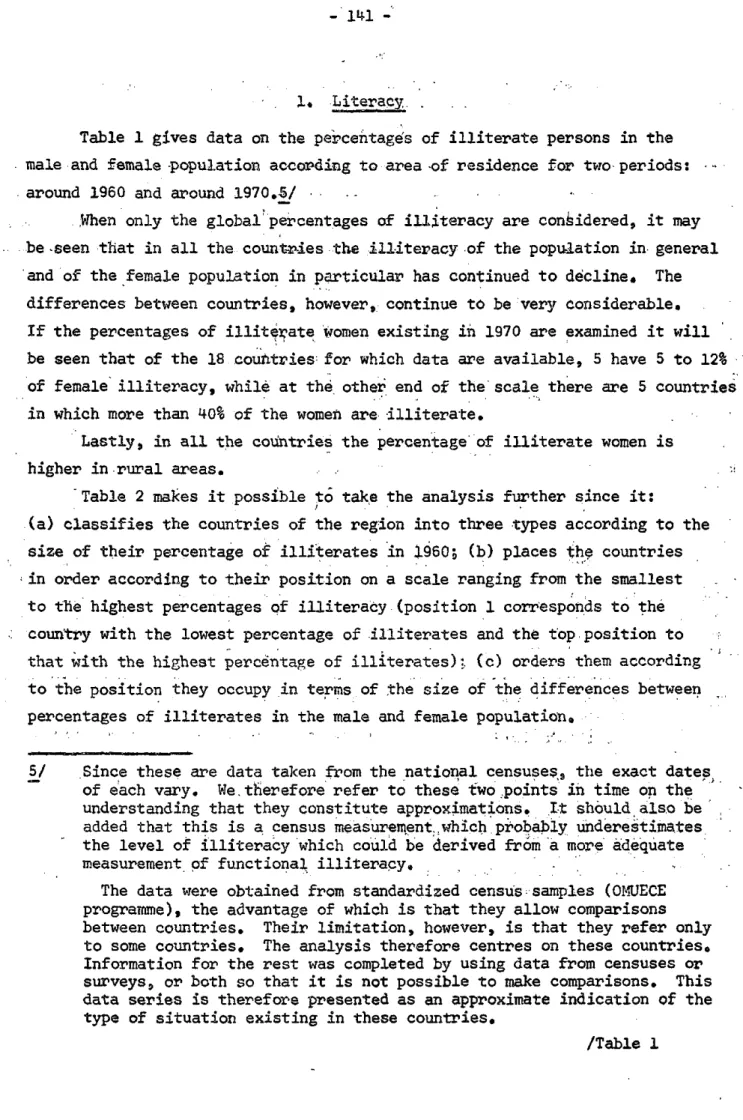
While enrollment in secondary and higher education is increasing rapidly, a significant proportion of the population aged 10 years and above is still illiterate. In this general context, the situation of women in the various countries of the region will be analyzed with the aim of discovering which action proposals have made the most progress and which need to be strengthened, and in which countries of the region the situation of women is most is. . CHARACTERISTICS OF THE EDUCATIONAL SITUATION OF WOMEN It seems easy to measure the situation of education since then.
UNESCO, Statistical Yearbook, 1976“ The data are obtained from the corresponding censuses or from surveys. To mention two extremes, this is the case in the countries with the lowest illiteracy rate: Argentina. A parallel process of gender equality is underway in most countries.
Finally, it seemed appropriate to make a cross-classification of the situation of the countries according to their level of illiteracy and the size of the differences between the percentage of illiterates in the male and female population (see Table 5). The four countries in which the educational position of women is relatively better reached the share of the female population with completed primary education between 40 and 53%. In the countries with the lowest percentages of female primary education, these figures are lower than 20% of the female population.
THE SITUATION SINCE.1975
As far as higher education is concerned, it has already been stated that women enroll much more in some disciplines than in others (see table 10), which is logical enough considering the content of. It should be emphasized that none of the countries have official programs specifically for women. Little can be said about secondary and university education, which can be seen as an induction of the fact that specific measures were not taken on behalf of women.
At the secondary level, co-educational teaching is provided only in some of the institutions, usually those recently established. In short, one can observe in the region a wish to improve and expand the coverage of the education system, and this has meant significantly. However, the changes are introduced slowly and generally the qualitative aspects of the content of the teaching provided.
PRINCIPAL PROBLEMS
Hence, both the content of the reading material and the teacher's approach are important. We have not directly faced this problem, which would be relatively easy to solve, as it involves a redefinition of key features of society, such as the form of division of labor between the sexes, the resulting relations and economic interdependencies between men and women at home and in society, and the dominant structure in general dominance. Nevertheless, and given the rate of increase in enrollment of women, which is higher than that of men, this discrimination is decreasing.
It must be remembered that education has a dual function - to train persons with their intellectual capacities developed to the maximum, and to train human resources qualified for. Therefore, the question arises as to what education should transfer, or more precisely what knowledge should be imparted in order to transform individuals into persons capable of understanding the conditions in which they live. What, knowledge should be disseminated to everyone, and what should only be included in individualized programs.
RECOMMENDATIONS AND SUGGESTIONS FOR ACTION
It will be enough to mention here "that. the main requirement of basic education is that it should be relevant as for. the fulfillment of the individual and the fulfillment of the demands of the social context in. d) Elimination of content that discriminates against women, both in texts and in the interaction between teachers and students. At the secondary level, it is recommended that the current programs for technical and vocational training be reviewed in order to harmonize the demands of the labor market with the need to provide knowledge. which is useful for the individual in his adult life and with the principle of non-discrimination between the sexes. Finally, a set of suggestions is presented regarding the evaluation of the progress achieved in the implementation of the Regional Action Plan.
The rates should therefore not be interpreted as an indication of the instruction at the first, second and third level. For a hypothetical cohort of 100 students enrolled in the first year in 1970. b/ The countries included in each group are the same as those listed in Annexes V, VI and VII. Employment of women in relation to the set targets 1. Employment of women in relation to the set targets. down from the regional action plan 183 2. Conceptual clarification and definitional problems 185. a) Women's participation in work 185 (b) Organization of the production structure and women's.
RECENT DEVELOPMENTS 221 D. PRINCIPAL PROBLEMS 223
The current study was designed to help determine the current status of women's employment in Latin America and the Caribbean. Finally, mention should be made of the factors influencing female participation in the labor market. Hence the importance of considering the role of women in the family and the place of the family in the social structure.
Two of the factors affecting women's work - the organization of the production structure and the family - are discussed in some detail below in light of their particular importance. The social division of labor uses sex as one of the main criteria to draw distinctions. 11/. Finally, it is important to underline the practical consequences of the foregoing for women.
