YouTube and coronavirus: analysis of video consumption on the
COVID-19 pandemic
YouTube y coronavirus: análisis del consumo de vídeos sobre la pandemia COVID-19
Marta Gil Ramírez. Málaga University. Spain.
[email protected] [CV]
Ruth Gómez de Travesedo Rojas. Málaga University. Spain.
[CV]
Ana Almansa Martínez. Málaga University. Spain.
[email protected] [CV]
How to cite this article / Standardized reference
Gil, M.; Gómez de Traveseo, R. & Almansa, A. (2020). YouTube and coronavirus: analysis of video consumption on the COVID-19 pandemic. Revista Latina de Comunicación Social, 78, 121-153. https://www.doi.org/10.4185/RLCS-2020-1471
ABSTRACT
Introduction: This research examines the typology of the consumption of the most viewed videos on YouTube in relation to the early stages of the coronavirus crisis in Spain, categorizing the topics that drew the most interest, the dates that recorded higher consumption levels, and the typology of the uploaders that served as the main sources of information. Methodology: From a quantitative- qualitative perspective, a content analysis of the 200 videos with the greatest impact from March 13 to April 13, 2020, is performed, based on the descriptors coronavirus and COVID-19. Results: The mass media channels, both Spanish and foreign, were the main sources of information about the status of the pandemic. The content focused on epidemiological data, followed by institutional communication, aroused the greatest interest. The consumption of videos increased after the decree of the State of Alarm, coinciding the peaks with the extensions of the decree, and with those times when the number of infections soared. Discussion and Conclusions: YouTube is operating on the COVID-19 pandemic as a depository platform for information from conventional media systems. It is significant the absence among the main uploaders of WHO as an international health agency reference in decisions taken by most of the affected countries, which raises a reflection on the opportunity of strategic use of YouTube as a means of mass dissemination during public health risk situations such as the coronavirus crisis.
KEYWORDS: Coronavirus; COVID-19; Pandemics; Media; YouTube; State of Alarm; Spain.
RESUMEN
Introducción: Esta investigación examina la tipología del consumo de los vídeos más reproducidos en YouTube en relación con las primeras etapas de la crisis del coronavirus en España, categorizando las temáticas que obtuvieron mayor interés, las fechas que registraron niveles de consumo más elevados, y la tipología de los uploaders que sirvieron como principales fuentes de información.
Metodología: Desde una perspectiva cuantitativa-cualitativa, se realiza un análisis de contenido de los 200 vídeos con mayor impacto entre el 13 de marzo y el 13 de abril de 2020, en base a los descriptores coronavirus y COVID-19. Resultados: Los canales de medios de comunicación, tanto españoles como extranjeros, constituyeron las principales fuentes informativas sobre la situación de la pandemia. Los contenidos centrados en datos epidemiológicos, seguidos de la comunicación institucional, fueron los que despertaron mayor interés. El consumo de vídeos aumentó tras el decreto del Estado de Alarma, coincidiendo los picos con las prórrogas del mismo y con aquellos momentos en los que el número de contagios se dispara. Discusión y Conclusiones: YouTube está funcionando en la pandemia de la COVID-19 como plataforma depositaria de informaciones provenientes de los sistemas de medios convencionales. Resulta significativa la ausencia entre los principales uploader de la OMS como agencia internacional de salud referente en las decisiones adoptadas por la mayoría de los países afectados, lo que plantea una reflexión sobre la oportunidad del uso estratégico de YouTube como medio de difusión masiva durante situaciones de riesgo para la salud pública como lo es la crisis del coronavirus.
PALABRAS CLAVE: Coronavirus; COVID-19; Pandemias; Medios de comunicación; YouTube;
Estado de alarma; España.
CONTENT
1. Introduction. 1.1. YouTube: disclosure of pandemic data and filtering of harmful content. 1.2.
YouTube as a source of journalistic information. 2. Methodology. 3. Results. 4. Discussion and Conclusions. 5. Bibliography. 6. Currículum Vitae. 7. Annexes.
Translation by Carlos Javier Rivas Quintero (University of the Andes, Mérida, Venezuela)
1. Introduction
The crisis caused by the SARS-CoV-2, generally known as coronavirus, has disrupted the normal functioning of all social sectors: healthcare, economy, politics, communication, transport, culture, etc. Nothing has escaped the extent of the COVID-19 pandemic, which has been the greatest in the past two centuries taking into account the number of countries and people affected by it (Costa- Sánchez and López-García, 2020). Not knowing of effective treatments for this novel pathogen, its high infection rate, its rapid spread, and its mortality rate, make this health crisis far more complex and with a greater impact than previous similar crises, as the Ebola or the H1N1 Influenza.
Despite being a global public health problem, the coronavirus has developed in different ways and times in the territories affected by it. In Spain, the first coronavirus case was announced on January 31, 2020, in La Gomera Island. Near the end of February, new isolated infections had already been detected in the Communities of Madrid, Catalonia and Valencia. On March 11, the World Health Organization (WHO, 2020) assessed the epidemic outbreak as a pandemic. However, as a probable result of institutional messages understating the risk and possible incidence of the disease in the earliest stages of the crisis (Costa-Sánchez and López-García, 2020), the Spanish population in its entirety did not become fully aware of the seriousness of the health situation until March 14, the date when the Government decreed the State of Alarm (España, 2020) by which the general compulsory
confinement (at the expense of the exceptions embodied in the law) set a turning point for the so- called “normality” of the country.
Among the sectors concerned by the coronavirus, this work addresses the field of communication, and, specifically, the changes in information consumption habits generated by this extraordinary social-healthcare situation and the consequent quarantine. Mass media acquire additional prominence during crisis situations related to health (Westlund and Ghersetti, 2015) increasing, as it has happened in the case of the COVID-19 pandemic, their production (Lázaro-Rodríguez and Herrera- Viedma, 2020) as a result of the significant increase in citizens’ interest in information (Casero- Ripollés, 2020), which de facto alters the usual media consumption rates (Masip et al., 2020). Under these circumstances, information, as the main source of knowledge of what is currently happening, has a soothing effect on the anxiety generated by the unknown, although, with inadequate treatment, it can contribute to the opposite, generating or augmenting that feeling of anguish or concern.
The magnitude of this issue for public health together with the halt in most social and economic life activities have resulted in unprecedented media coverage. Information regarding the coronavirus has dominated most of the content in traditional media, which have experienced significant increases in audience ratings (AIMC, 2020), and has similarly monopolized publications on websites (Costa- Sánchez and López-García, 2020) and social networks.
Different studies (Park, Boatwright and Johnson, 2019; Idoiaga-Mondragón, 2016) have assessed television and the press as reference mass media during health crises. Similarly, in the COVID-19 pandemic case, television stands as the most consumed media (Besalú, 2020; Casero-Ripollés, 2020).
Specifically, within television broadcast programming, news programs have been citizens’ first option to stay informed about the evolution of the pandemic (Masip et al., 2020). Traditional media have acted as “refuge media” (Xifra, 2020) in this health crisis, as institutions deemed credible by citizens. On another note, the important role played by online media (Lázaro-Rodríguez and Herrera- Viedma, 2020) and social networks in the field of information concerning the coronavirus has also been demonstrated (López-García, 2020), which reaffirms the hybridization of both media systems
—traditional and online— (Chadwick, 2013; López-Meri, Marcos-García and Casero-Ripollés, 2017; Masip et al., 2020), which tend to complement (Takahashi, Tandoc y Carmichael, 2015) or feed back into each other.
The extraordinary confinement to which a large portion of the world’s population has been forced and the global information flow typical of the new online media are two of the factors that have contributed to people considering this pandemic as the most mediatized to date, even generating a context of information overexposure (Casero-Ripollés, 2020; Masip et al., 2020), being counterproductive in some cases (Garfin, Silver and Holman, 2020). Communication plays a crucial role in this health crisis, hence the importance of addressing these peculiar communicative circumstances from the academic field.
This research aims to examine the characteristics of the most viewed videos on Youtube in the early stages of the coronavirus crisis in Spain, categorizing the topics that drew the most interest, the dates that recorded higher consumption levels, and finally determining the typology of the uploaders that served as the main sources of information.
1.1. YouTube: disclosure of pandemic data and filtering of harmful content
YouTube is one the most visited websites by Spanish users, only outstripped by Google —owner of said video platform—, Facebook and Amazon; and is above the portals of some of the leading media
in Spain —El País or El Mundo—, as well as other social networks such as Twitter or Instagram (AIMC, 2020).
Despite the playful nature and the entertainment purposes that characterize this online video platform, search queries for educational and informative content, and the latest news have increased on this social network, especially during health crisis situations such as the one at hand. This was demonstrated by Orduña-Malea, Font-Julián and Ontalba-Ruipérez (2020) who identified a considerable increase in the number of videos about COVID-19 on YouTube since the State of Alarm was declared in Spain and preponderant presence of national media channels as broadcasters of said content. Regarding the rise in consumption on YouTube in the early stages of the pandemic, these same authors (Orduña-Malea et al., 2020) refer to the study conducted by the 2btube company (http://2btube.com) that confirms a 55% increase in the number of views on the platform for videos that originated in the Spanish territory during the second half of March 2020, compared to the same period in 2019.
The official YouTube blog (https://youtube.googleblog.com/) collects, in a post made by the CEO Susan Wojcicki (06-11-2020), some of the main initiatives the platform has carried out in relation to the coronavirus crisis:
- One of the top priorities has been connecting people to trusted information as the coronavirus pandemic spread around the globe. Our teams started by engaging with public health officials in more than 90 countries so they could make locally relevant information available, which we display on our homepage and in panels that appear on videos and in search results about COVID-19. Collectively, these panels have been shown more than 200 billion times.
- Launching a dedicated COVID-19 news shelf, with videos from health authorities and news organizations, in more than 30 countries around the world.
- Actions focused on combating harmful medical misinformation by consulting on an ongoing basis with health authorities like the World Health Organization, as well as expert medical and public health professionals, to design policies based on the latest science. By June 11, 2020, YouTube had removed over 200,000 videos for violating their policies regarding deceitful or harmful content related to the coronavirus.
- Implementation of the #withme PSA campaign, encouraging users to stay at home and highlighting important messages about how to stop the virus, to which more than 700 creators and artists of YouTube’s community joined.
High increases in its consumption and the preeminence of mass media as content broadcasters during the COVID-19 pandemic, make YouTube a relevant platform to study the changes in communication dynamics experienced during this health crisis. The analysis of information consumption on this social network, considering its broad penetration, can provide a preliminary diagnosis of the topics that worried or interested citizens the most during the early stages of the State of Alarm in Spain, as well as via which sources they obtained information about the pandemic evolution in the country’s territory.
1.2. YouTube as a source of journalistic information
The content generated by traditional media continue to carry significant weight with citizens in media consumption, but online channels maintain an upward trend that makes one wonder about their progressive prominent role, particularly if we take into account the use that the youngest generations —digital natives— make of tools such as laptops, tablets and smartphones, for an
“almost permanent” connection to the Internet.
In the Spanish ambit, the television audience went from 91.3% in 1996 to 85% in 2018, the one of newspapers also decreased (32.9% in 1996; 22.8% in 2018), while that of the Internet, incipient in 1996 (1%), stood at 82.1% in 2018 (AIMC, 2019).
In this sense, the rise in the use of social networks is another factor that has directly influenced the transformation that the traditional media system has been undergoing. The penetration of online spaces such as Facebook, Twitter, or YouTube entails a phenomenon that must be taken into account in the reconfiguration of communicative practices.
Among the most popular social networks, YouTube is the one that, due to its purely audiovisual nature, bears the most resemblance to television as a means of communication. Not in vain, this online video platform has been defined as the “postmodern television” (Murolo, 2010) or “the paradigm of video and television on the Web” (Antolín-Prieto, 2012). However, this online platform, as the set of social networks, carries an unprecedented and distinctive social component compared to the set of traditional media: the possibility of citizen participation/intervention in content production and dissemination, an almost non-existent option in the offline media field.
The “disintermediation” (Masip, Ruiz-Caballero and Suau, 2019) that social networks promote, including YouTube, lies in the basis of its origin: places where users’ autonomy bypasses the intervention/interpretation of the representative media system. From this perspective, YouTube favors a horizontal communication model (Gil and Gómez de Travesedo, 2020) by which users self- manage the messages they produce, consume, and disseminate (Rodríguez-Serrano, García-Catalán and Martín-Núñez, 2019), becoming a place that represents a genuine manifestation of the sociocultural trend towards self-expression and participation (De Aguilera, Castro and Pérez-Rufi, 2018).
From the moment all media utilized a common code when producing their online content and the Internet eliminated the need for material means, making this production accessible without space or time limits, users established new rules and conditioned cultural industries to adapt to their demands. (Pérez-Rufi, 2012, p. 45)
However, in recent years several authors (Gallargo-Camacho, 2010; Gallardo-Paúls and Enguix- Oliver, 2016) have begun to question the “mythologized horizontality” that occurs in the information circulating on social networks that, beyond being generating sources of new content, would work as dissemination channels that redirect traffic to the different conventional media websites, circumventing a hierarchy of addressers very similar to that of the offline media reality (Gallardo- Paúls and Enguix-Oliver, 2016).
In the specific case of YouTube, most of the investigations that addressed the weight traditional media carry on the video platform highlight the concept “transmediation” (Berrocal, Campos and Redondo, 2012, 2014; Gil, 2019b). The greatest burden for content production on this network is placed on average citizens, but the predominant trend is to transfer content originally generated by mass media into this platform. Convergence or hybridization (Uribe-Jongbloed, 2016) are other terms used to describe the alliance or complementarity that has been established between this online video platform and companies of the traditional media system.
In this sense, Spain is, according to the number of media that use YouTube to disseminate audiovisual content, one of the leading countries in the European region. Most of traditional media have been present on this platform practically since its genesis in 2005 (Antena 3 and RTVE in 2006, La Sexta and COPE in 2007, or El País in 2008).
The high prominence this social network gives to conventional media could be one of the main reasons that lead them to be present on this mass consumption platform. On it, offline media exponentially multiply the dissemination of their content and considerably increase their audience.
Additionally, they have access to statistics and analytics provided by YouTube, something that can be strategically used afterwards.
The traditional media industry possesses marketing tools that put it in a favorable situation compared to the audiovisual production generated by common users on YouTube, hence contributing to positioning it as the leading generator of the most consumed audiovisual content on this social network (Pérez-Rufi, 2012). The dominance of big communication agencies is constantly increasing on YouTube (Gil, 2019a), where it has been verified, for example, the overwhelming influence of the Spanish generalist television networks that progressively gain prominence, and, therefore, influence on this social network (Gallardo-Camacho, 2010) or specific SEO (search engine optimization) strategies for better positioning of the Spanish cybermedia videos on this platform (Lopezosa, Orduña-Malea and Pérez-Montoro 2020).
Therefore, YouTube would work as a container of content coming from traditional media systems, as a secondary source of journalistic information that hosts the messages originally produced by conventional media —in their offline or online versions—.
In this particular case, the use of YouTube as a health information source has already been addressed in several crises preceding the COVID-19 pandemic. Various studies have analyzed the characteristics of the information produced and disseminated on the online video platform about Ebola (C.H. Basch et al., 2015; Nagpal et al., 2015; Pathak et al., 2015), H1N1 Influenza (Pandey et al., 2010; Walton, Seitz and Ragsdale, 2012), Zika virus (C.H. Basch et al., 2017; Bora et al., 2018), or West Nile virus (Dubey et al., 2014).
The scientific literature that links the coronavirus crisis (SARS-CoV-2) and YouTube is still at an incipient stage, but it is starting to build some foundations. The main coincidences found in the existing references to date underpin a significant increase in information consumption on this social network since WHO declared the COVID-19 to be a pandemic, as well as prominent presence of news agencies or mass media among the main broadcasters of the most viewed coronavirus-related content (C.H. Basch et al., 2020; C.E. Basch et al., 2020; Khatri et al., 2020; Orduña-Malea et al., 2020). Although, in the same way, preceding literature differs significantly from this proposal that tries to contribute to the emerging line of research that arises around the role of YouTube in the current health crisis generated by the coronavirus. Orduña-Malea et al., (2020) conducted a thorough metric analysis of more than 39,000 videos posted and disseminated on YouTube about COVID-19 that were directly or indirectly related to the Spanish territory. The geographical delimitation coincides with this proposal, but our research aims to carry out a more intensive rather than extensive analysis through a mixed perspective that adds the qualitative component to the quantitative examination. On another note, the studies that adopt, as this work, this type of methodology—
quantitative-qualitative— on a smaller sample, are faced with some limitations that this research tries to solve. Khatri et al., (2020) worked on a sample of 114 videos with the purpose of analyzing the quality of the information regarding the coronavirus available on YouTube, comparing the content uploaded in English with the one broadcasted in Mandarin. Li et al., (2020) worked on 65 videos collected from the searches for “coronavirus” and “COVID-19”, limiting the sample to content posted solely in English and focusing their investigation on the presence of misleading or dubious quality content. Moreover, with the objective of determining the amount of YouTube videos that conveyed some of the prevention measures recommended by the US Centers of Disease Control and Prevention, C.H. Basch et al., (2020) propose examining the top 100 most viewed videos obtained
from the search term “coronavirus”, taking into account, regarding the content language, both English and Spanish. The results of this first study (C.H. Basch et al., 2020), whose corpus was collected on January 31, 2020, were updated months later (March 20, 2020), resulting in a research (C. E. Basch et al., 2020) with the same methodological basis but with differentiating aspects in the findings.
This work aims to delve into the type of consumption linked to the Spanish territory that has been carried out on YouTube on information related to both the “coronavirus” and the “COVID-19”
disease during the early stages of the pandemic. Based on a 200 videos sample, posted both in English and Spanish, we proposed a thorough study of the topics that have drawn the interest of both users and uploaders (content broadcasters), who have acted as main sources of information regarding the health crisis evolution in Spain during the first month of the State of Alarm. The research is completed with a chronological examination of the moments that generated the highest consumption peaks.
2. Methodology
The sample collection was conducted through the YouTube.com search engine panel. At first, we considered using the three most popular and defining descriptors related to the pandemic:
“coronavirus” and “SARS-CoV-2” (in reference to the virus), and “COVID-19” (in reference to the disease). However, after a preliminary estimate of the videos obtained from the search query “SARS- CoV-2”, we decided to dispense with it since the content obtained was excessively technical and linked to the medical field, distant from this study’s purpose that seeks a more sociological approach.
Therefore, a search system based on query splitting (Orduña-Melea et al., 2020) was finally designed, basing on various components, with the purpose of obtaining a greater number of results.
- Component 1 (virus): “coronavirus”
- Component 2 (disease): “COVID-19”
- Component 3 (geographical link): “España” [EN: Spain]
This last geographical descriptor (“España”) was combined with the other two components to collect those videos addressing any aspect of the status and/or evolution of the pandemic in the Spanish territory. Given the differences in the impact, timing and handling of the health crisis in the different affected territories, it is necessary to address, specifically in the initial stages, each of them independently, regardless of how useful future investigations, with sufficient perspective, could be for the overall analysis of this event. Spain (by June 15, 2020), was the third country with the highest mortality rate (number of deaths per 100,000 inhabitants) due to COVID-19, only outstripped by Belgium and the United Kingdom.
Two of the filters YouTube provides were applied to the results obtained from both searches (“coronavirus España” and “COVID-19 España”): “upload date: this month” and “sort by: view count”, taking into consideration the first 100 results for each case. The sample was collected on April 13, 2020; hence the corpus obtained comprises the most viewed videos during the first stage of the health crisis (coinciding with the first month of the State of Alarm in Spain) regarding both the virus and disease concerning the pandemic.
Throughout the investigation and review conducted by the raters (MG and RG), two videos were excluded from the results obtained after entering the search query “COVID-19” due to the following reasons:
- The content of the video, uploaded by the same channel, is a duplicated version translated into Spanish 1. In this case, only the English version of this video is included in the sample, considering its higher number of views 2.
- The content of the video is duplicated since it has been broadcasted by two different channels. In this case again, only the video with the highest number of views remains in the sample 3.
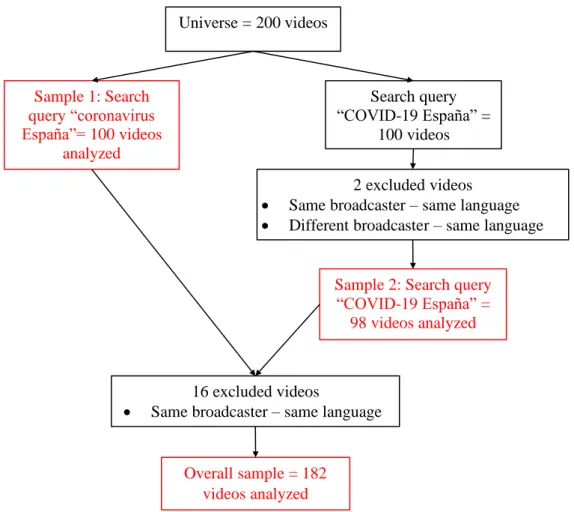
Among the 198 resulting videos from both searches, we found 16 duplicate pieces (same language and broadcasting channel). Once excluded, the overall sample was made up of 182 videos.
Figure 1: Construction process of samples 1, 2, and overall.
Source: authors’ own creation.
This investigation proposes carrying out an analysis from two different perspectives: on the one hand, considering the overall sample (n = 182) and, on the other, making a comparison between the results obtained via the two search queries used: “coronavirus España” (n = 100) and “COVID-19 España” (n = 98). This comparison implies novelty in contrast to previous studies and will allow demonstrating the nuances that occur when consuming information on YouTube, based on whether the content refers to the virus or the disease.
1 https://www.youtube.com/watch?v=cF23RKyoANo
2 https://www.youtube.com/watch?v=_J60fQr0GWo
3https://www.youtube.com/watch?v=uAT8EEKBySM (remains in the sample) https://www.youtube.com/watch?v=p6tvOgkI03c (excluded from the sample)
Universe = 200 videos
Sample 1: Search query “coronavirus España”= 100 videos
analyzed
Search query
“COVID-19 España” = 100 videos
2 excluded videos
• Same broadcaster – same language
• Different broadcaster – same language
Sample 2: Search query
“COVID-19 España” = 98 videos analyzed
16 excluded videos
• Same broadcaster – same language
Overall sample = 182 videos analyzed
The hyperlinks of each video were compiled in a spreadsheet for their subsequent comparison and consultation. The content of the overall sample (n = 182), which entailed watching more than 116 hours of audiovisual material, is higher than that examined in studies with a similar methodological design, related to videos about coronavirus or COVID-19 on YouTube (C.H. Basch et al., 2020; C.E.
Basch 2020; Khatri et al., 2020; Li et al., 2020).
To collect and code the data, we created a fact sheet including the main descriptive characteristics of each video: title, view count, upload date and length; as well as a set of categories that try to answer the following research questions:
-What are the most consumed information sources on YouTube based on the descriptors
“coronavirus España” and “COVID-19 España”? The classification of the variables proposed as answer options —Mass Media, Common users, Political parties, or Others— is grounded in the validity verified in previous studies that have addressed the online identity of YouTube content broadcasters: regarding the COVID-19 pandemic (C.H. Basch et al., 2020; C.E. Basch 2020; Khatri et al., 2020; Li et al., 2020; Orduña-Malea et al., 2020) or, before the health crisis, linked to the study of political communication on this social platform (Berrocal et al., 2012; Berrocal, Gil and Campos, 2016; Berrocal, Martín and Gil, 2017; Gil, 2019a, 2019b; Gil, Gómez de Travesedo and Almansa, 2019; Gil and Gómez de Travesedo, 2020).
- What are the topics addressed in the most viewed videos on YouTube based on the descriptors
“coronavirus España” and “COVID-19 España”? Despite the proposed descriptors already being a topic by themselves, it was considered interesting to establish subcategories to provide further detailed information about the specific issues that have aroused greater interest regarding the health crisis among users. In this sense, the previous literature does not have validated evaluation tools, so a specific instrument with 12 thematic variables is proposed (Table 1).
Table 1: Thematic analysis tool
CATEGORY VARIABLES DESCRIPTION
Health information
Epidemiological Information (except for that coming from the Government)
Number of cases, deaths, recovered patients, analysis of the pandemic evolution, data on hospitals status, funeral homes, etc.
Accounts From health workers, virologists, biologists, experts, etc., or from general public.
Information related to research on medications/treatments and/or vaccines against coronavirus.
Institutional communication*
Excerpts from press conference of the Coronavirus Technical Management Committee: epidemiological data alone
Full Press conference of the Coronavirus Technical Management Committee Formal appearances of the Spanish President
Other (Institutional Communication) Political criticism
Information regarding the evolution of the restrictive measures imposed by the State of Alarm and/or sanctions Economic information and/or employment data
Information related to the legal field Other
*Institutional communication: we refer to that information given by any of the spokespersons designated by the Government to convey details about any aspect related to the pandemic and the consequent State of Alarm to citizens.
Despite containing, on many occasions, health information, the prominence acquired by the Government, due to the centralized Competent Authority attributed to it by the State of Alarm, provides significant interest to the differentiated analysis of this category.
Source: authors’ own creation.
-What dates have motivated greater consumption of information linked to the Spanish territory on YouTube during the early stages of the coronavirus crisis? Are they related to any relevant social- health or political event or occurrence? The analysis of the evolution of information consumption regarding the COVID-19 pandemic at a chronological level and focused on the Spanish territory has been included in preceding studies, either in relation to the online video platform itself (Orduña- Malea et al., 2020), or in relation to Spanish online media (Lázaro-Rodríguez and Herrera-Viedma, 2020).
Two raters (MG and RG) reviewed and analyzed each one of the videos comprised in the sample.
Cohen’s kappa coefficient was utilized to evaluate the degree of agreement, resulting in k = 0.87.
3. Results
At the time of collecting the data (April 13, 2020), the videos in the sample (n = 182) accumulated a total of 113,336,735 views. The average number of views was 622,729 per video. Without excluding the duplicate videos, the sample referring to “COVID-19 España” (n = 98) outstripped, by more than 20 million views (82,121,567; mean = 837.975), the content obtained from the search query
“coronavirus España” (n = 100) (61,666,143; mean = 616.661). Information consumption on the pandemic evolution during its early stages and related to the Spanish territory has, therefore, been more leaned towards the term “COVID-19” than towards the word related to the virus (coronavirus).
Overall, among the 74 broadcasters detected, mass media channels have been the predominant uploaders (64.86%), that is, the leading source of information regarding the health crisis, holding 82.76% of the posted content. Foreign media accounts, through which videos related to the pandemic in Spain are uploaded, are more numerous (52.70%) than national media accounts (12.16%).
However, the latter are more active, posting an average of 2.76 videos for each medium against the 0.93 mean of videos broadcasted by a media system different from a Spanish one. Among national media, the activity of El País, El Mundo and La Vanguardia stands out, while among foreigners, participation by three European media, DW News (Germany), Sky News (The United Kingdom) and Euronews (France) is the most significant.
Common users uploaded 27.03% of the content, with a proportional relation between those indicating Spain as their location and those with a different one. On the other hand, users who maintain their anonymity are a majority (15.97%), that is, they do not provide information about their identity on their YouTube account; against those who do so (11.06%). Overall, these are users who, taking into account the number of subscribers (mean of 199,412), could be considered youtubers. Activity levels of this type of uploaders regarding content related to the pandemic evolution in Spain are very low, with an average of 0.45 posted videos per user.
Participation by the political sphere as content broadcasters on YouTube in the early stages of the pandemic in Spain is practically anecdotal, with Vox being the only political party uploading content that manages to obtain a significant number of views on the online video platform.
A reduced number of uploaders (6.76%) do not correspond to any of the previous classifications.
Among these broadcasters there is the record company Warner Music Spain or music producer Alejandro Abad (alejandroabadmusic), among others. The percentage of content posted on this type of channels is not representative in the sample (3.56%).
Chart 1: Uploaders typology and content uploading activity levels.
Source: authors’ own creation.
Regarding the language of the most consumed videos about the pandemic evolution in Spain;
Spanish (78.02%) prevails over English (21.98%).
Furthermore, regarding the comparison between the two individual samples obtained from the searches “coronavirus España” (sample 1: n = 100) and “COVID-19 España” (sample 2: n = 98) (See Annex 1), there is more prominent presence and activity of the Spanish media in sample 1, defined by the terms “coronavirus España”, than in sample 2 labeled “COVID-19 España”. In the first case, national media represent almost 20% of the broadcasters and accumulate more than half of the posted content; while in the second one, the percentage of national media posting content decreases to 9.26%, as well as of the number of videos these types of broadcasters upload to YouTube (15%), being positioned among the most viewed. Foreign media exhibit similar figures in their role as sources of information in both samples, but their uploading content activity in relation to the search query “COVID-19 España” stands out (60%), compared to that performed under the search terms “coronavirus España” (38%). There is a 3% and 9% coincidence of Spanish media and foreign media, respectively, between both search terms.
There are more Spanish common users than foreigners in sample 1, both in quantity and posted content. Regarding this classification, the percentages are balanced in sample 2. There is a 2%
coincidence of Spanish common users between both samples.
The presence and activity of other broadcasters different from the mass media, common users or political parties is significantly greater in the videos obtained from the search query “COVID-19 España”, in which, broadly speaking, the number and variety of broadcasters (54) is higher than that observed in the content resulting from the search terms “coronavirus España” (36).
0% 10% 20% 30% 40% 50% 60%
Spanish Foreign Unkown Spanish Foreign
OtherPolitica l PartyCommon UserMass Media
6,76%
1,35%
12,17%
12,16%
2,70%
12,16%
52,70%
3,56%
1,52%
5,47%
5,47%
1,22%
33,66%
49,10%
% Posted content % Uploader
Chart 2: Uploaders typology comparison and content uploading activity levels based on the search query used.
Source: authors’ own creation.
Among the topics of the videos addressing the status or evolution of the first stages of the health crisis in Spain that aroused the greatest impact, pure health information not coming from government sources stands out (38.94%). Specifically, epidemiological information is the most consumed in global terms. The content of the videos encompassed in this category mainly present figures on the number of infected people and deaths, as well as data on hospitals’ status. The videos presenting accounts, which are equally divided between those given by experts or health workers and those who narrate the experiences of citizens, are not among the topics that aroused the greatest interest, being represented only by a poor 7.02%. YouTube users did not pay special attention to the information starting to emerge about possible treatments for COVID-19 or a vaccine against the virus during the early stages under analysis either.
On another note, what we have called Institutional Communication, meaning that coming from any of the persons authorized by the Government to report about any aspect related to the pandemic, accumulates almost a quarter (22.59%) of the topics addressed in the videos that obtained the highest consumption rates in relation to this issue. YouTube users’ viewing percentages are similar, on the one hand, for excerpts from the press conference given daily by the members of the Coronavirus Technical Management Committee who, as heads of the Health Alert and Emergency Coordination
0% 10% 20% 30% 40% 50% 60%
Spanish Foreign Unkown Spanish Foreign
OtherPolitica l PartyCommon UserMass Media
Other Political
Party Common User Mass Media
Spanish Foreign Unkown Spanish Foreign SEARCH QUERY COVID-19
ESPAÑA % Posted content 6,00% 2,00% 9,00% 7,00% 1,00% 15,00% 60,00%
SEARCH QUERY COVID-19
ESPAÑA % Uploader 9,26% 1,85% 12,96% 12,96% 1,85% 9,26% 51,86%
SEARCH QUERY CORONAVIRUS
ESPAÑA % Posted content 1,00% 1,00% 4,00% 2,00% 2,00% 52,00% 38,00%
SEARCH QUERY CORONAVIRUS
ESPAÑA % Uploader 2,78% 2,78% 11,10% 5,56% 2,78% 19,44% 55,56%
Center of the Ministry of Health, either Fernando Simón or in his absence María José Sierra, provided the epidemiological numbers of the day; and on the other hand, videos that allowed watching the full press conference of this committee and, by which, in addition to providing numbers on the pandemic evolution, the information related to the performance of the Law Enforcement of the State, as well as that concerning the fields of transport and mobility was updated. The formal appearances of the President of the Government, Pedro Sánchez, aroused less interest among users on this platform who sought information about the health crisis situation in Spain.
Political criticism, aimed mainly at the handling of the pandemic by the Coalition government (PSOE - Unidas Podemos), was not, during its initial stages, a frequently consumed topic. Users’
interest in those videos conveying information about the restrictive measures imposed by the State of Alarm or the sanctions their non-compliance entails was not significant either. Concern over the economic situation, unlike today (June, 2020) that exhibits an upward trend as the de-escalation advances, practically did not arouse interest among YouTube video consumers in the early stages of the health emergency. Legal related information was non-existent.
Occasionally (9.62%) the content combines purely health information that does not come from government sources with some other topic, mostly with information related to restrictive measures and/or sanctions. Similarly, some of the videos (8.10%) among the most consumed ones regarding the coronavirus or COVID-19 in Spain, correspond to long-lasting programs (complete news programs, live broadcasts of several hours which are subsequently uploaded on YouTube, documentaries, etc.) that cover more than two of the topic types proposed. Finally, 8.60% of the content shows a thematic consumption that, although related to the pandemic situation in Spain, addresses it from other perspectives such as music, humor, conspiracy theories, or purely anecdotal aspects.
Char 3: Thematic classification. *Epidemiological data alone.
Source: authors’ own creation.
If we compare the most consumed topics based on the search terms used (see Annex 2), significant differentiating aspects are observed. Users who turned to YouTube to get informed about the pandemic situation in Spain using the term “coronavirus” mostly consumed content focused on Institutional Communication coming from the Government (36%), a subject that, however, went unnoticed (9.18%) when the search query was “COVID-19 España”. The videos obtained from these latter search terms mainly revolve around health information not coming from government sources (43.88%). The incipient presence of content addressing economic information (3.06%) also stands out in this sample (COVID-19 España), a topic absent in the videos obtained by the descriptor
“coronavirus España”, as well as higher consumption of videos focused on political criticism (8.17%
for COVID-19 España, compared to 4% for coronavirus España), long-lasting programs addressing various topics (10.20% for COVID-19 España, against 6% for coronavirus España) or content addressing the public health crisis in a closer way to entertainment than to information (9.18% for COVID-19 España, compared to 8% for coronavirus España).
It is striking that, despite the overall preponderance of health information and content focused on Government Institutional Communication, the most consumed video in both search queries was Resistiré 2020, a song produced by Warner Music Spain and performed by more than 30 artists locked down in their homes. By the date of this analysis (April 13, 2020) this video had accumulated 16 million views, way above the 3.7 million views of the second most viewed piece of content under the terms “coronavirus España”, and followed by the 11 million views accumulated by the video holding the second place in terms of consumption for the search query “COVID-19 España”.
0% 5% 10% 15% 20% 25% 30%
General others Full long-lasting programs addressing more than two topics Legal information Economic information Restrictive measures and/or sanctions Political criticism Health information + economic information Health information + political criticism Health information + restrictive measures and/or sanctions Other (Institutional Communication) Formal appearances of the Spanish President Full Press conference of the Technical Management Committee Press conference excerpts of the Technical Management Committee*
Investigation on treatments and/or vaccine Accounts Epidemiological Information
4,06%
7,08%
27,80%
1,51%
2,52%
9,02%
9,54%
1,02%
2,03%
6,57%
8,60%
8,10%
0,00%
1,53%
4,54%
6,08%
Health information Institutional communication Combination - health information with other topics Other topics
Chart 4: Thematic classification comparison based on the search query used. *Epidemiological data alone.
Source: authors’ own creation.
By crossing the data obtained from analyzing the uploaders who worked as main sources of information with the topics in the most consumed videos during the early stages of the health crisis in Spain (see Annex 3), we see how Spanish mass media stand as prominent broadcasters among the most viewed content related to Institutional Communication from the Government, especially those videos presenting fully or partially any of the daily press conferences given by the Coronavirus Technical Management Committee (31%). Regarding foreign mass media, these worked as a source of information mainly of the most impactful videos that convey epidemiological data about the development of the health emergency situation in the Spanish context (46.49%). Common users’
activity as broadcasters of content about the pandemic that managed to reach better consumption levels is widely distributed by topics between epidemiological information (3.06%), accounts (3.07%), political criticism (3.07%) and other topics (7.08%), with this last one, referred to less
0% 5% 10% 15% 20% 25% 30%
General others Full long-lasting programs addressing more than two topics Legal information Economic information Restrictive measures and/or sanctions Political criticism Health information + economic information Health information + political criticism Health information + restrictive measures and/or sanctions Other (Institutional Communication) Formal appearances of the Spanish President Full Press conference of the Technical Management
Committee
Press conference excerpts of the Technical Management Committee*
Investigation on treatments and/or vaccine Accounts Epidemiological Information
Combination - health information with other topicsInstitutional communicationHealth information
8,00%
6,00%
5,00%
4,00%
1,00%
6,00%
2,00%
3,00%
16,00%
15,00%
2,00%
6,00%
26,00%
9,18%
10,20%
3,06%
4,08%
8,17%
2,04%
3,06%
7,15%
1,02%
2,04%
2,04%
4,08%
6,12%
8,17%
29,59%
SEARCH QUERY COVID-19 ESPAÑA SEARCH QUERY CORONAVIRUS ESPAÑA
significant content (musicals, memes, anecdotes, etc.) related to the global public health crisis, standing out. The only political party (Vox) that managed to position content about the pandemic situation in Spain among the most viewed videos transposes in it the political criticism aimed at the coalition government PSOE - Unidas Podemos due to their handling of the health crisis.
Chart 5: Uploaders/topics data crossing.
Source: authors’ own creation.
Chart 6 shows the YouTube video consumption chronology based on the searches “coronavirus España” and “COVID-19 España”, as well as the overall result of both from March 13 to April 13, dates that coincide with the early stages of the pandemic in the Spanish territory and with the first
0% 10% 20% 30% 40% 50% 60%
General others Full long-lasting programs addressing more than two topics Legal information Economic information Restrictive measures and/or sanctions Political criticism Health information + economic information Health information + political criticism Health information + restrictive measures and/or sanctions Other (Institutional Communication) Formal appearances of the Spanish President Full Press conference of the Technical Management
Committee
Press conference excerpts of the Technical Management Committee: epidemiological data alone
Investigation on treatments and/or vaccine Accounts Epidemiological Information
Combination - health information with other topicsInstitutional communicationHealth information
Spanish media Coronavirus Spanish media COVID-19 Foreign media Coronavirus Foreign media COVID-19 Common User Coronavirus Common User COVID-19 Political Party Coronavirus Political Party COVID-19
Other Coronavirus Other COVID-19
month of the State of Alarm decreed. Coincidences of a higher number of videos being uploaded during important moments related to the very health situation (the rapid increase in the number of people infected in Europe or the spike in Spain), as well as with its handling by the Government (State of Alarm Declaration and its successive extensions) were observed.
Chart 6: Evolution of consumption of videos uploaded on YouTube about “coronavirus” or
“COVID-19” (March 13 – April 13, 2020).
Source: authors’ own creation.
Regarding the evolution of consumption, there are subtle differences depending on whether the uploaded content corresponds to a search descriptor or the other. By dividing the analysis period into 4 blocks of 8 days each, the terms “coronavirus España” generated, among the most consumed videos, a greater number of posts in the first and second blocks, decreasing progressively between the third and fourth ones. However, the most viewed videos regarding the search query “COVID-19 España” were mostly uploaded between the second and third blocks, decreasing more abruptly in the fourth one.
4. Discussion and Conclusions
This study’s findings must be considered within the context of the search descriptors proposed, both those related to the pandemic (Coronavirus and COVID-19) and those concerning the geographical delimitation (Spain), as well as the period being analyzed (videos uploaded from March 13 to April 13, 2020). Therefore, it is a cross-sectional study that shows the consumption trends in YouTube videos related to the health crisis situation at a national level and at a specific time: the early confinement stages since the State of Alarm was decreed by the Spanish Government. The dynamic nature of the online video platform makes this type of analysis very volatile, since view counts are
0 2 4 6 8 10 12 14 16 18
March-13 March-14 March-15 March-16 March-17 March-18 March-19 March-20 March-21 March-22 March-23 March-24 March-25 March-26 March-27 March-28 March-29 March-30 March-31 April-01 April-02 April-03 April-04 April-05 April-06 April-07 April-08 April-09 April-10 April-11 April-12 April-13
SEARCH QUERY CORONAVIRUS ESPAÑA SEARCH QUERY COVID-19 ESPAÑA OVERALL Declaration
of the State of Alarm
Coronavirus spreads across Europe
First extension
Second extension Spain reaches
infection spike
constantly changing on this social network. It is highly plausible that as this public health crisis develops, so will the most frequent terms and topics around it, and that the videos analyzed will be outstripped in views by new content. However, any study implementing this type of search strategy on YouTube entails this limitation. For this reason, the findings that derived from this proposal are circumscribed by the terms delimiting it, being necessary new studies to complement it by addressing periods related to the COVID-19 pandemic throughout its different stages, as well as on other social networks or other online platforms for video dissemination.
The geographical area to which this analysis refers —Spain—, only addressed so far by Orduña- Malea et al. (2020), aims to help elucidate the peculiar communicative characteristics that have taken place on the online video platform as a consequence of the particular incidence, timing and handling of the health crisis in the Spanish territory. These circumstances have varied depending on the idiosyncrasies of the affected country, hence addressing each of them independently, especially during the early stages, is of interest, regardless of how useful future investigations, with broader perspectives, might be for the overall analysis of this event.
Despite these conditions, the possibilities YouTube enables to convey information on the coronavirus crisis due to its outreach (millions of people every day) make the analysis of this mass dissemination medium very useful when it comes to knowing the consumption behaviors related to the pandemic.
This research provides a panoramic view of the social trend regarding the sources via which users of this social network got informed, or the topics that aroused the greatest interest during the early stages of the health emergency, in relation to Spain.
In this analysis, YouTube has worked as a depositary platform for information from conventional media systems. Consolidated media brands, both Spanish and foreign, have dominated the most viewed content regarding the coronavirus and COVID-19 linked to the Spanish territory. This can be understood from a twofold perspective: as a result of the flagship position citizens have given to traditional media (Xifra, 2020), and specially to news programs (Masip et al., 2020) during this pandemic, or as a consequence of the active SEO strategies that mass media implement in their online versions for a better positioning of their content on YouTube (Lopezosa et al, 2020) incorporating keywords related to the pandemic within the title, description or comment fields of the videos, thus harnessing the boost that searches related to the coronavirus crisis provide on this social platform (Orduña-Malea et al., 2020).
In line with previous studies (C.H. Basch et al., 2020; C.E. Basch et al., 2020; Khatri et al., 2020;
Orduña-Malea et al., 2020) mass media channels have worked as the primary uploaders to the detriment of the content uploaded through common user accounts on YouTube. Both Spanish and foreign media have been prominent sources of information on the status of the pandemic in Spain.
Among the former ones, the activity of El País, El Mundo and La Vanguardia stands out on the video platform, three media networks present in the ranking created by Orduña-Malea et al. (2020) of the channels with the highest number of uploaded videos regarding COVID-19, based on a metric analysis conducted on a sample of more than 39 thousand videos. As for the foreign media case, they also coincide with this ranking since Euronews in Spanish, together with DW News and Sky News stand out as the most active channels. In spite of the proposed geographical delimitation —Spain—, the scope of YouTube and the global dimension of this crisis promoted a significant incidence of foreign media videos in the consumption of information regarding the pandemic status in the Spanish territory. In this sense, Costa-Sánchez and López-García (2020) highlight a keen interest taken by the international press during the first month since the declaration of the public health emergency in Spain.
However, the high prominence of foreign media is not linked to the predominance of videos uploaded in English. Many of these media headquartered outside of Spain, use their Spanish versions when uploading information related to the Spanish territory on this social network or use Spanish directly as the conveying language, as in the case of Latin American media. The prevalence of Spanish as the language in the videos related to the pandemic situation in Spain coincides with the findings of Orduña-Malea et al. (2020) and differs from those of C.H. Basch et al., (2020) and C.E.
Basch et al., (2020), who found English to be the predominant language. This difference is explained by the geographical component (Spain) that both this study and in that of Orduña-Malea et al. (2020) incorporate in the searches providing the samples.
In the early stages of the pandemic, regarding the Spanish territory, the information from Political Parties’ official YouTube channels did not arouse the interest of users of this social network, not even that coming from the predominant party in the Government which carried greater weight in this health crisis handling (PSOE), despite this party’s account (https://www.youtube.com/user/psoe/videos) having a significant amount of content related to the pandemic’s impact on Spain and in spite of the important implications for Governments’
communication the handling of this extraordinary situation has entailed (Rojo-Martínez and Soler- Contreras, 2020). Only Vox achieved a minor view count through the consumption of its videos, probably as a result of the already demonstrated effectiveness of the narrative strategies implemented by this party on the online video platform (Rodríguez-Serrano et al., 2019).
It is also significant the absence as uploader, among the most consumed videos related to the public health crisis generated by the coronavirus, of WHO as an international health agency reference in decisions taken by most of the affected countries and main figure in a significant portion of the information disseminated by traditional media during the early stages of the pandemic. This fact can be explained by the low activity levels of WHO official YouTube channel (https://www.youtube.com/channel/UC07-dOwgza1IguKA86jqxNA) with just over 580 thousand subscribers and barely 1,400 videos uploaded since its creation in 2005. Khatri et al. (2020) already noted under representation of international health agencies when comparing the quality of the information available on YouTube related to the novel coronavirus, regardless of the content being uploaded in English or Mandarin. The demonstrated symbolic relationship shared between the journalistic and health fields (Lubens, 2015) in their relevant role in conveying information related to a disease outbreak, has not occurred in the case of the dissemination of content about the COVID- 19 pandemic status in Spain through YouTube.
Epidemiological information not coming from government sources is noted as the most significant topic among the videos having the greatest impact about the health crisis situation or evolution in its early stages in Spain. In line with previous research (Costa-Sánchez and López-García, 2020;
Orduña-Malea et al., 2020), statistical figures or data on infected people or deaths have been the most prominent informative resource in the consumption of information disseminated on YouTube about the health crisis in the Spanish nation. Following this type of content, Institutional Communication, meaning that coming from any of the persons authorized by the Spanish Government to report about aspects related to the pandemic, its impact on the different social spheres and/or its handling, was also recurrent in the consumption of information related to the pandemic performed by users of the online video platform. The live broadcasted video (which was later uploaded on this social network for people to watch it anytime) of excerpts or the full coverage of the daily press conferences given by the spokespersons of the Coronavirus Technical Management Committee stands out, something that Costa-Sánchez and López-García (2020) also observed in relation to the journalistic coverage of the pandemic in Spain both in matrix media, as on digital native media, nationally and internationally.