In line with previous CCS research, our press analysis focuses on identifying the type of discourse conveyed by the media in each of the regions studied (cross-country analysis), including identifying the actors involved in the CCS debate , underlying the main arguments. the variety of CCS discourses and possible differences between national, regional and local newspapers in each country. One of the methods used, and the core of this report, is a local media analysis that aims to identify the type of discourse on CCS that different media sources convey in each of the studied regions. This report is part of one of the deliverables in the Work Package 6 of PilotSTRATEGY project.
The main findings of previous media-related CCS research show that the general tone of news articles tends to be positive or neutral. An international review of media coverage of CCS (2012) shows that the general tone has been positive or neutral, although concerns about the technology have been growing. Other studies have specifically focused on understanding socio-environmental conflicts in offshore oil and gas extraction and the role of the media (Pinto & Castro, 2021).
Overall, the main arguments in favor of CCS, as put forward by the press, concern climate change mitigation, business opportunities, job creation, availability of the technology or the alternative future to coal. In summary, the social sciences have already analyzed the media portrayals of CCS in a number of EU countries and identified the tone of the articles and the type of arguments of the main actors in the CCS debate. In line with previous media analysis research on CCS, our main objective is to identify the type of discourse on CCS that different media sources broadcast in each of the studied regions (cross-country analysis).
Other objectives include identifying the different types of actors involved in the CCS debate, the main arguments underlying the variety of discourses on CCS, and the possible differences between national, regional and local media in each country.
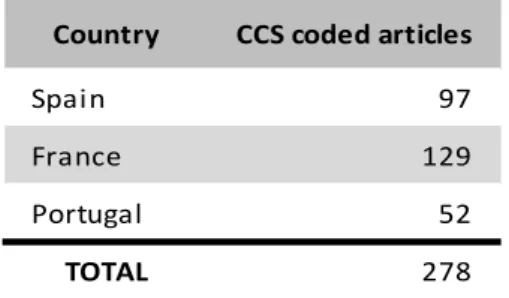
CHARACTERISATION OF ARTICLES ABOUT CARBON CAPTURE AND STORAGE
In terms of authorship, more than 67% are written by journalists in the three countries, mainly in France and Spain, with more than 70% in both (Figure 3). In Portugal, a large number of articles are written by news agencies, while in Spain, more than 20% of articles are written by academics or experts. In Portugal, 12% of articles are written by politicians, while in France and Spain politicians contributed less than 2%.
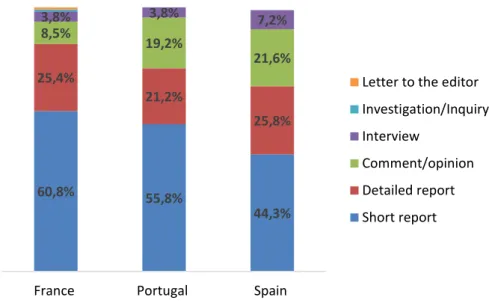
Regarding the length of the articles, half of them can be classified as medium (500 to 1000 words). In France and Portugal, a significant amount of articles (about 30%) are considered small (under 500 words). On the other hand, Portugal and Spain have a larger amount of large articles (more than 1000 words) than France (Figure 4).
CHARACTERISATION OF CARBON CAPTURE AND STORAGE IN ARTICLES
A very relevant finding is that the vast majority of news articles (78%) do not mention CCS in the title. In the case of Spain, this percentage increases even more, reaching 91% of coded articles. It should also be noted that in the majority of articles (68%), the focus scope of CCS is only allusive, especially in Spain with 83% of allusive articles.
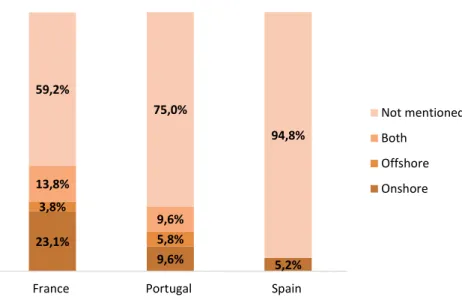
CCS appears as a central article topic in about 30% of articles in both France and Portugal, while only 6% in Spain (Figure 7). CCS appears as a secondary topic (not the main one) in 9 to 12% of articles in the three countries. In the majority of articles, the CCS location is not explicitly mentioned, which is particularly important in Spain, as 95% of the articles do not mention any CCS location (Figure 8).
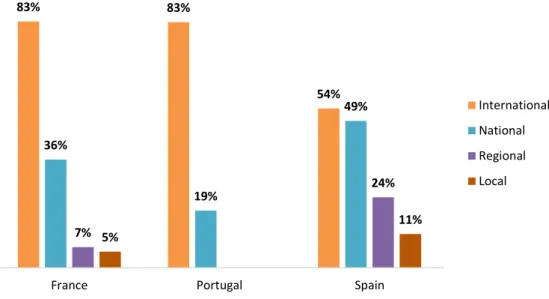
The geographical scope of CCS in cases that are explicitly mentioned is missing in almost three-quarters of the articles in all three countries (Figure 9). While France and Spain remain in the average, in Portugal the articles where the purpose is not mentioned are only 37%. Carbon/CO2 capture and sequestration is also used significantly in all three countries, particularly in Portugal and France.
Regarding the technical explanations in the articles, the vast majority (82%) do not contain any form of technical explanation (79% FR, 73% FR, 91% SP). In all three countries, less than 6% of articles provide an in-depth overview of CCS (Figure 10). Looking at the themes in the articles (Figure 11 and Figure 12), we can see that climate change, decarbonization and CCS is one of the most mentioned themes in all three countries, but especially as a central topic.
Information about a specific CCS project or location is also mentioned repeatedly, especially in France as a secondary theme. It is also important to show the importance of the challenges, risks and issues of the CCS and CO2 emissions market in the secondary themes France and Portugal. Information about a specific CCS project or location CCS and energy financing Collaborations, partnerships Challenges, risks and issues of CCS Meetings, summits, conferences CO2 emissions market.

VALUATION OF CARBON CAPTURE AND STORAGE IN ARTICLES
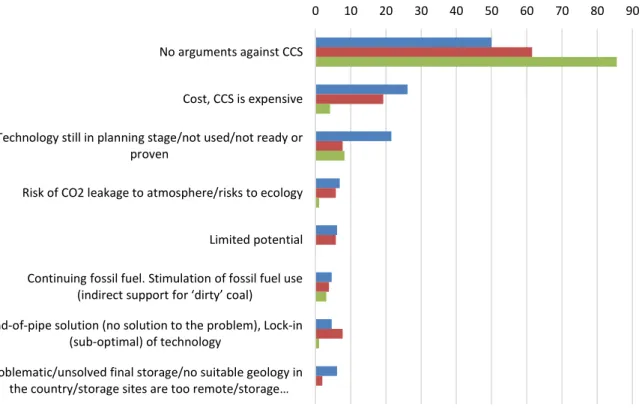
In terms of the tone of the article (Figure 15), the neutral and mixed/balance ratios account for almost 50%. Problematic/unresolved terminal storage/no suitable geology in the country/storage sites are too remote/storage. It is worth taking a closer look at CCS's rating based on some characteristics of the newspapers and articles.
Regarding the type of author of the articles, journalists and press agencies, as well as politicians and experts, prefer a neutral or positive tone, business actors a positive and NGO a negative point of view (Figure 18). In order to investigate the social acceptance of CCS, media analysis can provide relevant information about the representations of CCS to which the public is exposed. Our overall objective was to identify and understand the kind of information the public accesses when searching for CCS in the traditional media (newspapers) in three regions (France, Portugal and Spain).
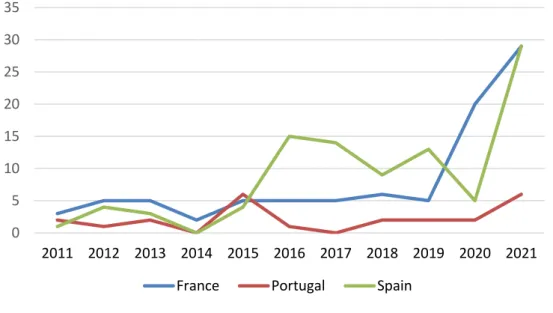
In line with previous research on CCS, the main objective of our print media analysis was to identify the type of discourse on CCS conveyed by different media sources in each of the studied regions (cross-country analysis). In terms of trends over time, the years 2015 and 2020 show significant increases in the number of articles in the three countries, which can be partially explained by COP meetings. Formal/institutional actors, especially administration and governments, industry, international organizations and experts, are more frequently mentioned in the media portrayal of CCS.
CCS is far from being a hot topic in the press: it does not appear in the headlines and most articles contain only allusive references (only a few words) to CCS. Carbon/CO2 capture and storage and carbon capture are the terms more frequently used in the media narrative, and most articles provide no technical explanation of the technologies. The main arguments in favor of CCS are its climate-friendly nature and its potential to mitigate climate change.
In general, the tone of press articles is neutral or mixed/balanced, with relevant differences between countries. 2016) Media analysis of the representations of fusion and other future energy technologies, In: 2015 4th International Conference on Advances in Measurement Methods for Nuclear Instrumentation and Their Applications (ANIMMA), pp.1-7IEEE. Scope of the article (in general): Main geographic focus of the article (may be several).
Main actors mentioned in the article: National/international related to the argument of the article. Problematic/unsolved final storage/no suitable geology in the country/storage sites are too remote/storage monitoring is not reliable enough/Uncertainty about reservoir behaviour.