CBI AS A MEANS TO REINFORCE CULTURAL AWARENESS IN THE L2 CLASSROOM FOR INDIGENOUS GROUPS IN NARIÑO
By
Susana Margarita Lyons Barrios
Submitted to the School of Human Sciences in partial fulfillment of the requirements for the degree of B.A. in the Linguistics and Languages
Department Universidad de Nariño
November, 2012
Las ideas aportadas en el Trabajo de Grado son responsabilidad exclusiva de los autores, artículo 1° acuerdo #324 del 11 de octubre de 1966 del Honorable Consejo Directivo de la Universidad
de Nariño.
Nota de aceptación:
______________________________________
______________________________________
______________________________________
______________________________________
______________________________________
_______________________________
Firma del presidente del jurado
______________________________
Firma del jurado
______________________________
Firma del jurado
San Juan de Pasto, Octubre del 2012
Acknowledgments
I would like to thank God for his assistance and unconditional love, for his protection and guidance, his presence has been always a constant encounter where people and coincidences had played a great role in my life. To my beautiful family who supported me in every single way, I can‟t imagine, none of this happening without their love and strength. Their values and
teachings are in everything I do, honesty and ethics in whatever I do.
To my father Calixto who cradled my dreams when I was little through his never ending stories and games, you are my kite and you know that! To my mom Isabel who always showed me that everyone is unique and special and that the meaning from impossible was possible when you believe. To my sister Mary, my brother Jason and my little Camille, your pictures where a company and our travels and memories were the sun in cloudy days, I love you guys.
To my love Fidel, thanks for your unconditional and constant company, your heart taught me that if you don‟t love what you do, the effort is not worth it. Thanks for believing in my dreams and for your healing music during this process.
To my family everywhere, knowing that everything is my family I want to thank every person and teacher that fed my life with a word or a smile, with a soft or strong word, I want to say that each minute you spent on me was worth it.
Thanks to the Colectivo de Investigación en Etnoliteraturas (Catalina-Fer- Adri-
Anouska) for being a platform to learn how to learn and learn how to believe in my own ideas.
To Fundación ALLPAYANA(Angelita- Vale- Lucho- Jeny- Santy – Jeny) another family in my path.
To my friends Jose, Jeni, Laura, Sony and Marcela whose presence was always present in difficult times.
Thanks to my dear cousin Carlos who told me there are three things in life that you cannot rewind, the word tossed, the arrow shot and the lost opportunity. Knowing how hard sometimes it has been living here in Pasto during these three years I would never go back in time and decide something different, each decision and circumstance made me what I am today.
To my advisor Ana Clara Sanchez Solarte who was my support during this process believing in my ideas and encouraging my capacities, always opening new possibilities, in the hard times you were as a sister to me, the list tip I would never forget. Thanks for your time and words. To my readers Helda Alicia Hidalgo and Gabriel Vicente Obando for their time and suggestions that made this paper possible and shaped my criteria.
To Universidad del Atlántico and the people that I meet there whose words and teachings I would never forget, to my Scuola Italiana Galileo Galilei where I learn that education can shape our minds and creativity.
To the Urkunina, place of transformation and the Flor de Los Cambios to whom I pray each time that I need a change. To the Medicine that helped me make this times much easier and the people who shared it with me!
To each community and family that shared their hearts and souls, memories and homes with me, to the children that shared their imagination and traditions with me.
CONTENIDO
pág.
Resumen ... 7
Abstract ... 8
CBI as a Means to Reinforce Cultural Awareness in the L2 Classroom ... 7
Linguistic Relativity: Naming Education in Native Languages ... 11
Redefining the concept of Bilingualism ... 12
Colombian Indigenous Historical Background ... 16
Own Education and Ethnic Education, an Overview ... 21
The Basis for Implementing CBI ... 23
Recognizing challenges and factors involved prior to writing the course plan ... 25
Implications for teachers when applying CBI ... 26
The Role of Materials in CBI Courses ... 29
Strategies and Tasks Suitable to Reinforce Cultural Awareness ... 32
Culture Related Issues and CBI ... 37
References ... 43
Resumen
Conociendo acerca de los factores históricos y sociales que modelaron la educación actual para grupos indígenas es necesario reconstruir la memoria colectiva del país y ser conscientes de los inconvenientes o aspectos desfavorables que en pasado contribuyeron al estado actual de las culturas y lenguas propias de Colombia. En este sentido, es crucial fortalecer los componentes culturales dentro del aula de segundas lenguas para comunidades indígenas. Para ello, CBI como método, puede ser el adecuado para desarrollar y vivenciar el conocimiento relacionado con cultura mientras se aprende una segunda lengua. Este documento de investigación pretende proveer los principios o bases de CBI como un punto de referencia para los docentes de segundas lenguas quienes podrían al mismo tiempo implementar estrategias que les permitan contribuir al fortalecimiento de la cultura propia.
Palabras claves: CBI, Currículo, Plan de Aula, Contenido, Bilingüismo, Educación Propia, Etnoeducación.
Abstract
Knowing about the historical and social facts that shaped today´s education for
indigenous groups it is necessary to reconstruct the collective memory of our country and to be aware of the drawbacks that in the past contributed to the current state of the Colombian native languages and cultures. In this sense, it is crucial to strength the cultural components inside the L2 classrooms for indigenous communities. To do so, CBI as a method, can be suitable to develop and experience knowledge related to culture while learning an L2. This paper aims at providing foundations on CBI as a way to have a reference point for L2 teachers which at the same time could be implemented as strategies that help them to contribute in the reinforcement of cultural awareness.
Keywords: CBI, Curriculum, Syllabus, Content, Bilingualism, Own Education, Ethnical Education.
CBI as a Means to Reinforce Cultural Awareness in the L2 Classroom In recent years a lot of importance has being paid to contextualized education in
Colombia, especially when ethnical, linguistic, social and economical differences are mediating on the process. Diversity in Colombia is the result of the migrations of plenty of groups
including indigenous people and maroons. The Colombian government‟s culture and education agenda has a number of main areas of interest concerning contextualized education. Some of them are the reinforcement of the cultural memory of the nation, the creation of an own
curriculum for ethnic groups and the Bilingualism Program (National Bilingual Program 2019).
It is important to state that although these initiatives appear to be positive, the clash between government policies and reality has shown otherwise. For instance, not many teachers are
embracing the National Bilingual Program (NBP) because the teaching and learning conditions do not allow them to reach the goal set by the government.
The creation of own curricula for ethnic groups is a deep and bilateral process stated both by ethnic groups and the MEN (Colombian Ministry of Education) to design a coherent and contextualized curriculum that includes the ethnic groups‟ beliefs and ways of addressing life and different approaches in education to fulfill students‟ needs and respect their identity. This process is the result of the creation of the decree 804 and its 24 articles signed by the President of Colombia on May 18th of 1995 which establishes the policies for schooling regarding ethnic groups.
This decree shows that the government is aware of the fact that Colombia is a
multicultural and multilingual country. Then it is somehow surprising that the same government starts talking about bilingualism. Then, it is evident that the need of alternatives in education in a multilingual country as Colombia demands teachers in every field of education who know how diverse and culturally rich Colombia and Colombian learners are. Besides, diversity is a
worldwide spread reality which means that any teacher or professor has to adapt materials, approaches and methods to elicit from students language in use and also to develop awareness of their own realities and cultures. If we consider this, the NBP is not adequate because it supposes that every region in Colombia is the same and this homogeneity allows achieving the same goals no matter the origin, region or identity of learners.
The goal of this paper is to discuss how we can conciliate the government policies and the reality and diversity of indigenous groups. The proposal is that this harmony could be achieved by implementing ideas taken from a current methodological approach in TESOL (Teaching
English as a Second or Foreign Language). Since the adoption of a commitment with reinforcing aspects of own culture has gained, Content-Based Instruction (CBI) can offer an alternative to develop and experience knowledge related to culture and traditions while students are learning English, Spanish or any indigenous language considered by the learners as a second or foreign language (L2), in this way students will not be isolated from the students‟ own cultures and meaningful learning would take place.
The willingness to develop cultural awareness while leading students to develop language proficiency in English or in any L2 for Indigenous students, demands syllabus adjustments in order to offer a more contextualized, content-based education and a commitment with
multilingualism instead of bilingualism, due to the actual fact that Indigenous groups are already bilingual and culture and traditions are evolving day by day.
This research paper also intends to present readers with an updated review of literature concerning language awareness and CBI. The paper focuses on showing as much related literature as possible and on analyzing the different points of view and perspectives that authors on these fields and areas of study have provided. Furthermore, it will show first-hand
information collected during field work of the “Colectivo de Investigaciones en Etnoliteraturas”
since 2008. It is important to know that “Colectivo de Investigaciones en Etnoliteraturas” (CIEL) is an interdisciplinary group of researchers from fields such as linguistics, philosophy, literature, among others, who conduct research in indigenous and maroons communities around the
Colombian territory to promote alternative approaches in research and academic writing. Its Founding members are Catalina Garcés Martinez, Fernando Guerrero Flórez and Susana Lyons Barrios.
This document could be relevant for the TESOL community since it can be a source of information that can contribute to making informed decisions about syllabus design, curriculum development and lesson planning. In addition, this paper will provide some basic principles and guidelines for developing CBI courses and the implications that this approach has for teachers inside the L2 classroom. Moreover it could be useful when conducting research on language learning strategies for diverse educational settings and reinforcement of cultural identity. We begin this overview by discussing a key issue when working with indigenous groups: Linguistic Relativity.
Linguistic Relativity: Naming Education in Native Languages
Linguistic relativity refers to a foundation on building a corpus of education based on the roots that a word in a native language could give to its community. Everett et al (1999) state that
“Linguistic relativity proposes that language and thought are so tied together that a person‟s language determines the categories of thought open to the person” (p.135). In addition, according to the Whorfian worldview hypothesis (1940-1956), the languages of native peoples in Latin America, Africa, Asia, and North America were thought by many anthropologists to be relatively simple. But following Whorf‟s ideas even the unwritten languages are as systematic and
logically rich as modern languages. Focusing on the complexity that each language hides, linguistic relativity could be a key concept to experience a new sense of education and the many ways that a single culture has to address it. For instance, in Awapit, which is the language of the Awá people settled in the Southern coast of Nariño, Colombia, “kamtatkit kamna kamtakit”
means to teach how to learn to teach, in Quechua, a language spoken still in some parts of Peru with a variation in Ecuador, Kichwa : “Yachqay” means to know or learn and “Yachachiy” is to teach, both of them come from the same root that could lead to the conception of education
where a human being learns by teaching others while others learn too, giving a sense of
bidirectional or circular knowledge. A single word then, can effectively show us these peoples‟
conceptions.
In addition to the previous ideas, Quintín (1939), elaborated on this process by saying that we have to learn to think so we could really think. But maybe what the Colombian educational system is not taking into account is the fact that inside a mother tongue there is a true and
particular way of naming reality itself, and that the way students should be “educated” -if we use this word- should be decided and vindicated by each community starting by naming the
processes in their mother tongue. Reality is relative and there is not a single way to teach or discover it, there is no right or wrong and we need to learn to respect other traditions and conceptions. With this in mind, we can now reframe the way bilingualism is seen.
Redefining the concept of Bilingualism
“People use the term „bilingualism‟ in different ways. For some, it means an equal ability to communicate in two languages. For others, it simply means the ability to communicate in two languages but with greater skills in one language. In fact, it is more common for bilingual people, even those who have been bilingual since birth, to be somewhat
"dominant" in one language.” Li (2008).
This means that being bilingual depends on the necessity to use both languages in the same context at the same time but, it is important to know that bilingualism refers also to the ability to speak more than one language which is the case of several indigenous communities in Colombia. In correlation to the previous ideas, the National Bilingual Program (Colombia
Bilingual 2019) is focused on mastering English as a second language (L2) in every school of the country by the year 2019. Even though some indigenous communities have Spanish as a second
language in their schools, some others still include EFL in their curriculum and even their mother tongue as an L2 in some cases. Due to these specific factors, every school should have especially designed syllabi for subjects such as Spanish, English and of course for the mother tongue that in some locations of the Colombian geography is taken as L2.
Indigenous groups are already bilingual since they have to express themselves in two languages: their mother tongue and Spanish. Most of the time they are facing the Spanish context mediated by public schools where education is not imparted in their mother tongue losing great part of the experience of being culturally respected individuals, plus the fact that the curriculum content offered is not contextualized or slightly related to their realities. If we take into account public or official schools intervened by local and national educational policies we could do a general revision on how far the policies early described in this paper are from being applied in indigenous schools.
Examples of such multilingual settings are the following cases:
La Institución Educativa Técnico-Agropecuaria Indígena Libardo Ramiro Muñoz located in Colimba, Nariño (Colombia), an indigenous jurisdiction of Los Pastos, is a multilingual setting where Spanish is the official language which means that all of the subject areas are imparted in Spanish. English as in every official Colombian school has a four-hour-a- week intensity, even though, Aldemar Ruano a writer-teacher of Los Pastos community in Colimba, a teacher of the above mentioned institution, suggested to take one hour of the English class to conduct a research on Kichwa as an L2 to reinforce cultural aspects since 2008, and supported by the Otavalo Linguistic Institute in Ecuador as a part of the Binational Program. (Documento
Técnico: Plan Binacional para el Fortalecimiento Cultural, Natural y Ambiental del Nudo de los Pastos, 2006).
A law Project associated to the previous situations exists now. It sustains the main aspects being considered to legalize the designing of protection and reinforcement programs of, in this case, Kichwa by a binational and bilateral treat in between the Institución Educativa Técnico- Agropecuaria Indígena Libardo Ramiro Munoz and the Linguistic Institute of Otavalo in Ecuador. The law project “Proyecto de ley 21 de Protección a las Lenguas Nativas de 1991 del Congreso de la República de Colombia” in its 15th article states that:
“Artículo 15. Pueblos Fronterizos. En el marco de acuerdos o convenios binacionales con las naciones vecinas al país, en cuyos territorios fronterizos con Colombia existan
comunidades y pueblos que hablen la misma lengua nativa de los dos lados de la frontera, el Estado, a través del Ministerio de Cultura y del Ministerio de Relaciones Exteriores, y en concertación con las autoridades de los pueblos aludidos, diseñará planes conjuntos de protección y fortalecimiento de las lenguas compartidas” (p. 4).
In the binational treaties framework with the neighboring nations of the country, the design of protection and reinforcement plans of the shared languages programs should be developed. Specifically, when there are communities and peoples that speak the same native language in both sides of the frontier, in this case in the Colombian side and in the Equatorial side there are members of the same communities.
All of this supports the fact that the members of the Institución Educativa Técnico- Agropecuaria Indígena Libardo Ramiro Muñoz, who are part of Los Pastos jurisdiction, should
be entitled to be taught Kichwa as an L2 and be offered an appropriate syllabus for this subject area given that Spanish spoken in this territory has a Kichwa heritage.
The Awá population is also in between frontiers, in the Colombian side they are placed in the “Resguardo Hojal La Turbia”, and in the Equatorial side “Resguardo Piedra Sellada”.
Parallel to the previously mentioned law project, the National and International
Constitutional Framework for indigenous groups, ONIC (2007), stated that the 1991 Colombian National Constitution, in its 10th article says that “The teaching in communities with their own linguistic traditions must be bilingual”, also in its article 68 is mentioned that “the members of an ethnic group will have the right to be given education that respects and develops their cultural identity” (p. 104).
In the “Inkal Awá sukin kamtana pit parattarit” (Mandato Educativo del Pueblo Awá, language policies of the Awá people, December 2010) bilingualism is described as “the capacity that Awá people have to express their feelings and mind frames in the Awapit language and in Spanish. This process is developed through oral skills starting with family, community and the different settings and daily life situations that result in the survival of the Awá people in a globalized world”(p. 67).
All of the indigenous students from the Awá territory receive secondary education at Institución Educativa Técnica Agroambiental Bilingüe Awá (IETABA) located in “Predio El Verde – El Diviso”, This institution has still the same curriculum as any official school in Colombia, the IETABA has not applied entirely he “Inkal Awá sukin kamtana pit parattarit”
(Mandato Educativo del Pueblo Awá, language policies of the Awá people, December 2010) and as a result of the armed conflict present in this area that does not allow the members of the MEN
to intervene in this important process. The Awapit language is taken as an L2 with weekly sessions of 4 hours, the same as English. The rest of the subject areas are taught in Spanish again contributing to the detriment of the mother tongue. As Mejía, a journalist in charge of the
communication field of the UNIPA organization informed, in September 2011.
Another case is the Inga people of Aponte-Nariño who are an indigenous group that initially was located in Putumayo, but because of violence and internal conflicts, some of the families migrated from their original territory at least 40 years ago according to the current inhabitants of this place. This group migrated with all of their traditions and their mother tongue (the Inga language). The classes taught at “Institución Educativa Agropecuaria Inga de Aponte”
have Spanish as the general spoken language. The classes of Inga Language and culture have one daily hour and English is taught for four hours a week. The Inga leaders are trying to build a strong curriculum with an emphasis in mother tongue in order to teach each subject in Inga.
All this indicates that indigenous groups are making efforts to adequate national policies, but also to keep their cultural heritage and language and foreign language teachers should respect and adapt to these initiatives.
Having shown some illustrations of how indigenous groups are evolving in terms of L2 instruction and policies, it is time to discuss briefly how indigenous groups have been schooled and if this treatment has been beneficial or not.
Colombian Indigenous Historical Background
Schooling in Colombia for ethnic groups started as linked to the Catholic Church through an 1886 treaty signed between the Catholic Mission and the State, by which the latter gives the church the administration and direction of the public primary schools for boys. By 1928, the
church was in charge of the scrutiny processes in all the educative institutions, educative
directive departments and commissaries, and in 1953 its coverage was strengthened when it was expressed that: “From now on, education will go hand in hand within the spirit and along with the Catholic, Apostolic and Roman Church” (Bodnard, 1989).
The church was given the power of creating and moving schools and the right to assign teachers for primary and secondary schools. All this time, education has been carried out in Spanish and taking into account the official syllabi provided for the whole country. Besides, education was offered considering the idea of the „White man superiority‟ and his customs, and with the final objective of “civilizing and integrating” indigenous people to the “national culture”. The general result of this process was the creation of houses where adolescents were
“educated” for a period of five years in which none of them could see their relatives. Also in some cases, youngsters from the communities were forced to go to these places by using violent means. This is, by no means, a good type of education
Later, in 1962 the evangelic missions in Colombia arrived with the New Tribes Mission which are described themselves in their web page as an international association of ministers and gospel missionaries who work in many countries around the world to look for communities, tribes and peoples. These „tribes‟, cultures and languages, as they say, have isolated them from the gospel, do not know the church or any of its components such as the gospel or the bible.
NTM workers get to learn the tribes‟ language and understand their culture as a way to present the gospel and plant a church in their territories. It is clear that the purpose here is to take advantage of indigenous groups, not to really educate them.
They affirm that in 2,500 out of the world‟s 6,500 groups of people, there are no churches, nor there is any work being done to establish a church. These are the people among whom NTM works. As the major activities, the NTM are in charge of presenting foundational Bible teaching to the “unreached people groups,” they establish churches that can take their rightful place as agents of change in their own communities.
In addition to this, the Summer Institute of Linguistics (SIL) in its arrival into Colombian indigenous territories presented themselves as a scientific organization sponsored by Universidad de los Andes in the name of a Master study course called “Maestría en Etnolinguística” which sent students to each corner of the country to conduct research on mother tongues and cultural issues. According to the first article of the pact made between the government and the DANE (National Administrative Department of Statistics, (1971), the institute‟s duty was to assess and support the Colombian Division of Indigenous Issues of the Ministry of Government. Ten years later a commission of professors was in charge of giving reports about the activities of such institute. The task was to translate part of the indigenous sacred traditions and to evangelize people in these territories beginning with their acculturation. This acculturation was achieved by teaching them Spanish as the official language. Friede, Friedemann, & Fajardo (1975).
Decontextualized curricula with a strong prohibition on mother tongue communication were settled by the implementation of such processes of the SIL (CRIC, 1987). Many
anthropologists and Linguists took part of the acculturation processes from the 1960s to 1980s in what history calls the immersion of the SIL in Colombia causing deep damage on linguistic and cultural aspects of different ethnic groups by making a narrow linguistic pattern of mother tongues around the territory and diminishing the communities strengths and traditions.
Fortunately, indigenous groups have started working to build their own curricula, fighting and trying to reverse the effects of the programs before mentioned. Nowadays, the Asociación de Cabildos y/o Autoridades Tradicionales Indígenas del Nudo de los Pastos “Shaquiñán” is working to keep on developing projects in every field of Los Pastos life-plan. Guerrero (2012),a pedagogue who currently Works with the MEN and the Cabildo Mayor del Resguardo Indígena de Aponte in the design and construction of the Inga Educative Curriculum, refers to life-plan as the communitarian work horizons in every specific area such as education, mother tongue and culture, health and traditional medicine, etc.
The UNIPA, (Unidad Indígena del Pueblo Awá) works on the Inkal awá life-plan and Inkal awá safeguard plan. Safeguard Plan is the result of the Auto 004 del 29 de enero de 2009 that appeared to guarantee the safeguard of 34 indigenous communities who are in danger of extinction due to violence and segregation issues. This safeguard plans allow the members of a community to generate possibilities of protection of their mind frames and traditions. The Cabildo Mayor del Resguardo Indígena de Aponte in Aponte, Nariño is also involved in developing their life-plan and safeguard plan and more indigenous organizations are working hard to vindicate cultural and linguistic rights in their communities to establish strong parameters on education and to design their own particular paths in the same area.
Proof of this is that every year more indigenous groups are demanding sovereignty regarding their decisions on their life-plans and their intercultural education plans which are fundamental factors in the processes of ethnic groups.
Social Factors Affecting Indigenous Groups. In the case of Nariño there is an important number of indigenous groups. The conflict for lands and mines in each of these settings makes
the panorama difficult for the government and the community‟s leaders. Plus the many
corruption issues that evolve in the lack of resources for education. All of this is evident given the presence of nonprofit organizations or ONG‟s such as ACNUR (Alto Comisionado de las Naciones Unidas para Refugiados), UNICEF (United Nations International Children‟s
Emergency Fund), among others, who allegedly promote communitarian processes in different areas.
For instance, the UNIPA and CAMAWARI (Cabildo Mayor Agua de Ricaurte) regularly express their views through online weekly reports on the UNIPA social network, in which they share their complaints related to the current social issues they face in their territory.
An example of these statements is as follows:
“Nosotros los indígenas del pueblo Awá, a raíz del conflicto armado interno, la incursión de megaproyectos y monocultivos en nuestro territorio, el negocio del narcotráfico y el abandono histórico del Estado, hemos visto como nuestra identidad física y cultural, en el transcurso de los años se ha ido debilitando. Como consecuencia de los factores expuestos, quienes hemos vivido ancestralmente en las comunidades Awá, no hemos podido disfrutar con plenitud las riquezas que tenemos en el territorio y, además, se nos ha dificultado mantener la relación de respeto, equilibrio y armonía con los espíritus de la montaña”.(Taken from “Plan de Salvaguarda del Pueblo Inkal Awá 2010”).
The Awá people have seen how their physical and cultural identity has been diminishing with the pass of the years due to the internal armed conflict, the immersion of megaprojects and monocultures in our territory, the drug traffic and the State‟s historical abandonment. As a consequence of the showed factors, they have not been able to benefit from the richness of their
territory; and besides it has been difficult for them to maintain the relationship of respect, balance and harmony with their sacred traditions, as described previously.
So far this paper has discussed the reasons why the government should not promote bilingualism as the only option for developing projects related to language or languages, the policies that have empowered indigenous communities and the policies or projects that have harmed the indigenous groups should be exhaustibly revised. Now it is time to define own education, a consequence of all the historical events that have occurred in Colombia.
Own Education and Ethnic Education, an Overview
The Awá people refer to Own Education as “a system that has a close relationship with every interest and needs of indigenous communities, giving special attention to context without forgetting about external conditions which, in the end, are a tool to expand knowledge and transform human life in balance and harmony with nature itself. Elders, cosmovision, territory, and cultural practices are the main aspects that have to be considered within pedagogical instruction and methodological design, and have to be taught in the indigenous communities‟
mother tongue‟‟.(Mandato Educativo del Pueblo Awá, language policies of the Awá people, December 2010).
On the other hand, Ethnical Education is a model established by the MEN (National Ministry of Education) to incorporate indigenous groups to some educational policies including general standards and other non contextualized items for education in these particular settings.
All of this shows us that despite a hundred and eleven years that have passed; no strong progress on institutional aspects is being done for ethnical groups in Colombia. As it has been suggested
earlier in this paper, it is the indigenous groups that have been making efforts to be visible and make a difference in terms of education.
Many indigenous groups starting by the Arhuacos in “La Sierra Nevada de Santa Marta”, northern side of Colombia, stated their needs and asked for participation in general meetings regarding ethnical education by the year 1984. Plenty of manifestations around the country to regain lands that were taken away from the conquest years to indigenous groups and a whole work on vindication processes in Education and Culture started. (Enciso, 2004)
Parallel to this, some indigenous groups started to meet in different communities to compare and share opinions on how their children were taught at official schools and decided to take actions on this area by getting to know more and more about curriculum design and political aspects of education, until recent years, when a revival of this well known vindication gained more importance, especially by achieving to establish a distinction between Ethnical Education and Own Education. Each community should name education in their own mother tongues due to the fact that it will shape the actual actions that finally evolve in it. As we know, language is a representation of culture and life. Learning and teaching should also be named in those languages that determine the way educative processes should be addressed. Besides, In many different native languages there are no words to name education, there is no equivalent to such word, though it doesn‟t mean that there is no education in such realities, here we could expand on decolonization of the tongue which means to contextualize word and meaning to each setting.
Communities should be able to shape their educational practices, but they cannot neglect government policies such as the NBP or the standards. So, we need a way to implement these
policies and maintain the indigenous groups‟ traditions and ideas. That way could be Content- Based Instruction (CBI). This approach is defined next.
The Basis for Implementing CBI
CBI has been a reality since the 1980‟s, from then on every instructional or educative setting where language and content are present or integrated, has been covered by the umbrella term of Content-Based Instruction.
There are several definitions and views on content and Content-Based Instruction.
Nevertheless, it is essential to have a clear understanding of these terms in order to design an effective course that takes into account the students and instructors‟ needs and roles.
The distinctions between authors and ways to address CBI have a potential significance given the fact that it can put forward tips and key features for implementation. A clear
background on CBI is necessary for the in-service teacher who has to develop the needed skills and the tools to assess students in an effective way and think over new paths on CBI, while keeping an eye on cultural awareness. Let us start by defining content:
As Chaput (1993) states, content is “any topic of intellectual substance which contributes to the understanding of language in general, and the target language in particular.” In that sense, the objective of using content in a classroom would be learning about a subject or topic while using the L2 as the medium of instruction. In the case of indigenous languages, content could also contribute to brining into the classroom themes and issues related to their life styles and traditions. In addition, Crandall and Tucker (1990) say that content is an “academic subject matter” while Curtain and Pesola (1994) describe content-based instruction as “curriculum concepts being taught through the foreign language.” All of these particular perspectives
represent a contrasting factor of CBI in which the content itself is emphasized in a language learning context.
If these two perspectives are considered before designing a course, teachers need to answer the following questions: Will the course be based on content where learning the content is the main objective? Will it be a course based on language where learning the language is the main objective? Or will it be a course that intends to emphasize both content and language? The answer, in the case of indigenous languages can be that the L2 is a medium to discuss cultural issues and strengthen their identity. Thus, the L2 is not an enemy or a disconnected element, but a tool to redefine and explore essential issues for these communities.
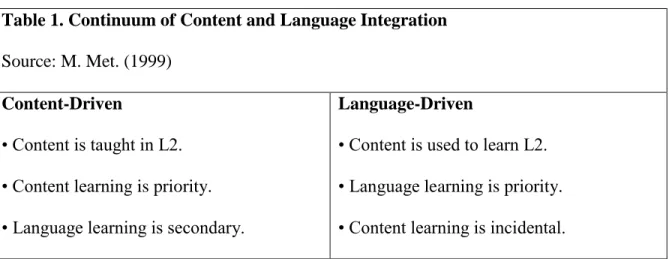
A framework provided by Met (1999), in table 1, provides curriculum developers a scheme to consider the balance that has to exist between content and language and which is suitable for every single context. This continuum can assist teachers in determining the overall course objectives together with the specific goals of language and content of each lesson.
Table 1. Continuum of Content and Language Integration Source: M. Met. (1999)
Content-Driven
• Content is taught in L2.
• Content learning is priority.
• Language learning is secondary.
Language-Driven
• Content is used to learn L2.
• Language learning is priority.
• Content learning is incidental.
•Content objective determined by course goals or curriculum.
•Teachers must select language objectives.
•Students evaluated on content mastery.
•Language objectives determined by L2 course goals or curriculum.
•Students evaluated on content to be integrated.
•Students evaluated on language skills/
proficiency.
When applying any of the CBI models, it is essential to integrate both language and content. Nonetheless, achieving the balance related to in-class roles that is accurate in a specific context that includes the teacher and the students will be one of the biggest challenges in CBI.
Murphey (1997) states that “The hardest task for most teachers seems to be in making their content area comprehensible and avoiding the two extremes (p. 123).” It will be then of great importance to take into consideration this balance when establishing course objectives and goals during the process of writing lessons.
Recognizing challenges and factors involved prior to writing the course plan
Every teacher will be approaching a different context for writing when creating a content-based course. Teachers design content-based courses for several situations. In any situation, the context has to be taken into account.
Before creating a CBI course, it is important to consider that there are four areas that come to be challenging. As Brooks (2004) states, those areas are related to students, teachers,
materials and external factors. A prior knowledge of the students is also needed. Besides, student‟s interests and motivation should be taken into account when developing syllabi. Here, the educators involved in own education are valuable resources of information that can aid the L2 teacher in identifying learners‟ needs and suitable topics for syllabus development.
Implications for teachers when applying CBI
Pessoa (2007) et al argue that some implications for teachers when applying CBI are that teachers need to be aware of the language of instruction when teaching academic content to promote student proficiency within the context of content-based instruction. Including explicit language goals in the course is one way to foster constant attention to the development of language competence. Those goals can be derived from the academic subject matter and can be linked lexically and functionally to the content being addressed. Curtain and Haas (1995) suggest designing a visual thematic web that includes language goals, academic content and cultural objectives. Moreover, Pessoa et al. (2007) express that “teachers need to learn how to monitor their oral interactive practices in and across their lessons, and to develop the ability to lead conversations with their students that reflects a cohesive academic topic and conversational features of interpersonal communication.” (p. 116)
Accordingly, Brinton (1989, cited by Navas, 2010), listed a series of guidelines to be considered when preparing a CBI course. These guidelines can be useful for teaching an L2 in any setting. They are:
1. Instruction-based decisions on content instead of language criteria: Although it is not easy to make decisions on whether or not content should precede language, the study of content will benefit students in order to increase their knowledge and increase their productive lexicon. Instructors must decide on the input students will be exposed to.
Learners need to communicate ideas related to the content studied in the L2 with an appropriate level of accuracy and fluency.
2. Integrate skills: Brinton, Snow and Bingham (1989) affirmed that in this approach, students are exposed to study skills and learn a variety of language skills which prepare them for the range of academic tasks they will encounter (p.2). Although content has a primary position in the preparation of CBI courses, instructors cannot simply rely on a series of readings or videos; they must know how to use them. One of the most difficult tasks is to use materials and integrate all language macro and micro skills. The
integration of skills and content will have a significant impact on interaction among students through various tasks and grouping techniques. In fact, Brinton as cited by Navas (2010) has indicated that CBI practitioners use an integrated skills approach to language teaching, covering all four language skills as well as grammar and vocabulary.
This reflects what happens in the real world, where interactions involve multiple skills simultaneously.
CBI lends itself to the incorporation of a variety of thinking skills, and learning strategies which lead to rich language development, e.g., information gathering skills, absorbing, questioning; organizing skills, categorizing, comparing, representing;
analyzing skills, identifying main ideas, identifying attributes and components, identifying relationships, patterns; generating skills, inferring, predicting, estimating (ASCD, Dimensions of Thinking) (Curtain, 1995; Met, 1991).
3. Involve students actively in all Phases of the Learning Process: Teachers can ask students to bring materials to class such as readings, short videos, questionnaires to activate background knowledge, and even online resources. They can feel more motivated when
teachers include those materials in the course. Furthermore, learners can be encouraged to comment on the materials chosen and give suggestions for further sessions. Classes must be learner-centered and teachers should be facilitators, in this way, students can play an active role as researchers to develop classroom autonomy and learn more about course content. Additionally, the teacher has to contextualize materials that can vary from a number of sources.
4. Choose Content for its Relevance to Students‟ Lives, Interests, and/or Academic Goals: Some of the main topics that should be covered within the course have to be determined taking into account the main cultural aspects that would lead to reinforce cultural awareness in any community such as environmental issues, domestics, traditions, handcraft, culture related topics and whatever aspect that is related to the students‟ beliefs and/or needs.
5. Select Authentic Texts and Tasks: CBI courses should include those materials that were not created for educational purposes. Learners must be exposed to authentic oral or written texts with a challenging level of difficulty. Some authentic materials can include the following: newspaper ads, case studies, extended academic lectures, documentaries, magazine ads, readings, tales, recordings, etc.
6. Draw Attention to Language Features: CBI tasks should have a section in which students reflect on language form. Brinton (Brinton (1989, cited by Navas, 2010), has pointed out that in order for students to acquire language through the study of
comprehensible input, it must have awareness-raising tasks to draw attention to specific language features found in the authentic texts. Teachers should prepare a short language section of the target feature so that learners have a clear idea of what the language feature
consists of. Then, raising-awareness tasks may include exercises in which students scan texts and look for a specific language feature (e.g., passive voice, compound adjectives, and conditional sentences, among others) and reflect on its use in context. After getting acquainted with this language feature, controlled and guided exercises may also be prepared.
These guidelines need to be brought into practice through materials. Materials are an important part of contemporary approaches since they need to be as authentic and meaningful as possible, and in the case of indigenous languages and own education, teachers may need to create them based on the topics and issues of interest for their students while also rising cultural awareness. The way materials influence teaching in CBI is explained next:
The Role of Materials in CBI Courses
Navas (2010) asserts that “the general and specific objectives of the course syllabus should serve as a point of departure in order to look for materials that meet the needs of students.
Then, instructors should become creative enough to select and adapt pre, while, and post activities which students will find relevant, appealing, and helpful. Tasks should also be
contextualized and communicative”(p. 7) also cites Met, M. (1994) who pointed out that in terms of choosing appropriate materials, instructors should keep in mind that the “criteria for selecting and developing materials include accessibility of language, text organization that facilitates comprehension (e.g., headings and sub-headings), availability of non-linguistic supports to meaning (illustrations, graphs, diagrams), and degree of cultural knowledge required for comprehension” (p. 17). Besides considering appropriateness of content, the layout should be carefully designed so that students can find it appealing and interesting. Table 2 includes a short
list of some useful authentic materials which can be used in the pre, while, and post stages to help learners to improve their reading and speaking skills.
- CBI materials should promote communication and participation among students.
- CBI lessons and resources must be student-centered instead of teacher-oriented.
Table 2
List of Authentic Materials for CBI Courses Stages of Lesson Authentic Materials
Speaking Skill Reading skill
Pre-Tasks -authentic survey questionnaires -illustrations and photographs
newspaper advertisements newspaper headings
opinions comics
graphs or diagrams
vocabulary-building exercises While-Tasks -interviews and role plays based on
authentic models
Articles
transcripts of lectures
real-life stories and anecdotes case studies and journals questionnaires
Post-Tasks -situations developed in pairs -debates
short lists of idioms lists of topic-related terms Source: Navas, (2010).
Strategies and Tasks Suitable to Reinforce Cultural Awareness
As a way to encourage students to learn an L2 and enhance their cognitive development, it is important to make the language class captivating, attractive, innovative, and interesting and which can have some value to the learners, Brewster (1999). This can, however, be a challenge for the L2 teacher who sometimes might tend to focus on formal aspects of the language. In own education it is necessary to go beyond vocabulary and grammar and work more towards the development of the particular values and thoughts of an indigenous group. Teachers then, need to decide which materials are appealing, appropriate and suitable to be brought into the L2
classroom.
The following strategies are aimed to be adapted, that is to say, that the teacher who chooses to use this approach and the associated strategies has to decide the level of complexity of the tasks and the possible topics that can be integrated or applied in these activities. These strategies are expressed as lesson plans and they can be adapted by teachers everywhere:
1. Storytelling with a puppets show: Here, students listen to the teacher telling a story related to their culture, traditions or myths using puppets and write a report about it.
Level: Lower-intermediate Time: 30 minutes
Objective: To familiarize students with the traditional myths or legends from their culture and encourage them to write a short paragraph containing their opinions about the story.
Language: basic verb tenses: present tense and past tense.
Structures: interrogative, negative, affirmative.
Organization: Incite students to organize themselves into a circle around the classroom so, that they all can watch the puppets show.
Procedure:
1. Before starting the storytelling presentation, the teacher provides the students several expressions they can use at the end of the show to give opinions, ask and answer questions.
2. The teacher begins the show presenting the puppets and greeting the attendants.
3. The teacher starts with the storytelling.
4. Once the teacher finishes telling the story he starts asking the students easy and simple questions such as did you like the show? Did you enjoy the story? What was your favorite
character? What was the best part of the story? Etc. and the possible answers can be: Very much, a lot, yes, my favorite character was, the character I liked the best was, the moment I loved the most was, etc. All the students have to participate.
5. At the end, the teacher asks the students to write a short paragraph including what they said.
This can be five to ten lines length.
2. Class journalists: A task in which students learn about the vocabulary related to journalism and look for information from articles, magazines, news bulletins, journals and websites about a topic related to current issues in their regions and communities. All of this provided by the teacher. For example, environmental, political, social and/or economical issues in your community.
Level: Upper intermediate Time: 30 minutes
Objective: Make students aware of their communities‟ current problems and provide them with the necessary vocabulary and expressions to build up a short article about the topic they select.
Language: Vocabulary about journalism, press language (how to write in a journal or a news bulletin), reporting an event, taking notes, summarizing.
Organization: group work.
Procedure:
1. The teacher explains to the students the task and gives them clear instructions telling them what the task is going to be about.
2. The teacher divides the class into small groups of three students and gives each group a topic and a set of articles from which students have to choose one in order to develop the activity.
3. Once the students have selected the information related to their assigned topic they read it in their groups and take notes that can be used to write the report or the summary that will be included in the final article.
During this activity, the teacher has to monitor the students work by clarifying difficult vocabulary and making sure they understand what they have to do.
4. At the end, every group presents their article to the rest of the class and the final result will be a journal containing every article, summary or report that the students wrote.
3. Show and tell: Make students bring to class traditional outfits, accessories or any object that belong or are part of their culture in order for them to change their appearance and show what the characteristics of the way of life of their communities are.
Level: Intermediate
Time: 5 to 10 minutes per each student
Aim: Recognize elements that belong to the learner‟s culture to reinforce and promote their relevance.
Language: keywords and expressions for descriptions as well as, the use of adjectives and nouns.
Verb tenses: simple present.
Organization: encourage students to volunteer, otherwise use random participation Procedure:
1. The teacher starts with a warm-up activity in which he/she tries to elicit from students information about the student‟s culture, way of life of their communities, traditions, etc.
2. The teacher provides the students with keywords, expressions and vocabulary that help learners build sentences to describe people and objects such as: this object is very colorful, it is long/short, it is used for; I am dressed like a…, people in my community wear…, etc.
3. Every student has 5 to 10 minutes to show and tell to the rest of the class the object, outfit or accessory he/she chose.
4. Learning about Initiation Rituals: Teach students about initiation rituals of other cultures around the world as a way to compare the rituals they have in their own settings and therefore talk about them and write a short paragraph reporting their ideas and the information they have about this topic.
Level: All
Time: 40 minutes
Aim: To establish relationships among cultures.
Language: use of comparatives.
Functions: relating facts, expressing points of view.
Organization: pair work Procedure:
1. The teacher brings to class a topic about initiation rituals and explains the language components he/she wants to make emphasis on and then he/she tries to elicit from students language to express their point of view about what they have learned and also to compare that information with their own realities in their communities.
2. The teacher makes students form couples.
3. Every couple discusses about the initiation rituals and answer questions such as: do you have the same ritual in your community? What is the importance of this ritual for your community?
Etc.
As it was said before, these lesson plans can be adapted to any proficiency level and setting where learning takes place. The flexibility exhibited by CBI is another reason why L2 teachers should attempt to implement this approach in their classrooms. An element to consider, however, is that the adoption of any method or approach involves an interaction between the L1 and the L2 cultures. So, a balanced approach to culture should also be taken into account by teachers.
Culture Related Issues and CBI
According to Rogers and Steinfatt (1999:190), assimilation is the degree to which an individual relinquishes an original culture for another. There is usually a loss of the previous culture. In relation to that, Acculturation is the process through which an individual is socialized into a new culture while retaining many aspects of a previous culture; this one turns into a mixture from all of the cultures that he or she has been into contact with. In order to palliate the expansion of this phenomenon, a pilot process that could be shared in future studies, with one or two student groups. It could be necessary to do a little adjustment on syllabi and an
implementation of CBI as a tool to contribute with more dynamism in the following teaching modifications stopping or at least preventing acculturation processes that are diminishing the native‟s culture strengths.
As a way to clarify more these concepts, as Sam (2006) stated, “in its simplest sense,
“acculturation” covers all the changes that arise following “contact” between individuals and groups of different cultural backgrounds” (p. 2). He also mentions a more formal definition for this concept which was proposed by Redfield, Linton and Herskovits (1936). They defined acculturation as “those phenomena which result when groups of individuals having different
cultures come into continuous first hand contact, with subsequent changes in the original culture patterns of either or both groups” (p. 149).
According to the Sociology Guide assimilation refers to “the process whereby large numbers of migrants from Europe were absorbed into the American population during the 19th and the early part of the 20th century. The assimilation of immigrants was a dramatic and highly visible set of events and illustrates the process well. There are other types of assimilation, however, and there are aspects of the assimilation of European migrants that might be put in propositional form.
First, assimilation is a two-way process. Second, assimilation of groups as well as individuals takes place. Third some assimilation probably occurs in all lasting interpersonal situations.
Fourth, assimilation is often incomplete and creates adjustment problems for individuals. And, fifth, assimilation does not proceed equally rapidly and equally effectively in all inter-group situations.”
In this part we can conclude that assimilation is not the goal of L2 teaching and learning and that L2 teacher need to keep a balance between the L1 and the L2 cultures. A way to do this can be to incorporate a comparative analysis of the two cultures in regular lesson plans. This strategy can also enhance conditions for reinforcing language awareness.
The previous ideas are feasible to implement in L2 classrooms in Colombia. L2 teachers can provide L2 instruction incorporating cultural elements relevant to the learners‟ reality while also including L2 content that can be a source of reflection and comparison. Unfortunately, not everything depends on teachers. We also need to consider the Colombian standards the government has been promoting since 2006 and that analyze the educational heritage and European Framework present in those standards.
According to Skliar (2002) to talk about educational heritage in Latin America a focus on deconstruction has to appear, our models on education are those models applied before in
different countries or cultures besides all of the political issues that make this whole process a matter of power and reproduction of collective or partial mind frames. Education is a window to all of the processes surrounding our realities and a reflection of all of those who participate and take action on the daily duty that it is. Europe has always been a reference on education for our nation and some decisions in educative processes are permeated by European perceptions of what education is and should be. An example of this could be the Common European Framework design process that lasted 60 years in England which the MEN in Colombia adopted 8 years ago and tried to implement in Colombian education without taking into account the adaptation that should be done, and forgetting about the real meaning of designing. Moreover, Europe is a multilingual continent in relation to Indo-European languages in contrast to Colombia which is a multilingual country in relation to indigenous languages.
To have a clear understanding of this, the article that talks about the adoption is cited bellow:
ARTÍCULO 2º.- Adopción de la referencia internacional: Adoptase el “Marco común europeo de referencia para las lenguas: aprendizaje, enseñanza,
evaluación” como el sistema de referencia para los procesos de aprendizaje, enseñanza y evaluación adelantados en Colombia. Las instituciones prestadoras del servicio educativo que ofrezcan programas de educación para el trabajo y el desarrollo humano en el área de idiomas, deberán referenciar sus programas con los niveles definidos en el referido marco común. (decreto número 3870 de 2 de noviembre de 2006)
Breaking part of this heritage in Education new ways of addressing pedagogy may appear to develop all of the potential that culture, history and traditions have to explore and specially our very particular settings of education. Kumaravadivelu, (1994) in “Post-Method Conditions”
stated that particularity means that every teaching experience is different which demands special attention to syllabus adjustment, methods, approaches, design and procedures to offer adequate teaching conditions in particular contexts. Such contexts have had a history in education imposed by foreign cultures triggering violence, cultural assimilation, migrations and in many cases segregation.
After having analyzed the situation of indigenous groups in Colombia, the importance of Own education and the feasibility of implementing CBI as a way to provide L2 instruction while including meaningful cultural content, it is time to outline some conclusions: They are listed as follows:
When emphasizing connections among students‟ real life situations and experiences, CBI offers an opportunity to link prior knowledge to activate those aspects related to language and content. For example bringing to class storytelling strategies related to their traditions mediated by the target language will activate on students background knowledge and will result in meaningful learning.
Due to the nature of CBI, contents can evolve and be changed when needed. Being flexibility one of the principal features of such approach redesigning and adapting are a continuous task for both the teacher and the students.
Many approaches and methods can be implemented to teach languages in diverse
settings; as a matter of fact, CBI can be a suitable approach to reinforce cultural awareness in the
L2 classroom. For instance, Krahnke (1987) defined CBI as the teaching of content or
information in the language being learned with little or no direct or explicit effort to teach the language itself separately from the content being taught. In this way more attention could be directed to contents to be shared in class and a focus on cultural aspects of the ethnic group without forgetting the balance between content and language.
Lightbown & Spada (1993), cited by CARLA, assert that CBI promotes negotiation of meaning, which is known to enhance language acquisition. In this case negotiating aspects of the students‟ own culture can easily escort to cultural awareness plus of course L2 proficiency.
Knowing that negotiation of meaning is of great importance in indigenous communities (which are oral cultures by excellence) suggest that the L2 classroom can qualify as an extended familiar setting.
It is of extreme importance to highlight the fact that commitment with reinforcing aspects of own culture is gained and should be maintained, it would be a good idea to develop group work on this area of study to promote community-friendly research projects.
One more conclusion is that TESOL methodology is suitable for teaching any possible language. This understanding would open the doors for adapting the numerous materials and take benefit from the rich literature that it offers for novice and in-service teachers, and, for teachers involved in Own education.
Though the implementation of CBI can be difficult and exigent for teachers and students, it can be motivating and gratifying as well. Whether you adopt this method or not depends on the willingness of your students, the school where you work and the accessibility of resources in your specific setting. It may be something that your institution wants to take into consideration to
introduce it across the curriculum or to implement it occasionally. It is important for you to try to involve other teachers within your school, particularly teachers from other subject matters.
This could be useful for both of you as a way to find sources of information and in having the support of others in helping you to evaluate your work.
In a nutshell, try to involve your students. Make them help you to decide what topics and
subjects they want to learn and find out how they feel this kind of lessons compares to your usual lessons. In the end what they have accomplished will reflect the success of all your work.
Finally, after revising all of this information and sources I could conclude that there are not current ethical education policies that facilitate the reinforcement of cultural awareness for indigenous groups in Colombia. This is the first step in order to create in the future syllabuses that respect those ways of addressing education from each or any indigenous group and that respect national educational policies of the MEN to integrate knowledge and real life needs of students in diverse settings.
References
Assimilation. A students guide to sociology. Retrieved from:
http://www.sociologyguide.com/basic-concepts/Assimilation.ph Bodnard, (1989). Qué es la Etnoeducación? Retrieved from
http://etnoeducacioncolombiana.blogspot.com/2009/06/que-es-la-etnoeducacion.html Brewster, J. (1999). Teaching English through Content: Supporting Good Practice' in 'Innovation
and Best Practice', Ed. by Chris Kennedy. 1999. Longman.
Brinton, D. et al. (1989). Content-Based Second Language Instruction. Boston: Heinle & Heinle Publishers
Brooks, M. & Sandkamp, J. (2006). The Essentials of Designing and Creating Content-Based Curriculum: Recommendations for Future CELE Curriculum Development . CELE Journal
Chaput, P. (1993). Revitalizing the traditional program. In Kreuger & Ryan (Eds.), Language And content: Discipline and content-based approaches to language study. Lexington, MA: D.C. Heath Curriculum. Retrieved from:
http://www.education.com/definition/curriculum/
Crandall, J. & Tucker, G. R. (1990). Content-based instruction in second and foreign languages.
In: Padilla, A., Fairchild, H., & Valadez, C. (Eds.), Foreign language education: Issues and strategies. Newbury Park, CA: Sage.
CRIC, (1987). Annual Report. Retrieved from: http://www.cric-colombia.org/portal/
Csikszentmihalyi, (1997). Content-Based Second Language Instruction: Rationale in Grabe &
Stoller, 1997 and Stoller, 2002). Retrieved from:
http://www.carla.umn.edu/cobaltt/CBI.html Curtain, H. A., & Pesola, C. A. (1994).
Languages and children: Making the match.New York: Longman.
Davies S. (2003). Content-Based Instruction in EFL contexts. The internet TESL Journal.
Retrieved from: http://iteslj.org/Articles/Davies-CBI.html
Enciso, P. (2004). Estado del Arte de La Etnoeducación en Colombia. MEN. Retrieved from:
http://www.red-ler.org/estado-arte-etnoeducacion-colombia.pdf
Rogers, E. & Steinfatt, T, (1999). Intercultural Communication. Waveland Press. Inc.
Friede J., S. (1975). Indigenismo y Aniquilamiento de Indigenas en Colombia, National University of Colombia.
Kinsella, K. (1997). Moving from comprehensible input to “learning to learn” in content-based instruction. In M. A. Snow, & D. M. Brinton (Eds.), The content-based classroom:
Perspectives on integrating language and content (pp. 46-68). NY: Longman.
Krahnke (1987). Content Based Instruction. Cambridge University Press.
Kumaravadevelu, B. (1994). Post-Method Conditions ESL & applied Linguistics Professionals.
New Haven, CT: Yale University Press.
Li (2008). Bilingual Web Resources. Retrieved from http://home.comcast.net/~bilingualism1.htm
MEN (1995). Diario oficial No. 41853 Decreto 804 de 1995 (mayo 18) por medio del cual se reglamenta la atención educativa para grupos étnicos). Retrieved from
www.mineducacion.edu.gov.co
MEN, (2011). Plan Decenal Colombia Bilingüe 2019, Retrieved from: Al Tablero http://www.mineducacion.gov.co/1621/article-97495.html
Met, M. (1999). Content-based instruction: Defining terms, making decisions. The National Foreign Language Center: Center for Advanced Research on Language Acquisition, Retrieved from:http://www.carla.umn.edu/cobaltt/modules/principles/decisions.html15 Murphey, T. (1997). Content-based instruction in an EFL setting: Issues and strategies. In M.A.
Snow, & D. M. Brinton (Eds.), The content-based classroom: Perspectives on integrating language and content .NY: Longman.
Navas, C. (2010) Using Content-Based Instruction to Create a Sample Lesson for the English Course Oral Communication I at the University of Costa Rica. Actualidades
Investigativas en Educación. Revista Electrónica publicada por el Instituto de
Investigación en Educación. Universidad de Costa Rica. ISSN 1409-4703. Retrieved from: http://revista.inie.ucr.ac.cr.
ONIC (2007). The National and International Constitutional Framework for indigenous groups (p. 104).
Pessoa, (2007). Discourse Perspective. Retrieved from Revista Electrónica
“Actualidades Investigativas en Educación. Volumen 10, Número 2, Año 2010, ISSN 1409-4703).
http://web.pdx.edu/~fischerw/courses/advanced/methods_docs/pdf_doc/wbf_collection/0 651-0700/0659_FLA07_06Pessoa.pdf
Sam, D. L. (2006), Acculturation: conceptual background and core components. Retrieved from:
http://psychologia.univ.gda.pl/podstrony/Sam,%20acculturation%20conceptual%20backg round.pdf
Skliar C. (2002), La Educación que es del Otro (p. 82)
Soto B. J., (2008). Educación Propia Un camino de resistencia de identidad cultural del pueblo Embera Chami del departamento de Caldas Online article, Retrieved from:
http://es.scribd.com/doc/6149101/Ponencia-Educacin-Propia-Nodo-Riosucio-Caldas Stoller, F. L., and Grabe, W. (1997). A six-t‟s approach to content-based instruction. In M. A.
Snow, & D. M. Brinton (Eds.), The content-based classroom: Perspectives on integrating language and content (p. 78-94). NY: Longman.
Li. What is Bilingualism? Bilingual Web Resources. Retrieved from:
http://home.comcast.net/~bilingualism1.htm
UNIPA et al (2010) Inkal Awá sukin kamtana pit parattarit. Mandato Educativo del Pueblo Awá, San Juan de Pasto, UNIPA Press.
Quintín. M. L., (1939). Los pensamientos del indio que se educó en las selvas colombianas.