
The first paper examines the physical and ecological impacts of climate change related to marine and inland fisheries and aquaculture. The second paper addresses the consequences of climate change impacts on fisheries and their dependent communities.
Physical and ecological impacts of climate change relevant to marine
Ian Perry
- Climate change: the physical basis in marine and freshwater systems 13
- CLIMATE CHANGE: THE PHYSICAL BASIS IN MARINE AND FRESHWATER SYSTEMS
- Heat content and temperature .1 Ocean ecosystems
- Ocean salinity, density and stratification
- Ocean circulation and coastal upwelling
- Sea level rise
- Acidification and other chemical properties
- Atmosphere-ocean and land-ocean exchanges
- Low frequency climate variability patterns
- OBSERVED EFFECTS OF CLIMATE VARIABILITY AND CHANGE ON ECOSYSTEM AND FISH PRODUCTION PROCESSES
- Summary of physiological, spawning and recruitment processes sensitive to climate variability
- Primary production .1 Global ocean
- Secondary production
- Distribution changes
- Abundance changes
- Phenological changes
- Species invasions and diseases
- Food web impacts from plankton to fish
- Regime shifts and other extreme ecosystem events
- SCENARIOS OF CLIMATE CHANGE IMPACTS ON FISH PRODUCTION AND ECOSYSTEMS
- General impacts
- Case studies
- Uncertainties and research gaps
- SUMMARY OF FINDINGS
- Climate change: the physical basis in marine and freshwater systems .1 Heat content and temperature
- Observed effects of climate variability and change on ecosystem and fish production processes
- Scenarios of climate change impacts on fish production and ecosystems General impacts on marine and aquatic systems as a result of large-scale changes
There are no clear patterns in nutrient changes in the deep ocean (Bindoff et al., 2007). Suspended sediment loads in the Huanghe River (yellow), for example, have increased two to tenfold over the past two thousand years (Jiongxin, 2003).
Climate change is impacting seals and whales in the North Atlantic Arctic and adjacent shelf seas. Changes in the range of some common rocky shore species in Britain – a response to climate change. Future changes in biological activity in the North Pacific Ocean due to anthropogenic forcing of the physical environment.
Periodic changes in the zooplankton of the North Sea during the twentieth century associated with oceanic influx.
Climate change and capture fisheries: potential impacts,
Adaptation of fisheries to climate change 137
Climate change will affect food security in fishing communities through multiple channels, including human movements to coasts, impacts on coastal infrastructure and habitat, and through more easily observed biophysical pathways of altered fishery productivity and availability. Non-climate issues and trends, such as changing markets, demographics, overexploitation and management regimes, are likely to have a greater impact on fisheries in the short term than climate change. The capacity to adapt to climate change is unevenly distributed across and within fishing communities.
Patterns of fisherfolk vulnerability to climate change are determined both by this ability to adapt to change and by the observed and future changes to ecosystems and fisheries productivity.
INTRODUCTION
- Fisheries’ contribution to food security
- Fisheries’ contribution to livelihoods and economic development
- Current trends and status of fisheries
- The exposure and sensitivity of fisheries to climate change
Ecosystem overfishing” has arisen as the species composition has been depleted and fisheries use smaller nets to catch smaller and less valuable species (Allan et al., 2005). Inland fish stocks have also been adversely affected by pollution, habitat modification, infrastructure (dams and water management schemes) and the introduction of alien species and cultured fish (Allan et al., 2005). Even small-scale fisheries are usually commercial to some extent, involving the sale of at least part of the catch (Berkes et al., 2001).
This report draws on examples from Allison et al. 2005), but aims to focus on new findings, additional pathways of impact and questions that have subsequently been raised.
CONCEPTUAL FRAMEWORKS 1 Fisheries categories
- Vulnerability and resilience
- Fisheries, poverty, livelihoods and the socio-economic context of fisheries The poverty of many fishing communities has conventionally been understood as
- Climate change and climate variability
- Units and scales of analysis
The Intergovernmental Panel on Climate Change's definition of vulnerability is "...a function of the character, magnitude and rate of climate variation to which a system is exposed, its sensitivity and its adaptive capacity." (McCarthy et al., 2001: p. 995). The dynamic nature of the concept makes it useful when considering uncertain effects of climate change on complex systems such as fisheries. Climate change can be seen to affect each of the five types of assets (reviewed by Allison et al., 2005), as well as changing the vulnerability context and impacting on policies, institutions and processes.
Climate change is likely to be experienced as an increased frequency of extreme events rather than a steady rise in temperature.
FISHERIES AND CLIMATE CHANGE MITIGATION
- Fisheries’ contribution to greenhouse gas emissions
- Emissions from fisheries operations
- Mitigation of operational emissions
- Emissions from trade
- Other potential contributions from fisheries to mitigation
- Impacts of global mitigation actions on fisheries
One of the goals of the Icelandic government was to improve energy efficiency in the sector through education on energy saving options, equipping new vessels with the best available technology and reduced use of HFC refrigeration systems. Intercontinental air freight of fish can thus emit 8.5 kg of CO2 per kilogram of fish shipped, which is about 3.5 times the emissions from sea freight and more than 90 times the emissions from local transport of fish if consumed within 400 km of the source (Table 4). If it is assumed that emissions per kilogram of fish was equivalent to intercontinental agricultural products, the 435,000 tonnes of air-freighted fish imports to the USA, Europe and Asia (Conway, 2007) would give rise to 3.7 Tg of CO2 emissions, which is approx. three to nine percent of the estimates for operational CO2 emissions from fishing vessels.
For example, the doubling of diesel prices in 2004 and 2005 doubled the share of fishermen's income spent on fuel, making many individual fishing activities unprofitable (FAO, 2007a).
CLIMATE CHANGE IMPACTS ON FISHERIES 1 Potential impacts and impact pathways
- Impacts by sector
- Small-scale and artisanal marine fisheries
- Large-scale marine fisheries
- Inland fisheries
- Market and trade impacts
- Potential positive impacts
- Observed and future impacts
- Observed impacts of climate change and variability
- Likely additional impacts within the next 50 years
- Impacts of climate change in the context of other trends
- Synergistic impacts
- Uncertainty of impacts
- Vulnerability of regions, groups and hot spots
- Geographic regions with high potential exposure
- Vulnerable economies
- Vulnerability of communities
- Vulnerable groups within society (demographic variations in vulnerability) At even finer scales, vulnerability varies between individuals within a community, with
- Gaps in knowledge about vulnerability
The lack of well-defined and stable resource limits presents particular challenges for fisheries governance in the context of climate change. The literature on climate change impacts (including this report) necessarily tends to list particular impacts, but it is important to be aware of the potential synergistic and cumulative effects of multiple impacts (see Box 7, for example). For example, McClanahan et al. 2008) derived an index of adaptive capacity related to the loss of fishing livelihoods of 29 coastal communities in five nations in the western Indian Ocean (Kenya, Madagascar, Mauritius, Seychelles and Tanzania).
Selection of adaptive capacity indices for individual households in communities in five Western Indian Ocean countries.
ADAPTATION OF FISHERIES TO CLIMATE CHANGE
- Examples of adaptation in fisheries
- Adaptation of fisheries management
- The role of institutions in adaptation
- Building adaptive capacity in fisheries
- Uncertainty, surprise and the need for general adaptive capacity
- Have we been here before?
There is great uncertainty in the nature and direction of changes and shocks to fisheries as a result of climate change. Implementation of the EAF can, for example, make an important contribution to adaptation in preparation for the consequences of climate change. Many fishers are vulnerable to a range of disturbances that together reduce their adaptability in the face of the impacts of climate change (FAO, 2007c,d).
Despite the recognition of the challenges, more resources and efforts are likely to be needed to adapt fisheries to climate change.
CONCLUSION
These familiar challenges to governance will continue and perhaps become more pressing in the face of climate change. Effects of climate change on the sustainability of capture and enhancement fisheries important to the poor: analysis of the vulnerability and adaptive capacity of fisherfolk living in poverty. Adaptation of fisheries and fishing communities to the effects of climate change in the CARICOM region.
Contribution of Working Group II to the Fourth Assessment Report of the Intergovernmental Panel on Climate Change.
Climate change and aquaculture
Brief synthesis of previous studies on climate change effects on
Impacts of Climate Change on Aquaculture 1685.1 Major Climate Change Potentially Affecting Aquaculture 168.
As a result of this increasing awareness of the importance of fatty acids in the human diet, there has been a general growth in fish consumption in most societies, especially in the developed world. How the global community collectively mitigates the causal factors associated with climate change and adapts measures to confront them will similarly determine the degree of impact on the various sectors in the following decades and perhaps centuries. Fisheries themselves have only been mentioned once in the IPCC Summary Report (2007), which suggests that in relation to the Atlantic meridional overturning circulation there are likely to be changes in ecosystem productivity and fisheries.
However, the debate and controversies center on the rate of change of key elements, such as global temperature, sea level rise and precipitation levels, that result in the changes we experience.
FOOD FISH PRODUCTION AND NEEDS
- Food fish needs
- Food fish production: changing scenarios
- Food security and fish
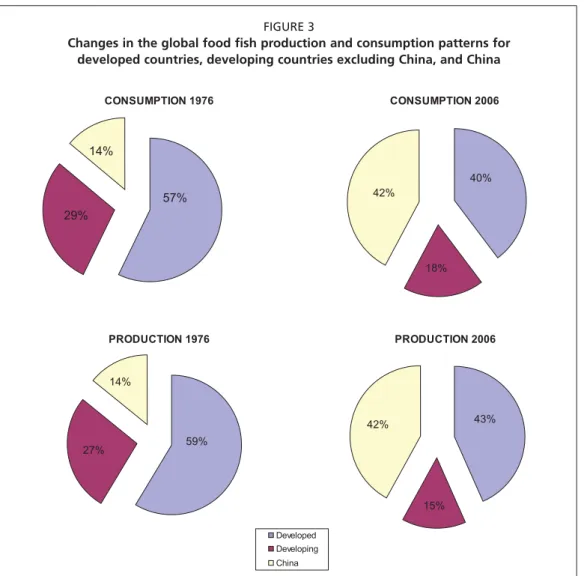
Changes in global food fish production and consumption patterns for developed countries, developing countries excluding China and China. This gain in the relative importance of the aquaculture sector will be indirectly reflected in the associated trade and therefore its relative importance in contributing to food security. Photos show women in the aquaculture processing sector in Vietnam (shrimp) and Myanmar (rohu).
It is likely that the development of aquaculture in the coming decades in South America and Africa will contribute even more to global food security and poverty reduction.
AQUACULTURE PRODUCTION
- Climatic distribution of production
- Environmental-climatic distribution of aquaculture
- Climatic-national-regional distribution of aquaculture
- Value of aquaculture products
- Growth trends in aquaculture
- Aquaculture and GDP
This is largely due to the high growth rate of aquaculture in tropical and subtropical regions, rather than a decline in absolute production in the temperate region per se. In order to obtain a view of the importance of the distribution of aquaculture production in relation to climate regimes (tropical, subtropical and temperate) by continents, the production of the four most important commodities in 2005 was analyzed in accordance with these two factors (Figure 6) . The value of aquaculture commodities produced in the different climate zones followed a similar trend to that of the overall production of each.
Production of each of the main aquaculture products (x106 t) by climate zone and habitat (in five annual intervals from 1980 to 2005).
BRIEF SYNTHESIS OF PREVIOUS STUDIES ON CLIMATE CHANGE EFFECTS ON AQUACULTURE AND FISHERIES
However, it is important to note that the first notable attention to climate change issues in relation to fisheries was made almost a decade ago (Wood and McDonald, 1997). Perhaps the most comprehensive study dedicated to aquaculture and climate change was that of Handisyde et al. In their review of the physical and ecological impacts of climate change on fisheries and aquaculture, Barrange and Perry indicate that significant uncertainties and research gaps remain (see Chapter 1, this section).
Many studies have been conducted on climate change and its impacts on fisheries, which could indirectly affect aquaculture, such as a decline in ocean productivity (Schmittner, 2005).
IMPACTS OF CLIMATE CHANGE ON AQUACULTURE
- Major climatic changes that would potentially impact on aquaculture Not all climatic changes are likely to equally impact fisheries and aquaculture, either
- Facets of aquaculture vulnerability to climate changes
- Direct impacts
- Known direct impacts to date
- Potential impacts
- Indirect impacts of climate change on aquaculture
- Fishmeal and fish oil supplies
- Other feed ingredients used in aquaculture
- Trash fish/low valued fish/forage fish supplies
- Impacts on diseases
- Impacts on biodiversity
- Social impacts of climate change on aquaculture
The largest part of aquaculture in the tropical and subtropical regions is finfish culture (Figure 9). The most important energy costs associated with the cultivation of these organisms are in the transport of the product to the consumer. Estimate fishmeal and fish oil used in aquaculture in the different continents and the aquaculture production per unit use of fishmeal and fish oil.
On the plus side, however, is the possibility that there could be a return, especially in the case of shrimp, to native species such as P.
POTENTIAL IMPACTS OF AQUACULTURE ON CLIMATE CHANGE
- Comparison of carbon emissions/contributions to green house gases from animal husbandry and aquaculture
- Carbon sequestration
The above scenario is not unrealistic and will result in very significant socio-economic impacts on producing countries and the high end of aquaculture production and processing. Admittedly, in the past, mangrove clearing was a major issue related to shrimp farming, but this practice no longer occurs. Likewise, the solid waste produced – organic manure – needs to be managed and this process results in the emission of significant amounts of methane.
The world needs more animal foods, driven by rising incomes and urbanization, especially in the developing world.
