The report combines analysis of the impact of COVID-19 on firms based on a large-scale global survey, with case studies and a thought leader's perspective. Although the pandemic has affected every corner of the world, the economic earthquake caused by COVID-19 does not affect everyone in the same way. For Africa – which needs to create 12-15 million jobs a year to keep up with a growing population – the implications of these employment figures could be catastrophic.
The ITC COVID-19 Business Impact Survey collected evidence on how the pandemic affected 4,467 businesses in 132 countries. The ITC COVID-19 Business Impact Survey found that informal businesses are 25% more likely to say the pandemic is pushing them towards bankruptcy. Most governments are implementing programs to respond to both the health and economic impacts of COVID-19.
About 20% of companies participating in the ITC COVID-19 survey took this approach. About 21% of companies participating in the ITC COVID-19 survey took this approach to cope.
COVID-19: The Great Lockdown and its Impact on Small Business
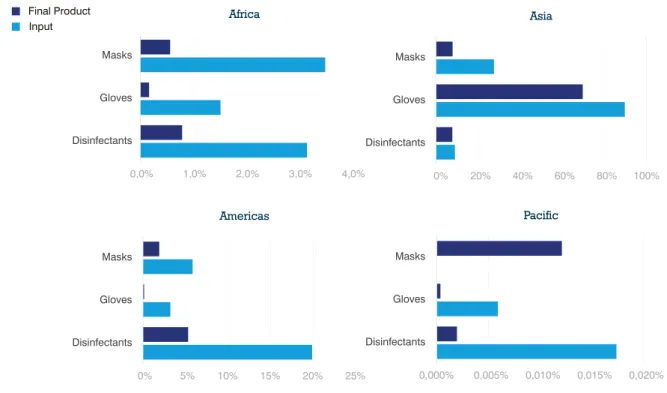
Health services in developing Pacific countries need 4,420 liters of disinfectants per month during the pandemic. Furthermore, the fact that there are only a few countries in the upper right part of the figure shows that global exports of latex and surgical gloves are highly concentrated. The Facebook post now regularly publishes practical advice to help small and medium-sized tourism businesses in Shan State prepare to welcome tourists in the "new normal" of COVID-19.
More than half of companies operating in the primary sector experienced reduced logistics services due to COVID-19 – a higher proportion than in manufacturing and services (Figure 20). This makes it more difficult for companies in the primary sector to reach international markets. This limits the continent's ability to absorb the effects of a sharp downturn in the global economy.
In the medium term, AfCFTA's strategy is to champion the development of a credible pharmaceutical industry capable of meeting Africa's growing demand and even playing a role in the global market. In a sense, the disruption in the global supply chain caused by COVID-19 - and the economic downturn that followed - provides a powerful rationale for the immediate implementation of the AfCFTA, as a means of spurring economic growth and building resilience across the continent.

Shutdown impacts have affected countries and regions where the pandemic led governments to adopt
Countries do not buy or sell goods abroad; Companies do.'34 The slowdown caused by the pandemic primarily affects the real economy, which consists of companies and the people who work for them. To help small and medium-sized enterprises (SMEs), it is useful to think about how the pandemic crisis is affecting such businesses. As small businesses face the COVID-19 crisis, they are going through four phases, one after the other or not.
Supply chain disruptions have affected companies around the world. The pandemic-induced lockdowns in
Demand depression has occurred first in pandemic- affected countries, where confinement reduced sales to
Recovery has begun gradually in instances where containment measures have been eased. The evolution of
Note: Respondents were asked “How has the coronavirus (COVID-19) pandemic affected your business?” and “What is the gender of the company's top executive?” Data on 2,109 companies in 120 countries. SMEs are likely to face more severe resource constraints than larger companies and will therefore have a harder time surviving when adversely affected by the COVID-19 crisis. This contrasts with the severity of impact survey findings, where the percentage of young entrepreneurs who reported being severely affected by COVID-19 was similar to the percentage of the rest of the population.
Ugandan start-ups are part of the solution to the pandemic Start-ups in Uganda are developing innovative online services to help consumers and businesses survive during COVID-19. Source: ITC calculations based on International Monetary Fund World Economic Outlook database (October 2019), Bruegel (2020) 'The fiscal response to the economic fallout from the coronavirus' and International Monetary Fund (2020) 'Policy responses to COVID-19' . In the early days of the pandemic, small and medium-sized businesses around the world responded in similar ways.
Source: ITC calculations based on ITC COVID-19 Business Impact Survey data collected between April 21 and June 2, 2020. Approximately 60% of companies that responded to the ITC COVID-19 survey took this approach to to tackle the coronavirus. The ITC COVID-19 survey shows that small and medium-sized businesses were much more likely to adopt a flexible response to the crisis than larger companies (Figure 30).
The fact that small businesses were more likely to be agile or to withdraw can be explained by another fact: they were significantly more likely to expect to go bankrupt due to the COVID-19 crisis. SheTrades, the ITC women's economic empowerment initiative, launched an emergency webinar series on the business impact of the pandemic. Business support organizations can provide information about COVID-19 from a business perspective, perhaps through a specialized webpage.
The COVID-19 crisis has also highlighted the need to increase the resilience of systems for the delivery of goods and services. Contagion of the COVID-19 virus and the economic consequences of its containment are causing many to reconsider established systems and priorities. Sustainability is likely to be more important in the post-pandemic global economy, and retrofitting for COVID-19 sanitation requirements and environmental friendliness may be prudent.61.

COUNTRY PROFILES
Definitions
Competitiveness is the demonstrated ability to design, produce and commercialize an offering, which fully, uniquely and continuously meets the needs of targeted market segments, while connecting with the business ecosystem and extracting resources, and a sustainable return on the resources used are achieved. For further details on the correspondence between products and sectors, see ITC Export Potential Map online. Natural latex and rubber Paper products Plastic and rubber Wood and vegetable materials Wood products.
Data sources
Methodological note for country profiles
In the absence of detailed production data, calculations are based on the value of imported inputs when it is below the value of required inputs, and on the value of required inputs in case imported inputs exceed the value. The estimate uses the 2019 annual trade reported in the ITC Trade Map from 85 countries and territories. Analysis of the remaining 60 countries, for which 2019 data are not available, is based on reported 2018 trade data.
Direct and mirror data are consolidated as follows: a simple average is used to average direct and mirror data when both reporting countries are reliable reporters and when both countries are considered unreliable reporters. Assuming that the CIF/FOB ratio is small in the reports of the same bilateral trade flow, the reliability of the reported trade is detected as follows. Each country's absolute difference between direct and mirror bilateral trade reports (separately for exports and imports) is estimated for each product and with each partner.
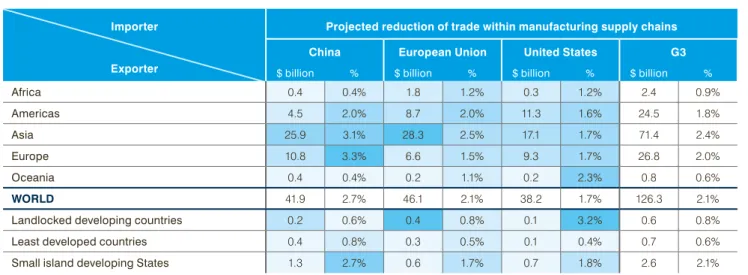
If this difference (weighted by the partner's reliability) accounts for more than half of the country's total exports or imports, the rated country "loses" its reliable reporter status. Projected annual supply chain trade reductions in 2020 are based on the assumption that the world's three major supply chain trade hubs (China, the EU and the US – the G3, which represent 63% of supply chain imports and 64% of supply chain exports) experience in 2020 the equivalent of a two months-long complete shutdown of all manufacturing production. Based on this assumption, the dollar value of the supply chain disruption is calculated to be 17%.
The data for the European Union includes the EU27 and the United Kingdom, for consistency across time periods. The direct shock concerns the first direct links of the international supply chains and does not take into account the contagion of the supply chain, i.e. the methodology is forward-looking (projects what is likely to happen in 2020) and is based on the assumptions about the future, which may not last.
In addition, the underlying links in the supply chain (the inputs required to produce each output) and the technical coefficients that determine how much of each input is required are assumed to be the same across countries. They are calculated using the input-output matrices of Mexico, the Philippines, and the United States (due to data availability), which may not correspond to the technical coefficients and production structure of other countries. Given the caveats and assumptions noted above, the numbers on international supply chain disruptions caused by G3 plant shutdowns due to the COVID-19 disease should be viewed as an indication of the order of magnitude of potential disruption in 2020, rather than a direct dollar value of the disruption.
Data availability for analysed countries and regions
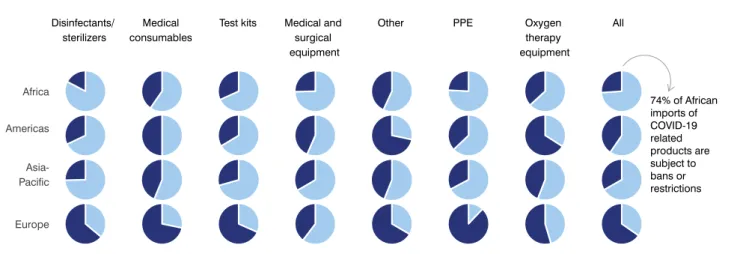
It considers a scenario in which G3 countries resume full industrial production after the first wave of COVID-19 passes, which could be optimistic if the world plunges into recession or multiple waves of infection. Lib' indicates liberalizing trade policy measures, while 'res' indicates restrictive trade policy measures introduced in response to COVID-19. The ITC COVID-19 Impact Survey and monitoring of the trade-related measures is ongoing; the analysis in this report is based on the survey data from June 2, 2020, and policy data from May 4.
Retrieved from https://www.cnbc.com the-oil-plunge-is-the-last-thing-boeing-and-airbus-needs-on-top-of-the-coronavirus-pandemic.html. Some of the world's airlines may go bankrupt due to the COVID-19 crisis, according to an aviation consultancy. COVID-19 outbreak brings attention back to the informal sector: Over 90% of the country's total workforce is in the informal sector.
How can cash transfers support workers in the informal sector in the COVID-19 (Coronavirus) crisis?' Work and development. Retrieved from https://www.imf.org/en/Topics/imf- and-covid19/Policy-Responses-to-COVID-19. Covid-19 crisis exposed weaknesses in supply chains: Companies with pricing power will be best insulated as production moves closer to home.
Build a resilient supply chain: How to apply lessons from business disruptions to the COVID-19 situation. Retrieved from https://www.controlrisks.com/covid-19/the-impact-on-workers-in-global-supply-chains. The Heterogeneous Impact of COVID-19 on Firms: Evidence from a Global Study (ITC Working Paper Series WP-02-2020.E).
Using private sector development to achieve a green recovery in the context of the COVID-19 pandemic. The role of supply chains in COVID-19-related trade disruptions (ITC Working Paper Series WP-01-2020.E).