EMBARGOED until 10:00 GMT
on Wednesday, 9 January 2013
Global and regional statistics and the extent of legal protection
International Labour Office Geneva
Libraries, institutions and other users registered with reproduction rights organizations may make copies in accordance with the licences issued to them for this purpose. Visit www.ifrro.org to find the reproduction rights organization in your country.
Domestic workers across the world: global and regional statistics and the extent of legal protection / International Labour Office – Geneva: ILO, 2013
146 p.
International Labour Office;
domestic worker / employment / data collecting / definition / methodology / working conditions / labour legislation / comment / developed countries / developing countries
13.11.6
ISBN 978-92-2-125273-3 (print) ISBN 978-92-2-125274-0 (web pdf)
ILO Cataloguing in Publication Data
The designations employed in ILO publications, which are in conformity with United Nations practice, and the presentation of material therein do not imply the expression of any opinion whatsoever on the part of the International Labour Office concerning the legal status of any country, area or territory or of its authorities, or concerning the delimitation of its frontiers.
The responsibility for opinions expressed in signed articles, studies and other contributions rests solely with their authors, and publication does not constitute an endorsement by the International Labour Office of the opinions expressed in them.
Reference to names of firms and commercial products and processes does not imply their endorsement by the International Labour Office, and any failure to mention a particular firm, commercial product or process is not a sign of disapproval.
ILO publications and electronic products can be obtained through major booksellers or ILO local offices in many countries, or direct from ILO Publications, International Labour Office, CH-1211 Geneva 22, Switzerland. Catalogues or lists of new publica- tions are available free of charge from the above address, or by email: [email protected]
Visit our website: www.ilo.org/publns
Photocomposed in Switzerland JMB
Printed in Switzerland ATA
Enhancing our knowledge on domestic work lays a solid basis for action that can make a difference in the lives of domestic workers. For too long, this group – a large majority of whom are women – has remained outside the realm of policy-making on social and labour issues, and has largely been confined to the informal economy. Since they work behind the closed doors of private households, domestic workers are shielded from public view and attention, and are often hard to reach by conventional policy tools.
However, this should not be used as a convenient excuse for inaction. In the words of the ILO’s Director-General, “[t]he ILO’s mandate requires it to reach out to those who are most vulnerable, who face great insecurity and for whom the denial of social justice is most cruel”. Numbering at least 53 million, domestic workers are one group of work- ers that deserve our attention.
In an unprecedented manner, this report attempts to capture the size of the domestic work sector and the extent of legal protection enjoyed by domestic workers on the basis of a verifiable and replicable methodology. Its findings contribute to over- coming the invisibility of domestic workers and carry a powerful message: domestic work represents a significant share of global wage employment, but domestic workers remain to a large extent excluded from the scope of labour laws and hence from legal protection enjoyed by other workers. Marginalization and exclusion is a theme that runs through the findings of this report. For instance – more than half of all domestic workers have no statutory limitation of their weekly working hours, more than two out of five are not entitled to be paid a minimum wage, and more than a third have no right to take maternity leave. From a human rights and gender equality perspective, this is inacceptable.
The Domestic Workers Convention (No. 189) and the accompanying Recommen- dation (No. 201), both adopted in 2011, offer a historic opportunity to make decent work a reality for domestic workers worldwide. Addressing exclusions from working conditions laws is an important focus in this regard and the statistics presented here set a benchmark against which future progress can be measured. As documented in this volume, extending labour law coverage to domestic workers is indeed feasible and many countries have already done so in the past. Since the adoption of Convention No. 189 and Recommendation No. 201, many countries have embarked on the ratifi- cation process and have pursued new legislative and policy reforms guided by these instruments, which is encouraging.
This report is the outcome of collaboration between lawyers, statisticians and working conditions specialists, and between many different units from within the ILO.
It clearly shows the value of an integrated perspective. It is part of a broader effort by the ILO to support the tripartite constituents – governments and workers’ and employ- ers’ organizations – under its Global strategy for action on decent work for domestic
workers. It is hoped the report, and other tools available through the global web-portal on domestic work (www.ilo.org/domesticworkers), will usefully assist ILO constitu- ents and partners in their efforts to secure social justice and decent work for domestic workers across the world.
Philippe Marcadent Chief,
Conditions of Work and Employment Branch (TRAVAIL)
Preface. . . v
Contents . . . vii
List of figures . . . ix
List of tables. . . x
List of boxes. . . x
Acknowledgements . . . xi
Chapter 1. Introduction . . . 1
Part I. Global and regional statistics 5 Chapter 2. Definitions, sources and methodology . . . 7
Definition of domestic workers . . . 7
Data sources . . . 11
Methodology for global and regional estimates. . . 16
Chapter 3. Global and regional estimates. . . 19
Global overview: Domestic workers across the world. . . 19
Trends from 1995 to 2010 . . . 24
Latin America and the Caribbean . . . 24
Asia and the Pacific . . . 28
Middle East . . . 31
Africa . . . 33
Developed countries, Eastern Europe and CIS . . . 35
Summary: Rising employment in a vulnerable sector . . . 39
Part II. The extent of legal protection 41 Chapter 4. National labour legislation and domestic workers . . . 43
New international instruments for the protection of domestic workers. . . 43
Exclusion of domestic workers from legal protections . . . 46
Methodology for the legal coverage estimates. . . 48
The scope of national labour legislation . . . 50
Chapter 5. Working time . . . 55
Domestic workers: Working day and night? . . . 56
Current working time regulation for domestic workers. . . 59
– Normal weekly hours . . . 60
– Weekly rest . . . 62
– Paid annual leave . . . 64
Summary . . . 66
Chapter 6. Minimum wages and in-kind payments. . . 67
Wages of domestic workers and reasons for low pay . . . 67
Minimum wages. . . 73
In-kind payments . . . 81
Summary . . . 84
Chapter 7. Maternity protection . . . 85
Maternity leave . . . 86
Maternity cash benefits . . . 88
Other elements of maternity protection . . . 91
Conclusions and points for consideration . . . 93
Chapter 8. Summary and conclusions . . . 95
References. . . 99
Appendices Appendix I: Methodology for global and regional estimates . . . 107
a) Concepts and definitions . . . 107
b) Global and regional estimates on the number of persons employed as domestic workers. . . 108
– Census approach . . . 108
– Estimation of country-level statistical data for 2010 . . . 110
– Treatment of non-response for statistical data . . . 111
– Estimating routine for global and regional estimates . . . 113
c) Estimates on the coverage of domestic workers by key working conditions laws . . . 114 – Treatment of non-response and estimation routine for legal coverage estimates . 115
Appendix II: National source statistics . . . 117 Appendix III: Coverage of domestic workers under national legislation . . . 131
List of figures
Figure 3.1 Distribution of domestic workers by sex and region, 2010 . . . 21 Figure 3.2 Total employment and employment of domestic workers in Spain,
1995–2011 . . . 36 Figure 4.1 Coverage of domestic workers by national labour legislation
across the world, 2010 . . . 51 Figure 5.1 Average hours of work for domestic workers, per week
(latest available year) . . . 57 Figure 5.2 Limitation of normal weekly hours of work for domestic workers
under national legislation, 2010 . . . 61 Figure 5.3 Entitlement to weekly rest (at least 24 consecutive hours)
for domestic workers under national legislation, 2010 . . . 63 Figure 5.4 Entitlement to annual leave for domestic workers
under national legislation, 2010 . . . 65 Figure 6.1 Average wages of domestic workers, in per cent of average wages
for all paid employees (latest available year) . . . 68 Figure 6.2 Member organizations of the International Domestic Workers’ Network
(IDWN), May 2012 . . . 72 Figure 6.3 Trends in real minimum wages and real average wages
of domestic workers in Brazil, 1995–2011 (in constant 2010 BRL) . . . 74 Figure 6.4 Minimum wage coverage for domestic workers, 2010 . . . 78 Figure 6.5 Permissible in-kind payments of minimum wages, 2010 . . . 82 Figure 7.1 Entitlement to maternity leave for domestic workers
under national legislation, 2010 . . . 87 Figure 7.2 Entitlement to maternity cash benefits for domestic workers
under national legislation, 2010 . . . 89
List of tables
Table 2.1 Coverage of the ILO’s statistical database on domestic workers, 2010 . . . 12
Table 2.2 India: Employment by industry subcategories and sex, 2004/05 (NIC 2004) . . . 15
Table 3.1 Global and regional estimates on the number of domestic workers in 2010, by sex . . . 20
Table 3.2 Estimates of number of children in domestic work by age and sex, 2008 . 22 Table 3.3 Global and regional estimates on the number of domestic workers in 1995 and 2010, by sex . . . 25
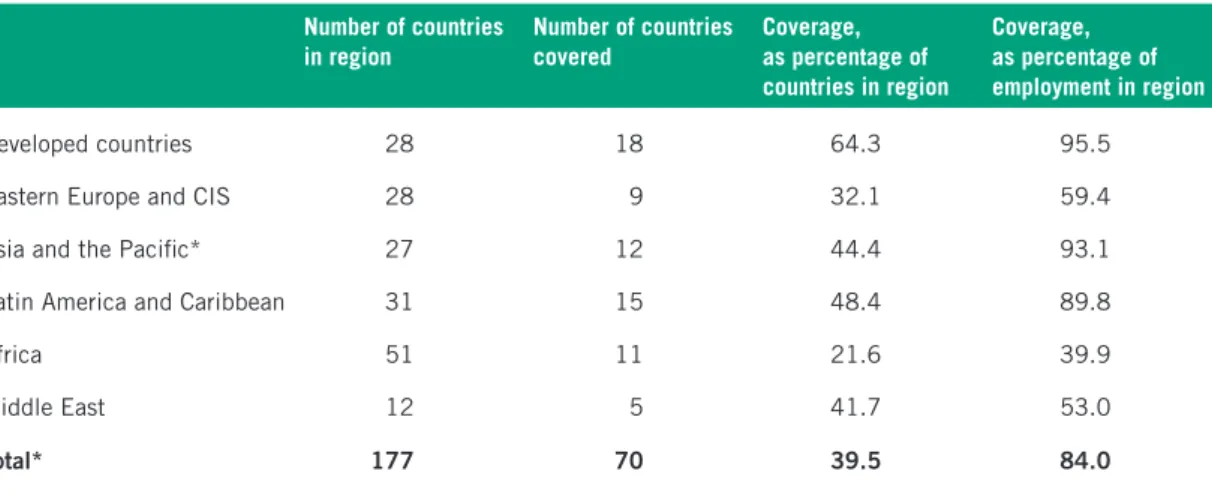
Table 4.1 Coverage of the combined statistical and legal database on domestic workers, 2010 . . . 49
List of boxes Box 2.1 How to count domestic workers? Alternative approaches to identifying domestic workers in household surveys . . . 9
Box 2.2 India: 2.5 or 90 million domestic workers? . . . 14
Box 3.1 Measuring child domestic work . . . 22
Box 4.1 Severe forms of exploitation and forced domestic labour . . . 45
Box 6.1 Towards strong and effective domestic workers’ organizations . . . 71
Box 6.2 Minimum wage increases and domestic workers in Brazil . . . 74
Box 6.3 The Wages Commission for Domestic Workers in Namibia . . . 77
This report was prepared by the Conditions of Work and Employment Branch (TRAVAIL) of the ILO Social Protection Sector with contributions from other techni- cal units at the ILO’s Geneva headquarters and many field offices. Work on the report was coordinated by Malte Luebker, who is also its principal author. Yamila Simonovsky (co-author) was responsible for compiling data from national sources into the statistical database that underlies the estimates presented in this report. Martin Oelz (co-author) advised on all legal questions and oversaw the coding of legal information, which was carried out by Andres Nunes Chiab, Dimity Leahy and Raul Maldonado Zafra.
In addition, this report heavily relies on contributions (some of which have been previously published in various policy briefs) from Laura Addati and Lindsay Tina Cheong (maternity protection), Amanda Aikman (forced labour), Uma Amara Rani (India), Janine Berg (minimum wages in Brazil), Yacouba Diallo (child domestic work), Miranda Fajerman (pay equity), Claire Hobden (domestic workers’ organiza- tions) and Amelita King-Dejardin (working time). Monica Castillo (Department of Statistics) advised on statistical definitions and the estimation methodology. Numerous counterparts in National Statistical Offices provided data and detailed information on sources. Steven Kapsos and Evangelia Bourmpoula shared data from the ILO’s Global Employment Trends (GET) model, and Bolívar Pino and Rigoberto García extracted wage data from the ILO/SIALC database.
Very helpful comments on draft versions were received from Patrick Belser, Monica Castillo, Sukti Dasgupta, Naj Ghosheh, Saadya Hamdani, Nelien Haspels, Annamarie Kiaga, Sangheon Lee, Jon Messenger, Yoshie Noguchi, Anna Olsen, José Maria Ramirez Machado, Anni Santhiago, Kuanruthai Siripatthanakosol, Max Tunon and Faustina Mukazi Vanaperen. Three unnamed peer reviewers contributed greatly to the improvement of the initial draft version. Charlotte Beauchamp, Chris Edgar and Coralie Thompson coordinated the editing and publication of the report.
Improving working conditions for domestic workers is a long-standing concern of the International Labour Organization. The topic first gained prominence in 1936, when the International Labour Conference adopted the Holidays with Pay Convention, 1936 (No. 52), which established the right to six days of paid leave for workers in manufac- turing and a range of other industries. The Convention excluded domestic workers, a shortcoming that prompted the Conference to request that “the question of holidays with pay for domestic servants [be put] on the Agenda of […] a future Session of the Conference […] and to consider at the same time whether other conditions of domes- tic servants’ employment could form the subject of international regulation”. 1 As a delegate argued at the time, “domestic servants […] are wage-earners, and therefore entitled to protection in the same way as other wage-earners”. 2
While many aspects of domestic work are unique, this argument remains as valid today as it was 75 years ago. However, as this report shows, many domestic work- ers are still excluded from provisions that other workers take for granted with respect to essential working conditions, such as paid annual leave, working time, minimum wage coverage and maternity protection. Moreover, the prediction that “the problem of domestic service is being gradually and slowly solved—by the working-men and women refusing to render such service” has turned out to be false (Rubinow, 1906, p. 504). Guaranteeing these minimum labour protections to the large and growing group of domestic workers and recognizing their rights as workers are at the heart of the Domestic Workers Convention, 2011 (No. 189), and the accompanying Recommenda- tion (No. 201). Adopted by the 100th Session of the International Labour Conference, these two historic documents are the first international labour standards specifically devoted to domestic workers, a particularly vulnerable and still often neglected group.
Within just over a year after its adoption, three countries – Uruguay, the Philippines and Mauritius – have ratified the Convention, which will enter into force in September 2013. 3 Further ratifications are expected in the near future; in the Plurinational State of Bolivia and Nicaragua the Parliaments have already approved the Convention, and in South Africa the National Economic Development and Labour Council (NEDLAC) and the Cabinet have approved ratification. In total, at least 20 other countries have initiated ratification procedures or are taking steps in this direction. 4
1 See Resolution concerning Holidays with Pay for Domestic Servants, submitted by the Committee on Holidays with Pay, adopted by the International Labour Conference, 20th Session (Geneva, 4–24 June 1936).
2 International Labour Conference, 20th Session (Geneva, 1936), Records of Proceedings, p. 465.
3 The instruments of ratification were received on 14 June 2012 (Uruguay), 5 Sep. 2012 (Philippines) and 13 Sep. 2012 (Mauritius). Under Article 21 of the Domestic Workers Convention, 2011 (No. 189), it will come into force 12 months after the date on which the ratifications of two Members have been registered with the ILO’s Director- General.
4 Based on information entered into an internal ILO database that monitors national developments.
This report provides a benchmark for the situation of domestic workers across the world against which progress in implementing the new instruments can be measured.
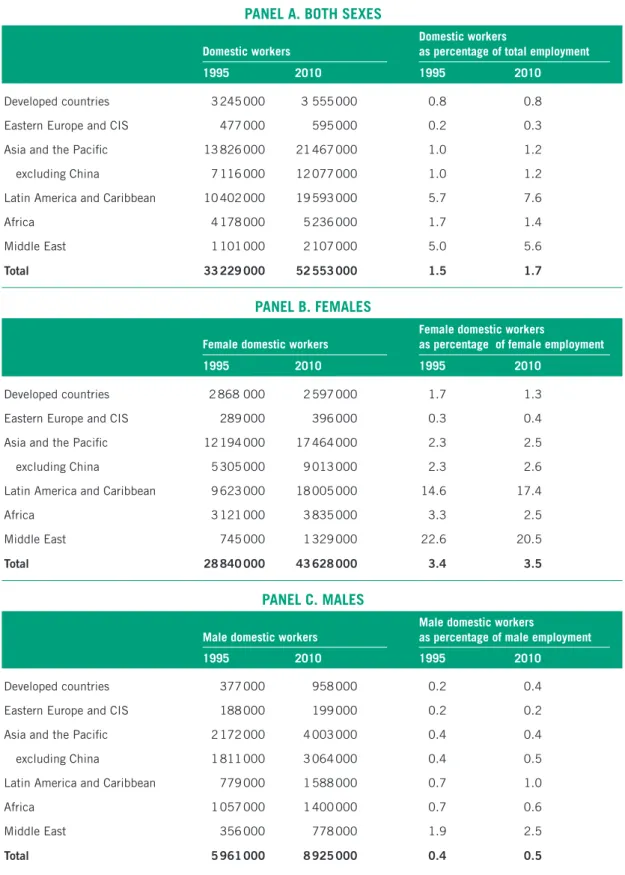
In its first part, it takes stock of global and regional statistics on domestic workers to answer two fairly basic, yet fundamental questions: How many domestic workers are there? How has their number evolved over time? To arrive at some answers, it starts by defining domestic workers in statistical terms and identifies measurement issues that are likely to create a downward bias in global and regional statistics (see Chapter 2). It then presents new ILO estimates on the number of domestic workers across the world, totalling at least 52.6 million men and women across the world in 2010. This represents an increase of more than 19 million since the mid-1990s. Most strikingly, domestic work accounts for 7.5 per cent of women’s wage employment world-wide, and a far greater share in some regions (Chapter 3).
Extending the protections that are available to other workers to domestic workers will address decent work deficits for a vulnerable group of workers. Many ILO instru- ments, including fundamental Conventions regarding freedom of association, discrimi- nation and the abolition of child labour and forced labour, apply to all workers and hence already cover domestic workers. 5 However, some are directed towards specific sectors – for instance, industry, commerce and offices, or agriculture – and hence do not cover domestic workers, while others allow for the exclusion of domestic workers from their scope. The new Domestic Workers Convention, 2011 (No. 189), seeks to close to this gap. Given the highly feminized nature of the sector, the Convention is widely seen as having great potential for achieving greater gender equality in the in the world of work. Providing domestic workers with stronger rights and recognizing them as work- ers would help to combat gender-based discrimination, and also discrimination on the grounds of race, national extraction or caste that often manifests itself in the sector.
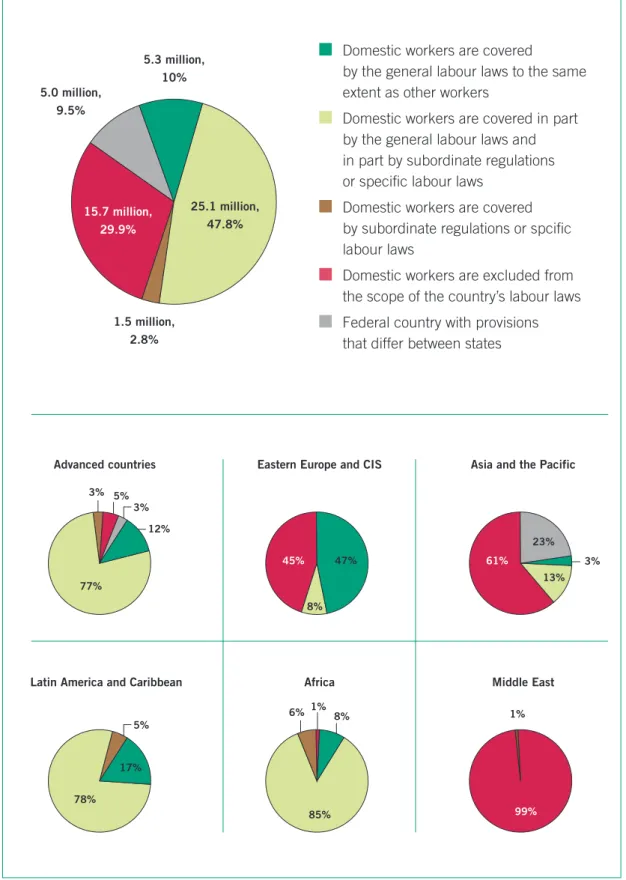
In light of the above, the second part of this report discusses the extent of legal protection for domestic workers with respect to minimum standards for working condi- tions. The legal coverage estimates presented in Part II of this volume are based in large part on data collected for the standard-setting process and on the ILO’s Data- base of Conditions of Work and Employment Laws.6 The findings show that domestic workers are frequently excluded from the scope of the labour laws or are only covered by less favourable legislation (see Chapter 4). This has negative consequences for domestic workers with respect to a number of working conditions, including working time. Indeed, the research conducted for this report confirms that domestic workers are frequently expected to work longer hours than other workers and do not have the same rights to weekly rest that are enjoyed by other workers (see Chapter 5).
Given that domestic workers are particularly vulnerable to exploitation and are among the lowest-paid workers, it is ironic that they frequently find themselves excluded from minimum wage coverage. Domestic workers often also have to accept deductions from their salaries for the costs of housing and food – even when living
5 The Preamble of Convention No. 189 reiterates that “international labour Conventions and Recommendations apply to all workers, including domestic workers, unless otherwise provided”.
6 Available online free of charge at http://www.ilo.org/dyn/travail/travmain.home.
in the employer’s household is a requirement that primarily benefits the household (see Chapter 6). Another example of unequal treatment is the exclusion from maternity leave and the associated maternity cash benefits. Given that more than 80 per cent of all domestic workers are women, this is an important shortcoming. While domestic workers often enable others to improve their balance of work and family obligations, domestic workers themselves are often excluded from crucial provisions: more than one-third of all domestic workers themselves have no right to go on paid maternity leave (see Chapter 7). Furthermore, the implementation gaps in many countries means that the effective protection is probably even weaker than these figures suggest.
While this report is clear in pointing out current gaps in protection, it does not fall into a pessimistic tone. Quite the contrary: it provides examples of what govern- ments – and also trade unions and employers’ federations – have done to improve the situation for domestic workers. More case studies can be found in the accompanying publication Effective protection for domestic workers: A guide to designing labour laws (ILO, 2012a) and a number of other materials published by the ILO. These comple- mentary materials are concerned not only with how countries can bring labour legisla- tion into line with the new international standards, but also with the creation of effec- tive implementation mechanisms that can make these rights protections a living reality for domestic workers across the world. Other ILO activities focus on other dimensions of domestic workers’ rights, including their right to join organizations of their own choosing. The appendices to the current report document the methodology that was used to produce the global and regional estimates and the underlying statistical and legal information at the county level. The information can be used as a benchmark for progress made with respect to three important aspects of working conditions – wages, working time and maternity protection – that form the core of the mandate of the ILO’s Conditions of Work and Employment Branch (TRAVAIL).
In order to arrive at a reliable and verifiable estimate for the number of domestic work- ers across the world and within each region, three important issues have to be addressed.
First, the term “domestic worker” has to be defined and translated into a statistical concept. Second, suitable national data sources have to be identified and statistics need to be gathered from as many countries as possible. Third, national figures need to be aggregated to obtain regional and global estimates on the basis of a solid methodology that takes into account the remaining data gaps. This chapter will address these three issues in turn, highlighting that some problems in national data collection are likely to exert a downward bias on the global and regional estimates (which should therefore be seen as conservative estimates).
Definition of domestic workers
When setting out to estimate the number of domestic workers, it is important to translate what we understand by domestic workers and domestic work into an operational, statisti- cal definition that enables us to compile comparable data from a broad range of countries.
This is no small undertaking, since domestic workers are not a homogenous group. This holds true not only with respect to their demographic profile (age and gender, as well as migration status), but also for the nature of their jobs – they perform tasks as varied as cleaning, looking after elderly people or children, guarding the house, driving children to school, gardening or cooking and beyond. Therefore, when defining the term “domestic worker”, the delegates to the International Labour Conference did not rely on a listing of the specific tasks or services performed by domestic workers, which vary from country to country and may change over time.7 Rather, they supported a general formulation that draws on the common feature of domestic workers that they work for private households. 8
7 The Committee decided that the use of the terms “domestic workers” and “domestic work” was best suited for an international labour standard. At the same time, countries continue to be able to use terminology most suited in their context (see ILO, 2010a, p. 15). In some countries the concept of “domestic” work has pejorative connotations.
For instance, in a number of Spanish-speaking countries the term “trabajo doméstico” is not used for this reason.
This also explains the inclusion, as a negotiated compromise, in the Spanish text of the Convention of a footnote that stating that the International Labour Conference considers the term “trabajora o trabajador del hogar” as synony- mous with the term “trabajadora o trabajador domesticó”.
8 While in many countries the legislation specifies that the employer must be a natural person, in other cases the employer can be the entire family/household (e.g. Brazil and Bulgaria) or even a representative or agent of the natural person (e.g. Barbados). Moreover, according to some legislation, the employer may be a third party, such as a recognized health-care agency (e.g. United States). (See ILO, 2010a, p. 35.) In this particular case, domestic workers – often migrants – still share the feature of working for a private household, but instead of being employed by the household directly, they are engaged in a triangular employment relationship, where the agency acts as an interme- diary by receiving the payment from the household and, subsequently, compensating the worker after making all the corresponding social security contributions.
The Domestic Workers Convention, 2011 (No. 189), reflects this when it defines “domes- tic workers” in Article 1:
(a) the term “domestic work” means work performed in or for a household or households;
(b) the term “domestic worker” means any person engaged in domestic work within an employment relationship;
(c) a person who performs domestic work only occasionally or sporadically and not on an occupational basis is not a domestic worker.
The simple, but very distinctive feature of being employed by and providing services for a private household is therefore at the heart of the Convention’s definition.
It is narrow in scope, since it excludes workers who provide care services in institutions such as orphanages, kindergartens, hospitals and old-age retirement homes (which, arguably, are part of a broader care economy; see Razavi and Staab, 2010). The restric- tion of domestic work to private households also provides a convenient way to identify domestic workers under the International Standard Industrial Classification (ISIC). The still widely used Revision 3.1 contains the division “Activities of private households as employers of domestic staff” (Division 95), which corresponds to the definition in the Convention. 9 It captures:
the activities of households as employers of domestic personnel such as maids, cooks, waiters, valets, butlers, laundresses, gardeners, gatekeepers, stable-lads, chauffeurs, caretakers, governesses, babysitters, tutors, secretaries etc. It allows the domestic personnel employed to state the activity of their employer in censuses or studies, even though the employer is an individual.10
Making use of the industry-based approach has several advantages over the main alternatives, which rely on tasks and occupations, the status in employment or the household roster (see box 2.1). First, the industry-based approach draws on the one characteristic that is common to all domestic workers, namely being employed in or by a private household or households – in other words, that they are in an employment relationship with a private household (even though it might sometimes be disguised).
This is more suitable than identifying domestic workers on the basis of their occupa- tion. Although some occupations are predominantly performed within households (see ILO, 2010a, box III.1), others can also be performed outside the home – a cook can also work in a restaurant, a gardener in a flower nursery and a gatekeeper at an office building. This makes it difficult to distinguish domestic workers from other workers
9 Published in 2008, ISIC Revision 4 includes Division 97 “Activities of households as employers of domestic personnel”; however, its definition is identical to that of ISIC Revision 3.1 Division 95, despite the slight modifica- tion to the title. ISIC Revision 4 was developed for use during the 2010 Population Census round, but it has not yet been adopted by many national statistical offices around the world. For more information on ISIC, please see: http://
unstats.un.org/unsd/cr/registry/regcs.asp?Cl=27&Lg=1&Co=9700.
10 See ISIC, Revision 3.1., Definition of class 9500 available at http://unstats.un.org/unsd/cr/registry/regcs.
asp?Cl=17&Lg=1&Co=9500. Class 9500 is the only class in Division 95. Also see Appendix I for correspondences between the different revisions of ISIC.
Box 2.1 How to count domestic workers? Alternative approaches to identifying domestic workers in household surveys
This box introduces a number of different approaches to identifying domestic workers on the basis of existing statistical classifications.
Task-based approach. The International Standard Classification of Occupations (ISCO-88 and ISCO-08) is sometimes used to identify domestic workers on the basis of their occupation. In par- ticular, the occupations “Housekeepers and related workers” (ISCO-88, code 5121), “Home-based personal care workers” (5133), and “Domestic helpers and cleaners” (9131) include typical tasks performed by domestic workers. In addition, “Child-care workers” (5131) have often been included because they “take care of employers’ children and oversee their daily activities” (see ILO, 2010a, p. 30). However, child-care workers also “engage in helping teachers to look after schoolchildren”, which falls outside the definition of domestic workers. Moreover, cooks, drivers and gardeners are not captured by the task-based approach because their occupations are not specific to households.
Excluding these occupational categories would undercount domestic workers, but including them would count also those not working for private households, which would lead to an overestimate.
Another drawback of the task-based approach is that it requires very detailed occupational data (at the four-digit level), which are only rarely available in published sources.
Status-in-employment approach. This is frequently used in Latin America, where many countries have adapted the International Classification by Status in Employment (ICSE-93) to distinguish between domestic workers and other employees. For example, Brazil’s Instituto Brasileiro de Geografia e Estatística (IBGE, 2010, p. 32) defines domestic workers as “persons who worked providing domestic services paid in cash or kind in one or more housing units”. In fact, in a recent publication, Domestic workers in Latin America: Statistics for new policies, Tokman (2010) utilized this approach. While this approach is useful, and for many countries delivers the same results as the industry-based approach,1 the distinction between domestic workers and other employees is not commonly made outside Latin America. This approach therefore cannot be used outside this region.
Household-roster approach. Some countries identify live-in domestic workers in the household roster of labour force survey (LFS) questionnaires, which notes down the relationship of each house- hold member to the household head (see for example the Philippines LFS). Where this is done, the household-roster approach can be used to identify domestic workers who live in their employer’s household. However, this approach will not capture live-out domestic workers, who do not stay with their employer, but have their own household and commute to work (and thus appear, for example, as household head or spouse in the household roster). Moreover, it is not clear whether domestic workers should be considered household members in the first place, even if they live in the same dwelling unit as their employer. The System of National Accounts (SNA-2008, paragraph 4.149) defines a household as “a group of persons who share the same living accommodation, who pool some, or all, of their income and wealth and who consume certain types of goods and services col- lectively, mainly housing and food”. Arguably, few employers share their income and wealth with domestic workers in the same way that they do with family members.
Industry-based approach. Finally, the International Standard Industrial Classification of all Economic Activities (ISIC, Revision 3.1) groups “Activities of private households as employers of domestic staff” in Division 95 (see discussion in the main text). The industry-based approach draws on a common characteristic of domestic workers – that they work in or for a household – and
solely on the basis of their occupation, and so, depending on whether these occupations are included or excluded, one would risk over- or undercounting domestic workers.
A second advantage of the industry-based approach is that it imposes relatively low requirements for the level of detail in statistical data. A disaggregation of the data at the one- or two-digit level is generally sufficient to identify domestic workers in published data from labour force or other household surveys. 11
The main drawback of the industry-based approach is that domestic workers who have an employment contract with a service agency (rather than with the household itself) are in theory excluded from the scope of Division 95. This triangular form of employment relationship is now common in some parts of Europe, most notably in Belgium (see discussion below and in Tomei, 2011). Likewise, in Asia and the Middle East, domestic workers are often recruited though agencies (but not necessarily employed by them). However, in practice, domestic workers deployed by an agency to a private household are often included in this division due to the lack of a suitable alter- native category. Therefore, the risk of undercounting this particular group of domestic workers is small.
11 In Revision 3 of ISIC, Division 95 coincides with Section P “Private households with employed persons” and a disaggregation at the one-digit level is therefore sufficient. In Revisions 3.1 and 4 of ISIC, “Activities of private households as employers of domestic staff” and “Activities of households as employers of domestic personnel”, respectively, were combined with undifferentiated production activities of private households into single sections (Sections P and T, respectively). Therefore, if using ISIC Revision 3.1 or 4, data at the two-digit level would be ideal.
Nonetheless, most goods-producing activities of private households for own consumption are classified in Section A (“Agriculture, hunting and forestry”), and service-producing activities other than paid domestic work are mainly unpaid household work by members of the household (which is not considered employment). Conceptually, there- fore, employment data classified in Section P (Rev. 3.1) or Section T (Rev. 4) should largely coincide with Section P under Revision 3 of ISIC.
captures quite well the common understanding of what a domestic worker is. It goes a long way to addressing the shortcomings of the task-based approach and the household-roster approach. Data on employment by industry are also available for many countries throughout the world (either under ISIC or under related classifications of economic activity, such as the North American Industry Classification System, NAICS), which makes it possible to generate comparable data across regions (unlike the status-in-employment approach, the use of which is limited to Latin America).
While the industry-based approach is best suited as a basis for global and regional estimates, the alternative ways of identifying and counting domestic workers can be useful for certain types of studies – in particular for single-country studies based on micro-data. For instance, a house- hold roster can be useful for identifying live-in domestic workers, and cross-tabulations of occu- pation and industry can provide a more differentiated picture of the types of tasks carried out by domestic workers.
1 For instance, in the case of Brazil the same number of domestic workers is obtained using either ISIC or the national adaptation of ICSE.
The global and regional estimates presented in this report therefore rely primarily on the industry-based approach: domestic workers are defined as workers employed by private households in the sense of ISIC Revision 3.1, Division 95.12 Since only persons of working age are counted as employed in labour statistics, this definition excludes children below the legal age for general admission to employment (see box 3.1 for separate estimates of child domestic workers). Likewise, the available source statistics (discussed in the next section) usually refer to the main job-holding of a worker, rather than all jobs. This means that workers who supplement their main source of income by taking up a second job as a domestic worker will usually be excluded from the scope of the estimates. As a result, those who perform domestic work only occasionally or sporadically are also omitted from the estimates.13
The industry-based approach is therefore a very close statistical equivalent of the definition of domestic workers used in the new international labour standards. Although some differences exist between countries in the use of the industry classification and in the precise definition of employment, this uniform approach should yield fairly consist- ent and comparative data on persons employed as domestic workers in their main job.
The data refer to men and women of working age (and hence exclude child domestic workers under the age of 15 years) and would often (but not always) include domestic workers employed by agencies (rather than the household itself).
Data sources
In many countries, the number of domestic workers is a contentious issue. One outstand- ing example is India, where figures frequently cited by non-governmental organizations (NGOs) and the media range from 2.5 million to 90 million domestic workers (see box 2.2). As Schwenken and Heimeshoff (2011) have shown in a recent compilation, esti- mates by NGOs and the media often substantially diverge from the statistics published by national statistical offices (NSOs). While there are reasons to believe that some NSOs undercount domestic workers (see discussion below), a major drawback of non- official figures is that it is usually not possible to verify the source or estimation method they are based on. One also needs to bear in mind that they are often produced for advo- cacy purposes, and could hence – whether with justification or not – be criticized as biased. In line with the objective of producing reliable and verifiable estimates, the new global and regional estimates therefore draw exclusively on official sources – although these are likely lead to a more conservative estimate of the extent of domestic work.
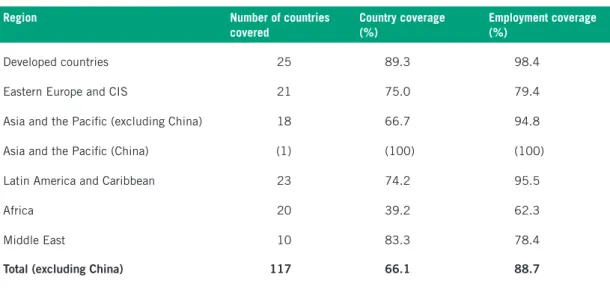
In total, data from 117 countries and territories were used to produce the global and regional estimates (see table 2.1 for coverage by region; details by country on the
12 If no data on domestic workers could be found using ISIC, the status-in-employment classification (ICSE) was used when available (see box 2.1). This approach was applied in four countries, namely Bangladesh, Honduras, Liberia and Paraguay (see also Appendix II).
13 Strictly speaking, labour force surveys (LFSs) should count anybody who works for at least one hour per week for a wage or other material gain as employed. However, it is very questionable whether LFSs in practice classify occasional babysitters and similar groups as employed.
Table 2.1 Coverage of the ILO’s statistical database on domestic workers, 2010
Region Number of countries
covered
Country coverage (%)
Employment coverage (%)
Developed countries 25 89.3 98.4
Eastern Europe and CIS 21 75.0 79.4
Asia and the Pacific (excluding China) 18 66.7 94.8
Asia and the Pacific (China) (1) (100) (100)
Latin America and Caribbean 23 74.2 95.5
Africa 20 39.2 62.3
Middle East 10 83.3 78.4
Total (excluding China) 117 66.1 88.7
Note: Country coverage refers to the number of countries for which data were found as a percentage of all the countries in the region, while employment coverage refers to the total number of employed persons in countries with available data as a percentage of all employed persons in the region (as of 2010). Regional groupings correspond to those in ILO (2010b).
Source: ILO statistical database on domestic workers.
sources used are provided in Appendix II.). 14 Although these 117 countries represent only two-thirds of all countries within the sample frame, they account for 88.7 per cent of total employment outside China. For China, a combination of official sources was used to produce a tentative estimate (see Chapter 3). Although the new database has a substantial global coverage, the availability of data is less than ideal in some regions, such as Africa (where data for countries that account for just under two-thirds of total employment are available).
For most countries, tabulated data from labour force surveys and other household sample surveys were used as sources. In some instances, detailed employment data by economic activity were only found in census reports, mainly dating back to the last round in circa 2000. These data were complemented with records retrieved from LABORSTA, which itself builds on data submitted by NSOs (mostly on the basis of labour force surveys). 15 For four countries, 16 the original labour force survey micro- data sets were used to tabulate the number of domestic workers and their share in total employment. Finally, for Oman and Hong Kong, China, where domestic workers are
14 The universe corresponds to countries and territories included in the ILO’s Global Employment Trends (GET) model. In addition, data were obtained for 17 small countries and territories (mainly small island states in the Caribbean and the Pacific) that are not included in the GET database. Given their small influence on global and regional aggregates, they were not used for the global and regional estimates.
15 LABORSTA is the ILO’s main database on labour statistics and is operated by the ILO Department of Statistics.
Data are compiled from censuses and labour force and other household surveys. Free online access is available at http://laborsta.ilo.org.
16 Columbia (retrieved through the Luxembourg Income Study), Guatemala (retrieved through the Luxembourg Income Study), India (NSSO) and United Republic of Tanzania (NBS). For further details, see Appendix II.
predominantly migrants, administrative records on work permits for domestic workers were used in the absence of household survey data. 17
Labour force surveys and other household surveys, the main underlying data sources for the estimates, have two key advantages: they are usually based on repre- sentative samples of all households in a country; and they are designed to capture all forms of employment – regardless of whether such work is registered with the authori- ties or not, irrespective of whether it is in the informal or formal economy, and whether it is carried out on a part-time or full-time basis. The ability to capture employment in the informal economy is a key difference to enterprise surveys, which usually only cover formal sector establishments and therefore cannot capture domestic workers employed directly by households. Labour force surveys are usually administered by an interviewer (either face-to-face or, in some developed countries, over the phone), rather than self-completed by the respondent. Hence, illiteracy among domestic workers does not prevent them from participating. Moreover, interviewers can prompt respondents when respondents give incomplete answers. However, a possible weakness of house- hold surveys is that interviewers, when not sufficiently trained, fail to recognize domes- tic workers as such (and believe misleading answers by proxy respondents, such as
“She is just a cousin helping out with the house work!”). Respondents might also be reluctant to disclose their activity when faced with a government official, despite reas- surances of anonymity and data confidentiality.
Another source of potential underestimation is that, given the broad range of activities that domestic workers carry out, some of those who correctly stated their activity during the interview could be misclassified during the coding of questionnaire responses. They would thus not appear in the division “Activities of private households as employers of domestic staff” (but in a default category, such as “Other service activi- ties”). There is, however, no way to gauge the potential extent of such coding errors (which, incidentally, might also lead to misclassification of persons as domestic work- ers who are not actually domestic workers in the sense of the definition outlined above).
In addition, domestic workers who are employed by an agency are in theory excluded from the scope of the definition of Division 95 (ISIC Rev. 3.1), which explicitly states that domestic services can only be produced by households (and not enterprises, such as service agencies). Since they fall under the definition of “work performed in or for a household or households”, their exclusion would lead to an underestimate of the number of domestic workers. In practice, however, statistical agencies appear to use Division 95 to classify agency workers. For instance, a large number of domestic workers who are grouped as employed in private households can be found in labour force surveys in countries where domestic workers are predominantly agency work- ers (Belgium), and even in establishment surveys, which collect data from enterprises rather than households (China).
A final source of potential underestimation is domestic workers who are undocu- mented migrant workers. These workers might not be captured in surveys that rely on
17 By their very nature, administrative records do not capture undocumented migrant workers, who enter irregu- larly (e.g. on a tourist visa) or overstay the validity of their work permit.
Box 2.2 India: 2.5 or 90 million domestic workers?*
Although it is not unusual to find discrepancies between official estimates and estimates from other sources, the case of India is particularly striking due to the magnitude of the difference. The media and NGOs frequently cite a figure of 90 million domestic workers for India. 1 However, the primary source for this figure is not given in any of the articles reviewed for this report, and it is not pos- sible to establish who first used it – and on what basis. At the other extreme, Palriwala and Neetha (2009) published an estimate of only 2.5 million domestic workers for India. They used household survey data, but their study focuses solely on paid care workers in India and they exclude gardeners, gatekeepers, watchmen and the residual category of “other workers” employed by private house- holds from their definition of domestic workers.
For the global and regional estimates, the same industry-based approach (see box 2.1) that was used in other countries was applied to India. Therefore, all persons employed by “Private house- holds with employed persons” were counted as domestic workers (Division 95 of NIC 1998, India’s adaptation of ISIC; see NSSO, 2006, p. 16). The most comprehensive data source for India is the Employment and Unemployment Survey, which is conducted by the National Sample Survey Office (NSSO) at the national level every five years. At the time when the global and regional estimates were first made, the most recent data from this survey refer to the 61st round, conducted between July 2004 and June 2005 (micro-data from the 2009/10 survey were not yet available).
An analysis of the micro-data set suggests that the number of domestic workers in India was 4.2 million in 2004/05, representing 1 per cent of total employment (see table 2.2). However, since the great majority of domestic workers are women, some 2.2 per cent of all employed women were domestic workers (compared to 0.5 per cent for men). Moreover, there is a clear distinction between the types of domestic tasks carried out by each gender: most female domestic workers are employed as housemaids or servants, while men dominate in subcategories such as gardeners, gatekeepers and in the residual category of “other” occupations (which includes, for example, butlers and chauffeurs).
These figures have, however, some margin of error. Since the estimates were made, results from 2009/10 have been published by both the NSSO and the Ministry of Labour and Employment.
According to the 66th round of the National Sample Survey (which drew on a sample of 100,000 households), only 0.8 per cent of all employed persons fell under Section P “Activities of private households as employers” (see NSSO, 2011, table S36). The Employment and Unemployment Survey, which was conducted by the Labour Bureau at the same time with a sample of 46,000 households,, produced a very different estimate: according to this source, 2.7 per cent of all employed persons were employed by private households as maids, watchmen or cooks (Ministry of Labour and Employment, 2010, p. 39). By utilizing the estimate of 1.0 per cent, the global and regional estimates are therefore likely to err on the side of caution.
* This box was prepared based on inputs received from Uma Rani (International Institute of Labour Studies).
1 See, for example, India Together, “’Domestic workers in India no better than slaves”, published 17 February 2009; The Times of India, “India of Domestic Workers”, published 21 June 2009; The Washington Post,
“Domestic workers in India ’want a better life, too’”, published 16 November 2008.
Sources: Ministry of Labour and Employment, 2010; NSSO, 2011.
household registration data to build their sample frame, and even when they are sampled, they might be reluctant to provide any information that would reveal their irregular status to a government official and may therefore refuse to participate in an interview.
Given the different factors discussed above, it is difficult to estimate the extent of the undercounting of domestic workers. As argued above, comparing official statistics and non-official estimates by NGOs is not necessarily informative, given that the meth- odologies supporting non-official estimates are often not well-documented. However, some statistical offices have looked further into potential methodological shortcomings of household surveys in recording paid domestic work. An example is Germany, where domestic work is frequently part of the “shadow economy”. Here, the 2009 labour force survey counted 203,000 persons engaged in “Activities of households” (ISCI Rev. 4, Tabulation Category T).18 The national accounts section of Germany’s federal statisti- cal office supplemented these data with other sources and estimated that some 712,000 persons work in the same industry (see Körner and Puch, 2011, p. 44). While some of the difference is due to the undifferentiated activities of households, the alternative estimate indicates that the true number of domestic workers might be substantially higher than the one captured by the labour force survey (see also Schupp, 2002). Nonetheless, the German statistical office recommended using the labour force survey data, which remain the best available verifiable source for statistics on the number of domestic workers.
While the German case suggests that undercounting of domestic workers by statis- tical offices is a significant problem even in countries with highly developed statistical
18 Note that the figure of 203,000 used for this publication is based on the original labour force survey (LFS) pub- lication. Körner and Puch (2011, p. 44) report a figure of 206,000 domestic workers under the LFS.
Table 2.2 India: Employment by industry subcategories and sex, 2004/05 (NIC 2004)
Occupations employed in Division 95:
Activities of households as employers of domestic staff
Both sexes Female Male
Housemaid / servant 2 312 200 2 011 300 300 800
Cook 123 400 89 300 34 200
Gardener 19 300 4 200 15 100
Gatekeeper / chowkidar / watchman 135 700 7 000 128 600
Governess / babysitter 87 700 62 800 24 900
Others 1 528 400 780 600 747 800
TOTAL 4 206 700 2 955 200 1 251 400
Total estimated employment 408 246 900 135 834 000 272 412 900
Domestic workers as percentage of total employment 1.0 2.2 0.5
Source: ILO analysis of the micro-data of the 2004/05 Employment and Unemployment Survey (61st round), National Sample Survey Organisation (NSSO) of India.
capacity, there is little evidence showing how much the measurement error varies between countries and regions. However, these data limitations imply that the estimates presented in this report are a lower bound for the true number of domestic workers.
This means that the estimates published in this report are conservative and thus do not exaggerate the importance of domestic work. In many ways, it is more useful to draw the reliable conclusion that “at least x million people work as domestic workers” than to face the opposite bias and to arrive at an estimate that “up to x million people work as domestic workers” (which could mean that the actual number is much, much lower).
Methodology for global and regional estimates
To obtain reliable global and regional estimates on the number of domestic workers, two methodological challenges need to be addressed. The first challenge is that the estimates refer to 2010, but many of the underlying national data reproduced in Appen- dix II were collected in earlier years (mostly during the late 2000s). Despite this, these are the best available data for the proportion of domestic workers in total employment.
However, because populations and employment have generally grown since the data were gathered – especially in developing countries – the estimation routine makes the assumption that the number of domestic workers has increased proportionately with growth in total employment.19 Therefore, for each responding country, the share of domestic workers in total employment was calculated for the latest year for which data were available; this ratio was then applied to the employment figures for the year 2010.20 This provided an unbiased estimate of the number of domestic workers in responding countries in 2010. However, while these figures for 2010 were used for the global and regional estimates, discussions of trends will make use of the official source statistics only (where the latest available data sometimes refer to 2008 or 2009).21 To generate a breakdown by sex, the shares of female and male domestic workers in the base year were applied to the estimate for 2010.
The second challenge is that data are not available for all countries, even though the coverage of the ILO’s statistical database on domestic workers is substantial (see table 2.1). To correct for the remaining data gaps, two principal approaches can be used.
The first is to impute missing data by estimating the number of domestic workers in all countries for which no data are available. However, since the objective outlined above was to use only official statistics for the global and regional estimates, this approach was not taken.22 The other principal option is to use only available information and to correct for non-response of countries: this is the approach taken for this report. This was done
19 While the share of domestic workers to employment might not have remained exactly constant, large shifts are unlikely in only a few years.
20 The employment figures for the year 2010 were retrieved from the ILO’s Global Employment Trends (GET) model.
21 Likewise, Appendix II only reports the official source statistics for the latest available year.
22 The only exception to this rule is the aggregation of data from different sources to produce an estimate for China (see Chapter 2) and, for countries for which no disaggregation by sex was available, to estimate male and female shares (see Appendix II).
based on a standard methodology, which is explained in detail in Appendix I. The basic underlying idea is to treat the available data as a sample, which is then used to make inferences about regions and the global total – much in the same way that a household survey relies only on a sample of the population, but the results are used to make state- ments about the unemployment rate or other labour market characteristics in a country as a whole (even though not all labour market participants were actually interviewed).
However, there is a problem: countries that have collected data on domestic work- ers might differ systematically from those for which no information is available. In other words, the data are likely to be non-random and to display some bias. For example, it can be expected that more advanced countries and larger countries within a region have a greater statistical capacity and therefore are more likely to produce data. This poses a problem if the same countries also employ more (or fewer) domestic workers than those for which no data are available. It is therefore necessary to correct for this response bias though a weighting procedure that takes into account the different likelihoods of countries to provide estimates on the number of domestic workers (see Appendix I).
Combined with the generally sufficient coverage, this estimation procedure can be expected to result in reliable global and regional estimates – although, as was discussed above, there are good reasons to believe that they are on the conservative side.
In addition to the estimates for 2010, this report also provides an estimate for 1995, which was produced using the same methodology as described above. However, instead of taking the latest available data point, the 1995 estimate uses the share of domestic workers in total employment in 1995 or the closest available year (adjusted for trends in overall employment). Again, the methodology described in Appendix I was used to correct for non-response.
Global overview: Domestic workers across the world
According to the new estimates, at least 52.6 million men and women were employed as domestic workers across the world in 2010. To put this into perspective, this figure is greater than the number of persons who are employed in large countries such as Viet Nam, Mexico or Nigeria. If all domestic workers worked in one country, this country would be the tenth largest employer worldwide. Domestic work is therefore an important, if often ignored, source of employment. It accounts for 1.7 per cent of total employment worldwide and some 3.6 per cent of all wage employment (see table 3.1).
The sector has particular importance in developing regions, such as Latin America and the Caribbean, where 11.9 per cent of all paid employees are domestic workers, or the Middle East, with a share of 8.0 per cent.
Since there are reasons to believe that some of the primary sources used for the global and regional estimates undercount domestic workers (see discussion in Chap- ter 2), the true extent of domestic work is likely to be even greater. The global number of domestic workers could be close to the estimate of 100 million domestic workers that was previously cited by the ILO.23 However, with current data availability, it is difficult to determine the range where the “true” value lies, and the figures presented here are the most reliable (and deliberately conservative) minimum estimates available.
Note that the estimates do not include children who have not yet reached working age, which in many countries is set at 15 or 16 years. As box 3.1 shows, there are an esti- mated 3.5 million children aged 5 to 11 years who work as domestic workers, and 3.8 million child domestic workers between the ages of 12 and 14 years.
Although about 8.9 million men are employed by private households – typi- cally as gardeners, chauffeurs or security guards – domestic work remains a heavily female-dominated sector: women account for 83 per cent of all domestic workers (see figure 3.1). Women domestic workers outnumber men in virtually all countries (see Appendix II) and in every region of the world. Women’s share among domestic work- ers ranges from approximately 63 per cent in the Middle East to 92 per cent in Latin America and the Caribbean. This makes domestic work a particularly significant source of wage employment for women, who often face greater obstacles than men in find- ing paid employment. Globally, one in every 13 female wage workers is a domestic worker (or 7.5 per cent), and the ratio is as high as one in four in Latin America and
23 For example, paper GB.301/2 (ILO, 2008a) quoted a global figure of 100 million domestic workers.
Table 3.1 Global and regional estimates on the number of domestic workers in 2010, by sex
PANEL A. BOTH SEXES
Domestic workers Domestic workers as percentage of total employment
Domestic workers as percentage of paid employees
Developed countries 3 555 000 0.8 0.9
Eastern Europe and CIS 595 000 0.3 0.4
Asia and the Pacific 21 467 000 1.2 3.5
excluding China 12 077 000 1.2 4.7
Latin America and Caribbean 19 593 000 7.6 11.9
Africa 5 236 000 1.4 4.9
Middle East 2 107 000 5.6 8.0
Total 52 553 000 1.7 3.6
PANEL B. FEMALES
Female domestic workers
Female domestic workers as percentage of female employment
Female domestic workers as percentage of female paid employees
Developed countries 2 597 000 1.3 1.4
Eastern Europe and CIS 396 000 0.4 0.5
Asia and the Pacific 17 464 000 2.5 7.8
excluding China 9 013 000 2.6 11.8
Latin America and Caribbean 18 005 000 17.4 26.6
Africa 3 835 000 2.5 13.6
Middle East 1 329 000 20.5 31.8
Total 43 628 000 3.5 7.5
PANEL C. MALES
Male domestic workers
Male domestic workers as percentage of male employment
Male domestic workers as percentage of male paid employees
Developed countries 958 000 0.4 0.5
Eastern Europe and CIS 199 000 0.2 0.2
Asia and the Pacific 4 003 000 0.4 1.0
excluding China 3 064 000 0.5 1.7
Latin America and Caribbean 1 588 000 1.0 1.6
Africa 1 400 000 0.6 1.8
Middle East 778 000 2.5 3.5
Total 8 925 000 0.5 1.0
Note: See Appendix I for detailed information on the methodology used to obtain the global and regional estimates and Appendix II for national source statistics.
Source: ILO estimates based on data from official sources.