FP7-223913
Deliverable
D4.1
Design of the SemSorGrid4Env ontology- based data integration model
Jean-Paul Calbimonte and Oscar Corcho
Universidad Politécnica de Madrid
Alasdair J G Gray
University of Manchester August 28, 2009 Status: Final Version
Scheduled Delivery Date: August 31, 2009
Executive Summary
Semantic technologies and ontologies have been successfully used in the latest years for data integration, the process of providing unified and transparent data access to multiple and heterogeneous data sources [Len02]. The problem of integrating these sources involves not only granting access to information but also providing mechanisms for interpreting and processing the data consistently, overcoming syntactical and semantic heterogeneity.
The main of these data sources in the context of the Semantic Sensor Grid Rapid Application Development for Environmental Management project (SemSorGrid4Env) are stream data sources coming form sensor networks. Sensor networks consist of multiple interconnected nodes that are able to sense and capture different kinds of data, accessed through query processors that use declarative continuous query languages. Managing streaming data differs significantly from classical static data. Streaming data is potentially infinite and transient, with tuples being constantly added. Therefore queries on this data are also continuous, i.e. their results are updated regularly as time passes [TGN+92].
The goal of the SemSorGrid4Env project is to provide a platform that supports the rapid development of applications that make use of existing heterogeneous data sources using semantic web technologies [GGF+09]. In this deliverable we propose the design of a Semantic Integrator Service that deals with the above-mentioned challenges, using ontology-based data integration and mapping techniques, for both streaming and stored data.
In order to produce this design we have reviewed work on ontology-based data access, ontology- based data integration, streaming data access, distributed query processing and quality of service notions. We have also reviewed relevant technologies and approaches in all these areas, which we will reuse in our work in this WP of the SemSsorGrid4Env project.
We have also proposed a walk-through of a typical use-case that shows how the user requirements expressed in the SemSorGrid4Env use-cases can be handled from the semantic integration point of view. We do not only show how requirements are fulfilled but also how we can implement the service functionalities outlined in the architecture of SemSorGrid4Env [GGF+09]. We have designed and described the components that we will develop and provide, outlining the main extensions to existing work that we have to accomplish.Finally we propose the main lines of our future work in this WP, which will be revised throughout the duration of the project and will be the focus of the following deliverables: R2O extensions for streams, extended SPARQL queries for streams, Translation of SPARQL for streams to streaming languages, Distributed Query Processing of integrated streaming data queries and Quality-of- Service optimizations.
Note on Sources and Original Contributions
The SemSorGrid4Env consortium is an inter-disciplinary team, and in order to make deliverables self-contained and comprehensible to all partners, some deliverables thus necessarily include state-of-the-art surveys and associated critical assessment. Where there is no advantage to recreating such materials from first principles, partners follow standard scientific practice and occasionally make use of their own pre-existing intellectual property in such sections. In the interests of transparency, we here identify the main sources of such pre-existing materials in this deliverable:
• Chapter 2 contains material adapted from [GGF+09]
• Chapter 3 contains material adapted from [GGF+09, GGF+09a]
• Sections 4.2.1 and 4.2.2 contain material adapted from [Bar06]
Document Information
Contract Number FP7-223913 Acronym SemSorGrid4Env
Full title SemSorGrid4Env: Semantic Sensor Grids for Rapid Application Development for Environmental Management
Project URL www.semsorgrid4env.eu
Document URL http://www.semsorgrid4env.eu/home.jsp?content=/sew/viewTerm&content=instance.jsp&_sew _var_name=instance&_sew_instance=D4.1&_sew_instance_set=SemSorGrid4Env&_origin=%
2Fhome.jsp EU Project officer Gaëlle Le Gars
Deliverable Number D4.1 Name Design of the SemSorGrid4Env ontology-based data integration model
Task Number T4.1 Name Design an ontology-based integration model
Work package Number WP4
Date of delivery Contractual 31 August 2009
Actual 31 August 2009
Code name D4.1 Status draft final ;
Nature Prototype Report ; Specification Tool Other Distribution Type Public ; Restricted Consortium
Authoring Partner UPM QA Partner UNIMAN
Contact Person Jean-Paul Calbimonte Email jpcalbimonte@delici
as.dia.fi.upm.es
Phone +34913363670 Fax +34913524819
Abstract
(for dissemination) Semantic technologies and ontologies have been successfully used in the latest years for data integration, the process of providing unified and transparent data access to multiple and heterogeneous data sources. The problem of integrating these sources involves not only granting access to information but also providing mechanisms for interpreting and processing the data consistently, overcoming syntactical and semantic heterogeneity.
The main of these data sources in the context of the Semantic Sensor Grid Rapid Application Development for Environmental Management project (SemSorGrid4Env) are stream data sources coming form sensor networks. Sensor networks consist of multiple interconnected nodes that are able to sense and capture different kinds of data, accessed through query processors that use declarative continuous query languages. Managing streaming data differs significantly from classical static data. Streaming data is potentially infinite and transient, with tuples being constantly added. Therefore queries on this data are also continuous, i.e. their results are updated regularly as time passes.
The goal of the SemSorGrid4Env project is to provide a platform that supports the rapid development of applications that make use of existing heterogeneous data sources using semantic web technologies. In this deliverable we propose the design of a Semantic Integrator Service that deals with the above-mentioned challenges, using ontology-based data integration and mapping techniques, for both streaming and stored data.
In order to produce this design we have reviewed work on ontology-based data access, ontology-based data integration, streaming data access, distributed query processing and quality of service notions. We have also reviewed relevant technologies and approaches in all these areas, which we will reuse in our work in this WP of the SemSsorGrid4Env project.
We have also proposed a walk-through of a typical use-case that shows how the user requirements expressed in the SemSorGrid4Env use-cases can be handled from the semantic integration point of view. We do not only show how requirements are fulfilled but also how we can implement the service functionalities outlined in the architecture of SemSorGrid4Env. We have designed and described the components that we will develop and provide, outlining the main extensions to existing work that we have to accomplish. Finally we propose the main lines of our future work in this WP, which will be revised throughout the duration of the project and will be the focus of the following deliverables.
Keywords Data Integration. Semantic integration
Version log/Date Change Author
0.1 / 22 May 2009 Initial Draft J-P. Calbimonte
0.15 / 30 July 2009 Table of contents, restructured J-P. Calbimonte & O.Corcho 0.2 / 15 August 2009 Revised proposal, major edits J-P. Calbimonte & O. Corcho 0.3 / 22 August 2009 Comments & corrections J-P. Calbimonte & O. Corcho 0.4 / 25 August 2009 Corrections from QA J-P. Calbimonte & O. Corcho & A. Gray 0.5 / 28 August 2009 Final revision J-P. Calbimonte & O. Corcho & A. Gray
Project Information
This document is part of a research project funded by the IST Programme of the Commission of the European Communities as project number FP7-223913. The Beneficiaries in this project are:
Partner Acronym Contact
Universidad Politécnica de Madrid (Coordinator)
UPM Prof. Dr. Asunción Gómez-Pérez Facultad de Informática
Departamento de Inteligencia Artificial Campus de Montegancedo, sn Boadilla del Monte 28660 Spain
#t +34-91 336-7439, #f +34-91 352-4819 The University of Manchester UNIMAN Prof. Carole Goble
Department of Computer Science The University of Manchester Oxford Road
Manchester, M13 9PL, United Kingdom
#t +44-161-275 61 95, #f +44-161-275 62 04
National and Kapodistrian University of Athens
NKUA Prof. Manolis Koubarakis University Campus, Ilissia Athina
GR-15784 Greece
#t +30 210 7275213, #f +30 210 7275214
University of Southampton SOTON Prof. David De Roure
University Road Southampton
SO17 1BJ United Kingdom
#t +44 23 80592418, #f +44 23 80595499
Deimos Space, S.L. DMS Mr. Agustín Izquierdo
Ronda de Poniente 19, Edif. Fiteni VI, P 2, 2º Tres Cantos, Madrid – 28760 Spain
#t +34-91-8063450, #f +34-91-806-34-51
EMU Limited EMU Dr. Bruce Tomlinson
Mill Court, The Sawmills, Durley number 1 Southampton, SO32 2EJ – United Kingdom
#t +44 1489 860050, #f +44 1489 860051
TechIdeas Asesores Tecnológicos, S.L. TI Mr. Jesús E. Gabaldón C/ Marie Curie 8-14 08042 Barcelona, Spain
#t +34.93.291.77.27, #f ++34.93.291.76.00
Table of Contents
1 Introduction ... 1
1.1 Glossary ... 2
2 Architecture ... 4
2.1 Overview ... 4
2.2 Semantic Integration and Query Service ... 5
2.2.1 Integration Interface ... 7
2.2.2 Query Interface ... 8
3 Requirements ... 11
4 Background ... 13
4.1 Fundamentals ... 13
4.1.1 Ontology-based Data Access ... 13
4.1.2 Ontology-based Integration ... 15
4.1.3 Streaming Data Access ... 18
4.1.4 Distributed Query Processing ... 22
4.1.5 Quality of Service ... 23
4.2 Related Technologies ... 24
4.2.1 R2O ... 24
4.2.2 ODEMapster ... 26
4.2.3 SNEEql ... 29
4.2.4 SPARQL for RDF Streams ... 30
4.2.5 OGSA-DQP ... 32
5 Semantic Integrator Proposal ... 34
5.1 Integration of Data Sources: Walk-through ... 34
5.1.1 Mapping to the Ontology ... 34
5.1.2 Querying over the Ontology ... 37
5.1.3 Query Execution ... 38
5.2 Service Implementation ... 40
5.2.1 Integration Interface Implementation ... 40
5.2.2 Query Interface Implementation ... 41
5.3 Future Work ... 42
5.3.1 R2O Extensions for Streams ... 43
5.3.2 SPARQL Support... 43
5.3.3 Support for R2O Extensions ... 43
5.3.4 Extended SPARQL for Streams ... 44
5.3.5 Query Translation ... 44
5.3.6 Distributed Query Processing ... 45
5.3.7 QoS Optimisations ... 45
6 Bibliography ... 46
7 Annexes ... 55
Linked Stream Data: A Position Paper ... 55
Index of Figures
Figure 2.1: SemSorGrid4Env Architecture. ... 4
Figure 2.2: Interfaces exposed by the Semantic Integration and Query Service. ... 6
Figure 4.1: Architecture of a distributed stream processing engine [ALM+04]. ... 21
Figure 4.2: Phases of query processing [Kos00]. ... 22
Figure 4.3: ODEMapster Architecture [Bar06]. ... 26
Figure 4.4: ODEMapster virtualised execution mode [Bar06]. ... 27
Figure 4.5: ODEMapster materialised execution mode [Bar06]. ... 27
Figure 4.6: ODEMapster execution steps. ... 28
Figure 4.7: OGSA-DQP Architecture [LMH+09]. ... 33
Figure 5.1: Sample Fire Ontology. ... 36
Figure 5.2: Sample mapping from stream-to-ontology... 36
Figure 5.3: Semantic Integrator modules. ... 38
Index of Tables
Table 2.1: Types used in the Integration and Query Interfaces. ... 6
Table 2.2: Faults used in the Integration and Query Interfaces. ... 7
Table 2.3: The IntegrateAs operation. ... 7
Table 2.4: The GetDataResourcePropertyDocument operation. ... 8
Table 2.5: The DestroyDataResource operation. ... 8
Table 2.6: The <GenericQuery> operation. ... 9
Table 2.7: The <GenericQueryFactory> operation. ... 10
1 Introduction
The goal of the Semantic Sensor Grid Rapid Application Development for Environmental Management project (SemSorGrid4Env) is to provide a platform that supports the rapid development of applications which make use of existing heterogeneous data sources including databases and sensor networks, using semantic web technologies [GGF+09].
The SemsorGrid4Env project activities are divided in separate work packages, and this deliverable is part of Work Package 4 (WP4). The objective of WP4 is to design and implement a Semantic Integration Service for the SemSorGrid4Env project and specify a suite of sensor network ontologies that will be used for describing sensors and related data.
This deliverable focuses on the issues and challenges of data integration for heterogeneous sources; and the design of the Semantic Integrator that will be in charge of combining these diverse sources.
Latest advances in wireless communications and sensor technologies have opened the way for deploying networks of interconnected sensing devices capable of ubiquitous data capture, collection and processing. Sensor networks deployments are expected to increase significantly in the upcoming years because of their advantages and unique features. Tiny sensors can be installed virtually anywhere and still be reachable thanks to wireless communications. Moreover, these devices are inexpensive and can be used for a wide range of applications such as security surveillance, traffic control, environmental monitoring, healthcare provision, industrial monitoring, etc.
However, sensor networks characteristics also raise several challenges for the research community, related to inherent constraints such as the low power resources of the devices, their restricted computation capabilities and limited storage. Another key challenge is related to the integration of the data collected by sensor networks. Applications such as the mashups in the SemSorGrid4Env project require a suitable platform to access and combine heterogeneous data coming from different sensor networks and other data sources such as databases. Furthermore, these applications require accessing this data in terms of a uniform schema that hides the diverse and internal data representations of each source.
Semantic technologies and ontologies have been successfully used in the latest years for data integration solutions, particularly in the area of databases. The integration solution that we propose in this deliverable will be built using ontology-based data access and mapping to data sources, which may be streaming sensor networks or relational databases.
The main contributions of this deliverable are:
• A study of the related work in the area of semantic data integration and ontology based access to relational data.
• A study of semantic querying over streaming data and identification of limitations on current formalisms regarding useful streaming query operators such as time windows, etc.
• A proposal of a high level ontology-based integration model for heterogeneous streaming and relational data sources.
The document is organised as follows:
In Chapter 2, we set the context of this work package, by introducing the SemSorGrid4Env architecture and its service tiers and interfaces. We focus in particular on the Semantic Integrator Service, which is the core component for the integration solution proposed in WP4.
In Chapter 3, we identify the requirements of WP4 based on the use-cases of the SemSorGrid4Env project.
In Chapter 4, we provide details about the previous works on the areas of ontology-based data access, ontology-based data integration, stream data access and integration, distributed query processing and quality of service concepts. Then we provide details about the technologies that will be used as basis for the remainder of the work in WP4.
In Chapter 5, we introduce our proposal for the design and internal details of the ontology-based data integration solution for the SemSorGrid4Env project.
An Annex (see Chapter 7) is included in this deliverable about linked stream data. This annex deals with the requirements and a proposal for generation of unique URIs for sensor network data, which may be useful for identifications creation during translation from stream to ontological models.
1.1 Glossary
API Application Programmer Interface. A set of defined method calls.
CQL Continuous Query Language C‐SPARQL Continuous SPARQL DBMS Database Management System.
DQP Distributed Query Processor.
DSMS Data Stream Management System.
GAV Global-as-View. A mechanism for mapping a global schema to the data source schemas.
GLAV Global-Local-as-View. A mechanism for mapping a global schema to the source schemas.
HTTP Hypertext Transfer Protocol.
LAV Local-as-View. A mechanism for mapping a global schema to the data source schemas.
OGSA‐DAI Open Grid Services Architecture Database Access and Integration Services.
OGSA‐DQP Open Grid Services Architecture Distributed Query Processing OWL The Web Ontology Language. A W3C standard for specifying ontologies.
QEP Query Execution Plan.
QoS Quality of Service.
R2O Relational-to-Ontology mapping language.
RDBMS Relational Database Management System.
RDF The Resource Description Framework. A W3C standard for modeling Web resources metadata.
REST Representational State Transfer.
SNEE Sensor Network Engine. A query compiler for the SNEEql language.
SNEEql Sensor Network Evaluation Query Language for querying streams of data.
SPARQL SPARQL Protocol and RDF Query Language for querying RDF documents.
SQL Structured Query Language for querying relational databases.
STREAM The Stanford data stream management system.
UNIMAN University of Manchester.
UPM Universidad Politécnica de Madrid.
URI Uniform Resource Identifier.
WP Work Package.
WS-* The group of Web service standards.
XML Extensible Markup Language
2 Architecture
In this chapter we present an overview of the SemSorGrid4Env architecture and its tiers (see Section 2.1). Then we focus on the Semantic Integrator Service, the component charge with the task of integrating heterogeneous data sources using semantic technology (see Section 2.2). Then we provide details about the interfaces exposed by this service.
2.1 Overview
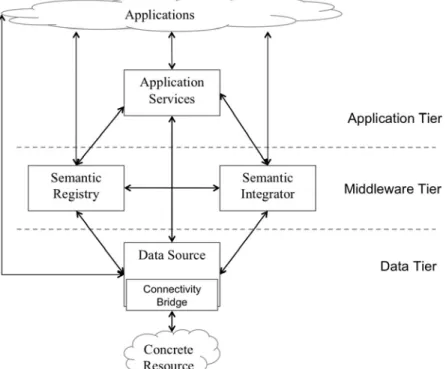
The SemSorGrid4Env architecture, as defined in [GGF+09] comprises of a set of web services that interact by calling each other, as depicted in Figure 2.1. The services can be categorised into three well-defined tiers: application tier, middleware tier and data tier.
Figure 2.1: SemSorGrid4Env Architecture.
Data Tier: Services of this tier are able to publish and provide access to classical database data or streaming data. In Figure 2.1 a single Data Source service is depicted. However for the SemSorGrid4Env project two different types of data services have been defined: Stored Data Service and Streaming Data Service, for databases and streams respectively [GGF+09a].
Middleware Tier: Two main services are available in this Tier: Semantic Registry and Semantic Integrator Service. The Semantic Registry [KKK09] allows discovering available data sources and services according to some criteria. The Semantic Integrator provides a mechanism for accessing multiple data sources as a single virtual source. The virtual data source will present a global ontological view and queries over this view will be translated to queries over the schemas of the original data sources.
Application Tier: This tier provides domain specific functionality to consumers so that mash-up applications can directly use them instead of dealing with the complexities of the middleware and data tiers.
WP4 focuses on one of the key classes of services of the middleware tier: the Semantic Integration and Query Service or Semantic Integrator Service.
2.2 Semantic Integration and Query Service
The Semantic Integration and Query Service or Semantic Integrator provides access to multiple data sources through a single mediated ontological view, as if it was a virtual data source. All SemSorGrid4Env services define a set of interfaces that will be available and will be exposed to consumers. For each interface there is a set of operations, the types they use for inputs and outputs and a set of faults that may be generated in case of errors.
The Semantic Integration and Query Service requires the following functionality from other services [GGF+09]:
• Retrieving data sources functional properties and metadata as defined by the Service Interface.
• Retrieving data sources data description and querying the data using the Query Interface.
• Receiving data streams using a pull-based mechanism using the Data Access Interface.
• Receiving data streams using a push-based mechanism using the Subscription Interface.
• Security mechanisms for data access authorization.
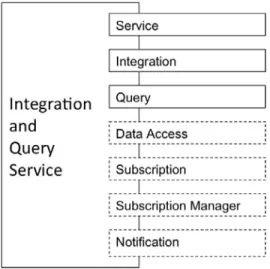
As detailed in the architecture document [GGF+09] and depicted in Figure 2.2, the Semantic Integration and Query Service exposes the following interfaces:
• Service Interface
• Integration Interface
• Query Interface
• Data Access Interface (optional)
• Subscription Interface (optional)
• Subscription Manager Interface (optional)
• Notification Interface (optional)
Figure 2.2: Interfaces exposed by the Semantic Integration and Query Service.
If the Integration Interface supports pull-based retrieval of streams, it must expose the Data Access Interface. If it supports push-based delivery of streams then it must expose the Subscription and the Subscription Manager interfaces. If the Integration Interface requires receiving a push-based delivery stream from a data source it must expose the Notification Interface.
The Integration and Query interfaces are detailed in the next sections. For each interface, a set of exposed operations is listed. Each operation has a set of input and output parameters, and a set of possible Faults. Notice the notation conventions: elements marked with ‘+’ may appear one or multiple times, elements marked with ‘?’ may appear once or may not appear.
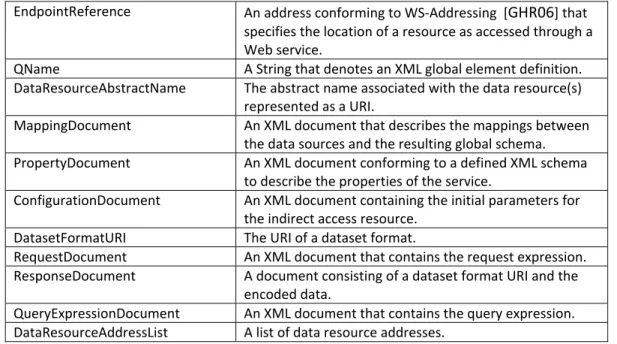
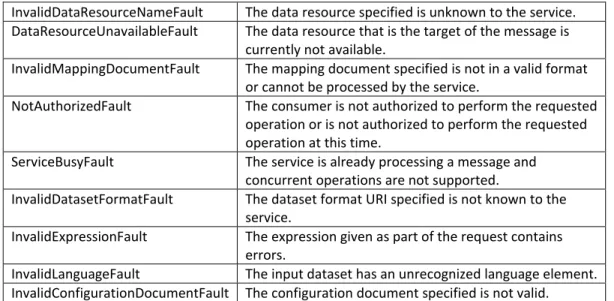
The types listed in Table 2.1 and faults in Table 2.2 are valid for the subsequent sub-sections.
EndpointReference An address conforming to WS‐Addressing [GHR06] that specifies the location of a resource as accessed through a Web service.
QName A String that denotes an XML global element definition.
DataResourceAbstractName The abstract name associated with the data resource(s) represented as a URI.
MappingDocument An XML document that describes the mappings between the data sources and the resulting global schema.
PropertyDocument An XML document conforming to a defined XML schema to describe the properties of the service.
ConfigurationDocument An XML document containing the initial parameters for the indirect access resource.
DatasetFormatURI The URI of a dataset format.
RequestDocument An XML document that contains the request expression.
ResponseDocument A document consisting of a dataset format URI and the encoded data.
QueryExpressionDocument An XML document that contains the query expression.
DataResourceAddressList A list of data resource addresses.
Table 2.1: Types used in the Integration and Query Interfaces.
InvalidDataResourceNameFault The data resource specified is unknown to the service.
DataResourceUnavailableFault The data resource that is the target of the message is currently not available.
InvalidMappingDocumentFault The mapping document specified is not in a valid format or cannot be processed by the service.
NotAuthorizedFault The consumer is not authorized to perform the requested operation or is not authorized to perform the requested operation at this time.
ServiceBusyFault The service is already processing a message and concurrent operations are not supported.
InvalidDatasetFormatFault The dataset format URI specified is not known to the service.
InvalidExpressionFault The expression given as part of the request contains errors.
InvalidLanguageFault The input dataset has an unrecognized language element.
InvalidConfigurationDocumentFault The configuration document specified is not valid.
Table 2.2: Faults used in the Integration and Query Interfaces.
2.2.1 Integration Interface
The Integration Interface provides integrated data access to multiple data resources through a unified virtual source that can be later managed and queried.
Operations
IntegrateAs: Creates a data resource which presents the global view over a set of data sources (see Table 2.3).
Inputs resourceNames+: DataResourceAbstractName mappings?: MappingDocument
Output integratedDataResource: EndpointReference Faults InvalidDataResourceNameFault
DataResourceUnavailableFault InvalidMappingDocumentFault NotAuthorizedFault
ServiceBusyFault
Table 2.3: The IntegrateAs operation.
This operation receives the names of the data resources and the mapping as an input. The data resource names are of type DataResourceAbstractName, represented by an URI. The mapping document will indicate how to transform the elements form the stored or streaming data to elements of the global schema. The output is a reference to the created virtual data source, and can later be used in order to query the information provided by the underlying original sources.
The implementation of this interface operation will need to use a mapping language expressible enough to represent complex mappings from the heterogeneous models to the global one, as described in Section 4.1.1.
The data source referenced by the result of this operation (integratedDataResource) will have to be able to be queried in terms of the global view. And the queries may include data that has been extracted from any of the local sources. Therefore the global view will need to cover the data that can be expressed in the local data source schemas.
2.2.2 Query Interface
The Query Interface defines operations for data access using a formal query language to specify the needed information. Two modes for retrieving the data are available in the Query Interface:
direct and indirect. In the direct mode the results are thrown in the response message of the query request. In the indirect mode the response message includes a reference to a data resource that can be queried using either the Data Access Interface or the Subscription and Subscription Manager Interfaces.
Operations
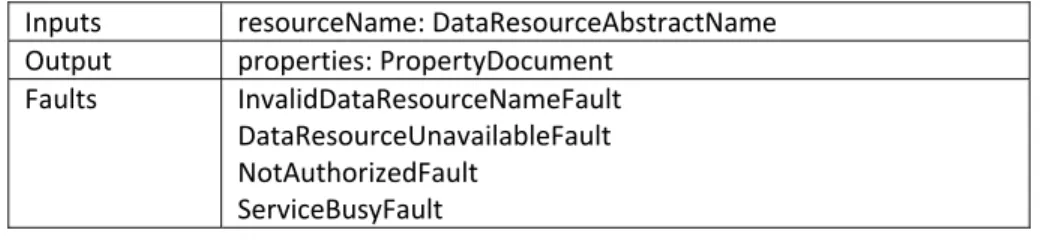
GetDataResourcePropertyDocument: Returns the core property document values associated with the service implementing this message (see Table 2.4).
Inputs resourceName: DataResourceAbstractName Output properties: PropertyDocument
Faults InvalidDataResourceNameFault DataResourceUnavailableFault NotAuthorizedFault
ServiceBusyFault
Table 2.4: The GetDataResourcePropertyDocument operation.
This operation returns a document containing metadata of the data source identified by the specified DataResourceAbstractName. It is expected that the resulting PropertyDocument will be an XML document complying with a defined schema.
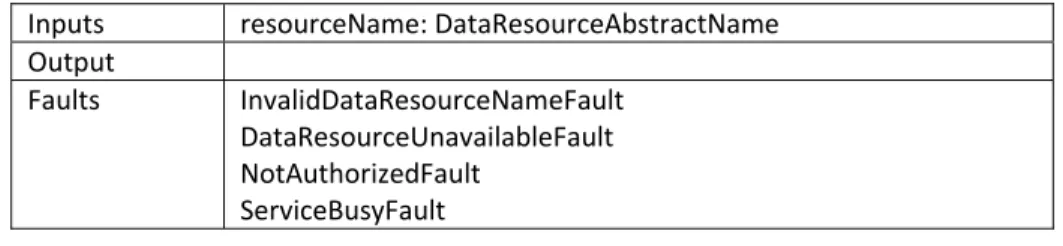
DestroyDataResource: Destroys the named data resource, future messages directed at the resource must yield an InvalidResourceNameFault (see Table 2.5).
Inputs resourceName: DataResourceAbstractName
Output
Faults InvalidDataResourceNameFault DataResourceUnavailableFault NotAuthorizedFault
ServiceBusyFault
Table 2.5: The DestroyDataResource operation.
This is a data source management operation that will typically be used when the data source is no longer in use.
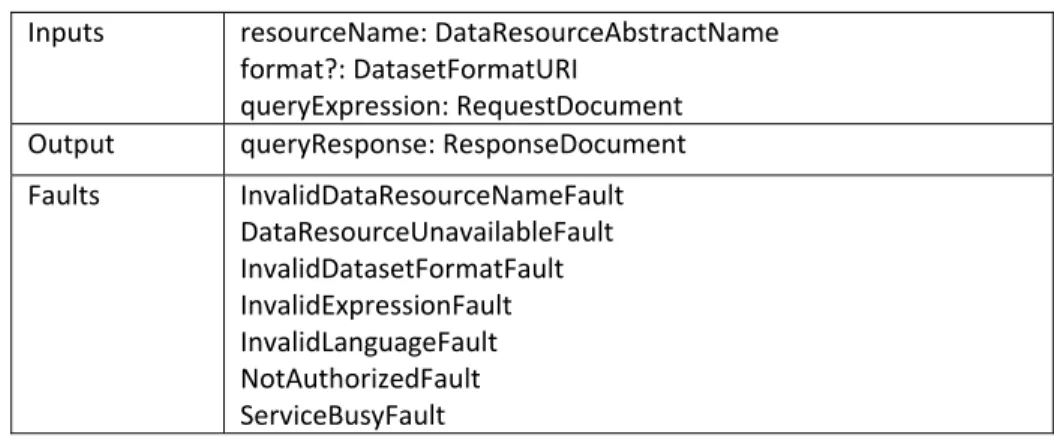
<GenericQuery>: Directs a query document to a data resource (see Table 2.6).
Inputs resourceName: DataResourceAbstractName format?: DatasetFormatURI
queryExpression: RequestDocument Output queryResponse: ResponseDocument Faults InvalidDataResourceNameFault
DataResourceUnavailableFault InvalidDatasetFormatFault InvalidExpressionFault InvalidLanguageFault NotAuthorizedFault ServiceBusyFault
Table 2.6: The <GenericQuery> operation.
This is the central operation of the Query Interface, as it allows retrieving results given a declarative query expression. The resourceName parameter will indicate which data source is to be queried, for instance a stored or streaming data source, or an integrated data source as the one thrown by the IntegrateAs operation of the Integration Interface. The query itself is contained in the queryExpression input parameter of type RequestDocument.
The query expression must be written in a declarative query language expressive enough to represent the different kinds of information requests typical of stored or streaming data access.
Therefore these queries must provide support for joins between relations and streams, aggregates, selections and projections, stream-to-relation operators, relation-to stream operators, etc, as it will be seen in Section 4.1.3. In the case of an integrated data source, it is expected that the queries are specified in terms of the global ontological view, rather than the local schemas.
Therefore a query language capable of querying ontological elements is required for such situations.
In this case the query results are directly outputted in the queryResponse parameter. The format of this response will depend on the optional format parameter of type DatasetFormatURI. It is also noteworthy that in case of querying an integrated data source in terms of a global ontological view, the results are also expected to be in terms of that view.
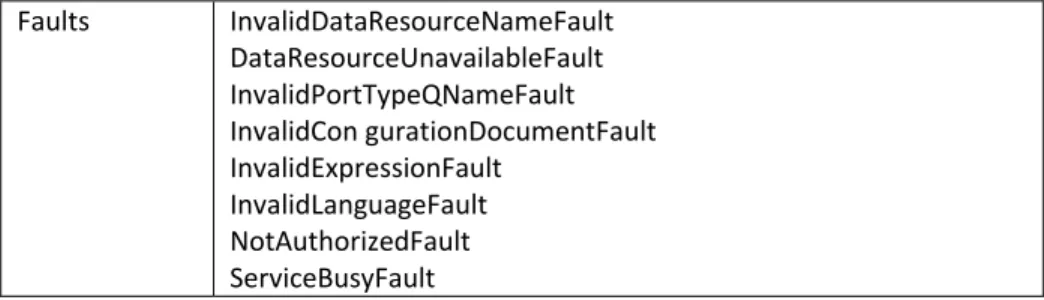
<GenericQueryFactory>: Creates a relationship between a data resource representing the result of a query and the data access service by which it will be accessed (see Table 2.7).
Inputs resourceName: DataResourceAbstractName responseInterfaceType?: QName
configurationDocument?: ConfigurationDocument preferredTargetService?: EndPointReference requestDocument: QueryExpressionDocument
Output resourceList: DataResourceAddressList<EndPointReference>
Faults InvalidDataResourceNameFault DataResourceUnavailableFault InvalidPortTypeQNameFault InvalidCon gurationDocumentFault InvalidExpressionFault
InvalidLanguageFault NotAuthorizedFault ServiceBusyFault
Table 2.7: The <GenericQueryFactory> operation.
In this operation the results are not directly thrown in the output message. Instead a list of data sources is provided as output, and these sources can be consulted to get the response data sets either with a pull-based mechanism using the Data Access Interface; or push-based using the Subscription and Subscription Manager interfaces.
3 Requirements
The SemsorGrid4Env project considers two concrete use-case scenarios in order to validate the proposed platform. The first is a fire risk monitoring and warning system in the Region of Castilla y León in Spain, and is under the scope of WP6 [LDI09]. The second is a coastal and estuarine flood warning system in the Southern region of the United Kingdom, and is the subject of WP7 [CHSR09].
This chapter summarises the requirements for WP4 gathered from the use-cases presented in the requirements specifications of WP6 and WP7. These requirements have also been analysed in [GGF+09] and [GGF+09a] and we include them here for completeness and consistency with the work done in WP2.
• Stored data sources must be accessible, mainly for querying and analysing archived information such as historic satellite or sensor network data.
• Stream data sources must be accessible, mainly for real-time queries and analysis such as continuous queries over a sensor network.
• Integrating different stored data sources through a unified view must be possible, for instance for retrieving and combining historic satellite and sensor network data.
• Integrating different streaming data sources through a unified view must be possible, for instance for combining data from different sensor networks.
• Integrating both stored and streaming data through a unified view must be possible, for instance in order to retrieve and combine current and past sensor network data.
• Posing declarative queries over the integrated view must be possible, independently of the stored or streaming data sources.
• Subscribing to events in the integrated data source must be possible.
• Results of the queries can be delivered either directly in the query response or indirectly through another data source.
• Streaming results can be accessed by explicit requests of the consumer or without any request. In the latter case the streams are generated and sent to consumers at a potentially unknown rate.
• The queries posed to the integrated data source must consider temporal interval filters and temporal correlation over streaming data.
• The queries posed to the integrated data source must consider spatial correlation.
• The integrated data source must consider Quality-of-Service parameters for optimizations in the query processing task.
In summary the Integration and Query Service is required to be able to combine different stream or stored data sources under a unified view. This integrated data source can later be queried as if it was a single data source.
4 Background
In this chapter we present a survey about previous work related to semantic data access and integration, data streams management and querying, distributed query processing and Quality-of- Service notions. This chapter is divided in two sections: Fundamentals (see Section 4.1), which describes the state of the art in the selected relevant topics, and Related Technologies (see Section 4.2), which describes the main technological products and assets that will be used for this WP in the context of the SemSorGrid4Env project.
4.1 Fundamentals
The following sections describe the state of the art in ontology-based data access and integration, streaming data access and integration, distributed query processing, and also quality of service representation for data services.
First in Section 4.1.1 we provide a short overview of the research and available solutions for ontology-based data access. Then we present the challenges of data integration (see Section 4.1.2) and the relevant works on the subject that consider the problem of semantic interoperability. In this section we focus primarily on ontology-based integration approaches and mapping from relational sources to ontological models.
Next in Section 4.1.3 we introduce the concepts of streams and how they differ from classic relational data. We include references to systems and approaches for managing and querying streaming data, and also for combining it with static relational data. Afterwards we identify the current limitations on semantic technologies to deal with stream information, particularly concerning time notions. Then we review other works dealing with semantic queries over streams and the specific extensions to currently available query languages.
Afterwards Section 4.1.4 is devoted to Distributed Query Processing, as it is expected that data integration of heterogeneous sources will require techniques from this area.
Finally in Section 4.1.5 we introduce some concepts about Quality of Service, relevant in the context of query processing and data quality evaluation.
4.1.1 Ontology-based Data Access
The realisation of the Semantic Web vision, where data is available, understandable and processable by computers, has launched several initiatives that aim at providing semantic access to traditional data sources. Most stored data is currently preserved in relational databases and it
has therefore become a need to generate Semantic Web content from them [SHH+08]. In this context there is a considerably large amount of research in the community, with the goal of exposing data in terms of ontologies that formally express the domain of interest [PLC+08]. This is the goal of Ontology-based data access (OBDA).
Most of the approaches attempt to provide some kind of mapping from a relational concept to a concept in an ontological model (such as OWL [BvHH+04] or RDF [MM04). Many problems arise then, as they have to deal with model mismatch issues, query interpretation, semantic reasoning, etc.
Some of the proposed systems use their own languages [BCG05, BC07] to define the mappings between ontology concepts and roles and their corresponding tables in the relational models.
Others rely on SPARQL [PS08] extensions and SQL [SQL92] expressions to define these mappings [PLC+08, SSW07, EM07, PC06].
OBDA systems use these kinds of mappings between the global ontology and the different data sources. These mappings allow constructing queries over the ontology (e.g. in SPARQL) which are then re-written to the data sources query language (typically SQL). Then the results are converted to RDF which is the result that is returned to the user [SHH+08]. We briefly describe the main works on this area that surfaced in the latest years.
One of the common approaches is to first generate a syntactical translation of the database schema to an ontological representation. Although the resulting ontology has no real semantics behind, it may be argued that it is a first step through an ontology model and that ontology alignment could be used later to map it to a real domain ontology [LT09, MBR01].
In SquirrelRDF [SSW07] they take this simple approach. A rough mapping of the relational database schema is built in RDF. There is no mapping to a mediated ontology. SPARQL queries can be executed and results are return in RDF.
An additional step is taken in RDBToOnto [Cer08], where the ontology generation process does not only take the database schema into account, but also the data. For instance it is able to discover subsumption relationships by finding categorisation columns in the database tables.
Even after this resulting ontology is produced, RDBToOnto allows users to create custom constraints. However this work focuses on the ontology generation and does not provide a querying mechanism to the database data.
Relational.OWL [PC06] builds an ontology based on the relational schema and then maps it to the mediated ontology through a RDF query language. The first phase -transforming the database schema to the Relational.OWL ontology- produces a syntactical representation without real semantics. It is thus necessary to proceed with the second step, mapping the Relational.OWL representation to the domain ontology. This mapping can be done with an RDF query language like SPARQL and it is therefore not necessary to create a new mapping language.
The SPASQL implementation [Pru07] is an extension for MySQL to support SPARQL queries.
It is thus technologically restricted to MySQL as it uses its query engine, although similar extensions could be built for other DBMSs. This extension is able to parse SPARQL queries and
compile them and directly execute them in the MySQL engine. The mapping is limited (e.g. no multi-field keys allowed) and it is not formalized.
Although automatic generation of ontologies and mappings can be useful in simple scenarios, for complex ones it is a limited approach. User expert knowledge may become necessary for complex mapping definitions, but it is also necessary to provide well defined languages that express those mappings.
The Virtuoso [EM07] declarative meta-schema language allows mapping relational schemas to RDF ontologies. SPARQL queries posed to the system are mapped to relational databases. The meta-schema is based on Quad Map Patterns that define transformations from relational columns into triples that match a SPARQL pattern. Notice that Virtuoso includes extensions to SPARQL for aggregates (COUNT, MIN, MAX, AVG, SUM) and it also allows SPARQL sub-queries.
In the D2RQ platform [BC07], a specific mapping language is introduced (D2RQ language) and formally defined by an RDF schema. The mapping defines relationships between an ontology and a relational database schema. The D2RQ Engine is implemented as a Jena graph. It provides a Jena or Sesame API plug-in for querying and reasoning with RDF. This plug-in rewrites thee API calls to SQL queries which are executed in the database server, using the mappings. Results are returned as RDF triples.
In [PLC+08] they propose MASTRO, a DL reasoner for ontologies whose data is accessed through mappings in an external source, i.e. an ODBA-enabled reasoner. The reasoner works over the DL-LiteA language, a fragment of OWL-DL. The mappings are specified through assertions that include SQL queries over the database. The language in this work is well formalized and the query answering complexity is well explored. The expressivity of the queries is limited to conjunctive queries (CQ). An implementation of a plug-in for data access to relational databases through SPARQL queries has also been built using this approach [PRR08].
The R2O language [BCG05] provides formal mappings from relational databases to ontologies.
The ODEMapster System uses this language to execute queries on the ontology that are translated to SQL to get results from the relational source. A complete description of this approach is detailed in Section 4.2.1.
4.1.2 Ontology-based Integration
Data integration can be defined as the process of providing unified and transparent data access to multiple and heterogeneous data sources [Len02]. The problem of integrating heterogeneous data sources involves not only providing access to information but also providing means of interpreting and processing the data in a consistent manner. When dealing with different sources it is often complicated to establish the meaning of the incoming data. And if the meaning cannot be clearly identified, then it is impossible to pair information for the different sources [RAY+00].
Problems of this kind are mainly due to confusion in term meanings and naming conflicts. Added to syntactical conflicts, the semantic integration challenge is hard to tackle.
We can identify the main issues of data integration as [WVV+01]:
• Incompatibility in communication and protocols, across different data management systems.
• Syntactical heterogeneity: differences in data model representation and structure, incompatibility of data values.
• Semantic heterogeneity: differences in naming and abstraction level, homonyms and synonyms in schemas.
Ontologies provide a means of explicitly specifying the meaning of the information that will be interchanged between systems. In that way it can help achieve semantic interoperability:
regardless of the source's data syntax or semantics, we can map it to a known ontology and access the data in terms of the mediated ontological view [WVV+01]. As a consequence semantic declarative queries can be written in terms of the mediated schema.
It has been acknowledged that ontologies may be useful to solve this semantic heterogeneity problem as it is described in [WVV+01, DH05]. We can mention several systems and prototypes based on ontologies for data integration support: OBSERVER [MIK+00], SIMS [ACH+93], Carnot [HJK+93], DWQ [CDL+98], PICSEL [GLR00], MOMIS [BBV+07].
The main role and purpose of ontologies in an integration system is to explicitly state the semantics of the data sources so that it can be possible to identify and establish semantic relationships between these sources. For instance, if a data source stores person information and another source stores student information, the ontology may represent both concepts, with person subsuming student. This information can later be exploited by query integrators to coherently perform joins or unions over these sources.
Data sources can be relational databases, data files, xml files or any other storing media. Most of the work on data integration has been centred on relational databases, as it is the most widespread way of storing large volumes of information. In any case the ultimate goal is to allow querying the different sources through a uniform interface, hiding the underlying heterogeneous schemas. Therefore the applications querying the integrated system must only focus on the information they wish to obtain, leaving to the integration system the work of searching for the information in the different sources, clearly simplifying the development of upper layer applications on top of the integration infrastructure.
Research on the subject has produced many approaches to building such integration systems. We mention two main alternatives: the virtualisation and materialisation approaches [IKK05].
In the virtualisation approach queries are posed over the mediated schema and a mediator component identifies the sources that will be needed to produce the answer. Then a series of appropriate sub-queries are automatically written for these sources and executed. The results of each source are retrieved, post-processed and transformed to the mediated schema and returned to the caller application.
This alternative allows answering queries on demand, even if the update rate of data is high and the queries are potentially arbitrary. As the queries are rewritten dynamically for each of the sources, it is possible to retrieve any portion of data exposed through the mediated schema. On the other hand the transformations on the queries and the processing of the data from the sources
to the mediated schema may be complex and incur in performance issues. Another potential problem is data source availability, as the queries are performed live; if the source is unreachable then the queries may not be able to be completed. Even if the source is available, latency caused by networking or connection problems may increase the query response time.
The materialisation approach differs from the virtualised one in that it extracts and transforms the data from the sources periodically, instead of performing on-the-fly conversions each time a query is being executed. Instead, relevant data is first identified, and extracted from the multiple data sources in a batch process operation. The extracted data is then stored in a data warehouse where it can be accessed by the external applications. The data warehouse can then be updated periodically depending on the requirements. Under this approach, the time consumed in retrieving the data from the sources is moved to the off-line phase of updating the centralized data warehouse. Therefore when the external applications query the integration system, results can be accessed almost immediately. However the data may be stale in occasions, and it may not be possible to access all possible pieces of data, as the warehouse only stores selected materialised views of the original sources.
In the case of the virtualised approach, a mediator component is introduced as a major feature of the integration architecture. This mediator is in charge of transforming the original query into sub-queries for the sources and then transforming the results back to the mediated schema. This process of transformation is performed thanks to mapping definitions that establish relationships between the mediated and source schemas. There are three main alternatives for defining these mappings [Len02, IKK05]: Global-as-view (GAV), Local-as-view (LAV) and a combination of both, GLAV.
In the LAV approach, each of the source schemas is represented as a view in terms of the global schema. If our system I is represented as:
I = <G,S,M>
Where G is the global schema, S is a source schema and M is the mapping between G and S, then the mapping assertions in M will be a set of elements of the form:
s → qG
Where s is an element of S and qG is a query over the global schema G.
This approach is useful if the global schema is well established and if the sources suffer modifications constantly. Notice that changes in the sources do not affect the global schema.
However, the query processing is not obvious, as it is not explicitly stated how to obtain the data in the mapping definition. Query rewriting techniques such as query answering using views can be used in this approach [Hal01]. Examples of LAV based works are DWQ [CDL+98], InfoMaster [GKD97], Information Manifold [Lev98], PICSEL [GLR00].
The other approach, GAV, defines the mappings in the opposite way. The global schema elements are represented as views over the source schemas. The mapping definition explicitly
defines how to query the sources to obtain the desired information in terms of the global schema.
Following the system representation I = <G,S,M>, in the GAV approach the mapping assertions are elements of the form:
g → qS
Where g is an element of the global schema G and is expressed as a view qS, a query on the source schema. The advantage is that the mapping itself already indicates how to query the sources to obtain the data, so the processor can directly use this information to perform the query rewriting. The main disadvantage is that in case of changes or additions on the sources -e.g. a new source is added- then the global schema may suffer changes and this may affect other mapping definitions. Examples of GAV based works are SIMS [ACH+93], TSIMMIS [GHI+97], Carnot [HJK+93], Gestalt [RS98], MOMIS [BBV+07], IBIS [CCDG+03], DIS@DIS [CDL+03].
For the sake of completeness we can mention the GLAV (Global-Local-as-view) approach, which is a generalization of the previous two. This formalism allows more expressive mappings than LAV and GAV combined, and it has been shown to reach the limits of tractability of these description languages [FLM99].
4.1.3 Streaming Data Access
Managing streaming data differs significantly from classical static data. Streaming data is potentially infinite and its items are constantly added. Therefore queries on this data are also continuous, i.e. their results are updated regularly as time passes [TGN+92]. On the other side classical database systems deal with mostly static data, with lower insert rates and queries that retrieve the state of the data at the current time.
While in database systems datasets are queried several times, stream data is transient and usually the latest registered information is used for queries, and the old items are less relevant. These items are either discarded or archived. Sliding windows provide a suitable way of selecting the stream data that a continuous query will handle [BBD+02]. For example, a sliding window selecting tuples received in the last 30 minutes can be used to process only a desired subset of the incoming data. Otherwise it would be impossible to compute aggregates such as averages, maximums and minimums, as the streaming data is potentially infinite.
Although the continuous queries on data streams operate over the newest items, it is also useful to take into account older information. Several approaches exist to deal with this issue. For example, significant samples of past received data can be stored in static tables or aggregates (e.g. average) can also be stored in some repository [BBD+02]. Storage and processing of all the archived data is also a possibility but it is impractical in many scenarios, due to the high volumes of collected data.
One of the requirements of the SemSorGrid4Env project for WP4 (see Chapter 3) precisely indicates the need for accessing historic stored data, and combining it with other stored or
streaming data sources. Therefore we emphasize on the importance of querying systems providing the means to integrate information from both relational and streaming sources.
Streaming Data Queries
Several Data Stream Management Systems (DSMS) or systems managing continuous data, have been designed and built in the past years, such as Tapestry [TGN+92], Tribeca [Sul96], TelegraphCQ [CCD+03], Aurora [ACC+03, CCC+02], STREAM [ABB+04], Borealis [AAB+05], NiagaraCQ [CDT+00], Gigascope [CJS+02], CAPE [RDS+04], TinyDB [MFH+05], Cougar [YG02] and SNEE [GBJ+08].
Some of them have their own stream query language although all are based somehow on SQL.
Although CQL (Continuous Query Language) [ABW06] has been regarded as the most prominent and best known of these languages and some standardization attempts have surfaced [JMS+08], there is still no common language for stream queries.
Formal models for stream management systems like [ABB+04] define both streams and relations and the operators that can be used on them. A stream [ABB+04, ABW06] S can be seen as a possibly infinite bag of elements (s,t) consisting of a tuple s and a timestamp t. A relation R is a finite bag of tuples at any instant t. This model has been used in various implementations and others have used it as a basis for extensions.
Stream systems require operators to limit streams to finite bounded structures in order to process only a smaller subset of data. Consider for example that we want to obtain the latest temperature values measured at the sea level. This is a subset of data that must be obtained from a stream of continuously appended temperature measurements. Windows are widely used to perform such transformations from streams to a bounded extents such relations [BGF+08]. The most common stream-to-relation operators are time windows. A time window usually takes a time interval as parameter and returns a relation containing tuples of the stream whose timestamp falls in that specified time interval. It can be said that a time window returns a finite snapshot of the stream in the window interval.
Time intervals in windows usually take the upper bound of the interval as the current timestamp.
For instance in CQL the following statement:
S [RANGE T]
denotes the relation consisting of the elements of S whose timestamp falls in the latest T time units. For example S [RANGE 30 seconds] would result in a window consisting of the elements issued in the latest 30 seconds. More complex time windows and special cases (e.g. NOW, UNBOUNDED) are also considered in most streaming languages.
Sliding parameters are another usual feature of time-based windows. The slide parameter specifies how often the window is produced [ABW06, BGF+08]. For instance in CQL the following statement defines a window that slides every L time units:
S [RANGE T SLIDE L]
Even though time based windows are the most widespread stream-to-relation operator, other kinds of windows have also been studied, most notably tuple-based windows. A tuple window contains the last N tuples of a stream, where N is an integer. For instance S [Rows 4] will represent a relation with the last 4 elements of the stream S. A slide parameter can also be specified for tuple-based windows. Other sliding windows exist in previous works, such as partitioned windows, fixed windows, tumbling windows, etc [ABW06].
Apart from performing stream-to-relation transformations it is often required to transform relations to streams. Consider the following query for stream S with attributes a1 and a2:
SELECT a1, a2 FROM S[RANGE 10 MIN SLIDE 10 MIN]
The result of this query is a window containing the a1 and a2 attributes of S produced in the latest 10 minutes. The SLIDE parameter indicates that a new window will be created every 10 minutes.
It may be however desired to build a single stream out of those windows that contains all their tuples. For those and other situations, relation-to-stream operators have been studied. The main operators available in most querying languages are RSTREAM, ISTREAM and DSTREAM [ABW06].
The ISTREAM operator applied to a relation R at time t, produces a stream that contains all tuples of R that are in R at time t but not in t-1. This behaviour informally specifies that the produced stream contains only the inserted elements in a relation at each time. The DSTREAM operator applied to a relation R at time t produces a stream that contains all tuples of R that are not in R at time t but were there in time t-1. Therefore the resulting stream contains the deleted elements of R at each time. Finally the RSTREAM operator applied to a relation R at a time t produces a stream that contains all tuples of R at time t.
Sensor Networks Query Processing
Sensor Networks are one of the main sources of continuous streaming data [ALM+04]. Sensor networks consist of multiple interconnected nodes that are able to sense and capture different kinds of data. It is evidently necessary to provide means to query data collected by these networks. In order to solve this requirement, research has produced Sensor Networks Query Processing engines such as TinyDB [MFH+05], Cougar [YG02] and SNEE [GBJ+08] (see Section 4.2.3). These processors use declarative query languages for continuous data like the ones we described earlier in this section. These declarative queries describe logically the set of information that is to be collected but leaves to the engine to determine the algorithms and plans that are needed to get the data form the different nodes of the sensor network.
These engines must also consider several optimization techniques in order to efficiently gather the information from the sensor nodes. Sensor networks are characterized by strong resource limitations such as energy consumption, computing power and storage capabilities. Architectures for query optimization in these constrained scenarios have surfaced [GBJ+09, MFH+05], showing that even with such limitations it is still possible to use rich and expressive declarative query languages.
Streaming Data Integration
As we have seen, in scenarios like sensor networks, there is an in-network integration among the participating nodes. This is a low level integration in the query processors that considers the different nodes where the requested data is being sensed [GBJ+09].
However the distributed inner nature of sensor networks is not the only case of distributed execution. In many stream management systems such as Borealis [AAB+05], D-CAPE [SLJ+05]
or Harmonica [KW07] the architecture has been extended in order to work as a distributed stream processor. The continuous queries issued to the system are distributed and processed across different sites. Each of these sites could even be a wrapper of a Sensor Network or whatever stream data source.
In the Borealis System for instance, each node has a Query Processor, Optimizer, Monitor and Communication module. Then all queries can be distributed to all nodes of the system, with each processor performing part of the execution.
As it is described in [ALM+04], the integration of sensor networks to each of the Query Processor nodes is possible through proxy wrappers. These wrappers make each of these integrated sensor networks appear as if was another node of the distributed streaming system.
Consequently when a query is issued, some part of the plan can be delegated to this node, and the wrapper will be in charge of transforming the plan operators to some implementation in the sensor network and possibly perform optimizations. Figure 4.1 shows this architectural approach:
Query Processor
Proxy
Wrapper Wrapper
…
…
Query Processor
Proxy
Proxy
Wrapper
Query Processor
Query Processor
Proxy
Sensor Network
Sensor Network
Figure 4.1: Architecture of a distributed stream processing engine [ALM+04].