SemSorGrid4Env FP7-223913
Deliverable D4.2v2
Implementation and Deployment of the Ontology-based Data Integration Service v2
Jean-Paul Calbimonte, and Oscar Corcho
Universidad Politécnica de Madrid
Alasdair J G Gray
University of Manchester
February 23, 2011
Status: Final version
Scheduled Delivery Date: 28 February 2011
Executive Summary
The realization of the Semantic Web vision, where data is available understandable and processable by computers, has launched several initiatives that aim at providing semantic access to traditional data sources. In recent years streaming data sources have become increasingly available thanks to advances in ubiquitous data capturing technologies such as sensor networks.
The required transparent integration of heterogeneous sources of this kind has brought new chal- lenges to the research community. In the context of the SemSorGrid4Env project and its Work Package 4 (wp4), we propose the design, implementation and deployment of a Semantic Integration Service for streaming and stored data sources. The design of this service follows an ontology-based approach that extends previous works on data access for relational databases.
This deliverable focuses on a core component of the semantic Integrator: the Ontology-based streaming data access module. To the best of our knowledge there is still no bridging solution that allows connecting ontology-based mappings and streaming data access technologies coherently in order to answer the requirements of i) establishing mappings between ontological models and streaming data source schemas, and ii) accessing streaming data sources through queries over ontology models. In summary our approach consists in creating an Ontology-based Streaming Data Access service that can receive requests over an ontological view and transforms them into queries for acquisitional or event-based stream sources or stored sources. The results of these queries can be integrated following a query plan and returned as RDF triples in terms of the global ontology. The implementation of the proposed solution is presented as part of the SemSorGrid4Env software platform.
The previously published deliverable D4.1 [CCG09] presented the design of the ontology-based integration service, and an initial prototype was presented in D4.2v1 [CC09]. This document describes the nal implementation of the service, called Integration and Query Service (iqs) and how it ts in the SemSorGrid4Env architecture. It diers from the precedent version in the following aspects:
• Section 1 The system description has been updated to reect the current status. The iqs service specication has been added, and the component formerly known as StreamMapster is referred as Semantic Integrator and includes a more complete description of its functionality.
• Section 2 The whole section has been added in order to explain the theoretical foundations of the delivered system.
• Section 3 The code description and dependencies have been updated to reect the current status.
• Section 4 The data sources used have been described in detail.
• Section 5 Full examples of how to use the iqs service have been included, i.e. registering an integrated data sources, creating queries and pulling data.
• Section 6 The whole section containing the test strategy has been added.
Note on Sources and Original Contributions
The SemSorGrid4Env consortium is an inter-disciplinary team, and in order to make deliverables self-contained and comprehensible to all partners, some deliverables thus necessarily include state- of-the-art surveys and associated critical assessment. Where there is no advantage to recreating such materials from rst principles, partners follow standard scientic practice and occasionally make use of their own pre-existing intellectual property in such sections. In the interests of trans- parency, we here identify the main sources of such pre-existing materials in this deliverable:
• Section 1 contains material from [GGF+10] and [CCG10].
• Section 2 contains material from [CCG10] and [CCG09].
Document Information
Contract Number FP7-223913 Acronym SemSorGrid4Env
Full title SemSorGrid4Env: Semantic Sensor Grids for Rapid Application Development for Environmental Management
Project URL www.semsorgrid4env.eu
Document URL www.semsorgrid4env.eu/files/deliverables/wp4/D4.2v2.pdf EU Project Ocer Antonios Barbas
Deliverable Number D4.2v2 Name Implementation and Deployment of the Ontology-based Data Integration Service v2 Task Number T4.2 Name Implement and deploy the Ontology-based in-
tegration model in the SemSorGrid4Env in- frastructure
Work package Number WP4
Date of delivery Contract 28 February 2011 Actual 28 February 2011
Code name D4.2v2 Status draft2 nal2
Nature Prototype2 Report2 Specication2 Tool2 Other2 Distribution Type Public2 Restricted2 Consortium2
Authoring Partner UPM
QA Parner UNIMAN
Contact Person Jean-Paul Calbimonte
Email [email protected] Phone +34913363670 Fax +34913524819 Abstract
(for dissemination) Thanks to the increasingly available ubiquitous data capturing technologies such as sensor networks, new requirements for streaming data access solutions have sur- faced. One of these is the integration of heterogeneous streaming data sources.
In the context of the SemSorGrid4Env project and its Work Package 4 (wp4), we propose the design, implementation and deployment of a Semantic Integration Service for streaming and stored data sources. The design of this service follows an ontology-based approach that extends previous works on data access for rela- tional databases. This deliverable focuses on a core component of the semantic Integrator: the Ontology-based streaming data access module.
This module, named Semantic Integrator, extends the odemapster engine that provided ontology-based access for databases, and uses the language for Stream- to-ontology mappings s2o. An implementation of the proposed solution is pre- sented, so that we can provide some evidence of the applicability of our approach.
This nal deliverable of the implementation has been completed and presented as part of the entire SemSorGrid4Env platform.
Keywords Semantic Integration, Query Translation, Mappings
Version log/Date Change Author
0.1 / 1 December 2009 Initial Draft J-P. Calbimonte
0.2 / 14 December 2009 Revised Text J-P. Calbimonte
0.3 / 15 December 2009 Comments from QA J-P. Calbimonte and O. Corcho
0.4 / 18 December 2009 Revised Text J-P. Calbimonte
1.1 / 18 January 2011 New version v2 J-P. Calbimonte
1.2 / 8 February 2011 Added Theory Section J-P. Calbimonte 1.3 / 14 February 2011 Added Code Section J-P. Calbimonte
1.4 / 15 February 2011 Corrections O. Corcho
1.5 / 16 February 2011 Remarks QA A. Gray
1.6 / 23 February 2011 Corrections QA J-P. Calbimonte
Project Information
This document is part of a research project funded by the IST Programme of the Commission of the European Communities as project number FP7-223913. The Beneciaries in this project are:
Partner Acronym Contact
Universidad Politécnica de Madrid
(Coordinator) UPM Prof. Dr. Asunción Gómez-Pérez
Facultad de Informática
Departamento de Inteligencia Articial Campus de Montegancedo, sn Boadilla del Monte 28660 Spain
#t +34-91 336-7439, #f +34-91 352-4819
The University of Manchester UNIMAN Prof. Norman Paton
Department of Computer Science The University of Manchester Oxford Road
Manchester, M13 9PL, United Kingdom
#t +44-161-275-69 10, # +44-161-275 62 04
National and Kapodistrian University
of Athens NKUA Prof. Manolis Koubarakis
University Campus, Ilissia Athina
GR-15784 Greece
#t +30 210 7275213, #f +30 210 7275214
University of Southampton SOTON Dr. Kirk Martinez
University Road Southampton
SO17 1BJ United Kingdom
#t +44 23 80594491, #f +44 23 80595499
Deimos Space, S.L.U. DMS Mr. Agustín Izquierdo
Ronda de Poniente 19, Edif. Fiteni VI, P 2, 2◦
Tres Cantos, Madrid 28760 Spain
#t +34-91-8063450, #f +34-91-806-34-51
EMU Limited EMU Dr. Bruce Tomlinson
Mill Court, The Sawmills, Durley number 1 Southampton, SO32 2EJ, United Kingdom
#t +44 1489 860050, #f +44 1489 860051
TechIdeas Asesores Tecnológicos, S.L. TI Dr. Jesús E. Gabaldón
C/ Marie Curie 8-14 08042 Barcelona, Spain
#t +34.93.291.77.27, #f +34.93.291.76.00
Contents
Glossary viii
1 Introduction 1
1.1 Data Integration in SemSorGrid4Env . . . 1
1.2 System Objectives . . . 1
1.3 System Description . . . 2
1.3.1 Semantic Integrator . . . 2
1.3.2 Integration and Query Service . . . 3
2 Theoretical Background 7 2.1 Motivation . . . 7
2.2 Query and Mapping Syntax . . . 8
2.2.1 SPARQLStream . . . 8
2.2.2 S2O: Dening Stream-to-Ontology Mappings . . . 8
2.3 Semantics of the Streaming Extensions . . . 10
2.3.1 SPARQLStream Semantics . . . 10
2.3.2 S2O Semantics . . . 11
2.4 Implementation and Execution: Walkthrough . . . 12
3 Source Code 15 3.1 Semantic Integrator . . . 15
3.1.1 Dependencies . . . 15
3.1.2 Conguration . . . 16
3.1.3 API . . . 16
3.2 Integration and Query Service . . . 18
3.2.1 Integration and Query Service WSDL . . . 18
3.2.2 Dependencies . . . 18
3.2.3 Conguration . . . 18
4 Source Data 19 4.1 CCO Data Source . . . 19
4.2 Ontologies . . . 21
4.3 Mapping Files . . . 21
5 Installation and Execution 23 5.1 Build . . . 23
5.1.1 Client code . . . 23
5.2 Conguration . . . 24
5.2.1 Conguring a iqs service . . . 24
5.3 Execution . . . 24
5.3.1 Client Conguration . . . 25
5.3.2 Listing the Registered Integrated Resources . . . 25
5.3.3 Retrieving an Integrated Resource Property Document . . . 26
5.3.4 Integrating Data Resources . . . 26
5.3.5 Registering a Query to an Integrated Data Source . . . 27
5.3.6 Listing the Registered Pull Resources . . . 27
5.3.7 Pulling data from Generated Resource . . . 28
6 Tests 29 6.1 Unit Tests . . . 29
6.2 Integration Tests . . . 29
List of Figures
1.1 Ontology-based Semantic Integrator for streaming data . . . 2
List of Tables
1.1 The Integration Interface. . . 4
1.2 The Query Interface. . . 5
1.3 The Pull Data Interface. . . 6
3.1 Semantic Integrator dependencies. . . 15
3.2 Java API of the SemanticIntegrator. . . 17
3.3 iqs dependencies. . . 18
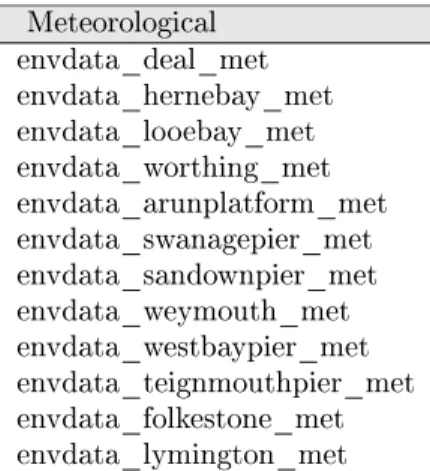
4.1 Channel Coastal Observatory meteorological streams. . . 19
4.2 Channel Coastal Observatory tide streams. . . 19
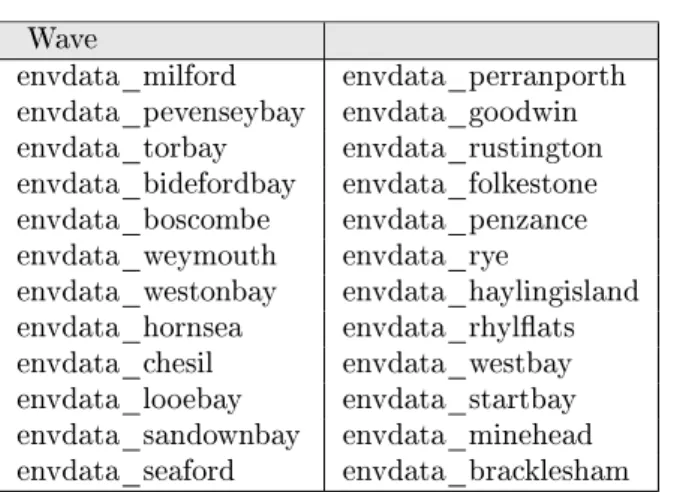
4.3 Channel Coastal Observatory wave streams. . . 20
4.4 Meteorological stream schema. . . 20
4.5 Wave stream schema. . . 20
4.6 Tide stream schema. . . 21
6.1 Semantic Integrator test coverage . . . 29
6.2 iqs test coverage . . . 29
Glossary
api Application Programming Interface. A set of dened method calls.
arq sparql processor for Jena.
cco Chanel Coastal Observatory.
d2rq Platform for Database-to-RDF processing.
gav Global-as-View integration.
iqs Integration and Query Service.
iri Internationalized Resource Identier.
nfcdd National Flood and Coastal Defence Database.
odemapster Library for transforming relational data to rdf data..
owl Web Ontology Language.
qname Qualied name within an XML document.
rdf The Resource Description Framework. A W3C standard originally designed for modelling metadata about Web resources.
r2rml Relational-to-RDF mapping language.
snee Sensor Network Evaluation Engine for processing queries over streams of data.
sneeql Sensor Network Evaluation Query Language for querying streams of data.
soap Simple Object Access Protocol.
sparql SPARQL Protocol and RDF Query Language for querying RDF documents.
sparqlStream sparql extended language for streaming data.
s2o Stream-to-Ontology mapping language based on R2O.
sweet Semantic Web for Earth and Environmental Terminology.
wsdl Web Services Description Language.
w3c World Wide Web Consortium.
1. Introduction
This document describes the implementation of the ontology-based semantic integration service of the SemSorGrid4Env architecture, and the technical details of its functionality.
1.1 Data Integration in SemSorGrid4Env
The main objective of the SemSorGrid4Env1 project is to specify, design, implement, evaluate and deploy a service-oriented architecture and middleware which allows application developers to build semantic-based sensor network applications for environmental management [GGF+10]. In this novel architecture, semantic technologies are exploited in various ways, and one of which is the integration of stored and streaming data sources.
One of the objectives of Work Package 4 (wp4) is to design and implement an ontology-based data integration service for streaming and stored data. This document describes the nal im- plementation of the service, called Integration and Query Service (iqs) and how it ts in the SemSorGrid4Env architecture.
In summary, the iqs service provides the following functionality:
• Create an integrated data resource exposed through an ontological schema, given a set of streaming data resources and a mapping document.
• Query integrated data resources using a sparql extension for streaming data, while the service internally accesses the underlying data sources.
• Provide data access to the continuous data queries registered for the integrated data sources.
• Register the created data resources in the SemSorGrid4Env Registry [KKK09].
• Provide metadata for the integrated data resources in the form of property documents as specied in the architecture [GGF+10].
The remainder of this deliverable document is organized as follows. We complete this section with a high level overview of the system objectives and the components delivered. In Section 2 we present the theoretical foundations of this work. Then we provide details about the source code of the components in Section 3, and about the data sources used in Section 4. We provide build and installation instructions, as well as a few use-case examples in Section 5, and nally we explain the test suites performed and planned for the delivered code.
1.2 System Objectives
The objectives of the ontology-based data integration service developed for phase II of the Sem- SorGrid4Env project are to:
• Provide a wsdl specication of the Integration and Query Service, including the integration, query, data access and subscription interfaces presented in the SemSorGrid4Env architec- ture [GGF+10].
1Semantic Sensor Grid for Rapid Application Development for Environmental Management, http://www.
semsorgrid4env.eu.
• Provide an Implementation of the Integration and Query Service, capable of integrating streaming sources, and querying them through the sparql extended language sparqlStream.
• Implement a query translation component capable of transforming sparqlStreamqueries into data stream queries using the s2o mappings.
1.3 System Description
The system developed consists of two main components. The rst is a software library that is capable of translating sparqlStream queries into data stream queries in a target language in terms of the underlying stream schemas, and then executing these queries and returning the results as sparql bound variables. This component is called Semantic Integrator. The other component is the Integration and Query Service (iqs), which provides a web service interface according to the SemSorGrid4Env architecture specication.
1.3.1 Semantic Integrator
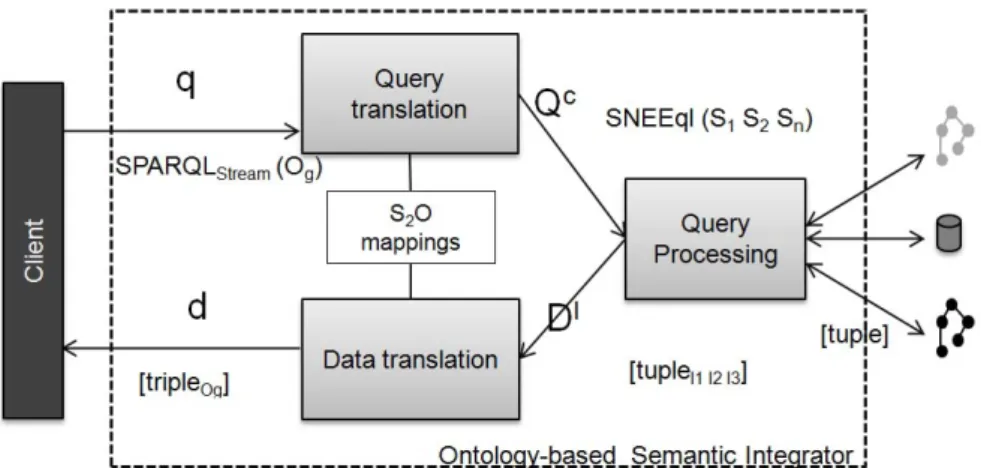
Our approach to enable ontology-based access to streaming data is depicted in Figure 1.1. The service receives queries specied in terms of the classes and properties2 of the ontology using sparqlStream, an extension of sparql that supports operators over rdf streams (see Section 2.2.1).
In order to transform the sparqlStream query, expressed in terms of the ontology, into queries in terms of the data sources, a set of mappings must be specied. These mappings are expressed in s2o, an extension of the r2o mapping language, which supports streaming queries and data, most notably window and stream operators (see Section 2.2.2). This transformation process is called query translation, and the target is the continuous query language sneeql, which is expressive enough to deal with both streaming and stored sources.
Figure 1.1: Ontology-based Semantic Integrator for streaming data
After the continuous query has been generated, the query processing phase starts, and the evaluator uses distributed query processing techniques [Kos00] to extract the relevant data from the sources and perform the required operations, e.g. selection, projection, and joins (See Section 2.3.1). Note that query execution in sources such as sensor networks may include in-network query processing, pull or push based delivery of data between sources, and other data source specic settings. The result of the query processing is a set of tuples that the data translation process transforms into ontology instances.
2We use the owl nomenclature of classes, and object and datatype properties for naming ontology elements.
This approach requires several contributions and extensions to the existing technologies for con- tinuous data querying, ontology-based data access, and sparql query processing. This deliverable focuses on a rst stage that includes the process of transforming the sparqlStream queries into queries over the streaming data sources using sneeql as the target language. In Section 2 we pro- vide the syntax and semantics for the querying of streaming rdf data and the mappings between streaming sources and an ontology. In the remainder of this section we provide details about the sub-components of the Semantic Integrator delivered in D4.2v2.
Query Translation
During query translation, the following phases can be identied:
• Query Parsing First the incoming sparqlStreamquery, specied in terms of an ontological schema, is parsed using an extended version of the arq sparql parser3. Consequently the result of this phase is an extension of the arq sparql abstract syntax tree. This tree can be easily explored to nd the elements that will later be mapped and translated.
• Mapping Reading The stream-to-ontology mapping is read and the relevant mappings to the sparqlStream input query are extracted. These mappings are provided as an input to the translation phase. The r2o extended language, called s2o is used as mapping language, although there is also support for the r2rml mapping language format4.
• Translation The translation phase uses the sparqlStreamsyntax tree and the relevant map- ping denitions to construct streaming relational algebra trees. These algebra expressions can be optimized using standard static optimization techniques, and is nally serialized into a streaming query language expression. The current implementation translates queries to the sneeql language. The details of the translation process is explained in Section 2.3.
Query Processing
In this stage the Semantic Integrator delegates query execution to the distributed query process- ing service [GGF+10]. In order to be able to be used by the Query Executor sub-component, a wrapper class must be implemented for the specic engine. Currently it is a wrapper of a Sem- SorGrid4Env web-service implementation of the streaming data service. Alternatively, the snee engine is supported natively through its Java api, as it was initially implemented in D4.2v1.
Data Translation
After the results are returned by the Query Processing component, they are translated again to instances of the ontologies referenced in the original query. This process requires again the mappings of the translation phase. Currently results are returned as sparql bound variables.
1.3.2 Integration and Query Service
The functionality exposed by the iqs is specied by the Integration, Query and Pull Data interfaces of the SemSorGrid4Env architecture[GGFP09]. We present them in tables 1.1, 1.2 and 1.3.
The service implementation is based on the capabilities of the Semantic Integrator library described in Section 1.3.1. Examples and details of the whole process of query translation and execution is provided in Section 2 and in [CCG10].
3http://jena.sourceforge.net/ARQ/
4http://www.w3.org/2001/sw/rdb2rdf/r2rml/
Types
DataResourceAbstractName The abstract name associated with the data resource(s) rep re- sented as a URI (As dened in WS-DAI).
MappingDocument An XML document consisting of a mapping format URI and the encoded mappings between the data sources and the resulting global schema.
Faults
ServiceBusyFault The service is already processing a message and concurrent op- erations are not supported.
NotAuthorizedFault The consumer is not authorized to perform the requested oper- ation or is not authorized to perform the requested operation at this time.
InvalidResourceNameFault The data resource specied is unknown to the service.
DataResourceUnavailableFault The data resource that is the target of the message is currently not available. This could be caused by a temporary fault or could indicate that the data resource has stopped operating per- manently.
InvalidMappingDocumentFault The mapping document specied is not in a valid format or cannot be processed by the service.
Operations
IntegrateAs Creates a data resource which presents the global view over a set of data sources.
Inputs resourceNames+: DataResourceAbstractName, mappings?: MappingDocument,
integratedSourceName?: String
Output integratedDataResource: EndpointReference Faults InvalidDataResourceNameFault,
DataResourceUnavailableFault, InvalidMappingDocumentFault, NotAuthorizedFault,
ServiceBusyFault
AddSource Add one or more data sources to the set of known data sources.
Inputs resourceNames+: DataResourceAbstractName, Output
Faults InvalidDataResourceNameFault, DataResourceUnavailableFault, NotAuthorizedFault,
ServiceBusyFault
RemoveSource Remove one or more data sources from the set of known data sources.
Inputs resourceNames+: DataResourceAbstractName, Output
Faults InvalidDataResourceNameFault, DataResourceUnavailableFault, NotAuthorizedFault,
ServiceBusyFault
Table 1.1: The Integration Interface.
Types
DataResourceAbstractName The abstract name associated with the data resource(s) repre- sented as a URI.
DatasetFormatURI The URI of a dataset format.
RequestDocument An XML document that contains the request expression, i.e. the query and its parameters.
ResponseDocument A document consisting of a dataset format URI and the en- coded data.
CongurationDocument An XML document containing the initial parameters for the indirect access resource.
PropertyDocument An XML document conforming to a dened XML schema to describe the properties of the service.
Faults
ServiceBusyFault The service is already processing a message and concurrent op- erations are not supported.
NotAuthorizedFault The consumer is not authorized to perform the requested oper- ation or is not authorized to perform it at this time.
InvalidResourceNameFault The data resource specied is unknown to the service.
DataResourceUnavailableFault The data resource that is the target of the message is currently not available.
InvalidExpressionFault The expression given as part of the request contains errors.
InvalidLanguageFault The input dataset (usually the expression component of an in- coming request) has an unrecognized language element.
InvalidDatasetFormatFault The dataset format URI specied is not known to the service.
InvalidCongurationDocumentFault The conguration document specied is not valid.
Operations
GetSPARQLPropertyDocument Returns the core property document values associated with the service implementing this message.
Inputs resourceName: DataResourceAbstractName Output properties: SPARQLPropertyDocument
Faults InvalidResourceName, DataResourceUnavailableFault, NotAuthorizedFault, ServiceBusyFault
DestroyDataResource Destroy the named data resource; future messages directed at the resource MUST yield an InvalidResourceNameFault.
Inputs resourceName: DataResourceAbstractName Output
Faults InvalidResourceName, DataResourceUnavailableFault, NotAuthorizedFault, ServiceBusyFault
SPARQLExecute Directs a query document to a data resource.
Inputs resourceName: DataResourceAbstractName format?: DatasetFormtURI,
queryExpression: RequestDocument Output queryResponse: ResponseDocument
Faults InvalidResourceNameFault, DataResourceUnavailableFault, InvalidDatasetFormatFault, InvalidExpressionFault,
InvalidLanguageFault, NotAuthorizedFault, ServiceBusyFault SPARQLExecuteFactory Creates a relationship between a data resource representing the
result of a query and the data access service by which it will be accessed.
Inputs resourceName: DataResourceAbstractName responseInterfaceType?: qname ,
congurationDocument?: CongurationDocument, preferredTargetService?: EndPointReference, requestDocument: RequestDocument Output queryResponse: QueryExpressionDocument
Faults InvalidResourceNameFault, DataResourceUnavailableFault, InvalidPortTypeQnameFault, InvalidExpressionFault, InvalidCongurationDocumentFault, InvalidLanguageFault, NotAuthorizedFault, ServiceBusyFault
Table 1.2: The Query Interface.
Types
DataResourceAbstractName The abstract name associated with the data resource(s) rep re- sented as a URI.
DatasetFormatURI The URI of a dataset format.
StreamDataset A document consisting of a dataset format URI and the en- coded data.
PropertyDocument An XML document conforming to a dened XML schema to describe the properties of the service.
Faults
ServiceBusyFault The service is already processing a message and concurrent op- erations are not supported.
NotAuthorizedFault The consumer is not authorized to perform the requested oper- ation or is not authorized to perform the requested operation at this time.
InvalidResourceNameFault The data resource specied is unknown to the service.
DataResourceUnavailableFault The data resource that is the target of the message is currently not available.
Operations
GetDataResourcePropertyDocument Retrieves the PropertyDocument for the pull stream response resource.
Inputs resourceName: DataResourceAbstractName Output properties: PropertyDocument
Faults InvalidResourceName,
DataResourceUnavailableFault, NotAuthorizedFault
ServiceBusyFault
GetStreamItem Retrieves a specied count of stream items from the pull stream service from a specic point in the available history.
Inputs resourceName: DataResourceAbstractName datasetFormatURI?:anyURI,
position?: xsd:dateTime | xsd:int, count?: xsd:duration | xsd:int, maxTuples?: xsd:int
Output streamDataset:StreamDataset Faults InvalidResourceName,
DataResourceUnavailableFault, InvalidDatasetFormatFault, NotAuthorizedFault, InvalidWindowFault, MaxTuplesExceededFault, ServiceBusyFault
GetStreamNewestItem Retrieves the most recent stream items in the pull stream re- sponse resource up to the specied count.
Inputs resourceName: DataResourceAbstractName datasetFormatURI?:anyURI,
count?: xsd:duration | xsd:int, maxTuples?: xsd:int
Output streamDataset:StreamDataset Faults InvalidResourceName,
DataResourceUnavailableFault, InvalidDatasetFormatFault, NotAuthorizedFault, InvalidWindowFault, MaxTuplesExceededFault, ServiceBusyFault
Table 1.3: The Pull Data Interface.
2. Theoretical Background
In this section we provide details about the theoretical foundations of the query translation mecha- nisms used to access streaming data sources through sparqlStreamqueries over ontological schemas.
2.1 Motivation
Recent advances in wireless communications and sensor technologies have opened the way for deploying networks of interconnected sensing devices capable of ubiquitous data capture, processing and delivery. Sensor network deployments are expected to increase signicantly in the upcoming years because of their advantages and unique features. Tiny sensors can be installed virtually anywhere and still be reachable thanks to wireless communications. Moreover, these devices are inexpensive and can be used for a wide variety of applications including security surveillance, healthcare provision, and environmental monitoring.
As an example, consider a web application which aids an emergency planner to detect and co- ordinate the response to ood risk alerts along the south east coast of England. This involves retrieving relevant data from multiple sources, e.g. meteorological forecasts from the Met Oce (UK's National Weather Service)1, real-time wave and tide data from sensor networks deployed in the region by the cco (Channel Coastal Observatory)2, and any other relevant sources of data such as the nfcdd (UK's Environment Agency3 National Flood and Coastal Defence Database) providing data about coastal defences. Typically sources are managed autonomously and model their data according to the needs of the deployment. To integrate the data requires linking the sources to a common data model so that conditions that are likely to cause a ood can be detected, and presented to the user in terms of their domain, e.g. ood risk assessment. We propose that ontologies can be used as such a common model. For the scenario presented here, we use an ontology that extends ontologies from sweet4 and the w3c incubator group's semantic sensor network ontology5.
The semantic web community has already addressed the problem of accessing stored data sources using mappings, such as r2o [BCGP04] and d2rq [BC07]. However, similar solutions for streaming data mapping and querying using ontology-based approaches have not been explored yet. The database community has investigated data stream processing where the data is viewed as an append-only sequence of tuples. Systems such as stream [ABB+06] and Borealis [AAB+05] have focused on query evaluation and optimization over streams with high, variable, data rates. Other systems such as snee [GBG+11] and TinyDB [MFHH05], have focused on data generated by sensor networks, which tends to be at a lower rate, and query processing in the sensor network where resources are more constrained and energy eciency is the primary concern. There have also been proposals for query processing over streaming rdf data [BGJ08, BBCG10].
However there is still no bridging solution that connects these technologies coherently in order to answer the requirements of i) establishing mappings between ontological models and streaming data source schemas, and ii) accessing streaming data sources through queries over ontology models.
In this section we focus on providing ontology-based access to streaming data sources, including sensor networks, through declarative continuous queries. We build on the existing work of r2o for enabling ontology-based access to relational data sources, and snee for query evaluation over streaming and stored data sources. This constitutes a rst step towards a framework for the
1http://www.metoffice.gov.ukaccessed 15 September 2010.
2http://www.channelcoast.org/accessed 15 September 2010.
3http://www.environment-agency.gov.uk/accessed 15 September 2010.
4http://sweet.jpl.nasa.gov/accessed 15 January 2011.
5http://www.w3.org/2005/Incubator/ssn/wiki/Semantic_Sensor_Network_Ontology accessed 15 January 2011.
integration of distributed heterogeneous streaming and stored data sources through ontological models.
2.2 Query and Mapping Syntax
In this section we introduce the sparqlStreamquery language, an extension to sparql for streaming rdf data, which has been inspired by c-sparql [BBCG10] and sneeql [BGFP08]. However, signicant improvements have been made to c-sparql that correct the types supported and the semantics of windowing operations, which can be summarized as: (i) we only support windows dened in time, (ii) the result of a window operation is a window of triples, not a stream, over which traditional operators can be applied, as such we have added window-to-stream operators, and (iii) we have adopted the sparql 1.1 denition for aggregates. We also present s2o for the denition of stream-to-ontology mappings.
2.2.1 SPARQL
StreamJust as in c-sparql we dene an rdf stream as a sequence of pairs (Ti, τi) where Ti is an rdf triplehsi, pi, oiiandτi is a timestamp which comes from a monotonically non-decreasing sequence.
An rdf stream is identied by an iri , which provides the location of the data source6.
Window denitions are of the form `FROMStartTOEnd [STEP] [Literal]', where the Start and End are of the formNOWor NOW Literal, and Literal represents some number of time unit (DAYS, HOURS, MINUTES, or SECONDS)7. The optional STEP indicates the gap between each successive window evaluation. Note, if the size of the step is smaller than the range of the window, then the windows will overlap, if it coincides with the size of the window then every triple will appear in one and only one window, and if the step is larger than the range then the windows sample the stream. Also note that the denition of a window can be completely in the past. This is useful for correlating current values on a stream with values that have previously occurred.
The result of applying a window over a stream is a timestamped bag of triples over which conjunc- tions between triple patterns, and other classical operators can be evaluated. Windows can be converted back into a stream of triples by applying one of the window-to-stream operators in the SELECTclause: ISTREAMfor returning all newly inserted answers since the last window,DSTREAM for returning all deleted answers since the last window, andRSTREAMfor returning all answers in the window. Listing 1 shows a complete sparqlStream query which, every minute, returns the average of the last 10 minutes of wind speed measurements for each sensor, if it is higher than the average speed from 2 to 3 hours ago.
Note, sparqlStreamonly supports time-based windows. Other similar languages, such as c-sparql also have the notion of triple-based windows. However, such windows are problematic to dene in an approach where RDF triples are generated on the y, since the number of triples required to generate an answer may be greater than the size of the triple window. For example, consider a window size of 1 triple and the graph pattern from the example query in Listing 1. Only one of the triples that form the graph pattern would be kept by the window, which provides insucient information to compute the expected query answer.
2.2.2 S
2O: Dening Stream-to-Ontology Mappings
The mapping document that describes how to transform the data source elements to ontology elements is written in the s2o mapping language, an extended version of r2o [BCGP04]. An r2o
6Note in our work the iri identies a virtual rdf stream since it is derived from the streaming data sources.
7Note that the parser will also accept the non-plural form of the time units and is not case sensitive.
PREFIX f l o o d : <h t t p : / /www. s e m s o r g r i d 4 e n v . eu#>
PREFIX r d f : <h t t p : / /www. w3 . org /1999/02/22−r d f−s ynt a x−ns#>
SELECT RSTREAM ? WindSpeedAvg
FROM STREAM <www. s e m s o r g r i d 4 e n v . eu / S e n s o r R e a d i n g s . s r d f > [FROM NOW− 10 MINUTES TO NOW STEP 1 MINUTE]
FROM STREAM <www. s e m s o r g r i d 4 e n v . eu / S e n s o r A r c h i v e R e a d i n g s . s r d f > [FROM NOW− 3 HOURS TO NOW
−2 HOURS STEP 1 MINUTE]
WHERE {
{ SELECT AVG(? speed ) AS ? WindSpeedAvg WHERE
{ GRAPH <www. s e m s o r g r i d 4 e n v . eu / S e n s o r R e a d i n g s . s r d f > {
? WindSpeed a f l o o d : WindSpeedObservation ; f l o o d : hasSpeed ? speed ; }
} GROUP BY ? WindSpeed }{
SELECT AVG(? a r c h i v e d S p e e d ) AS
? WindSpeedHistoryAvg WHERE
{ GRAPH <www. s e m s o r g r i d 4 e n v . eu / S e n s o r A r c h i v e R e a d i n g s . s r d f > {
? ArchWindSpeed a f l o o d : WindSpeedObservation ; f l o o d : hasSpeed ? a r c h i v e d S p e e d ; }
} GROUP BY ? ArchWindSpeed
}FILTER (? WindSpeedAvg > ? WindSpeedHistoryAvg ) }
Listing 1: An example sparqlStreamquery which every minute computes the average wind speed measurement for each sensor over the last 10 minutes if it is higher than the average of the last 2 to 3 hours.
mapping document includes a section that describes the database relations, dbscehma-desc. In order to support data streams, r2o has been extended to also describe the data stream schema. A new component called streamschema-desc has been created, as shown in the top part of Listing 2.
The description of a relational stream is similar to a relation in terms of the r2o language. An additional attribute streamType has been added, it denotes the kind of stream in terms of data acquisition, i.e. event or acquisitional, as this will have an impact on the underlying implementation.
In the same way as key and non-key attributes are dened, a new timestamp-desc element has been added to provide support for declaring the stream timestamp attribute. Since s2o extends r2o, relations can also be specied using the existing r2o mechanism. For the class and property mappings, the existing r2o denitions can be used for stream schemas just as it was for relational schemas. This is specied in the conceptmap-def element and the attributemap-def elements, as shown in the bottom part of Listing 2.
In addition, although they are not explicitly mapped, the timestamp attribute of stream tuples could be used in some of the mapping denitions, for instance in the uri construction (uri-as element). Finally, a sparqlStreamstreaming query requires an rdf stream to have an iri identier.
For this, s2o creates a virtual rdf stream and its iri is specied in the s2o mapping using the virtualStream element. It can be specied at the conceptmap-def level or at the attributemap-def level.
streamschema−desc name MeteoSensors has−stream SensorWind
streamType push
documentation "Wind measurements "
k e y c o l−desc s e n s o r I d columnType i n t e g e r timestamp−desc timestamp
columnType d a t e t i m e nonkeycol−desc speed
columnType f l o a t nonkeycol−desc d i r e c t i o n
columnType f l o a t
conceptmap−d e f WindSpeedObservation
v i r t u a l S t r e a m <h t t p : / / s e m s o r g r i d 4 e n v . eu / S e n s o r R e a d i n g s . s r d f >
u r i−as
c o n c a t ( SensorWind . s e n s o r I d ) d e s c r i b e d−by
a t t r i b u t e m a p−d e f o b s e r v a t i o n R e s u l t
v i r t u a l S t r e a m h t t p : / / s e m s o r g r i d 4 e n v . eu / S e n s o r R e a d i n g s . s r d f >
o p e r a t i o n c o n s t a n t
has−column SensorWind . speed a t t r i b u t e m a p−d e f o b s e r v a t i o n R e s u l t T i m e
v i r t u a l S t r e a m h t t p : / / s e m s o r g r i d 4 e n v . eu / S e n s o r R e a d i n g s . s r d f >
o p e r a t i o n c o n s t a n t
has−column SensorWind . timestamp
Listing 2: An example s2o declaration of a data stream schema and mapping from a stream schema to an ontology concept.
2.3 Semantics of the Streaming Extensions
Now that the syntax of sparqlStream and s2o have been presented, we dene their semantics.
2.3.1 SPARQL
StreamSemantics
The sparql extensions presented here are based on the formalization of Pérez et al. [PAG09].
An rdf streamS is dened as a sequence of pairs (T, τ) where T is a triple hs, p, oi and τ is a timestamp in the innite set of timestampsT. More formally,
S={(hs, p, oi, τ)| hs, p, oi ∈
((I∪B)×I×(I∪B∪L)), τ ∈T},
where I, B and L are sets of iris, blank nodes and literals. Each of these pairs can be called a tagged triple.
We dene a stream of windows as a sequence of pairs (ω, τ)where ω is a set of triples, each of the formhs, p, oi, andτ is a timestamp in the innite set of timestamps T, and represents when the window was evaluated. More formally, we dene the triples that are contained in a time-based window evaluated at timeτ∈T, denotedωτ, as
ωtτs,te,δ(S) ={hs, p, oi |(hs, p, oi, τi)∈S, ts≤τi≤te}
wherets, te dene the start and end of the window time range respectively, and may be dened relative to the evaluation timeτ. Note that the rate at which windows get evaluated is controlled by theSTEPdened in the query, which is denoted byδ.
We dene the three window-to-stream operators as
RStream((ωτ,τ)) ={(hs, p, oi, τ)| hs, p, oi ∈ωτ}
IStream((ωτ,τ),(ωτ−δ,τ−δ)) ={(hs, p, oi, τ)| hs, p, oi ∈ωτ,hs, p, oi∈/ωτ−δ} DStream((ωτ,τ),(ωτ−δ,τ−δ)) ={(hs, p, oi, τ)| hs, p, oi∈/ ωτ,hs, p, oi ∈ωτ−δ}
whereδis the time interval between window evaluations. Note that RStream does not depend on the previous window evaluation, whereas both IStream and DStream depend on the contents of the previous window.
We have provided a brief explanation of the semantics of sparqlStream. This is particularly useful in the sense that users may know what to expect when they issue a query using these new operators.
However, as the actual data source is not an rdf stream but a sensor network or an event-based stream, e.g. exposed as a sneeql endpoint, we need to transform the sparqlStream queries into sneeql queries. The next section describes the semantics of the transformation from sparqlStream
to sneeql using the s2o mappings.
2.3.2 S
2O Semantics
In this section we will present how we can use the s2o mapping denitions to transform a set of conjunctive queries over an ontological schema, into the streaming query language sneeql that is used to access the sources. This work is based on extensions to the odemapster processor [BCGP04] and the formalization work of Calvanese et al. [CDGL+05] and Poggi et al. [PLC+08].
A conjunctive queryqover an ontologyOcan be expressed as:
q(~x)←ϕ(~x, ~y)
ϕ(~x, ~y) : ^
i=1...k
Pi, withPi
Ci(x),Ciis an atomic class.
Ri(x,y),Riis an atomic property.
x=y
x,yare variables in~x, ~yor constants.
where~xis a tuple of distinct distinguished variables, and~ya tuple of non-distinguished existentially quantied variables. The answer to this query consists in the instantiation of the distinguished variables [CDGL+05]. For instance consider:
q1(x)←W indSpeedObservation(x)∧
isP roducedBy(x, y)∧
W indSensor(y)
It requires all instances xthat are wind speed measurements captured by wind sensors. In this examplexis a distinguished variable andy a non-distinguished one. The query has three atoms:
W indSpeedObservation(x),isP roducedBy(x, y), and W indSensor(y).
Concerning the formal denition of the query answering, let I = (∆I,I) be an interpretation, where∆I is the interpretation domain andI the interpretation function that assigns an element of∆I to each constant, a subset of∆I to each class and a subset of∆I×∆I to each property of the ontology. Given a queryq(~x)←ϕ(~x, ~y)the answer toqis the setqI~x of tuples~c∈∆I× · · · ×∆I that substituted to~x, make the formula∃~y.ϕ(~x, ~y)true inI[CDGL+05, PLC+08, LT09]. Now we can introduce the denition of the mappings. LetMbe a set of mapping assertions of the form:
Ψ;Φ
where Ψ is a conjunctive query over the global ontology O, formed by terms of the form C(x), R(x, y),A(x, z), withC,R, andAbeing classes, object properties and datatype properties respec- tively inO; x, y being object instance variables, and z being a datatype variable. Φ is a set of expressions that can be translated to queries in the target continuous language (e.g. sneeql) over the sources.
A mapping assertionC(fCId(~x));ΦS1,...,Sn(~x)describes how to construct the conceptC from the source streams (or relations)S1, . . . , Sn. The functionfCId creates an instance of the classC, given
the tuple~xof variables returned by theΦexpression. More specically this function will construct the instance identier (uri) from a set of attributes from the streams and relations. In this case the expressionΦhas a declarative representation of the form:
ΦS1,...,Sn(~x) =∃~y.pP rojS
1,...,Sn(~x)∧pJ oinS1,...,Sn(~v)∧pSelS1,...,Sn(~v)
where~v is a tuple of variables in either~x, ~y. The termpJ oin denotes a set of join conditions over the streams and relationsSi. Similarly the termpSel represents a set of condition predicates over the variables~v in the streamsSi (e.g. conditions using<,≤,≥, >,=operators).
A mapping assertionR(fCId1(x~1), fCId2(x~2));ΦS1,...,Sn(x~1, ~x2)describes how to construct instances of the object propertyRfrom the source streams and relationsSi. The declarative form ofΦis:
ΦS1,...,Sn(x~1, ~x2) =∃~y.ΦS1,...,Sk(x~1)∧ΦSk+1,...,Sn(x~2)∧pJ oinS
1,...,Sn(~v)
where ΦS1,...,Sk,ΦSk+1,...,Sn describe how to extract instances of C1 and C2 from the streams S1, . . . , Sk andSk+1, . . . , Sn respectively. The termpJ oin is the set of predicates that denotes the join between the streams and relationsS1, . . . , Sn.
Finally an expressionA(fCId(~x), fAT rf(~z));ΦS1,...,Sn(~x, ~z)describes how to construct instances of the datatype propertyAfrom the source streams and relationsS1, . . . , Sn. The functionfAT rf exe- cutes any transformation over the tuple of variables~zto obtain the property value (e.g. arithmetic operations, or string operations). The declarative form ofΦin this case is:
ΦS1,...,Sn(~x, ~z) =∃~y.ΦS1,...,Sk(~x)∧ΦSk+1,...,Sn(~z)∧pJ oinS
1,...,Sn(~v)
The denition follows the same idea as the previous one. The variables of~zwill contain the actual values that will be used to construct the datatype property value using the functionfAT rf. When a conjunctive query is issued against the global ontology, the processor rst parses it and transforms it into an abstract syntax tree and then uses the expansion algorithm described in [BCGP04] (that is based on the PerfectRef algorithm of [CDGL+05]) to produce an expanded conjunctive query based on the TBox of the ontology. Afterwards the rewritten query can be translated to an extended relational algebra.
A queryQO(~x)[ts, te, δ] is a conjunctive query with a window operator (wherets, te are the start and end points of the window range andδis the slide) in order to narrow the data set according to a given criteria. For a query:
QO(~x)[ts, te, δ] = (C1(x)∧R(x, y)∧A(x, z))[ts, te, δ]
the translation is given byλ(Φ), following the mapping denition:
λ(ΦS1,...,Sn(~x)[ts,te,δ]) =πpP roj(1pJ oin (σpSel(ωts,te,δS1), . . . , σpSel(ωts,te,δSn)))
The expression denotes rst a window operationωts,te,δ over the relations or streamsS1, . . . , Sn, with ts, te, and δ being the time range and slide. A selection σpSel is applied over the result, according to the conditions dened in the mapping. A multi-way join 1pJ oin is then applied to the selection, also based on the corresponding mapping denition. Finally a projection πpP roj
is applied over the results. For any conjunctive query with more atoms, the construction of the algebra expression will follow the same direct translation using the gav approach.
2.4 Implementation and Execution: Walkthrough
The presented approach of providing ontology-based access to streaming data has been imple- mented as an extension to the odemapster processor [BCGP04]. This implementation generates sneeql queries that can be executed by the streaming query processor.
Consider the motivating example where a sensor network generates two streamsWindFolkestone andWindHernebayof wind sensor measurements. The associated stored information about the sensors, e.g. location and type, are stored in a relationSensors.
WindFolkestone: (sensorId INT PK, timestamp DATETIME PK, speed FLOAT, direction FLOAT) WindHernebay: (sensorId INT PK, timestamp DATETIME PK, speed FLOAT, direction FLOAT) Sensors: (sensorId INT PK, sensorName VARCHAR(45), lat FLOAT, long FLOAT)
Listing 3: Relational schema of the stream data source.
The schemas are presented in Listing 3. Also consider the following ontological view:
SpeedObservationvObservation W indSpeedObservationvSpeedObservation
SpeedObservationv ∃observationResult SpeedObservationv ∃observationResultT ime
Observationv ∃isP roducedBy.Sensor Sensorv ∃hasLatitude
Sensorv ∃hasLongitude
We can dene an s2o mapping that unies theWindFolkestoneandWindHernebaystream tu- ples into instances of aW indSpeedObservationconcept. Listing 4 is an extract of the s2o mapping document concerning theW indSpeedObservation. The mapping extract denes how to construct theW indSpeedObservationandSensor class instances from the streamsWindFolkestoneand WindHernebayand theSensorstable:
ΨW indSpeedObservation;ΦWindFolkestone WindHernebay
ΨSensor;ΦSensors
It needs to perform a union operation over both streams, as specied in the mapping document, and assign an alias name to this union (SensorWind). In the case of theW indSpeedObservationthe functionfW indSpeedObservationId produces the uri's of the instances by concatenating thesensorId andtimestampattributes.
conceptmap−d e f WindSpeedObservation
v i r t u a l S t r e a m <h t t p : / / s e m s o r g r i d 4 e n v . eu / S e n s o r R e a d i n g s . s r d f >
u r i−as
c o n c a t ( ' h t t p : / / s e m s o r g r i d 4 e n v . eu / WindSpeedObservation_ ' , SensorWind . s e n s o r I d , SensorWind . timestamp )
u n i o n
name SensorWind
has−stream WindFolkestone has−stream WindHernebay d e s c r i b e d−by
a t t r i b u t e m a p−d e f o b s e r v a t i o n R e s u l t
o p e r a t i o n c o n s t a n t has−column SensorWind . speed a t t r i b u t e m a p−d e f o b s e r v a t i o n R e s u l t T i m e
o p e r a t i o n c o n s t a n t has−column SensorWind . timestamp d b r e l a t i o n m a p−d e f i s P r o d u c e d B y
toConcept S e n s o r j o i n s−v i a
c o n d i t i o n e q u a l s
has−column S e n s o r s . s e n s o r I d has−column SensorWind . s e n s o r I d conceptmap−d e f S e n s o r
u r i−as
c o n c a t ( ' h t t p : / / s e m s o r g r i d 4 e n v . eu / Sensor_ ' , S e n s o r s . s e n s o r I d ) d e s c r i b e d−by
a t t r i b u t e m a p−d e f h a s L a t i t u d e
o p e r a t i o n c o n s t a n t has−column S e n s o r s . l a t a t t r i b u t e m a p−d e f h a s L o n g i t u d e
o p e r a t i o n c o n s t a n t has−column S e n s o r s . l o n
Listing 4: s2o mapping from the data streams WindFolkestone and WindHernebay to the ontology conceptsW indSpeedObservation.
PREFIX f l o o d : <h t t p : / /www. s s g 4 e n v . eu / f l o o d O b s e r v a t i o n#>
PREFIX r d f : <h t t p : / /www. w3 . org /1999/02/22−r d f−s ynt ax−ns#>
SELECT RSTREAM ? speed ? time ? l a t ? l o n
FROM STREAM <www. s s g 4 e n v . eu / S e n s o r R e a d i n g s . s r d f > [FROM NOW− 10 MINUTES TO NOW STEP 1 MINUTE]
WHERE {
? WindSpeed a f l o o d : WindSpeedObservation ; f l o o d : o b s e r v a t i o n R e s u l t ? speed ; f l o o d : o b s e r v a t i o n R e s u l t T i m e ? time ; f l o o d : i s P r o d u c e d B y ? S e n s o r .
? S e n s o r a f l o o d : S e n s o r ; f l o o d : h a s L a t i t u t e ? l a t ; f l o o d : h a s L o n i t u d e ? l o n . }
Listing 5: sparqlStreamquery which every minute returns the wind speed for the last ten minutes.
Now we can pose a query over the ontology using sparqlStream, for example to obtain the wind speed measurements taken in the last 10 minutes (See the query in Listing 5).
A class query atomW indSpeedObservation(x)and theobservationResultT ime(x, t)andobservationResult(x, z) datatype property atoms can be extracted from the sparqlStream query.
The window specication:
[ts=NOW−10, te=NOW, δ= 1]
is also obtained8. The s2o mapping denes thatW indSpeedObservationinstances are generated based on thesensorIdandtimestampattributes of theWindFolkestoneandWindHernebay streams, using a concatenation function to generate each instance uri. Similarly the s2o mapping denes thatobservationResultproperties are generated from the values of thespeedattribute of the streams.
The processor will evaluate this as:
λ(ΦWindFolkestone WindHernebay
xsensorId xtimestamp
zspeed
[now−10,now,1]) =
πsensorId timestamp speed
∪ω
now−10,now,1(WindFolkestone) ωnow−10,now,1(WindHernebay)
Similarly the evaluator will compute theSensor instances needed for the join that is produced in order to generate theisP roducedByobject property. The query generated in the sneeql language is shown in Listing 6. The relational answer stream that results from evaluating the query in Listing 6 are transformed by the Data Transformation module depicted in Figure 1.1 according to the s2o mappings. This results in a stream of tagged triples which are instances of the class W indSpeedObservation. According to the select statement of the sparqlStream query, the result in this case will be a set of bound variables.
SELECT RSTREAM concat(’http://ssg4env.eu#WindSpeedObservation_’, WindSensor.sensorId,WindSensor.timestamp) AS id,
WindSensor.speed AS speed, Sensors.lat, Sensors.lon FROM ( SELECT sensorId, timestamp
FROM WindFolkestone [FROM NOW - 10 MINUTES TONOW SLIDE 1 MINUTE]
UNION
SELECT sensorId, timestamp
FROM WindHernebay [FROM NOW - 10 MINUTES TO NOW SLIDE 1 MINUTE]
) AS WindSensor, Sensors WHERE WindSensor.sensorId = Sensors.sensorId;
Listing 6: The sneeql query that is generated for the input query in Listing 5.
8For the simplicity of presentation, we assume that the system rewrites all time specications to minutes. The implemented system uses milliseconds as the common time unit.
3. Source Code
The code delivered comprises both the Semantic Integrator Java library and the iqs web service described in Section 1.3.
3.1 Semantic Integrator
The Semantic Integrator code can be located in its open source SVN repository: https://
semanticstreams.googlecode.com/svn/stream-translator/trunk. It can be found under the Java packagees.upm.fi.dia.oeg.integration.
The code follows a Maven1 project organization:
• src/main/java: Java source les.
• src/main/resources: Application resources.
• src/main/javacc: sparqlStream parser grammar.
• src/test/java: Test source les.
• src/test/resources: Test resources.
3.1.1 Dependencies
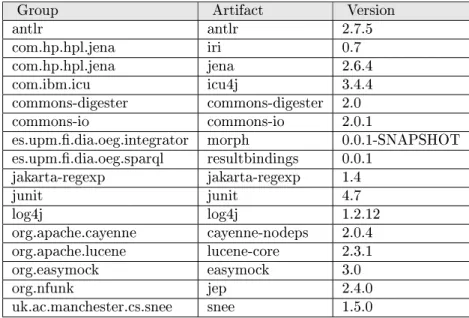
Table 3.1) species the external dependencies for the Semantic Integrator.
Group Artifact Version
antlr antlr 2.7.5
com.hp.hpl.jena iri 0.7
com.hp.hpl.jena jena 2.6.4
com.ibm.icu icu4j 3.4.4
commons-digester commons-digester 2.0
commons-io commons-io 2.0.1
es.upm..dia.oeg.integrator morph 0.0.1-SNAPSHOT es.upm..dia.oeg.sparql resultbindings 0.0.1
jakarta-regexp jakarta-regexp 1.4
junit junit 4.7
log4j log4j 1.2.12
org.apache.cayenne cayenne-nodeps 2.0.4 org.apache.lucene lucene-core 2.3.1
org.easymock easymock 3.0
org.nfunk jep 2.4.0
uk.ac.manchester.cs.snee snee 1.5.0 Table 3.1: Semantic Integrator dependencies.
1http://maven.apache.org, accessed 15 February 2011.
3.1.2 Conguration
Integrator settings The Semantic Integrator is congured using a Properties le with a set of key-value pairs. This le is by default located atconfig/config.propertiesthough it can be initialized from elsewhere. The main settings are:
• integrator.queryexecutor.adapter: Specify the streaming data processor (e.g snee).
• integrator.repository.provider: Specify the type of storage of the integrator re- sources (e.g. memory-only, le system).
• integrator.repository.url: Specify the location of the registered mappings and con- gured integrated resources metadata.
Stream engine settings In case of hosting an embedded stream processing engine (e.g. snee), the engine settings must also be set. For further details about the snee conguration refer to deliverable D2.2v2[GGF+11].
Logging The system uses standard log4j logging mechanisms and is congured using a le namedlog4j.properties.
3.1.3 API
Table 3.2 provides the Java api for the Semantic Integrator.
Constructor Summary
SemanticIntegrator(Properties properties) Create a SemanticIntegrator congured according to the given properties.
Method Summary
void addSource(String url)
Register a new streaming data source, so that it can be used to create an integrated data source.
DataSourceMetadata integrateAs(List<DataSourceMetadata> sources, String integratedSourceName, MappingDocumentMetadata map- ping)
Register a new integrated data source, based on the list of original streaming data sources. The new source ontological schema is mapped to the underlying data sources schemas.
DataSourceMetadata pullQueryFactory(String integratedSourceName, Query- Document query)
Register a pull query against the integrated data source.
ResponseDocument pullData(String pullSourceName)
Pull data from a registered pull data source.
ResponseDocument pullLatestData(String pullSourceName)
Pull latest data form a registered pull data source.
DataSourceMetadata retrieveIntegratedDataSource(String integratedSource- Name)
Retrieve the metadata for the specied integrated data source.
Collection<DataSourceMetadata> retrieveIntegratedDataSourceCollection()
Retrieve the metadata for all integrated data sources.
DataSourceMetadata retrievePullDataSource(String pullDataSourceName) Retrieve the metadata for the specied pull data source.
Collection<DataSourceMetadata> retrievePullDataSourceCollection()
Retrieve the metadata for all pull data sources.
void removeIntegratedDataSource(String integratedSource- Name)
Remove the specied integrated data source.
void removePullDataSource()
Remove the specied pull data source.
Table 3.2: Java API of the SemanticIntegrator.
3.2 Integration and Query Service
The iqs can be found in the SemSorGrid4Env project SVN repository: https://ssg4env.
techideas.net/repos/IntegrationQueryService/trunk. The java source les are or- ganized under theeu.semsorgrid4env.service.iqspackage.
The iqs project is subdivided in two sub-projects: iqs-ws and iqs-client. The rst is the web service implementation itself and the latter is a sample web service client project that can be used for integration testing.
The code follows a Maven project organization:
• src/main/java: Java source les.
• src/main/resources: Application resources.
• src/main/webapp: Web application resources.
• src/test/java: Test source les.
• src/test/resources: Test resources.
3.2.1 Integration and Query Service WSDL