
A principios de 2009, más de 1.600 MW de proyectos renovables no convencionales estaban aprobados o en trámite en el sistema de evaluación de impacto ambiental. ERNC Energías renovables no convencionales/Energías renovables no convencionales (ERNC) FP Factor de planta/Plant factor.
Motivación y justificación/Motivation and justification
Estas señales, junto con el crecimiento de los precios de los combustibles fósiles en los mercados internacionales, también son percibidas por potenciales inversores en proyectos ERNC, tanto presentes actualmente en el mercado eléctrico nacional como nuevos inversores nacionales e internacionales. Esto se demostró en el proceso dinámico de desarrollo de proyectos ERNC en los sistemas eléctricos nacionales.
Objetivo y alcance/Objectives and scope
To better understand the unique characteristics of the Chilean electricity market, the criteria and market designs developed in Chile are contrasted with those used internationally. Details regarding the topics discussed in the first chapters are included in the specific appendices of this document.
Estructura del documento/Structure of the document
Con el fin de facilitar la comprensión de las características del mercado eléctrico chileno, se contrastan los criterios y diseños de mercado desarrollados en Chile con esquemas establecidos internacionalmente.
Desarrollo energético/Energy development
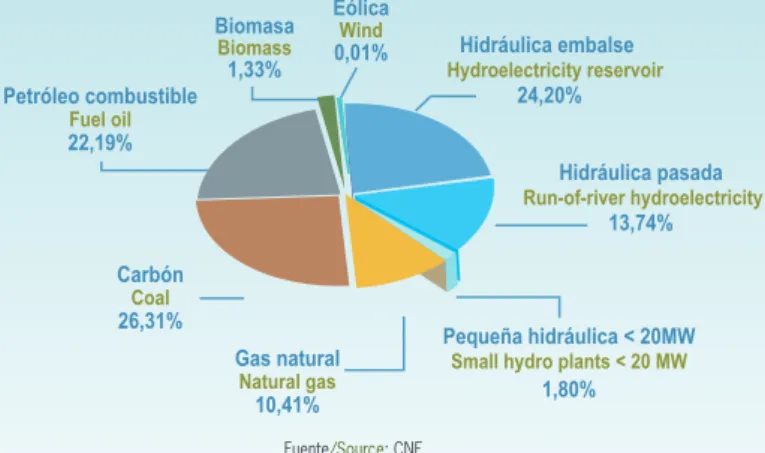
En línea con la actividad económica del país, el 37% del consumo eléctrico se concentra en el sector minero, mientras que otras industrias consumen el 31%, el sector residencial el 17% y el sector comercial y público el 14% (ver Figura 4).
Sistemas eléctricos/Electricity systems
Northern Interconnected System (SING): An important system that supplies the northern zone of Chile, from Arica in the north to Coloso in the south. Aysén electricity system: In practice, it consists of five medium-sized systems in the southern part of the country: Palena, Hornopirén, Carrera, Cochamó and Aysén.
Oferta de energía eléctrica/Supply of electricity
Capacidad instalada/Installed capacity
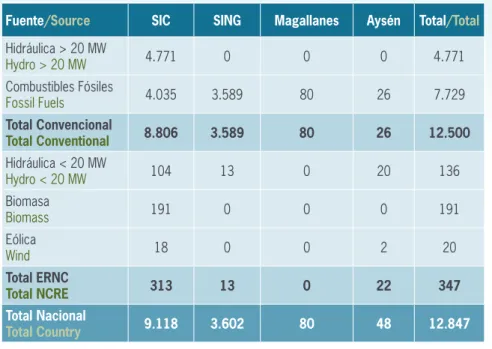
El análisis de los gráficos muestra que en los últimos años se ha observado una caída en el nivel de inversión productiva. En el caso del SING, sistema térmico que presenta una importante sobreinstalación desde 1999, la evolución de las inversiones marca una tendencia a partir de 2002, donde la capacidad instalada disminuye levemente.

Energía generada/Production of electricity
En el caso del SIC se observa una reducción del margen de reserva en valores cercanos al 35%, lo que para un sistema hidrotermal sugiere una vulnerabilidad en la seguridad del suministro energético.
Consumo y clientes/Consumption and customers
Cliente regulado/Regulated customer
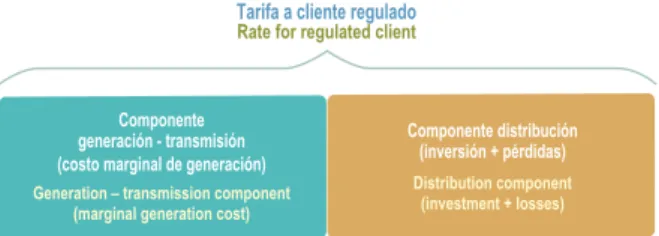
These prices are set every 6 months by the Comisión Nacional de Energía (CNE), based on expected marginal cost projections in the system for the next 48 months2. The expansion plan can be found on the CNE website (www. .cne.cl) under section “Electricidad” (document “Fijación de Precios de Nudo.
Cliente libre/Non-regulated customer
Sistemas de transmisión y distribución/Transmission and distribution systems
Sistemas de transmisión/Transmission systems
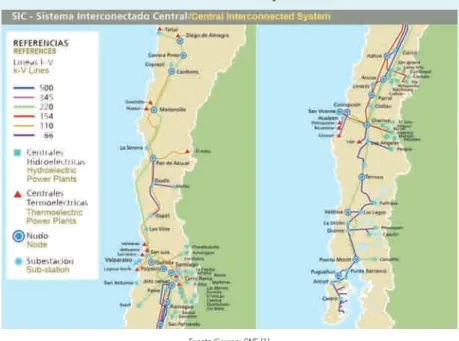
5 There are several 154 kV power installations that are part of the main transmission system. In the case of SING, the main transmission system is defined in the annex of Law 19.940 (Short Law I) and represents the installations located between the nodes of the S/E Encuentro – S/E Crucero substations, i.e.
Tratamiento reglamentario/Regulatory treatment
Los ingresos tarifarios se transfieren a los transportistas como parte del pago de sus anualidades reconocidas en los procesos tarifarios. En términos de referencia, para una red de transmisión económicamente ajustada, el ingreso tarifario corresponde al 20% de la remuneración anual de una red de transmisión.
Sistemas de distribución/Distribution systems
It is worth noting that all generators participate in the payment of transmission fees, regardless of the voltage level or subsystem they are connected to. According to these definitions, the feeders of distribution systems (high voltage distribution) operate at different voltages within the specified range, as well as 23 kV.
Marco institucional del sector eléctrico/Institutional framework of the electricity sector
- Comisión Nacional de Energía (CNE)/National Energy Commission (CNE)
- Superintendencia de Electricidad y Combustibles (SEC)/Superintendency
- Comisión Nacional del Medio Ambiente (CONAMA)/National Environmental
- Centros de Despacho Económico de Carga (CDEC)/Economic Load
- Panel de Expertos de la Ley General de Servicios Eléctricos/Panel of Experts
- Tribunal de Defensa de la Libre Competencia/Tribunal for the Defence of
- Resolución de conflictos/Conflict resolution
CDECs are private organizations in charge of coordinating the operation of the electric power system. The expert group of the General Act on Electricity Services is an entity established by Act no.
Fundamento económico del mercado eléctrico/Economic framework
The production, transmission and distribution activities have thus been separated in the electricity market, each of which has a different regulatory environment. In the production segment, a competitive system based on marginal cost pricing (peak pricing) has been established, where consumers pay a price for energy and a price for capacity (power) in connection with peak hours (see figure 19).

Modelo del mercado eléctrico/Model of the electricity market
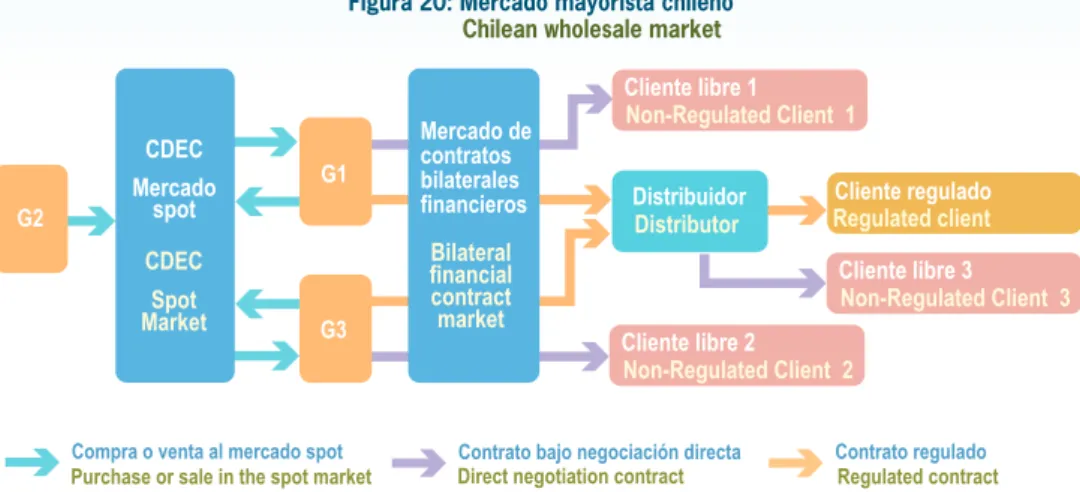
Physical and economic transfers (sales and purchases) are determined by the relevant CDEC, and – in the case of energy – are assessed on an hourly basis at the border. In the case of Figure 20, the contract between the distribution company and unregulated customer 3 is not direct.
El mercado spot/The spot market
In the wholesale market16, transfers of energy and capacity take place between production companies in accordance with contractual delivery obligations. 16 The definition of wholesale market can be found in the glossary of terms, see appendix 5.

Mercado de contratos/Contract market
From 2010, however, prices for regulated customers will be determined based on the energy. The nodal price of energy is the average of the marginal costs expected in the short term, with a minimum of 24 and a maximum of 48 months, adjusted to a free price band. 17.
Servicios complementarios/Ancillary services
Two major initiatives have been launched for that purpose: improving the legislative framework of the electricity market and implementing direct support mechanisms for investment initiatives in NCRE. It also intends to create the conditions to implement a portfolio of NCRE projects to accelerate the development of the market, remove the barriers that often inhibit innovation and create confidence in the electricity market regarding this type of technology.
Contexto general de las ERNC/General context of NCRE
This chapter discusses that law and other aspects of the electricity market relevant to NCRE. NCRE's integration and operation in the market is necessarily dictated by the design of the electricity market in which they intend to operate.
Descripción general de etapas de desarrollo de proyectos ERNC/General description
Operation in the market refers to the pricing system an NCRE project must face to estimate its revenues and costs during operation. Finally, the market exit phase refers to the conditions that an agent from the sector must comply with in order to stop operating on the electricity market.
Definición de medios de generación de ERNC/Definition of NCRE generators
Energía renovable no convencional: electricidad producida por medios no convencionales de producción renovable. La clasificación de los medios de generación renovables no convencionales, presentada en el apartado anterior, agrupa una serie de subclasificaciones para las cuales la Ley 19.940, la Ley 20.257 y el D.S.
El marco regulatorio para las ERNC/The regulatory framework for NCRE
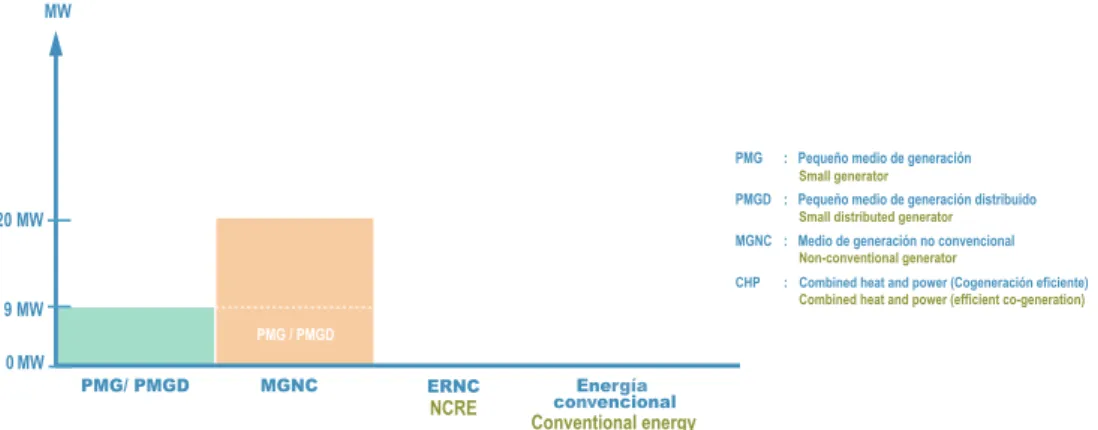
Junto a los proyectos ERNC de menos de 20 MW, esta categoría también incluye proyectos de cogeneración eficiente de menos de 20 MW a base de combustibles fósiles. Cabe mencionar en este contexto que para aquellas unidades con una capacidad entre 9 y 20 MW, la exención del peaje se determina mediante un ajuste proporcional, siendo pleno (100%) para 9 MW y cero para medios de producción con 20 MW. o más.

Ley de Energías Renovables No Convencionales (Ley 20.257)/Law on Non-Conventional
Laws and regulations related to this process produce price signals that are followed by decision makers in the electricity market. These alternatives also refer to the voltage level in the network (distribution with voltages lower than or equal to 23 kV, subtransmission or transmission with voltages greater than 23 kV) to regulate the connection of an NCRE project.

Alternativas de integración a un sistema eléctrico/Alternatives
Sin embargo, en el Capítulo 2 se presentan distinciones más detalladas de los sistemas entre sí.
Tramitación de permisos técnicos/Processing technical permits
Conexión a redes de distribución/Connection to distribution networks
Electrical data of the transformers to be used in the connection with the distribution system (SD). Copies of the SCR will be sent to the SEC and CDEC within the next 3 days after its submission to the distribution company.

Conexión al sistema de transmisión/Connection to the transmission system
Before starting the synchronized operation of the PMGD, the Commissioning Protocol is carried out, which refers to the set of technical tests necessary for the approval of the commissioning of the devices. Before starting the operation of the PMGD, the owner of the PMGD must send a copy of the start-up protocol accepted by the concerned company to the SID.
Costos de conexión/Connection costs
Costos de conexión a redes de distribución/Connection costs
El valor de estas provisiones adicionales no se considerará parte del nuevo valor de reposición de la empresa distribuidora correspondiente”. El PMGD interesado presenta una solicitud de información a la empresa distribuidora a la que desea conectarse.
Costos de conexión a un sistema de transmisión/Connection costs to
La operación en el mercado de un proyecto ERNC se rige por los términos y condiciones generales aplicables a cada unidad generadora, los cuales se describen en la Sección 2. La Figura 32 muestra un diagrama esquemático relativo a los elementos considerados en la operación en el mercado.

Descripción general de alternativas de comercialización/General description
- Venta de energía en el mercado spot/Sale of energy in the spot market
- Venta de potencia en el mercado spot/Sale of capacity in the spot market…
- Mercado de contratos/Contract market
- Cuotas de ERNC/NCRE portfolio standard
Venta de energía y potencia a través del CDEC en el mercado spot a precio estabilizado (correspondiente al precio de inyección nodal) de la energía ya precio de potencia nodal a otras empresas generadoras. Los productores compran (energía y potencia) en el mercado spot para suministrar sus contratos en un centro de acopio o suministro.

Las alternativas de comercialización/Commercialization alternatives
- Alternativa 1: Venta de energía y potencia en el mercado spot/
- Alternativa 2: Combinación entre mercado spot y contrato con un
- Alternativa 3: Combinación entre mercado spot y mercado de contratos
- Alternativa 4: Contrato directo con empresa de generación/Option 4: Direct
- Alternativa 5: Fuera de mercado mayorista (contrato directo con empresa
Finalmente, en el caso de las transferencias de energía (intercambios), estas se realizan al precio de nudo de energía. Un proyecto ERNC puede firmar un contrato con una empresa generadora que participe en el mercado mayorista (transferencias de potencia y energía en un contrato a largo plazo).
Pago por uso de las redes (peajes)/Payment for the use of networks (transmission charges)
Pago de peajes por uso del sistema de transmisión troncal/Payment of
Pago de peajes por uso del sistema de subtransmisión/Payment of
Pago de peajes por uso del sistema de distribución/Payment of transmission
Este componente se conoce como Valor Agregado de Distribución (VAD) y se determina cada 4 años. El valor de estas tarifas está regulado por el Decreto Tarifario n. 99 de 2005, que define las fórmulas para determinar su monto.
Exención de peajes/Exemption from transmission charges
En este caso, el valor del peaje corresponderá al componente pagado por los usuarios regulados por el uso de las instalaciones de distribución.
Servicios complementarios y ERNC/Ancillary services and NCRE
This optimization also determines the hourly marginal cost (spot price) for each busbar in the system. Each of the stages and concepts used in the calculation process is described below.

Proyectos ERNC en evaluación ambiental/Annex 2: NCRE projects
Marco regulatorio del sector eléctrico (énfasis en ERNC)/Annex 3: Regulatory
Leyes/Laws
- Decreto con Fuerza de Ley N o 4, Ley General de Servicios
- Ley 19.940 (Ley Corta I)/Law 19.940 (Short Law I)
- Ley 20.018 (Ley Corta II)/Law 20.018 (Short Law II)
- Ley 20.257 (Ley ERNC)/Law 20.257 (NCRE Law)
- Ley 20.220 Para Resguardar la Seguridad del Suministro a los
Reglamentos/Regulations
- Decreto Supremo N o 327/Supreme Decree No. 327
- Decreto Supremo N o 244/Supreme Decree No. 244
- Decreto Supremo N o 62/Supreme Decree No. 62
El Decreto Supremo N° 244 con el título oficial “Aprueba reglamento para equipos de generación no convencionales y pequeños equipos de generación” fue promulgado por el Ministerio de Economía, Fomento y Reconstrucción en septiembre de 2005. El Decreto Supremo N° 62 oficialmente denominado “Aprueba Reglamento para Transferencias de Energía entre Empresas Generadoras Establecidas en la LGSE” fue promulgada en febrero de 2006 por el Ministerio de Economía, Fomento y Reconstrucción.
Normativa técnica/Technical regulation
- Norma Técnica de Seguridad y Calidad de Servicio (NTSCS)/Technical
- Norma Técnica de Conexión y Operación (NTCO) de PMGD en media
This requires calculating the contribution of hydropower plants during the peak hours of the annual peak period (winter period). The initial capacity of the power plant is the average capacity generated during all peak hours of the period.
Otros/Others
- Decreto Supremo N o 26/Supreme Decree No. 26
- Decreto No 99 / N o 188/Decree No. 99 / No. 188
Aspectos de funcionamiento del mercado/Annex 4: Market operation aspects
Despacho/Dispatch
La generadora ha suscrito contratos de venta de electricidad con C1 y C2 por US$62/MW y US$70/MW respectivamente. La generadora ha suscrito contratos de venta de electricidad con C1 y C2 por US$62/MW y US$70/MW respectivamente.
Remuneración de la generación – energía/Remuneration of generation – energy
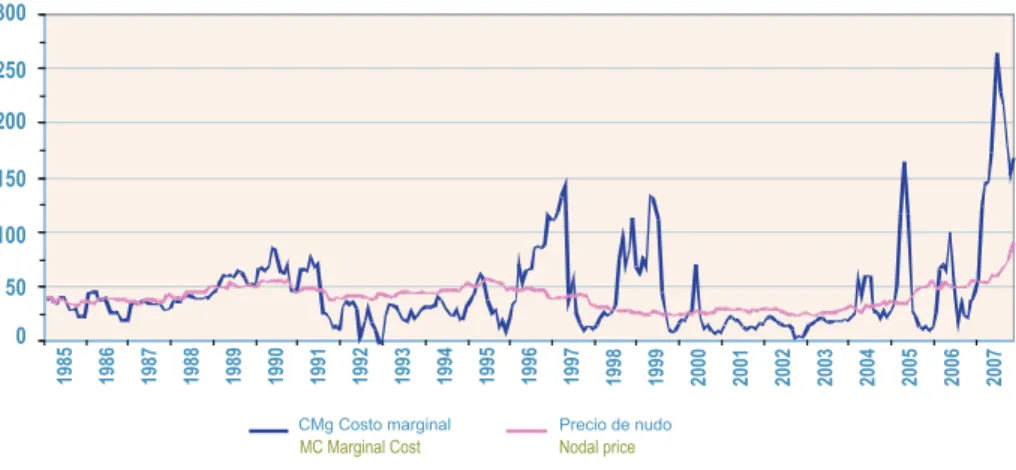
However, due to the new tendering regime for regulated customers, the resulting prices will gradually evolve to a weighted average of the prices resulting from the tenders. Since these are averages and because they are transferred to the end customer, their movements are highly buffered, but nevertheless follow the general trend of marginal cost variations.
Potencia firme (metodología actual)/Firm power (present methodology)
En todos ellos, la simulación de la operación busca maximizar la producción de las plantas en horas pico. La potencia inicial de la planta es el promedio de la potencia generada entre todas las horas pico del período.
Potencia de suficiencia (metodología D.S. 62, futura)/Adequacy power
El precio de la electricidad se estima en función del coste de inversión de la turbina de gas necesaria para asegurar el suministro en condiciones de máxima demanda del sistema. Sector Energético en Chile, Capacidades de Investigación y Áreas de Desarrollo Científico y Tecnológico, Junio 2007.

Glosario de términos/Annex 5: Glossary of terms


