Stoycheva for the award of the degree of Doctor of Science, has been carried out under our supervision at the Department of Electronic, Electrical & Automatic Control Engineering of Rovira i Virgili University, Tarragona, Spain, and that it meets all the requirements to be in eligible for the European Doctorate Label. Last but not least, I would like to thank all members of the Technical and Scientific Service, URV Tarragona, for their continued assistance and cooperation during my research.
Abstract
Resumen
Thesis publications
Full papers
Conference proceedings
Posters and presentations
INDEX
Chemical Vapour Deposition (CVD) techniques for development of active sensing material for gas sensors applications
Preparation and characterization of intrinsic and gold (Au) functionalized tungsten trioxide (WO3) nanostructure-based gas.
Fabrication and characterization of intrinsic and gold (Au) functionalised tungsten trioxide (WO 3 ) nanostructure-based gas
- Characterization of gas sensors based on Au-functionalised WO 3
Fabrication and characterization of internal tin oxide (SnO2)-based gas sensors deposited by the AACVD method..131.
Fabrication and characterization of intrinsic tin oxide (SnO 2 )- based gas sensors deposited via AACVD method
Introduction
Introduction
- Motivation
- Objectives
- Structure of the thesis
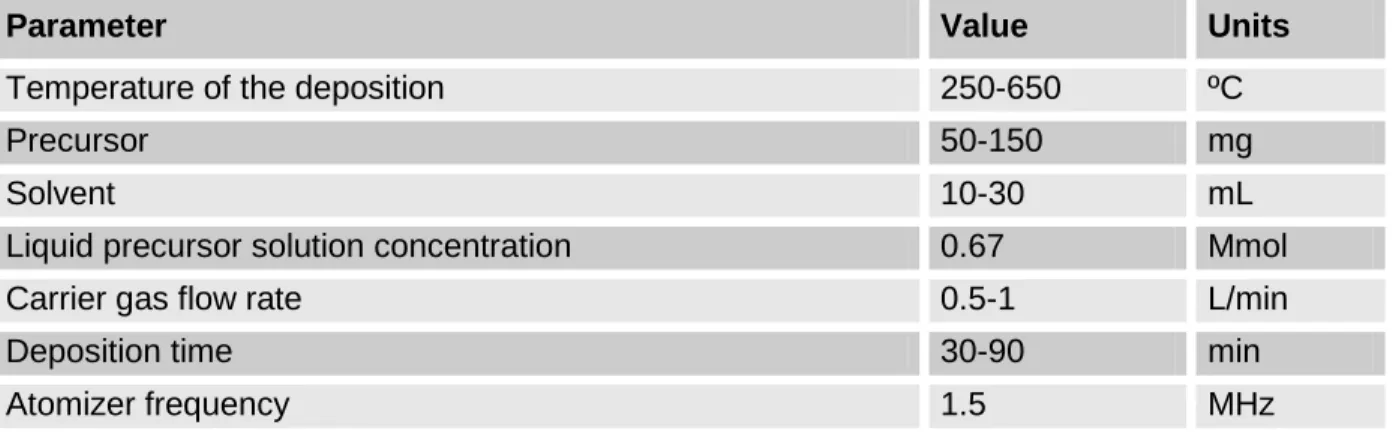
Subsequently, the use of the obtained SnO2 films as a gas detection element will be investigated. This consists of the AACVD system and the direct growth deposition conditions used for the various fabrication of metal oxide based gas sensors.
State of the art
State of the art
- WO 3-x gas sensors
- Physical and chemical properties of WO 3-x
- WO 3-x for gas sensors applications
- Nanostructured gas sensors
- Nanostructured materials
- Nanostructured metal-oxide in gas sensor applications
- Modified nanostructures
- Deposition methods for nanostructured metal-oxides gas sensors
- Chemical Vapour Deposition (CVD) techniques for development of active sensing material for gas sensors applications
- CVD basic principles
- CVD methods and their applications for nanostructured gas sensors
- Aerosol-assisted deposition methods – applications for gas sensors
Table II.1 presents the chemical and physical properties of elemental tungsten and tungsten oxides. Table II.2 compares the properties of the oxidation states of tungsten oxides and tungsten suboxides. WO3-x is considered one of the most interesting materials for active sensing in the field of gas sensors based on metal-oxide semiconductors [21, 22].
The first step in the manufacture of the gas sensor is the synthesis and deposition of the active sensor material. They include: Route 1 - synthesis of the semiconductor matrix followed by the addition of nanoparticles in the second step. In [99], a growth model, shown in Figure II.8, was proposed to observe the quasi-one-dimensional growth of tungsten oxide nanowires.
In general, the right choice of deposition technique can affect the sensing characteristics of the gas sensor devices. In Figure II.12 the influence of the temperature on the aerosol-assisted deposition process is shown.
![Table II.2: Properties of the oxidations states of tungsten oxide [10]](https://thumb-us.123doks.com/thumbv2/123dok_es/5788308.5474280/45.892.92.785.683.1053/table-ii-properties-oxidations-states-tungsten-oxide.webp)
Experimental methods and material characterization
- Film deposition
- AACVD system
- Precursor synthesis - general procedure
- Active sensing layer deposition
- Functionalisation of the deposited layers
- Material (physical) characterization of the active layers
- ESEM – Environmental Scanning Electron Microscopy
- AFM - Atomic Force Microscopy
- TEM - Transmission Electron Microscopy
- XRD - X-ray Diffraction and crystallite size calculations
- The other methods
- Gas sensor fabrication
- Alumina gas sensors
- Microhotplate gas sensors
- Gas sensors characterization study
- Measuring set up
- Target gases
This flask is immersed in a tank of the ultrasonic atomizer (500 ml capacity), which contains water (300 ml). The sputtering process of the alumina gas sensors was performed by UPC (Technical University of Catalonia), Barcelona, Spain. The study of the preferred orientation was made by Rietveld analysis [181] of the X-ray diffractograms using software TOPAS [182].
The front view images of the microwave gas sensor substrate are shown in Figure III.6. The wiring and substrate packaging of the microheat gas sensor was manufactured by CNM (National Center of Microelectronics), Barcelona, Spain. The schematic view of the test set for gas sensor characterization is presented in Figure III.8.

Fabrication and characterization of intrinsic and gold (Au) functionalised tungsten
Fabrication and characterization of intrinsic and gold (Au) functionalised tungsten trioxide (WO 3 ) nanostructure-
- Introduction
- Nanostructured WO 3 film deposition
- Film analysis
- Characterization of gas sensors based on nanostructured WO 3 films
- Sensing film analysis
- Gas sensing characterization
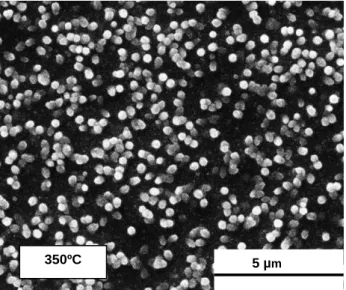
Increasing the precipitation temperature was found to affect the morphology (Table IV.2). The sample deposited at 500 ºC using the mixture of acetone and toluene as the solvent showed that the length of the nanoneedles was about 10 μm. In Figure IV.4, the deposition temperature is shown as a function of the length and width of the nanoneedles, depending on the solvent used.
Subsequently, these craters serve as nucleation sites for the growth of the nanoneedle-like structures. Figure IV.7 shows ESEM images of the cross-section of the deposited films on alumina substrate. The gas sensors were assembled according to the procedural steps described in point 3.1 of the experimental part.

Film analysis
- Morphology
- Chemical composition
- XRD analysis
The surface morphology analysis of the Au-deposited WO3 nanostructures, deposited at 350 ºC on alumina substrate, confirmed the presence of a high density of non-aligned nanoneedles, similar to that observed in the non-functionalized films that of the mixture of acetone and toluene (Figure IV.6). The TEM image of the WO3 nanoparticles functionalized with Au nanoparticles in-situ via AACVD revealed traces of Au nanoparticles around the nanoneedle surface (Figure IV.14). The inset (Figure IV.15.b), shows a typical high resolution image of Au nanoparticles, where one can note the family of planes with lattice spacing of 2.4 Å, corresponding to (111) planes.
The peak broadening observed in the Au/WO3 sample is associated with the presence of surface defects in the WO3 nanoneedles which became quantitatively important in the XPS spectrum due to the higher surface area of the WO3 nanoneedles compared to the WO3 thin film standard [102] . Examination of the Au 4f core level XPS spectra showed that the deposited Au nanoparticles were metallic, again indicating only a weak electronic interaction with the WO3 nanoneedles. Figure IV.16.b shows the comparison of the Au core level spectrum recorded on the sample and on Au crystal.

Gas sensing characterization
- Sensor response
- Stability
Similar to our previous study (section 3), Au/WO3 samples have shown an increase in electrical resistance when exposed to lower concentrations of EtOH (Figure IV.18), while WO3 gas sensors normally show a reduction in resistance. Similar to the sensors tested in Section 3, after gas sensing experiments that were conducted for one month at temperatures up to 350 ºC and in several toxic environments (NO2, CO, C6H6), the Au/WO3 samples were again examined using ESEM . and TEM techniques. This indicates a good stability of the obtained structures and the possible use of these materials for gas sensor applications.
![Figure IV.18: Typical gas sensor response to 1.5 ppm EtOH at 250 ºC operating temperature [52]](https://thumb-us.123doks.com/thumbv2/123dok_es/5788308.5474280/147.892.87.792.334.867/figure-iv-typical-sensor-response-etoh-operating-temperature.webp)
Micro-machined gas sensors with nanostructured WO 3 films
- Film analysis
- Morphology
- XRD analysis
- Gas sensing characterization
- Sensor response - reducing gases
- Sensor response - oxidizing gases
- Stability
The response of the WO3 gas sensors was measured when exposed to different reducing target gases and various concentrations. The microhot plate WO3 gas sensors showed gas sensing response (S = 4.36) to H2S at the lower (150 ºC) operating temperature. The gas sensing results obtained for H2 were found to be lower compared to the results obtained for alumina WO3 gas sensors.
After achieving deposition on the microhotplate substrate, response/recovery times were improved for WO3 gas sensors. On the other hand, the microhotplate WO3 gas sensors were less sensitive compared to the co-deposited Au-functionalized WO3 nanoneedles on the alumina gas sensor substrate. Figure IV.24 shows the resistance changes of the sensing layer in air for the micro-hob based gas sensors.
Summary
Improved gas sensor substrate design and initial nucleation of a nanostructured layer due to the nature of the substrate surface were found to improve gas sensing properties, indicating the importance of these parameters. Gas sensors showed increased sensitivity to lower concentrations (1.5 ppm) of EtOH and provided a sixfold increase in gas sensor response. These results support our hypothesis that the shorter electrode spacing (~50 µm and ~200 µm for the micro-hot plate and alumina gas sensor substrates) and the initial nucleation of the nanostructured layer due to the nature of the gas sensor substrate can increase the gas sensitivity.
It was observed that the gas sensor responses of the micro-hotplate-based gas sensors to NO2 were higher than those of the gas sensors based on the alumina substrate. In general, during the gas characterization study, it was noted that the gas sensors based on both alumina and micro-hot plate gas sensor substrates have shown absence or relatively low response to reducing gases at lower operating temperatures. At the same time, the response of the gas sensor to oxidizing gases, such as NO2, was higher at 100 ºC and 150 ºC operating temperatures.
Fabrication and characterization of intrinsic tin oxide (SnO 2 )-based gas sensors
Fabrication and characterization of intrinsic tin oxide (SnO 2 )-based gas sensors deposited via AACVD method
- Film analysis
- Morphology
One of the first and still most widely used metal oxide materials for gas sensing applications is SnO2. Furthermore, aerosol-assisted CVD (AACVD) as a variant of conventional CVD offers more flexibility in process control and improves the compatibility of the gas sensor fabrication process. This chapter discusses the results of film analysis, sensor fabrication, and gas sensing findings for SnO2 active layers grown via the AACVD method using the two new tin complexes, namely [Sn(18-Cr-6)Cl4] and [Sn( H2O)2Cl4](18-Cr-6), as precursors.
The gas sensors characterization study was carried out by applying the experimental conditions described in point 4 of the experimental part. Due to the higher roughness of the alumina gas sensor substrates, they were not suitable for AFM analysis. For this reason, the SnO2 films were grown on the silicon wafers and used for detailed study of the morphology of the obtained tin oxide layers.
- XRD analysis
- Gas sensing characterization
- Sensor response
- ºC NO 2 , 10 ppm
- Stability
- Summary
The XRD analysis of the same samples annealed at 400 ºC for 2 hours has shown similar results, indicating a stable structure. It was observed that the response of the sensor to the exposure of NO2 gas increases with the increase of the operating temperature, showing the highest value at 300 ºC. The sensor's baseline resistance changes were recorded in air over three weeks of the experiments.
It was found that during the study period of the gas characterization, the changes in the base resistance of the SnO2 sensing layers deposited by the tin II complex were negligible, indicating a good stability of the sensor. On the other hand, the resistance changes of the SnO2 sensing layers deposited by tin complex I were more pronounced during the first week. These results indicate the low cross-sensitivity of the fabricated SnO2 gas sensor to reducing gases.
![Figure V.1: AFM of tin oxide films deposited via AACVD at 250 ºC, 400 ºC and 500 ºC, using tin complex I (a) and tin complex II (b) [220]](https://thumb-us.123doks.com/thumbv2/123dok_es/5788308.5474280/167.891.107.763.104.1089/figure-oxide-films-deposited-aacvd-using-complex-complex.webp)
Conclusions
Conclusions
The presented work has addressed the investigation of the material properties of Au-functionalized and internalized WO3 films and their gas sensing application. By applying ex-situ (r.f. sputtering) and in-situ (AACVD co-deposition) deposition techniques, WO3 nanoneedles were modified and the improvement of gas sensing properties was observed. The material properties of WO3 films deposited by the AACVD method were investigated in the first part of our study.
The AACVD method was successfully applied for the direct growth of WO3 nanoneedles on gas sensor substrates with typical thickness of the films in the range of ~7000 to 12000 nm. It was found that the in situ Au functionalization via AACVD of the WO3 nanoneedle gas sensing devices provides improved sensing properties compared to the ex situ Au functionalized and intrinsic WO3 nanoneedles. Finally, it was suggested that the improvement of the electrode design is necessary for the adequate exploitation of various nanostructures in commercial gas sensing devices.
Bibliography
Bibliography
Moulzolf, et al., "Effects of stoichiometry and microstructure on chemiresistive tungsten oxide films," Sensors and Actuators B: Chemistry, vol. Qin, et al., "Microstructure characterization and NO2 sensing properties of tungsten oxide nanostructures," Sensors and Actuators B: Chemical, vol. Senguttuvan, et al., "Gas Sensing Properties of Nanocrystalline Tungsten Oxide Synthesized by Acid Precipitation Method," Sensors and Actuators B: Chemical, vol.
Liu, et al., "Enhanced H2 sensing properties of Co-doped SnO2 nanofibers," Sensors and Actuators B: Chemical, vol. Yang, et al., "Synthesis and growth study of SnO2 nanowires," Sensors and Actuators B-Chemical, vol. Inglés, et al., "Electro-thermal simulation and characterization of preconcentration membranes," Sensors and Actuators A: Physical, vol.
![Figure II.1: Model of inter-grain potential barrier (a) in the absence and (b) in the presence of gases [17]](https://thumb-us.123doks.com/thumbv2/123dok_es/5788308.5474280/49.891.146.730.104.381/figure-model-inter-grain-potential-barrier-absence-presence.webp)
![Figure II.5: Schematic illustration of three basic models of initial nucleation in the film growth [91]](https://thumb-us.123doks.com/thumbv2/123dok_es/5788308.5474280/62.892.147.763.668.1096/figure-schematic-illustration-basic-models-initial-nucleation-growth.webp)
![Figure II.8: Schematic image illustrating the mechanism for formation of tungsten oxide nanowires through VS process [99]](https://thumb-us.123doks.com/thumbv2/123dok_es/5788308.5474280/67.892.119.750.588.789/figure-schematic-illustrating-mechanism-formation-tungsten-nanowires-process.webp)
![Figure II.9: A schematic illustration of the key CVD steps during deposition [137]](https://thumb-us.123doks.com/thumbv2/123dok_es/5788308.5474280/77.892.107.760.254.617/figure-ii-schematic-illustration-key-cvd-steps-deposition.webp)

![Figure II.12: Influence of the temperature on aerosol-assisted deposition process [137]](https://thumb-us.123doks.com/thumbv2/123dok_es/5788308.5474280/86.892.130.793.102.563/figure-ii-influence-temperature-aerosol-assisted-deposition-process.webp)
![Figure III.4: (a) TGA profile for [Sn(18-Cr-6)Cl 4 ], (b) TGA profile for [Sn(H 2 O)2Cl 4 ](18-Cr-6)](https://thumb-us.123doks.com/thumbv2/123dok_es/5788308.5474280/100.891.109.805.105.581/figure-iii-tga-profile-sn-cr-tga-profile.webp)