English Language Education (ELT) is included in the P-12 curriculum in most of the private institutions in this country. Some branches of ESP are: EAP (English for Academic Purposes) it deals with the communication in English required for study purposes in formal education systems and used for academic studies; EOP (English for Occupational Purposes). Design: it refers to the level of a method which specifies the relationship between the linguistic theories and the classroom materials and activities (Richard and Rogers 1982, cited in Brown 1994, p. 48).
Therefore, it is essential to be aware of the aspects involved in ESP so that students can achieve their language goals.
The process of curriculum development and syllabus design
White looks at criticisms of the traditional top-down, means-ends model of curriculum development from an educational perspective. The objectives of the curriculum had to consider not only the content of the subject to be learned (language forms and rules, for example), but also the processes involved in language acquisition and the outcomes in terms of what the learner should be able to do with the tongue. On the other hand, it can be related to testing - how the learner will be asked to demonstrate that they have mastered the content of the course.
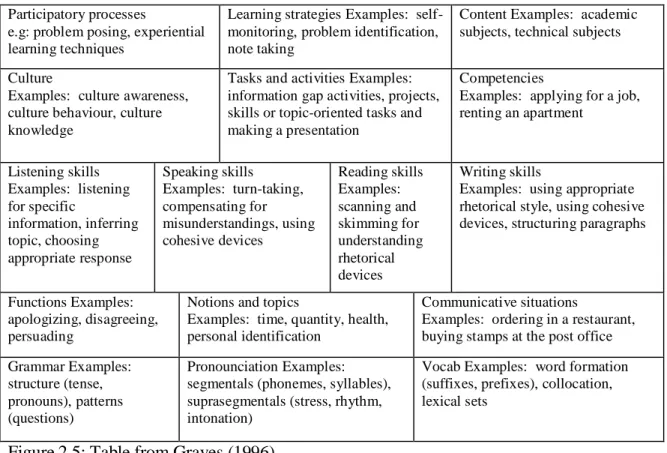
A structural curriculum describes what is to be learned in terms of the grammatical system (grammatical rules or sentence patterns) and the lexical and phonological systems of the language. Skills Curriculum; lexical syllabus of words and phrases to be learned in the course; phonological curriculum; syllabus topics and situations etc. ESP consists of English language teaching designed to meet the specific needs of the learner.
The different levels of the ESP courses are shown according to the specialist in each ESP category. At the next level down, the ESP courses are placed according to the general nature of the specialist area;. The first states that ESP is designed to meet specific needs of the learner.
The second mentions that ESP is substantively related to certain disciplines and activities by making use of the underlying methodology. These developments in English Specific Purpose (ESP) have grown in line with the increasing recognition of students' needs and wants as a central part of curriculum development in general language education (Brindley 1984, Holliady 1994, Mumby 1978, Nunan 1998, White 1988, Willis 1996, Yalden 1985).

ESP course design
Among other things, this concentration of the individual pedagogue has tended to maintain the form of the second and foreign language specialist by paying much attention to the well-developed area of general curriculum construction. 34 This summary shows the development of the approach that allows the relatively inexperienced teacher to meet this challenge first the theoretical background defined: Concepts of communicative competence and second language proficiency are examined: and speech act theory, pragmatics and interactional analysis are discussed . . Alternative solutions to the questions of how to reorient language teaching in light of the new body of theory are critically presented.
In other words, the need to be able to use language that fits the social context has become a central focus for teachers and researchers. The first of these key questions concerns the audience for whom the program and materials will be developed, the actual consumers of the new program—teachers and students. Studies of error analysis were e.g. based solely on the study of second language learners' acquisition of structures.
While a student-centered curriculum will contain elements and processes similar to traditional curricula, a key difference will be that information from and by students will be incorporated into each phase of the curriculum process. Second language teachers can sometimes feel that they face a void after the collapse of the concept of a universal teaching method. 37 The richest sources of inspiration in course design are now theories, and theories about the development of the second language on the second.
Two phases in course design
It is at this point that the concept of pedagogical course design becomes useful. There are many possibilities for organization, and therefore one should consider the question of course type before entering this phase of design. In the second phase of the design process, from the basic form, appropriate classroom techniques are selected and tasks that utilize relevant language examples are determined across important, or necessary, language forms.
Then it is up to the teacher, ideally with the help of the learner or learners, to negotiate which activities will be used on a given day during a given lesson. From a set of units that make up a framework, various teachers can produce several different classroom plans. These frameworks offer the possibility of maximum flexibility at a time when much remains to be achieved in needs analysis, in discourse analysis, in the study of communicative competence and its components, and in the study of second language learning. As a result, it has been extensively investigated, especially in the context of English for specific target programs, but also more and more in general planning for language teaching, thus replacing the concept of method.
But in the course design with tips and techniques in teaching in this case in adults, because we need to know how the learners develop the knowledge. Instructors should use open-ended questions to bring out the major experiences of the mature learners. Pike (1989), an internationally recognized expert in human resource development and author of the book Creative Training Techniques, has conducted thousands of adult training seminars.
Experimental education
His principles of adult learning, also called "Pike's Laws of Adult Learning," build on the original philosophy to provide similar guidelines for trainers. When you are involved in the learning process and understand how it can help you do your job or other chosen task better, you can experience the pure joy of learning (Hutchison and Waters, 1983:61). The ability to apply new material is a good measure of whether learning is taking place.
This chapter presents the design of the instruments and procedures of the study. As mentioned above, the needs of the DCCA students were not adequately met, that is, neither the syllabus nor the materials matched the specific needs of the students. That is why a needs analysis was also carried out.
Research setting
Research subjects
Instruments
Since we started this questionnaire, we noticed that lack of time, personal problems and schedules were some of the problems that adult students face on a daily basis. The questionnaires were given at school, at the beginning of the lesson, because the students' answers were more reliable, as one of the main goals was to obtain specific information about the students' needs. The instrument description decided to use is the explication of design questionnaires to obtain data.
These questionnaires helped us to determine the specific data and the main factors involved in the process of learning a foreign language in adults.
Procedure
The purpose of the course is based on the combination of the result of the needs analysis with the literature review and the search for an appropriate approach as a basis for the design of a course. In this chapter, the results of the previous data collection will be analyzed. The first three answers are shown in graphics related to students' interest, expectations and skills they want to have during the ESP course.
The last three questions are answered qualitatively, they are related to the design criteria, the theoretical principles of ESP and the current conditions in DDCA in BUAP.
Research questions
Results of the needs analysis
47 The results obtained in this question show that 6 of the 15 students are interested in taking an ESP course because they will have a better salary in their job, another 6 students will have a better job and the last 3 students of the 15 will be completely trained. The results of what kind of abilities they want to practice more during the course are illustrated in figure 2 below. The result of this question is that 50% of the 15 students prefer to practice speaking skills in class, and 30% of the 15 students prefer to practice listening skills in class.
While 10% of 15 students prefer to practice reading skills in class, 10% of 15 students prefer to practice writing skills in class. The result of this question was that 50% of the 15 students wanted to develop 4 skills (speaking, writing, reading and listening). On the other hand, 30% of the 15 students want to have a better English level, and 20% of the 15 students want to be approved for the course.
Objectives are important to design an ESP course to focus on the content or skills students want to improve. Materials help to organize the teaching learning process by providing a path through the complex mass of language to be taught, good materials should provide a clear and coherent unit structure which will guide the teacher and the learner in different activities and in one way (Hutchison and Waters 1987). Furthermore, the implications of the study as well as its limitations and some directions for further research are also provided.
Conclusion
Dudley - Evans, A, (1998) Desarrollos en inglés para fines específicos. 1987) Inglés para fines específicos: un enfoque centrado en el aprendizaje. Esta entrevista está diseñada para explorar sus necesidades del idioma inglés para que podamos diseñar un curso que lo ayude a hacer su trabajo. Este cuestionario está diseñado para explorar sus necesidades del idioma inglés para que podamos diseñar un curso que le ayude a hacer su trabajo.