Adaptation Diplomacy', which aims to support urban areas, particularly in the Global South, to overcome barriers and accelerate adaptation to climate change. The findings in this report are expected to give cities and regions a voice in a major national review on climate change and sustainable development in 2018.
DATA SPEAK LOUDER THAN WORDS
WORKING TOWARD A SUSTAINABLE AND
The Sendai Framework for Disaster Risk Reduction (Sendai Framework), adopted in March 2015, ushered in the year of global optimism. The Sendai Framework shifted the focus from disaster-to-disaster management to proactive disaster risk reduction approaches.
Setting the scene: The Global Frameworks of 2015 and where we are now
Aiming to reduce loss of life, economic disruption and damage to critical assets worldwide, the Sendai Framework created a "baseline" for human survival, and its goals were naturally incorporated into the subsequent larger international effort to create the Sustainable Development Goals (SDGs). In June 2017, the “transformational optimism” that had accompanied the international climate agenda for two years was dashed when the United States federal government announced its intention to withdraw from the Paris Agreement.
The importance of sustainability and climate resilience at the local level
Due to their geographic location, socio-economic and demographic conditions, the majority of cities and regions in the global south are directly threatened by climate change. By building a world of sustainable cities and regions, humanity has a greater chance to achieve the global sustainable development agenda and thrive in the face of ongoing global changes.
WORKING TOWARD A
For those cities and regions, climate change migration and annual loss and damage due to increasing disasters is a reality. However, often the international community, the media, civil society organizations and – more alarmingly – international donors focus only on climate change mitigation.
SUSTAINABLE AND CLIMATE RESILIENT
Adaptation may be the only way forward for cities and regions in the global south, many of which barely contribute to global greenhouse gas emissions. The Paris Agreement mandates all countries to adopt and communicate ambitious Nationally Determined Contributions (NDCs) to combat the adverse impacts of climate change.
The stocktaking exercises of 2018
So in fact the inventory process started in 2018 as part of the official Facilitating Dialogue, known as the Talanoa Dialogue. The result of this initial global recovery is to push nations to submit NDCs by 2020 that reflect the vision and mission of the Paris Agreement.
Assessing progress made toward a better urban future
Based on the Talanoa spirit of inclusion, local and regional governments have conducted their own dialogues in support of the global. This publication expands on the findings of the GCoM Global Aggregation Report 2018 by offering in-depth analysis on climate change adaptation and resilience at local and regional levels.
PRELIMINARY ASSESSMENT OF CLIMATE CHANGE
ADAPTATION AND URBAN RESILIENCE ACTIONS AND
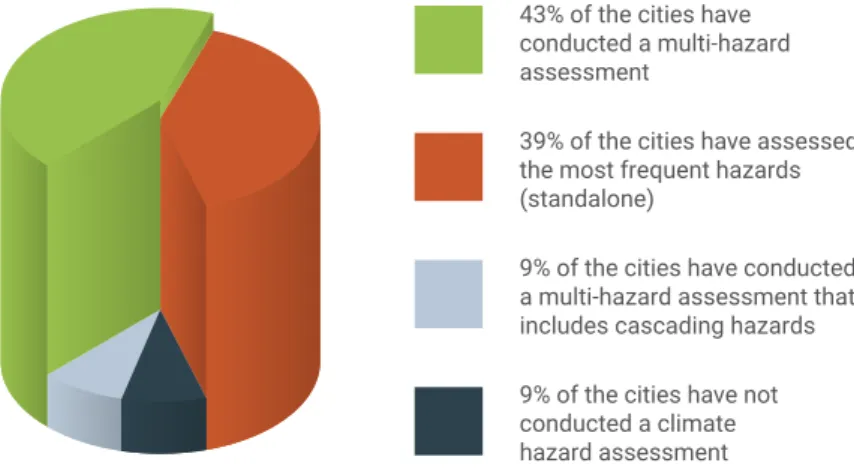
295 local and regional authorities (hereinafter “entities”) have reported to the adaptation section of the CCNR within the specified period. Cumulatively, however, only one fifth of reporting governments (21%) are taking or are in the process of doing all steps 1 to 5.
A snapshot of local and regional progress on adaptation worldwide
With 1,059 registered entities from 88 countries, representing 836 million inhabitants, the carbonn® Climate Registry (cCR)33 is one of the most widely used reporting platforms in the world for cities, towns and regions. Note that this is an update on the data included in the ICLEI publication Boosting subnational climate action through new climate governance.34 New information contained in the section below includes data from November 2017 to October 2018. Data reported over this period provide a snapshot of local progress in adaptation and urban climate resilience planning.
Stage of progress in urban adaptation planning
Within a year, all cities committed to the Compact of Mayors had to report their climate risk and adaptation information through this new section, called CRAFT. The following presents (a) a summary of the findings from data analysis of the new section, and (b) information on adaptation actions and action plans reported since 2011. Key findings are presented below to inform action in climate change adaptation at all levels of government and provide clear, data-driven , evidence-driven messages for adaptation diplomacy in major international processes in 2018.
PRELIMINARY STOCKTAKE OF
PLANS
CLIMATE HAZARDS (HIGH RISK)
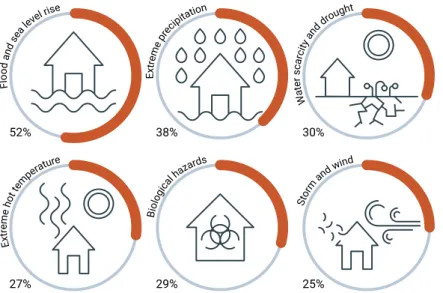
Climate risks can have a particularly precarious impact on cities and regions in the Global South that are already struggling with pre-existing demographic, economic, environmental, social or political stressors. Looking ahead, the vast majority of reporting entities (79%) expect risks to increase in intensity and frequency in the future. The reporting entities expect the same 6 main climate risks (see above) to increase in both frequency and intensity in the short- and long-term future.

Assets and services affected by climate change
160 reporting entities responded to this specific section in the cCR, which asked entities to identify conditions from a list of 26 non-exhaustive factors that affect their climate resilience efforts by either hindering or enabling climate adaptation measures changes in their jurisdiction.
Factors affecting adaptive capacity3.5
Barriers and opportunities presented as a result of local adaptation planning
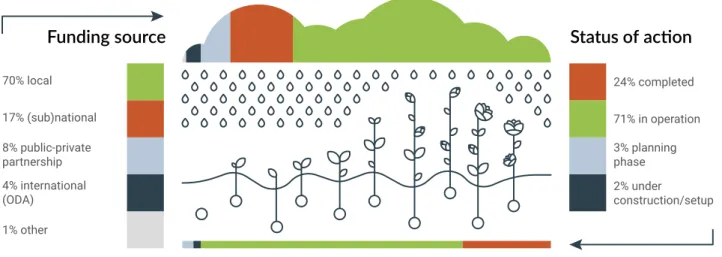
A total of 2,046 "adaptation-relevant actions" ("adaptation actions" and .. adaptation actions with a secondary focus on low-emission development/ . mitigation") were reported. Of the "adaptation-relevant actions", 73% are already "under construction/setting up" or "in operation", while 24% are "completed" and only 3% are in the "planning phase" (i.e. seeking funding to be implemented). The combined data represent the current status quo, where more than half of all "adaptation-relevant measures " is financed or expects to be financed by local funds (70%).
Funding source
Findings from an initial stocktaking of climate change adaptation and urban resilience efforts Adaptation actions and action plans. A total of 162 reporting entities (of which half or 54% from the Global South) reported that they had either "completed" or were "in progress" completing their climate adaptation plan (that is, "climate adaptation/resilience plans" and "integrated climate plans”). However, to present the whole picture, the latter figure must be observed in conjunction with data illustrating the current source of funding for climate adaptation actions (see Figure 7 below).
Status of acon
THE DATA SPEAK
KEY TAKEAWAYS FROM INITIAL STOCKTAKE
Findings of the Initial Review of Climate Change Adaptation and Urban Resilience Efforts Based on progress made at the local level.
Learning from local level integration4.2
KEY TAKEAWAYS FROM INITIAL
Existing barriers for cities and regions in the Global South to implement adaptation plans
Resilience of cities and adaptation to climate change are smart investments, as disaster relief and reconstruction are much more expensive than disaster risk reduction measures.48 Investments in prevention and preparation for an increasingly changing climate contribute to long-term social and economic development. In addition to a lack of financial resources, these areas often lack accurate and actionable data and knowledge to initiate climate change adaptation efforts. Several cities are already facing the extreme impacts of climate change on many key urban assets and services.
In focus: Global South cities and regions’
Especially for urban areas in the Global South, the mere financial obstacle is enough to halt the process of integrated climate action and sustainable development. Access to tools and scalable data, as well as contextualized support and curated information is required to guide local decision-making and future scenario planning in the rapidly growing resource-constrained cities of the South (see Appendix II for two Global South City Profiles from UN-Habitat's City Resilience Profiling Program). As Figure 4 on page 22 shows, the Global South is particularly affected by climate risks.
The national government is trying to harmonize and complement efforts with local governments to respond effectively to the growing threat of climate change. It helps local governments formulate climate and disaster risk-sensitive Comprehensive Land Use Plans (CLUPs) and zoning regulations that guide land use planning to reduce (as much as possible) vulnerability to impacts of climate change. 59. Climate and Development Knowledge Network (CDKN), Quito Metropolitan District Environment Secretary, Stockholm Environment Institute (SEI), (2014), Climate Change Vulnerability Assessment: quitoestudiodeclima.
OVERCOMING BARRIERS AND ACHIEVING A
COLLECTIVE VISION ON ADAPTATION
ICLEI is developing an Integrated Measurement, Reporting and Verification System (MRV) to link reporting at the local level with that of other levels, supporting the GCoM committed cities and other local and regional authorities tackling climate change. Local and regional governments have already laid the groundwork for such processes at the local level and could help countries kick-start national efforts with some progress already made. Funding these efforts requires multi-level governance mechanisms to provide local and regional governments with access to long-term funding sources.
Zoom in on integrated urban development approaches
OVERCOMING BARRIERS AND
C40's new Adaptation and Mitigation Interaction Assessment (AMIA) tool67 further emphasizes the importance of integrated actions at the local level by presenting numerous city case studies where climate change mitigation and adaptation actions are considered through the lens of synergies, trade-offs, misinvestment, and piggy-backing. backing (actions that are complementary when designed and/or implemented together). The Green Climate Fund (GCF) has committed to providing equal amounts of funding to adaptation and mitigation projects. International financing institutions are called to increase the availability and accessibility of financial resources for subnational governments for climate change action (mitigation and adaptation).
Unlocking adaptation finance at the local and regional level
Cities and regions will need to combine public and private funding from international, national, local, community and private sector sources to address the expected costs of climate change adaptation. Diversification spreads risk for a more sustainable, locally-controlled strategy.73 Therefore, it is necessary to consider new partners as an eligible part of the climate change adaptation financing puzzle. Individual climate change efforts (at the local, regional or national level) are not sufficient to tackle the increasing global challenges of climate change.
The partnerships necessary to galvanize climate adaptation from the local level
Equipping cities and regions with the skills and tools they need to develop fundable projects is a priority that IFNs have recognized in recent years by creating a number of Project Preparation Facilities (PPFs). Often the problem for cities in the Global South is a lack of knowledge or data on key aspects, such as urbanization rates, climate change risks and how these will affect local communities in the coming decades. The Know Your City Campaign: Gaining access to relevant climate change data in cities of the Global South.
CONCLUSIONS AND NEXT STEPS
The private sector is required to work closely with local and regional governments to generate the necessary capacity (technical and financial), drive innovation, share proprietary data and develop customized tools to support cities to build resilience climatic. This report shows that with enhanced and aggregated information, local and regional governments can clearly demonstrate their leadership in climate action. One of the objectives of this report is to give voice to local and regional governments in international processes.
List of City Climate Hazards
Extreme precipitation Extreme cold temperature Water scarcity
Storm & wind Extreme hot temperature Flood & Sea level rise
Chemical change Biological hazards
City Profiles from UN-Habitat’s City Resilience Profiling Programme (CRPP)
Initial analysis has shown that epidemics and pandemics (e.g. malaria), natural hazards such as heat waves, floods and tropical cyclones, and environmental hazards such as coastal erosion are the most pressing for the city. Increased awareness of implementation of global agendas: The initiative has raised awareness of resilience across the city through local and national media coverage. This knowledge base forms Asunción's City Resilience Profile and serves as a database to make informed decisions about resilience actions, identify priorities and simulate the impact of action.
Supporting evidence-base: Messages from C40’s Africa Adaptation Forum
Implementation of SDGs, the New Urban Agenda and the Paris Agreement in African cities - the challenges and needs of cities for technical expertise, capacity to generate data and research on climate impacts, action pathways and funding. Climate change data should stimulate conversation to emphasize the importance of climate change adaptation. However, statistics on climate change in relation to other data sets, such as poverty or the economy, are difficult to find.
Supporting evidence-base: Messages from Africa Adaptation Forum
Since the SDGs are the result of international political negotiations, contextualization is needed: how international agreements are translated into the local context of the city. Information was collected from the cities on the status of achieving the objectives of the Paris Agreement. This resulted in a brief overview of progress in plans, strategies, implementation and cooperation with national governments for each participating city.