19th Annual Global CEO Survey / 2016
A more connected, yet divided world?
p08/ Delivering better for less
p14/ Redefining success (for SEOs)
p22/ Building the foundations for growth
p26/ Measuring and communicating success
p32/ An agenda for action
p37Government and the Global CEO
Redefining success in a changing world
74%
of CEOs are concerned about geopolitical uncertainty69%
of CEOs believe government and regulators have a high or very high impact on their organisation’s strategy1,409
CEOs interviewed in 83 countries and 41 government representatives / state backed CEOs
Foreword
Welcome to ‘Redefining success in a changing world:
Government and the Global CEO’, in which PwC assesses
the critical changing relationship between government,
business and society.
Each year, PwC’s Annual Global CEO Survey captures the issues at the top of the agenda for the world’s business community. As in past years, we deepened the research for PwC’s 19th Annual Global CEO Survey1 by including a range of interviews with senior decision makers in governmental organisations around the world.
Our aim in doing so is to compare and contrast the views of business and government, understand the policy and delivery responses for the challenging conditions of today, and tomorrow, and contribute to greater understanding and stronger relationships between the public and private sectors.
Redefining success
Last year, PwC’s 18th Annual Global CEO Survey2 found that leaders were making changes across their organisations to make their businesses fit for the future, with CEOs recognising the increasing importance of building and sustaining trust in society.
So, what are we exploring this year? New political, economic and social models are prompting new ways of doing business across the world. The 19th Annual Global CEO Survey looks at how organisations are responding to changing societal expectations of business and how leading organisations are responding by: reshaping the way they define success;
redefining their corporate purpose, including the broader impact they have on society; and measuring and reporting on their wider business impacts.
In turn, with our public sector interviews, we have been seeking to understand better both the policy and public sector delivery responses to these issues and also how public sector organisations themselves can get ready for tomorrow’s challenges by:
• Redefining their purpose to drive success and channel their resources.
• Collaborating with business to build the foundations for growth.
• Measuring success and impact in smarter ways.
This report also looks at confidence, concerns and opportunities for growth and, in particular, the distinctive views of CEOs of state backed organisations.
We would like to thank not only the 1,409 company leaders across the world who shared their views with us for PwC’s 19th Annual Global CEO Survey, but also the 41 government representatives and state backed CEOs who took the time to share their thoughts in depth with us.3 We are grateful to them for their cooperation and insights.
Rollie Quinn Global Government &
Public Services Leader
Nick C Jones Director, PwC’s Public Sector Research Centre
A more connected, yet divided, world?
08
08 How confident are CEOs?
09 Where is growth coming from?
10 Where are the clouds on the horizon for CEOs?
11 A new world order?
Measuring and
communicating success Summary
32
33 Measuring and communicating – the great divide 34 The direction of travel for public services
36 Questions to think about
Contents
Building the foundations for growth
26
27 What are the CEO priorities for business and government?
28 Taxing times
28 Skilled for the future 28 Investing in infrastructure
31 How are governments performing on these priorities for business?
31 Questions to think about
06
06 Redefine purpose and restore public finances:
delivering better for less
07 Actively own and manage state backed organisations
07 Build the foundations for growth 07 Measure success in new ways
An agenda for action
Redefining success (for SOEs)
22
22 Going for growth?
22 What worries the state backed CEO?
22 Priorities for government 23 The impact of stakeholders
24 What makes the SOE of the future?
25 Questions to think about
Delivering better for less 14
14 Redefining purpose
15 Delivering strategic cost reduction 16 To own or not to own?
17 Developing government’s finance and accounting 18 Becoming digitally-led
20 Maintaining agility
21 Attracting and retaining talent 21 Questions to think about
37
37 Questions to think about
38 Meet our interviewees 41 Acknowledgements 42 Contacts
44 Notes and sources
Summary
Over-regulation remains the top concern for business while geopolitical uncertainty, exchange rate volatility, skills availability, fiscal deficits/debt and an increasing tax burden are also clouds on the horizon. Seven in ten or more of the CEOs surveyed are ‘somewhat’ or
‘extremely’ concerned about each of these issues.
Looking at business priorities for government, CEOs have clear views: a clearly understood, stable and effective tax system (56% of those surveyed) is top of their wish lists for government attention. Next comes a skilled, educated and adaptable workforce (53%), followed by adequate physical and digital infrastructure (50%).
In addition, CEOs see the need to pay attention to wider stakeholder needs, with government and regulators only second behind customers in their impact on organisations’ strategies.
This may provide public sector bodies with more opportunity to work with business to co-produce the societal outcomes that the public wants and needs.
In response to these findings, we believe that there are four areas for attention in the public sector.
Redefine purpose and restore public finances: delivering better for less Fiscal deficits remain in the spotlight, with 71%
(72% last year) of CEOs surveyed ‘somewhat’
or ‘extremely’ concerned about this threat.
The challenge remains for public sector organisations to ‘do better for less’ and strategically manage their costs in the face of budgetary pressure and ever increasing demands on public services.
This requires a fundamental reassessment of the public sector cost base in relation to the outcomes to be achieved. In this context, it is
essential to take a fundamental look at the purpose of public bodies, invoking a zero- based strategic review of the activities, costs and assets of public bodies. This requires finance functions in governments to step up and play their role, delivering insights through analysis.
In addition, there is a need to build the digital capability of public sector organisations as well as the agility and resilience to cope with future changes. This includes retaining and
attracting the talent needed, often under severe competition from the private sector at a time of public sector cuts and pay restraint.
Actively own and manage state backed organisations
We know that State Owned Enterprises (SOEs) are an influential force globally.4 And this year, 12% of the CEOs surveyed lead organisations with some form of state backing.
A significant difference for state backed CEOs is who they see as having the biggest impact on their organisation’s strategy. In contrast to the private sector where the customer is king, government and regulators have a ‘high’ or
‘very high’ impact for 87% of state backed CEOs.
It’s therefore important that SOEs are actively owned and managed by their state backers.
This requires those undertaking key roles in state backed organisations, particularly the board and executive leadership, to have:
• Clarity: a clear understanding of the purpose and objectives of the SOE and their role in delivering this.
• Capacity: the time and resources to conduct their roles well.
• Capability: required and relevant expertise and experience to steer and manage the state backed organisation.
• Commitment to integrity: serving citizens to create societal value.
In addition, state ownership status should be
Build the foundations for growth For over three quarters of the CEOs surveyed this year having a skilled, educated and adaptable workforce is the outcome which to them is most important to society today and is also the outcome which is the most important priority for business itself to deliver.
Acquiring the right skills is clearly an essential prerequisite to the desired outcomes for citizens, particularly new entrants to the labour force, of getting a job and earning a decent income. But another key issue is matching people to opportunities so that the right skills are in the right places at the right time.
In addition, business needs effective, efficient and sustainable infrastructure – the backbone on which economic success and prosperity can grow. In particular, transport, which is so important for connectivity nationally and internationally, needs particular focus.
Measure success in new ways As the saying goes, ‘what gets measured gets done’. The 19th Annual Global CEO Survey looks at the ways in which CEOs are redefining business success. Around three quarters (76%) of CEOs agree that in future business success will be defined by more than just financial profit; and many agree that they should be doing more to measure and communicate their impact on wider stakeholders. The starting point for CEOs is to redefine success fundamentally such that creating societal value is part and parcel of a profitable enterprise.
This offers an opportunity for public bodies as well: to engage with business and support a shift to measuring and managing performance over the longer term which rewards a ‘whole of enterprise’ and ‘whole of society’ view, focused on outcomes and impact.
12%
of the CEOs surveyed lead organisations with some form of state backing76%
of CEOs agree that in future business success will be defined by more than just financial profitA more connected, yet divided, world?
74%
of CEOs are concerned about geopolitical uncertaintyHow confident are CEOs?
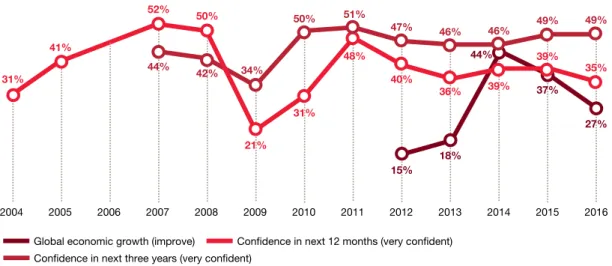
Over the past year, business sentiment seems to have become further becalmed with 49% of CEOs who responded to this year’s Survey believing that global economic growth will stay the same over the next 12 months, while those thinking it will improve has fallen to 27% (see Figure 1).
It also seems that, unlike last year, lacklustre economic growth expectations and rising concerns about potential threats (discussed later) are having an impact on CEOs’ confidence in their own short term growth prospects.
2011 2010 2009 2008 2007 2006
2004 2005 2012 2013 2015 2016
Confidence in next 12 months (very confident) Global economic growth (improve)
Confidence in next three years (very confident)
2014 41%
52% 50%
21%
31%
48%
40%
36% 39%
15%
18%
44%
31% 35%
27%
44% 42% 34% 39%
50% 51%
47% 46% 46% 49% 49%
37%
Figure 1 CEO confidence in revenue growth
Q: How confident are you about your company’s prospects for revenue growth over the next 12 months and next three years? Do you believe global economic growth will improve, stay the same, or decline over the next 12 months?
Note: From 2012–2014 respondents were asked ‘do you believe the global economy will improve, stay the same or decline over the next 12 months’
Base: All respondents (2016= 1,409; 2015= 1,322; 2014=1,344; 2013=1,330; 2012=1,258; 2011=1,201; 2010=1,198; 2009=1,124; 2008=1,150; 2007=1,084) Source: PwC 19th Annual Global CEO Survey
CEOs who responded to the 19th Annual Global CEO Survey have become less optimistic about global economic growth prospects. Nearly half of CEOs surveyed believe that global growth will plateau over the next 12 months. Over- regulation remains the top concern for business while geopolitical uncertainty, exchange rate volatility, skills availability, fiscal deficits/debt and an increasing tax burden are also clouds on the horizon.
Base: All respondents (2016= 1,409; 2015=1,322) Source: PwC 19th Annual Global CEO Survey
There are, however, some regional differences in sentiment. Short-term confidence has fallen most dramatically in North America, Latin America and the Middle East. However, in the long term (next three years) confidence is highest in North America and the Middle East.
Where is growth coming from?
CEOs see growth opportunities emanating from diverse places. Mature markets are generally in favour, notably the US, which has remained ahead of China as the most important country for the overall growth prospects in the next 12 months for the CEOs surveyed. Meanwhile, Mexico and UAE make the top ten this year (see Figure 2).
CEOs view Mexico as the most important emerging market (excluding the BRICs) for overall growth, closely followed by UAE. But the marketplace remains uncertain and volatile with about two thirds of the CEOs surveyed identifying that there are more threats to growth while a similar (slightly lower) proportion see more opportunities compared to the 18th Annual Global CEO Survey (see Figure 3).
US
China
Germany
UK
India
Brazil
Japan
Russia
Mexico
UAE Australia
Indonesia
2016 2015
Up from
last year Down from
last year Same rank
as last year
39 %
34 %
19 %
11 %
9 % 8 %
5 %
5 %
5 %
5 %
19
%38
%34
%11
%10
%9%
8%
6%
6% 6% Figure 2 Top ten attractive markets for growth Q: Which three countries, excluding the one in which you
are based, do you consider most important for your overall growth prospects over the next 12 months?
32 %
see only more threats
26 %
see only more opportunities
34 %
see both more opportunities and more threats
60 %
see more opportunities
66 %
see more threats 2015
31%
30%
29%
2016
Figure 3 Uncertain times?
Q: To what extent do you agree or disagree with the following statements about threats and opportunities facing your business?
Where are the clouds on the horizon for CEOs?
CEOs’ level of concern has again increased across a number of potential threats this year.
But CEOs still see the enduring issue of over- regulation as the top threat to their growth prospects this year, with 79% of CEOs concerned. (see Figure 4).
Over-regulation is a particular problem for CEOs surveyed in companies with over $10 billion turnover (88% of CEOs surveyed) and for CEOs in Latin and North America as well as Western Europe (all with eight in ten or more of CEOs surveyed).
In addition, 42% of CEOs surveyed believe unclear or inconsistent standards or regulations are a barrier to responding to stakeholder expectations. The call therefore grows ever louder for a smarter approach to regulation (see 'Smarter regulation' box).
Added last year as a new threat, in this year’s Survey geopolitical uncertainty has also quickly risen to prominence and is now seen as a top-3 threat. This is particularly the case in the Middle East (94% of CEOs surveyed) and Central and Eastern Europe (86%) where it is the top threat in both of these regions, perhaps reflecting the levels of tension inherent in regions where there is conflict. Social instability has also seen the biggest surge in concern over the past year (by five percentage points globally) and is also the second biggest concern for CEOs surveyed in the Middle East (91%).
Geopolitical uncertainty, in turn, impacts on business investment and locational decisions.
Indeed, 84% of the CEOs surveyed in
companies with over $10 billion revenues in the last year, and those therefore most likely to have the greatest international exposure, appear to be ‘extremely’ or ‘somewhat’
concerned by this threat.
In general, CEOs appear to be increasingly concerned across the majority of potential threats (compared to previous years). With geopolitical uncertainty on the rise, and social instability seeing the biggest increase, the conclusion might be drawn that business is increasingly troubled.
Over-regulation Geopolitical uncertainty
79 % 74 %
Exchange rate volatility
73 %
Geopolitical uncertainty
Increasing tax burden Social instability Cyber threats Shift in consumer spending and behaviours Exchange rate volatility
Lack of trust in business Climate change and environmental damage
72%
71%
69%
61%
65%
60%
55%
50%
79%
74%
73%
Over-regulation
Availability of key skills Government response to fiscal deficit and debt burden Key threats
Top-three threats
Top risers since 2015
Bribery and corruption Social instability
2015 2016 2015 2016
51
55
6065
Figure 4 Threats to business
Q: How concerned are you about the following potential economic, policy, social and business threats to your organisation’s growth prospects?
Base: All respondents (2016= 1,409) Source: PwC 19th Annual Global CEO Survey
A more connected, yet divided, world?
A new world order?
This does seem to be borne out by the emerging view of the CEOs we surveyed who believe that the world is becoming more divergent (see Figure 5).
The majority of CEOs surveyed (three quarters or more) believe there is a move towards multiple belief and value systems, laws and liberties together with the rise of regional trading blocs and investment banks. And yet there is a high level of agreement that the world is more connected than ever before through free and open access to the internet.
Smarter regulation5
For regulation to be smarter it needs to be proportionate, accountable, consistent, transparent and targeted. In particular, a smarter approach to regulation needs a focus on:
• Outcomes and impacts, not purely process and box-ticking.
• Clarity and stability, with rules for regulation that are clear and not subject to constant tinkering.
• Even-handed implementation, with not only a transparent set of rules, but implementation that is done in a fair way.
Figure 5 What’s the world coming to?
Q: For each alternative, please select the one that you believe the world is moving more towards.
Political unions
Economic unions and unified economic models
Single global marketplace
Single global rule of law and liberties
Common global beliefs and value systems Free and open access to the internet
A global world bank
Nationalism and devolved nations
Multiple economic models
Regional trading blocs
Multiple rules of law and liberties
Multiple beliefs and value systems
Fragmented access to the internet
Regional investment banks 39%
35%
22%
15%
14%
72%
15%
53%
59%
75%
81%
83%
25%
79%
Base: All respondents (2016= 1,409) Source: PwC 19th Annual Global CEO Survey
We are living in a day and age where technology gets us connected so easily, but also is drawing us somehow apart.
His Excellency Marwan el Sarkal
CEO, Sharjah Investment and Development Authority
This divergence of views is being driven primarily by technology, demographics and economic shifts (see Figure 6) and the collisions between them. Even as globalisation and digital connectivity brings the world closer together, people appear to be becoming more polarised, localised and divided.
Together these factors are changing wider stakeholders’ expectations of business and of government.
In this context, it is not surprising to see that governments are being challenged on many fronts, not least how best to cope with some of the more far-reaching consequences, such as how to manage their borders to maintain prosperity while being agile to deploy military resources to address new challenges (see ‘Border management – facilitating prosperity, maintaining security’ and
‘A new global defense map’ boxes). How nations address these challenges will also profoundly impact global stability.
In the rest of this report, we look at how government and public sector organisations can enable prosperity, with a focus on ‘doing better with less’, enabling growth and working with businesses with a new societal purpose to co-produce outcomes.
Border management – facilitating prosperity, maintaining security6
Globalisation brings real opportunities and effective border management is an integral element of what needs to be put in place to both facilitate prosperity and maintain security.
Although events in Paris have changed many perceptions, governments that wish to share in the benefits of globalisation have to be able to facilitate the movement of people and trade.
This presents challenges for border management arrangements, particularly when under additional pressure from the large numbers of refugees and displaced people from conflict areas.
Governments have to reconcile the demands of commerce and travellers for high standards of service, particularly timeliness, nd the requirement to examine the goods and people wanting to enter to ensure their true identity and safety.
Security and service to travellers are not conflicting, but dependent. Any national economy that wants to compete globally has to provide those visiting or trading levels of security. Effective border management needs innovative technology and infrastructure, effective international cooperation, coherent processes and an agile organisation.
77%
58%61%
43%
36%
Technological advances Demographic shifts
Shift in global economic power Resource scarcity and climate change Urbanisation Figure 6 Megatrends in action
Q: Please rank the top three global trends, which you believe will be most likely to transform wider stakeholder expectations of businesses within your sector over the next five years?
Note: Percentage of respondents ranking first, second or third Base: All respondents (2016= 1,409)
Source: PwC 19th Annual Global CEO Survey
A more connected, yet divided, world?
A new global defense map7
Nations around the globe are facing a myriad of threats that vary greatly in both scope and scale and are transforming the global defence landscape.
As a consequence, governments are considering how to prioritise their defence spending and position or 'posture' their countries in the new global security environment, where threats are as great from 'lone wolves' and terrorist groups as they are from neighbouring nations (see Figure 7).
The resulting security challenges leave defence leaders with some tough choices:
• What institutional reform initiatives are needed to posture their ministries for the future?
Defense Prioritization
• How much does the country spend: total and % GDP?
• Recent trends and expected future vector: upward, flat or down?
Security Posture
• Does the country have a global, regional or domestic security orientation?
China UK France
Russia USA
Italy
Brazil Germany
Saudi Arabia
India
0% 0.5% 1% 1.5% 2% 2.5% 3% 3.5% 4% 4.5% 5%
Notes:
Country bubble size = 2014 total defense spend
2010–14 Growth <0 2010–14 Growth 0–1%
2010–14 Growth >1%
//
Territorial Security Seekers Threat-Focused Self-Defenders Coalition Partners
DomesticRegionalGlobalSecurity Posture
Defense Prioritization (2014 Defense Spend % GDP)
Robust Self-Defenders Global Power Projectors
5.2%
10.4%
11.6%
5.1%
5.9%
5.2% 5.4%
Constrained Force Projectors
Norway South Africa
Egypt Croatia
Malaysia
Thailand Angola
Turkey
Poland
Japan
Indonesia Philippines
Venezuela Mexico
Canada Spain
Sweden
New Zealand
Qatar Chile
Singapore
Kuwait Algeria
Estonia
South Korea Bahrain
UAE Israel
Oman Australia
Finland Denmark
Lithuania Latvia
The Netherlands
Belgium Switzerland
Austria
Syria Ukraine
Argentina Greece
Vietnam Taiwan Iran
Pakistan
Iraq Portugal
Morocco Colombia
Figure 7 A New Global Defense Map
• What procurement priorities are needed for the coming years?
• How do they build the necessary
organisational agility in order to address a wider range of threats?
• How should they cooperate with allies and partners around the world?
• What should be the priorities for their domestic industrial base?
In order to address this complex and dynamic threat environment, defence ministries around the world must adapt their operating concepts, acquire advanced capabilities, and transform their business processes to create more agile and effective organisations.
Source: SIPRI, Teal Group International Defense Briefing, The Military Balance, IHS Defense Budgets, PwC Analysis
Delivering better for less
Meanwhile there is a need to make best use of digital technology and build the agility and resilience of public sector organisations to cope with future changes. This includes retaining and attracting the talent needed, often under severe competition from private sector
opportunities at a time of public sector cuts and pay restraint.
Redefining purpose
The starting point for any fundamental review of the financial position of any individual public body begins with its purpose, which guides the formulation of the vision and mission and sets the strategic direction. This is the bedrock of a public body (see Figure 8).
Although politicians define the purpose of public bodies, this needs to encompass a range of internal and external stakeholders’ points of view. It should also reflect changes in the organisation’s environment on the functions needed to deliver the outcomes important to politicians, and their constituencies, in the relevant policy area.
Vision and leadership are essential to connect people to the organisation’s purpose: without agreement on the point of an organisation, being productive (in the sense of getting things done) seems meaningless. Clarity of
organisational purpose, objectives and outcomes therefore impacts directly on staff engagement and productivity.
Our main goal is sustainability of the institution – supporting itself to implement its mandate independent from government.
Benedict Libanda CEO, Environmental Investment Fund, Namibia
Fiscal deficits remain in the spotlight, with over seven in ten of CEOs surveyed ‘somewhat’
or ‘extremely’ concerned about this threat.
The challenge remains for public sector organisations to ‘do better for less’. This means strategically managing costs in the face of both budgetary pressure and ever increasing demands on public services.
Since the financial crisis, CEOs concerns globally about the ability of governments to tackle fiscal deficits have continued at a high level, with over seven in ten (71%) of CEOs ‘somewhat’ or ‘very’
concerned about fiscal deficits.
There is also a large regional variation. For instance, CEOs surveyed in the Middle East (85%), Latin America and Africa (84%) were the most concerned. In comparison, the lowest level of concern is in Western Europe (59%), which may seem surprising given the continuing need to repair government balance sheets across the region.
Indeed, despite significant effort to restore fiscal balances in many countries, there is still some way to go. For instance, the OECD in its
‘The State of Public Finances 2015’8 points out that “although OECD countries have achieved a considerable amount of fiscal consolidation from 2009 to 2014, there is still a significant gap left to attain a debt ratio of 60% of GDP by 2030.” It goes on to highlight 14 countries still with “very high consolidation needs”.
As such, it is essential to take a fundamental look at the purpose of public bodies, invoking a zero-based strategic review of their activities, costs and assets. This requires finance functions in governments worldwide to step up and play their role play too.
Whether in the role of leader of a major government department, a manager in a council or a porter in a hospital, people need to see purpose in their work and how they add value. As Dr Steve Peters comments: “When we have a sense of purpose in life it brings with it a sense of meaning and this in turn leads to achievement, satisfaction and wellbeing.”9 Indeed, the foundation of having a good job is that it means something, not only to the worker, but to wider stakeholders. In public services, purpose is given by being connected to the outcomes valued by the public.10
Delivering strategic cost reduction With clarity of purpose established, the next step is to ensure that costs are managed strategically to deliver outcomes and value within the resource constraints set by the relevant government of the day. So what can be done at the individual organisational level?
When we talk about affordability or cost, we focus the conversation on value, ensuing our stakeholders see the value they derive.
Laura Nashman CEO, British Columbia Pension Corporation, Canada The Lenses Key characteristics
Internal management capabilities Vision and
mission Political purpose Internal
stakeholders Intelligence scanning External stakeholders
Successful execution of strategy
Outcomes Impact
ble naaistSu
outcom
es
Internal-externa
l balance
Citizen-ce
ntric Innovative
Agile Connected Transparent
Leadship Smart funding and financial management Talent management
Partnering and networking Service commissioning, design and delivery Prioritisation and implementation planning Programme, project and risk management Performance measurement and outcome assessment Rapid prototyping Figure 8 Tomorrow’s Leading Public Body
Source: Future of Government, PwC
In our experience, an approach to strategic cost reduction is needed which:
• Enables public bodies to develop an
evidence-based view of the opportunities to get cash out of the business while balancing priorities, risks and savings across their portfolio of services.
• Provides fundamental challenge, and is enabled by robust data, while being deliverable quickly to meet often challenging timescales.
• Produces transparent resource allocation across business areas that feels fair and is able to withstand scrutiny.
• Is highly participative, and utilises knowledge and experience across public bodies to consider costs, operational effectiveness and risk as a whole.
• Provides a rapid opportunity assessment alongside a rigorous zero-based approach.
Figure 9 sets out an overview of the approach which we have found valuable in helping public bodies through the process, even when addressing cuts of up to 40% or more of their budgets.
Public bodies should begin with a strategic assessment of opportunities to reduce costs.
This involves a particular focus on identifying the cost drivers associated with the policy and service portfolio and the operating model including optimising its effectiveness.
The heart of this approach is the zero-based review (ZBR) which provides a data-driven and structured way to identify and realise cost reductions. The ZBR process should force public service owners to clearly articulate the impact of the drivers of cost, and the risks and opportunities associated with different cost reduction options. It is then driven by a series of collaborative challenge panels, where service leads walk through their analysis and proposals for cost reduction options.
Figure 9 A bold approach to strategic cost reduction
What you do Inherent drivers of cost − largest influence on total spending
How you do it Structual and systematic drivers of cost
How well you do it Drivers of realised execution costs − smallest influence on total spending
Population segments
Policy and service portfolio
Process architecture
Physical footprint
Technology performance
Process efficiency Operational effectiveness
Services and products
Organisation structure
IT architecture Operating model
Workforce effectiveness
Sourcing and supplier management
Strategic, longer term transformation
Strategic plays that deliver significant saving opportunities
Tectical and short term opportunities – delivering early cash savings
This leads to an implementation plan, a roadmap for realisation of the benefits and a sustainable plan to reduce costs that is owned by the whole organisation: the key to effective delivery.
To own or not to own?11
As part of this strategic approach to day-to-day operations, there is also a need to question whether the assets held in public hands are realising most value. There are many cyclical and political trends at work when it comes to the question of public ownership of assets and how to maximise their value. And there is no universally ‘right’ answer.
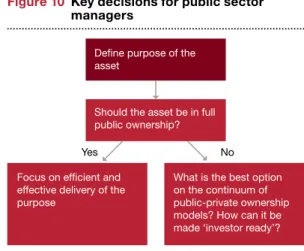
Indeed public bodies are, on a day-to-day basis, aiming to make best use of the resources and assets at their disposal. But it is helpful on occasion for all public bodies to stand back and take stock of their existing operations and assets in the light of their organisation’s core purpose (Figure 10).
Budgets are always about what you would like to do and what the government can afford to give you.
Carolyn Tremain Chief Executive and Comptroller of Customs, New Zealand Customs Service
The role of the state should primarily be regulatory while providing goods and services that are
necessary and can be best provided by the state ...
But the state doesn’t have to own assets for public services to be delivered at optimal levels.
Honourable Donville O. Inniss Minister of Industry, International Business, Commerce and Small Business Development, Barbados Source: Strategy& PwC
Delivering better for less
Figure 10 Key decisions for public sector managers
The key questions to be asked are: do we need to be providing all of our current range of services, given spending constraints? And are all of our assets still needed to enable a public service requirement to be met? If the answers are that assets should be retained in public ownership, there is clearly an important job to be done to ensure value for money, with efficient and effective service delivery and examining how new business models could deliver better outcomes for less.
Of course if the answer is that an asset should be moved out of the public sector (in part or in full), there is then a need to choose the right option from the range of alternatives and ensure that the assets are ‘investor ready’ - packaged in a way which is attractive for private sector investment.
There is then a need to follow through and pay attention to realising the full potential benefits from any sale including modelling the trade- offs between up front proceeds versus longer term value for money while also identifying the right structure for the transaction.
The reality is that if the value of assets is to be maximised, whether in the public or private sector, there needs to be innovation and appropriate risks taken. By building capability, being pragmatic and putting in place the right rewards and incentives, the chances of success are increased.
Define purpose of the asset
Should the asset be in full public ownership?
Focus on efficient and effective delivery of the purpose
What is the best option on the continuum of public-private ownership models? How can it be made ‘investor ready’?
Yes No
Developing government’s finance and accounting
Whether looking at current cash flow or an organisation’s assets, the finance function clearly also has a key role to play.
The global financial crisis, and subsequent sovereign debt crisis, brought into sharp focus how a lack of transparency in public finances and poor public finance management can put at risk governments’ abilities to service large public debts and meet their public service delivery objectives.
Indeed, there is now growing recognition of the importance of appropriate accounting and financial management in the public sector as a key means of achieving sustainable public finances.
Governments need to adopt sound and transparent accounting and reporting rules.
According to our research,12 accounting modernisation reforms are being initiated or planned all over the world, with seven in ten governments intending to use accrual accounting in five years’ time, often taking IPSAS13 as a reference point.
Transitioning to accrual accounting is not, however, an end in itself: the ultimate goal is to deliver better public services with sustainable public finances, creating a positive legacy for the next generation. This requires transparent accrual-based financial statements reflecting the true long term implication of political decisions and helping governments to demonstrate, and users to evaluate, accountability for the use of public funds.
Adoption of high quality accrual accounting also lays the basis for developing better management information systems, and contributes to better decision making and a better use of public money.
Becoming digitally-led
In an increasingly complex and interconnected world, where the pace of change in society is accelerating, governments know that change is inevitable, and that they must re-invent the ways they do business.
For years, the public sector has been grappling with how to meet citizens’ increasing
expectations. The inherently risk averse nature of government means that public service innovation has often been avoided.
But the acceleration of technology and globalisation has put pressure on government to catch up to the private sector and to invest in innovation, even if it means taking on greater risk and the possibility of failure.
Digital is a good example, where the private sector sees the use of technology as the top priority to respond to changing stakeholder needs (see Figure 11).
39%
44%
44%
51%
49%
48%
6%
6%
6%
How we use technology to assess and deliver on wider stakeholder expectations
How we define and manage risks
How we manage our brand, marketing and communications
No change at all Some change Significant change Note: Responses for ‘don’t know’/‘no response’ are excluded so may not total 100% in each case
Base: All respondents (2016= 1,409) Source: PwC 19th Annual Global CEO Survey
Participative governance14
The digital age has empowered connected citizens to be more aware and expect more from public services. Governments, however, are inherently process driven and usually risk averse. And they seldom move as fast as the emerging technologies of the times.
However, a handful of governments, most of whom rank highly in the United Nation’s e-Government index, are innovating and taking the lead by seeking citizen participation in important matters of governance. For instance, Singapore initiated, with its REACH programme, participation of citizens in policy making and setting priorities on public expenditure.
This has gradually picked up pace with more than a handful of
countries now striving towards open and participative governance. For instance, the US has challenge.gov to crowdsource ideas in the form of online citizen competitions. And India has recently started a
programme called MyGov to facilitate citizen-government dialogues on important governance matters.
Three indicators are critical in ensuring the success of such
participative governance programmes. First is timing. For instance, a government is better off starting when the country’s general sentiment is of hope and development rather than when a country is in crisis, conflict or economic turmoil. Second is strong political will, to make bold changes to existing policies and programmes. Third, and the most important, is a machinery of the state which has an appetite to welcome feedback and undertake improvement mid-way through established programmes.
Delivering better for less
Figure 11 The role of digital
Q: To what extent are you making changes in the following areas in response to changing stakeholder expectations?
Top three responses.
We should create an eco-system that is conducive for innovation to flourish in the public sector.
Dato` Sri Dr. Sharifah Zarah Syed Ahmad
Secretary General, Ministry of Communications and Multimedia (KKMM), Government of Malaysia
With democracy reaching the grassroots, the involvement of citizens to solve their local problems will become more essential.
Nitin Bhadauria Commissioner, Municipal Corporation, Dehradun, India
Predicting what's going to work in the digital age is not easy. In government, this makes investing in big system and process change a huge risk. But bringing in the expertise of many different providers – such as corporates, start-ups and platform innovators - could combat this risk.
A radically improved ecosystem can then generate the best public services driven by consumer choice. This means a new role for government across siloes, understanding demand and providing the controls and standards for others to deliver safely, securely and seamlessly.
The challenge is to create a vehicle that puts citizens in the driving seat and for a new relationship to be created between citizens and the state – powered by digital (see ‘Participative governance’ box).
Through digital, there is also now much more data than ever before. And there is great potential for big data to improve outcomes for the public if there is the investment, innovation and imagination to make this happen (see
‘Data: opportunity or threat?’ box).
Data: opportunity or threat?
The agenda for public sector leaders looking to create more data-savvy organisations is challenging. In ‘Big data, better public services’,15 we set out some clear areas for action:
• Building the skills base: Public bodies need to develop their data collection, management and analytics capacity and capability in order to produce the quality insight and intelligence required to underpin their strategies and plans.
• Integrating data: Master data management, standards, policies and clarity on who is gathering what data for what purpose is needed. Big (and expensive) systems are not required to achieve these goals. This is about collecting, using and sharing information better. Citizen data gathering, trend analysis and the use of digital enables the development of these approaches.
• Opening up good data: Research into the use of open data and data analytics16 has highlighted that the volume, veracity and speed of data all need to be improved. Overall, the quality, accuracy or completeness of the underlying data within
organisations is often the biggest hurdle to making good decisions along with limitations on the ability to share data for different purposes.
• Balancing rights: There is an important balance to be found between the rights of individuals to privacy and confidentiality and the benefits from sharing information. This requires better selling of the value proposition to the public, building public trust and reducing cynicism as to how their data will be used and alongside confidence in data security.
Maintaining agility
Public sector leaders are also looking to become more agile: adaptable, flexible and resilient in the face of uncertainty. Our research reveals five key elements of agility17:
• Adaptability – the ability to adjust and meet changing requirements.
• Innovation – the ability to generate and use new ideas, methodologies and technologies.
• Collaboration – the ability to leverage internal and external knowledge and resources to enhance the mission for the organisation.
• Visibility – the ability to create and maintain transparency to enhance fact- based decision making.
• Velocity – the ability to recognise and respond with the requisite tempo to new circumstances and events.
Agile government
In Canada, along with Canada’s Public Policy Forum,18 we reflected on how government can be more agile. Through a series of roundtable sessions and one-on-one interviews with leaders from health care, education and the public and private sectors we explored the concept of agility and what it means in today’s government. The key themes that emerged from our discussions include:
• Partnership: Agility won’t be fully realised until governments are more open and engage meaningfully with potential partners.
• Leadership: Agility can’t be expected without investing in the required leadership skills.
• Human capital: Agility overwhelmingly hinges on the capabilities of public servants.
• Technologies: Investment in IT is unavoidable if the public service is going to be agile and keep pace with the digital revolution.
There was also frank discussion about risk and existing and potential barriers to success. For instance, change has to begin at the top.
Inherent in cultural change is that organisations don’t change – people do. This means questioning some core assumptions of public service leadership and preparing to explore new ways of working together outside their comfort zone.
Our focus on our pipeline of future leaders
Workplace culture and behaviours
Effective performance management
Pay, incentives and benefits we provide for our workforce
Our focus on skills and adaptability in our people
Our reputation as ethical and socially responsibile employers
Our focus on diversity and inclusion
Our use of predictive workforce analysis
Our focus on productivity through automation and technology
38 %
30 %
22 %
4 %
16 %
49 % 41 %
33 %
29 %
Figure 12 Our greatest asset!
Q: What aspects of your talent strategy are you changing to make the greatest impact on attracting, retaining and engaging the people you need to remain relevant and competitive?
Base: All respondents (2016= 1,409) Source: PwC 19th Annual Global CEO Survey
Delivering better for less
I believe that qualified people can be attracted [into public
administration] by the challenges we are dealing with, and in some ways by the variety of tasks.
Eduard Muřický Deputy Minister, Ministry of Industry and Trade, Czech Republic
What is our purpose and is it still relevant and resonant with political priorities?
What’s the direction and are our key stakeholders on board?
What are the organisation’s priorities to ensure that public service delivery is targeted on achieving maximum outcome and impact, while maintaining affordability?
Is the capability in place to commission for outcomes and implement payment by results contracts with payments linked to the successful delivery of results?
What drives our costs and the value we generate?
Do we need to be providing all of our current range of
services, given spending constraints?Are all of our assets still needed to enable a public service requirement to be met?
Is the Finance function delivering the robust management
information and insight needed to enable decisions?How do we maintain agility in the face of change?
Will the workforce strategy attract and retain a skilled
workforce in the face of private sector competition for talent?Questions to think about
?
The potential rewards of greater agility are worth grasping – higher productivity, greater employee satisfaction and higher citizen satisfaction – as we found in discussions with Canada’s Public Policy Forum (see ‘Agile government’ box).
Attracting and retaining talent One of the biggest challenges is for public leaders to retain and attract talent, often under severe competition from private sector opportunities. For CEOs, the availability of skills remains a top six threat and, with many public bodies facing pay restraint and job cuts, it becomes even more important for public leaders to invest in their people and offer attractive careers.
PwC’s 19th Annual Global CEO Survey highlights the actions CEOs surveyed plan to attract, retain and engage their people (see Figure 12). CEOs appear most likely to change their talent strategy to focus on the pipeline of leaders, workplace culture and behaviours as well as effective performance management.
Public sector leaders will clearly be looking to act in a similar fashion in order to seek and preserve the talent they need to deliver their missions.
Redefining success (for SOEs)
What worries the state backed CEO?
State backed CEOs’ perceptions of the key threats are very similar this year to non-state backed CEOs. Overregulation, geopolitical uncertainty and exchange rate volatility are the top threats.
The other key threats are also similar although state backed CEOs are relatively more
concerned about the readiness to respond to a crisis (70% of state backed CEOs surveyed).
Like other CEOs, state backed ones also see the world as one which is becoming more divergent, moving to multiple beliefs/value systems and rules of law and liberties (78%) and regional trading blocs and investment banks (75%).
Priorities for government
State backed CEOs see the same top three priorities for government as non-state backed CEOs (set out in full in the next section) although in a slightly different order. The top priority for state backed CEOs is adequate physical and digital infrastructure (52% of those surveyed), followed by a skilled, educated and adaptable workforce (50%) and a clearly understood, stable and effective tax system (43%, although significantly less than the 58%
of non-state backed CEOs surveyed).
But when it comes to effectiveness of government delivery, state backed CEOs are more positive across the board, with a net positive balance on infrastructure, workforce health and wellbeing and employment levels (see Figure 13).
We know that State Owned Enterprises (SOEs) are an influential and growing force
globally.19 For instance, the proportion of SOEs among the Fortune Global 500 has grown from 9% in 2005 to 23% in 2014,20 driven particularly by the growth of Chinese SOEs. In this year’s Survey, 12% of the organisations surveyed had some form of government ownership or backing.
Going for growth?
Our findings this year suggest that state backed CEOs have a similar (less optimistic) view to their private sector counterparts when it comes to their confidence about revenue growth over the next 12 months or three years. But they are slightly more optimistic about the prospects for global economic growth over the next 12 months: about a third (34%) expect improvement compared to a quarter (25%) of CEOs without any form of state backing.
However, relatively more CEOs in state backed organisations are expecting to reduce
headcount, with just under a third (30%) expecting to decrease headcount over the next year compared to 20% of the non-state backed CEOs surveyed. Perhaps unsurprisingly, cost reduction initiatives are also the most prevalent restructuring activity – in line with companies with no state backing - although relatively more state backed CEOs (36%) are planning to outsource in the next 12 months (compared to 27% of non-state backed CEOs).
The impact of stakeholders
A significant difference for state backed CEOs is who they see as having the biggest impact on their organisation’s strategy. In contrast to the private sector where the customer is king, for the state backed CEOs surveyed government and regulators have a ‘high’ impact for 41% of them and a ‘very high’ impact for 45%. This highlights the unique influence of government and regulators where they have an ownership stake. Nevertheless, for 53% of state backed CEOs surveyed customers and clients still have a very high impact.
State backed CEOs also seem to take a wider view of their role and purpose. For instance, 92% of the state backed surveyed believe they are expected to address wider stakeholder needs today - significantly more than the 83% of CEOs surveyed without state backing. Meanwhile 82%
report on financial and non-financial matters and 77% believe their purpose is centred on creating value for wider stakeholders – both again significantly above their private sector counter-parts.
In addition, state backed CEOs feel they should be doing more compared to their private sector counter-parts to measure impact and value on the environment (52%) and wider communities (41%) and to communicate this too (56% and 55% respectively). These results are
significantly higher than for non-state backed CEOs, perhaps due to the more direct influence of government and regulators.
Significantly more (45%) state backed CEOs also
‘agree strongly’ that business success in the 21st century will be redefined by more than just financial profit, with another 32% ‘agreeing’.
In responding to these wider stakeholder expectations, however, significantly more state backed CEOs (50% of those surveyed) see unclear or inconsistent standards or regulations as a barrier. Similarly, significantly more state backed CEOs believe that conflict between stakeholder interests and financial performance
Figure 13 Delivering on priorities?
Note: Net % is the difference between CEOs responding that government is greatly effective or effective and those responding greatly ineffective/ineffective
Base: All respondents (2016= 163 state backed CEOs; 1,229 non-state backed) Source: PwC 19th Annual Global CEO Survey
State backed CEO (net %) Non-state backed CEO (net %) High levels of employment
Adequate physical and digital infrastructure
A skilled, educated and adaptable workforce
A clearly understood, stable and effective tax system
Reduced environmental impacts
Good health and wellbeing of the workforce
Workforce diversity and nclusiveness
Safeguards around usage of personal data
Greater income equality
-7
-8
-20
-38 -20
-18 -10
-6
-6 2
-2 8
-4
-6
-27 -8
6
-36
What makes the SOE of the future?21 So what are the implications for state backed enterprises?
Clearly there are many different drivers where state ownership is the favoured option. But whatever the primary motivation, one
consequence is that SOEs need to be evaluated not only on the basis of financial results (the profit and loss account), but more widely on how they contribute to societal value creation, taking an integrated and holistic view of their impact (see Figure 14).
As such, SOEs face a number of areas for attention. Of primary importance, they need to be actively owned and managed. This means establishing a clear purpose and mission for the SOE, linked to desired societal objectives and outcomes, and continually monitoring and evaluating state ownership to ensure that public value continues to be delivered.
It also means that those undertaking ownership and management roles, particularly the board of directors and the executive leadership, need to fulfil the “4 Cs” tests:
• Clarity: Clear understanding of the purpose and objectives of the SOE and their role in delivering this.
• Capacity: Time and resources to conduct their role well.
Figure 14 Strategic positioning of SOEs
Loss making Profitable
Societal value creation
Societal value deterioration
Role model Strategic
investment
Review options including exit/
closure
Re-engineer to reduce/avoid non- value adding activity
Source: State Owned Enterprises, PwC 2015
Redefining
success (for
SOEs)
• Capability: Required and relevant expertise and experience to steer and manage the SOE.
• Commitment to integrity: Serving the citizen for the purpose of societal value creation.
SOEs of the future also need to be transparent and accountable through quality, timely and reliable reporting of SOE performance. This goes beyond financial reporting to integrated reporting, with SOEs being role models for good reporting practices. This also aids in building trust between the government (owner) and the citizens and other stakeholders (including other shareholders).
An appropriate internal-external balance also needs to be achieved. Like any organisation, SOEs need sound internal management in order to maximise efficiency and effectiveness. They should also leverage technological and service innovations to deliver products and services which meet user needs within constrained budgets (doing ‘better for less’), as well as achieve desired outcomes economically and socially.
At the same time, the SOE should leverage its external influence by co-creating value with other stakeholders in society and driving good growth, linked to its purpose, mission and strategic objectives.
In this way, SOEs really can become catalysts for sustainable public value creation.
For whom are SOEs creating value?
Who are the most influential and important stakeholders?
How is public value defined?
To whom should SOEs be ultimately accountable?
How does this affect their purpose, management and operations?
Do owners and managers pass the “4Cs” test?
What is the total impact beyond profit and loss considerations?
How is SOE performance being monitored and evaluated in a way that reflects its contribution to societal outcomes?
Is there a clear vision and continuing purpose for state ownership?
For SOEs which no longer need to be under state ownership,
Questions to think about
?