19th Annual Global CEO Survey / January 2016
Growing in complicated times
p06/ Addressing greater expectations
p12/ Transforming:
technology, innovation and talent
p18/ Measuring and communicating success
p26/ Navigating complexity to exceed expectations
p32Redefining business success in a
changing world CEO Survey
1,409 CEOs interviewed in 83 countries
66% of CEOs see more threats today
76% of CEOs define
business success by more
than financial profit
Introduction from Dennis Nally
As they look forward to the year ahead CEOs are less confident about prospects for the global economy than they were in 2015. The same is true overall when they consider their own company’s prospects for growth.
Many CEOs do still see opportunities but they are looking to play things safe.
The United States and China are far and away the most important markets that CEOs identify as offering the best prospects for growth, with Germany and the United Kingdom some way behind.
That said, CEOs also see potential in India’s bullish business attitude and in Brazil despite its current political and economic struggles. Potential new opportunities in Mexico and the UAE have also made CEOs pay attention in the last year.
CEOs continue to highlight over- regulation as their biggest concern.
But even as issues like an increased tax burden and governments’ response to fiscal deficits and debt burdens loom large, geopolitical uncertainty (exacerbated by regional conflicts and increased terrorism attacks) is a top concern for nearly three- quarters of CEOs.
More disorienting still for CEOs is their growing feeling that our globalised economic and social fabric is fraying as divergent political, business, societal and cultural movements take hold.
This is driven by digital technologies that have enabled people all over the world to be more connected, better informed, and as a result, increasingly empowered and emboldened.
It’s not lost on CEOs that a great many of these technologically empowered citizens are also their customers or potential customers. While they are better connected than ever before they must also navigate a world that is being dramatically shaped by other megatrends such as increasing urbanisation, climate change and rapid demographic and social shifts. Faced with these changes, CEOs tell us that customers will increasingly judge companies based on how they help greater society and how they live up to their own values. Notably, nearly a quarter of CEOs said their company has changed its sense of purpose in the last three years to take into account the broader impact it has on society.
To successfully address the expectations of a super-connected and technologically smart society, companies are looking to technology (of course) for answers.
Internet-enabled technologies continue to help companies innovate by creating more relevant products and user experiences for customers, while ‘digital native’ talent is now deemed essential for future business growth. Yet for all the technological breakthroughs in areas like customer insight and marketing, companies still struggle to create a business proposition that both drives growth and creates value for greater society.
How to lead in complicated times? That’s the question all CEOs are
seeking to answer at a time of prolonged and continuing uncertainty.
Dennis M. Nally
Chairman, PricewaterhouseCoopers International Limited
This could be because, in a digitally driven world where theoretically every part of business can be measured, CEOs haven’t yet mastered how to measure the long-term success that comes from being a trusted company and good corporate citizen. Over time, technology, once again, will no doubt help CEOs effectively measure how better products and services, combined with a transparent relationship with customers, employees and greater society can future-proof their companies in this uncertain world. But they have to know what success looks like in the first place.
I’d like to thank the more than 1,400 company leaders from 83 countries who have taken the time to share their insights with us. Their active and candid participation is the single greatest factor in the success of PwC’s Annual Global CEO Survey, now in its 19th year. We greatly appreciate our respondents’ willingness to free up their valuable time to make this survey as comprehensive and accurate as possible. We’re especially grateful to the 33 CEOs who sat down with us to hold deeper and more detailed conversations. You’ll see their comments throughout this report.
Growing in complicated times
06
09 Moving beyond globalisation
11 Steering a true course in an uncertain world
Measuring and
communicating success 26
26 A new mindset for measurement
28 Can everything be confidently measured?
30 Communicating impact
Contents
Transforming: technology, innovation and talent
18
18 Walking the talk
20 Putting technology to work 21 The innovation edge 22 The people edge
24 Why government and business need to work together
Addressing greater expectations
12
13 So what do your stakeholders want?
14 Is this the era of the good consumer?
14 A central concern – the quest for trust 15 What do you stand for?
Navigating complexity to exceed expectations 32
32 Linking strategy to execution
34 Looking for more data?
36 Meet the CEOs we talked to
38 Research methodology and contacts 39 Acknowledgement and thanks 40 Notes and sources
Growing in
complicated times
74%
of CEOs are concerned about geopolitical uncertaintyToday’s CEOs face a business environment that’s becoming increasingly complicated to read and adapt to.
Seven years on from the global financial crisis, the business landscape still hasn’t really returned to what it was. Will it ever? Last year regulation, skills, national debt, geopolitical uncertainty and taxes topped CEOs’ list of concerns about threats to business growth. None of these have gone away this year. In fact, the level of worry is higher today than at any point in the past five years.
Concern about over-regulation in particular is still highest, cited by 79% of CEOs – making it the fourth year in a row that it’s risen (see Figure 1).
Geopolitical uncertainty, meanwhile, has become the second biggest concern, cited by 74%
of business leaders. This comes at a time when terror attacks are increasing and touching every part of the world, many linked to the heightened conflict in Iraq and Syria. Global conflicts are also connected to anxieties about social instability and readiness to respond to crises, named by 65% and 61% of CEOs, respectively.
Cyber security is also a worry for 61% of CEOs, representing as it does threats to both national and commercial interests.
Are we in an environment where change will take place at tremendous speed, whether it’s economic leadership, challenges of emerging countries or developed countries, political unrest, challenges with extremist views around the world, new technology, or new business models? That is the new normal.
Companies and countries that will lead this new normal have to deal with an environment where there’s constant change, and be able to adjust to those at a faster and faster pace.
John Chambers
Executive Chairman of the Board, Cisco Systems, Inc., US
... low oil prices have ramifications in terms of social dynamics because it will put pressure on the availability of funds in the Middle East, especially as far as the oil-producing countries are concerned ... [which]
have very large young populations ... there are going to be enormous budgetary pressures on the various countries.
Dr. Ahmed Heikal
Chairman and Founder, Qalaa Holdings, Egypt
Over-regulation Geopolitical uncertainty
79 % 74 %
Exchange rate volatility
73 %
Geopolitical uncertainty
Increasing tax burden Social instability Cyber threats Shift in consumer spending and behaviours Exchange rate volatility
Lack of trust in business Climate change and environmental damage
72%
71%
69%
61%
65%
60%
55%
50%
Top-four risers since 2013 79%
74%
73%
Over-regulation
Availability of key skills Government response to fiscal deficit and debt burden Key threats
Top-three threats
Bribery and corruption
Lack of trust in business
Social instability
New in 2015 Consumer spending
and behaviours
2013 2014 2015 2016 2013 2014 2015 2016
41
52 51
55
37 49
53
55
49 52
60
60
60
65
Figure 1 CEOs are getting more concerned about a wide range of risks Q: How concerned are you about the following potential economic, policy, social and
business threats to your organisation’s growth prospects?
There are, moreover, other uncertainties CEOs must contend with. Where there’s reasonable economic growth it’s often being aided by extraordinary monetary policies, even though the United States’ Federal Reserve bucked this trend recently by raising US interest rates for the first time in nine years. This move, together with China’s surprise devaluation of the yuan in August 2015, helps explain why exchange rate volatility, cited by 73% of CEOs, is third among their top concerns.
Indeed, CEOs are keeping a very close eye on China given the continued importance they place on its economy for their own growth prospects. Its economic rebalancing, the fragility of its debt-laden local governments and its faltering manufacturing sector continue to spook investors and rattle a number of industries – not least the commodities sector that rode the wave of China’s rapid growth and now is bearing the brunt of the slowdown.
These factors are having different effects in different places, but together they’re increasing the level of uncertainty about the global economy, and CEOs are less optimistic about prospects this year. The optimists – those who think global growth will improve over the next 12 months – have dropped to 27% from 37%
last year (see Figure 2). Those who think it will worsen have increased from 17% to 23%.
As we might expect, CEOs’ confidence about their own company’s prospects for revenue growth in the coming year has also fallen, though not to the same extent as confidence about the world economy. Thirty-five percent of CEOs are ‘very confident’ about short-term business growth compared to 39% last year (see Figure 2).
It’s become more difficult to pin down where growth will come from, but CEOs are still banking on familiar faces. The United States and China, and to a lesser extent Germany and the UK, remain the countries that most CEOs cite among their top overseas growth markets (see Figure 3).
Growing in complicated times
2011 2010 2009 2008 2007 2006
2004 2005 2012 2013 2015 2016
CEOs very confident in business growth prospects CEOs confident global economic growth will improve 2014
Figure 2 CEOs are less confident about global economic and business growth prospects in
these uncertain times
Q: How confident are you about your company’s prospects for revenue growth over the next 12 months?
Do you believe global economic growth will improve, stay the same or decline over the next 12 months?
Figure 3 CEOs continue to see investment opportunities across the BRICs Q: Which three countries, excluding the one in which you
are based, do you consider most important for your overall growth prospects over the next 12 months?
Base: All respondents (2016=1,409; 2015=1,322; 2014=1,344; 2013=1,330; 2012=1,258; 2011=1,201; 2010=1,198; 2009=1,124; 2008=1,150;
2007=1,084; 2006 (not asked); 2005=1,324; 2004=1,386)
Note: In previous years, respondents were asked ‘Do you believe the global economy will improve, stay the same or decline over the next 12 months?’
UK India Brazil Japan Russia Mexico UAE
11%
9%
8%
5%
5%
5%
5%
39%
34%
19%
USA China Germany
... for us in India, it looks like a situation where we will be one of the top few economies in terms of growth rates.
Chitra Ramkrishna
Managing Director and CEO, National Stock Exchange of India Limited (NSE), India
I definitely expect moderate growth in the United States. That’s the most important and resilient market for me to see growth, and the most important market for us.
Takeshi Niinami President and CEO, Suntory, Japan
35%
of CEOs are very confident about short- term business growthAfter two years, Mexico is back in the list of top-ten countries and is also CEOs’ highest- ranked non-BRICs emerging market. The UAE is also in the top ten and is currently the bright spot in the Middle East given its relatively lower dependence on oil revenues.
Moving beyond globalisation This complicated world picture isn’t just being shaped by economic and geopolitical trends. We believe there is a more fundamental shift taking place, namely from a globalising world to one with many dimensions of power, growth and threats – a transition that we call multi-polar. The majority of CEOs already anticipate this shift: 59% expect multiple economic models, 75% expect increasing regionalisation in trade, over 81% see increasingly divergent systems of laws and liberties, and 83%
predict differing fundamental belief systems underpinning societies (see Figure 4). No wonder there is so much concern about growth and where it will come from.
... the TPP is really the largest trading agreement we have had since the WTO. This would bring 40% of the global GDP together in one economic block. I’m very excited.
2015 is going to be fantastic for Vietnam, not just because of the TPP – where I believe Vietnam will come out as the top beneficial member of the TPP’s 12 nations – but because Vietnam is in the middle of the AEC, the ASEAN Economic Community, which will be fully integrated by the end of 2015.
Don Lam
Chief Executive Officer and Founding Partner, VinaCapital, Vietnam
Figure 4 CEOs must navigate an increasingly complicated and multi-polar world Q: For each alternative, please select the one that you believe the world is moving more towards
Political unions
Economic unions and unified economic models
Single global marketplace
Single global rule of law and liberties Common global beliefs and value systems Free and open access to the internet
A global world bank
Nationalism and devolved nations
Multiple economic models
Regional trading blocs
Multiple rules of law and liberties
Multiple beliefs and value systems
Fragmented access to the internet
Regional investment banks 39%
35%
22%
15%
14%
72%
15%
53%
59%
75%
81%
83%
25%
79%
CEOs also continue to see investment opportunities across the BRICs, despite the complicated picture they present. India, which has continued to do well under Prime Minister Narendra Modi’s pro-business government, is now among CEOs’ five most promising overseas markets. Brazil, meanwhile, has slipped only a notch despite its political and economic problems. Even Russia has held fast despite geopolitical tensions and its heavy dependence on oil and gas. While a few years ago CEOs might have been tempted to consider the BRICs as one bloc (so to speak), today they seem to be sizing up opportunities on a case-by-case basis.
Some are employing a ‘wait and see’ approach to these markets, while others are forging ahead bolstered by their confidence in these countries’ longer term fundamental strengths – not least a large and growing middle class.
The one area where CEOs, in contrast, see greater convergence is the internet – but even this plays a core role in highlighting divergent beliefs even as it brings the world closer together.
This greater devolution of power brings both threats and opportunities. Different points of view, exacerbated by economic insecurities, are certainly leading to more conflict. But regional trading blocs, for example, can lead to better quality trade agreements and policies.
There’s evidence that most business leaders, for example, are optimistic about deeper economic integration as a result of the Asia- Pacific Economic Cooperation (APEC).1 This isn’t to say that globalisation is dead.
The climate change accord reached at the United Nations Climate Change Conference in Paris in December 2015 is a good example of inter-governmental cooperation.
Given the plethora of uncertainties CEOs are facing, it’s little wonder that they’re divided about whether there are more threats or opportunities today. Two thirds of CEOs (66%) believe that their business faces more threats today than three years ago, while almost as many (60%) see more opportunities (see Figure 5).
32 %
see only more threats
26 %
see only more opportunities
34 %
see both more opportunities and more threats
60 %
see more opportunities
66 %
see more threats 2015
31%
30%
29%
2016
Figure 5 CEOs see more threats to their business today than three years ago Q: To what extent do you agree/disagree that there are
more growth opportunities/threats for your company than there were three years ago?
For a number of years we saw a consolidation in the regulatory environment that we operate in, but over the past five plus years there has been a divergence.
Countries like China, South Korea, India and Brazil have all created their own regulatory regimes which – in theory – are similar to those of other countries, but have enough differences to create a divergence.
Michael Daniell
Managing Director and CEO, Fisher & Paykel Healthcare Corporation Ltd., New Zealand
Base: All respondents (2016=1,409; 2015=1,322)
Growing in complicated times
We have a lot of treaties, a lot of rules, a lot of conventions – we need to make sure they can handle the problems of today. We also need to be sure we don’t replace them with something worse.
Michael Møller
Director-General, United Nations Office at Geneva (UNOG), Switzerland
?
Have you adjusted your operational model to accommodate future potential increases to your cost of capital as interest rates rise and currency markets become more volatile?
Are you tracking the right risks around new political dynamics such as geopolitical uncertainty and cybersecurity as they replace concerns related to coping with the financial crisis?
What’s your organisation doing to prepare itself to respond to and recover from crisis?
Do you have a strategy in place for a more divergent world where authority and influence are more widely distributed?
How are you preparing your organisation to face non- traditional competitors now and in the future?
Tough questions to ask about growing in complicated times
Steering a true course in an uncertain world
CEOs understand that despite the tremendous challenges they face in managing their business for today, they also need to look ahead and build a business that’s ready for the more complex global marketplace of the future.
To equip themselves for this challenge, CEOs are focusing on three core capabilities that we will examine in more detail.
The first capability is based around addressing greater expectations. CEOs acknowledge that their customers as well as other stakeholders increasingly want them to do more to tackle important problems. The response for many has been to focus even more strongly on customer needs as well as drawing on their companies’ own sense of purpose – what they stand for – to define a more comprehensive view of how their businesses operate within society. Some CEOs are taking concrete steps to align this broader mission to their company’s core goal of profitability.
The second harnesses technology, innovation and talent to execute the strategies that meet these greater
expectations. CEOs are using technology to get closer to consumers but are being challenged to align all parts of their operating model behind customer strategies. Some companies are bridging what we call an ‘execution gap’ by shaping their entire value proposition, strategy, operations and capabilities tightly around a strong commitment to what they stand for.
They’re also looking to build better innovation and people capabilities to address changing customer expectations.
The final capability CEOs are looking to develop are methods of measuring and communicating success. CEOs are seeking to better measure the impact and value of innovation and key risks for stakeholders.
Companies are addressing these challenges through a greater focus on data and technology to gain better insight into business processes and to measure a broader range of variables.
They’re also looking to better communicate a range of ‘softer’ issues in a reliable and consistent way across multiple channels.
You’ve got to run a company for profit, you’ve got to run it for revenue growth, but you also have to run it to be around ten years from now doing the right things. That’s one of the biggest issues most CEOs face today.
Ajay Banga
President and Chief Executive Officer, MasterCard, US
As technology and other factors create an environment of higher transparency, CEOs have set their radar on a wide range of stakeholders.
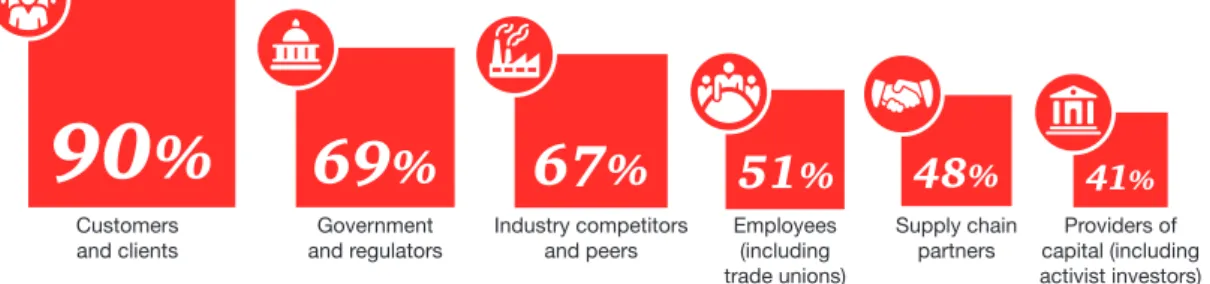
Customers remain the top priority, with 90% of CEOs indicating they have a high or very high impact on their business strategy (see Figure 6).
But government and regulators come in second (cited by 69% of CEOs). That’s higher than industry competitors and peers (67%) and no doubt reflects CEOs’ enduring concerns about over-regulation in the marketplace.
The views of these and other stakeholders, including employees and investors, aren’t just evolving but diverging, as CEOs have told us.
Customer behaviour, in particular, has become more complicated as values and buying preferences evolve. The three biggest trends CEOs see as most influencing those views – technological advances, demographic changes and global economic shifts – as well as the interactions between them, are only going to continue to drive change (see Figure B, Looking for more data?, page 34).
Addressing greater expectations
Customers and clients
90 %
Providers of capital (including activist investors)
41
%Supply chain partners
48
%Government and regulators
69 %
Employees (including trade unions)
51 %
Industry competitors and peers
67 %
Figure 6 Customers and clients are top priority for CEOs
Q: What impact do the following wider stakeholder groups have on your organisation’s strategy?
The way we deal with our customers and charge our customers and delight our customers has changed completely from the old way of doing business.
Johan Dennelind
CEO, TeliaSonera AB, Sweden
Note: Respondents who indicated high or very high impact
So what do your stakeholders want?
We were not surprised to see that the majority of CEOs (70%) feel their customers are most interested in cost, convenience and functionality.
But we were surprised to discover that more than a quarter (27%) of CEOs believe that their customers are seeking relationships with organisations that address wider stakeholder needs (Figure 7). This surges to 44% when CEOs consider what their customers will prioritise in five years’ time. In the future it seems clear that CEOs believe customers will put a premium on the way companies conduct themselves in global society.
That’s a lot of change in a relatively short time.
And it isn’t just happening on the customer front.
On the talent side it’s even more pronounced.
Fifty-nine percent of CEOs believe that top talent wants to work with organisations that share their social values and 67% feel it will be important in five years. Meanwhile, 37%
of CEOs believe their investors seek ethical investments and 45% believe this will be the case in five years.
At the heart of this evolution in values lies technology. CEOs are convinced it will
transform stakeholder expectations of business in the next five years, with 77% of business leaders naming it as a top-three influencer.
Mobile connectivity and social media in particular have become fundamental ways to get information and buy goods and services.2 The ‘Uberization’ of a growing number of sectors – offering quick, simple and dynamic ways to access goods and services using mobile apps – is also becoming an important trend in changing customer perceptions of value. At the same time, these technologies are giving more people more access to more information about what companies do and the impact of their actions. Together, these factors are helping to reshape how people interact with and think about brands, albeit in very different ways.
... as a consequence of the internet and the digital way of doing things, customers basically want to do a lot of things themselves. They’re self-directed, as we call it.
They know everything.
They Google everything.
Therefore they come to the bank with a completely different expectation.
Ralph Hamers
CEO, ING Group, Netherlands
Our purpose is centred on creating value for
wider stakeholders We prioritise long- term over short- term profitability
Our customers seek relationships with organisations that address wider stakeholder needs
Top talent prefers to work for organisations with social values which are aligned to their own Our investors are
seeking ethical investments Creating value for
wider stakeholders helps us to be profitable We are expected
to address wider stakeholder needs
Corporate responsibility is core to everything we do We report on financial
and non-financial
matters in our reporting 67%
72%
64%
84% 52%
37%
59%
27%
71% 82%
81%
70%
85%
55% 45%
67%
44%
87%
Today In five years
Figure 7 CEOs believe customers are seeking relationships with organisations that address wider stakeholder needs Q: Thinking about the wider stakeholder expectations you see, which of these
statements best describes your organisation today?
Q: Which of these statements best describes successful organisations in your sector in five years' time?
90%
of CEOs say customers have the biggest impact on strategyIs this the era of the good consumer?
It’s long been assumed that only a small percentage of consumers seek out ethical and sustainable products and services.
There’s growing evidence, however, that this is changing. Take the consumer goods giant, Unilever. Its portfolio of so-called ‘Sustainable Living’ brands now equals half of the company’s total growth and is growing twice as fast as Unilever’s other brands.3 It’s just one of nine companies globally that generate a billion dollars or more in annual revenue from sustainable products or services.4 Indeed, in 2015 sales of consumer goods from brands with a demonstrated commitment to sustainability grew more than 4% globally.5 As Wilson Ferreira Jr., CEO of CPFL Energia, observes, “Today’s consumers make choices not only based on the quality of the service provided, but even based on the causes that a company supports. In fact, we are living in the era of the good consumer.”
Part of this change is being amplified by
demographics: the millennial generation and its growing purchasing power. Globally, 10,000 people turn 30 every day and it appears they’re more likely to buy from companies that take action on sustainability issues.6 Campbell Soup is one company that’s taking notice. It’s just bought Plum Organic Baby Food, giving the company “a window into millennial parents and an understanding of how to improve the way children are eating and making healthier selections at a very young age ... Training the taste-buds of the next generation is meaningful to us, and very much aligned with our company purpose,” according to Denise Morrison, President and Chief Executive Officer of US-based Campbell Soup Company.
And what about the expectations of emerging markets consumers? They face the challenges of forging a middle-class lifestyle amid diminishing access to natural resources and rapid urbanisation, with its associated problems like pollution and overcrowding. CEOs in Africa and Asia Pacific are more likely to say that their customers seek out organisations that address the needs of a wider set of stakeholders (39%
and 31%, respectively) compared to the global total (27%).
Yet interpreting customer views isn’t a simple black-or-white picture. Those same emerging markets consumers, in Asia Pacific for example, are still happy to drive SUVs as opposed to more fuel-efficient vehicles.7 And there’s evidence that those same millennials who value so-called green products and services are also driven by getting the best deal.8
A central concern – the quest for trust It’s hard enough for companies to juggle current customer expectations while delivering results year in, year out. Yet CEOs know that they must take on an even more challenging task and that is to start preparing their businesses today for the more complex customers of tomorrow. They worry that not doing so could impact trust in their brand, creating a significant risk to the long-term viability of their business. CEOs are all too familiar with the fallout from breaches of trust. Over half the CEOs surveyed (55%) are concerned about the lack of trust in business today – compared with 37% just three years ago. The Edelman Trust Barometer 2015 also showed that public levels of trust in business in 2015 had declined to the lowest level since 2008 – and that CEOs were seen as among the least credible sources of information.9 The challenge facing business leaders is this: are they trusted to help navigate this increasingly complex landscape?
Perhaps the most eloquent description of the problem was articulated by John Nelson, chairman of Lloyd’s, the global specialist insurance market. As he explained to a meeting of business leaders in 2015, “Most concerning of all in my mind is that we are seeing a definite shift in the attitudes towards business of populations around the world. There is a lack of trust in business – big business in particular – and this is leading – in terms of real issues in some cases – to mistrust in capitalism.”10 There is a body of research supporting the idea that, when there is a high level of trust in a company, it drives business performance by attracting new customers and retaining existing ones.11 A high level of trust also makes employees more committed to staying with the company, partners are more willing to collaborate and investors more prepared to entrust stewardship of their funding.
Consequently, those organisations that can build trust seem to garner significant benefits.
Addressing greater expectations
I think our social purpose and the associated emotional engagement from our colleagues is one of the keys to developing a winning successful strategy for Legal &
General. Why that is important is it creates tremendous trust amongst our customers and the other politicians who are helping shape the future, whether those are local politicians or national politicians, and they want to engage with trustworthy companies.
Dr. Nigel Wilson CEO, Legal & General, UK
What do you stand for?
In this increasingly complex world, are leaders altering their organisation’s purpose in order to reflect greater expectations of business? We found that almost one in four (24%) said their organisation’s purpose had changed within the last three years to reflect broader stakeholder expectations, and an additional 45% felt that this had always been the case. In total 69% of all CEOs linked their organisation’s purpose to a broad set of constituents in society (see Figure 8).
But what do CEOs really mean by purpose? For some, it’s why their business exists; for others it’s more around what their businesses do or aim to achieve, or how business is done. And how do they perceive their organisation’s broader impact on society? When asked to describe their corporate purpose, CEOs talked about value for one or more of a variety of stakeholders, including shareholders, supply chain partners, employees, customers and society at large – as well as their business itself, in terms of things like growth, productivity or costs (see Figure 9).
24 %
16 %
Changed within last three years
45 %
Have always had broader purpose
Not changed and not considering doing so
12 %
Not changed but considering doing so Figure 8 A majority of leaders have an organisational purpose that
reflects greater expectations of business
Q: In which of the following ways has your organisational purpose been impacted by wider stakeholder expectations?
Figure 9 CEOs describe their corporate purpose in terms of value for a variety of stakeholders
Q: In your own words, what is the purpose of your organisation today? To create value for...
Our customers
Wider society
Our business
Our supply chain Our shareholders
Our people 53%
31%
26%
16%
14%
5%
... our purpose is to be an effective, responsible champion of low- carbon electricity.
Jean-Bernard Lévy CEO and Chairman, EDF, France
Purpose is something you carry in your heart, not something an ad agency makes up. So we pulled the company’s purpose out of our people’s hearts and manifested it in seven words: Real food that matters for life’s moments.
We validated those words with consumers and our employees. Consumers told us stories about how our brands really matter to them. That’s led to an umbrella over all of our brands, that purpose can encompass and motivate our people around why what we do every day matters.
Denise Morrison
President and Chief Executive Officer, Campbell Soup Company, US
Base: 1,982 (includes additional interviews in some countries) Note: Respondents may have highlighted more than one dimension in response to this question.
... once you have done your bit – fulfilled your social responsibilities and formed a community with shared interests, with local people – they will welcome your projects and provide huge support. So a company’s own interest and the social value it provides are closely connected.
In fact, this is also a kind of investment, and it always brings returns.
Li Huaizhen
President, China Minsheng Investment Corp., Ltd., China
Addressing greater expectations
Over half of CEOs (53%) define their organisation by the value that’s created for customers. But of those CEOs, over a third (35%) also talk about value for wider society, employees and/or supply chain partners, reflecting a clear recognition of the changing expectations of their customers.
This acknowledgement of the changing needs of customers – as well as those of other stakeholders, including their employees – is reflected in other ways that CEOs describe their organisation. Eighty-four percent of CEOs believe their companies are expected to address wider stakeholder expectations; 82% tell us their company prioritises long-term over short-term views; 64% say that corporate social responsibility is core to their business rather than being a stand-alone programme; and 72%
say their company reports on non-financial as well as financial matters (see Figure 7).
52%
of CEOs say creating value for wider stakeholders helps profitabilitySuch efforts, moreover, are seen to be
compatible with profitability, albeit in different ways. Fifty-two percent of CEOs say that creating value for a wider set of stakeholders helps profitability. Richard Goyder, Managing Director of Wesfarmers, a diversified
conglomerate headquartered in Australia, puts it this way, “I don’t think, as a listed company, there’s any doubt that our primary objective is to generate returns for our investors. But we have to do that sustainably, we have to do it ethically and we have to do it in a way that contributes to the communities in which we operate. That’s for our own good anyway.
Because if we help the communities in which we operate then those communities will have more capacity to do business with us in the future.”
Forty-six percent of CEOs, meanwhile, say profitability is the platform that helps provide value for a wider set of stakeholders. As Don Lam, Chief Executive Officer and Founding Partner of Vietnam-based investment management and real estate development firm VinaCapital, says, “... our core objective as an investment firm is always making money for investors, first and foremost. The reason why I’m saying that ... is that you need to make money so that you can use that profit and give it back to society.”
CEOs aren’t only responding to customer and other stakeholder needs however; they’re very aware that their competitors and peers are also preparing for the future. Five years from now, CEOs believe that the most successful organisations in their sector will have shifted their views and priorities in terms of recognising changing expectations and the value in addressing them, embedding corporate responsibility into their business, reporting on non-financial matters and taking the long-term view.
You know, very recently we reviewed the company’s purpose, and we made a slight change. It used to be
‘Building the Future’. Now it’s ‘Building a Better Future’. CEMEX is a company that embraced sustainability a long time ago – and we believe that sustainability is creating a new economy, a different type of economy, reshaping certain economic activities.
And we’re saying that the first companies to understand and embrace this will be the companies that will be on top of the trend and doing better business than others.
Fernando Gonzalez Olivieri CEO, CEMEX, Mexico
Has your organisation undertaken scenario modelling or other initiatives to better understand how global trends like technological advances, demographic changes and global economic shifts are driving customer expectations today and tomorrow?
How are your CIO and CMO working together to make the best use of data analytics for a full picture of your customers now and into the future? How about your workforce?
As customers, employees and other stakeholders
increasingly care about what companies stand for, how are you demonstrating your organisation’s purpose and values?
How is your organisation building trust by better understanding
Tough questions to ask about addressing greater expectations
?
Transforming: technology,
innovation and talent 45 %
42 % 33 %
31
%31
% 24%23
% 20%Additional costs to doing business
Unclear or inconsistent standards or regulations
Conflict between stakeholder interests and financial performace expectations
Customers’ unwillingness to pay
Lack of the right capabilities
Insufficient information about wider stakeholder expectations
Inability to effectively execute on our strategy
Misalignment between stakeholder interests and business strategy
We have to have propositions which are based on sound ethics but which customers are prepared to pay a commercial price for.
And getting that balance right is fascinating and not necessarily straightforward.
Richard Pennycook CEO, The Co-operative Group, UK
Walking the talk
It’s evident that most businesses today, in defining what they stand for, recognise the needs of a wider set of stakeholders – and their customers’ expectations about how they address those needs. Translating a broader corporate purpose into the everyday, however, is another matter entirely. Even the most committed can find it challenging in the extreme to reshape their company while facing day-to-day battles on every front to fight off competition, grow revenues and cut costs.
There are a number of barriers that CEOs say they’re encountering when responding to the changing expectations of customers and other stakeholders. Chief among these are the additional costs of doing business, cited by 45% of CEOs (see Figure 10). Compliance with unclear or inconsistent regulations, cited by 42% of CEOs, also incur costs, which are often passed onto customers via higher prices (see Why government and business need to work together, page 24). This adds to the premium that customers often have to pay for goods and services deemed sustainable – something that 31% of CEOs don’t think they’re willing to pay.
45%
of CEOs say additional costs of doingbusiness are a barrier to responding to stakeholder expectations
45 %
42 % 33 %
31
%31
% 24%23
% 20%Additional costs to doing business
Unclear or inconsistent standards or regulations
Conflict between stakeholder interests and financial performace expectations
Customers’ unwillingness to pay
Lack of the right capabilities
Insufficient information about wider stakeholder expectations
Inability to effectively execute on our strategy
Misalignment between stakeholder interests and business strategy Figure 10 CEOs are facing a number of barriers to execution when responding to changing
customer and stakeholder expectations
Q: Which of the following barriers, if any, is your organisation encountering when responding to wider stakeholder expectations?
These barriers to execution are creating conflicts for companies trying to balance changing stakeholder expectations with pursuing business growth and profitability over both the short and long term.
Nevertheless, CEOs are increasingly aware that they must overcome these barriers in order to transform their businesses and align them fully behind broader strategies.
Putting technology to work
Technology, as in most situations nowadays, can help.
As we’ve seen in the previous section, business leaders understand all too well how technology is transforming their relationship with
customers as well as other stakeholders. So it makes sense that they see technology as the best way to assess and deliver on changing customer expectations, with 51% of CEOs making significant changes in this area (see Figure 11).
At the top of CEOs’ minds is the use of technology to better interpret the complex and evolving needs of customers in order to better engage with them. Nearly a quarter of CEOs (24%) feel they don’t have enough information about what customers or other stakeholders want, and a recent PwC survey showed that the top-three challenge most cited by global operations leaders (63%) is understanding what customers value.12 Sixty-eight percent of CEOs back the power of data and analytics to deliver these results and 65% favour customer relationship management (CRM) systems (see Figure 12).
Indeed, CEOs’ growing faith in, and dependence on, data and analytics signals just how far a data-based, scientific mindset has penetrated even the complex world of stakeholder management. And as big data, cloud computing and the Internet of Things become even more important in modern business, the role that technology plays in helping understand wider stakeholder expectations is also being applied to meeting and even surpassing those expectations.
Transforming: technology, innovation and talent
39%
44%
44%
51%
51%
57%
49%
51%
49%
48%
35%
34%
33%
31%
44%
45%
49%
51%
44%
6%
6%
6%
11%
12%
9%
14%
24%
15%
18%
18%
34%
31%
30%
23%
23%
18%
How we use technology to assess and deliver on wider stakeholder expectations
How we define and manage risks
How we manage our brand, marketing and communications How we measure success and what we hold ourselves accountable for
How we partner and who we partner with
Workforce rights and wellbeing
How we minimise social and environmental impacts of our business operations
Our values, ethics and codes of conduct
How we maximise societal value of our R&D and innovation
How we develop new
‘ethical’ products and services
How we minimise social and environmental impacts of our supply chain
How we manage our tax affairs
No change at all Some change Significant change Figure 11 Technology and risk management are the top areas in which
CEOs are making significant changes to respond to stakeholder expectations
Q: To what extent are you making changes in the following areas in response to changing stakeholder expectations?
Figure 12 Most CEOs see data and analytics technologies as generating the greatest return for stakeholder engagement
Q: Select the connecting technologies you think generate the greatest return in terms of engagement with wider stakeholders
68 %
65 %
50 %
33 %
30 %
23
% 21%44 %
53 %
Customer relationship management systems
Data and analytics
R&D and innovation
Social media communications and engagement
Web-enabled collaboration tools
Online reporting technologies
Personal data security
Social listening tools
Investor relationship tools
The innovation edge
Over half of CEOs ranked R&D and innovation technologies as generating the greatest return in terms of successful stakeholder engagement (see Figure 12). The winners in the innovation game, however, will be those that harness technology and innovation to deliver products and services that are cost-effective, convenient, functional and sustainable.
Today, some of the most in-demand products reflect customers’ changing values. Take Nest’s energy efficiency home monitors for example, or Nike’s shoes and clothing developed with tools enabling suppliers and designers to quickly assess sustainability criteria. Companies like GE, meanwhile, are pioneering innovation in healthcare and smart cities.
Digitisation is central to these efforts, allowing companies to obtain and utilise data about business processes that’s necessary to support innovation efforts, and to remove costs from the system through greater efficiencies.
And while technology plays a critical role in innovation, often it’s in conjunction with business model change as epitomised by the likes of Airbnb and its ‘sharing economy’ peers.
Most companies, however, struggle to achieve innovation-led growth. Innovating to meet customers’ changing demands for sustainable and ethical goods and services adds a
challenging dimension to this pursuit, one that many companies are only just beginning to address. This probably explains why fewer numbers of CEOs are making significant change in maximising the societal value of their R&D and innovation and developing ethical products and services (see Figure 11).
The major trend that all industries face is the impact of technology on every single aspect of a company. Whether it’s your operational efficiency in applying technology to traditionally manual processes.
Whether it’s enhanced intelligence, from big data analysis to help managing marketing, risk, product creation, or assessment of ideas … technology is going to lead to sea changes in how companies are organised and run across all industries, and ours is no different.
Brian Moynihan
Chief Executive Officer, Bank of America Corporation, US
Our company was founded by Thomas Edison almost 130 years ago and he has a great quote that I like repeating very much. He said: “I find out what the world needs. Then, I go ahead and invent it.” And that has been exactly the core value of our company over 130 years. We listen to our customers. We understand what they need and we continuously innovate around customer needs. While we’re doing that, the area that we have chosen for ourselves is solving tough world problems.
Canan M. Özsoy
President and CEO, General
... the biggest opportunity for us is digitalisation ...
and based on [that] we will improve all our business and create added value for all our stakeholders.
Mikko Helander
President and CEO, Kesko Corporation, Finland
Transforming: technology, innovation and talent
To meet these new expectations, we’re leveraging our R&D and our 2000 researchers, who are developing innovations for the smart grid, new energies, carbon storage, and more.
We’re also developing new offers, with household management services like the Linky metre, EDF &
Moi and e-equilibre.
Jean-Bernard Lévy CEO and Chairman, EDF, France
The people edge
As companies look to meet the complicated expectations of stakeholders and society, they will need a new generation of people with an entrepreneurial mindset who can harness technology and drive innovation.
Sometimes it’s easy to equate technology-led success solely with Silicon Valley internet models. However, PwC’s comprehensive study of the world’s self-made billionaires showed that over 80% of these mega-wealthy individuals made their fortunes in highly competitive markets like consumer products, retail or business services.13 This means that almost any market can be reinvented.
I believe shareholder value is not about increasing the short-term stock price but about a set of strategic actions led by innovation and employee commitment that aim at long-term value creation in a sustainable manner.
André Calantzopoulos Chief Executive Officer, Philip Morris International, Inc., Switzerland
Our focus on our pipeline of future leaders
Workplace culture and behaviours
Effective performance management
Pay, incentives and benefits we provide for our workforce
Our focus on skills and adaptability in our people
Our reputation as ethical and socially responsibile employers
Our focus on diversity and inclusion
Our use of predictive workforce analysis
Our focus on productivity through automation and technology
38 %
30 %
22 %
4 %
16 %
49 %
41 %
33 %
29 %
Figure 13 CEOs are most likely to change their talent strategy to focus on their leadership pipeline Q: What aspects of your talent strategy are you changing to make the greatest impact on attracting, retaining and
engaging the people you need to remain relevant and competitive?
Think about the new skills that CEOs need to be comfortable with, if current CEO predictions are right. They'll need to be able to operate in a world with multiple stakeholders, different values and diverse attitudes toward law and rights, all in an increasingly volatile economic context. In addition, they will have to be comfortable with data, analytics and many new technologies. This type of leader will also need to be able to develop new leaders with the right skills and adaptability to deliver the ‘people edge’ required.
Focusing on the leadership pipeline will also help ensure that future leaders can present consistent messages to the wider employee base, and the visibility and ‘tone from the top’ that’s necessary to turn words into action.
The ability to align the entire workforce behind business and growth goals, however, is also critical to execution. As Susan Lloyd-Hurwitz, CEO and Managing Director of Australia-based asset management company Mirvac Group says,
“Aligning people to the business, the changes, the expectations and our purpose is absolutely key.”
We have a very strong corporate culture. It is very much centred on being a responsible owner, being a
responsible employer and having a role in society, as well as of course creating profitable companies ... I think it’s also a competitive edge to have in the coming 10 to 20 years.
Susanna Campbell CEO, Ratos AB, Sweden
It’s no wonder, then, that 72% of CEOs are concerned about the availability of key skills, particularly with 48% planning to increase headcount in the coming year. And it explains why by far the most CEOs (75%) say that a skilled, educated and adaptable workforce should be a priority for business in the country where they’re based (see Figure 14). This is such a vital factor that CEOs see it as a top priority for both business and government – together.
Brian Moynihan, Chief Executive Officer at Bank of America Corporation acknowledges the importance of people, “Even with all the new technology, people skills are actually more important now. Whether it’s providing day-to- day services in our bank branches or managing our data analytics: it’s all about people.”
So what are CEOs doing to develop the workforce they need for today and tomorrow?
Nearly half are making changes to how they develop their leadership pipeline (see Figure 13). It’s not hard to understand why. This new generation of leaders has grown up in a different world and is better equipped to tackle thorny societal issues.