Instituto Tecnológico y de Estudios Superiores de Monterrey EGADE Business School
Monterrey
The Sustainability of Mexican Subnational Debt
A dissertation presented by Ernesto del Castillo de la Fuente
Submitted to the EGADE Business School
in partial fulfillment of the requirements for the degree of Doctor of Philosophy
In
Business Administration Major in Macro-Finance
Monterrey, N.L., June 02, 2022
Dedication
This dissertation is dedicated to My parents, María and Ernesto.
and my sisters, Conny and Nathaly, Thank you all for your love and support.
Acknowledgments
First, I want to thank my family and friends for their love and support. I will always be in debt to my parents; I only came this far because of your teachings, efforts, and sacrifices. Thanks to my sisters, who are always there for me, and Diana Tello, my dearest friend.
Secondly, I want to thank all my teachers at EGADE Business School.
Especially to Dr. René Cabral Torres, my advisor during the doctoral program and my dissertation director. I am very grateful for believing in me, for his guidance and patience. Likewise, I would like to thank Dr. Fausto Hernández-Trillo and Dr.
Edgardo Arturo Ayala for their valuable contributions to improving my work.
I want to recognize the support from all my classmates: Claudia, Diana, Lucila Nataly, Nuria, Pancho, Julio, and Humberto. All of you made this journey an incredible adventure. Very special thanks to my former classmates and now co- authors, Dr. Lucila Osorio, and Dr. Francisco Layrisse. It was a pleasure to collaborate with you from the very first day. I know that besides being colleagues, now we are lifelong friends. Also, I would like to express my appreciation to other former classmates from the program: Marisol and Nancy.
Also, I want to acknowledge the people who help me through these years:
Giovanna Martínez, Rubén Silva, Felipe Ortiz, and Mayte. Thank you all.
Last but not least, I am very grateful to Tecnológico de Monterrey for granting me a full-tuition scholarship. Also, I thank CONACyT for the living support scholarship I was given.
The Sustainability of Mexican Subnational Debt.
by
Ernesto del Castillo de la Fuente Abstract
After the costly bailout of subnational public finances in 1995, the Mexican central government began a process of fiscal decentralization aimed to prevent unsustainable debt levels and further subnational bailouts. Despite the efforts, between 1996 and 2016, subnational debt grew ten times in nominal terms. As a response, the Ley de Disciplina Financiera de las Entidades Federativas y los Municipios (hencefort LDF) was enacted in 2016. The LDF included a new fiscal rule intended to discipline subnational governments. The purpose of this dissertation is two-fold. First, it provides an assessment of Mexican states' and municipalities' debts from 1993 to 2017, paying particular attention to the effects of the 2008-09 global financial crisis. Second, it evaluates the effectiveness of the new fiscal rule encoded in the LDF.
Study 1 proposes a novel indicator that eases the interpretability and communicability of public debt sustainability. Then, it uses the developed indicator to assess the sustainability of all Mexican states from 1993 to 2016.
Study 2 uses the same indicator developed in Study 1 to evaluate the public debt sustainability of 110 Mexican municipalities from 2007 to 2017. Then, it tests the statistical robustness of the sustainability indicator by means of Monte Carlo simulations.
Study 3 evaluates the impact of the LDF's fiscal rule on the levels of debt accumulation of Mexican states. A quarterly panel dataset (2013-2020) and differences-in-differences (DID) techniques are used to evaluate the LDF´s effectiveness.
Contents
CHAPTER 1. INTRODUCTION 1
1.1 Motivation………... 1
1.2 Problem statement and context……….. 3
1.3 Objectives……….. 5
1.4 Dissertation structure……… 5
1.5 References………. 8
CHAPTER 2. THE SUSTAINABILITY OF SUBNATIONAL PUBLIC DEBT EVIDENCE FROM THE MEXICAN STATES 11 2.1 Introduction……….... 13
2.2 Literature review on debt sustainability and emerging markets……… 13
2.2.1 Controls for SNG borrowing……….. 13
2.2.2 Methodologies for SNG debt sustainability………. 15
2.2.3 Emerging market economies' debt sustainability………... 16
2.3 Institutional background and Mexican states' public debt……… 18
2.4 Data………. 19
2.5 The model and testable predictions……… 21
2.5.1 The Empirical Model……… 21
2.5.2 Testable predictions……… 25
2.6 Empirical Results……….. 30
2.6.1 Main findings……… 30
2.6.2 Robustness across sample characteristics……….. 32
2.6.3 Robustness across time………. 32
2.7 Conclusions……….……….. 36
2.8 References………. 37
CHAPTER 3. THE SUSTAINABILITY OF MEXICAN MUNICIPAL DEBT 43 3.1 Introduction……… 43
3.2 Literature Review……….. 46
3.2.1 Institutional Background………. 46
3.2.2 Debt Sustainability Review………. 50
3.3 The Empirical Model………. 52
3.4 Methods……….. 55
3.4.1 Data………... 55
3.4.2 Estimation Methods………. 58
3.5 Empirical Results……….. 60
3.5.1 Expected Variable Signs………. 61
3.5.2 Results……….. 61
3.5.3 Robustness Analysis……….. 62
3.6 Monte Carlo Simulations……….. 65
3.7 Conclusions……… 68
3.8 References………. 71
Appendix. Qualitative to Ordinal Financial Rating transformation……….. 75
CHAPTER 4. IS THE NEW SUBNATIONAL FISCAL RULE WORKING? 77 4.1 Introduction………... 77
4.2 Literature Review……… 79
4.2.1 Subnational Fiscal Rules………. 79
4.2.2 Mexican Subnational Debt Context……… 82
4.2.3 The Law of Fiscal Discipline for States and Municipalities………. 85
4.2.4 The LDF alert system as a fiscal rule………. 86
4.3 Methods………... 90
4.3.1 Introduction to Difference-in-Differences……….. 90
4.3.2 Difference-in-Differences with staggered treatment adoption………… 91
4.3.3 Identification strategy for the LDF fiscal rule………. 93
4.4 Data……….. 96
4.5 Empirical Strategy……….. 99
4.5.1 Testing the PTA……… 99
4.5.2 The Callaway and Sant’ Anna (CS) approach………. 102
4.6 Empirical Results……… 103
4.7 Conclusions………. 108
4.8 References……….. 110
CHAPTER 5. CONCLUSIONS 115 5.1 General Conclusions……….. 115
Curriculum Vitae………. 119
List of tables
2.1 States’ debt measurements evolution.….……… 27
2.2 States’ SGMM Estimations……… 28
2.3 States' partitioned sample ………...………. 29
3.1 Municipal´s panel descriptive statistics………..……….. 58
3.2 Municipal´s Panel Unit Root Tests ………... 59
3.3 Municipal´s SGMM Estimations……… 64
4.1 LDF alert system classification rules………...………... 88
4.2 LDF Panel descriptive statistics……… 98
4.3 CS Doubly Robust ATT estimates……… 106
List of figures
2.1 Subnational debt levels as a percentage of guaranteed resources………. 21
2.2 Sustainability indicator (!) evolution……….... 35
3.1 Total subnational debt evolution………... 49
3.2 The sample geographical distribution……….. 56
3.3 A Simulated panel example………... 66
3.4 Simulated (!!) distributions……… 67
4.1 Evolution of Mexican States' total real debt………. 85
4.2 Panel staggered treatment……… 94
4.3 Pre-trend PTA testing. Unconditioned vs. regionally conditioned……… 96
4.4 Event Study Plot using the TWFE estimator……… 101
4.5 Event Study Plot using the CS DR estimator………... 104
CHAPTER 1 INTRODUCTION
1.1 Motivation
Public debt is a government instrument that can drive economic growth and social development. Still, if misused, it can be counter-productive and become a burden for future generations (Buchanan, 1958). Public debt's potential to foster development versus becoming a burden for future generations has been debated for several decades. However, the 2008-09 global financial crisis reignited the debate as the financial crisis exposed the unsound fiscal policies that led to a massive increase in public debt worldwide (Woo, 2015). Though there is no universally accepted definition for sustainable fiscal policy, the literature agrees that expanding public debt is unsustainable in the long run (Beqiraj et al., 2018).
The IMF (2020) defines subnational governments (henceforth, SNGs) as "all levels of government below the central government, including local governments, regions, and states (or provinces) in federations". Although most empirical studies focused on national governments' debt, SNGs were not exempted from excessive debt expansion. The SNGs debt growth is not a new phenomenon but has increased in relevance due to fiscal decentralization and debt market expansion in developing countries (Canuto and Liu, 2010).
Moreover, SNGs' debt sustainability has become a growing area of research, as mismanagement of SNGs' finances can be costly for central governments bearing their bailouts. There are examples of SNGs bailouts in developed countries like Germany (Seitz, 2000) and the OECD members (von Hagen et al., 2000) but they are more usual among developing economies, like Argentina (Nicolini, 2002), Brazil (Webb and Dillinger, 1999), Colombia (Echeverría et al. 2010) and Mexico (Giugale et al., 2000).
Mexican SNGs have been bailed out several times by the central government.
Hernández-Trillo et al. (2002) provide the best-documented example of the latest Mexican SNG financial bailout after the 1995 Tequila crisis. Moreover, between 1996 and 2016, subnational debt grew ten times in nominal terms, while as a percentage of GDP, it increased from 1.16% in 2001 to 4% in 2016, a level even higher than before the Tequila crisis (3.5%).
In response to the rapid growth of subnational debt, the Mexican central government enacted new regulations. First, in 2013, the Ley General de Contabilidad Gubernamental (LGCG) was passed to end subnational accounting discretion setting standardized accounting criteria and financial reporting for all government levels. Then, in 2016, the Ley de Disciplina Financiera de las Entidades Federativas y los Municipios (LDF) was enacted to promote subnational fiscal discipline by means of transparency and accountability mechanisms.
Measuring the sustainability of subnational public debt is relevant for three main reasons. First, unsustainable debt levels increases the risk of failing to provide essential public services and necessary public goods such as infrastructure.
Second, it represents a burden on the public finances that can lead to higher taxation and less well-being for the citizens. Third, generalized high levels of public debt can become unsustainable and threaten the macroeconomic stability of the financial system. This scenario is especially true under extreme shocks, such as the economic crisis caused by the COVID-19 pandemic.
Despite the subject's relevance, there are very few studies assessing the debt sustainability of Mexican subnational governments, and some of them lack a rigorous methodology. Therefore, the significance of the matter urges the evaluation of Mexican subnational debt sustainability using the most reliable empirical methods available. Thus, this dissertation aims to present a very much-needed assessment of the current state of Mexican subnational public debt.
1.2 Problem statement and context
Increased debt levels do not necessarily constitute a threat to public finances unless they become unsustainable, i.e., when debt costs exceed the burden of public finances. (Balassone and Franco, 2000). Therefore, to identify the risks associated with high debt levels, it is necessary to distinguish a sustainable path from a non- sustainable one.
Public debt sustainability is part of the broad debate in the theoretical and empirical economic literature. Although theory generally defines debt sustainability as permanent solvency over time (Wyplosz, 2005), practitioners are still trying to provide a more operational definition. This issue has been the subject of intense discussion and analysis using several methodologies (Paparas et al., 2015). The debate continues as a consensus on the methodological definition of debt sustainability has not yet been reached (Neck and Sturm, 2008).
Nevertheless, two main methods for assessing public debt sustainability have guided the debate. The traditional unit root testing (Hamilton and Flavin, 1986) and the intertemporal budget constraint model (Bohn, 1998). Whereas unit root testing has been severely criticized for being highly sensitive to structural breaks (Uctum and Thurston, 2006), Bohn's model has become the methodological standard due to its statistical properties. Bohn (1998) addressed the deficiencies of the unit root approach by proposing a model that examines the government's fiscal reaction to changes in the debt-to-GDP ratio. The central assumption in the fiscal response theory is that if a government wants to increase its current debt level, it must increase its future fiscal surplus as a corrective measure. This condition would imply that the debt-to-GDP ratio will reverse to its mean and reach a sustainable debt level.
In other words, the intertemporal budget constraint aims to test "whether the data can reject the hypothesis that the condition ruling out Ponzi games on public debt holds" (Mendoza and Oviedo, 2009, p.8). Bohn's (1998) hypothesis is examined using dynamic panel data regression techniques, such as the system generalized method of moments (SGMM), a common standard for experienced econometricians.
However, despite its desirable statistical properties, the regression output from Bohn's model can be cumbersome for a non-expert audience (such as most policymakers). Therefore, considering the topic's relevance and the policy implications of a robust yet easily understandable measurement of debt sustainability, this dissertation proposes an alternative indicator aiming to provide a more intuitive interpretation of the measure of sustainability.
In addition to the methodological contribution to the measurement of debt sustainability, this dissertation provides empirical evaluations for both levels of subnational governments in Mexico. To the best of my knowledge, no previous studies assess the sustainability of Mexican state's and municipalities' debt using dynamic panel data techniques. Still, the mentioned evaluations were carried out using available data before the LDF implementation. Hence, the evaluations did not assess the impact of the reform.
Since one of the LDF´s objectives is to promote fiscal discipline and subnational debt sustainability, the impact of its execution directly concerns the objectives of this dissertation. The assessment of the effects of a new policy (or reform) is called impact evaluation. Traditionally, those evaluations were performed using an immediate and observable input-output framework, not paying attention to long-term and unobservable causal effects. Thus, the main challenge for effective impact evaluations is to identify the causal relationship between the policy and the outcome of interest (Gertler et al., 2016).
In the context of this dissertation, the challenge is to identify the LDF´s implementation true causal effects over unbiased measurements of public debt.
Therefore, I propose a novel identification strategy that exploits quarterly panel data and difference-in-differences techniques to perform an impact evaluation of the LDF.
To the best of my knowledge, this dissertation is the first to conduct an empirical assessment of the LDF over the levels of subnational debt. Furthermore, it contributes to the scarce empirical literature on the matter for developing economies.
1.3 Objectives
The purpose of this dissertation is two-fold. First, to evaluate the sustainability of Mexican subnational public debt after the impact of the 2008-09 global financial crisis, but before the LDF was enforced. Second, to assess the LDF effectiveness four years after its implementation. Specifically, five objectives are addressed: (1) propose a novel indicator to ease the interpretability and communicability of public debt sustainability; (2) test the robustness and theoretical properties of the newly developed indicator by means of Monte Carlo simulations; (3) evaluate the sustainability of Mexican states debt from 1993 to 2016 using the proposed indicator;
(4) evaluate the sustainability of 110 most indebted Mexican municipalities debt between 2007 and 2017 using the developed indicator; and (5) offer an impact evaluation of the LDF's fiscal rule on Mexican states' debt accumulation levels.
1.4 Dissertation structure
In order to achieve the dissertation objectives, three studies were conducted. The first study begins by presenting a literature review of fiscal sustainability in the aftermath of the 2008-09 global financial crisis. Then, it reviews the methodologies used to evaluate fiscal sustainability; here, it differs from the common Bohn (1998) model proposing an alternative sustainability indicator. It derives a different reaction function, which responds to the debt-to-GDP ratio in previous periods and the primary fiscal surplus-to-GDP ratio. Thus, the derived sustainability indicator (!) depends on the magnitude and significance of the lagged debt-to-GDP ratio's coefficient. The new indicator (!) contributes to the literature by providing a more easily interpretable global debt sustainability measurement (Objective 1). Next, it applies the proposed approach to evaluate the debt sustainability of all Mexican states during the period 1993 to 2016 (Objective 3). This study pays special attention to the 2008-09 global financial crisis and its effects on the Mexican states’ debt accumulation. Finally, the study tests several propositions concerning differences across states in terms of economic growth, openness to capital flows, and population
density. This study was co-authored with Dr. René Cabral Torres and Dr. Fausto Hernández-Trillo, director and lector of this dissertation, respectively. A version of this study was published in the journal Regional & Federal Studies (2021); thus, due copyright permissions have been requested from the referred journal.
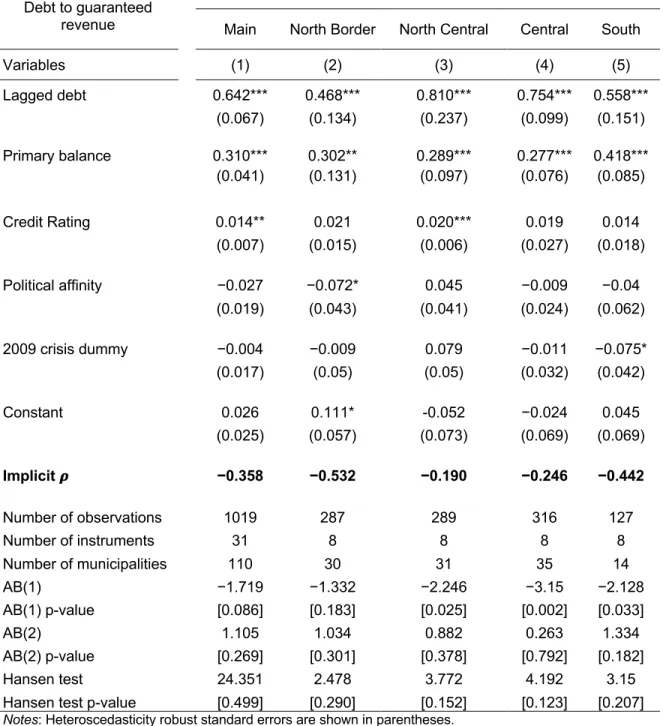
The second study extends the evaluation of subnational debt to the 110 most indebted Mexican municipalities from 2007 to 2017. The study begins by summarizing the relevant municipal literature. Then, it uses the same indicator from the previous study to evaluate debt sustainability at the municipal level (Objective 4). The evaluation comprises several robustness checks, including regional differences, alternative control variable specifications, and structural breaks testing.
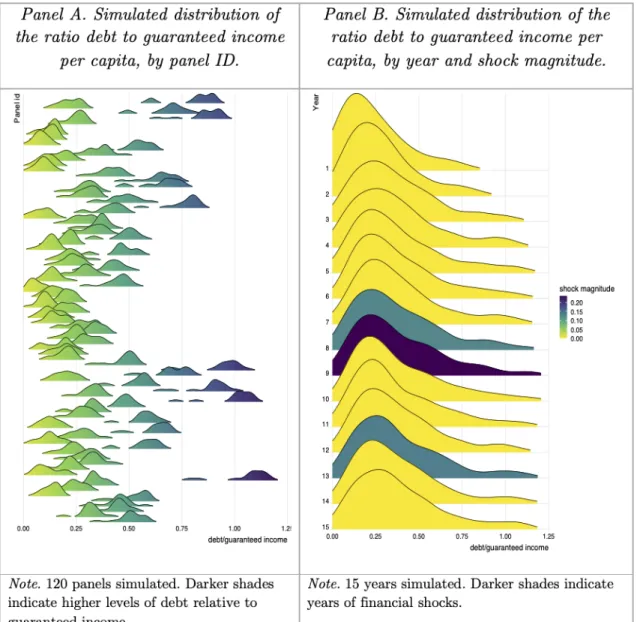
Considering the significance of the 2008-09 global financial crisis in both studies, testing the indicator's robustness under extreme volatility scenarios became paramount. Thus, a second contribution consisted of examining the robustness and theoretical properties of the proposed indicator (!) using Monte Carlo simulations (Objective 2). Specifically, the examination consisted in simulating thousands of panel datasets, each with varying magnitudes of random financial shocks, then calculating the sustainability parameter and constructing the probabilistic distribution from the Monte Carlo simulations. Then, the stability of the proposed indicator was assessed by contrasting the simulated probabilistic distribution against the expected behavior derived from its theoretical properties. The main conclusion from the Monte Carlo simulations was that the proposed indicator (!) behaved according to its theoretical properties, thus demonstrating that it is a reliable sustainability measurement even under scenarios of extreme volatility. This study was co- authored with Dr. René Cabral Torres and Dr. Eduardo Saucedo de la Fuente. A version of this study was published in the journal Sustainability (2022); hence, due copyright permissions have been requested from the referred journal.
The third study analyzes the effects of the LDF on subnational debt, which were not considered in the two previous studies. However, the study focuses on the state level due to insufficient information to conduct an impact assessment at the municipal level. This study argues that the LDF alert system characterizes an explicit
fiscal rule according to Eyraud et al.'s (2018) definition. Specifically, this study evaluates the impact of the LDF fiscal rule on the Mexican States' indebtedness levels using a quarterly panel dataset (2013-2020) and differences-in-differences (DID) techniques (Objective 5). Using the DID methodology allows me to analyze the initial impact of the COVID-19 crisis on the levels of subnational debt. I can conclude that although the recent crisis has somewhat reduced the alert system's effectiveness, the mechanism prevented excessive indebtedness even in an extreme economic shock caused by the COVID-19 pandemic. The study contributes to the scarce literature evaluating the effectiveness of fiscal rules to reduce debt accumulation at the subnational level. To the best of my knowledge, no previous studies had empirically assessed the impact of the LDF on Mexican states. Hence, this study is the first to present such an assessment. I solely authored this study.
1.5 References
Aspromourgos, T., Rees, D., & White, G. (2010). Public Debt Sustainability and Alternative Theories of Interest. Cambridge Journal of Economics, 34(3), 433–447.
Balassone, F., & Franco, D. (2000). Assessing Fiscal Sustainability: A Review of Methods with a View to EMU. SSRN Electronic Journal.
http://doi.org/10.2139/ssrn.2109377
Beqiraj, E., Fedeli, S., & Forte, F. (2018). Public debt sustainability: An empirical study on OECD countries. Journal of Macroeconomics, 58, 238–248.
Bohn, H. (1998). The Behavior Of US Public Debt And Deficits. The Quarterly Journal of Economics, 113(3), 949–963.
http://doi.org/10.1162/003355398555793
Buchanan, J. M. (1958). Public Principles of Public Debt. Homewood, Ill: Richard D. Irwin.
Canuto, O., & Liu, L. (2010). Subnational debt finance and the global financial crisis (No. 54507) (pp. 1–7). Washington, DC.
Echavarría, J. J., Rentería, C., & Steiner, R. (2010). Decentralization and Bailouts in Colombia. IDB Publications (Working Papers). Inter-American
Development Bank.
Eyraud, L., Debrun, M. X., Hodge, A., Lledo, V. D., & Pattillo, M. C. A. (2018).
Second-generation fiscal rules: Balancing simplicity, flexibility, and enforceability. International Monetary Fund.
Gertler, P. J., Martinez, S., Premand, P., Rawlings, L. B., & Vermeersch, C. M.
(2020). Impact evaluation in practice. World Bank Publications.
Giugale, M., Korobow, A., & Webb, S. (2000). A New Model for Market-based Regulation of Subnational Borrowing. World Bank Publications.
Hagen, von, J., Bordignon, M., Dahlberg, M., Grewal, B. S., Peterson, P., & Seitz, H. (2000). Subnational Government Bailouts in OECD Countries: Four Case Studies. http://doi.org/10.2139/ssrn.1814672
Hamilton, J. D., & Flavin, M. A. (1986). On the Limitations of Government
Borrowing: A Framework for Empirical Testing. American Economic Review,
76(4), 808–819. http://doi.org/10.3386/w1632
Hernández-Trillo, F., Díaz-Cayeros, A., & González, R. G. (2002). Fiscal
decentralization in Mexico: the bailout problem. Inter-American Development Bank, Research Department.
IMF. (2020). How to Design Subnational Fiscal Rules: A Primer . (L. Eyraud, A.
Hodge, J. Ralyea, & J. Reynaud, Eds.). Washington, DC : International Monetary Fund.
Mendoza, E. G., & Oviedo, P. M. (2009). Public Debt, Fiscal Solvency and
Macroeconomic Uncertainty in Latin America: The Cases of Brazil, Colombia, Costa Rica and Mexico. Economía Mexicana, 18, 133–173.
Nicolini, J. P., Posadas, J., Sanguinetti, J., & Tommasi, M. (2002).
Decentralization, Fiscal Discipline in Sub-National Governments and the Bailout Problem: The Case of Argentina. http://doi.org/10.2139/ssrn.1814725 Paparas, D., Richter, C., & Paparas, A. (2015). A synthesis of empirical research in
the sustainability of fiscal policy. Journal of Economics Bibliography, 2(4), 164–183.
Seitz, H. (2000). Subnational Bailouts in Germany. IDB Working Paper Series.
http://doi.org/10.2139/ssrn.1814669
Uctum, M., & Thurston, T. (2006). Public Debt, the Unit Root Hypothesis and Structural Breaks: A Multi Country Analysis. Economica, 73(289), 129–156.
http://doi.org/10.1111/j.1468-0335.2006.00451.x
Webb, S. B., & Dillinger, W. (1999). Fiscal Management in Federal Democracies:
Argentina and Brazil. The World Bank. http://doi.org/10.1596/1813-9450- 2121
Woo, J., & Kumar, M. S. (2015). Public Debt and Growth. Economica, 82(328), 705–739. http://doi.org/10.1111/ecca.12138
Wyplosz, C. (2005). Fiscal policy : institutions versus rules. National Institute Economics Review, 64–78.
CHAPTER 2
THE SUSTAINABILITY OF SUBNATIONAL PUBLIC DEBT EVIDENCE FROM MEXICAN STATES
2.1 Introduction
Macroeconomic fiscal sustainability has long received considerable attention, first, in the early 1990s with the Maastricht Treaty. More recently, due to the 2008-09 US financial and economic crisis that spread across the entire world economy.
Particularly in Europe, since the early 1970s, a persistent, solid public debt growth in some countries often coincided with low average GDP growth. Moreover, the latest global financial and economic crisis created an environment characterized by public debt problems that left several European Union (EU) members (for example, Greece, Portugal, Ireland, Spain, and Cyprus) unable to repay their debt or to bail out over-indebted banks under national supervision without the assistance of third parties (Beqiraj, Fedeli, and Forte, 2018). Since then, many theoretical and empirical papers have focused on evaluating fiscal sustainability at the national level.
In this context, assessing the fiscal sustainability of subnational governments (henceforth, SNGs) has become of paramount importance and a growing area of research. Indeed, when SNGs follow an unsustainable fiscal policy, it can jeopardize the services it manages, the financial system's safety, and, ultimately, the country’s international creditworthiness and overall macroeconomic stability.
The objective of this chapter is to assess fiscal sustainability for Mexican SNGs. This experience is relevant as the country, a developing federal economy, has a reputation of frequently bailing out states (Giugale et al., 2000) due to a lack of fiscal discipline à la Lane (1993). This dissertation chapter contributes to the literature in two important ways. First, it proposes an intuitive approach to assess sustainability. As in Bohn's (1998) seminal model, the setup departs from the present value constraints. A different reaction function is derived, which responds to the debt-
to-GDP ratio in previous periods and the primary fiscal surplus-to-GDP ratio.
Treating the reaction function as a first-order difference equation, is demonstrated that sustainability depends on the size and significance of the lagged debt-to-GDP ratio coefficient. Therefore, the model provides a more intuitive interpretation of lagged debt-to GDP coefficients to measure fiscal (un)sustainability. The second contribution of this dissertation chapter is that, by exploring the case of Mexican states, it extends the geographical reach of the existing empirical research assessing public debt sustainability at the SNG level. As mentioned above, most of the existing literature on public debt sustainability examines the case of industrial economies and employs time series unit root tests.
This dissertation chapter pays special attention to the role of the 2008-09 global financial crisis and political factors as potential determinants of public debt accumulation. Since the acquisition of additional public debt in Mexican states needs to be approved by state congresses, this chapter test whether a party majority at the same local congress as the governor might influence the accumulation of public debt. Following this initial assessment, the fiscal stances of different states it is examined using criteria such as size, openness, and economic growth.
The results suggest that Mexican states maintain a sustainable fiscal position.
However, we also find that Mexican states' fiscal position has deteriorated in recent years, suggesting that fiscal policy has been unsustainable when measuring debt sustainability as a ratio of debt to guaranteed revenue (non-earmarked federal transfers plus own resources). We also observe the very significant effect of the financial crisis on public debt. Finally, we find that smaller, more open, less dynamic states had more compromised fiscal stances, particularly following the recent global financial crisis.
The rest of this chapter proceeds as follows. Section 2.2 revisit the relevant literature for emerging markets. Section 2.3 provides background about the evolution of public debt in Mexican states. Using alternative measures of indebtedness employed later in the empirical analysis, Section 2.4 presents descriptive statistics showing the growth of public debt at different time points. It also shows Mexico's
political map, describing its regional divisions and comparing states according to their debt levels. Section 2.5 introduces the methodology employed, which is based on a simple theoretical framework of debt sustainability. Section 2.6 first presents some unit root tests and then develops an empirical assessment of fiscal sustainability across Mexican states based on the model proposed in Section 2.3.
Finally, Section 2.7 provides some concluding remarks.
2.2 Literature review on debt sustainability and emerging markets
Broadly speaking, the literature shows two analytical approaches that study fiscal sustainability. The first is concerned with testing several types of controls for subnational borrowing to achieve sustainability. The second is more concerned with the development and implementation of methodologies to evaluate debt sustainability. Although this chapter's objective is better aligned with the latter approach, we also briefly review the former.
2.2.1 Controls for SNG borrowing
Here, the main concern is to promote fiscal responsibility and political accountability by subnational governments. Thus, the main question is, what are the most effective policies or mechanisms to control SNGs’ excessive public debt accumulation? In this category, much of the research is related to international organizations, such as the World Bank (Giugale et al., 2000; Liu and Webb, 2011; Webb, 2004), the IMF (Lane, 1993; Ter-Minassian and Craig, 1997; Chalk and Hemming, 2000; Plekhanov and Singh, 2006), the OECD (Ter-Minassian, 2007; Blöchliger, 2013), or the ECLAC (Paunovic, 2005; Ter-Minassian and Jiménez, 2011).
This research branch categorizes policies (or enforcing mechanisms) intended to reach subnational fiscal sustainability in four categories. First, the market discipline approach is confident that free and open financial markets will likely
restrain excessive subnational borrowing when there is no perceived possibility of a bailout in case of default. Empirical evidence suggests that if the rigorous market conditions defined by Lane (1993) are not met, the market approach will likely lead to increasing levels of subnational indebtedness, as in the case of Canada and Brazil (Ter-Minassian and Craig, 1997).
Under the second approach, the SNGs' limits of indebtedness are individually negotiated and agreed upon according to the local requirements. Evidence shows that the so-called cooperative controls approach may not effectively prevent subnational debt accumulation when either market discipline or the central government's fiscal management is weak. Also, they are susceptible to SNGs’
asymmetrical bargaining power (Ter-Minassian, 2007).
Third, under centrally imposed rules the central government exerts direct control over the SNGs’ borrowing. Although this variety of control is conflicted with the trend toward rising fiscal responsibilities for SNGs, evidence suggests that when vertical fiscal imbalances are wider, this becomes the best alternative, especially for emerging economies (Plekhanov and Singh, 2006).
The last category, the rules-based approach, investigates legal devices (rules) intended to anchor expectations about a government's commitment to fiscal discipline. There are several types of fiscal rules. Some set limits on the absolute level of debt; others stipulate that borrowing can be resorted to only for designated purposes; some restrict debt to a maximum allowed service ratio, while others prohibit certain risky types of borrowing.
It is important to remark that, because of this tendency of SNGs to contract debt, many countries have imposed different mixtures of fiscal rules. Ter-Minassian (2007) and Liu and Webb (2011) review the types of fiscal rules imposed in different countries and their effectiveness. These authors show evidence that fiscal responsibility laws (FRL), which contain the fiscal rules, can help coordinate and sustain fiscal prudence commitments. Still, FRLs are not a substitute for commitment and should not be viewed as ends in themselves. In other words, the FRLs have
helped to make debt sustainable, though this is still lacking even after the law has been introduced (Liu and Webb, 2011).
The evidence also suggests that fiscal rules tend to be more effective at the national level and perform somewhat poorly at the subnational level, mainly due to local governments' autonomy (Ter-Minassian, 2007). Here Kopits (2004) argues that decentralization requires a mechanism to enforce rules at each decision-making level (a bottom-up approach) rather than a top-down mechanism.
2.2.2 Methodologies for SNG debt sustainability
Regarding the methodological literature to assess debt sustainability, two families of methodologies stand out. The first try to verify whether the solvency condition has held for the past budgetary policies and then recommend future actions. The seminal work of this approach is Hamilton and Flavin (1986).1 Based on this work, others refine this methodology (Wilcox, 1989; Ahmed and Rogers, 1995; Uctum and Wickens,1997). The tests' results are mixed, but the main limitation is that they are hardly useful for policymakers because solvency within a sample period does not guarantee solvency in the future.
Buiter, Persson and Minford (1985) and Blanchard (1990) suggest synthetic indicators to gauge sustainability. Buiter et al. uses public sector net worth to GDP.
The problem with this indicator is that the government’s net worth is hard to obtain.
Blanchard solves the problem by using the debt-to-GDP ratio, which is the most widely used.
The second family of methods employs the present value budget constraints as a starting point. In this chapter, we use an approximation to Bohn’s (1998) seminal model, which, as mentioned earlier, we modify and adapt to assess sustainability at the SNG level. We used this model because it is possible to derive a different
1 Chalk and Hemming (2000) review most papers based on this approach.
reaction function, which responds to the debt-to-GDP ratio in previous periods and the primary fiscal surplus-to-GDP ratio. Thus, our model provides a more intuitive interpretation of lagged debt-to-GDP coefficients as a measurement of fiscal (un)sustainability.
More recently, Mendoza and Oviedo (2009) proposed a third framework for assessing public debt sustainability, explicitly incorporating revenue uncertainty and financial market shocks. This framework estimates a measure of Natural Debt Limit (NDL), which denotes a credible commitment to be capable of repaying even during a fiscal crisis. It then computes the economy's stochastic equilibrium dynamics, based on the government tax and expenditure “smoothed” policy. This approach has been gaining the attention of researchers, especially in emerging economies such as Indonesia (Lestari, 2014), Costa Rica (Chaverri, 2017), and Guatemala (Catalán- Herrera, 2020).
2.2.3 Emerging market economies’ debt sustainability
Several papers have studied fiscal sustainability across industrial economies using Bohn’s framework (Beqiraj et al., (2018), Fincke and Greiner, (2012); Greiner et al., (2007) and Potrafke and Resichmann (2015)). Still, this method has received less attention in emerging economies.
Considering this context, we reviewed the literature that has examined sustainability in emerging market economies. Among the national level debt assessments, we find the works of de Mello (2008) for Brazil; Lozano (2010) for Colombia; Cerro et al. (2008) for Argentina, while Cevik and Nanda (2020) tested 16 Caribbean countries' debt sustainability using panel data. At the subnational level, we found applications of the Bohn framework in Daude and De la Maisonneuve (2016) and Jaimes (2020) to Colombian states and municipalities. While for India, Renjith and Shanmugam (2018) and Kaur et al. (2018) both utilize panel data of 20 Indian states for testing the sustainability of public debt.
Regarding SNGs’ debt sustainability assessment using the fiscal rules framework, the evidence is still inconclusive for developing countries (Kopits, 2004).
Several developing countries, such as Chile, Brazil, Mexico, and Peru, where rules- based fiscal policies effectively promoted fiscal discipline. In contrast, they failed in the cases of Argentina and Venezuela.
Webb (2004) argues that fiscal rules require strict ex-ante controls (regulations) and severe ex-post consequences (no bailouts) to be effective.
However, considering that both conditions depend on credibility and enforcement capacity, they are less effective in developing countries where weak institutional frameworks prevail (Ter-Minassian and Craig, 1997; Kopits, 2004). Moreover, to serve as an expectation anchor, the rules require broad political support, which must be sustained in the long run as even a temporary abandonment would weaken the rules’ credibility.
As a policy implication for developing countries, Kopits (2004) suggests coding fiscal rules into the Constitution or other high-level laws and promoting strict procedural rules, including best practices in transparency and accountability with an independent audit mechanism. The inclusion of rules stabilizes public expense in case of exogenous shocks or macroeconomic volatility. Finally, for economies that are highly dependent on nonrenewable resources (like oil), a commodity stabilization fund is recommended to avoid wide revenue fluctuations.
In the Mexican case, the two main fiscal rules were inscribed in the Constitution. First, the federal and subnational governments are subject to the golden rule: borrowing can only finance public investment. Second, subnational governments are prohibited from incurring liabilities with foreign entities and contracting liabilities in foreign currency. Compliance with these rules is supervised by Congress, which also approves the fiscal balance target. Although the Mexican executive branch still retains many discretionary powers, the existing rules have promoted healthy public finances even during recent economic slowdowns and oil shocks (Conesa et al., 2004).
2.3 Institutional background and Mexican states' public debt
Mexico has three levels of government: federal (central), state (subnational), and municipal (local). Intergovernmental fiscal relations follow a revenue-sharing system.
Nevertheless, the government is highly centralized, with about 90% of total fiscal revenue collected at the federal level. Because of this centralization, state governments significantly rely on federal transfers to finance current and capital expenditures. In terms of public debt, states and municipalities obtain loans from private banks (commercial), public banks (developmental), and the financial markets (by issuing bonds) to finance new infrastructure in local currency. As in many other emerging economies, government expenditures in Mexico tend to be cyclical, decreasing during economic downturns and rising during upturns (Abbott, et al., 2015). In these circumstances, state governments employ public debt to smooth out expenditures during business cycles.
Over the last couple of decades, several factors have contributed to these increasing subnational public debt levels in Mexico. The first was the 2008-09 global financial crisis that originated in industrial economies but spread rapidly to the rest of the world. The second influence on Mexico's subnational public debt growth are changes in the regulatory framework, put in place after the domestic crisis of 1995 and the recession of 2001. Following the Mexican peso devaluation in 1994 and the subsequent economic crisis of 1995, many states were left with high debt levels and little ability to serve and repay their obligations. The crisis led to a bailout of 28 of the 32 states by the federal government via extraordinary transfers and debt restructuring support.2 In 1997, a new regulatory framework for subnational public debt was introduced, aiming to increase market transparency and prevent future bailouts. Under the new legislation, states wishing to issue debt had to be evaluated by two of the three rating agencies approved by the federal government (Moody's, Standard and Poor's, or Fitch). To make the acquisition of debt transparent, states
2 Hernández-Trillo, et al. (2002) documented these bailout episodes and the moral hazard issues that emerged from them. They also provide evidence of the regressive effects that bailouts have on less indebted, less wealthy states, which generally received fewer resources.
were also obliged to register all new loans with the federal government and to publish their levels of debt, debt service, and financial statements.
Another significant breakpoint, caused by changes in the regulatory framework, occurred in 2001 when states began using more debt securitization.3 According to the Deputy Chamber's Public Finance Studies Center (CEFP, 2009), the total amount of securitized subnational debt went from 90 million in 2001 to 35 trillion in 2007.
Finally, political factors influencing Mexico's national public debt accumulation, which have been documented in the literature, also might have affected subnational public debt issuance. The seminal work by Alesina and Tabellini (1990) develops a theoretical model suggesting that public debt was issued strategically by policymakers to influence their successors' choice. Additional empirical evidence suggests that political factors may influence public debt levels and fiscal sustainability (see, for instance, Alt and Lassen (2006) and Skilling and Zeckhasuer (2002), regarding OECD economies, and Neck and Getzner (2001), regarding Australia).
2.4 Data
The data set contains information from 1993 to 2016 for all 32 Mexican subnational entities (31 states and Mexico City). All data are taken from official Mexican statistical sources. The states’ public debt and non-earmarked federal transfers were obtained from the Mexican Ministry of Finance. Data on the states' GDP, revenues, and deficits were taken from Mexico's National Statistics Institute and state population figures from the National Population Council. Finally, information regarding state congresses' composition and majorities, the numbers of votes cast in local elections,
3 States have been allowed to securitize their public debt since 1998. The state of Aguascalientes was the first issuer of securitized debt in 1999, but securitization was not used more broadly until 2001.
and governors' political parties were taken from the states' electoral institutes.
This dissertation chapter employs two different public debt measures: the debt-to-GDP ratio and the debt to guaranteed resources ratio (local revenue plus non-earmarked federal transfers).4 Credit rating agencies use the latter to assess states' capacity to acquire additional debt, and the former has been employed in the literature to assess the central governments' ability to sustain public debt.5 Figure 2.1 presents a political map of Mexico and registers debt levels as a percentage of guaranteed resources in 2016. The figure shows four categories of indebtedness, where lighter colors indicate states with lower levels of debt. By this measure, the states of Chihuahua, Coahuila, and Nuevo Leon, in the north, and Quintana Roo, in the south, are the most indebted, with a level of debt that surpasses their guaranteed revenue. Although there is no clear geographical pattern, it is evident that two of the six northern states that border with the United States are among the most indebted.
All six border states consistently score in the top 10 in our two different public debt sustainability measures.
Table 2.1 presents average total debt for 1993–2016 and the evolution of public debt for our two measures of sustainability at two points in time: 2006 and 2016. Between 2006 and 2016, both measures of debt sustainability more than doubled. The average debt-to-GDP ratio rose from 1.2% to 2.6% of GDP, whereas the debt to guaranteed resources ratio went from 24.4% to 48.9%. The 2016 debt- to-guaranteed ratio was highest in Coahuila, Chihuahua, and Quintana Roo and lowest in Tlaxcala, Queretaro, and Campeche. Chiapas, Chihuahua, and Quintana Roo showed the highest debt-to-GDP ratios, whereas Queretaro, Campeche, and Tlaxcala had the lowest.
4 Mexico's federal fiscal system follows a revenue-sharing mechanism. Participaciones are non-earmarked transfers that can be used for general spending purposes, including the repayment of public debt. For a full description of earmarked and non-earmarked transfers (aportaciones) in Mexico, see Abbott, et al. (2017).
5 Because of vertical imbalances, a state's GDP is not correlated either to its own revenues or to its non- earmarked transfers. Hence, guaranteed resources are used to measure solvency.
Figure 2.1 Subnational debt levels as a percentage of guaranteed resources
2.5 The model and testable predictions 2.5.1 The Empirical Model
This chapter's empirical model derives from the present value constraint framework (Bohn, 2008; Taylor et al., 2012; Wickens, 2012). In the model, capital letters correspond to nominal values and lowercase letters to real ones. The model's starting point is the government budget constraint:
"!+ (1 + &")(!#$= *!+!+ Δ-!+ (! (2.1)
Where "! is total government expenditures, (! is debt issued in period t, &! is the nominal interest rate, -! is the money supply, *! is the price level, and +! is nominal tax revenue.6
Dividing Equation (2.1) by nominal GDP (/! = *!0!) and solving for the primary fiscal balance, 1! = (!− (1 + &")(!#$, the resulting reduced form is simply:
%!
&! = (1 + !!)%!"#
&!"#+'&!
! (2.2)
Where 1 + !! =($(+$()!
!)($(-!), 3! is the inflation rate, and 4! is real GDP growth. The resulting expression is a first-order difference equation, in which the current debt-to- GDP ratio depends on the debt-to-GDP ratio of the previous period, the current primary deficit-to-GDP ratio, and the long-term stability parameter !!.
Assuming a constant nominal interest rate, inflation, and real GDP growth and using a backward solution, it can be shown whenever !! < 0, the debt-to-GDP ratio converges to a long-term finite level and is sustainable. Meanwhile, when !!> 0, the debt-to-GDP ratio goes to infinity, and the government's long-term fiscal position is unsustainable. In a time series, empirical framework, this conclusion is also consistent with observing a unit root. Here it must be noticed that the long-term stability parameter !! captures the sustainability across all subnational governments.
Thus, !! must be interpreted as a global sustainability measurement rather than an individual indicator.
6 Without loss of generality, we can exclude money supply from our model (Δ"!= 0), provided that SNGs cannot print money.
Departing from Equation (2.2), the empirical specification we estimate while employing panel data methods is
%$!
&$! = 8.+ 9!+ :%&$!"#
$!"#+ ;'&$!
$!+ <Γ + >.! (2.3)
Where 8. and 9! are fixed and time effects, respectively. According to Equation (2.2), coefficient ; is equal to unity. However, this might change in an empirical setup (Ghosh et al., 2013). Also, in Equation (2.3), X is a vector of additional control variables that affects public debt accumulation. Several control variables have been explored in the literature as important determinants of long-term debt accumulation. For instance, Ghosh et al. (2013) and Bohn (1998, 2008) employ the output gap and the government expenditure gap as control variables, along with other additional controls such as oil prices, trade openness, inflation, and a proxy of political stability. Since we explicitly incorporate some of those determinants from the literature as part of our measurement of sustainability (e.g., GDP, federal transfers, non-earmarked transfers from central governments, and prices), our model focuses instead on testing the impact of two other important factors that presumably influenced the accumulation of public debt in Mexican states: the 2008- 09 financial crisis and the political affinities of the local congresses and state governors.7
As discussed earlier, the financial crisis played a vital role in the accumulation of global public debt, not just in industrial and emerging economies but also in their subnational political entities' debt. We introduce a dummy variable (crisis) that takes the value of one for 2009 and zero for any other year to control this effect. In addition to this crisis dummy, we also introduce another dummy to control the effect of the 1995 domestic economic crisis.
As reviewed earlier, Mexican states increased their level of debt during the
7 Benton and Smith (2017) included this variable at the municipal level.
financial crisis and well afterward. Several factors may explain this. First, due to the quantitative easing in the US, interest rates plummeted sharply, and this movement is generally transmitted to Mexico (Iacoviello and Navarro, 2019). Hence, states faced lower interest rates. Second, given that state revenues are highly procyclical, they faced liquidity problems during the financial crisis, so they were prone to acquire greater debt levels. In short, the macro environment is always present when analyzing the fiscal sustainability of SNGs.
In general, SNGs cannot effectively absorb macroeconomic shocks as they do not have sound fiscal instruments. On the one hand, they have virtually no powerful taxes to levy and absorb the macro shock.8 On the other hand, they can only contract debt in national currency as, by law, states and municipalities cannot borrow from abroad. In this sense, a macro shock hits them harder than the federal government. Therefore, including the dummy variable in the analysis is important.
In Mexico, local congressional approval is required to acquire additional state- level public debt. Therefore, a Governor with a partisan majority in the provincial congress has better chances of getting approval to increase debt. We take care of this by introducing a dummy variable for a political affinity effect that takes the values of one whenever a Governor has a partisan majority (50% +1) in the local congress and zero otherwise. We hypothesize that both the financial crisis and political affinity between a congressional majority and a government make the accumulation of public debt more likely.
Equation (2.3) is estimated using System Generalized Method of the Moments (SGMM) techniques. Alternatively, Blundell and Bond (1998) propose using SGMM to estimate a system of equations employing lagged differences as well as lags of endogenous variables as instruments. This produces more robust estimations when autoregressive processes become persistent. According to the Arellano–Bond (AB(2)) test, GMM estimators are consistent if no second-order
8 States have limited tax instruments: tourism, payroll, and vehicle property taxes. These are not powerful in terms of the tax collection as compared to personal, corporate, and value-added taxes. Hence, they are too weak to be used as instruments to absorb macro shocks.
autocorrelation exists in the residuals and if the instruments employed are valid according to Hansen's J-test. Finally, to double-check that the model is correctly specified, following Roodman (2009) the number of instruments and observations is reported. To avoid problems of overidentification, the number of instruments must not outnumber observations in the sample.
Also, instead of relying on only one measure of sustainability in the form of public debt-to-GDP ratio (which might not be the most appropriate measure to judge subnational finances), we employ an alternative measure: the debt to guaranteed resources (local revenue plus non-earmarked federal transfers) ratio. Rating agencies prefer this measurement because state GDP is not correlated with these two sources as vertical imbalances. Of course, the nature of coefficient !! changes when the real GDP (0!) is replaced in Equation (2.3) by the sum of non-earmarked federal transfers plus the states' own revenue. Nevertheless, Equation (2.2) is still interpreted as a first-order difference equation whose stability depends on !!. Hence, we analyze sustainability using these alternative measures when GDP is in the denominator.
2.5.2 Testable predictions
Looking first at the full sample of Mexican states, we explore the following testable predictions:
1) The fiscal position of the Mexican states is unsustainable.
2) Political affinity, in the form of a congressional majority and a governor of the same political party, causes higher debt in states.
3) The global financial crisis had a significant impact on public debt accumulation in recent years.
When segregating states according to different criteria, such as economic growth, openness to capital flows, and size, we expect that
4) Less dynamic states with lower economic growth, lower (own) revenue, and a smaller provision of central government transfers require more public debt relative to more dynamic states.
5) States that are more open to capital flows and more exposed to shocks and uncertainty require larger governments. Therefore, they accumulate more debt relative to less open states.
6) Larger states, with better economies of scale in the provision of public goods, require smaller governments and therefore accumulate less debt than smaller states.
Finally, when testing the sustainability of public debt over time,
7) For both public debt measures, we expect to observe a deterioration in SNG stances, particularly in the years following the financial crisis.
In what follows, these seven predictions are empirically tested.
Table 2.1 States’ debt measurements evolution
1993–2016 1996 2006 2016
State Average Total Debt (millions of pesos)
Contribution to national
GDP (%)
Debt- to- GDP
(%)
Debt to guaranteed
Resources (%)
Contribution to national
GDP (%)
Debt- to- GDP
(%)
Debt to guaranteed
Resources (%)
Contribution to national
GDP (%)
Debt- to- GDP
(%)
Debt to guaranteed
resources (%)
Aguascalientes 1,443 0.64 1.31 39.64 0.60 0.91 21.25 0.52 1.05 22.86
Baja California 6,080 2.28 1.67 17.04 2.85 1.26 37.87 3.03 2.47 57.76
Baja California Sur 1,041 0.66 2.85 75.78 0.40 0.91 18.28 0.35 1.16 24.78
Campeche 440 0.97 1.75 43.10 0.00 0.00 0.00 0.21 0.26 10.64
Chiapas 6,455 2.04 2.75 28.76 0.55 0.47 5.81 3.97 6.39 59.42
Chihuahua 12,745 5.71 3.13 72.68 4.31 2.16 45.54 9.52 7.61 150.81
Coahuila 9,926 2.10 1.40 48.53 0.26 0.12 4.07 7.08 5.29 153.34
Colima 1,056 0.55 2.39 30.22 0.56 1.66 29.29 0.59 2.65 48.59
Distrito Federal 38,262 13.89 1.44 28.27 27.54 2.44 53.79 14.33 2.31 42.01
Durango 2,700 1.14 1.96 50.29 1.67 2.35 51.20 1.34 2.94 58.80
Guanajuato 3,273 0.87 0.56 16.05 1.23 0.55 12.58 1.16 0.75 13.19
Guerrero 2,065 1.85 2.55 50.88 1.44 1.59 23.46 0.41 0.79 10.64
Hidalgo 2,088 0.03 0.05 0.54 1.53 1.65 33.53 1.17 2.04 37.72
Jalisco 11,693 7.28 2.63 71.30 5.52 1.35 30.24 3.45 1.32 31.73
Mexico 27,787 25.17 5.66 100.35 19.97 3.82 49.51 7.15 2.19 21.46
Michoacan 5,997 0.47 0.48 11.31 1.76 1.25 22.48 4.05 4.51 77.20
Morelos 1,443 0.46 0.81 14.36 0.46 0.58 12.52 0.74 1.75 27.85
Nayarit 1,944 0.33 1.39 24.60 0.34 0.82 12.71 1.07 4.07 66.42
Nuevo Leon 22,118 10.27 3.60 61.21 10.44 2.28 69.98 11.83 4.41 100.10
Oaxaca 3,341 0.36 0.53 2.17 0.94 0.88 15.01 2.27 4.07 52.49
Puebla 4,008 0.58 0.39 9.77 2.10 1.03 20.63 1.10 0.89 14.43
Queretaro 1,520 1.91 2.71 78.09 1.07 0.91 24.70 0.20 0.24 6.20
Quintana Roo 5,954 1.39 2.65 76.62 1.17 1.36 29.32 3.77 6.41 127.71
San Luis Potosi 2,374 1.02 1.34 35.84 1.69 1.41 32.50 0.76 0.97 20.29
Sinaloa 3,851 3.15 3.48 78.25 2.64 2.03 37.64 1.07 1.28 25.96
Sonora 9,475 11.43 9.53 240.53 3.90 1.98 37.76 4.75 3.75 56.29
Tabasco 1,814 0.77 1.42 11.12 0.40 0.21 3.83 0.82 0.96 16.11
Tamaulipas 4,096 0.68 0.53 16.15 0.49 0.22 6.00 2.29 2.