
Conserving these supplies of life represents one of the highest priorities for world governance now and in the future. The following report is based on the documents and proceedings of the previous workshop in Buenos Aires (Argentina) and the conference of the Club of Rome held in Punta del Este in November 1991.
The ups and downs of economic growth
Almost all of Latin America is going through a similar 25 difficult political but also economic transformation. We will then discuss the great assets in terms of real development that Latin America nevertheless has and is using.
From prosperity to economic decline
The depression of the 1930s - p r e - was destroyed in many Latin American countries by a series of trade, finance. Part of the capital allocated to European countries through the Marshall Fund, which was allowed to be spent offshore, found its way to Latin America.
To get a general impression of the situation, we have reviewed the latest statistics which show the position of the region in general in terms of several important economic and social indicators: the current level of GNP per capita and the growth of the domestic product, inflation. , changes in savings rates, external debt and the cost of servicing it, the amount and nature of imports and exports, the volume of aid, the size and distribution of national budgets. We then analyzed how some of these factors affected each of the countries in the region.
The debt problem
México also swapped $22.8 billion of the debt for government bonds issued at the fixed rate of 6.25. Furthermore, it was to make the terms of the Agreement more flexible (reschedule the debt under very favorable conditions, with the possibility of canceling one third of it).

Exports
Latin America's attitude today regarding these issues has been to bear the responsibility for this situation and the great efforts to correct it. Latin America has paid the interest costs, rescheduled the debt, although a few countries are not yet at the stage of negotiations.
The fiscal crisis
The Problem of inflation
This recovery depends on the success of the stabilization policies and adjustments made, especially in the case of countries with a high inflation rate. 40 the economic policy established by the new government appears sufficiently credible to encourage the re t u r of $60 million taken from the country.
The remedies applied to the crisis and their side-effects
Especially in the beginning, some countries tried to achieve adaptation through half-hearted policies aimed at preventing the worst casualties. Only now there is hope that some countries are moving towards a recovery with low inflation and manageable debt, as we have seen before.
Is Latín America out of the red?
34; Latin America has been the guinea pig in the experimental laboratory where theories for the perfect economy were tested. Conversely, Brazil ranks 37th in economic rankings and 59th in human development rankings.
Life expectancy
Access to health care
Although there is no direct relationship between the number of health professionals and life expectancy, it is clear that when there is one doctor and nurse for less than 1,500 people, the average life expectancy is over 70 years. There are a few exceptions: Mexico, which has an average life expectancy of 70 years, but has only one doctor and nurse for Table 5.
Differences start at birth
The fate of children in Latin America
While millions of children are on the streets every day to work, beg or steal, fortunately, according to H e r b e r t de Souza, only a few thousand have to sleep in the open air. Not only do these children live in the most abject poverty, they are also preyed upon by unscrupulous adults and are victims of extortion and violence by some members of the police. The same thing is now affecting other Brazilian cities, and has started on the streets of Bogotá and Colombia.
For another, these children do not attend school, or not for a long time, so that they cannot escape the spiral of ignorance and poverty in which the parents are t r a p e d " (Barefoot Revolution).
Education
Poor children in Latin America, like their counterparts in many parts of the world, are their earliest. Many of the mines have now closed, but there are still many child slaves, such as the 50 children aged between 10 and 14 whose bodies were found in August. First, they are paid much less than an adult earning for the same task: the profit from the child's work therefore goes to his employer, not to his family.
Líteracy programmes or educatíon?
Literacy is in the interest of those in power, providing a pool of wages for agribusiness and city factories. In classrooms, w r i t e n o r d is accompanied by images that encode the contradictions of the learners' lifestyles. Illustrating the seriousness of the crisis in Latin America is the decline in per capita income and the decline in per capita income during the 1980s.
A large part of the 23 million added between 1986 and the present are estimated to be victims of adjustment and restructuring programs carried out in the region to stimulate the economy.
The public accounts in Latin America
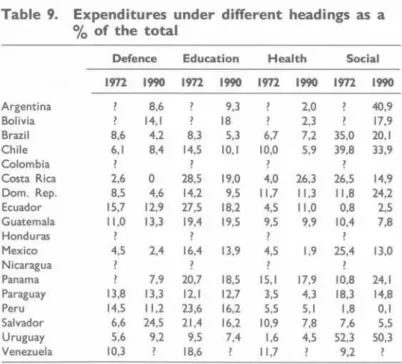
In rural areas and shantytowns, we see the other side of pietatura: the poor live in shantytowns, schools are dilapidated, and there is a great need for dispensaries and hospitals. The proportion of the total derived from each of these sources has varied considerably over the past 20 years (Table 8). If we look at how the various budgets have evolved over the last 20 years in countries for which statistics are available, we see that – apart from the defense expenditure just discussed – the results are as follows.
As for education, it seems that almost everywhere in the region the share of the state budget has fallen, to a greater or lesser extent.
Income distribution
Inequaiities between the sexes
Rural-urban disparities
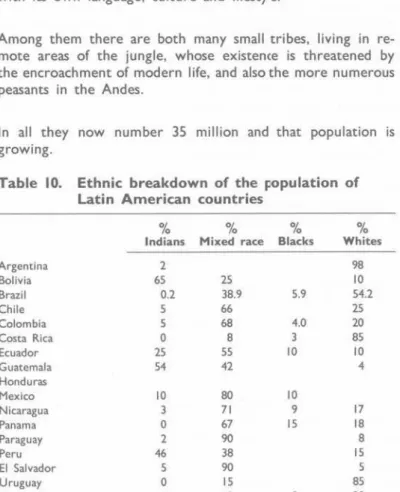
68 their belongings and moved in the middle of the night to an empty private piece of land. O n of them, the largest of all, is as large as the state of Rio de Janeiro. The Indians were then in the majority, but occupied the lowest rungs of society and were excluded from the political process.
Brazilian bishops have condemned the disappearance of Indians from their country as an organized genocide. One of the most recent and largest swap proposals has been proposed by the World Bank to Mexico. The resettlement of the Indians who lived in the now flooded area was poorly handled, as was the evacuation of wild animals.
Emigration
Central America in particular suffered during the 1980s from the consequences of the conflict between the United States and the Sandinista regime. In Colombia, the guerrillas of the Colombian Revolutionary Armed Forces continue to attack the police and the army. It is a machine that operates for its own purposes, without regard to the needs for which it was intended.
The real problem is a legal one: the concept of the state and the way it works."
Protection of human rights
But in other countries serious human rights violations are still taking place, as we have seen for example in Guatemala. In any case, human rights violations cannot be measured only by the freedom of expression, of the press and of political opinions. We must find ways to develop our own systems, to deal with the delicate and important interests of the poor.
For obvious reasons, however, most human rights organizations have focused their efforts on the defense of civil and political rights. Promotion may include measures aimed at achieving the adoption of laws and regulations dealing with the protection of human rights. Equally, this could mean working so that international human rights treaties are approved or ratified.
Promoting human rights means ensuring adequate legal mechanisms for their protection and prevention of abuse.
The Catholic Church and líberation theology
In 1990, several hundred farmers were murdered for resisting the expropriation of their land, either to incorporate it into large estates or to exploit the natural resources found there. For example, the start of the Carajas project in Brazil, which was criticized above by the European Parliament, led to the death or disappearance of many in the Tocantin Valley in Para State. The example of D o m Helder Cámara, one of the most famous representatives of the Church, was followed by many others.
Elsewhere, governments have found bishops to be fervent supporters, especially when authorities declared themselves guarantors of the Christian faith threatened by Marxism.
Is there a place for the militar/ in the new democracies?
An impressive number of priests, nuns and monks and even several bishops have died as a result of this resistance. Despite the problems discussed here, Latin | 19 America – viewed as a whole, but also per country – has extremely positive aspects that give it an honorable place in the world. Things are starting to change, at different speeds and with varying degrees of success depending on the country, as it is now realized that countries are more likely than not to benefit in the long run from opening up their economies.
The vast regional market proposed in the Latin American Free Trade Association (LAFTA) in 1960 was undoubtedly before its time and did not meet the expectations of the signatory countries.
Central America
20 From the late 1950s, bilateral and multilateral agreements began to be negotiated, but there were considerable difficulties because the balance between the partners was not always properly taken into account. Between 1958, when the first free trade area in Central America was created, and 1991, when the treaty establishing MERCOSUR was signed, many initiatives were launched that worked for a while and then were often abandoned. Today, economic cooperation is organized in several different areas: some cover Central America, others South America, others unite the Andean countries, and yet another the "South End", while there are agreements or - possible agreements also with North America.
The Andean countries
Perhaps because of the Andean Treaty, Peru and Ecuador are t r y i n g to resolve a dispute over their f r o n t i e s that has lasted half a century.
The Southern Cone
Agreements on culture, scíence and technology
Agreements with ¡ndustrialízed countries
They have begun to forge closer links with Europe through the good offices of Spain and Portugal in the f r a m e w o r k of the C I N (Confederaron of Ibero-American Nations). For the same reason, it is urgent to break through stagnation and achieve a p r o m p t and obvious improvement in the welfare of the poor. Socially, Latin America remains one of the most polarized regions in the world.
We observe examples of gross irresponsibility in financial scandals, c o r r u p t i o n and e x to r t i o n , vandalism and t e r r o r i s m , and in the operations of the drug trade.
