I DECLARE that this study entitled "Lewis Acidic Zn(II) Schiff Base Complexes in Homogeneous Catalysis" presented by Daniele Anselmo for the award of his PhD was carried out under my supervision at the Institut Català d'Investigació Química.
Schiff bases
Salen ligands and their metal complexes
Schematic drawing of the "salen" ligand showing the N2O2 metal binding pocket and possible substitutions in both the bridging and aromatic side groups. Arguably the most widely used salen-based catalyst system is the manganese(III) complex of the salen ligand carrying a chiral cyclohexyl bridging fragment known as Jacobsen's epoxidation catalyst (Figure 3).

Salphen ligands and their metal complexes
Synthesis of salphen ligands and complexes
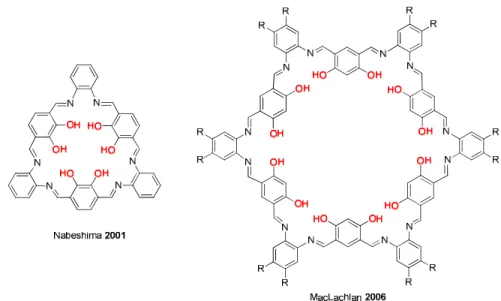
The easy access of these monoimines can lead to the synthesis of new non-symmetrical chiral mono- or bis-salphen ligands and complexes. The same approach was later extended to bis-salphen derivatives leading to the formal desymmetrization of the coordination environment of the salphen unit in bis-salphen scaffolds.[14] It is also possible to synthesize larger molecules based on the salphen scaffold.
Catalysis with salphen based complexes
A biomimetic cavity structure proposed by Rebek and colleagues active in acetylation of choline (left) and the proposed cooperative mode of catalysis (right). Rebek and co-workers prepared a sophisticated biomimetic salphene-based catalyst for the acetylation of choline.

Aim and outline
Some mechanistic considerations are also presented and discussed in relation to the state of the art. Zn(II) complexes show strong self-aggregation under apolar conditions, which can be reversed by adding a competing ligand or increasing the polarity of the medium.
Notes and references
In the case of 3,5-dibromobenzaldehyde, after 22.5 hours the amount of the 2‒CR derivative decreased to around 4%. Determination of stability constants for assembly 1·(2)2: To describe the behavior of assembly (1)·(2)2 in a non-polar medium and to obtain stepwise binding constants from 2 to 1, we used the model described in Scheme 2, which includes four colored species (free Zn(salphen) 2 and composite species with stoichiometries 1:1, 1:2 and 1:3).
Isolation and Characterization of a New Type of μ-hydroxo-bis-
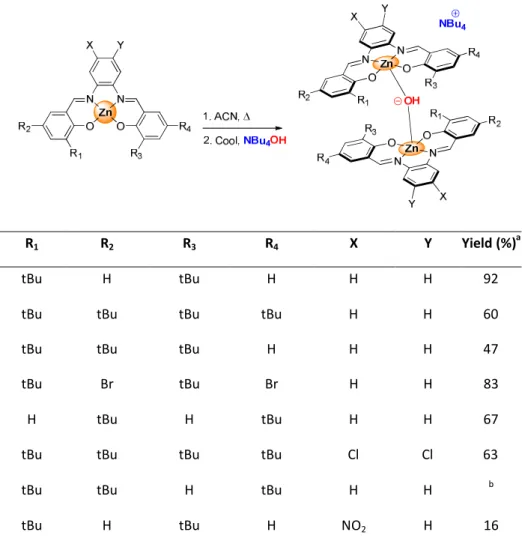
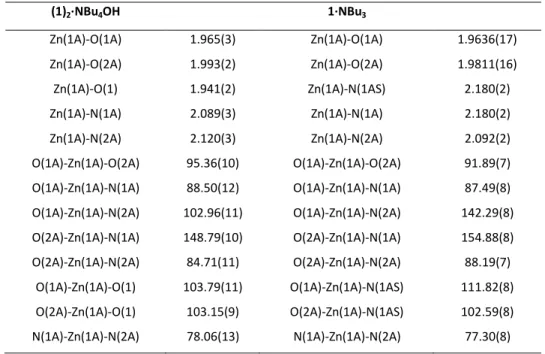
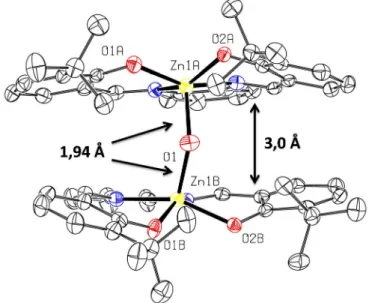
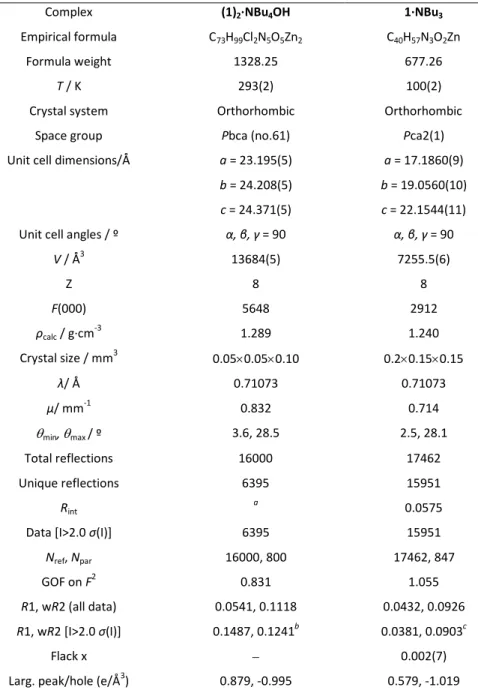
Synthesis and characterization of the assemblies
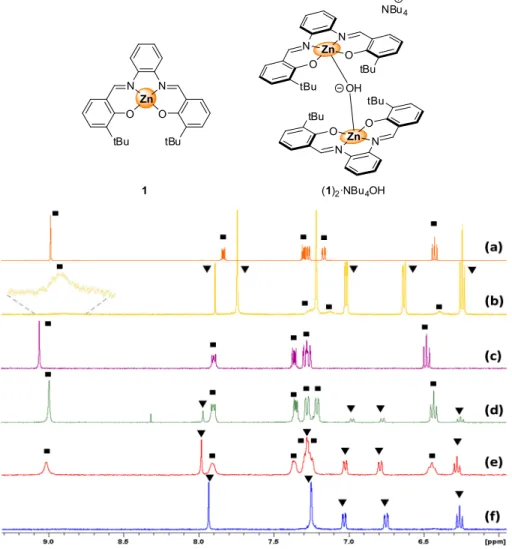
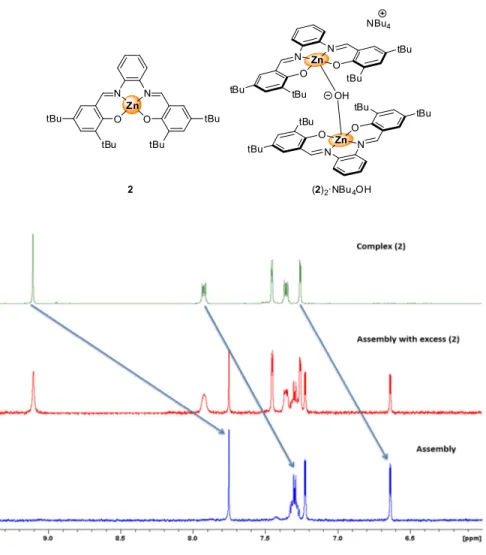
The stability of the assembly (1) 2 · NBu4OH was then investigated under increasingly polar conditions (Fig. 2). Mass spectrometric analysis (MALDI-TOF-MS or ESI-MS/MeOH, both in negative mode) also confirmed the formation and stability of the collected species.
Phosphoester cleavage catalysis….….…
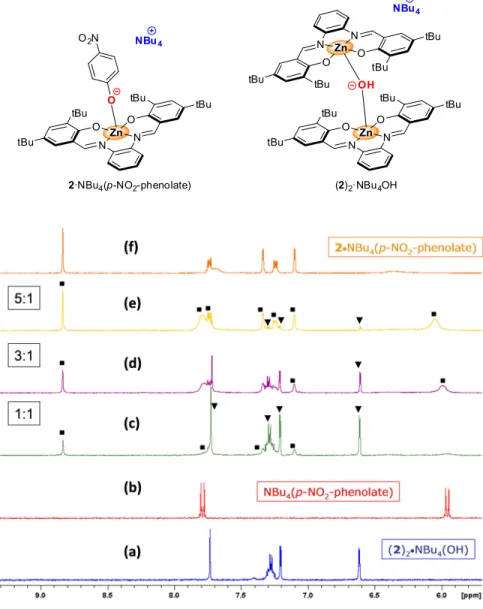
It is clear that the formation of p-nitro-phenolate (Fig. 8C) is evident, but the total conversion is very low. For completion, the NMR trace of the salt NBu4(p-nitro-phenolate) was also provided (Fig. 10, spectrum b).

Conclusions
From the much smaller upshift found for the imine-H (Δδ = -0.26 ppm) of the 2·NBu4 (p-nitro-phenolate) assembly it is clear that the p-nitro-phenolate anion is unable to form binuclear assembly with complex 2 (Fig. 11). Therefore, the NMR data help to confirm that strongly interacting ligands such as p-nitro-phenolate are indeed able to compete with the OH anion for complexation in 2 and can provoke the formation of mononuclear (catalytically inactive) structures.
Experimental section
The appropriate amount of NBu4OH (1 M solution in MeOH) is then added and the mixture is left undisturbed. In the case of (3)2·NBu4OH and (4)2·NBu4OH the reaction mixture was cooled to -25º to force crystallization of the product.
Notes and references…
Here we report a comprehensive study of the use of Zn(salphen) complexes as mediators of 3‒CR affording 3-substituted indoles. Furthermore, lower than stoichiometric amounts of DIPEA had a detrimental effect on the formation of the 3‒CR compound. Much lower amounts of the 3‒CR (14) product were formed, and at the same time higher amounts of 2‒CR (15) were present (Table 2).
Mild Formation of Cyclic Carbonates using Zn(II) Complexes based on
Results and discussion
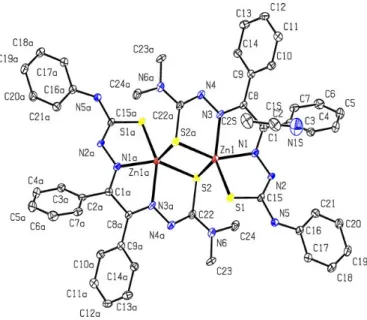
An isolated sample of these crystals was dried in vacuum and then examined by 1H NMR (DMSO-d6); surprisingly, the spectrum did not show the expected signals for the epoxide substrate as only 3 was present.[24] The crystal structure was then determined and the result is presented in Figure 1. The catalyst 3 was further used to study the substrate scope in the formation of cyclic carbonates by various terminal epoxides (Table 2), MEK as solvent and with the help of mild reaction conditions (45°C, p(CO2) = 10 bar) and ' a low catalyst loading. As also previously observed with Zn(salphen)-based catalysts with sterically more obstructed epoxides, [15,16] conversion of 2,2-dimethyl- and 2,3-dimethyl-oxirane (entries 17 and 18) was difficult, holding related to the steric hindrance in the ring-opening step of the coordinated epoxide when using a bulky nucleophile (i.e., iodide).
Conclusions……………………………………………………………….………………………. . 4 5
Compound F (500 mg, 2.12 mmol) was added to the solution and the mixture was stirred at room temperature for 3 h. Then, methyl ethyl ketone (5.0 mL) and mesitylene (280 µL mol) were added and the solution was stirred until complete dissolution occurred. A sample of the solution was then analyzed by 1H NMR spectroscopy (DMSO-d6) and the yield was determined using mesitene as an internal standard.
![Figure 2. Spectral changes of complex 3 upon the addition of pyridine with [3] = 50.0 x 10 -6 and the corresponding titration curves and data fits at λ = 529 nm](https://thumb-us.123doks.com/thumbv2/123dok_es/5793394.5475721/61.723.87.616.162.422/figure-spectral-changes-complex-addition-pyridine-corresponding-titration.webp)
Notes and references
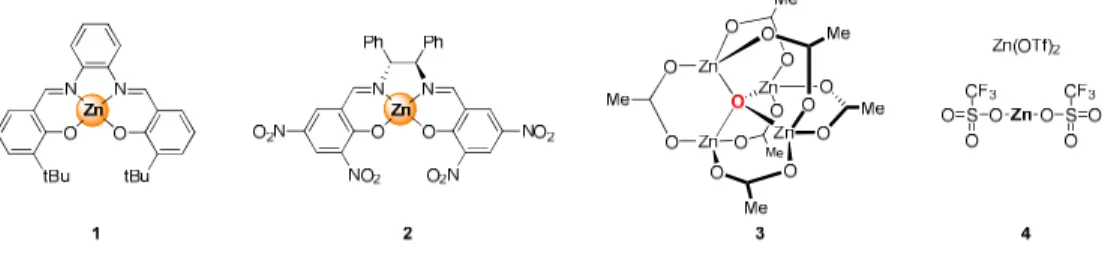
Note that the used complexes 1–3 were prepared by these authors and used in this collaborative project. Please note that in this case the S atoms are not used for the formation of a dinuclear species. The synthesis of 3-substituted indoles has been investigated through a multi-component reaction (MCR) approach using aldehydes, indole and malononitrile as reagents.
Introduction
3‒CR was investigated in detail and covered the influence of base, solvent, reagent stoichiometry and also included stability studies. The fact that Cu(salphen) complexes can catalyze this 3‒CR attracted our attention, as we recently reported that Zn(salphen) complexes are excellent Lewis acid activators in the catalytic conversion of oxiranes and carbon dioxide to give organic carbonates.[ 5] While Cu(salphenes) are coordinatively saturated, Zn(salphenes) show a tendency to form pentacoordinated structures due to the high Lewis acidity of these systems. [6] Therefore, we envisioned that the use of Zn(II) complexes instead of Cu(II)salphen would be beneficial for the efficient synthesis of 3-substituted indoles. Process parameters such as temperature, solvent, type of base, catalyst structure, stability of intermediates and final product 3‒CR were performed and compared with previously reported data [4]: the results show that the 3‒CR approach to 3 -substituted indoles (Scheme 1) is much more complicated than previously reported, and the selectivity toward the desired target is compromised by the formation of a side product involving the reaction between the intermediate 2-CR and malononitrile.
Results and discussion
As can be concluded from Table 2, Zn(sulfene) 8 showed the highest selectivity for the 3‒CR derivative (60%) at 25°C, a result that could not be improved by increasing the reaction temperature (40°C: 41 %). As for benzaldehyde, the reaction is slow (as expected) and low levels of the 3‒CR product are formed (about 25%) after 22.5 h. Interestingly, under these conditions there is a slow decay of the 2‒CR intermediate after a rapid initial formation.
Conclusions
Experimental section
Product 3‒CR, the reaction mixture was dried over Na2SO4 and the solvent was removed under reduced pressure. NMR studies: NMR studies were performed following the same conditions adopted for the catalysis experiments except for the use of deuterated dichloromethane as solvent. The precipitate that formed after cooling the reaction mixture to room temperature was isolated by filtration and dried in vacuo, after analysis by NMR spectroscopy.
Notes and references
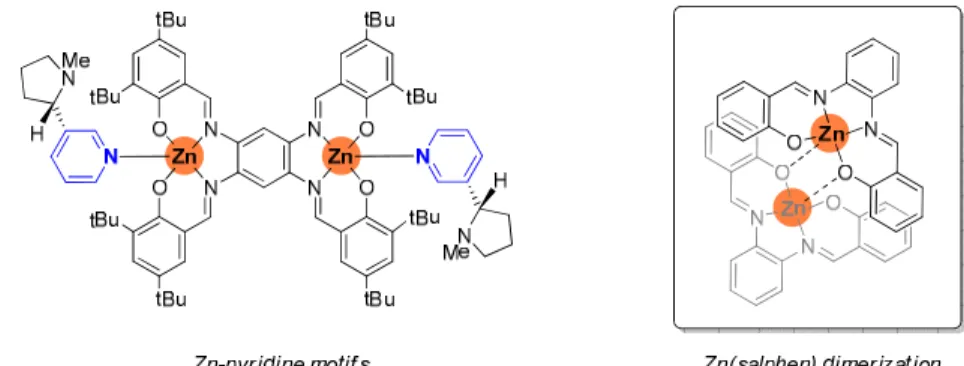
First of all, to understand the strength of the Zn−N interaction, we used the Zn(salphen) complex 2 and titrated a solution of it in toluene with PN3 1 (see also experimental section). The presence of ½ equiv of DMSO was supported by 1H NMR analysis of the dried sample. A solution of the guest (G) in the host was prepared to maintain a constant concentration (H) after each guest addition.

Supramolecular Bulky Phosphines Comprising of 1,3,5-triaza-7-
Results and discussion
In the work of Tsuji,[19] covalent bulky phosphines (Fig. 9) still provided high-activity catalyst systems even when excess (4 equiv.) of the phosphine was present. The highest conversion/yield was again noted when 3 equiv (average) of Zn complex per PN3 ligand 1 was used (entry 11) close to the yield reported when only two equiv of the supramolecular phosphine was combined with the Rh precursor. Apparently, the extent of the PN3/Zn(salphen) ligand composition does not present the formation of (catalytically inactive) tri- or tetra-phosphine species and signal integration for both P-containing compounds (Figure 10d; ~1: 1) is in good agreement hypothesizing that only two phosphines can be simultaneously bonded to the Rh metal center.

Conclusions……………………………………………………………….………………………. . 8 5
The elemental analysis was carried out by the Unidád de Análisis Elemental at the Universidad de Santiago de Compostela. Mass spectrometric analysis and X-ray diffraction studies were performed by the Research Support Group at ICIQ. Stepwise stability constants and cooperativity factors (α) for PN3-Zn(sulfene) assemblies based on direct titration of Zn(sulfene) 2 with PN3 1. a) Spectral changes effected by addition of PN3 1 to complex 2 in toluene at M; (b) Titration curve and data fitting at λ = 438 nm; (c) Simulated spectra for this titration at the specified equilibrium constants; (d) Simulated concentration profiles for this titration at the specified equilibrium constants.
![Figure 11. (a) Spectral changes of complex Zn(salphen) 2 upon the addition of quinuclidine carried out in toluene at [2] = 5.46 × 10 -5 M; (b) Titration curve and data fits at λ = 435 nm](https://thumb-us.123doks.com/thumbv2/123dok_es/5793394.5475721/102.723.110.634.95.250/figure-spectral-changes-complex-salphen-addition-quinuclidine-titration.webp)
Notes and references
Self-assembly is a modern tool for the convenient construction of larger, complex molecules with minimal synthetic effort.[1] Such non-covalent structures have proven useful in various fields of research such as nanochemistry, [2] supramolecular catalysis [3] and the fabrication of functional polymers [4]. Key factors contributing to successful self-assembly. First, the activity of the cocatalyst (KI) was determined (entry 9), which showed only traces of the product after workup. The presence of three DMF molecules was supported by 1H NMR analysis of the isolated and dried product.
Merging Catalysis and Supramolecular Aggregation Features of Triptycene
Results and discussion
The titration curve for mononuclear 8 shows that addition of approx. 800 equiv. (Table 1, entry 7) of the epoxide is sufficient to completely deaggregate dimer 8, and catalysis performed under pure conditions (i.e., in the pure epoxide) should favor maximal reactivity. Further workup of the isolated catalyst mixture by trituration with MeOH (in which 7 is insoluble) gave only 50% of the original amount of complex 7. Therefore, another co-catalyst was investigated (KI, Table 2, entries 9–13) ) to increase the recycling potential of the catalyst pair 7/KI.

Conclusions
The loss of catalyst mass can be rationalized by the interaction of the co-catalyst NBu4I with Zn3 complex 7 through reversible anion coordination to the Zn centers, a feature previously described by us.[22] The co-catalyst therefore apparently provides higher solubility of the Zn3. The subsequent cycles (entries 11−13) showed that the carbonate yield dropped slightly even though catalyst recovery was efficient. The latter results show that the co-catalyst is indeed a crucial parameter in the recycling procedure.
Experimental section
UV-Vis titrations: Typical procedure: a solution of the host (H) was prepared in dry toluene at an approximate concentration of 1 × 10⁻⁵ M. Portions of the gas solution were added stepwise to 2.00 ml of the host solution in ' n 1.00 cm quartz cuvette. The absorbance at the λmax of the characteristic band of the respective Zn(salphen) near 400 nm was plotted against the amount of gas added.
![Figure 7: (a) Spectral changes of complex 8 upon the addition of pyridine carried out in toluene at [8] = 1 ×](https://thumb-us.123doks.com/thumbv2/123dok_es/5793394.5475721/127.723.88.618.95.485/figure-spectral-changes-complex-addition-pyridine-carried-toluene.webp)
Notes and references
This was illustrated by the ability of the p-nitro-phenolate anion to compete with the OH anion for coordination to the Zn(salphen) complex. I would like to thank all current and former members of the Kleij group for a nice time in our laboratory, especially Giovanni and Martha for their scientific contributions to this thesis. I would like to express my special thanks to all members of the ICIQ research support units, especially Dr.