
Planning for Climate Change: A Values-Based Strategic Approach for Urban Planners Volume 1 (Guide) & Volume 2 (Toolkit). Guidance for local planners and local governments to simplify the planning process based on understanding the long-term impacts of climate change, urban development challenges and citizen needs. Application: This guide has been used in various trainings and in Cities and Climate Change.
A tool for urban planners to better understand, assess and respond to climate change at the local level. It is specifically aimed at the needs of urban planners and allied professionals in low- and middle-income countries, where the challenges of climate change planning are particularly great. Quick Guide for Policy Makers on Resilience to Poor Urban Climates in Asia and.
Quick Guide for Policy Makers on Pro-poor Urban Climate Resilience in Asia and the
In Asia and the Pacific region, we use this as an additional reference and guide, just as we do with City Climate Action Planning. Unique Elements of the Guide: Developed for local government officials and policy makers to increase their understanding of climate change, appreciate how it affects their cities and decide what actions they can take to make their populations more resilient to the impacts of climate change. Lessons learned: pro-poor approaches to urban climate resilience that are holistic, flexible and participatory are also an effective way to promote inclusive and sustainable urban development.
The Guiding Principles for City Climate Action Planning review typical steps in the city-level climate action planning process in light of a proposed set of globally applicable principles. These principles developed through a robust and open multi-stakeholder process, support local officials, planners and stakeholders in climate action planning.
N/A City Level
- Ambitious B. Inclusive
- Comprehensive and integrated E. Relevant
- Actionable G. Evidence-based
- Transparent and verifiable
- 4 Major City
Unique Elements: Providing guidance and impetus to city leaders and city planners to help achieve the global 2 degree goal, provide strategic insights and new ideas, and are supported by a community of practice to help cities tackle climate change while meeting their other long-term goals . term goals. This publication attempts to make a modest contribution to the efforts to reconcile both thematic areas, climate change and urban development strategies. This effort to climate-proof urban development strategies is an ongoing process and requires additional efforts from governments, academia and urban development partners around the world.
Delivery Modality: self-learning climate change guide and resource for urban practitioners developing an urban development strategy focused on integrating climate change into urban development strategies. This guide indicates ways in which local governments can integrate the gender dimensions of climate change into the various stages of policy making. The Handbook is not intended to be exhaustive, but rather a starting point that introduces gender concepts and gender dimensions of climate change, as well as resources, tools and ideas for action for climate policy decision makers, consultants and practitioners in local governments.
Step-by-step approach to develop gender- sensitive urban climate policies
Commitment
Problem Analysis
Strategy & Priorities
Action Plan
Implementation & Monitoring
Evaluation & Revision of Action Plan These steps are complemented with resources,
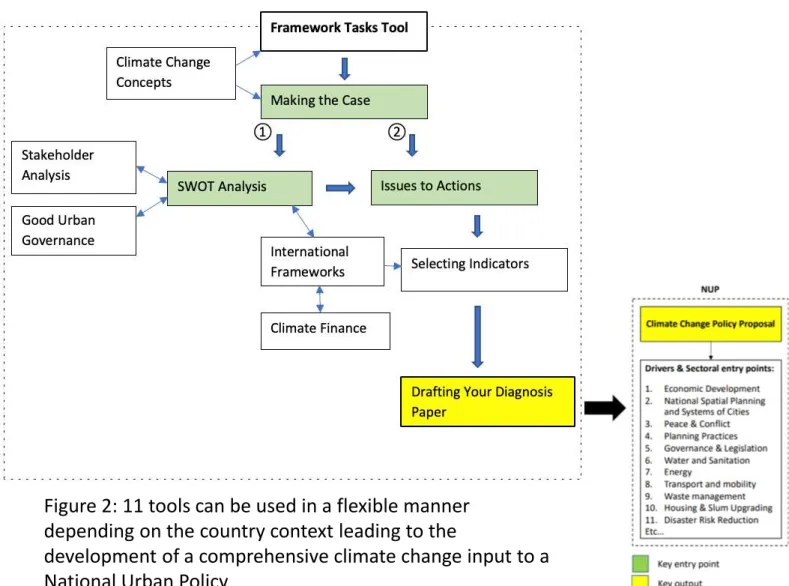
Addressing Climate Change in National Urban Policies
Recommendations
Tools/recommendations/opportunities: Provides 16 recommendations to promote low-carbon urban development ('Mitigation'), build climate resilience ('Adaptation') and address urban climate. Unique elements: Provides recommendations and actions suggest ways in which national urban policy can be used as a vehicle to combat the effects of climate change in urban areas.
Pro-Poor Climate Action in Informal Settlements
Case Studies: 9 case studies and references highlighted throughout the Guide motivate further reading and sharing of best practices. The City Resilience Action Planning (CityRAP) Tool aims to empower local governments of small to medium-sized cities, or neighborhoods.
3 Secondary City
Preparatory Phase
- Understanding Urban Resilience
- Data Collection & Organization
- Data Analysis & Prioritization
- Development of the city Resilience Framework for Action (RFA)
Main result: Resettled local community located in a flood risk area; Improved two neighborhoods by opening and widening streets that will also serve as emergency evacuation routes; Mapped and opened natural drainage channels. CRPT can be implemented in all cities, regardless of their size, culture, location, economy and/or political. Recommendations/possibilities: access to data from all departments of the municipal council and from .. external sources where necessary, willingness to share this data for the purpose of implementing the tool .. and data should always be disaggregated by gender and age group.
Unique elements: the ability to connect local government departments and various interest groups around a common project. Main outcome: A road map that includes short, medium and long-term actions with a description sheet per action; .. generation of a complete map of stakeholders and planning tools, including key local stakeholders, processes and actions to be involved and data .. assessment conclusions map and document of current databases and their existing gaps. Lessons learned: the need for a roadmap for local governments to initiate positive change through .. preventive actions based on verifiable evidence on stresses, shocks, challenges.
The main objective of this publication is to reduce the vulnerability of people living in urban areas to climate change-related impacts. It aims to achieve this through two supporting objectives: .. which are i) to support countries to effectively address human settlement issues in the formulation and implementation of NAPs by building their capacity and ii) to improve more. Application: integration of cities in national adaptation plan processes and proposals for national adaptation plans for the Green Climate Fund in Egypt, Ethiopia.
Timeframe/Delivery Modality: process may take more than a year, also useful for training, technical assistance and policy advice. Tools/ Recommendations/ Opportunities: Lists 26 tools and guides and can be used as a resource to identify best practices and includes numerous case studies and further reading. Lessons learned: strengthening government stakeholders' capacities and ensuring transparent processes are prerequisites for improved access to international climate finance by national.
Climate Change Vulnerability and Risk
- 4 Community Level
- Preparation
- Vulnerability and Risk Assessment
- Action Planning
- Planning & Designing for Implementation
- 4National
- 4 Subnational,
Unique elements: Responds to the needs of mainstreaming climate change and slum upgrading processes; Provides step-by-step guidance on how to conduct community vulnerability assessments and climate action plans; People-directed information and participatory approaches for equity-focused interventions. Main result: A vulnerability assessment and climate action plan that: improved understanding of the root causes of vulnerability; Identified key perceptions of climate change and disaster risk; Collected information on the spatial dimensions of key assets and hazard exposure. Partners: Arup, Coalition for Urban Transitions, C40, Commission on Environment, Forests and Climate Change of the Federal Democratic Republic of Ethiopia, Environmental Protection Agency of Liberia, Deutsche Gesellschaft für Internationale Zusammenarbeit (GIZ), Global Convention of Mayors for Climate & Energy, Global Green Growth Institute, Go Green for Climate, Local Governments for Sustainability (ICLEI), Partnership for Nationally Determined Contributions (NDC), Renewable Energy Policy Network for the 21st Century (REN21), United Nations Development Program (UNDP), United Nations Environment Program (UNEP), the United Nations Framework Convention on Climate Change (UNFCCC) and the University of Southern Denmark.
Identification of concrete policies and actions for the integration of human settlements in the KKD, applying an urban lens. This guide has been developed as a call to action to mainstream climate change into national-level urban policy frameworks in Asia and the Pacific. Timeline, cost and mode of delivery: This is a specialized tool which is applied during the development of a National Urban Policy or when climate change is included in the NUP.
It was developed for use in the Philippines as a reference guide for local government units, practitioners, communities and institutions working in the country. To address such limitations, the Guide encourages non-statutory means to promote UPD for climate change resilience and to advance transformative climate action where and when no legal or national regulations exist to anchor local resilient design initiatives. The main feature is also guidance for cities in addressing climate risks with slow (eg temperature rise) and permanent (eg land flooding due to sea level rise) impacts that are often missing from the plan. of climate action of Philippine cities.
City, Region and Year: The guide used the experiences and process of developing Climate Resilient Urban Plans and Designs for Angeles City, Legaspi City, Cagayan De Oro City, Ormoc City and Tagum City in the Philippines. The manual is intended to serve as a guide for national and local officials on how to assess the vulnerability of Myanmar's townships to climate change and hazards. The assessment framework presented here captures a wide range of issues related to climate change and its impact on townships and communities.
The map below shows that if this trend continues at current levels, agriculture – the main source of livelihood in the Township – will not be viable by 2050. national policy on climate change. Notes aim to help teams address a relatively narrow topic in the context of those policies: how their countries should deal with climate change in urban areas.
Law and Climate Change Toolkit
Implementation can also be supported by UN-Habitat by facilitating background research, discussion of findings with national experts and presentation of the production of a final summary report. To assess law enforcement and the wider environment, the results of the tool should be discussed and validated with country/city experts. The evaluation questionnaire has more than 100 questions in 5 areas: Governance, urban planning instruments, adaptation planning, mitigation planning and financial instruments.
Unique elements of the tool: (1) a database with provision-level search functionality (not just laws, but provisions within laws), (2) an evaluation questionnaire with immediate feedback on areas for improvement and examples to help states and cities implement recommendations, (3) covers and evaluates various climate-related urban laws based on the UN-Habitat core principles of climate action, governance, urban planning, land and tenure security, and municipal finance. A quick guide for policymakers on pro-poor urban climate resilience in Asia and the Pacific.
WHEN TO APPLY WHICH TOOL?
GUIDES/TOOLS BY TARGET AUDIENCE
Planning for Climate Change
Building climate resilience in informal settlements
Tools to enhance social inclusion
City profiling and city-wide assessments
City action planning & strategies
Climate change & urban policies
NDCs & NAPs
Gaps/issues identified
Opportunities

