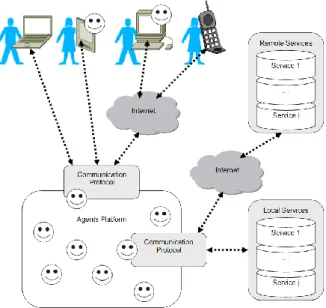
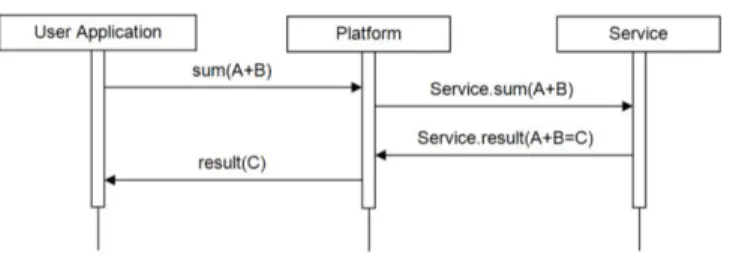
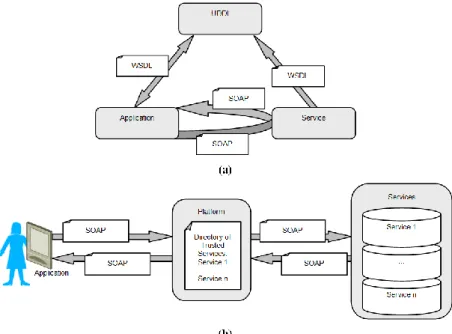
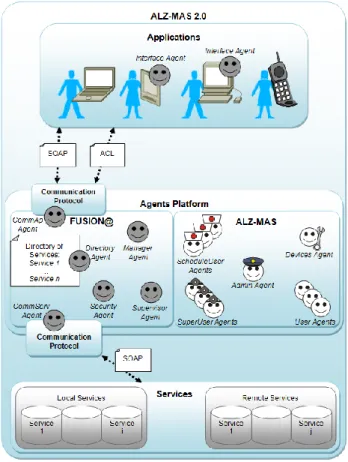
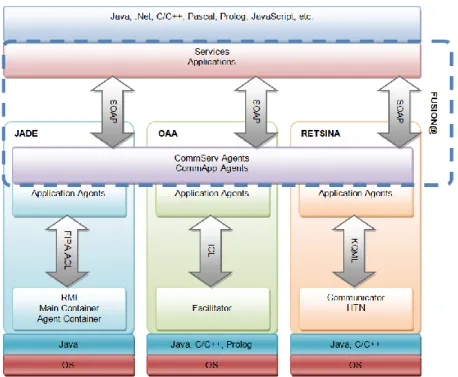
The architecture focuses on distributing most of the systems functionality to remote and local services and applications. It also proposes a new and easier method of building multi-agent distributed systems, where system functionalities are not integrated into the agent structure, but are modeled as distributed services and applications that are invoked by operating agents. as controller. and coordinators. The characteristics of agents make them suitable for the development of dynamic and distributed systems based on Ambient Intelligence, as they possess the ability to adapt to users and environmental characteristics (Jayaputera et al. 2007).
One of the advantages of these intelligent reasoning mechanisms is the effective division of computing tasks into services and applications. 6 One of the most common alternatives to these architectures are agent and multi-agent systems that can help distribute resources and reduce the tasks of the central unit (Ardissono et al. 2004) (Voos 2006). Furthermore, FUSION@ not only provides communication and integration between distributed agents, services and applications; it also proposes a new method to facilitate the development of distributed multi-agent systems by modeling the functionalities of the agents and the systems as services.
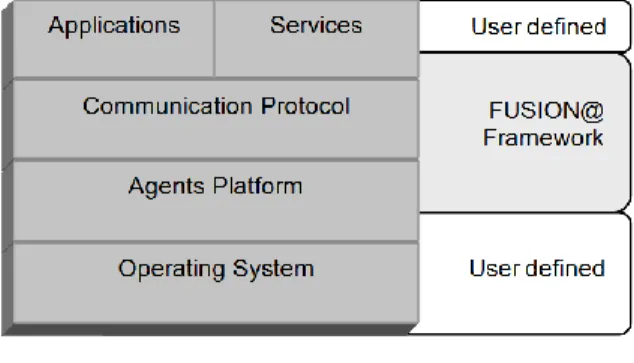
It is absolutely necessary that all services follow the communication protocol to interact with the rest of the architecture components. This agent also sends the problem to the Directory Agent, which modifies the QoS of the service where the message was sent. FUSION@ is an open architecture that allows developers to change the structure of the agents described before, so that agents are not defined in a static way.
However, most agent functionality should be modeled as services, freeing them from tasks that can be performed by services.
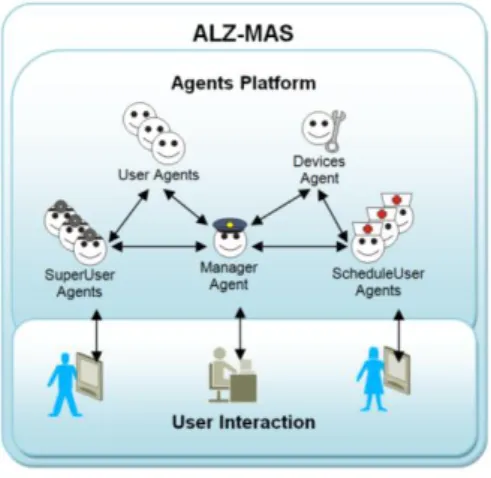
Using FUSION@ to Improve ALZ-MAS, a Multi-Agent System for Health Care
Case-Based Planning Service
CBR systems solve new problems by adapting solutions used in the past to solve similar problems, learning from each new experience. Finally, the retention phase allows the system to learn from the experiences gained in the three previous phases and updates the case memory. This solution is generated by taking into account the plans that have been applied in the past to solve similar problems.
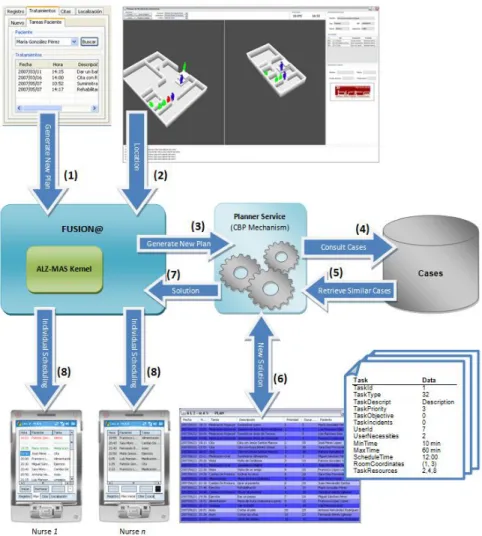
In the initial version of ALZ-MAS, CBR and CBP mechanisms are deeply integrated into the agent structure. To create a new schedule, the ScheduleUser Agent (running on a PDA) sends XML to the platform. The solution is then sent to the platform, which delivers the new schedule to all running ScheduleUser agents.
23 The CBP service used in ALZ-MAS creates optimal paths and scheduling to facilitate the completion of all tasks assigned to the nurses connected to the system. The location of each nurse and patient in the residence is also sent to the planner service. Then the solution is sent to the platform which delivers the new plan to all nurses connected to the system.
The CBP service creates optimal paths and scheduling to facilitate the completion of all tasks assigned to the nurses connected to the system. In the retrieval stage, those problem descriptions that are found within a range of similarities close to the original problem description are retrieved from the belief base. One solution contains all the plans (sequences of tasks) executed to achieve the goals for a problem description (assuming replanning is possible) in the past, as well as the effectiveness of the solution provided.
If the evaluation of the plan is at least 90% similar, the case is stored in the case memory. 24 The variation of the plans will essentially be induced by: the changes that occur in the environment, which force the original plan to be changed; and knowledge from the success and failure of the plans used in the past, which are favored or penalized via learning. To achieve this, the basic proximity function used in the Kohonen network is modified and the number of neurons in the output layer corresponds to the locations that the subject wants to visit.
Results and Conclusions
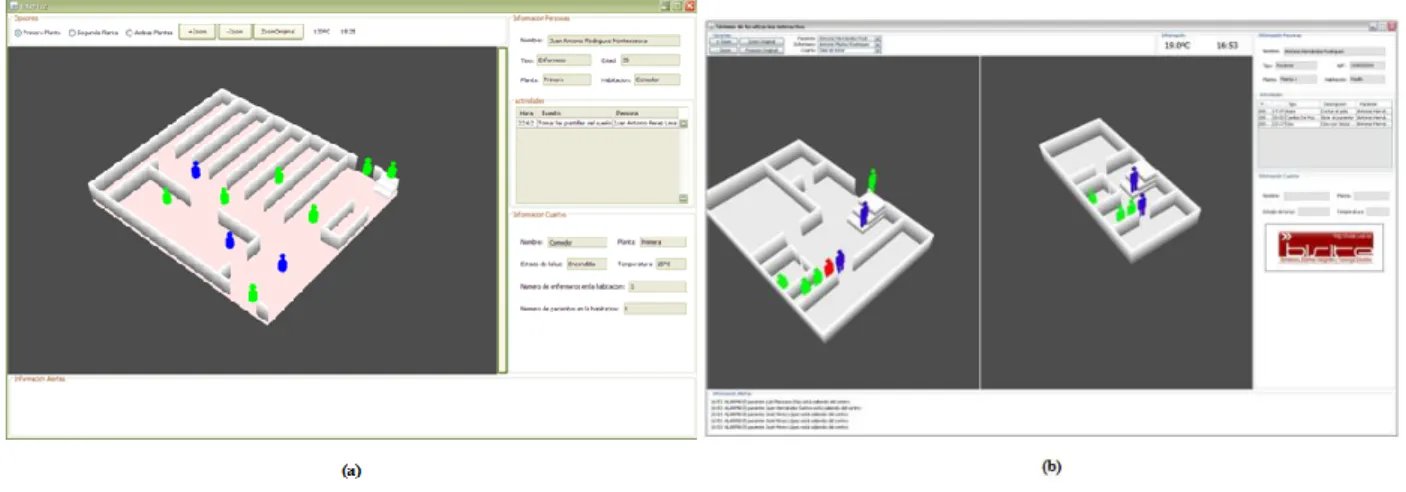
Next, the results obtained after applying the distributed approach in ALZ-MAS with the help of FUSION@ are presented. In fact, it was used to develop an improved version of ALZ-MAS V.2, a system designed to improve assistance and health care for Alzheimer's patients in geriatric homes, which improves upon the previous ALZ-MAS solution (Corchado et al. 2008). . 26 Figure 9 shows the main user interface of ALZ-MAS (a) and ALZ-MAS V.2 (b), which have the same functionalities and share almost the same user interface.
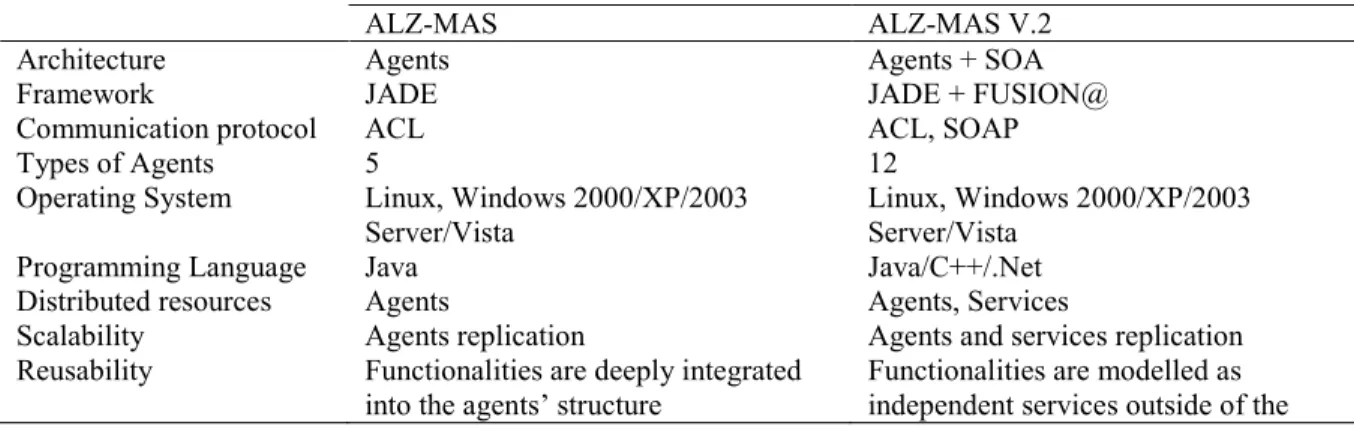
However, the performance of ALZ-MAS V.2 has been greatly improved, mainly because the scheduling mechanism has been modeled as a Service. The characteristics of architecture used to develop the ALZ-MAS system can be compared to those provided for multiagent architectures such as Open Agent or RETSINA. a) ALZ-MAS main user interface; (b) ALZ-MAS V.2 main user interface. Several tests have been conducted to compare the overall performance of ALZ-MAS and ALZ-MAS V.2, the latter using FUSION@.
For each new test, the case memory of the CBP mechanism was removed to avoid a learning failure, which required the mechanism to complete the entire planning process. For ALZ-MAS V.2, five CBP services with exactly the same characteristics and with a maximum QoS value (1) were replicated. As shown in Figure 10, the previous version of ALZ-MAS was unable to handle 15 concurrent schedules and the time increased to infinity because it was impossible to serve those requests.
However, ALZ-MAS V.2 had 5 duplicate services available so that the workflow was distributed and allowed the system to complete plans for 30 concurrent agendas. Another important fact is that although the previous version of ALZ-MAS performed slightly faster in processing a single agenda, the performance continuously decreased as new concurrent agendas were added. This fact proves that the overall performance of ALZ-MAS V.2 is better when dealing with distributed and concurrent tasks (e.g. agendas) instead of individual tasks.
As can be seen, the previous version of ALZ-MAS is much more unstable than ALZ-MAS V.2, especially when comparing the number of downed agents. In conclusion, we can say that although FUSION@ is still under development, preliminary results show that it is suitable for building complex systems and using composite services, in this case ALZ-MAS V.2 and the CBP mechanism presented in this paper. . FUSION@'s distributed approach optimizes usability and performance because lighter agents can be obtained by modeling system functionalities as independent services outside the agent structure, so the services can be used in other developments.
Acknowledgements
However, services can be any functionality (mechanisms, algorithms, routines, etc.) designed and deployed by developers. FUSION@ laid the foundation to promote and optimize the development of future projects and systems based on Ambient Intelligence. This architecture facilitates the development of systems based on the paradigm of Ambient Intelligence because it is able to solve problems during execution over highly dynamic and distributed environments.
FUSION@ makes it easier for developers to integrate independent services and applications because they are not limited to programming languages supported by the agent frameworks used (e.g. JADE, OAA, RETSINA).
US Department of Health and Human Services, CDC, National Center for Health Statistics, Hyattsville, Maryland. In EXP - in search of innovation (Special Issue on JADE), Department of Informatics, University of Hamburg, Germany. In Revised Papers of the 4th International Workshop on Distributed Communities on the Web (April.