This chapter examines the current state of national accounts estimates in Latin American and Caribbean countries. The only exception is Cuba, which uses the System of Balances of the National Economy (MPS). 4. A detailed inventory of the availability of proforma invoices for individual items is shown in the tables in the appendix.
Gross domestic product by type of compensation
Estimates of the same aggregates in constant prices are only available for 19 countries, according to Table 2 in the Appendix. In addition to Grenada — the only country that does not have data at current prices — 9 other countries do not have estimates available in fixed prices: Bahamas, Barbados, El Salvador, St. On the other hand, Argentina, which has stopped publishing its series at present. prices, presents the figures in constant prices in full form, as do the rest of the countries with the exception of Brazil and Haiti, which show the same limits as pointed out with reference to current prices, and Dominica, which does not detail the components of capital formation at constant prices .
Available national income
Vincent and the Grenadines, which has information relating to domestic proceedings, but not relating to transactions abroad. Of the seven countries that reported calculating net purchases of intangible assets from the rest of the world, only Ecuador has significant amounts. Under the rubric of external transactions, all estimates relating to foreign countries are included; these in aggregate form form a consolidated.
- Detailed classification of the gross domestic product by class of economic activity
- Domestic factor incomes by kind of economic activity
- Supply and utilization of goods and services
- General government final consumption expenditure by function
- Final general government consumption expenditure by composition of costs and functions
- Final private consumption expenditure by object
- Final private consumption expenditure by type of expenditure
- Gross fixed capital formation by type of goods
- Increase in stocks by type of goods
- Gross fixed capital formation by kind of economic activity Table 20 of the annex shows the estimates on gross fixed capital formation
SNA and ISIC recommendations, the state of the estimates at constant prices is practically the same as indicated for the calculations at current prices, except in the following cases. Detailed classification of the gross domestic product by class of economic activity class of economic activity. Panama, on the other hand, has estimates at current and constant prices, although without classifying the inventories of the goods-producing industries by type of product.
INSTITUTIONAL SECTORS
- Incomes and expenditures of non-financial enterprises (corporations and quasi-corporations) and
- Incomes and expenditures of the general government
- Incomes and expenditures of households, including non-financial enterprises and
- Capital transactions of non-financial enterprises (corporations and quasi-corporations) and
- Capital transactions of the general government
- Capital transactions of households
- METHODS OF ESTIMATING THE SECTORAL PRODUCT A N D FINAL DOMESTIC EXPENDITURE
The availability of detailed information on current revenues and expenditures of the general government is presented in table 21 of the annex. Tables 3 and 4 summarize the availability of estimates for the region as a whole, measured by the number of countries that have information for each category. Finally, it can be said that the development of national accounts in the countries of the region is not homogeneous at all.
ESTIMATES AT CURRENT PRICES
This second part briefly describes the general methods and main procedures applied for developing the estimates of the sectoral product and the domestic utilization of goods and services. All the other countries of the region obtain the total value of private consumption residually, as they do not have annual, direct and independent estimates. Logically, the countries determine the value of government consumption expenditure based on the expenditure recorded by the corresponding budget units.
Estimates of the product by class of economic activity
Ideally, to obtain the output of a productive sector at constant prices, it would be necessary to use independent estimates of the intermediate output and consumption of each activity, at constant prices and in relation to an input-output table. This double deflation method does not apply in cases where the product is calculated using the income method. However, even in cases where output is calculated by the production method, it is essential to have valid and reliable indicators of quantities or prices, in relation to gross output and intermediate consumption, as errors in these can become cumulative.12 In On the other hand, based on experience, the use of the double deflation method does not seem to be appropriate for industries whose added value represents only a small part of the value of production and in those in relation to which, as As a result, there are errors in input indices - usually larger than those of output - that have a significant impact on the estimation of real output.13 Considering these difficulties, most countries in the region use approximate estimation methods, based on sectoral value added, either by extrapolating the aggregate value of the base year or by deflating value added at current prices.
As shown in Table 7, only Mexico uses double deflation as the main method of estimating actual product by sector origin, while Chile, El Salvador, Peru and Uruguay use it secondarily for some activities. Most of the countries concerned use extrapolation as the main method for estimating the sectoral product and deflation as the secondary method applied for some activities. However, El Salvador and Honduras apply deflation to a wider range of activities, while Venezuela uses this method to estimate the true product of most sectors and only secondarily applies the extrapolation method.
Components of final domestic expenditure
In a subset of the countries considered (Argentina, Colombia, Chile, Guatemala, Honduras and Uruguay) public and private construction are estimated separately; the real value of the former is obtained in all cases by deflating current values, while the expression for the value of private construction in constant prices is estimated by extrapolating the values of the base year, except for Honduras, which does this by deflating current values. Among these, Brazil, Haiti and Paraguay do not divide it into public and private, and they express it in fixed prices by extrapolating the value of the base year through quantum indicators; on the other hand, Mexico, Panama, Peru and the Dominican Republic determine the public component using the expenditure method (and its real value in deflation), obtaining by discrimination the value of the private construction. Some countries estimate the real value of gross investment in machinery and equipment without distinguishing between their domestic or imported origin, and almost all use current value deflation.
Most of the countries considered in Table 10 evaluate at constant prices, treating these components separately: in general, for goods of national origin, extrapolation is applied, while for goods of imported origin, current value deflation is used. Almost all countries in question calculate general government final consumption expenditure at constant prices by treating separately the value of workers' compensation and the value of intermediate purchases. To obtain the first component at constant prices, some countries extrapolate base year values and others deflate current values.
The countries that use the expenditure method to estimate the increase in stocks at current prices obtain their expression in constant prices by deflating these values. Those who mainly use statistics on physical stocks naturally use extrapolation of the base year values, while in those countries where the increase in stocks is calculated from accounting information, its expression is obtained in constant prices by deflation. Mexico obtains the increase in inventories by calculating private consumption at constant prices directly using the commodity flow method.
However, the few countries that use the commodity flow method for alternative or control estimates of final private consumption expenditure obtained by difference in current prices are able to classify expenditure by purpose in constant prices; Honduras (until . 1976) and Panama do this mainly by using extrapolation of base year values using quantitative indicators.
- Use of goods and services
- Institutional sectors
- Public sector
The starting point consists of the estimates of production at producer prices and of imports of different classes of commodities. To obtain the value of the supply of each class at buyers' prices, it is necessary to add estimates of the corresponding transport and distribution margins. The accuracy of the results obtained by applying the commodity flow method will fundamentally depend on the number of classes of commodities considered in the analysis.
The estimate of increases in inventories is another expenditure area where progress can be made in most countries in the region. Nevertheless, this is also an area where most of the countries in the region can make progress. With few exceptions, global plant consumption in Latin America is estimated as a component of gross domestic product based on manufacturers' accounts.
In practice, a permanent program of national household surveys, integrating surveys for different purposes, should suffice for the estimation of the income and expenditure account. If the countries of the region are to make significant progress on national accounts, they must of course set up a permanent system for conducting household surveys. In national accounts, the most frequently produced estimates are those related to the measurement of gross fixed capital formation of the public sector by type of property.
In SNA, the production accounts of the producers of government services and the revenue, expenditure and capital financing accounts of the government are effectively separate.
- Sources of basic statistics
- Generalized application of the commodity flow method
- Balance sheets on availability and their use as an instrument for estimating agricultural production
- Non-marketable and domestic agricultural production
- Estimates of the industrial product
- Biases in the declaration of the value of production
- The use of household surveys in estimating the craft sector product and that of informal activities
- Preparation of statistics on foreign trade at constant prices
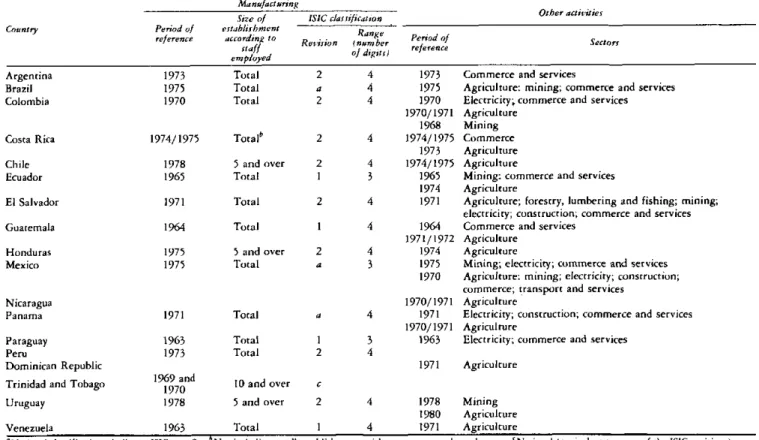
The data on goods and services are linked to the first stages of the countries' statistical development. Most of the countries in the region have economic censuses for manufacturing, which cover the total number of enterprises (see Table 11). Mexico DGE 1963 Annual The most important of the groups currently classes c 4 X activities selected by activities.
Doubts often arise regarding the definitions of the various terms included in these sources of information. International recommendations indicate the use of sales prices in the reference period of the study. In accordance with the UN's recommendations and established traditions, the change in the basis for the indices is made approximately every 10 years.
Different procedures are used to estimate these flows at constant prices, but there is very little information on the criteria used in the publications of the national offices. Expenditures for the same categories mentioned are reduced by a consumer price index of industrialized countries. 4 U n i t e d N a t i o n , Basic Principles of the National Economy Balance System, Studies in Methods, Series F, No.
34; United Nations, Statistical Office, Report of the Expert Group on Future Guidelines for the Work of the United Nations System of National Accounts, E/C N. United Nations, Future Guidelines for the Work of the System of National Accounts (SNA): Report of the Secretary-General, E/CN. 3/541, New York, 1980. United Nations, Basic Principles of the System of National Economic Balances, Studies in Methods, Series F, no.