
MLR Ministry of Land and Resources of the People's Republic of China MNE multinational enterprise. MOST Ministry of Science and Technology of the People's Republic of China MPS manages printing services.
Overview
Core Elements of Section 301
Actions specifically authorized under section 301(c) include: (i) suspending, withdrawing, or preventing the application of concessional benefits of trade agreements; (ii) imposing duties, tariffs or other import restrictions on the goods or services of a foreign country for such time as is deemed appropriate; (iii) withdrawal or suspension of preferential duty treatment under a preferential program; (iv) entering into binding agreements that commit the foreign country to eliminate or phase out the offending conduct or to provide compensatory trade benefits; or (v) limiting or denying the issuance of service sector authorizations, which are federal permits or other authorizations required to provide services in certain sectors in the United States.8 In addition to these specifically listed actions, USTR can take any action that is "within the power of the President in relation to trade in goods or services, or in relation to any other field of relevant relations with a foreign country."9.
Background to the Investigation
Initiation of the Investigation
Third, the Chinese government allegedly directs and/or unfairly facilitates systematic U.S. investment and/or U.S. acquisitions. Fourth, the investigation will examine whether the Chinese government is conducting or supporting unauthorized intrusions into the United States.
China’s Bilateral Commitments to End its Technology Transfer Regime and to
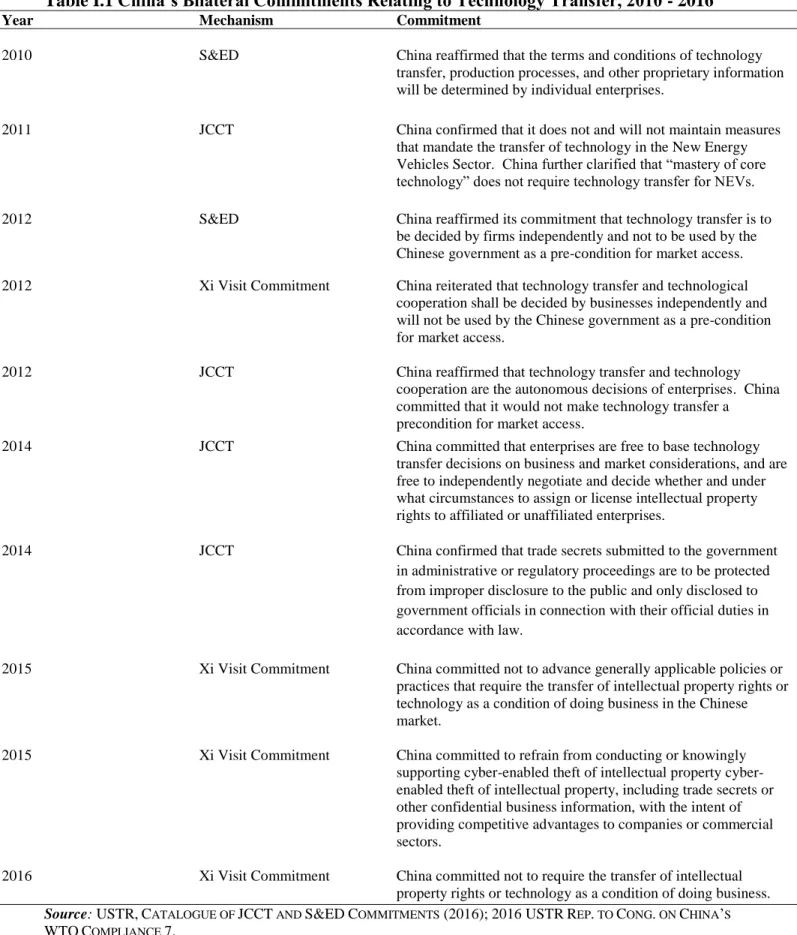
China's bilateral commitments to end the technology transfer regime and refrain from state-sponsored cyber intrusions and theft. The evidence presented in this study demonstrates that China's technology transfer regime continues despite repeated bilateral commitments and government statements, as summarized in Table I.1 below and discussed in the remainder of this report.
Input from the Public
Because USTR itself initiated this action, no particular company or group of companies was required to come forward and file a Section 301 petition to initiate this investigation. In addition, USTR and the interagency Section 301 Committee considered not only investigative submissions and testimony, but also public reports, scholarly articles, and other reliable information.
China’s Technology Drive
China’s Unfair Technology Transfer Regime for U.S. Companies in China
Second, the Chinese government uses its administrative licensing and approval processes to force technology transfer. These two aspects of China's technology transfer regime are fostered by the opaque and discretionary nature of China's foreign investment approval system.
Introduction
Key Elements of China’s Technology Transfer Regime
The evidence gathered in this investigation from hearing witnesses, written submissions, public reports, journal articles and other reliable sources indicates that there are two key aspects of China's technology transfer regime for inward foreign investment. China's technology transfer obligations are contained in Protocol of Accession, General Provisions ¶ 7.3 and Working Group Report ¶ 203 (incorporated into the Protocol of Accession by ¶ 1.2).
A Persistent Problem for U.S. Business
The evidence further confirms that China uses discretionary and non-transparent administrative review and licensing processes to pressure technology transfer or force the unnecessary disclosure of sensitive technical information. According to a 2011 public consultation process conducted by the EU, the main barriers to investment in China included technology transfer requirements; JV requirements; foreign.
Foreign Ownership Restrictions as Used in China’s Technology Transfer Regime
The Foreign Investment Catalogue and Technology Transfer
The Foreign Investment Catalog is a starting point for analyzing restrictions on foreign investment in a particular industry, and is an important part of China's technology transfer regime.126 First. Negative List” system, in which foreign investment is allowed in all sectors, unless this is the case.

Illustrative Examples of China’s Use of Investment Restrictions to Pressure
180 Zie KEITH CRANE, et al., RAND, THE EFFECTIVENESS OF CHINA’S INDUSTRIAL POLICES IN COMMERCIAL AVIATION MANUFACTURING 27 (2014). 187 KEITH CRANE, ET AL, RAND, THE EFFECTIVENESS OF CHINA'S INDUSTRIEEL BELEID IN COMMERCIAL AVIATION MANUFACTURING 31 (2014).
Administrative Review and Licensing Processes as Used in China’s Technology Transfer
Technology Transfer Pressure in Administrative Approvals and Licensing
The relatively opaque nature of inward FDI approval procedures allows China's investment approval authorities to favor domestic competitors over foreign investors if they so desire without leaving a paper trail of discriminatory written regulations that could clearly violate WTO obligations. As described above, the discretion in China's administrative licensing process can be used to require technology transfer or to impose special business conditions in exchange for licenses that a foreign investor needs to operate in China.
Forced Disclosure of Sensitive Technical Information
232 USCBC, UPDATE: LICENSING CHALLENGES AND BEST PRACTICES IN CHINA 8 (Jan. 2014); USCBC, IMPROVING CHINA'S LICENSING SYSTEM: RECOMMENDATIONS FOR KEY SECTORS 2 (Mar. 2014);. Paul Ranjard, Benoit Misonne, Study 12: Exploring China's IP Environment, in Study on the Future Opportunities and Challenges of EU-China Trade and Investment Relations 15 (2007).
China’s Acts, Policies, and Practices Are Unreasonable
Indeed, the OECD has consistently ranked China's foreign investment regulatory regime as one of the most restrictive in the world based on an assessment of (i) restrictions on foreign-owned capital, (ii) screening and prior approval requirements, (iii) personnel regulations and (iv) restrictions on the operation of foreign enterprises.247 For example, in 2016, China was ranked the fourth most restrictive economy out of 63 OECD and non-OECD economies measured— only the Philippines, Saudi Arabia and Myanmar. were more restrictive. Consequently, China's technology transfer regime—including foreign ownership restrictions and the administrative approval and licensing process—are used to require or pressure the transfer of technology from the US.
China’s Acts, Policies, and Practices Burden or Restrict U.S. Commerce
China’s Discriminatory Licensing Restrictions
As explained in more detail below, due to mandatory provisions in China's technology regime regulations, the US Foreign Licensing Restrictions and China's Technology Transfer Regime governs the cases in which an entity seeks to transfer technology to China according to it.
Foreign Licensing Restrictions and China’s Technology Transfer Regime
- Different Outcomes for U.S. Companies versus Chinese Competitors
- Indemnification Against Infringement Claims
- Ownership of Improvements to Licensed Technology
- Use of Technology after the Technology Contract Expires
The "shall be provided" language in Article 27 of the TIER does not permit parties to a technology import contract to negotiate other terms. Article 43(3) of the JV Regulation states that the term of the JV technology transfer agreement "should not generally exceed ten years."
Concerns Raised by Other Trading Partners
In the course of the Section 301 investigation, USTR established additional licensing restrictions in the JV regulations. This means that under the JV regulation, the Chinese joint venture licensee has the right to enter the U.S.
China’s Acts, Policies, and Practices are Discriminatory
Justifications for Discrimination
303 See CCCME, Submission, Section 301 Hearing 9 (Oct.) which claims that "contracts are concluded according to companies' independent willingness. CCCME, Submission, Section 301 Hearing 5 (Oct. However, over the past five years, CCCME has received neither dispute nor complaints relating to intellectual property and technology transfer.”).
Acts, Polices, and Practices of Other Countries
The Convention and the WIPO document are reflected in Article 353 of the PRC Treaty Law, but the TIER also conflicts with the US and, as with Section 87.14, there is an exception to the presumption under Philippine law for situations listed in Section 91 of the same Act. , which include technology transfer agreements that are.
China’s Acts, Policies, and Practices Burden U.S. Commerce
Outbound Investment
See also Shun Chiao Chang, The Determinants and Motivations of China's Outward Foreign Direct Investment: A Spatial Gravity Model Approach, 43 GLOBAL ECON.REV. OF INTERNATIONAL STUDIES Luke Hurst, Comparative Analysis of the Determinants of China-owned Foreign Direct Investment in OECD and Non-OECD Countries, 19 CHINA &.
Policy and Regulatory Framework
Major Policies to Acquire Foreign Technology
In support of the "Going Out" strategy, China has emphasized the need to promote "international cooperation," a term that often refers to strategic outbound investment guided by the state's industrial policy. China Exim has described "international industrial capacity cooperation" as a government policy that has informed its lending for outbound investment projects.367 Likewise, MOFCOM, on its online "Going Out" Public Service Platform, maintains a website dedicated to.
The Chinese Outbound Investment Approvals System
The 2016 edition of the Investment Catalog states that all outbound investment in . all investments by “local enterprises” worth $300 million or more require “filing of records”387 with government departments under the State Council. 416 Notice of the State Administration of Foreign Exchange on Further Simplifying and Improving Foreign Exchange Management Policies for SAFE Direct Investment, Hui Fa [2015].
Sectors “Encouraged” for Outbound Investment
Going Out strategy for products, technologies and services."427 It also aims to expand the speed, scale and efficiency of China's outbound investment to promote "transformation and upgrading of the domestic economy" and "international cooperation on industrial capacity .”428 In addition, the 2017 investment opinion redefines the broad categories of “encouraged. Technology acquisition and use is a key consideration in determining whether a sector is "encouraged". For example, the 2017 Investment Statement encourages investments that strengthen "investment cooperation" with "overseas high and new technology enterprises and advanced manufacturing industry enterprises," as well as investments that promote.
Outbound Investment Policy in Technology and Sectoral Policies
The SEI decision also calls for "supporting companies to use methods including overseas registered trademarks and overseas acquisitions […]"434. Likewise, the Made in China 2025 Communication, which, as discussed in Section I.C, serves as the basis for the Made in China 2025 Policy, calls for “supporting enterprises to make.
State-Backed Actors
Therefore, PKK members and leadership have a mandate to ensure the dominance of the state and SOEs in the economy. The growing influence of the BCP has affected foreign enterprises located in China.
Chinese Investment Activity in the United States: Analysis of Data
Rosen, RHODIUM, CHINESE INVESTMENT IN THE UNITED STATES: RECENT TRENDS AND THE POLICY AGENDA 66 (Dec. 2016). AEI reports that China's average annual global investment in alternative energy in the period 2005-2013 was $673 million.

Effect of State Policies and Implementing Measures on Chinese Acquisitions
Notice on the Issuance of Multiple Policies to Further Promote the Development of Software and Integrated Circuit Industries (State Council, Guo Fa) 2011] No. 4, issued Jan. Notice of the 12th Five-Year Strategic Development Plan for New Industries, Box 5. 649 English translation of the Chinese term jishu binggou.
Leveraging “International Innovation Resources” Through Engagement with Silicon
927 ZGC Group Silicon Valley Incubator Center established and open for business [Chinese], ZHONGGUANCUN DEVELOPMENT GROUP, Dec. Silicon Valley Zhongguancun Hanhai Science and Technology Park [Chinese], HANHAI HOLDINGS, http://www.hanhaiholding.com/overseascon.aspx ?id=66 (last visited Jan.
China’s Acts, Policies, and Practices are Unreasonable
Unauthorized Intrusions into U.S. Commercial Computer Networks and Cyber-Enabled
Documented incidents of Chinese cyber intrusions against commercial entities in the US are closely related to China's industrial policy goals. In September 2015, the presidents of China and the United States pledged to refrain from cyber theft of intellectual property (IP) and other confidential business information for commercial gain.971 The United States closely monitors China's cyber activities, and evidence suggests that China is continuing its more than decade-old policy and the practice of using cyber intrusions to target the US.
China’s Acts, Policies, and Practices Regarding Unauthorized Intrusions into U.S
- The Chinese Government’s Extensive Cyber Activities
- The United States Department of Justice Indicted Chinese Government Hackers in
- China’s Institutional Framework Supports Cyber Intrusions into U.S. Commercial
- China’s Recent Cyber Intrusion Activities Against U.S. Commercial Networks
978 MANDIANT,APT1: EXPOSING ONE OF CHINA'S CYBER ESPIONAGE UNITS 3 (2013); see also Mark Stokes, PROJECT 2049 INSTITUTE, THE PLAGENERAL PERSONNEL DEPARTMENT THIRD DEPARTMENT SECOND BUREAU: AN ORGANIZATIONAL OVERVIEW OF UNIT 61398,3-4 (July) Signals intelligence (SIGINT), or technical reconnaissance in the PLA lexicon of the Chinese Communist Party , the interests (CCP) and the People's Republic of China (PRC) International Trade Commission (USITC) against Baosteel, which they said was "known to be one of the beneficiaries of China's state-sponsored cyber attacks."1014.
China’s Acts, Policies, and Practices Regarding Cybertheft of Intellectual Property Are
In support of this objective, we affirm that no country should conduct or support ICT-enabled theft of intellectual property, including trade secrets or other confidential business information, with the aim of providing competitive advantage to companies or commercial sectors."1090. Based on the above factors, China's Actions, Policies, and Practices for Cyber Intrusions into U.S. Computer Networks
China’s Acts, Policies, and Practices Regarding Cybertheft of Intellectual Property
Other Acts, Policies, and Practices of China
- Measures Purportedly Related to National Security or Cybersecurity
- Inadequate Intellectual Property Protection
- China’s Anti-Monopoly Law
- China’s Standardization Law
- Talent Acquisition
Companies have raised particular concerns about the Cyber Security Law of the People's Republic of China (Cyber Security Law). The People's Republic of China's Standardization Law Amendments raise concerns about whether the U.S.
Conclusion
Actions, policies, and practices of the Chinese government directed at transferring to the United States. The United States Trade Representative also consulted with members of the Section 301 Interagency Committee.

