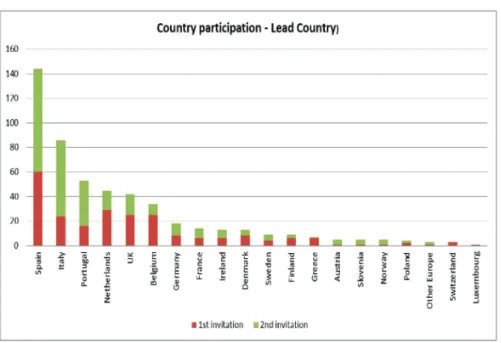
Policy analysis of the European Innovation Partnership for Active and Healthy Aging and its impact in Spain. The objectives of the Europe 2020 strategy are reflected in the Digital Agenda for Europe8 and the Innovation Union9. The importance of the program in Spain is evident from the level of participation and the number of commitments from Spanish organizations.
This means that 25% of the total work on EIPonAHA, either in advisory groups or by individual actors, is carried out by Spanish organizations. This proves not only the importance of the programme, but also the work carried out at the national level and the many experiences and activities that have been carried out in this area. This ensures greater political visibility of health authorities, greater involvement and greater importance of program implementation.
This report aims to explain in detail the main elements of the program design and its implementation.
FOUNDATION AND HYPOTHESIS OF THE STUDY
OBJECTIVES
MATERIAL AND METHODS
The evaluation consisted of an analysis of the context, processes, results and effects of the implementation of EIPonAHA in the EU. It therefore aimed to identify factors that could have an impact on the rationale, design and implementation of the program as well as an analysis of the program itself. Next, it continued with an analysis of the intervention and its mission, as well as a reconstruction of the program's internal argumentation.
The evaluation of the impact and outcomes was therefore partial and limited to information from documents about achievements that were available on the program website23,24. In other words, to what extent the objectives of the program constitute an answer to the problem. The full version of the survey is published in the Spanish version of this report25.
The second objective of this report is to search for mechanisms that improve efficiency in program implementation.
RESULTS
The degree of achievement and implementation of the activities varied between the different AGs. This could be due to the delay in the development and subsequent implementation of the MAFEIP. At the very least, there is a certain lack of internal coherence with regard to the representativeness and involvement of the Member States.
These tasks are essential to implementing innovation and transforming the NHS. The introduction and adaptation of the MBUMK is an issue that will be addressed in the following period. A real and in-depth assessment of the impact and effectiveness of the program across Europe will be difficult.
The full results of the survey can be found in the Spanish version of this report25. Four experts fully agree and eight partially agree that all stakeholders have been able to participate in the different phases of the programme. None of the experts fully agree that the majority of interventions are underway, although ten partially agree with this statement.
For the majority of experts, the EIPonAHA emerged as an interesting, important and structured strategy. It is even true that other aspects that must be taken into account in the development and implementation of technology are fundamental for the success of the interventions. The majority of the AGs also address issues related to the training and participation of professionals and carers.
Finally, all the AGs, in addition to the RS, are requested to provide evidence on effectiveness. A summary of the answers provided by the experts in the open response fields can be seen below. Within Spain: dissemination and replication of the care models validated and tested as effective in the RS.
What has been discussed, plus the strong development of the field of aging in national calls.

DISCUSSION
In short, it is about building on the strengths gained by EIPonAHA and transferring this vision of a comprehensive strategy to our real, everyday context. To use a Spanish pun, this is talking about an EIPonAHA where the first "E" of the acronym stands for "Español" (Spanish) instead of "European". Perhaps the best strategy to improve Spain's position in Europe is to improve the transfer and translation of knowledge at the national level and to become a consolidated, structured reference point for innovation at the global and European level.
This is much faster and more feasible than improving the transfer and translation of knowledge at the European level, although this does not mean that it is easy. Thus, the analysis in this study encourages better national coordination of activities related to the EIPonAHA, both in the interest of preserving the Spanish NHS. Nevertheless, given the problems detected at the European level, it seems necessary to establish homogeneous criteria at the national level, especially regarding innovation monitoring, in the process of implementation, deployment and scalability.
Even more critical, however, is the implementation of a monitoring system that responds to and complements current national measurement systems, facilitating the provision of evidence. To achieve true healthcare transformation, it is essential to maintain cross-sectoral communication. Also, it is essential to advocate for leadership from health authorities in close coordination with other authorities in the field of R&D&I and other sectors related to ageing.
On the other hand, EIPonAHA should have a sense of prioritization in which measures of progress in innovation should generate systemic changes13. It would be necessary to redefine and consider the activities and interventions previously described in the SIP, which are not yet addressed, but which are essential in the new space of care, especially in addressing aspects of public health, primary prevention and inclusion social. However, Spain is in the best position to make progress and this is only possible by increasing communication and coordination between RS, regions and stakeholders.
LIMITATIONS
CONCLUSIONS
BIBLIOGRAPHY
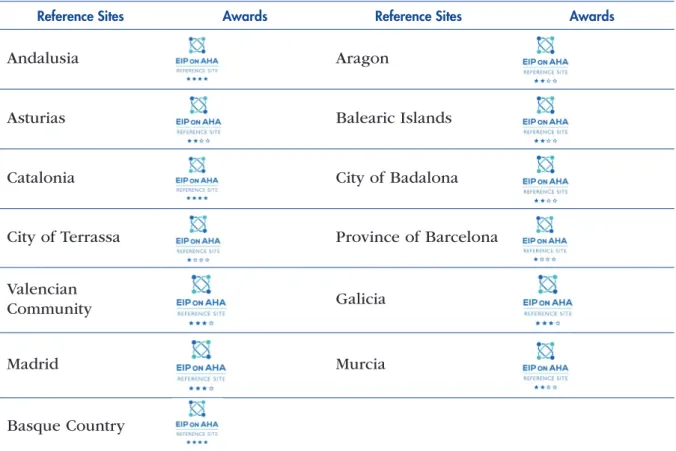
SPANISH REFERENCE SITES 2016
- Projects for people with a disability
- Research Projects
- Training
- International cooperation projects
Andalucia represents the RSCN in the European Commission's eHealth Stakeholder Group and contributes to its work and discussions and facilitates the adoption of digital innovative solutions in the field of health and social care. One of the main strategic orientations of the organization is care for the elderly with chronic diseases. Promoting healthy habits, making attention accessible and maintaining patients' autonomy are the goals of SALUD.
In addition, the participation of the University researchers connected to the Biomedicine and Health cluster in the EIP-AHA groups, from the first call. The candidature was promoted by the General Directorate of Public Health and Participation (GDPHP) of the Regional Ministry of Health. Today we know that health services are not the main factor that determines the health of the population.
So far, 72% of the primary healthcare centers of the Balearic Islands have joined the project. The activities cover all the pillars of the European strategy reflected in the EIP AHA. Integrated care is a key aspect of the Basque health strategy, where it has been operating for several years.
To take advantage of the potential that the elderly represent in the life of towns and cities of Euskadi as generators of well-being. Conducts professional training for students in the sanitary and social fields. Counseling takes place during the intervention and CVI professionals provide training to the user in managing the aid.
It is financed by the Municipal Institute of Disabled Persons of the Barcelona City Council and with the cooperation of the Barcelona Health Consortium. At the European level, Healthcare Living Lab Catalonia is part of EIT HEALTH, one of the largest healthcare initiatives worldwide. The Region of Murcia has been recognized as a place of reference in active and healthy aging for its commitment to the care of the elderly in the framework of innovation, research and sustainability.
The candidature was promoted by the Coalition for Innovation in Active and Healthy Aging of the Region of Murcia, http://blogs.
RESULTS OF THE EVALUATION OF THE EIPONAHA
EIPonAHA proposes structural changes in the delivery of health services that improve equity and universality in terms of access. Are all of EIPonAHA's interventions and activities organized in a way that makes it possible to achieve the objectives. Does the intervention include an appropriate, practical system of performance indicators to monitor and evaluate program performance and success?
Coordination Number of activities in more than three AGs with possible overlaps or covering common issues. Have participation mechanisms for different stakeholders been introduced in the diagnosis, design and implementation of the programme? Participation Number of activities to involve the different interested parties: Sherpa, MS, public consultations, commitments.
Is the current pace of implementation transforming the health and care system and achieving the triple win by 2020? Are the monitoring and reporting mechanisms suitable for objectively measuring the progress of interventions and measuring results at European level in 2020 B3 - At least 50 regions with chronic disease case management programs covering 10% of the target group.
Note: The analysis of the achievements of the Scalability Strategy is intended to be illustrative only, as it was adopted in December 2014. Provides a set of parameters and frameworks to enable stakeholders to carry out the feasibility assessment of good practice. Provides tools to classify good practices and identify their transferable elements based on systems.