In-vivo and in-beam monitoring of PET
activation in proton therapy: tests in a chicken embryo model with 18 O-enriched water
A.E. Rodriguez1,2, V. Sánchez Tembleque1,2, M. García-Díez1,2, V.V. Onecha1,2, F. Arias Valcayo1,2, D. Sánchez Parcerisa1,2, S.
España1,2,3, J.A. Vera4, A. Mazal4, J.M. Udías1,2, L.M. Fraile1,2
1 Grupo de Física Nuclear, EMFTEL and IPARCOS, Universidad Complutense de Madrid, CEI Moncloa, Madrid, Spain
2 Instituto de Investigación Sanitaria del Hospital Clínico San Carlos (IdISSC), Madrid, Spain
3 Centro Nacional de Investigaciones Cardiovasculares (CNIC), Madrid, Spain
4 Centro de Protonterapia de Quirónsalud, Pozuelo de Alarcón, Madrid, Spain 1
2
1. Introduction.
Paganetti, Harald. Proton beam therapy. Bristol: IOP Publishing, 2017.
1. Increase dose deposition in the tumour 2. Prevention and reduction of radiation- induced side effects
P rotons deposit the maximum energy at the end of their range, also known as the Bragg peak.
Protons vs Photons
XIII CPAN DAYS
1. Introduction. Range uncertainties
• There are different sources of range uncertainty:
₋ CT conversion of Hounsfield Units to stoppint powers
₋ Dose reconstruction algorithm
₋ Daily errors: anatomical changes, patient setup …
• The dosimetric characteristics of the protons is a double edge sword, since more
precision
is needed to deliver the same amount of dose in the tumor.• Safety margins are increased -> less optimal treatment
Tumor Protons
Photons
Kira Grogg et. Al, IEEE-MIC 15 Nov, 2014 Seattle, WA
The range of the uncertainty has been estimated to be 1–3%:
< 1 mm
XIII CPAN DAYS4
1. Introduction.
Physical rationale of in-vivo proton range verification.
Drawbacks of natural isotopes:
1. High energy production threshold
2. Low activation in natural isotopes
1. High proton-induced reaction cross sections 2. Low reaction threshold
Rodriguez, A. Espinosa, et al. Radiation Physics and Chemistry 185 (2021): 109485.
España, Samuel, et al. *Radiation Physics and Chemistry 182 (2021): 109385.
Range verification with contrast agents
We propose the use of contrast agents We propose the use of contrast agents
XIII CPAN DAYS
1. Introduction. Water 18
2019
Phantom experiment Off-line PET
2020 In-vivo Off-line PET
2021 In-vivo On-line PET
España, Samuel, et al. "Direct proton range verification using oxygen-18 enriched water as a contrast agent." Radiation Physics and Chemistry 182 (2021): 109385.
~ 1 hour West German Protontherapy Center (Essen)
100 MeV protons
West German Protontherapy Center (Essen) 100 MeV protons
XIII CPAN DAYS
1. Introduction. Water 18
2019
Phantom experiment Off-line PET
2020 In-vivo Off-line PET
2021 In-vivo On-line PET
España, Samuel, et al. "Could 18O-enriched water increase signal for PET proton range verification? A study using a chicken embryo model." arXiv preprint arXiv:2104.13090 (2021).
CMAM (Madrid) 7.5 MeV protons – Chicken CAM assay CMAM (Madrid) 7.5 MeV protons – Chicken CAM assay
XIII CPAN DAYS
2. Materials and methods
7
2019
Phantom experiment Off-line PET
2020 In-vivo Off-line PET
2021 In-vivo
On-line PET imaging
+ Clinical facility
2. M&M
The experiment was performed at the Quironsalud protontherapy center (Pozuelo de Alarcón, Madrid) CLINICAL facility
CLINICAL facility
In-beam PET system MINIPET: on-line measurements In-beam PET system MINIPET: on-line measurements
IBA, Proteus®ONE
Experimental set-up
XIII CPAN DAYS
• 6 detectors consisting of a 338 crystal array with 1.55 mm pixel pitch DOI correction with phoswich LYSO (7mm)+GSO(8mm).
• DAQ able to process up to 10 Msingles/sec (average) and >200 Ms/s
(instantaneous count rates).
5 5 1 1
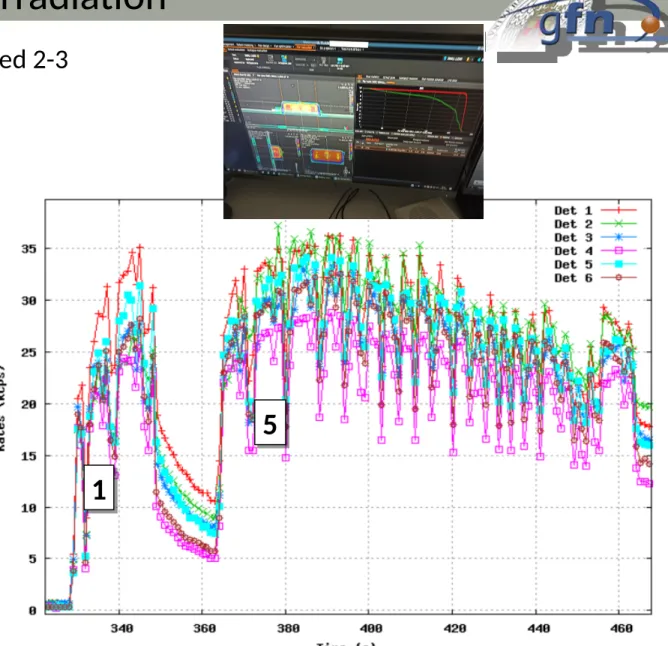
• Each fraction was delivered in a sequency of 24 spots, separated 2-3 seconds (see Fig).
Table . Summary of the measurements performed.
9
2. M&M
70-80 MeV protons 70-80 MeV protons
Irradiation
XIII CPAN DAYS
Fig . Singles rates ev 1 s during irradiation. Spots 1 and 5 are indicated.
Beam intensity ~ A (proton flux)
2-23 nA
3. RESULTS a) Singles
10
11 Fig 1. Singles rates. Right: zoom into 12 pulses. Left: 10 us zoom into 1
pulse with rates computed every 1 us (instantaneous dose rate).
3a. Results-singles
• Time resolution of 40 ns, enough to observe the charazteristic
pulsed beam time structure (f=1 KHz) and resolve individual proton bunches
Ms beam structure
12 pulses
XIII CPAN DAYS 1 ms
EGG-2
EGG-2
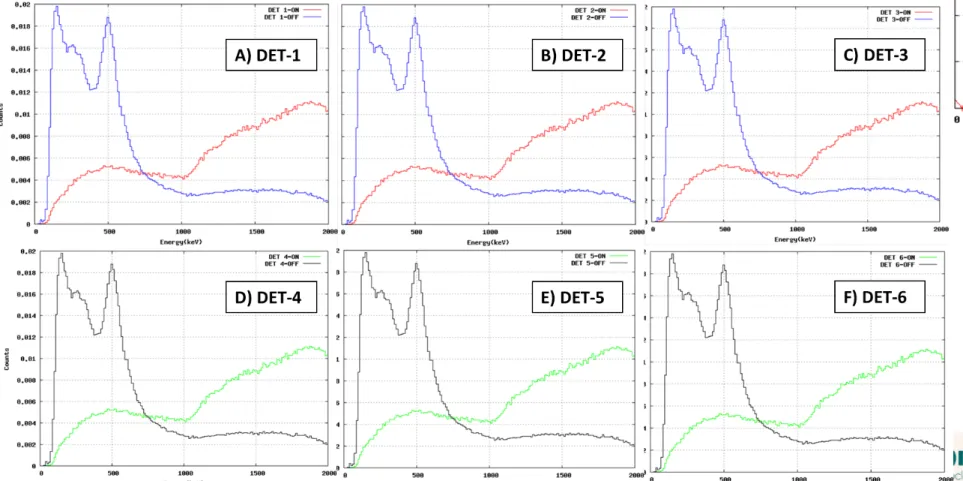
The characteristic structure of the beam and the time resolution of the system can be used to separate events beetween consecutive pulses.
Fig . Normalized energy spectra of each detector during and between consecutive irradiations
Fig . Singles rates computed every 5 us.
12
3a. Results-singles Energy spectra
XIII CPAN DAYS Beam on
Beam of Beam on Beam of
3. RESULTS
b) Coincidences
13
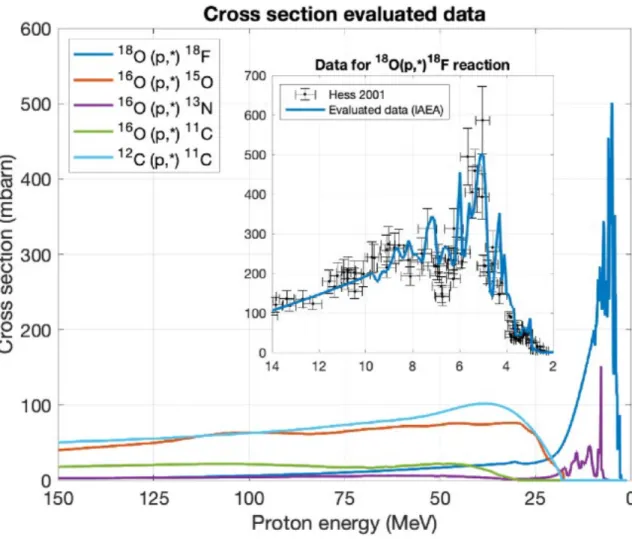
Fig. Proton-induced evaluated reaction cross sections for the main channels involved
Table. Main available isotopes for PET proton range verification in human tissues.
3b. Results-coincidences
14
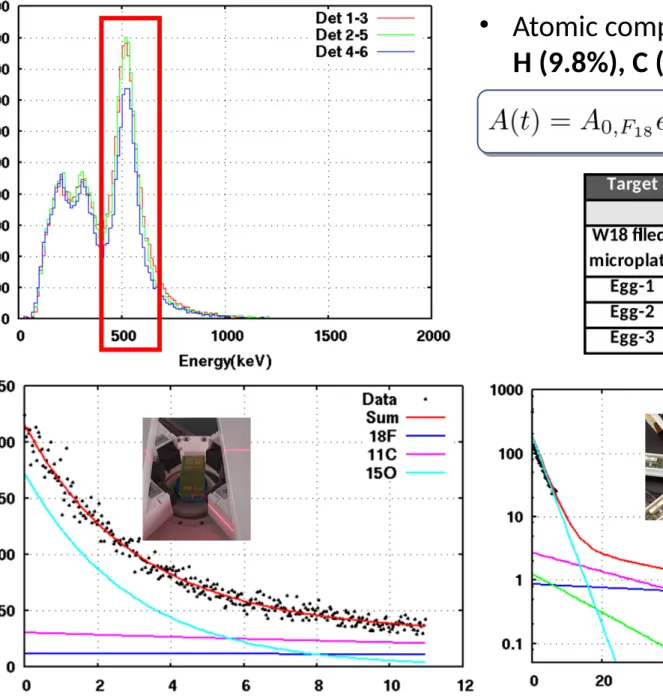
• Atomic composition for squamous cell carcinoma:
H (9.8%), C (19.5%), N (4.8%) and O (65.0 %)
Decay analisis
XIII CPAN DAYS
Fig. Decay curves and
corresponding fits combining the information of the measurements inside and outside the bunker.
Left: W18-filled microplate. Right:
First egg.
15
3b. Results-coincidences Decay analisis
XIII CPAN DAYS
• Atomic composition for squamous cell carcinoma:
H (9.8%), C (19.5%), N (4.8%) and O (65.0 %)
3. RESULTS
d) 3D PET activation images
16
BEAM-ON
BEAM-ON DECAY-1 ~10 min DECAY-1 ~10 min
EGG-1 EGG-1
MICROPLATE +W18 MICROPLATE
+W18
EGG-2 EGG-2
EGG-3 EGG-3
DECAY (outside the bunker) ~ 1h 30m DECAY (outside the
bunker) ~ 1h 30m
• 511 energy window
• Normalized to the adquisition lenght
• 80x80x40 voxels (0.5 mm)
17
20 Gy
8 Gy
2 Gy 3c. Results-coincidences
BEFORE BEFORE
XIII CPAN DAYS
18
3c. Results-coincidences
BEAM-ON
BEAM-ON DECAY-1 DECAY-1
EGG-1 EGG-1
MICROPLATE +W18 MICROPLATE
+W18
Dinamic PET reconstuction
• 1 sec. frames • 30 sec. frames
XIII CPAN DAYS
19
3c. Results-coincidences Dinamic PET reconstuction
SPOT 0 SPOT 0
Burst-1 Burst-2
• EXAMPLE: MICROPLATE
Burst-1 Burst-2
XIII CPAN DAYS Beam-of
20
3c. Results-coincidences Dinamic PET reconstuction
SPOT 0 SPOT 0
Burst-1 Burst-2
• EXAMPLE: EGG-1
Burst-1 Burst-2
XIII CPAN DAYS Beam-of
Beam-of
21
4. Conclusions and future perspectives
• First in-vivo experimental results:
• Analysis of proton activation in W-18
→ Clinical scenario. Quironsalud protontherapy center: 70-80 MeV proton beam
→ On-the-fly. On-line data acquisition during irradiation
→ Animal model. Experiment in a chicken embryo CAM model
→ Singles. Up to 10Msingles/sec with us time resolution
More experiments are on-going, stay tuned!
→ Water-18. Low production at clinical doses
• Outlook:
→ On-line PET activity reconstruction. Single spot localization in streaming, during irradiation
→ Coincidences. 3D PET dynamic maps with sub-mm and ms resolutions.
→ W18 concentration. Reevaluation at clinical doses.
22
Thank you!
Detectores
23
•6 detectores con 338 cristales cada uno, 1.55 mm pitch por crystal, corrección DOI con phoswich LYSO (7mm)+GSO(8mm).
•Campo de visión de 5 cm diámetro x 2 cm de profundidad.
•Electrónica capaz de adquirir y procesar 10 Msingles/segundo sostenidos y
>200 Ms/s instántaneos, en rachas cortas.
•Singles time-stamped con 100 ps de resolución.
• El cuello de botella son los 300 ns de tiempo muerto por detector, o unos 20 Msingles/s para el sistema de 6 detectores.
•Desarrollo conjunto SEDECAL+UCM