CENTRO DE ENSEÑANZA TÉCNICA Y SUPERIOR
Con reconocimiento de validez oficial de estudios del Gobierno del Estado de Baja California según acuerdo de fecha 10 de Octubre de 1983
Assessing the Effectiveness of Facebook Advertising Campaigns on Business Performance: A Case Study of a Liquidation Specialist
Tesis para la obtención del grado de maestría
Presenta:
Nadia Priscila Tellez Almeida
Director:
Dr. Jorge Alberto Wise Lozano
Mexicali, Baja California Junio de 2023
Table of Contents
Abstract...3
Introduction...4
Literature Review...7
Development and Propositions Description...15
Definition of the Problem...16
Describing Marketing Campaigns in Digital Social Media...18
Propositions...19
Description of the Variables...20
Research Methodology...24
Data Collections Results and General Findings...34
Data Analysis...39
Testing of Propositions...55
Study Limitations...61
Managerial Application of the Findings...63
Abstract
This thesis examines the effectiveness of advertising campaigns on Facebook and their impact on the sales performance of a small business specialized in liquidations. The study utilizes the Meta Business Suite platform to gather and analyze relevant data. The primary metrics used in the analysis are Cost per Lead (CPL) and Conversion Rate (CR). The objective of the research is to evaluate the influence of marketing campaigns on business outcomes and determine if these campaigns lead to increased sales for the company. Through a comprehensive analysis of financial data and campaign performance metrics, the study reveals that Facebook advertising campaigns can indeed have a positive impact on business performance. However, it also highlights the existence of additional factors that influence sales outcomes beyond the sole influence of campaigns. The findings underscore the importance of
considering various factors, such as product quality, market conditions, and customer preferences, in conjunction with advertising efforts. While campaigns contribute to enhanced business performance, their effectiveness is contingent upon a holistic approach that encompasses other strategic elements.
This study provides valuable insights for businesses aiming to optimize their marketing strategies by emphasizing the significance of a comprehensive business perspective that extends beyond the scope of advertising campaigns alone.
Keywords: social media marketing, digital advertising campaign, liquidations
Introduction
Marketing and advertising are critical components of any business strategy, and their
effectiveness can significantly impact the success of small businesses. In today's competitive business landscape, small businesses face numerous challenges, including limited resources, increased
competition, and changing consumer preferences. In such a scenario, the ability to execute effective marketing and advertising campaigns becomes paramount for small businesses to attract and retain customers, increase brand visibility, and ultimately achieve sustainable growth.
This thesis aims to assess the effectiveness of marketing and advertising campaigns in small businesses, with a focus on understanding the impact of different marketing and advertising strategies on business outcomes. This study conducts a comparative analysis of various marketing and advertising techniques used by a small businesses and evaluates their effectiveness by understanding the metrics of their performance.
Marketing and advertising play a crucial role in the success of small businesses by enabling them to reach out to their target audience, create brand awareness, and drive customer engagement (Tyagi, 2020). Small businesses often operate with limited resources and face intense competition from larger corporations. As such, they need to be strategic in their marketing and advertising efforts to make the most out of their limited budget and resources.
Effective marketing and advertising campaigns can help small businesses build a strong brand image, establish credibility, and differentiate themselves from competitors. They can also help small businesses identify and capitalize on market opportunities, understand customer needs and preferences, and tailor their offerings accordingly. Furthermore, marketing and advertising campaigns can drive customer loyalty, increase repeat business, and generate positive word-of-mouth, which are crucial for sustaining long-term business growth (Hoffman & Fodor, 2010).
Firstly, the provides valuable insights into the effectiveness of different marketing and
advertising strategies in social media, helping small businesses make informed decisions when planning and implementing their marketing campaigns. Small businesses can leverage the study findings to optimize their marketing and advertising efforts, allocate resources effectively, and improve their overall marketing performance.
Secondly, this study contributes to the existing body of knowledge in marketing and advertising literature by providing empirical evidence on the effectiveness of marketing and advertising campaigns in small businesses. The study sheds light on the unique challenges faced by a small business and
identifies the strategies that are most effective in this context. This fills a gap in the literature and provide a valuable resource for future research around small businesses marketing and advertising.
Lastly, the study's findings can also benefit marketing practitioners, including marketing agencies and consultants, by providing them with evidence-based insights to better serve their small business clients. Marketing practitioners can use the findings to design more effective marketing strategies tailored to the unique needs and challenges of small businesses and provide them with data-driven recommendations to optimize their marketing and advertising efforts.
The context of this study is around selling return items from large companies or vendors like Amazon. This has become popular in recent years, becoming one of the most innovative and unknown markets. Nevertheless, studies on this sector of the local economy have not been discovered enough to perform an investigation into this type of business.
Vendors like Amazon refer to returned products as "returned merchandise". When a customer returns an item, it is processed and evaluated by the company to determine its condition and eligibility for resale. If the returned items are still in new or sellable condition, they may be repackaged and sold as
"Amazon Warehouse Deals" or "Amazon Renewed" products at a discounted price. However, if the returned items are damaged, defective, or not in a condition to be resold as new, Amazon may liquidate
them through various channels, including selling them in bulk as return pallets. These return pallets typically contain a mix of products from various categories, such as electronics, home goods, apparel, toys, and more. The exact contents of the pallets can vary, and they are often sold through liquidation auctions, online marketplaces, or directly to resellers. However, it is important to note that the condition of the items in the pallets can vary, and there is a level of risk involved as some items may be damaged, incomplete, or require refurbishment.
There was a surge in the demand for products offered by outlets due to the COVID-19 pandemic years, 2020-2022. As many people were losing their jobs, they started to look for other ways because of the increased unemployment rate, where 12.5 million people lost their jobs in Mexico due to these events (Gobierno de Mexico, 2021), many looked for ways to earn income in other ways. Acquiring merchandise on pallets offered an opportunity to generate income. By purchasing these pallets at a discounted price, individuals had the opportunity to generate income by reselling the products online or through local sales platforms. This allowed them to adapt to the challenges of the pandemic, explore self-employment opportunities, and develop valuable skills in online selling, inventory management, and customer service. The flexibility and variety of products offered by the pallets enabled individuals to cater to changing customer demands and potentially diversify their income streams, providing some financial stability during a challenging time.
The business in question is entrepreneurship-focused and sells products of liquidations coming from big-known companies in the United States. While the impact varied for individuals, the acquisition of merchandise on pallets presented a pathway to entrepreneurship and self-employment, allowing individuals to regain a sense of control over their economic circumstances. It fostered adaptability, resilience, and skill development, which could have long-term benefits beyond the pandemic. Acquiring and reselling merchandise on pallets required individuals to develop various skills, including marketing and online selling.
Literature Review
Marketing campaigns in social media have become a crucial aspect of modern digital marketing strategies. With the rapid rise of social media platforms, businesses are leveraging these channels to engage with their target audience, promote their products or services, and build brand awareness. Social media campaigns offer unique opportunities to connect with customers, generate leads, and drive conversions. In this increasingly competitive landscape, understanding the nuances of creating and implementing effective marketing campaigns in social media has become essential for businesses looking to stay relevant and achieve their marketing objectives. In this text, the focus is on delving into the world of social media marketing campaigns, exploring their significance, best practices, and potential impact on business outcomes.
A social media network refers to a web-based platform that allows individuals to create a profile, connect with other users, and share content, information, and ideas within a virtual community (Boyd &
Ellison, 2008). These networks are characterized by their user-generated content, interactive features, and ability to facilitate communication and social interaction among users. Facebook is a social
networking platform that was founded by Mark Zuckerberg and his colleagues in 2004. It allows users to create a profile, connect with friends and family, share information and media, and engage with various communities through online groups and pages. According to Boyd and Ellison (2008), Facebook is defined as a "networked publics" platform that enables users to engage with a broad range of social ties, including strong ties (e.g., family, close friends) and weak ties (e.g., acquaintances, colleagues). This social media network is used in the study as the main tool for customer engagement and as the platform for marketing campaigns for the company.
Advertising campaigns have an impact on the sales volume of companies that use digital media.
An advertising campaign can be defined as “a family of ads that share a visual or verbal identity and promote a single idea to a defined target audience” (Blakeman, 2015). To make it successful, there are
concrete elements when designing an advertising campaign. Among the essential elements are the objectives, bringing to the table the expected achievements; the target audience, understanding their needs and behavior; the unique selling proposition, which is what set you apart from competitors;
messaging; channels to reach your audience; budget; metrics, and timeline (See Table 1). When
considering these elements, businesses can develop successful campaigns reaching their target audience and achieve their desired goals. (Blakeman, 2011).
Table 1
Elements of a Marketing Campaign
Element Description
Objectives These explain in detail the goals the company wants to achieve with the marketing campaign
Target Audience
This defines who is or who is going to be the buyer personas of the business model understanding the needs they have, how they behave, their aspirations, what they do, and more specific data like how high their income is and what they do for living.
The Unique Selling Propositions
As the competition increases with time, experience, and popularity, more
alternatives had to be taken into consideration to attract the customer’s attention and make them loyal. There are many value propositions for this type of business such as the quality of the products, the price, the customer service, or the store source of the items.
Channels to Reach your Audience
The company must search for the right channels to reach the customers.
Budget The company must set a specific range of money they can spend to destinate marketing purposes and create a strategy where this amount of money can be used in the best way.
Metrics To measure the effectiveness of the campaigns a set of metrics is established.
Knowing the numbers of a company is an essential action to understand its situation and context. In this way, better decisions can be taken, and a strategy can take place.
Timeline This is about how long the campaign is going to last.
Measuring the effectiveness of an advertising campaign is key to assure the success of the business. There are different ways to measure it, such as setting specific goals for a company, analyzing the site traffic and metrics before and after this campaign, reviewing lead quality, and making surveys to
determine who saw your advertisement (Cint, 2022). To ensure this effectiveness, all these ways must be taken into consideration.
There are many studies related to the subject, where different contexts such as the hotel industry and tourism are investigated, or big companies of retail. These studies suggest the relevance and effectiveness of social media advertising, where the key elements to follow are highlighted and summarized.
Marketing Campaign Effectiveness
Assessing the effectiveness of a marketing campaign can be complex, but it is an important process to ensure that your efforts are achieving the desired results. Tanton (2022) defines campaign measurement as “the process of measuring the impact of your marketing or advertising efforts against your campaign goals. It involves looking at the KPIs of your campaign and assessing whether they’re adequate for meeting your goals”. Among the ways to successfully measure a marketing campaign are the setting of clear goals and objectives, the use of metrics; also known as rates, tracking the return of investment (ROI), conducting customer surveys, and analyzing the competition (Tanton, 2022).
It is essential to set clear goals and objectives before launching a marketing campaign, being sure of defining them correctly to measure the success of the campaign and determine whether you have met your targets. The purpose of your campaign can be to attract more leads, increase sales, create brand awareness. Key Performance Indicators (KPIs) start to make sense when making this measurement and to achieve it, a specific goal must be set in first place. In this way, the analysis is easier (Tanton, 2022).
There are a number of different metrics a company can use to track the development of a advertising campaign. These metrics are conversion rates, return of investment, return on ad spend, cost per lead, cost per acquisition, website visits, click-through rate, cost per click, cost per conversion, engagement rates, number of sales, grow revenue, among other ones. Metrics are defined depending on
the goals and channels of the campaign and they give a quantitative approach, easier to understand (Tanton, 2022).
The return of investment (ROI) is the comparison of how much is spent on a campaign and how much was earned during and after its duration. This metric can be considered as the most important one because the higher it is, the more revenue for the company. Furthermore, it can determine if the marketing campaign was worth its investment. The understanding of this metric and the correct track of it can also lead to more opportunities and to optimize the campaigns (Tanton, 2022).
Another way to analyze the marketing campaign a company is making, is by the evaluation of the competition. When comparing it with other, it is easier to determine its effectiveness and creativity. In this way, the advertising strategies can be improved in more ways where the company was not thinking of. Perhaps the approach might be redefined when more areas for improvement are identified.
To measure the effectiveness of the campaigns, one of the most reliable methods the company can have, is the analysis of metrics before and after by the statistics in the results. Among the metrics that are analyzed are the number of messages received on every social media, how many of them turn into sales, how the sales increase compared to previews months, and then, the profit after the sales period, also compared to previews periods.
After digging into 55 studies, Li and Yang (2019) identify the factors that contribute to advertising effectiveness, which are the informational value of social media advertising; the entertainment value that gets brand loyalty, the interactivity within the advertising, the trustworthiness of the brand, and the type of platform where the social media network brings a very important factor to the effectiveness of a campaign. All of this contributes to purchase intention and brand loyalty.
Social media advertising can be highly effective but depends on targeting the right audience, creating engaging content, and on the leverage of social networks to amplify reach and credibility.
Krishnamurthy and Singh (2014) provide a comprehensive review of the existing literature on social
media advertising effectiveness. Among the factors needed for a successful social media campaign are the target market, the engagement around the advertising, the word-of-mouth, and cost-effectiveness.
Like it was mentioned before, engagement could be the key element of these campaigns, being
mentioned as a common point in another investigation led by Yang and Li (2018) as well, which examines the effectiveness of social media advertising in the United States using consumer-brand engagement metrics.
The previous studies gathered information in different ways. Chatterjee and Richard (2016), conducted a survey to collect data, including questions about ad format, ad relevance, ad credibility, and purchase intention. Then, analyzed participants' responses to questions about purchase intention, which assessed their likelihood to buy a product or service after seeing a social media ad. The authors also analyzed participants' responses to questions about ad relevance and ad credibility, which assessed their perceptions of the quality of the ads. The findings of the study show that the ad content, the social influence, and the brand familiarity are the key elements for a relevant and successful social media advertisement.
Yang and Li (2018) used machine learning algorithms to classify posts as either advertising or non-advertising. They then analyzed the engagement metrics of the advertising posts and calculated engagement rates, which are the percentage of users who engaged with the post out of the total number of users who saw the post. To assess the effectiveness of social media advertising, the authors compared the engagement rates of different types of ads, such as those with different ad formats, call- to-action buttons, and social media platforms. They also analyzed the impact of ad relevance, which is the extent to which an ad is relevant to a user's interests, on advertising effectiveness.
In another study, Yang and Li (2019) extracted data from the studies on various factors related to social media advertising, including ad format, message content, platform type, and audience
demographics. They used a statistical technique called meta-analysis to combine the findings from the
individual studies and calculate an overall effect size for the impact of social media advertising on purchase intention and brand loyalty. They also conducted a subgroup analysis to examine the effects of specific factors, such as ad format and platform type, on social media advertising effectiveness. They used a statistical technique called moderator analysis to determine whether these factors moderated the relationship between social media advertising and purchase intention and brand loyalty.
Furthermore, there are challenges in measuring the effectiveness of online marketing. Among these, there are various reasons to carry out regular measurements of the effectiveness of a business.
The reason may include the understanding of some aspects; where they cannot change, understand, check, or improve the data. If the results cannot be measured or evaluated, then there is no way to distinguish whether something was effective or not. Also, failures can be repeated if they are not recognized, wasting valuable resources (Krizanova et al., 2019).
A methodology based on a marketing survey of Slovakian hotels found that evaluating marketing communications online is considered important regardless of hotel size, length of operation, budget, or class (Krizanova et al., 2019). In this study, hotels preferred financial metrics and particularly return on investment (ROI) for evaluating the effectiveness of online communication activities. The return of investment was proposed as the most appropriate metric for this purpose based on the findings.
Other studies have shown success factors, highlighted best practices, and drew attention to determinants of poor performance in destination marketing campaign activities. Pratt et. al. (2010) focused on evaluating 18 campaigns directed towards potential domestic visitors using the conversion study technique, which assessed expenditure impact and return on investment. The investigation aimed to contribute to marketing practice by providing insights into the key components that lead to a high return on investment and higher impact in destination marketing campaigns. It is important to highlight the merits of cross evaluating the impact of destination marketing campaigns using similar methods.
Pratt et. al. (2010) Evaluation measurements show that generic campaigns perform significantly better than niche campaigns in terms of total expenditure, revenue per inquiry, and return on
investment, despite higher costs. The methodology they estimated conversion rates, visitor expenditures, and return on investment is consistent across all 18 campaigns. Despite limitations outlined in the literature review, using the same methodology allows for an objective comparison between campaigns, enabling policy makers to compare them on an equal basis.
The key factors influencing a good return on investment for destination marketing organizations' marketing investment are identified as the proportion of visitors who have booked before receiving marketing material, the proportion of respondents who visited the destination, the influence of the marketing material, visitor expenditures (per person per night expenditure, length of stay, party size), and the reach of the marketing campaign. Pratt et al. (2010) concluded that the strength of marketing influence on consumers and the reach of the marketing campaign are important factors for achieving a higher return on investment.
Social Media Marketing Campaign
Bruhn, Schoenmueller, and Schäfer (2012) say social media marketing began to gain popularity in the mid-2000s, being used in branded social media pages, viral marketing campaigns, and influencer marketing. After a survey of 584 consumers in Germany, it was found that social media play a significant role in brand equity creation, but traditional media such as TV and print advertising still have a stronger impact. The study also found that social media are used more for emotional brand communication, while traditional media are used more for rational brand communication. Also, emotional brand
communication, which is more prevalent on social media, has a stronger impact on brand equity than rational brand communication. Using both social media and traditional media in their campaigns to maximize their effectiveness.
Chae and Kim (2015) investigated the effects of social media on brand attachment and brand loyalty. After conducting a survey with 325 participants in the United States, it was found that social media have a positive impact on brand attachment and brand loyalty. The study also found that the impact of social media on brand attachment is stronger for consumers who have a higher level of involvement with the brand. It is recommended that marketers use social media to engage with consumers and build relationships with them.
Luo and Song (2019) estipulate that social media information quality, tie strength, and social identification all have a positive impact on brand loyalty after their research. A survey of 343 participants in China showed that the impact of social media information quality on brand loyalty is stronger for consumers who have stronger ties with the brand and a stronger social identification with the brand. The authors recommend that marketers focus on providing high-quality information on social media and building strong ties and social identification with consumers to enhance brand loyalty. As part of the recommendations, the authors claim that marketers focus on providing high-quality information on social media and building strong ties and social identification with consumers to enhance brand loyalty.
Ahmed et al. (2018) examined the impact of Facebook advertising on brand awareness and purchase intentions. In a study conducted in the country of Pakistan, 262 Facebook users were part of a survey that was only for people who had interacted with Facebook ads. The results showed that
Facebook advertising has a significant impact on brand awareness and purchase intentions. Additionally, the study found that the impact of Facebook advertising on purchase intentions is mediated by brand awareness.
Facebook has been growing in popularity for marketing purposes and users work with a wide range of advertising options, including sponsored posts, display ads, and video ads. Also, the platform Facebook advertising has potential benefits such as the ability to target specific audiences and its relatively low cost compared to other advertising channels. The use of these tools in social media can
increase brand awareness and ultimately drive purchase behavior with a focuson developing targeted advertising campaigns (Ahmed et. al., 2018).
Development and Propositions Description
Definition of the Problem
The study is focused on how the execution of a marketing campaign, with the right combination of elements inside of it, can contribute significantly to the number of sales of a company with a relatively new business model, focused on the distribution of liquidation products around a specific demographic zone. Creating a campaign with the correct elements has demonstrated a positive effect on many businesses. For this new way of business making, there is new information to be added to the facts experts already know about this topic.
Despite having information about the effectiveness of advertising or marketing campaigns on diverse kinds of businesses, there is no data about the type of business in academic resources or
databases. After the review of several sources on the web, it was found that the topic regarding returned merchandise or liquidations is not well-known and has a lot of potential for a new investigation. The study gives the audience a hint at how effective these campaigns can be in this new context.
This study gives a new record of the performance of advertising campaigns in one of the most influential social networks in recent years, Facebook (Facebook, 2021). Despite having information on the effectiveness of advertising campaigns in different types of businesses, there is still no record of how it can benefit emerging businesses such as the one discussed in this thesis. Having the theory in the first instance, the knowledge is applied to create effective campaigns in the said social network. Its results are exposed in detail in the development of the investigation.
The study’s main objective is to find the effect of advertising campaigns on the return and liquidation pallets sector. The main objective of this study is to look for the impact of a marketing
campaign in social media in this business. By analyzing what is the relevance and impact of this specific kind of tool, it is determined how useful it can be and how it is used. Marketing campaigns have
demonstrated their effectiveness in businesses, where the return of investment is larger when there is a stronger influence of marketing overall (Pratt, 2010). Nevertheless, this analysis has not been done in this kind of business and this study is focused on a different type of business model than from other applications.
Creating a successful marketing campaign includes the correct combination of the elements it has, such as a target audience, a unique selling proposition, the message, and the channels (Blakeman, 2011). All the elements previously mentioned applied in the correct way gives a way to the analysis and thus, to know which combination of elements is the most effective. In this way, the investigation analyzes the response rate from the customers and the number of sales generated in a company that is dedicated to the sale of "returned merchandise" items. All of this summarizes to understanding who the people are interested in acquiring this type of merchandise; for which it is necessary to understand who has the motivation to obtain an extra income. Knowing who our buyer personas are, content is created within the advertising to attract the attention of potential customers, tailoring the message, and choosing the right channels to reach them (Blakeman, 2011).
The elements to design an advertising campaign are analyzed to create the most effective campaign for this type of business, which had not been previously investigated. For example, the target audience can be known from previous statistics from the web page; the message must be clear to attract people who want so to be an entrepreneur, and the channels where the audience is going to be reached (Blakeman, 2011). Since it is a yet non-discovered type of business, the analysis is done from scratch and without a previous reference.
This study consists of an analysis of the results of the different advertising campaigns that the company has carried out for approximately four years. All this with the aim of knowing if these
campaigns had an impact on the increase of the sales and profits of the company. This investigation focuses on seeking effective results in the city of Tijuana, Baja California, to attack the market closest to the main branch of the company analyzed. Knowing how to do the perfect advertising campaign can improve the process of making it, less money is invested because there is a better understanding of what the company needs, and the profitability is higher.
To keep up with the customers, advertising campaigns are more reliable to keep up with the customers since the strategies have been developing and more competitors enter the market. The customers tend to come from these campaigns and customer service has become the most important aspect of the company. The same past marketing strategies as these campaigns have been the primary reason for the customer’s loyalty.
Due to these changes over time, different ways have been proposed to obtain the attention of customers through different media, and one of the most influential is social networks. For this same reason, they began to use the Meta Business Suite tools available for the management of Facebook and its management of information regarding fan pages within the platform.
Describing Marketing Campaigns in Digital Social Media
The social media Facebook offers an advertising platform that allows businesses and individuals to create and run targeted ad campaigns to reach their desired audience. This platform has a range of advanced features, targeting options, and optimization techniques. The specific details and options available can vary based on factors like campaign objectives, budget, ad account settings, and Facebook's advertising policies. Each marketing campaign goes through a process to make it more effective and choose the correct settings.
Advertising campaigns on Facebook typically involve several key steps. Firstly, advertisers set their campaign objective, which could be anything from increasing brand awareness to driving website traffic or generating leads. Next, they create the actual ad, choosing the format, crafting engaging ad
copy, and adding relevant pictures or videos. They can also include a call-to-action button to guide users toward the desired action. Targeting comes next, where advertisers define their target audience based on demographics, interests, behaviors, and Facebook connections. This ensures that the ads are shown to people who are most likely to be interested in the offerings. Once the ad is created and the target audience is defined, advertisers determine the budget and bidding strategy for the campaign. They set a daily or lifetime budget and choose a bidding option like Cost per Click or Cost per Engagement. Ad placement is another important consideration. Advertisers can choose automatic placements, allowing Facebook to optimize ad delivery across its platforms, or manually select specific placements across Facebook, Instagram, Messenger, and the Audience Network. Throughout the campaign, advertisers monitor performance through Facebook Ads Manager, which provides insights on reach, impressions, clicks, and conversions. They can adjust and optimize the campaign based on the data, such as refining targeting, modifying ad creative, or adjusting budgets. Finally, after the campaign concludes, advertisers analyze the performance to gain insights and make data-driven decisions for future campaigns. Facebook Ads Manager offers detailed reports on metrics and audience insights, facilitating continuous
improvement in advertising efforts.
Propositions
Understanding whether a marketing campaign in social media increases sales or not holds significant importance for research focused on measuring the effectiveness of marketing campaigns through social media. This information bears implications that are valuable to businesses and marketing professionals. If the research findings confirm that a marketing campaign in social media indeed
increases sales, it provides compelling evidence to support the allocation of resources towards social media advertising efforts. Such findings establish a strong case for businesses to invest in social media marketing strategies, as they directly impact revenue growth. Moreover, the knowledge that social media campaigns are effective in boosting sales helps businesses set realistic goals, optimize their
marketing budgets, and develop targeted strategies to maximize return on investment (ROI). On the other hand, if the research indicates that marketing campaigns in social media do not increase sales, this information becomes equally important. It highlights the necessity for businesses to reassess their social media marketing strategies, identify areas for improvement, and explore alternative approaches. By understanding the impact of marketing campaigns in social media on sales, businesses can make informed decisions, allocate resources wisely, and enhance their overall success in the digital landscape.
Therefore, the following propositions are detailed (see Figure 1).
P1: A marketing campaign in social media increases sales.
P1a: A new marketing campaign in social media increases sales in monetary value.
P1b: A past marketing campaign in social media increases sales in monetary value.
P1c: A new marketing campaign in social media increases sales in units.
P1d: A past marketing campaign in social media increases sales in units.
Figure 1.
Diagram of the Relationship Between Variables and Propositions
Note. Marketing Campaigns may have an impact on the sales value of the company.
Description of the Variables
In this thesis, the description of variables is a critical section that outlines the key constructs, concepts, or factors that are being studied and measured. This section provides a comprehensive overview of the variables under investigation, including their definitions, operationalizations, and potential relationships or interactions. Describing the variables thoroughly and accurately is essential for
readers to understand the design of the study and interpret the findings accurately. This introduction serves as a guide to the subsequent sections where the variables are described in detail, providing a clear understanding of the key elements of the study. In this section, an overview is provided of the variables that are examined in the thesis, including their importance, relevance, and potential impact on the study's outcomes.
Variable: Marketing Campaign in Social Media
This is the independent variable of this study and determines a continuous effect on the periodical results of the firm, and this covers all the propositions previously mentioned. The continuous effect of a marketing campaign can be positive or can mean no difference to the sales results of the company, and that is what the propositions are about. The periodical results are described monthly. After collecting the data, the conclusions about the campaigns can prove either the increase in sales value and sales quantity or the absence of any difference in those facts of the company.
The marketing campaigns in social media of this paper are done and described in Meta Business Facebook, a tool for businesses who look for the creation of this type of content for their companies. The platform offers several metrics to evaluate the performance of the all the campaigns that are on. As it has been explained previously on the paper, the metrics are an essential part on measuring the
effectiveness of marketing strategies. Among these essential metrics, the number of times the audience interacted with the ad and the extent of reach among individuals are observed. Also, the person creating the campaign can introduce the money destinated to it by selecting the amount before posting the ad.
Even though the format of the campaign it is not part of the common metrics used to measure them, it is considered that plays a very important role on the impact of a campaign. On the analysis of the raw data collected from the social media platform, the relevant factors are the interactions, the number of users reached, the format; whether it was pictures or videos, the type; either organic or paid
advertisement, and how much did the campaign costed at the end of it. The previous mentioned elements are analyzed to determine how they can make a difference on the development of a campaign.
Marketing or advertising campaigns help in brand awareness, traffic visibility to the brand, creating loyalty and trust lasting, in relations with customers, and help them to buy (Tyagi, 2020). This knowledge applied to social media can mean a difference in the expected results. The impact can be positive in communicating with the audience and attracting the attention of customers. With the help of the new tools social media brings to businesses, all the good aspects of marketing are applied in multiple platforms and many other ways.
Social media has become a powerful tool that allows content to be shared in a fast way with a broad audience. It is a platform for worldwide communication and content creation which is used for both personal and professional purposes. This also means a new opportunity for businesses and marketers since it can provide a quick channel of communication and information sharing (Katiyar &
Dixit, 2021). Advertising campaigns can be implemented on social media platforms as well, making it a new way to use marketing in favor of companies through other methods.
Companies to know if marketing campaigns on social media apply can make a significant change in the sales results every month one is on. Since this type of business model and products are different from anything ever made and put on academic writings, this variable must be highlighted. Putting the main approach on social media as the channel to reach customers through advertising campaigns, the relevant information is analyzed. This is the reason why the study is focusing on the effect of the tools marketing can provide with advertising campaigns. Identifying the importance of a marketing campaign on the social media of a business can lead to its success.
Variable: Sales
Sales in Monetary Value. The "sales" refers to the sales value total monetary worth of the sales made by a company during a specified period, often measured in terms of revenue or sales revenue. It is
a key financial metric that reflects the company's performance in generating sales and capturing market share. In this variable, the number of sales per month is described. The period is each month because of the way the information of our first variable, the marketing campaign, is obtained from the database of the social media platform. The information on the sales values is acquired from the database the company has for its finances.
Having a solid understanding of the financial aspects of a business is crucial for several reasons.
Sales value is a key indicator of a company's business performance. It reflects the effectiveness of a company's sales efforts, market demand for its products or services, and its ability to attract and retain customers. By analyzing changes in sales value over time, a company can assess its sales performance, identify trends, and make data-driven decisions to improve sales strategies.
Sales value is closely related to a company's market share, which refers to the portion of the total market that a company captures with its sales. Higher sales value indicates that a company is capturing a larger share of the market compared to its competitors. Monitoring changes in sales value can help a company assess its market position, competitiveness, and identify opportunities to gain or maintain market share.
It is a key component in financial analysis, assessing a company's profitability, and
competitiveness. It is used to calculate various financial ratios and metrics, such as gross profit margin, sales growth rate, and return on investment (ROI), which provide insights into a company's financial health, efficiency, and profitability. Analyzing sales value in conjunction with other financial data helps in evaluating a company's overall financial performance and making informed financial decisions.
Furthermore, the sales value is a critical measure of the effectiveness of a company's marketing campaigns. By analyzing changes in sales value before, during, and after marketing campaigns, a company can assess the impact of its marketing efforts on sales performance. This information helps in evaluating the return on investment (ROI) of marketing campaigns and making data-driven decisions
about marketing strategies and resource allocation. It serves as a crucial measure of the impact of marketing campaigns on a company's sales performance.
Sales in Units. In this variable, the number of items sold per month is described. This is the number of products sold summarized in quantity and a whole number at the end of a period. The period is each month because of the way the information of our first variable, the marketing campaign, is obtained from the database of the social media platform. The information on the sales quantity is acquired from the database the company has for its finances. The quantity in question can be defined as the sum of the items sold in the business during the period of a month, displayed periodically.
Research Methodology
The company mentioned in this study is a dynamic and innovative organization that specializes in wholesale distribution of products sourced from major vendors such as Amazon. With a strong
commitment to customer satisfaction, it is a priority to understand and fulfill the unique needs of our clients. The team of dedicated professionals combines extensive industry expertise with a passion for excellence, ensuring that every project undertaken is executed with precision and creativity. Also, there is an unwavering dedication to quality, integrity, and continuous improvement that drives us to
constantly explore new opportunities for growth and remain at the forefront of our industry. With a proven track record of success and a forward-thinking mindset, the company is poised to exceed expectations and make a lasting impact in the market.
In the early stages of the company, advertising campaigns were initially developed empirically.
Throughout its journey and through professional courses, it was understood that for greater efficiency in social media and campaigns, proper market segmentation was necessary. That is why the company began researching this topic and identifying its target market to achieve greater efficiency in every activity carried out on social media. The process of the selection of the market segment is described in the following section.
Market Segmentation
To get the attention of customers and receive messages on social networks, it was needed to know the segment of the population that is really interested in the merchandise or in the products that are offered. In the same way, a segment of the market must be identified to know why a customer can look for one product over the other. With the sales experience the company has, there is a theory that
says that the better the campaign, the more sales it will be. The company would like to see if this segmentation and the number of people reached by the campaign are important factors in increasing sales.
The business in question has had into consideration different segments that might be interested in buying the products they offer. Among these segments are the small-scale or online resellers and discount retailers, who can acquire a variety of products at a lower cost and then resell them through their own channels. These could include eBay sellers, flea market vendors, local discount stores, or online marketplace sellers. Thrift stores, consignment shops, and outlet retailers may find value in purchasing return pallets as they can sort through the items, refurbish if necessary, and sell them at discounted prices. These businesses often cater to budget-conscious customers who are looking for deals on a wide range of products. Also, online sellers who operate their own e-commerce platforms or marketplaces may see an opportunity in buying return pallets. These sellers can list the individual products for sale on their websites or leverage online marketplaces to reach a broader customer base.
Some businesses specialize in refurbishing or repairing electronic devices, appliances, or other products.
They might purchase return pallets to source components, spare parts, or repairable items that they can refurbish and resell. Finally, non-profit organizations, charities, or community organizations might be interested in acquiring return pallets for various purposes. They may use the items for fundraising events, donations to those in need, or to stock thrift stores operated by the organization. All these segments are potential customers and there have been purchases from all in the past as well.
It is important to note that the market segment interested in buying return pallets may vary based on location, market conditions, and individual business strategies. Each segment has its own specific needs, target audience, and approach to selling the items. Also, it is crucial for potential buyers to research and understand their market, customer demand, and profit potential before venturing into
purchasing return pallets. Despite the big number of possible clients the company can have, it had focused on small-scale sellers, online resellers, and e-commerce sellers.
Small-scale sellers are often home-based or operate from small physical locations, selling products through local markets or online platforms. Return pallets are attractive to small-scale sellers due to the variety of products they offer in one bulk purchase. By acquiring diverse inventory at a discounted price, small-scale sellers can maximize their profit margins and remain competitive. Return pallets provide flexibility, allowing sellers to curate their inventory based on customer preferences, market trends, and their own expertise. This enables them to cater to a wide range of interests and demands, ensuring a compelling product selection for their customers.
Online sellers primarily operate their businesses through e-commerce platforms or their own websites. Return pallets offer online sellers an opportunity to expand their product offerings cost- effectively. By diversifying their inventory through return pallets, they can attract new customers and increase sales potential. Purchasing products at a discounted price allows online sellers to offer
competitive prices while maintaining healthy profit margins. With efficient fulfillment processes in place, they can effectively handle and process the items from return pallets, ensuring a streamlined workflow from purchase to delivery.
E-commerce sellers predominantly rely on their own e-commerce platforms instead of third- party marketplaces. Return pallets are appealing to e-commerce sellers as they facilitate inventory scaling. With a single purchase, e-commerce sellers can quickly acquire a substantial amount of merchandise, enabling them to meet the demands of their growing customer base. By strategically sourcing products from return pallets, e-commerce sellers can curate their inventory to align with their target market and niche. This helps differentiate their brand, attract customers seeking unique or discounted items, and capitalize on trending product categories. Through effective marketing and
fulfillment strategies, e-commerce sellers can maximize the benefits of buying return pallets and drive success in their online businesses.
It is important for all these segments to carefully assess the value and potential marketability of the items in return pallets before making a purchase. Understanding their target audience, conducting market research, and having effective marketing and fulfillment strategies in place is key to maximizing the benefits of buying return pallets. All the descriptions of each segment capture the general benefits and motivations of each seller type, individual circumstances and strategies can vary significantly. For sellers, it is vital to conduct thorough research, evaluate market conditions, and adapt their approaches accordingly to make informed decisions when purchasing and selling return pallets.
Examples of Campaigns
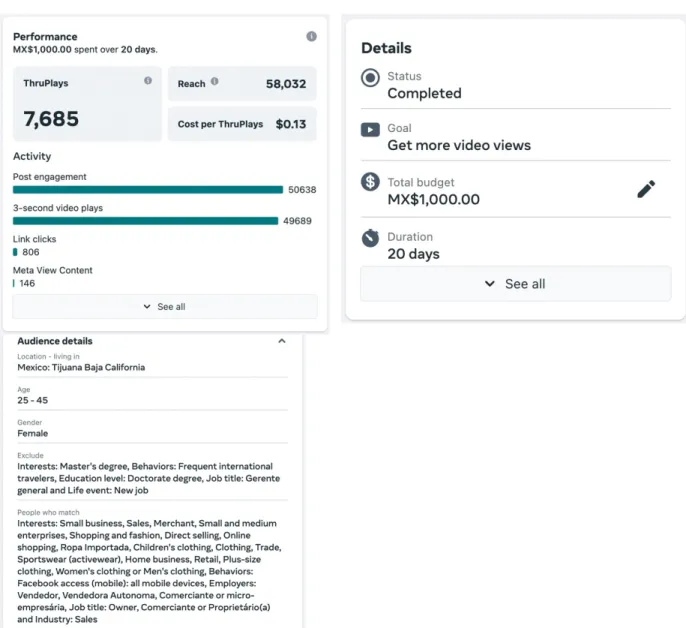
Ad with the goal of video views. In the following advertising campaign on Facebook, the main objective was to get more video views. It created an engaging ad that utilizes a video that was part of a live broadcast on the page. Through targeted audience segmentation, the intention was to reach out to the female population who lived in Tijuana, Baja California, between the ages of 25 and 45; with interests in small businesses, sales, online shopping, direct selling, retail, trade, home business, and clothing; and with the behavior of being an independent seller or businesswoman. To ensure the campaign's success, there was an allocation of a budget of $1000 MXN, and selected a bidding strategy of Cost per ThruPlays, which each cost $0.13 MXN. For optimal ad placement, Facebook News Feed was chosen. Throughout the campaign, its performance is closely monitored using Facebook Ads Manager, where metrics can be analyzed. Among these, one can find metrics such as the number of people reached, clicks, ThruPlays, post engagement, and many more (See Figure 2). Based on the insights gained, some necessary adjustments were made to improve the campaign's effectiveness, whether by refining targeting, modifying ad creative, or reallocating the budget. This comprehensive approach
allows the company to maximize the impact of the advertising efforts on Facebook and achieve the desired outcomes.
Figure 2 Ad results
Note. Summary of the development of the campaign described.
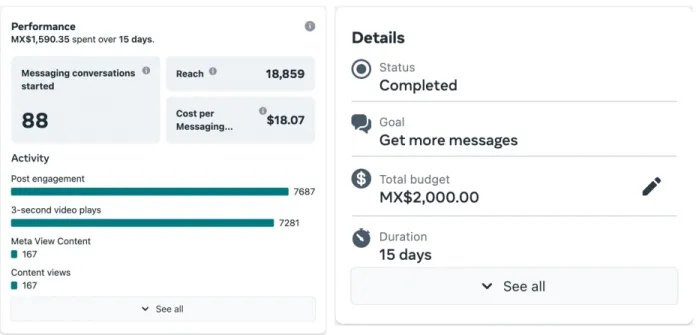
Ad with the objective of messaging. For this advertising campaign on Facebook, the main objective was to start messaging conversation. It created an engaging ad that utilizes a video that was part of a live broadcast on the page. Through targeted audience segmentation, the intention was to reach out to the population who lived in Tijuana, Baja California, between the ages of 25 and 40; with interests in wholesale, merchant, businesses, home businesses, and retail, and with no specific behavior.
To ensure the campaign's success, there was an allocation of a budget of $2000 MXN, but it only spent
$1,590.35 MXN and selected a bidding strategy of Cost per Messaging conversation started, which each cost $18.07 MXN. For optimal ad placement, Facebook News Feed was chosen. Throughout the
campaign, its performance is closely monitored using Facebook Ads Manager, where metrics can be analyzed. See Figure 3 to observe the details of how the information is displayed after the campaign is done and no longer active.
Figure 3 Ad results
Note. Summary of the development of the campaign described.
Data Collection Method and Procedure
The company has been using Facebook as its main platform to reach customers since it started.
It has been demonstrated to be a convenient tool for the objectives the company has had in past marketing strategies. Since there are already some examples of marketing campaigns for the past months and years, these ones are analyzed with their different elements to understand how these campaigns work. Then, there is a comparison between the number of sales in a certain month and the elements within the marketing campaign.
The past marketing campaigns have been developed on the social media Facebook, with the help of Meta Business, a platform for companies to manage their fan pages and the audience of these businesses. Once these campaigns are done, the summary of its statistics, and how It performed is available on the profile of the fan page in duty. The objective is to obtain all the data necessary for the analysis, covering the most important aspects of the campaign, the ones the firm needs to understand and follow the most. Meta Business shows the relevant data needed to know the campaign details. This gets the right information to fill the questions. These questions involve the most relevant data the study needs to continue with the analysis of the propositions. After reviewing and comparing the campaigns and their success in sales, their relevance on social media is identified.
How the Information is Obtained
Meta, previously known as Facebook, is the tool used for this study. Apart from being a social media network, this platform offers companies the opportunity to show their business and products in new ways to reach the audience. Companies have fan pages, their own space on the website, where they show their information to the users. Inside this platform, the website accumulates data, which is media, numbers, and statistics of how the page works. Using this knowledge from the digital platform Facebook, the study obtained useful information for the analysis.
Meta Business Suite is a tool specifically for fan pages of the social network Facebook. This software helps companies to manage accounts and to create ads for small businesses mainly. Inside this program, there is an option called “Content”, where all the information related to content created and published within the page is located for the purpose of advertising. The details are displayed in the form of a table, with the name of the publication in the first column and its respective descriptions in the following columns on the right side of the interface. A series of data emerges in each of the publications made by the pages on the social network. This data has different sections of information, for example, its publication date, the reach of people, people who interacted with the post, and the number of
comments, among other factors. All these facts are useful for companies who use Meta Business Suite.
The Facebook page of the company in question has hundreds of posts. However, only those that were intentional towards a massive advertising campaign where the company allocated a budget for its dissemination and success are considered. Once these campaigns are classified, a more accurate judgment is obtained in the analysis of the statistics in reference to these publications. By discarding publications that cannot add much value to this study, the results are more accurate when it comes to matching the propositions and drawing conclusions.
Sample
The information required for the study is obtained from the software tool found on Meta Business Facebook of the company previously described, which specializes in the wholesale distribution
of liquidation products. This platform gives the user important data and statistics about the business fan pages at the same time it helps to develop marketing campaigns. Past campaigns are collected to get crucial information about the effectiveness of these posts on social media. The target users of this social media are from the city of Tijuana, Baja California, so the information is based on the same location. The database of social media gives information from May 27th, 2019, to February 24th, 2023. From all the information that could have been collected from this database. Only advertising campaigns with
sufficient information have been chosen to proceed with the analysis. This is because, in some instances, possibly due to a software issue, complete data for the campaigns was not available. In total, 60
campaigns with their corresponding complete data have been collected.
Measurement Instrument
The objective of this study is to determine if the marketing campaign has an impact on the sales of a specific kind of business. The company has a database where financial information is collected to understand how sales amounts changed over time. From this database, the necessary information is the monetary value shown in Mexican pesos (MXN) of the sales each month from June 2019 to March 2023.
Data collection through the social media Facebook and their analytics tools. Meta Business Suite is a comprehensive set of business tools and services offered by Facebook (now known as Meta) that are designed to help businesses manage their online presence, engage with customers, and advertise effectively on Facebook's various platforms. It could include features such as ad management tools, analytics and reporting, customer relationship management (CRM) tools, e-commerce solutions, and other business-oriented functionalities to facilitate business growth and success on Facebook.
There are different aspects to take into consideration for the study. Among the data needed are the campaign date, the number of people reached when it was ongoing, the number is interactions the campaign had, this includes comments, likes to the posts, and the times people shared the post; the type
of advertising, referring if it was paid or organic; and finally the format the campaign had, this can be in videos or pictures. All these aspects are relevant for the analysis in the study and for future conclusions.
In addition to collecting information through tables such as those already described above, a residual effect is expected in each of the advertising campaigns that have come into existence. This means that a publication can influence potential customers many more months before its
publication date. In the experience within the framework of what the business is, a positive effect on sales of the advertising campaigns that have been developed and entered into force last
approximately four to six months. This is also due to the change in products, promotions, and even the operations within the company. That said, the residual effect of an advertising campaign is expected to last a maximum of six months, and that is the limit when it comes to creating a judgment in the investigation.
Data Collections Results and General Findings
The data collection results section of a thesis serves as a crucial component in presenting the empirical findings and outcomes of this study. This section provides an opportunity to delve into the collected data, analyze it, and draw meaningful conclusions. By examining the data in detail, this study gets insights into the questions, validates, or refutes the propositions, and ultimately contributes to the existing body of knowledge in the field. In this section, the findings derived from the collected data are presented and discussed, highlighting the key patterns, trends, and relationships observed. Through a systematic exploration of the data, this section aims to shed light on the objectives, provide evidence for the claims, and offer valuable insights for future studies.
After collecting the information from a small business database about their financial information (see Table 2), the first relevant data is observed. In this table, each line has a number to identify a specific month in future analyses. Speaking about the columns; the Sales Value is in Mexican pesos, and the Items Sold column refers to the number of transactions during the month. It is important to
emphasize that both columns may not be directly proportional, and that can be an important factor ahead. These financial details give Key Performance Indicators like Gross Profit Margin.
Table 2
Company’s Sales
Year Month Sales Value Items sold
2019 June $ 71,375.00 17
2019 July $ 109,424.00 24
2019 August $ 49,030.00 12
2019 September $ 202,360.00 29
2019 October $ 251,001.00 34
2019 November $ 339,675.00 40
2019 December $ 593,724.00 46
2020 January $ 506,477.00 43
2020 February $ 504,118.00 55
2020 March $ 812,712.00 71
2020 April $ 318,950.00 40
2020 May $ 1,148,850.00 109
2020 June $ 2,637,546.00 311
2020 July $ 3,143,113.00 350
2020 August $ 2,337,997.00 236
2020 September $ 1,813,816.00 166
2020 October $ 1,847,699.00 208
2020 November $ 425,079.00 51
2020 December $ 720,145.00 69
2021 January $ 1,683,562.00 185
2021 February $ 209,787.00 37
2021 March $ 1,144,330.00 127
2021 April $ 900,575.00 94
2021 May $ 1,237,754.00 108
2021 June $ 815,770.00 79
2021 July $ 1,177,517.00 119
2021 August $ 959,898.00 108
2021 September $ 1,100,510.00 113
2021 October $ 985,236.00 102
2021 November $ 847,434.00 94
2021 December $ 540,592.00 54
2022 January $ 154,493.00 15
2022 February $ 495,618.00 7
2022 March $ 742,242.00 55
2022 April $ 788,850.00 50
Table 2
Company’s Sales Continued
2022 May $ 778,350.00 62
2022 June $ 750,270.00 68
2022 July $ 650,450.00 53
2022 August $ 474,420.00 41
2022 September $ 235,928.00 23
2022 October $ 115,695.00 15
2022 November $ 178,070.00 16
2022 December $ 157,160.00 18
2023 January $ 308,573.50 29
2023 February $ 249,753.30 18
2023 March $ 152,201.00 10
For the variable of marketing campaigns, different elements were collected to measure its effectiveness. Within Table 3, the elements are displayed in the titles of the columns. The first column is to numerate the line of information and access it easily. The rest of the columns are the factors
previously described and the ones that are analyzed in contrast with the other information, the financial statement. Effectiveness is measured when doing the comparison to the number of sales generated in the same month or after a maximum of four after the campaign was in place.
Within the following table, important data is presented for the subsequent analysis of this study.
Each advertising campaign has its start date, the number of people reached during its active period, and the number of interactions users have had with the campaign on the platform, which is called Post Engagement, regardless of the content. On the right of this column, the amount of money put into the budget of the campaign is shown, below Investment. The format specifies the type of content for each campaign, which could have been a single picture, a promotional video only called a Video, a set of pictures or a video that was live broadcasted. Out of the 37 advertising campaigns collected from the database; 11 were a single picture, 9 had a set of pictures, 4 were a promotional video, and 13 were live videos.
Table 3
Result of the Campaigns
No. Campaign Date
Users Reached
Post Engagement
Investmen
t Format
1 02/06/19 29,208 2,889 $ 356.52 Pictures 2 16/08/19 12,664 467 $ 285.57 Pictures 3 03/09/19 19,710 848 $ 300.00 Picture 4 28/10/19 9,634 3,371 $ 512.40 Live video 5 20/11/19 6,984 1,393 $ 321.87 Video 6 25/11/19 21,184 5,735 $1,000.00 Live video 7 27/12/19 62,768 24,619 $2,200.00 Live video 8 13/02/20 46,832 31,074 $ 900.00 Live video 9 07/04/20 58,032 50,638 $1,000.00 Video 10 08/10/20 783 27 $ 47.58 Picture 11 09/10/20 3,131 317 $ 32.26 Pictures 12 09/10/20 747 47 $ 22.68 Picture 13 03/11/20 44,799 999 $2,995.93 Picture 14 25/01/21 11,084 1,292 $1,000.00 Pictures 15 08/03/21 10,536 6,868 $1,000.00 Live video 16 15/07/21 40,552 20,865 $3,669.65 Live video 17 30/07/21 18,859 7,687 $1,590.35 Live video 18 16/08/21 13,079 2,128 $1,000.00 Video 19 30/08/21 121,400 72,338 $3,000.00 Live video 20 20/09/21 39,826 826 $1,438.44 Picture 21 05/10/21 24,741 584 $3,000.00 Picture 22 05/11/21 9,805 7,933 $1,500.00 Live video 23 15/11/21 13,425 383 $1,000.00 Picture 24 27/11/21 7,833 2,819 $1,500.00 Video 25 11/12/21 9,161 152 $2,000.00 Picture 26 06/01/22 12,143 8,183 $2,080.00 Live video 27 08/01/22 9,611 168 $1,500.00 Picture 28 09/03/22 10,466 5,469 $1,000.00 Live video 29 24/05/22 8,094 359 $ 450.00 Picture 30 24/05/22 20,525 494 $1,140.00 Picture 31 13/06/22 15,164 815 $1,000.00 Pictures 32 20/06/22 12,740 1,767 $1,500.00 Pictures 33 20/06/22 21,444 823 $1,500.00 Pictures
Table 3
Result of the Campaigns Continued
34 07/07/22 21,948 1,832 $2,083.00 Pictures 35 22/09/22 4,462 375 $ 609.73 Pictures 36 04/11/22 95,023 41,153 $3,000.00 Live video 37 20/12/22 15,148 8,323 $ 880.00 Live video
For the analysis of the collected data, the information from both databases to find the relationship between the two results is compared, as to how the impact of advertising campaigns on social media has manifested, and how this has helped or not in increasing the company's sales. It is important to emphasize that the campaigns have had different factors that affect their effectiveness.
Among these factors are the conversion rates, return of investment, return of spend, cost per lead, and many more previously mentioned in the paper. Furthermore, everything is related to the functioning of the algorithm of the social network Facebook, which is still being rediscovered.
There is no detailed information available about how the Facebook algorithm works since everything is confidential and the company does not provide specific details. However, it is known that it operates to curate and personalize the content that users see in their News Feed based on various factors. These factors can include posts that encourage interaction, time spent, and extremely partisan users. Thanks to some information available to the public, internal Facebook documents and interviews with workers, other people can have a glimpse into how the algorithm works and can modify the content of, in this case, marketing or advertising campaigns (Oremus et. al., 2021).
The format of the content on the company's social media platform matters greatly as it captures users' attention and prompts them to interact with the posts. Since Facebook rewards certain types of content, brands need to be informed about this functionality and stay in trend. Apparently, the amount of time users spend on a post is one of the most valuable metrics for the algorithm, and videos have proven to be the reason why people stay engaged. To remain relevant, pages have predominantly opted for video production as it effectively captures and retains users' attention. (Oremus et. al., 2021).
Data Analysis
On the data analysis, this study takes the methodology of Pratt. et. al. (2010) as the basis for the comparison of the information, giving examples of how to measure the effectiveness of marketing campaigns. In selecting the metrics to measure this effectiveness, various factors were considered, and ultimately chose to focus on Cost per Lead, Conversion Rate, and Return of Ad Spend (ROAS). These metrics were deemed critical for gaining insights into the campaign's impact on desired outcomes and financial performance. Cost per Lead offers insights into the efficiency of the campaign's lead generation efforts by measuring the cost incurred for acquiring each potential customer or lead. By tracking and analyzing these metrics, the study aims to gain a comprehensive understanding of the campaigns' effectiveness, impact on financial outcomes, and cost-effectiveness in acquiring leads, thereby contributing to a robust analysis of the data. The Conversion Rate metric provides a quantifiable measure of the percentage of users who took the desired action, such as making a purchase or completing a specific goal, thereby indicating the campaign's success in driving conversions. Lastly, Return of Ad Spend provides a financial perspective, directly linking the revenue generated to the ad spend invested. This enables businesses to assess the profitability and efficiency of their marketing efforts, providing a clear picture of the return on investment. This makes it easy to understand and compare across different campaigns and channels. By measuring the revenue generated in relation to the ad spend, marketers can evaluate the direct impact of their social media advertising on the company's bottom line.
Cost per Lead (Users Reached and Post Engagement)
The cost per lead (CPL) is a metric that calculates the average cost of acquiring a single lead or potential customer. It measures the effectiveness and efficiency of marketing or advertising campaigns in generating new leads. To measure it, the total of money invested should be divided into the number of leads the campaign gained. This tells in average how much money the company spent to acquire a new