PROPOSAL FOR ALTERNATIVE HOUSING WITH THREE-CELL MORTAR HOLLOW BLOCK WALLS, FOR LOW-INCOME FAMILIES. CASE
STUDY: COPAINALA, CHIAPAS, MEXICO
—
Arminda Martínez Álvarez [email protected] Lorenzo Franco Escamirosa Montalvo
Facultad de Arquitectura de la Universidad Autónoma de Chiapas. México
— Abstract—
Construction system with masonry of hollow mortar blocks for walls housing, has been extensively studied and used in Mexico, Latin America and in other countries; however, families of low income living on the outskirts of cities, built makeshift homes, with high levels of insecurity and poor health. This paper discusses low-income families’ homes characteristics and conditions, in three outlying colonies to Copainala, Chiapas, Mexico, resorting to self-construction of homes with masonry of hollow block mortar, with two cells, constructed with insufficient structural confine- ment, which warns problems of insecurity, vulnerability to earthquakes and possible risks in inhabitants’ safety. In addition, results of compression tests performed on masonry blocks prepared on-site by inhabitants were compared. Results of parts with three cells proposed by this research team, made with the same quantity of materials, but with an enhanced com- paction process and curing concrete, show that the average compressive strength increased 14.73%; also, included two alternative housing with integral masonry, i.e. structurally confined from placing reinforcing steel and concrete inside of cells, in both directions and the length and high of walls, in order to increase homes earthquake-resistant capacity and to avoid potential risks in inhabitants’ safety.
Keywords
Housing; masonry; bloques-huecos-concrete; safety; self.
To quote this article:
Martínez A., Ariminda, Escamirosa M., Lorenzo. (2020). Propuesta de vivienda alternativa con muros de bloques huecos de mortero de tres celdas, para familias de bajos ingresos.
Caso de estudio: Copainalá, Chiapas, México. Espacio I+D, Innovación más Desarrollo.
IX(22), 111-149. doi: http://dx.doi.org/10.31644/IMASD.22.2020.a07
H
ousing has been constituted as the basic cell of human settlements and is one of the most precious goods for human beings. Today, housing is considered a universal right, which provides physical space indispensable for people, individually or in groups, to establish and develop specific activities related to rest, food, satisfaction of physiological needs, life in common and interrelation with immediate environment, which includes social ties with others. However, in Mexico, as in Latin America countries and the Caribbean, due to population growth and lack of economic resources, numerous families can be observed on the outskirts of cities and in small towns, living in spontaneously built houses with precarious conditions and high levels of insecurity and unhealthiness; that is, they have dirt floors, use poor quality materials and even waste, have inadequate, insufficient and poorly ventilated spaces, and do not have access to basic water and sanitation services. The above are important risk factors that negatively influence people's health, which limits their economic and social development, to quality of life detriment.In this context, low-income families are the most affected, and due to this economic condition, they resort to self-construction of houses, where owners occupy and direct the work or, in the best case scenario, employs bricklayers. In both situations, houses are built without basic requirements established in technical regulations, to make buildings functional, structurally safe, durable and healthy.
On the other hand, confined masonry structures with reinforced concrete construction technique, is a system widely studied and used for housing construction in the world and particularly in Latin American countries. This system, repeatedly applied in less economically affluent sectors, constitutes an important alternative to solve housing problems and also provides a means to facilitate self-management (Acosta, et al. 2005).
In this regard, masonry structures construction for housing in the state of Chiapas, is very traditional and widely requested by inhabitants, as corroborated by inegi records (2017), which indicate 73.13% of all housing walls, are built with partition, brick, block and stone.
The present work deals with technical construction application for housing, understood as the systematic way of building according to social context in a given place, which relates inhabitants, elements, tools and materials used in the production of housing (Hernández, 2006). The research focuses on self-construction of housing in the city of Copainala, Chiapas, in three colonies located on the periphery: Vicente Fox, El Triunfo, Siglo XXI, especially those inhabited by low-income families, who have no possibility of hiring professionals or technicians, and do not have means to help and guide people to build their homes; therefore they resort to improvised self-construction, apply inappropriate uses and customs, and
produce informal buildings. In the case study, most houses are built with conventional system of masonry walls with two-cell hollow mortar blocks1, preferred by inhabitants because it includes safe, durable and economical materials. In addition, because it is a well-known and widespread technique in the region, cracks were identified in walls intersection and in doors and windows openings during the work carried out on site; it was also observed that they do not have sufficient structural confinement, as established in technical standards for construction (ntc, 2017). In respect to the hollow block pieces, commonly used in houses’ walls, compression tests carried out in the Materials Laboratory of the Faculty of Architecture show that they do not comply with the nmx-c-404-onncce-2012 standard, which warns of structural insecurity problems, vulnerability to seismic action movements and possible risks to their occupants’ safety.
As part of the research, and with the purpose of seeking solutions to the aforementioned problem, this research presents two housing models with a construction system based on masonry walls with hollow mortar blocks;
likewise, the proposed model can consider the possibility of expanding, over time, and thus meet the future family’s spatial needs, in accordance with its economic availability (Bazant, 2003; -progressive housing-).
Walls construction of housing models was carried out based on the proposal of Escamirosa, et al. (2016), which consists on using pieces of three-cell hollow mortar blocks, to facilitate the placement of cells’ interior reinforcement in both directions, established in the standards (ntc, 2017), and to avoid the use of falsework in transverse construction, enclosure and intermediate chains, as well as in intermediate castles and walls intersection, which will allow for greater savings in materials and required structural safety. In addition, laboratory tests were carried out to determine average compressive strength of the proposed three cell pieces, made with the same materials proportion: cement-sand and water, used in situ by inhabitants, but with better concrete compaction and curing. Results obtained show that the average compressive strength of the proposed pieces increased by 14.73%.
Progressive housing models that are presented, are oriented so that low-income families in the neighborhoods of Copainala, Vicente Fox, El Triunfo, Siglo XXI, have the possibility of accessing a decent home: safe, economical and healthy. Models consider necessary elements and constructive processes, with the purpose that they serve as a guide in self-construction of houses, in benefit of families and with it, contributing to improve the inhabitants’ quality of life.
1 Empty spaces left inside blocks, in order to lighten them and sometimes improve structural conditions.
2. BACKGROUND
For many years, Zoque ethnic groups have settled in the Copainala territory;
for this reason, their customs and traditions predominate in the region to this day, and the original language is still spoken. The name of the place comes from the Nahuatl, Koa-painal-lan which means "Place of the snakes that ran" and the population was recognized in the sixteenth century as an important site for the purposes of Spanish conquerors. Natives’ evangeli- zation was carried out by Dominican friars, who built the main religious buildings in the area (inegi, 2010).
The city of Copainala is the head of the municipality of the same name and is located in the north of Chiapas. It borders the municipalities of Coapilla to the east, Ocotepec to the northeast, Francisco León to the north, Tecpatan to the west, San Fernando to the south, Chicoasen to the southeast, and Berriozabal to the southwest. It is located in a small hollow on the banks of the Zacalapa River, with considerable slopes due to the presence of important numerous hills that surround it: Coapilla, Huimango, Tres Picos, El Soltero and Piedra Parada. The surface is 131 hectares, delimited by coordinates 17°05' and 17°06' North latitude and 93°12'15" and 93°12'55"
East longitude. Average altitude is 440 meters above sea level (inegi, 2010).
Due to Copainala’s population center rugged topography, different problems are present: Excessively fragile slopes that imply high construction costs to stabilize soil and avoid erosion or landslides in rainy season. Also, as a result of the place orography, introduction of basic services networks represents high investment costs.
In Copainala, according to information from inegi (2017), there is a population of 21,800 inhabitants and 5,682 homes, of which 10.07% have an dirt floor; walls, 0.05% are made of cardboard or waste material, 3.66% are built of bajareque, asbestos or metal sheets, reeds, bamboo or palm trees, 28.67% are made of wood or adobe and 67.49% of partition walls, brick, stone or concrete. House roofs are made 64.63% of metal sheets, asbestos, fibro- cement or organic material such as palm, straw or wood, 15.10% of clay tiles and 19.39% of concrete slabs. In regard to services, 97.17% of homes have electricity, 95.04% have piped water, and 97.17% have drainage. Specifically, Copainala has 6,550 inhabitants, of whom 13% are indigenous and 5.10% speak an indigenous language; there are 2,215 homes and of these, 97.86% have electricity, 98.78% have piped water and 97.40% have a toilet.
3. NATURAL ENVIRONMENT CHARACTERISTICS
Chiapas is located in a region of high seismic activity, due to frontal interaction of three tectonic plates: Cocos Plate, North American and Caribbean, so this
fact is very unfavorable for buildings and infrastructure works. According to the Mexican Republic seismic regionalization (cfe, 2008), Copainalá is located in zone C, below zone D, where frequent earthquakes with high magnitude have historically been recorded, whose ground accelerations can exceed 70% of the acceleration of gravity. Zone C is considered an interme- diate zone that registers earthquakes not so frequently, with accelerations lower than 70%.
On the other hand, earth's crust is formed by sedimentary rocks and limestone in 68.15%, very suitable for masonry foundation constructions;
however, there is shale in 25.90%, very unstable soil with humidity and low resistance, especially in rainy season. Regarding climate in Copainala the following are registered: Warm sub-humid with rain in summer, 51.02%;
warm humid with summer rainfall, 43.24%; warm humid with rainfall all year, 4.21%; and semi-warm humid with rainfall all year, 1.54% (inegi, 2010).
4. CURRENT HOUSING SITUATION
As an important concentration center, Copainala has hosted displacement of inhabitants from rural areas; a consequence of migration that seeks greater work, education, health and trade opportunities. Population has spontaneously formed new settlements on the outskirts of the city, without planning or even observing building regulations and without basic services. Houses, mostly inhabited by indigenous or peasant families -with low economic incomes- were built with available resources; labor of inhabitants them- selves, limitations for acquisition of materials and application of inadequate technical procedures, which has originated the construction of informal, unsafe and unhealthy housing.
5. METHOD
Research consisted, at first, in analyzing in situ, houses characteristics and current conditions located in the case study: Vicente Fox Colonies, El Triunfo and Siglo XXI, in Copainala. Information was collected in a sample manner, in accordance with delimitation of the study area and aimed at low-income families. For this purpose, a previously designed information registration card (survey) was applied, which included various aspects and elements of analysis and evaluation: number of inhabitants, general condi- tions and dwellings characteristics, structure and construction processes used, materials, etc. In a second moment, from the results analysis and interpretation obtained, work was focused on the elaboration of two housing models, according to context and appropriate for low-income families, with growth possibility -progressive housing- and with technical-constructive
characteristics commonly used by inhabitants, with the purpose of taking advantage of local labor force experience. Also, laboratory tests were carried out to determine average resistance to compression of the pieces of two-cell hollow mortar blocks, traditionally made and used by inhabitants. Results obtained were compared with the corresponding results of three-cell pieces, proposed in this study, made with the same amount of materials, but with better concrete compaction and curing.
5.1 Determining area of study
Field visits were made to the periphery of the northeastern side of Copainala, in order to recognize and select the colonies that still have common land and, also, due to the topography, connectivity to hydraulic and sanitary networks is difficult, among other aspects of urban infrastructure.
Area of study was determined from houses that were made through self-construction processes, located on cheap land, either because of its legal irregularity or because of the site’s poor conditions, which does not have basic water and sanitary drainage services, and where groups of people with low economic income settle. With these considerations, three colonies were selected: El Triunfo, Vicente Fox and Siglo XXI, with common characteristics and with homes built by their owners, without technical advice and with masonry walls conventional system based on pieces of two-cell hollow mortar blocks (Image 1).
Selected colonies are relatively recent, with little more than 10 years of foundation. El Triunfo colony (code 001), is located on one side of the Zacalapa River and according to inegi data (2010), it has 89 homes; it lacks a sanitary sewage network and street paving. Vicente Fox colony (code 002), adjacent to the previous colony, lacks the same services and has a total of 42 houses. Colonia Siglo XXI (code 003), has 67 houses and, unlike the other colonies, has a sanitary drainage network, most of its streets are paved (Image 1).
Image 1. Copainala, Chiapas. Source: Globe Digital Image (2013), Modified
5.2 Information recording instrument design
House analysis was oriented towards architectural characteristics identification, structural and constructive elements conditions. To this end, a registration certificate was drawn up in order to obtain information on site, related to specific data on the houses, land, materials and labor used, construction processes and quality of construction, among others. The article has three sections; the first records information on the family, construction’s technical characteristics, materials, labor employed, with technical advice or self- construction; the second, to identify and record in schematic drawings, frequent problems observed in the dwelling construction processes; the last section was created to integrate a photographic report.
Information was collected in situ, according to a sample of the total number of dwellings established in selected colonies. Sample size was determined based on the generic formula of Kendall, et al. (2005), with 80%
confidence level. Based on the 198 existing dwellings in the three colonies, a sample of 43 dwellings was obtained (table 1), of which, 19 corresponded to El Triunfo, 9 to Vicente Fox and 15 to Siglo XXI (Images 2, 3 and 4).
Dwellings in the sample were selected randomly and the surveys were applied to families with incomes below the minimum wage (mw) or between two
and three mw, and were directed at the owners, through interviews that allowed a relationship to be established between the researcher and the study subject (user-household), the fundamental principle of the research.
Table 1
Number of owners surveyed, by colony
Code
number Colony Total house number Homes where the owner was surveyed
001 El Triunfo 89 19
002 Vicente Fox 42 9
003 Siglo XXI 67 15
Total 198 43
Source: Own elaboration
Image 2. El Triunfo colony (001). Source: Globe Digital Image (2013), Modified
Image 3. Vicente Fox colony (002). Source: Globe Digital Image (2013), Modified
Image 4. Siglo XXI colony (003). Source: Globe Digital Image (2013), Modified
5.3 Field information gathering
Information gathering in the field began with heads of families interviews, based on a brief explanation of the research work reasons, which was exclusively for academic purposes. During the visit, people were invited to express their opinions, with the aim that they would have freedom of speech; in other words, care was taken while doing field work in a sensitive manner. Some inhabitants did not want to participate, so the next house was selected.
5.4 Analysis and interpretation of the obtained results
In the analysis and interpretation of the information obtained in field work, the following results were obtained.
• Of the total number of homeowners surveyed, 36% homes are occupied with more than 6 people, 9% between 4 and 6 people, and 55% with less than 4 people.
• In the house construction, 83% of families did not resort to a professional to advise them; they considered that it was not necessary, besides they did not know to whom to resort and they did not have money for that; however, the remaining 17% indicated that they had professional advice, referred to a master builder or a bricklayer.
• When asked who built the house, 52% responded that the family had participated in self-construction and 48% mentioned that it was built by a mason or construction worker and that, in some cases, it was a family member.
• In the construction stages, it was observed that 55% of houses were built completely and 45% progressively; that is, they started with only one room, then an additional room, followed by the kitchen and bathrooms as annexes.
• In relation to the construction standards or regulations, 60% do not know them and 40% said they did; however, in these cases it was observed that houses do not comply with technical standards.
• In spite of the lack of knowledge of the norms and lack of professional advice, 76% of families did not go to the municipal authorities to carry out construction procedures; likewise, 98% stated that they did not have any type of technical supervision by the authorities and 2% responded that they did, but they were families that benefited from housing offered by state programs.
• On the other hand, 81% of surveyed homeowners do not know the situation of seismic region of Copainala and the remaining 19%
stated that they are aware of these effects; however, their homes do not have the necessary elements to guarantee the safety of their occupants.
With the above results, it can be objectively observed that municipal authorities do not approach inhabitants during the process of building their homes, either for a review or assistance during construction process or for the inhabitants to acquire the necessary technical information or practical knowledge. In this regard, in the interview conducted with officials from the Public Works Directorate of Copainala, they commented that construction
permits are issued only when people request them and that inhabitants generally process property deeds; they also stated that there is no protocol to follow regarding procedures and supervision of construction, which is why permits are issued without any technical review of corresponding plans.
It was also observed that some houses are built on upper parts of the hills adjacent to the municipality, where topography is very rugged and ground unstable, with possible landslides and rock falls. On the site, inhabitants level the ground and create platforms in an improvised way to build foundations and raise walls; however, in some cases, due to slopes, soil is contained in walls houses and produces lateral thrusts that affect their stability and safety.
5.5 Frequent problems in housing construction process
Colonies analyzed did not have a previous planning, they are the result of inhabitants’ economic situation, the urgency to settle down and to build their own houses. By observing this situation closely, it becomes evident that families have had to create their own spaces to protect themselves from the outside, regardless of construction quality or whether it was of a specific type. Most families built their homes based on their needs and economic capacity, which allowed them to acquire materials for construction; others had the possibility of hiring a mason or master builder who would be respon- sible for construction, but always with the direction of the owner, and in both cases, it is corroborated that the construction quality is deficient.
Image 5. Cracks at the intersection of walls
Image 6. Cracks at the intersection of walls
In Images 5 and 6, we can see wall cracks of houses built with pieces of two- cell hollow mortar blocks, specifically in the upper part of the intersection, on door and window openings, and on the lower part adjacent to the floor of house walls. This is a consequence of the lack of structural confinement, since it was observed that vertical reinforced concrete elements (castles) were only built at intersections of walls and vertical reinforcement in door and window openings was omitted (Images 7 and 8).
Image 7. Absence of vertical reinforcement in openings. Source: Own elaboration
Image 8. Absence of horizontal reinforcement in window. Source: Own elaboration
Masonry walls of analyzed houses, built with hollow mortar blocks, in addi- tion to existing vertical and horizontal reinforcement (castles and chains), must necessarily have additional structural reinforcement inside cells, in both directions, as established by the Normas Técnicas Complementarias para el Diseño y Construcción de Estructuras de Mampostería (ntc, 2017).
For this reason, and due to poor quality of dwellings construction, as well as the presence of various wall cracks and failure to comply with the minimum regulatory requirements for safe and durable buildings, it is noted that analyzed dwellings are vulnerable to the effects of seismic movements and, therefore, there are possible risks that do not guarantee their occupants’ safety.
5.6 Typology of analyzed dwellings
The rectangular shape of dwellings analyzed is predominant, with dimen- sions that vary between 7 to 8 m in front and 5 to 6 m on each side, with a construction area of less than 50 m2. The facades have an average height of 3 m, are rectangular and above the door and window openings, a solid stands out. The windows are generally square, 1 m per side; however, in very specific cases, windows measuring 1.5 x 2.0 m were found. The roof is gabled and predominant roofing system is zinc sheet, followed by clay tiles. Interior and exterior walls of the majority of the houses do not have covering (finish), which allows us to appreciate the poor quality of labor used; it is also observed that floors are made of concrete with a polished finish in gray and walls are painted with bright colors and, in some cases,
borders and skirting board are defined with contrasting colors, in search of an identity that is expressed in the images (Images 9 and 10).
Image 9. Facade of a dwelling at street level. Source: Own elaboration
Image 10. House with a small garden. Source: Own elaboration
The living room is the space is linked to the kitchen, the dining room and one or two bedrooms that usually have a window. The dining room and kitchen have well-defined areas; the kitchen contains the stove, the refrigerator and, in some cases, the fireplace located behind the house.
Toilets are separated from the house, because in El Triunfo and Vicente
Fox colonies, they do not have a drainage system, unlike in the Siglo XXI colony which has a sewage system and toilets are located inside the houses.
Most of the analyzed homes have construction processes carried out in several stages. In the first one, the main construction dominates the front, which is located in the adjacent area to the street, where the room is the basic space of the dwellings, which grouped together form a single housing complex characteristic and typical of the place typology (Image 9). In some cases, houses have a garden area at the front (Image 10), and at the back they have a sufficiently large courtyard that they use as fruit tree planta- tions and plants for self-consumption. All these spaces are built according to family needs and economic resources available, and are generally added progressively to the housing.
5.7 Evaluation of hollow mortar blocks, manufactured by inhabitants The handcrafted elaboration of hollow mortar blocks is a practice widely used in house constructions and main applications are load-bearing walls, dividing walls and fences. With the purpose of analyzing the procedure of the three-cell hollow mortar blocks artisan elaboration, used on the walls, Mr. Isidro Vázquez, who is dedicated to the production of hollow mortar blocks in Copainala, was interviewed to observe the procedure that he applies and the amount of materials used. Subsequently, average compres- sion resistance of the pieces was evaluated based on simple compression tests carried out in the Materials Laboratory of the Faculty of Architecture of the Universidad Autonoma de Chiapas.
Handcrafted elaboration process of hollow mortar blocks.
River sand used comes from the "Tres Picos" bank, located 8 km from the Copainala-Chicoasen highway; water and Portland cement were acquired on site. Production of hollow mortar block pieces is usually done on site.
Mixture of materials to make the pieces was done in the following proportion:
15 sand cans (19 liters per can) and 3 water cans, with a cement bundle.
Mixing of materials began with the sand measurement and its placement, in a circle, on a previously prepared surface; then, cement was placed on top and, using shovels, materials were stirred until a homogeneous mixture was obtained; finally, water was added with the necessary care to obtain uniform humidity and corresponding mixing was carried out.
Next, the mortar was poured into the steel mold and the material was compacted with a wooden bar; furthermore, on one occasion, the mold was raised to approximately 30 cm and dropped to achieve better compaction;
then, missing material was added to the mold and the bar was again used
for compacting and levelling. Excess material was removed and once the task was completed, the mold was taken to a surface destined for drying the mortar blocks pieces (Images 11 and 12).
Image 11. Block processing. Source: Own elaboration
Image 12. Storage and drying. Source: Own elaboration
In the drying area, the mold was rotated 180° and slowly removed vertically.
There, the block was left to dry and rest on drying surface for two days and then stored or used immediately in construction. Obtained pieces were 12 x 20 x 40 cm (12 cm wide, 20 cm high and 40 cm long) (Image 12).
Evaluation of hollow blocks of handmade mortar.
Five blocks were selected, at random, to perform compression and maximum absorption tests, according to the following procedure:
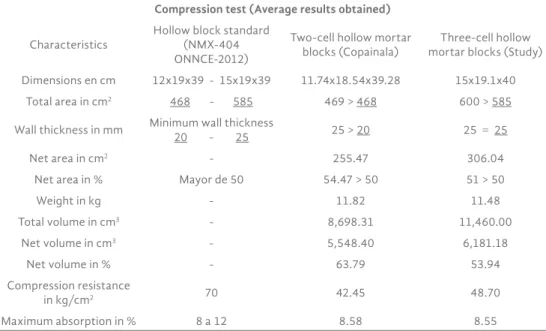
• Records and measurements of each piece were made. Pieces average dimensions were: 11.74 cm wide, 18.54 cm high and 39.28 cm long, their exterior and interior walls were greater than 25 mm; average total area was 469.01 cm2 and net area was 255.47 cm2, which corresponds to 54.47%. Dimensions and calculations were verified with the corresponding standard (nmx-c-404-onncce-2012), and it was found that obtained results were within specified parameters and tolerances.
• Each block piece was weighed and, on average, a weight of 11.82 kg was obtained.
• Then, the absorption test of the pieces was performed. Each dry piece was weighed before being immersed in water for 24 hours;
then each piece was weighed again to obtain absorption percentage.
Average absorption obtained was 8.58%, which, according to current standard, is in range established between 8 and 10% (ntc, 2017).
Prior to resistance test, each piece was pitch tested to create a uniform surface, on both sides and with 48 hours of drying, before being placed in the machine and performing the compression test (Image 13).
Image 13. Pitching of the mortar blocks. Source: Own elaboration
Image 14. Compression test. Source: Own elaboration
• Finally the test was executed and an average compression resis- tance of 41.45 kg/cm2 was obtained. Tests were carried out in an Elvec digital electric press with a compression frame of 120,000 kgf. In each test the load was applied with uniform and continuous speed, without producing impact nor loss until reaching failure by the maximum load applied to the specimen, which was divided by net area to determine compression resistance. In this regard, the standard (nmx-c-404-onncce-2012) specifies that minimum compression resistance of block must be 70 kg/cm2; which means that this standard was not met (Image 14).
6. PROPOSED HOUSING MODEL
In the elaboration of housing models, characteristics and conditioning factors of the analyzed houses were considered; in addition to applying preferential and accessible construction technique for inhabitants from the use of hollow mortar blocks, with the purpose of creating appropriate models to the context of the area of study that attend to spatial and service needs of the families. Proposals were mainly oriented to guarantee inhabitants safety.
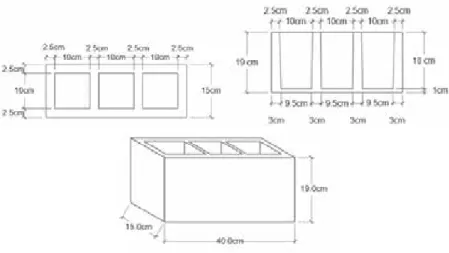
For this reason, the study focused on addressing the walls structure, using masonry with hollow pieces with reinforcement inside the cells, as established in the Normas Técnicas Complementarias para el Diseño y Construcción de Estructuras de Mampostería de la Ciudad de México (ntc, 2017). In this regard, for the walls construction it was determined to use three-cell hollow block mortar pieces, proposed in similar cases by Escamirosa, et al. (2016) (Image 15)
Figure 15. Characteristics of the three-cell hollow block. Source: Escamirosa, et al. 2016
The same amount of materials used on site by inhabitants was applied to the production of the three-cell hollow mortar blocks: 15 cans of sand (19 liters per can) and 3 cans of water, for a cement bundle. The mason who helped to make the pieces, Virgilio Castellanos Guzmán, followed the same procedure used by inhabitants:
• Homogenization: Materials were mixed, cement-sand, and water was added.
• Blocks manufacture: The mixture was poured into the mold and compacted with the help of a bar. Then, the mold was raised with handles and dropped freely three times, to achieve greater mixture compaction and avoid gaps inside the mold, then removed excess mixture with the bar. With this process, the density of the pieces was increased and, therefore, greater resistance was obtained. In the elaboration of the pieces in the locality, to compact the mixture, only the mold containing the mixture was dropped freely, on one occasion only (Images 16 and 17).
• Storage and drying of the pieces: On site, the mold was removed and the pieces were obtained, which were then left to dry and, after three or four hours, the concrete was cured for six days. This curing process (wetting of blocks) was not carried out in the town’s pieces production.
Image 16. Block manufacturing process. Source: Own elaboration
Image 17. Mold Removal Process. Source: Own elaboration
In the previously described procedure, compaction of the mortar contained in the mold was improved and necessary piece curing was ensured. It is important to point out that due to the lack of experience in the elaboration of three-cell blocks, Virgilio Castellanos had difficulties at the beginning to obtain the pieces, since they were crumbling when trying to remove the mold; however, after several attempts, the process was easy and fast to execute. A total production of 37 block pieces was obtained, with dimen- sions of 15x19x40 cm. production process began at 8:00 a.m. and ended at 12:30 p.m. on the same day.
After the necessary time for the mortar blocks to reach maximum resistance, compression and absorption resistance tests were carried out;
five pieces were selected at random and tested in the laboratory. In the first stage, each piece was recorded and characteristics of the 5 specimens were measured; average dimensions were 15x19.1x40 cm, average net area was 51% of the gross area, which is equivalent to obtaining an average net area of 306.04 cm2; likewise, each specimen was weighed and the average weight was 11.48 kg (Images 18 and 19). Then, absorption test was performed, obtaining an average absorption of 8.55%, which is within the range established in the standard (ntc, 2017). In the second stage, the compression test was performed on each specimen and average compression resistance of 48.70 kg/cm2 was determined.
Image 18. Registration of the pieces of the block. Source: Own elaboration
Image 19. Pitching process. Source: Own elaboration
Table 2 shows average results obtained from tests applied to the two-cell hollow mortar blocks made in the locality, and the corresponding results of the three-cell hollow mortar blocks. Results show average compression resistance obtained from blocks, in both cases, with the same amount of materials, but with different molds and manufacturing process (three-cell pieces had greater compaction and were properly cured); it is also observed in the results obtained that three-cell hollow blocks had better compaction and therefore, a greater resistance (48.70 kg/cm2); likewise, results show that these pieces have very low water absorption, which, corroborates the above mentioned; the greater the compaction, the less the absorption.
Table 2
Average results of resistance to compression and absorption
Compression test (Average results obtained) Characteristics
Hollow block standard (NMX-404 ONNCE-2012)
Two-cell hollow mortar blocks (Copainala)
Three-cell hollow mortar blocks (Study) Dimensions en cm 12x19x39 - 15x19x39 11.74x18.54x39.28 15x19.1x40
Total area in cm2 468 - 585 469 > 468 600 > 585 Wall thickness in mm Minimum wall thickness
20 - 25 25 > 20 25 = 25
Net area in cm2 - 255.47 306.04
Net area in % Mayor de 50 54.47 > 50 51 > 50
Weight in kg - 11.82 11.48
Total volume in cm3 - 8,698.31 11,460.00
Net volume in cm3 - 5,548.40 6,181.18
Net volume in % - 63.79 53.94
Compression resistance
in kg/cm2 70 42.45 48.70
Maximum absorption in % 8 a 12 8.58 8.55
Source: Own elaboration
On the other hand, in of Latin America countries and the Caribbean that have worked on the confined masonry system, such as Domingo Acosta (2005), a system of structural masonry confined walls with steel reinforce- ment for low-cost housing has been proposed, and the performance of the masonry and its seismic-resistant capacity has been improved; the work carried out by Escamirosa, et al, (2016), in rural housing prototypes construction in Ocuilapa de Juárez, Chiapas, with masonry walls with three-cell hollow mortar blocks, confined with steel reinforcement inside, in the vertical and horizontal direction, according to technical standards and with the use of local techniques and materials of the place; sand with
high clay content (22%). results of the seismic evaluation carried out on these prototypes, based on in situ measurements with an accelerometer, showed that dwellings structural efficiency is satisfactory (Escamirosa, et al., 2018). Without a doubt, reinforcement steel inside the walls increases the seismic-resistant capacity of the masonry walls and, consequently, reduces the seismic vulnerability of the houses.
6.1 Progressive housing models proposal: "A" and "B
In alternative housing models: "A" and "B", for families in the colonies: El Triunfo, Vicente Fox and Siglo XXI, the minimum necessary spaces are considered, with the possibility of expanding and building in stages - progressive growth. Designs of the two models "A" and "B", were developed on a modular quadrangular grid of 3 m x 3 m, with a surface of 36 m2 starting house, which allows to organize functional, technical-constructive and structural aspects, adapting them to different requirements and functions that users carry out.
Proposals were based on the study carried out, from houses social and technical-constructive aspects, involving inhabitants (users), typology, rescue of some traditional elements and techniques, use of local materials, etc., with the purpose of reducing construction costs. House characteristics are the following: Gable roof, walls with pieces of three-cell hollow mortar blocks, necessary interior spaces: living-dining room, kitchen, bathroom and bedrooms; also, with possibility of expanding (progressive), with two options: towards the front or in double height. To achieve a good structural configuration, the house architectural spaces were defined in a modular sense, which manages to obtain symmetry in floors, as well as in elevation.
Both housing proposals contemplate the rescue of vernacular elements, such as the gabled roof with clay tiles on roof and portico that will give access to the house, but with masonry walls with pieces of hollow mortar block. On the other hand, use of materials from the region is very important in the proposals: use of sand and stone from the place for the construction of the foundation, walls and other concrete elements; also, wood from the place in the structure of the roof, or in doors and windows. Constructive elements proposed for both models are: foundation of stone masonry of the place, walls of three-cell hollow mortar blocks (modular), roof with wood structure and tile of colonial mud, floors with firm of concrete, doors and windows of metallic frames or, in its case, of wood, to the taste and economic possibility of the user.
Type "A" housing model (progressive single-store house).
This housing, is proposed for families of 2 up to 5 members, from a compact model with a surface of 36 m2, and it is developed in a plant, organized by two bedrooms, stay, dining room, kitchen and bath; later, the option to extend housing is available, in agreement with the family’s economic possibilities. Extension in a future growth is given in the front part of this one, where it is considered the access porch that distributes towards the housing interior. Future growth consists of a bedroom and the extension of spaces in the living and dining room (Plans 1 and 2; Images 20 and 21).
Housing model "B" (progressive double height housing).
The second proposal is similar to the previous one, in terms of space and distribution of the starting house. For future growth, a double height (mezzanine) is considered. In the access there is a staircase that leads to the mezzanine that considers the space for two more rooms. Ground floor is distributed with a living-dining room and kitchen, with open spaces and two bedrooms. The bathroom module is the only one that is closed. The proposed construction elements are the same as model "A". However, in this model, a higher height in the walls for wall covering and with the roof sloping to two waters is considered (Plans 3 and 4 and Image 22).
Plan 3. Architectural Floor Model "A" (Starting house). Source: Own elaboration
Plan 4. Architectural Floor Model "A" (Future horizontal growth). Source: Own elaboration
Image 20. Model “A” perspective (Starting house). Source: Own elaboration
Image 21. Model “A” perspective. (Future growth) Source: Own elaboration
Plan 1. Architectural Floor Model "B" (Starting house) Source: Own elaboration
Plan 2. Architectural Floor Model "B” (Future horizontal growth) Source: Own elaboration
Image 22. Model “B” perspective (two floors) Source: Own elaboration
The following technical recommendations are proposed, with the aim of facilitating construction process and supporting low-income families in building their homes, in accordance with the standards (ntc, 2017)
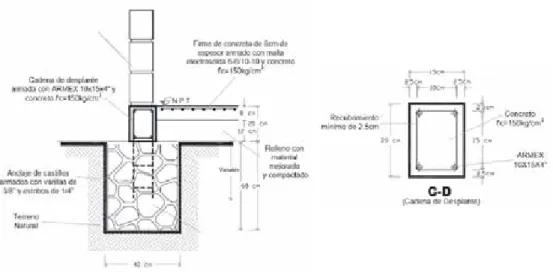
• Foundations: Masonry with local stone, seated with cement-sand mortar; ratio 1:3.5 (1 bag of cement, 7 cans of local sand and 1½ of water) The base will be 40 cm wide and 60 cm deep, with a trowel chain reinforced with armex (10x15x10 cm) and concrete f'c = 150 kg/cm2 (1:3:4 = 1 bag of cement, 6 cans of screened sand from site, 8 cans of gravel from ¾" and 2 cans of water) (diagram 1 and plan 5).
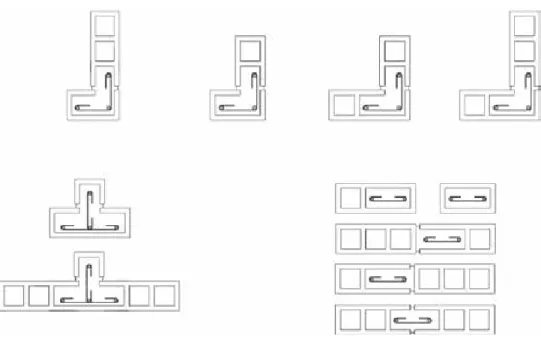
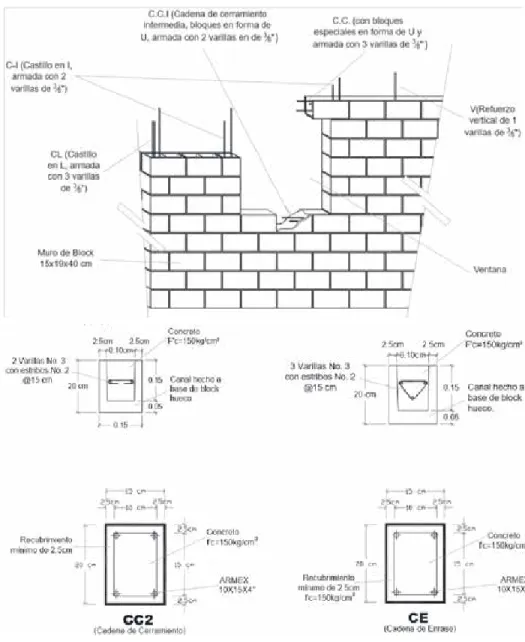
• Structure: The walls will be made of three-cell hollow mortar blocks, confined with castles and reinforced concrete chains of f'c=150 kg/cm2, in intersections and in openings of doors and windows; additionally, vertical and horizontal elements of rein- forced concrete will be placed inside the cells, with characteristics indicated in diagrams 2 and 3, and in model 5. Mortar with a 1:4 proportion will be used to join the pieces (1 cement lump, 8 cans with local sand, 1¾ water).
• Roof: The roof is proposed to be gabled, with a wooden structure that will support a local clay tile roof, with 16x18x46 cm dimen- sions. The wooden structure is installed starting from the center of the house and supporting the ends of it, on the side walls; the wood, on the other hand, is made of pine from the municipality of Coapilla, located 35 km from Copainala, where there are legal sawmills to acquire and transport the wood. Dimensions used in the sections of the elements, are those of common use; rulers of 2.5x10 cm, bars of 5x10 cm and 5x15 cm, pollen of 10x10 cm, and according to the specifications of the norm (plane 6).
• Floors: On the foundation base, 12 cm of improved and compacted material are placed, which will receive the 8 cm thick concrete pavement, reinforced with 6-6/10-10 electro-welded mesh and f'c concrete = 150 kg/cm2.
• Service installations: In cases where there is no sanitary sewage network, a bio-digester or septic tank will be used in the house.
Regarding the supply of electricity, colonies have this service; they also have water service, which reaches the houses through the municipal network. Both housing models consider construction of a tank for water storage.
Diagram 1. Proposal for the foundations of the houses. Source: Own elaboration
Diagram 2. Placement of hollow block pieces to build castles on the walls. Source: Own elaboration
Plan 5. Proposed type of foundation for housing. Source: Own elaboration
Diagram 3. Steel reinforcement inside wall, both directions. Source: Own elaboration
Plan 6. Proposed type of roof for housing. Source: Own elaboration
CONCLUSIONS
The study conducted in the homes of low-income families in El Triunfo, Vicente Fox and Siglo XXI colonies in Copainalá, Chiapas, identified the presence of cracks in masonry walls built with hollow mortar blocks located at the intersection of these and in the vicinity of door and window openings, which are the result of insufficient structural confinement. In this regard, and in order to take advantage of the experience of local labor force and
the inhabitants preference for two-cell hollow mortar blocks and a section of 12x19x40 cm, for the construction of their homes, it is proposed to use new pieces of hollow blocks, with three cells and a section of 15x19x40 cm, made with the same amount of materials used on site by inhabitants, but with better compaction and curing of concrete. Obtained results in the laboratory tests, show that the average resistance to the three-cells pieces compression, increased 14.73%.
On the other hand, the characteristics of the houses, uses and customs, typology and materials of the place used, guided the formulation of two models of alternative housing: "A" and "B", that were designed based on the norms and low income families spatial needs. Application of a construction technique known and preferred by inhabitants, based on masonry walls with new pieces of hollow blocks, with three cells and a section of 15x19x40 cm, will facilitate house constructions, and in particular, of castles steel reinforcement placement at walls and the chains intersection; as well as reinforcement inside the cells, in both directions, distributed along the length and height of walls, as indicated in the standard for masonry walls in the Mexico City building regulations (ntc, 2017). It is also proposed to start construction with a minimum surface (starting house), of 6 x 6 m, with possibilities of growth in the future, from a modular structure of 3 x 3 m.
Model "A" considers a frontal progression, and model "B" proposes a vertical progression (double height), so that families will have the possibility of choosing the housing model most favorable to their needs, according to the availability of their economic resources. In addition, housing proposals aim to reduce construction costs, both in the use of materials and labor, since the placement of steel reinforcement inside the cells of the pieces, eliminates the use of formwork (wooden formwork).
The work presented here is intended to contribute to the improve- ment of housing and reduction of vulnerability to seismic events, for the benefit of low-income families in Copainala. The characteristics of the models proposed facilitate construction process and support families in the construction of their homes. However, in order to avoid bad construction practices, participation of authorities with technical advice and construction follow-up should be considered. Likewise, in self-construction of housing, technical assistance of a facilitator is recommended: a student or technical professional from the University, who guides the construction processes established in the information. "Fulfilling this purpose is a great aspiration for the University, the linkage of its work with social reality. Although it is true that proposals made for housing and sanitation are at project level, we believe that this is a good start for the management and search for financing to materialize the proposed housing" (Escamirosa, 2001).
REFERENCES
Acosta, Domingo, Christian Vivas, Enrique Castilla y Norberto Fernández (2005). Sistema de muros de mampostería estructural confinada con perfiles de acero para la vivienda de bajo costo. Venezuela.
Bazant, Jan (2003). Viviendas progresivas. Construcción de vivienda por familias de bajos ingresos (Ed. Trillas). México.
Comisión Federal de Electricidad [cfe] (2008). Manual de diseño de obras civiles de Comisión Federal de Electricidad. Diseño por sismo (pp. 4-53).
México: Instituto de Investigaciones Eléctricas. Recuperado de http://
es.scribd.com/doc/52197523/cfe-Sismo-08#scribd
Hernández Castro, Nieves Lucely (2006). Conformación del hábitat de la vivienda informal desde la técnica constructiva. Colombia: Universidad Nacional de Colombia.
Escamirosa, L. (2001). Mejoramiento de la vivienda y saneamiento de la comuni- dad Nuevo San Juan Chamula, Mpio. de Ocozocoautla de Espinosa, Chiapas, Facultad de Arquitectura, Universidad Autónoma de Chiapas. México Escamirosa L., Mérida A., Ocampo M., Zebadúa S., López A., Badillo R.,
Molina N., Del Carpio C., Pérez L., Linares M., De la Torre R. y Reyes B. (2016). Manual para la autoconstrucción de viviendas y servicios sa- nitarios en el medo rural. Caso de estudio: Ocuilapa de Juárez, municipio de Ocozocoautla de Espinosa, Chiapas (2ª Ed.), México: Universidad Autónoma de Chiapas, 322 pp.
Escamirosa, L., Arroyo, R., Ocampo, G. & Del Carpio, C. (2018). Evaluación sísmica en dos prototipos de vivienda rural construidos con bloques de concreto hueco, en Ocuilapa de Juárez, Chiapas, México. Chile: Revista Ingeniería de Construcción, 33(1), 29-40. Recuperado de http://dx.doi.
org/10.4067/S0718-50732018000100029
Instituto Nacional de Estadística & Geografía [inegi](2010). Conteo de Población y Vivienda 2010. México.
Instituto Nacional de Estadística & Geografía [inegi](2017). Conteo de Población y Vivienda 2015. México.
Kendall Kenneth E. & Kendall Julie E. (2005). Análisis y Diseño de Sistemas.
Pearson Educación, México.
nmx-c-404-onncce (2012, diciembre 13). Norma Mexicana de la Industria de la Construcción para Mampostería de bloques, tabiques o ladrillos y tabicones para uso estructural, Especificaciones y Métodos de ensayo (pp. 1-16). Organismo Nacional de Normalización y Certificación de la Construcción y la Edificación S. C., México.
Normas Técnicas Complementarias [ntc] (2017, diciembre 15). Normas técnicas complementarias para el diseño y construcción de estructuras
de mampostería (pp. 614-688). Gaceta Oficial de la Ciudad de México.
México: Gobierno de la Ciudad de México.
ACKNOWLEDGMENT
We would like to thank everyone who gave their support for this work: families interviewed, Mr. Isidro Vázquez and Mr. Virgilio Castellanos Guzmán. Special thanks to Nguyen Molina Narváez, head of the Materials Laboratory of the Faculty of Architecture of the Universidad Autonoma de Chiapas, for his facilities and advice on experimental trials. To all of them, our sincere thanks.