AND SUSTAINABILITY FOR TOURIST DESTINATIONS
Dr. Aurora Pedro Bueno [email protected]
University of Valencia
Keywords: tourism competitiveness, competitiveness models, measuring competitiveness, destination, destination management, sustainable tourism, sustainable tourism indicators.
Since the second half of the last century, tourism has gained weight between the productive activities of countries and regions worldwide. Although traditionally economic growth has been identified with the expansion of the industry, in the last decades of the twentieth century tourism was consolidated as another productive sector, capable of generating employment and income.
The characteristics of this activity allow it to develop, with more or less intensity and success, in areas excluded from the expansion of industrial activity. Moreover, it has become an opportunity for areas hit by deindustrialization and a complementary activity to rural areas and those at risk of depopulation.
Tourism has established itself as an activity of great importance internationally. According to the WTO (WTO, Tourism Highlights 2014, 2014) tourism accounts for 9% of the world´s GDP, 6% of world exports, 29% of service exports worldwide, and generates one in eleven jobs globally . In addition, growth forecasts are optimistic:
it is expected to reach 1.400 million arrivals in 2020 and 1.800 million arrivals in 2030 (WTO, 1999, 2011; see Figure 1).
In a context of deep economic crisis that is affecting mainly the large regions of the world, tourism is still a growing and expanding activity. Tourist arrivals worldwide increased in 2013 by 5% over the previous year, and developed countries have grown above the world average (5.4%) and the emerging countries lower (4.5%).
That is, despite the economic crisis that hit the most advanced economies the hardest, there is being recorded an increase in international tourist arrivals higher than the world average. By region, there is a notable increase in Asia and the Pacific (6.2%) and Africa (5.4%), followed by Europe (5.4%) and the Americas
(3.2%). The Middle East recorded a decrease (-0.2%) due to political instability and armed conflicts affecting some countries in the region1. In 2014, very positive data returned, resulting in a new record. Until October this year the number of international arrivals has increased by 5%.
If we consider a longer period, from 2005 to 2013, we can confirm how emerging economies have increased the number of international arrivals above the world average and from advanced countries: 4.8% versus 3.8% and 3% respectively. Asia and the Pacific (6.2%) and Africa (6.1%) increased above average in this period. The remaining regions that the WTO noted grew below average were noteworthy- Europe and the Americas with the smallest increase: 2.9% for both. It is confirmed, therefore, one of the forecasts made by UNWTO for 2020 first and then for 2030:
the world’s leading destination, Europe, is losing market share worldwide (WTO, 1999, 2011). On the other hand, as expected, increasing the global middle class will encourage tourism growth in emerging countries.
Tourism income has shown a similar behavior. Globally, it rose 5.3% between 2012 and 2013, registering a greater increase (6%) in advanced countries and 4% in emerging countries. Regionally, behavior was very different: the largest recorded increase was in the Asia Pacific region, with 8.2%, followed by the Americas with 6.4%. Europe recorded a more moderate (3.8%) increase, while Africa and the Middle East remained down by 1.9%.
Highlighting another feature of this activity worldwide: the speed of recovery after a crisis or resilience. The impact of political and military (such as the Gulf War) crisis, terrorist attacks (like 9/|11), climatic disasters (hurricanes, floods), epidemics (such as SARs), the economic crisis ... is quickly reflected in a drop in arrivals. But the recovery of this activity is very fast.
1 http://media.unwto.org/press-release/2014-12-18/international-tourism-track-end-2014-record-numbers
Figure 1. Forecasts for growth of tourism in 2030. UNWTO
THE CONCEPT OF COMPETITIVENESS. MODELS OF COMPETITIVENESS
The reflection on competitiveness and the elements that improve a competitive position has figured prominently in economic research since the last quarter of the last century instead. Michael Porter (1980, 1990) launched a line of work and research on competitiveness that has left a mark investigation until today. Porter’s work has focused mainly on industry, although some concepts have been useful also in the world of tourism.
Growth and economic development of a country is determined by the microeconomic conditions. If companies are competitive, countries will be competitive.
If for the classics comparative advantages explain the differences between the degree of industrialization of the country’s export capacity and ultimately economic growth, for economists of the twentieth century the growth differential is explained by
the ability of countries companies to build competitive advantage.
Especially after the reflection of Porter, competitive advantage will be the subject of special attention to explaining the different economic success of countries.
In economics, competitiveness is defined as the ability to compete in markets for goods and services. It is the capacity to sustain and improve the added value or per capita income, but also to maintain or promote trade balances with the rest of the world or to attract foreign direct net investment. This ability depends largely on the ability to generate new ideas and to generate innovations in both products and processes.
Competitiveness is a relative (a country is more competitive in relation to another country) and multidimensional (multiple variables affect it) concept. It is therefore a very complex concept to analyze and measure, although there has been developed indices that measure and provide a ranking of countries based on a number of variables.
In the scheme proposed by Porter, competitiveness advances in leaps. We can distinguish several stages that mark the evolution of competitiveness of a nation:
• Step-driven by factors: the basic factors are essential and widespread source of competitive advantage.
• Step-driven by investment: the competitive advantage lies mainly in a heavy investment that allows better and more specialized factors.
• Step-driven by innovation: the sophisticated local demand, domestic rivalries and support clusters of companies generate benefits.
Innovation is therefore essential at this later stage because:
• Innovation increases productivity
• Productivity determines the standard of living of a country
• Productivity determines competitiveness
If companies are competitive, countries will be competitive. The analysis must therefore focus on business and the environment in which this takes place. It is at this level that the strategy should be designed to improve competitiveness. The companies are located in clusters, next to other competitors and others which offer services necessary for production and sales (transportation, inputs, financial advice, etc.).
In Porter’s model, clusters are homogeneous geographic areas that have a very own distinct strategy with sufficient infrastructure for the entire area, and that make trade relations between them.
The proximity offered by the cluster companies can create business networks that interact and strengthen ties thanks to its proximity and physical, technical, economic and social complementarity in a favorable territorial and institutional framework. The reasons why companies tend to focus on a cluster are:
1. Access to providers, services and labor specialists 2. Information advantages
3. Flexibility and rapid change due to the extreme specialization 4. Imitation facilitates rapid adoption of innovations
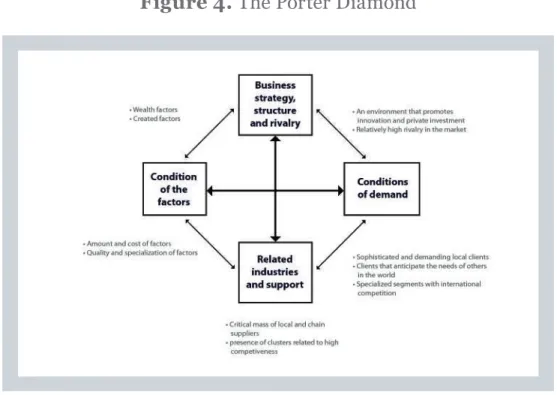
From these concepts, Porter’s diamond details the cluster elements and the relationships established between them (Figure 4).
• Strategy, structure and business rivalry: the context that gives competition incentives based on investment and the best sustained organization; strong competition between local rivals.
• Terms of factors: the importance of quantity and cost of inputs; their quality ; specialization of production factors.
• Related and supporting industries: Presence of capable local suppliers and companies in related areas;
clusters instead of isolated industries.
• Demand conditions: sophisticated and demanding local customers; specialized segments that can be served globally; clients whose needs are anticipated to the region and other areas.
Figure 4. The Porter Diamond
These elements constitute the environment of productive activity.
It is the environment that permits greater competition between companies on the one hand, and greater cooperation by others.
As we mentioned, Porter’s model was designed for the industry.
However, some of the concepts and elements of it can be adapted and incorporated into tourism. The research on tourism competitiveness has advanced significantly. In addition, in recent decades, a repeated idea is that destinations have to take chances to be more competitive in a changing world.
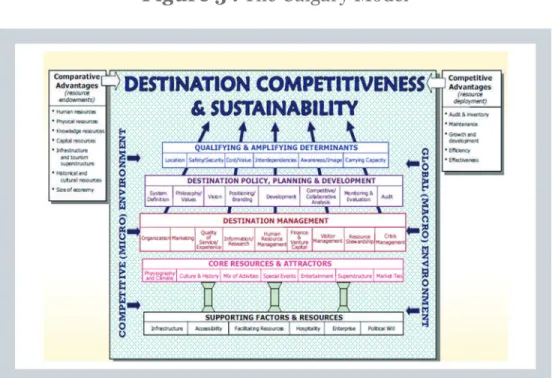
Among the various proposals and models, we can highlight the model of tourism competitiveness of Crouch and Ritchie (Crouch & Ritchie, 1999; Ritchie & Crouch, 2000, 2003). This model is considered as the most comprehensive approach to tourism competitiveness, although not the only proposal or model (Mazanec, Wöber, & Zins, 2007). The model is based by distinguishing between comparative and competitive advantages while it intends to include all factors that determine the competitiveness of a tourist destination, distinguishing five major sections: qualifiers and amplifiers (location, safety, cost, dependencies, etc.), policy, planning and destination development (vision, positioning and branding, analysis, audits, etc.), destination management (organization, marketing, information and research, HR management, etc.) and resources and support factors (climate, history and culture, leisure, etc.). From this model, an initial proposal of 32 items that can be considered a first index of compound competitiveness to a destination is performed.
The model recognizes that tourism competitiveness is based on the resources endowed to the destination (comparative advantage) and the ability to develop resources (competitive advantage) (Figure 5).The model also recognizes the impact and influence of the global environment (for example: global economy, terrorism, demographic trends, etc.) and competitive circumstances of the micro-environment affecting the tourism destination. The model recognizes 36 competittiveness attributes in five grades groups.
Attractors include eleven elements: natural, summit, cultural and social, general infrastructure, basic infrastructure services, tourism superstructure, access and transport facilities, tourist attitudes, price levels and costs, etc. Among the detractors of destinations are security (political instability, health, laws and regulations such as visas, etc.). These factors may act as barriers when visiting a particular destination.
Figure 5 . The Calgary Model
Ritchie and Crouch (2003)
The Ritchie and Crouch model is not the only proposal for conceptualization and management indicators of tourism competitiveness2. But they to introduce for the first time the main elements to consider regarding the concept of tourism competitiveness.
Why is the concept of competitiveness so important for a tourist destination? Research on tourism competitiveness will allow a better understanding of the elements that determine if a destination is more or less competitive (Crouch, 2007; Mazanec, Wöber, & Zins, 2007). More knowledge is this area can help tourist destination managers to better manage it, especially when the public-private management has become increasingly important.
2 Mazanec, Wöber, & Zins (2007) made a revision of various proposals about competivity and destination ma- nagement.
TOURISM COMPETITIVENESS AND TOURISM DESTINATION
There is still no single accepted definition of competitiveness in tourism. If we look at the definition used in economics, competitiveness can be defined as the ability to maintain and improve the added value or per capita income, but also the trade balance or even the ability to attract foreign direct net investment.
It also refers to the ability to create and innovate from a more dynamic perspective3.
To Ritchie and Crouch (2000), competitiveness can be understood as the ability of a country to create value and enhance national welfare, by managing processes and attractive advantages, aggressiveness and proximity, and integrating the relationships between them in an economic and social model.
In a narrower sense, it can be defined as the ability to respond to consumer demands, especially when these demands are consistently and significantly changing. Competition between destinations makes them have to be differentiated from each other by offering distinctive, high quality experiences (CES, 2013).
For Dupeyras and MacCallum (2013), the competitiveness of a tourist destination is the ability to optimize its attractiveness to residents and non-residents, providing quality tourism services which are innovative and attractive (for example, providing a good value or “value for money “) to consumers and gain market share in both domestic and international tourism, while ensuring that the available resources which support the development of the tourism activity are efficiently and sustainably used.
As we see there is no single definition of tourism competitiveness (CES, 2013). As Mazanec, Wöber, & Zins (2007) show , there is no broad agreement on the concept of tourism
3 See CES (2013)
competitiveness, although they seem to have agreed on a broad interpretation as proposed by Ritchie & Crouch (2003, p. 2): “what makes a competitive tourist destination is the ability to increase tourism spending, increasingly attracting visitors while they offer memorable and rewarding experiences that are profitable for the destination, while the welfare of the residents of the destination is improved and the natural capital of destination is preserved for future generations. “
Considering these definitions and considerations, the ability of the destinations to maintain and improve the main indicators of tourism in destinations (number of tourists, tourism expenditure, etc.) depends increasingly on destination management.
Destinations are facing increasing domestic and international competition, depending on the type and characteristics of each destination. The creation of the basic adequate conditions that generate unique tourism experiences are “memorable and successful”- in other words innovation is not only in the hands of private companies, but the opportunities generated in the environment where they are located.
The destinations management becomes more important in a globalized world (“think globally, act locally”). Management involves in first place knowledge, and so it is important to “know what their internal structure and components are because, in the extent that one place includes all of its elements (supply, demand, transportation and marketing) it acts as a small scale laboratory of the tourism system. “ (González, F., 2012, p. 8)
The concept of a tourist destination as we see in the definition of the WTO approaches the concept of Porter’s cluster. The homogeneity, in the case of the destination, would be related to:
• The territorial and urban model
• The economic, cultural and natural resources
• Infrastructure and environmental management
• The behavior and characteristics of supply and demand
• The inter-municipal complementarity
Thus the competitiveness of businesses is also strongly influenced by the environment: the destination. The destination is composed of a number of elements of very different natures, which include private companies and public property, natural resources, the resident population, etc. In short, the destinations are given, just as in the cluster, two major strengths: competition (rivalry) among companies that form it, and another of cooperation and collaboration.
Since the early 1990s, tourism research focused on understanding the elements and structures of competitiveness of tourism destinations. One can distinguish two main lines of research and generation of knowledge (Crouch, 2007):
1. Focused on specific elements of the tourism competitiveness: pricing, marketing, positioning, destination management systems, etc.
2. Centered in knowing and understanding competitiveness holistically.
We can also find a number of important investigations that focus on tourist destinations (USA, Las Vegas, ski resorts, etc.).
The literature on tourism competitiveness has improved the understanding of this concept from the theoretical and conceptual models applied to tourism. The different investigations have allowed progress can be made one step closer towards empirical research and analysis of tourist destinations and markets. For them it is fundamental to enhance the knowledge of the elements that promote competitiveness in the destinations, as well as their relationship or situation at different stages of development of the destinations (Dwyer and Kim 2003; Mazanec, Wöber, &
Zins, 2007).
As experts note, there are still significant gaps in some aspects of tourism competitiveness, especially the assessment of the relative importance of different attributes of competitiveness. This is a vital
aspect in the management of tourist destinations if we consider that resources are scarce and should be directed towards actions that would allow further progress on competitiveness. It is also vital to advance research on the issues that affect competitiveness at different stages of development of the destination, for example what combinations of factors are most appropriate for improving competitiveness at different times of the life cycle of a destination.
MANAGEMENT OF TOURIST DESTINATIONS
The tourist destination is the appropriate level of action to adequate the tourism offer to changing consumer demands. It takes place where the tourist experience takes place; a result of a combination of public and private property; the quality of the tourism experience depends not only on what the private enterprise is able to offer (hotel, restaurant, etc.), but the environment in which the visit takes place (quality of the urban environment, safety, sanitation, information, etc.). Economic and social globalization, information technology and communication, economic and social changes, the challenges of sustainability, etc., have increased pressure on destinations. Tourism has become an industry capable of generating income and employment. For the already consolidated destinations, maintaining the activity (measured in number of tourists and / or income) is critical for profitable facilities and to continue to offer employment. For those who are still in the early stages of the life cycle (introduction, growth), they remain committed to attracting tourists as its main objective. Increasing global competition between destinations requires advance thinking on the issues that affect the management of destinations.
The management structures of destinations (Destination Management Organization or DMO) have emerged from the need to respond to the needs and requirements of the agents involved in tourism: the public sector, private sector, residents, and tourists. At
their start , DMO’s often have limited and very specific functions, generally related to promotion, that continue to expand to generating product information, act as hosts to tourists, etc. (FEMP, 2006). In the present context, the DMO is acquiring more functions due to the increased international competition and complexity of a changing market and consequently, are becoming more professional. The participation of other actors besides the public sector, especially the private sector, is one of the characteristics of the destination management since late last century.
A competitive destination is an innovative destination. It is the destination where innovation takes place in tourism. The multilevel cooperation (public-private) between different agents is a vital aspect in this process. A differential fact with respect to other economic activities is the presence of a large diversity of actors (public and private institutions, educational, financial, local development agencies, etc.).With this diversity of actors and taking into account the reasons we have discussed for public intervention, it is precisely the public sector who has to take the initiative and leadership, while incorporating decisions and financing into the private sector ( “3P model-Private-Public-Partnership).
With regard to management, experts have made several proposals for indicators. The indicators can be grouped into four categories (Dupeyras & MacCallum, 2013; p. 14):
• Indicators that measure performance and impacts: the increase in the value of tourism is important for advanced tourism economies, for what implies the maintenance of competitiveness in the global tourism market as compared to other industries. Increasing the value of tourism requires the review and collaboration across the tourism value chain, which can help overcome high fragmentation, create a better experience for the tourist and better use of existing infrastructure, staff and resources. For an indirect measurement of these issues traditional tourism indicators
can be useful that measure changes and trends in jobs, income and revenue.
• Indicators that measure the ability of a destination to offer quality and competitive tourism services: this measurement should start with the business environment and supply or production structure. As mentioned, a direct source of competitiveness for a destination is a dynamic environment for tourism businesses. Thus, this group of indicators relate to the supply side of the tourist economy.
• Attractiveness indicators of a destination: the attractiveness of a destination is a broad concept, but closely interconnected with the notion of competitiveness and quality of the tourist experience. I.e., maintaining competitiveness requires maintaining and improving the attractiveness and distinctiveness of the destination, with special emphasis on natural and cultural resources and a welcoming lifestyle.
• Indicators that describe economic opportunities and the political responses: well-designed policies to improve competitiveness and sustainability generated from dynamic environment and appropriate institutional framework.
Tourism policies can help create new values that support development and develop innovative tourism services.
The introduction of indicators can help significantly in management.
As we have seen, these proposals are based on theoretical models that attempt to explain tourism competitiveness. However, they are still proposals for improvement. The main criticisms of the existing systems of indicators are (Mazanec, Wöber, & Zins, 2007;
Crouch, 2007):
1. Most theoretical models give little attention to the appropriate level of aggregation for the destination.
The concept of the destination continues to drag a bias still very much oriented towards production.
2. From an epistemological point of view, some of the models, such as those by Ritchie and Crouch, indicate that there seems to be more efforts for defining, while before models reflected cause-effect relationships. That is, they end being just a relationship of elements that can affect competitiveness, but not determining how.
3. Tourism competitiveness models have begun to incorporate economic theories recently. For example, the theory of hedonic prices.
4. If tourism competitiveness should lead to improving the welfare and prosperity of the resident population, the debate about whether external criteria to measure the tourism competitiveness (such as market share ...) are suitable.
In short, while the theoretical frameworks and definitions of tourism competitiveness does not adequately incorporate causality and effect, the practical benefit to the management of tourist destinations is limited. They can be useful to highlight the weaknesses and strengths of a destination. We know there are a large number of factors affecting competitiveness and they are difficult to handle in management. In addition, some of these factors are the responsibility of organizations and many different players within the destination. And when you consider that it is a relative concept, it also depends on what is happening in other destinations. Nor do we have confirmation of how the different elements of tourism competitiveness may determine the destination at different stages of development. Ultimately, further progress is needed in knowledge about tourism competitiveness.
In conclusion we highlight the following (Peter, 2012):
• A more competitive tourism sector contributes to a more competitive country and reaps greater benefits for the country.
• The competitiveness of tourism destinations depends on the ability of its industry to innovate and constantly improve the quality of their products.
• Competitiveness depends heavily on the work done in local tourist destinations.
• National policies should be designed to help local tourism destinations to improve their competitiveness, creating dynamic and efficient environments.
• Continuous improvement of the tourism cluster is the source of competitive advantage in markets where competition is chosen.
• Quality and efficiency are fundamental in improving competitiveness.
THE MEASUREMENT OF COMPETITIVENESS.
THE CASE OF MEXICO AND CHIAPAS
As we have seen, the reflection on the competitiveness of destinations has evolved in the definition of the elements that determines or affects competitiveness and that may be important for the management of destinations. In a study conducted in 2009, the European Union identified 5 major factors for increasing competitiveness and adapt to the environment (ECORYS, 2009): political, economic, environmental, social, technology and innovation. These factors will be different if we look at the major tourism sub-sectors: transportation, lodging, attractions, tourist, brokers, etc.
The World Economic Forum (WEF) has published the Global Competitiveness Report that evaluates the competitiveness of countries4. For many years this same agency has published Travel
4 Since 1996 the WEF has made a study about competitiveness in collaboration with Harvard Business School (M.
Porter) and with the Center for International Development of Harvard University (J. Sachs, A. Warner).
and Tourism Competitiveness Index (TTCI) every two years.
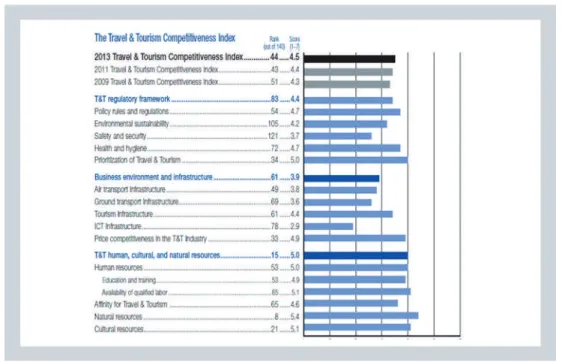
The TTCI is made for a total of 140 countries, obtaining a global ranking of countries in tourism. It is calculated from 70 variables grouped into 14 columns. The 14 columns are grouped into three sub-indices that contain a broad category of key variables in determining the competitiveness of the tourism sector. TTCI index is the average of the three sub-indices (Figure 6)
1) Regulatory framework (public sector): policy and regulations; environmental sustainability; public safety;
health and hygiene; priority for travel and tourism.
2) Infrastructure and industry environment: air transport infrastructure; land transport infrastructure; tourism infrastructure; ICT infrastructure; price competitiveness in the travel and tourism sector.
3) RR. HH, cultural and natural: human resources; affinity for travel and tourism; natural resources; cultural resources;
climate change.
Figure 6. Competitiveness Index for Travel and Tourism (WEF)
In the ranking of countries in descending competitiveness offered by the TTCI for 2013, Switzerland ranks first followed by Germany, Austria, Spain and the UK (see Figure 7). For countries on the American continent, the US ranks sixth and Canada eighth.
Figure 7. TTCI. Results for 2011 and 2013
In 2013, Mexico was ranked 44 in world rankings; one place less than the TTCI from 2011, but occupying a better position compared to that of 2009 (See Figure 8). Looking at the three sub-indices, Mexico stands out for Human, Cultural and Natural resources(position 15 in world rankings); the best position is obtained for natural resources (position 8), followed by cultural resources (position 21). At the other extreme, the sub index on the public sector shows a worse position: 83RD place in all countries in the study. Within this indicator we can find Mexico’s worse position- Public Safety (121) Environmental Sustainability (105) and Health and Hygiene (72). In the third subscript occupies position 61, with a worse position in ICT Infrastructure (78), followed by the Terrestrial Infrastructure (69).
Figure 8. TTCI. Mexico. 2013
The Tecnológico de Monterey also makes a Tourism Competitiveness Index for Mexican States (ICTEM). ICTEM identifies 10 dimensions, each containing different variables:
1. Resources and cultural activity
2. Natural resources and environmental protection 3. Human resources and education indicators
4. Infrastructure and professionalization of the hotel sector 5. Flow of people and vehicles
6. Complementary services for tourism
7. Public safety and protection of the citizens 8. Profitability and economic aspects
9. Tourism Promotion
10.Participation and government efficiency
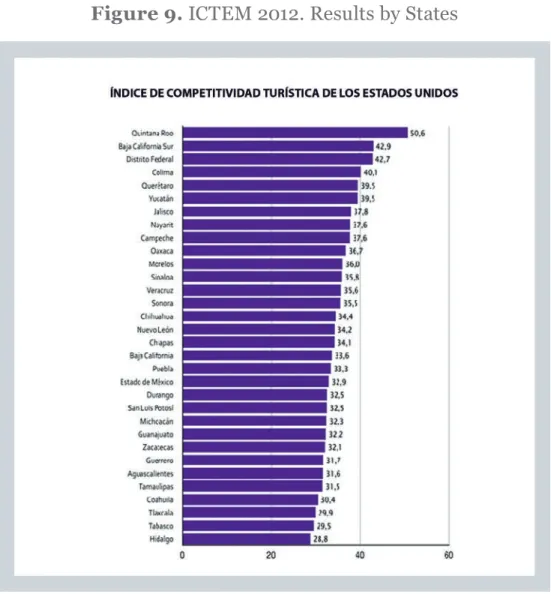
For the year 2012 (Tello Cerda, & Pardo, 2012) , the study done between the different states of Mexico establishes a ranking of states that is more or less competitive, led by Quintana Roo,
followed by Baja California Sur and Mexico DF. In the last places we find Tabasco and Hidalgo. Chiapas ranked 17 in this set of states (Figure 9).
Figure 9. ICTEM 2012. Results by States
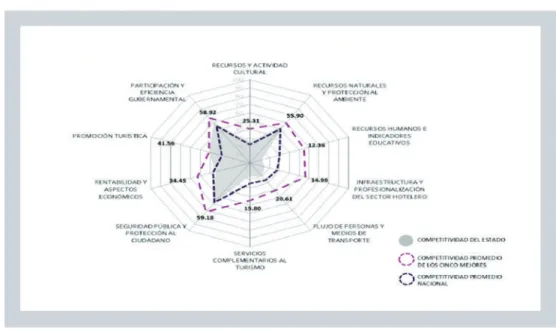
In the case of Chiapas, we can highlight (Figure 10):
• If we focus on the different dimensions that are recognized by the ICTEM, Chiapas is above the national average and very close to the average of the top 5 states in the dimension of promotion of tourism.
• It is also noted that the value in the dimension of human resources and education indicators are below the national average.
To conclude, and as a result of exercise in the ICTEM of 2012, some key principles that were identified that they tourist destinations must follow if your goal is to become more competitive:
• put the environment and the concept of sustainability as priorities,
• make tourism a key sector,
• improve and create more distribution and arrival channels, and
• create and foster a dynamic private sector.
Figure 11. Results ICTEM for Chiapas
TOURISM SUSTAINABILITY
Competitiveness and sustainability are the two ultimate goals of tourism policies developed since the last decades of the last century (Peter, 2012a, 2012b). Tourism competitiveness is closely related to sustainability as the quality of tourist destinations is strongly influenced by their natural environment and the integration of the local community (EU, 2013).
It is not easy to define sustainability. From the proposal made by the Brundtland report, sustainable development would be one that meets the needs of the present without compromising those of future generations. But this definition, although politically correct is not very operative.
Sustainability covers a very diverse set of issues such as the responsible use of resources, consideration of the impacts of the activities carried on tourism (positive and negative impacts), the type of energy used, protection of the natural and cultural heritage, the type of jobs created, etc.
Therefore, we must consider the concept of sustainable development as a set of theoretical contributions of pre- paradigmatic character in a still open scientific research field.
The scientific community is still far from defining with consensus and total clarity on what is meant by sustainable development.
The increase in inequality in the world, the persistence of hunger and poverty, and the challenges posed by climate change put pressure to advance on a proper definition of sustainability. In any case, sustainability should not be a cosmetic correction of the paradigm of indefinite growth, but its replacement by a different definition, more in tune with the times and new needs.
From a critical perspective, sustainable development is considered by this critical current as a “strategy of makeup”
(greenwashing) consisting of covering with green the same paradigm of industrialization, competitiveness, unlimited growth (in production, the economy in general , and benefits
in particular) and imposition of economic models and Western consumer policy on development in order to continue in the same pathway; the pathway is considered by itself essentially unsustainable (Pons, 2013).
From a technical perspective, academics have focused the debate and research in the definition of concepts that make up the various aspects of sustainable development. Scientific progress requires measurement, data and the elaboration of indicators of evolution. For them, in a similar manner we have seen for competitiveness, their work on the concept of sustainability leads to the idea of their use for management.
The conceptual model distinguishes three main dimensions:
• Economic sustainability
• Environmental sustainability
• Sociocultural sustainability
The WTO defines concrete objectives and pillars of sustainability (Figure 12):
The responsibility of governments is critical to create an environment conducive to the balanced development of the activity. The presence of important public goods in tourism (beaches, natural resources, landscapes, etc.) requires that public sector in involved in preservation as much as possible the elements that have favored the development of the activity, because they are the guarantee that such activity is maintained over time. Thus, public policy, especially tourism policy, is a key instrument in the process of the development of sustainable tourism.
The development of indicators answers the need for references and standards, to make comparisons with other locations to assist in the process of sustainable tourism development. In other words, to have selected information that is regularly used to guide the management of the destinations and to help reduce future risks to the destination and the tourism activity that occurs there.
The indicators can measure:
• Changes in tourist structures and internal factors
• Changes in external factors affecting tourism
• Impact of tourism
In the context of sustainable tourism development, the indicators are a chronological series of strategic information for the sustainability of a destination, its assets and ultimately, the future of the tourism sector. In Figure 13 we have a proposal of sustainability indicators from the WTO (WTO, 1999, 2005).
Figura 13. Sustainability indicators. OMT
INDICADOR MEDIDAS ESPECIFICAS
Protección del Sitio Categoría de la protección del sitio según el índice de la UICN
Presión (Sobre el sitio) Número de turistas que visitan el sitio(por año/mes máximo)
Intensidad de uso Intensidad de uso en alta temporada (persona/hectárea)
Impacto Social Ratio entre turistas y residentes (alta temporada y exceso de tiempo)
Control de Desarrollo Existencia de procedimientos de revi- sión ambiental o controles formales del desarrollo del sitio y densidades de uso
Gestión de desechos
Porcentajes de aguas residuales del sitio ereceptor del tratamiento (Entre otros indicadores adicionales pueden incluir- se los límites estructurales de la capa- cidad infraestructural del sitio, como el suministro de agua)
Proceso de Planificación Existencia de plan regional organizado para la región destino turístico (con inclusión de los componentes turísticos) Ecosistemas críticos Número de especies raras en peligro Satisfacción del Turista Nivel de satisfacción de los visitantes
(basado en encuestas)
Satisfacción de la Población Local Nivel de satisfacción de los residentes (basado en encuestas)
Contribución del Turismo a la Economía Local
proporción de la actividad económi- ca local generada únicamente por el turísmo
ÍNDICES COMPUESTOS
Capacidad turística
Medida compuesta de alarma temprana de factores clave que afectan a la capa- cidad del sitio para soportar diferentes niveles de turismo
Presión sobre el sitio
Medida compuesta de los niveles de impacto sobre el sitio (sus atributos na- turales y culturales debido al turismo y otras presiones acumilativas del sector)
Atracción
Evaluación cuantitativa de los atributos del sitio que lo hacen atractivo para el turismo y que pueden cambiar con el tiempo
Several initiatives are trying to guide actions to determine the sustainability or good practices on the road to sustainability of tourist destinations. In recent decades, we have witnessed the attempt to consolidate “sustainable” or “green” certifications.
Certifications certainly help guide actions and to reward good practices, but should be globally accepted and controlled by a recognized and international organization. One of these initiatives is called the Global Criteria for Sustainable Tourism5. These criteria are an effort to standardize as far as possible, the performance in tourism destinations which aims to achieve sustainability. They can therefore be regarded as minimum standards that address any tourism organization wishing to be sustainable should aspire to achieve. The Global Sustainable Tourism Council (GSTC) emphasizes that these criteria are part of the response of the tourism community to achieve some of the Millennium Development Goals of the United Nations6 .
5 These criteria are administered by the Global Counsel of Sustainable Tourism (GCST) that is formed of a num- ber of important organizations that are involved in tourism activities, like the WTO, destination management organisms, etc.
6 These criteria are oriented towards the eradication of extreme poverty and hunger, the gender equality, and environmental sustainability including climate change
These Global Criteria for Sustainable Tourism identify four groups of indicators:
1. Demonstrate an effective & sustainable management 2. Maximize social and economic benefits for the local
community and minimize negative impacts
3. Maximize benefits to communities, visitors and cultural heritage and minimize negative impacts
4. Maximize benefits to the environment and minimize negative impacts
But in conclusion, we can say that:
1. There does not exist a universal formula of sustainable tourism , aspects such as the maturity of the destination or tourism product, its stage of economic development, sociocultural phenomenon, perception of sustainability, the geographical nature of the destination, etc., make it impossible to reproduce a single model of sustainable tourism.
2. The measure of sustainability in tourism destinations is poorly underdeveloped. The series of homogeneous and comparative data on the ability of tourism to generate positive and negative effects are still incipient. Progress in this field requires special attention to the system of indicators of sustainability.
CONCLUSIONS
As we have seen, tourism continues to establish itself as an industry with great potential for the growth and development of countries.
The following are highlights of the main features of this activity in recent years:
• Growing importance of tourism as an economic sector worldwide
• Expansion of tourism to all world regions, although the weight and pace are different
• Optimistic outlook for the coming decades; UNWTO forecasts point to a continued growth through 2030, reaching 1.8 billion international arrivals
• Emerging countries progressively gain an international market share
• Extraordinary resilience of tourism after crises (9/11, SARS, etc.)
Competitiveness and sustainability are the two main objectives of tourism policy. In other words, the public sector intervention in the tourism market. As we have seen throughout this work, there has been a significant effort of definition and conceptualization of both concepts. However, we cannot say that there is a widely accepted definition or that both concepts are fully defined so that they can serve in the management of tourist destinations.
The need to change before greater international competition, rapid changes in the profile and demands of tourists, advances in information technology and communications, changes that cause climate change, etc., make it increasingly more necessary to adopt decisions in one’s destiny. The management of these tourist areas require standards and references to guide action.
Competitiveness research has generated measurement indices which incorporate a large number of variables. In the case of sustainability, proposals for indicators are advancing for destinations in such a way that they can become a useful & defined concept in the management of destinations.
Both concepts continue to set different trajectories in research.
There has not been an effort to try to reconcile the two. The trend toward improved management of destinations requires that both concepts can be reconciled within innovative management schemes.
BIBLIOGRAFÍA
Buhalis, D. (2000). Marketing the competitive destination of the future.” Tourism Management, 21: 97-. Tourism Management 21, 97-116.
CES. (2013). Enhancing the Competitiveness of Tourism in the EU - 20 Cases of Innovation and Good Practices. Sevenoaks, Kent, United Kingdom : Center for Strategy and Evaluation Services.
Crouch, G. (2007). Modelling Destination Competitiveness.
A Survey and Analysis of the Impact of Competitiveness Attributes. Queensland, Australia: CRC for Sustainable Tourism.
Crouch, G., & Ritchie, J. (1999). Tourism, Competitiveness and Societal Prosperity. Journal of Busness Research, 44(3), 137-152.
Dupeyras, A., & MacCallum, N. (2013). Indicators for Measuring Competitiveness in Tourism: A Guidance Document. http://
dx.doi.org/10.1787/5k47t9q2t923-en: OECD Tourism Papers, 2013/02. OCDE PUblishing.
Dwyer, L. R., Mellor, Z., Livaic, D., & Kim, E. a. (2009).
Dwyer, L., & Kim, C. (2003). Destination Competitiveness.
Determinants and Indicators. Current Issues in Tourism, 6 (5), 369:414.
Dwyer, L., Mellor, R., Livaic, Z., Edwards, D., & Kim, C. (2004).
Attributes of Destination Competitiveness: A Factor Analysis.
Tourism Analysis, 9 (1), 91–101.
ECORYS. (2009). Estudio sobre la Competitividad del Sector Turístico de la UE. Rotterdam, The Netherlands: ECORYS SCS group.
EU. (2013). European Tourism Indicator System Toolkit fo Sustainanle Destinations. http://ec.europa.eu/enterprise/
sectors/tourism/sustainable-tourism/indicators/index_
en.htm: DG Enterprise and Industry.
FEMP. (2006). Modelos de Gestión Turística Local. Madrid:
FEMP.
Gonzalez, F. (2012). Destinos Turísticos. Concepto y Estructura.
Materiales Máster Estrategia y Gestión de los Destinos Turísticos. Barcelona: Fundación UNWTO.Themis. UOC.
IPK. (2013). World Travel Monitor 2013.
Ivanov, S., Webster, C. (2013). Globalisation as a Driver of Destination Competitiveness. Annals of Tourism Research 43, 624-650.
Mazanec, J., Wöber, K., & Zins, A. (2007). Tourism Destination Competitiveness: From Definition to Exlanation? Journal of Travel Research, 46:86.
OMT. (1999). Guía para Administraciones Locales: Desarrollo Turístico Sostenible. Madrid: UNWTO.
OMT. (2005). Indicadores de Desarrollo Sostenible para los Destino Turísticos. Guía Práctica. Madrid: UNWTO.
Pedro, A. (2012a). La Política Turística. Materiales Máster Esrategia y Gestión Sostenible de los Destinos Turísticos.
Barcelona: Fundación UNWTO.Themis. UOC.
Pedro, A. (2012b). Competitividad y Sostenibilidad. Materiales Màster EStrategia y Gesión Sostenible de los Destinos Turísticos. Barcelona: Fundación UNWTO.Themis. UOC.
Pons, J. (2013). Comunicar la Sostenibilidad. Materiales Máster Estrategia y Gestión Sostenible de los Destinos Turísticos.
Barcelona: Fundación UNWTO.Themis. UOC.
Poon, A. (1993). Tourism, Technology and Competitive Strategies.
Wallingford: CAB.
Porter, M. (1990). The Competitive Advantage of Nations.
London: Mcmillan.
Porter, M. E. (1980). Competitive Strategies: Techniques for Analysing Industries and Competitors. Nwe York: Free Press.
Ritchie, J. R., & Crouch, G. (2000). The Competitive Destination:
A Sustainability Perspective. Tourism Management, 21 (1), 1–7.
Ritchie, J., & Crouch, G. (2003). The Competitive Destination:
A Sustainable Tourism Perspective. Wallingford, Oxon, UK:
CABI Publishing.
Tello, J., Cerdá, G., & Pardo, P. (2012). Indice de Competitividad Turística de los Estados Méxicanos 2012. Monterrey: Centro de Investigación y Estudios Turísticos. Tecnológico de Monterrey.
UNWTO. (2014). Tourism Highlights 2014. Madrid: UNWTO.
Wilde, S., & Cox, C. (2008). Linking Destinatio Competitiveness and Destination Development: Findings from a Mature Australian Tourism Destinations. Australia: Southern Cross University.