ADOBE BRICKS USED IN THE REGION OF TUXTLA GUTIERREZ, MEXICO
J. Alejandro Ruiz Sibaja1
Francisco Vidal Sánchez2
1Autonomous University of Chiapas (Mexico), 2University of Granada (Spain)
ABSTRACT
This paper presents the results of a series tests for the mechani- cal characterization of adobe mud used in the region of Tuxtla Gutierrez. The tests were carried out in the Materials Laboratory of the School of Engineering of the Autonomous University of Chiapas during the second half of 2008. The following features for adobe bricks were studied: volumetric weight, compressive and flexural strength. Compression tests were also done on stacks built with individual pieces and clay mortar specimens used to join these pieces. The test material was obtained directly from manufacturers in the urban area of América Libre, in the mu- nicipality of Chiapa de Corzo. A comparison between the results that were obtained and the recommendations that are followed in other countries for construction with adobe was performed.
Keywords: adobe, testing, masonry, mechanical character- ization, regulations.
Adobe is a cheap building material made from sand, clay, sand and water, to which you would normally add fiber or organic material, usually straw (or other vegetable fibers such as grass or manure). It is prepared in a traditional way, molded into a brick and allowed to dry in the sun. It is known to be a material used since ancient times (from 8000 years B.C., Houben and Guillaud, 1994), and allows for the con- struction of very durable structures. Many constructions made with this material continue to exist, which are among the oldest in the world. Moreover, 30% of the world population lives in clay buildings, and about 50% of the population of developing countries, including most of the rural population and at least 20% of urban and suburban population, live in clay houses (Houben and Guillard 1994).
Adobe buildings are masonry walls (usually without reinforce- ment) made from raw bricks (manufactured locally) and generally joined with mud mortar. They are structures that do not involve spe- cialized technicians, which is why they are known as “undirected” or
“without technical supervision”.
Traditional adobe buildings respond very poorly to seismic shocks. These structures lack ductility and are therefore very frag- ile, resulting in sudden failure under seismic loading. Poor seismic performance of these constructions is due to the weight of the struc- tures, their low strength and brittle behavior (Blondet et al., 2004, 2011). Seismic vulnerability is very high- class A (European Macro seismic Scale -EMS ).
Much of this type of construction is in areas of moderate to high seismic activity, and is particularly susceptible to severe structural damage and even collapse when an earthquake occurs, even after shaking with intensity of grade VIII (EMS). For this intensity, typi- cal damage in these constructions is represented by large cracks and disintegration in walls, separation of walls in the corners, between roofs and bearing walls. In many cases this leads to partial and total collapse. In addition, the percentage of partial collapse in construc- tions is very high (40-60%) and total collapse is significant (5-15%).
For earthquakes with an intensely grade of IX (EMS), the percentage
of adobe buildings with total collapse is particularly high (> 50%).
This damage causes severe and lethal injury to its residents and gen- erates a lot of debris, which hampers and slows the rescue of victims.
In Mexico the majority of most humble dwellings were built with adobe, which is why its use has been associated with low quality construction. In the headlong rush to take advantage of modern ma- terials and construction methods coupled with aggressive advertis- ing campaigns of cement companies in the middle of the last century, its use has been slowly disappearing.
Currently adobe is still being used in Chiapas as a building ma- terial, either for dwellings in small communities or for mixed-use buildings in rural populations. Adobe is used since it is an inexpen- sive, readily available material which is used by the self-builder, and at the same time reduces construction time. It also has a high thermal inertia due to the thickness required to build with it, which serves as an internal temperature regulator-it retains coolness in summer and warmth in winter.
While this material is still appealing, there are not enough stud- ies on the mechanic characterization of adobe to allow for adequate levels of security in these types of constructions. To date there have been no studies conducted in Chiapas which are conducive to know the mechanical characteristics of adobe, and there is a lack of build- ing codes for designing structures based on this construction system.
BACKGROUND
The study and research of adobe mud buildings is important for un- derstanding the evolution of building systems based on soil, and to predict the structural behavior of these systems and propose solu- tions to the problems of low-income housing distributed throughout Chiapas. No studies have been conducted in Chiapas on the behavior of adobe manufactured in this state. In 2008, as a first step towards the mechanical characterization of adobe, the Faculty of Engineering
UNACH carried out a testing campaign which main objectives were to evaluate the compressive strength and flexibility of this material.
The tested parts were obtained directly from the manufacturers of the urban area of America Libre, in the municipality of Chiapa de Corzo. The volumetric weight of each block was also obtained and compression tests were performed on parts built with adobe and united with mud mortar.
METHODOLOGY
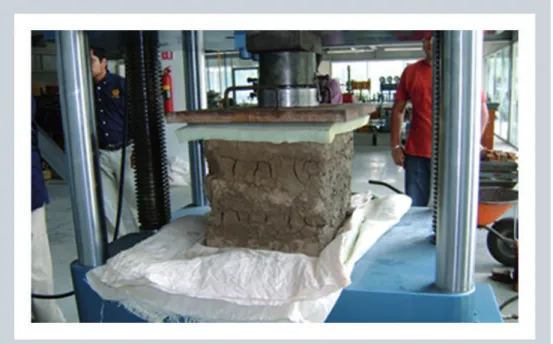
The characteristics of resistance to compression and flexibility of the adobe pieces were determined, and the results were statistically pro- cessed in order to obtain representative values of compressive force and flexibility for this building material. The tests were carried out using a 100-ton universal press. Average volumetric weight of the test pieces and compression tests were performed on three pieces formed by adobe columns. A total of 10 pieces were tested for compression, 10 for flexion, and 10 stacks.Figure 1 some of the tested specimens are shown. The tests were performed according to the protocol specified in the Complementary Technical Norms for Design and Construction of Masonry Structures (Normas Técnicas Complementarias para Diseño y Construcción de Estructuras de Mampostería 2004) and the Regulations of the Secretary of Communications and Transportation (Normativa de la Secretaría de Comunicaciones y Transportes, 2000 and 2005). It is worth mentioning that these regulations were used because a clear procedure for testing adobe masonry is not available in Mexico. Laboratory work was performed according to the following steps:
1. Weight by volume: each of the pieces was weighed in order to record their weight (see Figure 2). An average of the weight of the 50 tested pieces was made.
2. Preparation of the samples: because adobe cannot be coated with a thin layer of plaster and sand for testing compression, rubber foam was used in order to have better distribution of the compression force on the adobe pieces (see Figure 3).
3. Resistance to compression: compression was applied to each adobe piece until reaching failure, and its value was regis- tered. (see Figure 3).
4. Resistance to flexion: each piece was subjected to a state of flexion and a value was registered at the point of failure (see Figure 4).
5. Resistance to compression of columns: a total of 10 stacks using 3 pieces of adobe for each were built. A compression force was applied and a value was registered for the failure of each stacks (see Figure 5).
6. Resistance to compression of mortar between the parts used to build the stacks (see Figure 6). Three examples were pre- pared with dimensions of 5 × 5 × 5 cm.
Figure 1. Typical adobe bricks from the municipality of Chiapa de Corzo (Ovando Ruíz de la Cruz and Castellanos, 2010)
Figure 2. Obtaining the weight of each of the parts of tested adobe (Ovando Ruíz de la Cruz and Castellanos, 2010)
Figure 3. Compression test of the adobe parts (Ovando Ruíz de la Cruz and Castellanos, 2010)
Figure 4. Flexion test on pieces adobe (Ovando de la Cruz y Ruíz Castellanos, 2010)
Figure 5. Compression test of adobe stacks (Ovando de la Cruz y Ruíz Castellanos, 2010)
Figure 6. Compression test on clay mortar specimens (Ovando de la Cruz y Ruíz Castellanos, 2010)
RESULTS AND DISCUSSION
Average volumetric weight of the adobe pieces The 50 pieces which were tested had an average volumetric weight of 23.20 kg, and the average size of the pieces was 48.65 × 28.54
× 9.19 cm. Thus, an average volumetric weight of 1817.26 kg / m³ was obtained. In the consulted literature, it is mentioned that the average weight of a piece of adobe should be 1600 kg / m³ (Cemex, 2005). It was deduced that follows that the tested adobe has a qui- te reasonable volumetric weight for the Mexican environment and meets the requirements of national construction.
Compression test of adobe pieces
10 pieces of adobe were randomly selected and subjected to com- pression using a universal press with a capacity of 100 tons. The amount of pressure at the time of failure for each piece was recor- ded. With this data the compressive strength was calculated by dividing the value of the maximum load on the piece between its gross area. Table 1 shows the results of the 10 tests.
Table 1. Compression tests on adobe bricks
PIECE AXIAL FORCE (KG) GROSS AREA (CM²)
COMPRESSIVE STRENGTH
(KG / CM²)
1 40 000.00 1435.50 27.86
2 28 000.00 1411.20 19.84
3 38 000.00 1396.50 27.21
4 28 000.00 1377.40 20.33
5 33 000.00 1372.80 24.04
6 38 000.00 1406.30 27.02
7 40 500.00 1396.50 29.00
8 41 500.00 1342.32 30.92
9 33 000.00 1421.00 23.22
10 30 500.00 1376.90 22.15
Average 25.16
Standard deviation 3.59
Variation Coefficient 0.14
The resistance of the design to compression was obtained by the following expression that appears in section 2.1.2 of the NTCDCM-2004:
In the equation (1) fp represents the average compressive stren- gth tests obtained from the 10 parts that were tested (25.16 kg / cm²);Cp is the coefficient of variation, 0.14, that is found at the end of Table 1. Thus, using equation (1) resulted in a value of fp* equal to 18.64 kg / cm². Rotondaro and Patrone (2009) report that good adobe, with a volumetric weight of 1800 kg / m³ or more, must resist axial compression at least 1.6 MPa (16.31 kg / cm²). It was concluded that the test pieces meet internationally accepted mini- mum recommendations for compressive strength.
Flexion test of the adobe pieces
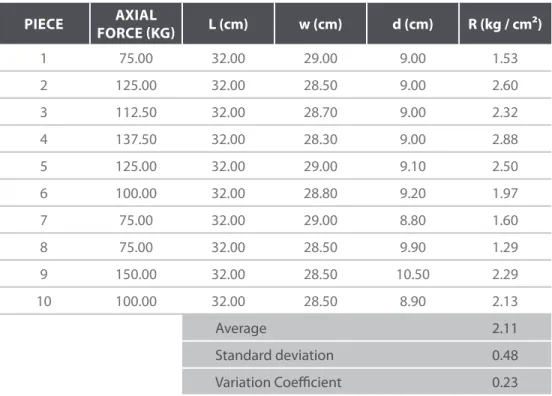
10 pieces of randomly chosen adobe pieces were tested for flexion according to the protocol indicated by the SCT regulations (2000 and 2005). The pieces were arranged as shown in Figure 4 , and an axial load was exerted until the material ruptured. Table 2 shows the results of this test. The value of flexion resistance indi- cated in the sixth column was obtained by applying the following expression (SCT, 2000 and 2005):
Table 2. Flexion test of the adobe bricks
PIECE AXIAL
FORCE (KG) L (cm) w (cm) d (cm) R (kg / cm²)
1 75.00 32.00 29.00 9.00 1.53
2 125.00 32.00 28.50 9.00 2.60
3 112.50 32.00 28.70 9.00 2.32
4 137.50 32.00 28.30 9.00 2.88
5 125.00 32.00 29.00 9.10 2.50
6 100.00 32.00 28.80 9.20 1.97
7 75.00 32.00 29.00 8.80 1.60
8 75.00 32.00 28.50 9.90 1.29
9 150.00 32.00 28.50 10.50 2.29
10 100.00 32.00 28.50 8.90 2.13
Average 2.11
Standard deviation 0.48
Variation Coefficient 0.23
The average flexion was 2.11 kg / cm² as shown in the table above.
Oscar Hernández et al. (1981) report an acceptable value of flexion resistance of 3 kg / cm² for adobe. It was concluded that the tested material had a lower resistance to flexion to what has been obtai- ned in other studies.
Compression test of adobe stacks
Stacks were made using 30 pieces of adobe, with 3 pieces used for each stack, obtaining a total of 10 stacks. The mortar was allowed to dry for a week. These specimens were subjected to a compressi- ve load until achieving the rupture of the material (see Figure 5).
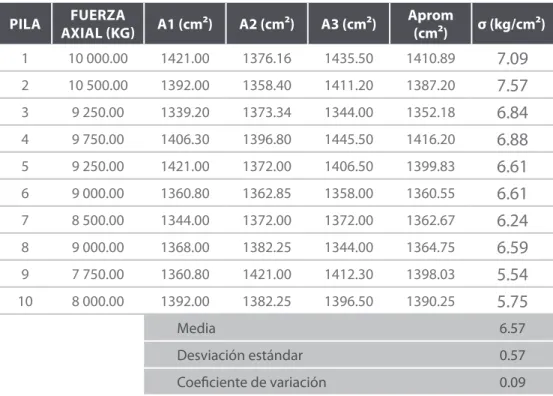
Table 3 shows the results obtained in this test.
Table 3. Compression test of adobe stacks
PILA FUERZA
AXIAL (KG) A1 (cm²) A2 (cm²) A3 (cm²) Aprom
(cm²) σ (kg/cm²) 1 10 000.00 1421.00 1376.16 1435.50 1410.89 7.09
2 10 500.00 1392.00 1358.40 1411.20 1387.20 7.57
3 9 250.00 1339.20 1373.34 1344.00 1352.18 6.84
4 9 750.00 1406.30 1396.80 1445.50 1416.20 6.88
5 9 250.00 1421.00 1372.00 1406.50 1399.83 6.61
6 9 000.00 1360.80 1362.85 1358.00 1360.55 6.61
7 8 500.00 1344.00 1372.00 1372.00 1362.67 6.24
8 9 000.00 1368.00 1382.25 1344.00 1364.75 6.59
9 7 750.00 1360.80 1421.00 1412.30 1398.03 5.54
10 8 000.00 1392.00 1382.25 1396.50 1390.25 5.75
Media 6.57
Desviación estándar 0.57
Coeficiente de variación 0.09
In the above table, A 1, A 2 and A 3 refer to the gross area of each of the pieces that each stack was constructed. In the sixth column, the average of these three areas is shown (A avg). The seventh column refers to the tensile strength to compressive load (σ) of each stack.
The resistance of the design to compression was obtained by equa- tion (1), therefore, considering the average value of 6.57 kg / cm² and the coefficient variation of 0.57, there was compressive design strength of 5.36 kg / cm². Oscar Hernández et al. (1981) report an acceptable value for compressive strength for low walls of adobe at 6.00 kg / cm². Given the paucity of literature on the subject, this data was adopted as reference of the test on the stacks. Thus, it is concluded that resistance to compression of this design is slightly below what is recommended by Oscar Hernandez et al (1981).
Compression test of adobe mortar
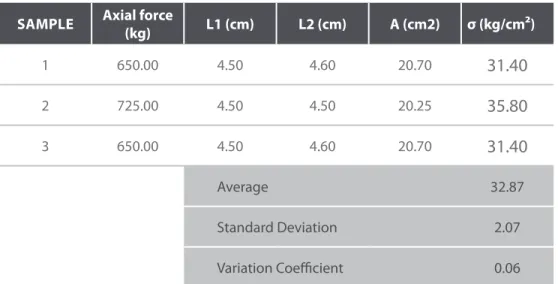
Compression tests were performed on 3 examples of clay mortar which was used to join the adobe pieces to form the stacks. The same material that comprised the adobe bricks was used in its preparation. The dimensions of these specimens were 5 × 5 × 5 cm. After 11 days of drying, the clay specimens were tested for compression (see Figure 6). The results of these tests are sum- marized in Table 4.
Table 4. Compression test of adobe mortar
SAMPLE Axial force
(kg) L1 (cm) L2 (cm) A (cm2) σ (kg/cm²)
1 650.00 4.50 4.60 20.70 31.40
2 725.00 4.50 4.50 20.25 35.80
3 650.00 4.50 4.60 20.70 31.40
Average 32.87
Standard Deviation 2.07
Variation Coefficient 0.06
In Table 4, L 1 and L 2 are the dimensions of the sides of the cube face that receive the compressive force. The area shown in the fifth column is obtained by multiplying L 1 × L 2. In the sixth column, the axial stress (σ) is shown, for which the break occu- rred in the specimen sample. As in the previous cases of com- pression tests, the design strength of the tested compression set was obtained by equation (1).Thus, considering the average value of 32.87 kg / cm² and the variation coefficient of 0.06, there is a resistance to compression of this design of 28.58 kg / cm². No re- ferences to the desirable clay mortar strength were found. The use
of mortar arises from the need to fill the gaps between the pieces and to provide adhesion and continuity. Given that the stacks that were tested show a design compression strength less than that re- commended in other studies, it is concluded that mortar that was tested did not improve the compression behavior of the stacks.
Further studies should be conducted to find the optimal ratio of a mortar that achieves desirable design strengths in compression.
Comparison with regulations and practices of other countries
Currently New Zealand, The United States and Peru have official standards for adobe construction. Multidisciplinary teams from Mexico, Colombia, El Salvador and Ecuador are preparing stan- dards for construction with this material. In this section the stan- dards and recommendations used in Peru and Ecuador for the construction of adobe mud are succinctly demonstrated and are compared with this case study. The cases of Peru and Ecuador are considered because they are countries with similar construc- tion practices to those applied in Mexico, and in which there is already an effort to standardize the construction of such buil- dings (Castillo et Al, 2009). The following are the highlights of this comparison.
Peruvian regulations
Peru is the only country in the Pacific Ring of Fire which has an official technical standard for adobe construction. The National Institute of Research and Standardization of Housing (Instituto Nacional de Investigación y Normalización de la Vivienda - ININVI) of Peru published the Design Standards for Adobe in 1987. Its second edition is currently in use, which was approved
in 1999 by the Ministry of Transport, Communications, Housing and Construction of Peru (MTC, 2000).
This document details the conditions that the different com- ponents of the housing need to comply in order to ensure stability with respect to stress, especially regarding earthquakes. The ba- sic condition is that the adobe walls are load bearing, and structu- rally there are no other load bearing elements on the walls.
The rules indicate that the resistance to compression is deter- mined by testing carved cubes whose edge has the smallest dimen- sion of the adobe. A value of resistance (f0 , force of permissible compression) is calculated based on the cross sectional area. This value will be exceeded by 80% of the test pieces. The minimum number of parts to be tested shall be six (6) and must be completely dry. The value of f0 should not be less than 12 kg / cm².
The compressive strength of adobe stacks may be determi- ned by:
1. Tests stacks with the materials and technology used in construction. They are composed by a number of who- le adobes necessary to obtain a slenderness coefficient (height / thickness) of three (3).
2. The minimum number of adobes should be four (4) and the thickness of the joints 2 cm. The drying time of the mortar of the stacks should be 30 days and the number of the test stacks is three (3).
This regulation does not say anything about flexion of the test pie- ces of adobe or the compressive strength of the clay mortar.
In the tests described in previous sections, 10 pieces of adobe were tested, whereby the recommendation of Peruvian legislation to study a minimum of 6 pieces per lot is met. The average resis- tance obtained was 18.64 kg / cm² , a value that exceeds the resis- tance requirement f0= 12 kg / cm², as outlined in this regulation for individual pieces of adobe.
In addition, 10 stacks were studied which were built with three parts joined with a clay mortar, leaving a thickness of about 2 cm in the joints (see Figure 4). The design strength of compression in these stacks was 5.36 kg / cm², a value above that recommended by the Peruvian legislation (fm= 2kg / cm², the value to be exceeded by 2 out of 3 test stacks ) for this type of testing (MTC, 2000).
It should be noted that not all of the requirements demanded by these recommendations were followed. Peruvian regulations su- ggest using four pieces for building stacks, while in this case 3 were used. Similarly, the drying time for the mortar was lower (7 days) to that indicated (30 days) in the regulations. This point should be considered for improving the compression behavior of test stacks.
It should be mentioned that the mortar with which the parts are joined to form the stacks was developed using the same mate- rial that made up the adobe bricks. This material was screened in No. 4 mesh (as recommended by the local building practice) and mixed with water to a paste consistency optimal for use as mortar.
The Peruvian regulations indications for masonry joints in adobe buildings were not used- proportion cement-thick sand mortar for type I (between 1:5 and 1:10). Nor were there adjustments for the recommendations for type II mortar (based on soil with straw).
The results show that additional materials should be included in the mixture, such as cement, gravel and straw, to improve their be- havior under compression . The proportions that should be used to optimize this resistance should be subject to further studies.
Overall, despite that the formalities of Peruvian regulations were not met, the tested masonry had good compression behavior even higher than required by this standard.
Recommendations from Ecuador
In Ecuador, the following criteria for adobe clay masonry are used not as a rule but as an “adequate” building practice (Cevallos Salas, 2002):
1. The adobe bricks will be made with soils which granulo- metry has a sand content between 50 and 60% and the rest between fine silts and clays.
2. The allowable compression force will be f_0 = 10 kg / cm 2. 3. Mortars are manufactured with compatible materials
with adobe and its quality should never be less than the pieces being used.
It may be noted that these recommendations only consider ba- sics aspects of adobe resistance. Nothing is indicated regarding the protocol for testing pieces of adobe built in stacks with this material or for samples of mortar used to join the pieces. Also the statistical interpretation of the results of these tests is not men- tioned. An interesting approach is that it suggests the desirable characteristics of the granulometry of the soil that is used to make the adobe bricks.
As noted above, the average strength of test pieces was 18.64 kg / cm², a result which is above Ecuadorian recommendations f0= 10 kg / cm². Thus it is considered that the test pieces exceed Ecuadorian guidelines.
In contrast, the recommendation of the granulometry that the adobe soil should have was not observed. Where this mate- rial is obtained (urban area of America Libre of Chiapa de Corzo), manufacturers do not usually take into consideration the detail of the granulometry of their products. In any case, they are careful that no stones or plant material enter their adobe bricks. This is an area to consider in future trials of adobe.
With regards to mortar, the Ecuador recommendations do not indicate a minimum resistance or drying time in order to reach optimum strength. In this sense, since the tested mortar was made of the same material used for the adobe bricks, it was deemed to comply with than these recommendations.
It can be concluded that although not all of the criteria re- commended by the constructive practice of Ecuador are met, the tested material meets the basic recommendations.
CONCLUSIONS
The most relevant results of a campaign of experimental tests conducted in 2008 on adobe bricks manufactured in urban area of America Libre in municipality of Chiapa de Corzo have been presented. The tests were performed according to the protocol for compression tests established by the Technical Standards for the Design and Construction of Masonry Structures (2004) and the provisions established in the Regulations of the Secretary of Communications and Transportation (2000 and 2005).
Despite the high brittleness of the material that was tested, the results are encouraging since most tests of the adobe showed similar behaviors to those recommended in other projects. The volumetric weight obtained in the corresponding test was a pretty fair value for the requirements of national construction. Similarly, in the compression test of adobe pieces, an average compressive design strength that meets the minimum recommendations for compression resistance accepted in other countries was reached.
It cannot be said the same for the flexion resistance of the test pie- ces that obtained a value of 2.11 kg / cm², which is less than 3 kg / cm² suggested by other researchers. Moreover, in the compres- sion test in adobe stacks had results that are slightly below those reported by Oscar Hernandez et al (1981). Finally, in the mortar tests, average compressive design strength of 28.58 kg / cm² was
recorded. There are not sufficient references of similar tests to be able to analyze this result. However, it can be inferred that the mortar that was tested did not improve compression behavior of the stacks. Comparison of the results described in these tests, contrary to what the Peruvian and Ecuadorian regulations recom- mend, shows that despite the lack of an adequate quality control adobe manufactured in the region of Tuxtla Gutiérrez have me- chanical properties suitable for good mechanical behavior.
Since in Chiapas there are still historic buildings built with adobe, and that this material is still used in rural areas for low- cost mass housing, most of our attention should focus on its mechanical characterization, thus preserving the aesthetic and cultural values and historical, traditional architecture patrimony of raw earth, as well as for the protection of the physical integrity of the inhabitants of adobe houses.
It is recommended that a standard is established or adopted, so that a formal document is available with the main purpose of providing guidelines for seismically safe adobe buildings that pri- marily benefit the most marginalized sector of the population.
GRATITUDE
The authors acknowledge the unrestricted collaboration for con- ducting these tests of Jorge Vila Gallegos and Hugo Vázquez Gómez, Academic Technicians at the School of Engineering of the Autonomous University of Chiapas.
REFERENCIAS
Blondet M, Garcia GV. (2004). Earthquake Resistant Earthen Buildings, 13th World Conference on Earthquake Engineering, Paper No. 2447.
Blondet, M., Villa Garcia, G. Brzev, S. y Rubiños, A. 2011, Earthquake-Resistant Construction of Adobe Buildings:
A Tutorial, Earthquake Engineering Research Institute, 2nd edition. Oakland, California. 37 pp
Castillo, Francia, Parra, Daniela y Soto, César (2009). El adobe: di- señar la tierra. Seminario “La construcción patrimonial: un desafío técnico y legal”, Colegio de Ingenieros de Chile, Chile.
Cemex (2005). Manual del Constructor, México.
Cevallos Salas, Patricio (2002). Normas para diseño y construcción con tierra. I Seminário Ibero-Americano de Construção com Terra. São Salvador da Bahia, Brasil.
Gaceta oficial del Distrito Federal (2004). Normas Técnicas Complementarias para Diseño y Construcción de Estructuras de Mampostería. Gobierno del Distrito Federal, México.
Hernández, Óscar; Meli, Roberto; Padilla, Marciano; Valencia, E. (1981). Refuerzo de vivienda rural en zonas sísmi- cas. Estudios experimentales. Informe 441, Instituto de Ingeniería, UNAM, México.
Houben, H. and Guillaud, H. (1994). Earth Construction – A Comprehensive Guide. ITDG Publishing, London, UK.
MTC (2000).
MTC (2000). “Reglamento Nacional de Construcciones. Adobe:
Norma Técnica de Edificación E-080”. Ministerio de Transportes, Comunicación, Vivienda y Construcción (MTC). Servicio Nacional de Capacitación para la Industria de la Construcción (SENCICO). Lima, Perú.
Ovando de la Cruz, Henri Ovando y Ruíz Castellanos, José Antonio (2010). Caracterización mecánica del adobe
de Tuxtla Gutiérrez. Tesis de Licenciatura, Facultad de Ingeniería, Universidad Autónoma de Chiapas, México.
Rotondaro, Rodolfo y Patrone, Juan Carlos (2009). La cons- trucción con tierra, una tecnología posible para el hábi- tat. Revista Saber Cómo, Instituto Nacional de Tecnología Industrial, Argentina.
Secretaría de Comunicaciones y Transportes (2000).
Normas de construcción: Muestreo y Pruebas de materia- les. Parte Segunda, Tomo IX, México.
———— (2005). N-CMT-2-01-001/02, Ladrillos y bloques cerámicos (CMT Características de los materiales, parte 2). México.