First stage of Project KID (CID)/ALFA III in Tapachula , Chiapas, Mexico
Susana Maria Sosa Silva
About the author
Susana Maria Sosa Silva
Full time professor at the Autonomous University of Chiapas General Coordinator of the Virtual University
Email: [email protected]
Boulevard Belisario Dominguez, Km. Tuxtla Gutiérrez, Chiapas.
Abstract
The following article presents the first part of the implementation of the KID(CID) Project ALFA III, which has as an objective the social inte¬gration of typically excluded groups. The application of the project in Mexico is held by ANUIES and in Chiapas by the Autonomous University of Chiapas (Universidad Autónoma de Chiapas – UNACH).
The methodology proposed by the European Union was applied in the municipality of Tapachula de Córdova y Ordoñez, in the state of Chiapas, where the KID Committee is located and the Pact for Learning and Knowledge was established.
Keywords: ALFA KID, social integration, Chiapas.
Background
The ALFA Program in Latin America
Since 1994 the ALFA program began strengthening cooperation operations between two regions , Latin America (LA) and the European Community (EC) . Three phases were established:
The first phase, ALFA I (1994-1999) , with an EC contribution of
€ 31m was developed until 1999, involving 1064 institutions operating 846 micro -projects.
The second phase, ALFA II (2000-2006) , with a total of 10 selection rounds, was represented by an EC contribution of € 54.6m distributed to 225 approved projects undertaken by 770 institutions divided into networks with an average of 9 institutions from Latin America and from the EC.
The third phase, ALFA III (2007-2013) , is endowed with a budget of 85 million euros. ALFA III represents a significant increase in its budget in terms of the contribution of the European Union, but it also constitutes a new and improved program structure, consisting of 3 specific lots : Lot 1- Joint projects , Lot 2- Structural projects, Lot 3 –Accompanying measures. ( European Commission , 2012 )
Within the priorities suggested for this program is the reform of institutions of higher education and their programs, from which quality human resources are expected to develop. Among others, it is contemplated that this would result in the creation of a shared space for Higher Education in Latin America through three types of projects:
a) Joint Projects (Lot 1 )
Exchange of experiences, methodologies and knowledge
Topics: Institutional management / Academic Management / Technical and Scientific ; Social Cohesion.
b ) Structural Projects ( Lot 2 )
Reforms , modernization, harmonization of educational systems Topics: Modernization of Higher Education Systems in LA and social cohesion .
c ) Accompanying Measures ( Lot 3 )
Creating synergies, coordination between projects and components
Topics: Regional visibility / regional program awareness, best practices, exchange of experiences, coherence/ coordination / synergy of components ( European Commission , 2012).
In the case of Latin America, ALFA III’s specific objective is “to promote higher education ( ... ) as a means to contribute to economic and social development of the region. “ (European Commission, 2012).
As part of these strategies to support higher education, as mentioned in the rubric “ Structural projects “ , is the KID Project : Knowledge - Inclusion - Development (KID ) cooperative strategy between higher education institutions in countries such as Argentina , Bolivia , Brazil , Chile , Colombia , Costa Rica , Cuba , Ecuador , El Salvador , Guatemala , Honduras , Mexico , Nicaragua , Panama , Paraguay , Peru , Uruguay and Venezuela , and the nations that form the European Union .
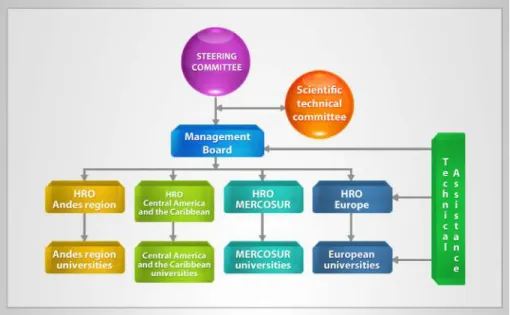
With this in mind, it is intended that the experience of universities contribute to the “local development , access to university education and especially continuing education for socially disadvantaged persons . “ ( ANUIES , 2011 ) . This work focused on the integration of Compact for Learning and Knowledge (CLK) in which three actors merge: universities, industry and social sectors of America and The Caribbean. (Figure 1)
Figure 1. Various continuous simulators and discreet events for simulating the operational life cycle of a spacecraft using HLA.
This systemic perspective of social integration contains various objectives, which include: rethinking the role and educational programs offered by the universities , and integrating specific sectors - men over 40 and unemployed women - into the workforce and thus meet the needs of industry and business in the region. The fundamental concepts are considered from the following definitions:
Knowledge as a key fulcrum for the emancipation of social and economic development;
Inclusion as an objective of economic democracy, participation and active citizenship
Development as the purpose of well-being and sustainable progress. ( Carapella , S. F. )1
KID Project in Mexico
The KID Project began in Mexico in 2011 with the determination to execute it (with resources and methodology) through the National Association of Universities and Institutions of Higher Education ( ANUIES ) . Traditionally, the project in Europe and
in other American nations such as Argentina and Colombia , operates directly through a university applying the installation methodology of the CLK. Due to some particularities of Mexico such as the pre-election context of 2012 and the socio-economic nature of its municipalities, the project does not operate in major universities in the nation. Rather, they choose to work with those that meet the following characteristics:
• IHE that are in states that meet the highest percentage of low-income population (according to 2010 Census data )
• Are public institutions of higher education (IHE ) whose campus supports the greatest numberof enrolled students.
• Are IHE’s linked to their environment through continuous service projects as much as knowledge, such as helping their populations. ( ANUIES , 2011 )2
Computer systems that assign events on multiple processors to speed up the simulations improves execution time , especially when operating the large number of high speed processors and internal communications that are found in high-performance computing platforms . The object-oriented architecture has a significant impact on the development of these systems. The entities in a system can be represented by individual classes. These representations, in turn, facilitate the distribution of the models on different processors and the design of parallel experiments. Additionally, the distributed environments are run through the World Wide Web.
In addition to previously mentioned characteristics, other features are sought out such as the appropriate technological infrastructure for establishing networks of knowledge and experience in community work. The KID Project was initially established in the states of Puebla ,
1 Bruno Caparella points out the relevance of such a project that “ In Latin America , a place of great cultural fervor and systemic fragility of its territories , the model of development based on knowledge and knowledge as a competitive factor appears sustainable, sound , intuitive “ .
2 ANUIES has among its members 164 public and private institutions of higher edu- cation throughout Mexico as of April 2012 .
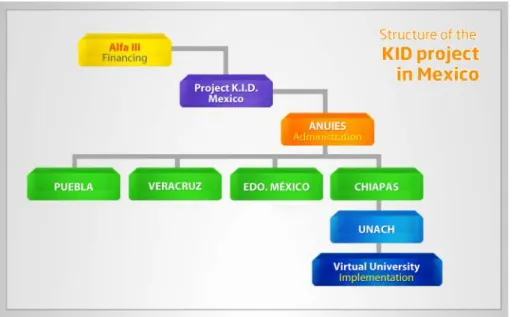
Veracruz , The State of Mexico and Chiapas . It currently only operates in Veracruz , the State of Mexico and Chiapas . (Figure 2)
Figure 2.Structure of the KID project in Mexico.
Additional objectives emerge from the general objective of the KID Project, such as:
• Disseminate a model of social cohesion [ ... ] based on the needs of the territory and needs of the target groups.
• Improve the location of universities within the framework of local development policies and social cohesion [ ... ]
• Plan [ ... ] training interventions that respond to the characteristics of the target groups and alternating systems between the university, family and work ; promote equal opportunity policies in the territory.
• Strengthen the capacities of universities [ ... ] with respect to the needs of the territory.
• Build networks among higher education institutions of Latin American and Caribbean countries and Europe, and promote the establishment of a Community of Work and Learning [ ... ] . ( Carapella , S. F. )
Methodology for the implementation of the CLK
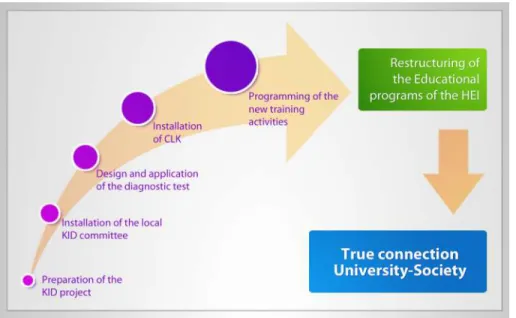
The previously mentioned objectives are consistent with the proposed methodology for the integration of the CLK. Beginning with the presentation of the project and the appointment of the venues, the first phase consists of integrating a KID committee, which will consist of higher education institutions in the region, entrepreneurs, general employers, institutions that represent the local government, as well as nongovernmental organizations ( NGOs).
This Committee has among its functions guiding the project until the establishment of the ALK. The committee ensures that all of the voices included from the social sectors are represented in the decisions of the CLK , as will be explained later . The next phase is the implementation of a diagnosis of the specific target populations, in order to know the educational and training needs first-hand from residents and employers in order to design a relevant and tailored offer . This same diagnosis will serve to observe current educational programs.
Upon completion of the previous phases, we proceed to the signing of the CLK , which will be explained more fully hereinafter , but consists of a series of commitments and policies that will direct training actions for the given population. Finally, the training is conducted and with the above result, the educational programs offered by the IHEs are revised so that there was a real link between University and Society . Figure 3.
Figure 3 (reevaluation of the Educational programs of the IHE)
Application of the methodology CID ALFA Project in Chiapas
The operation of the KID Project in Chiapas, is at the hands of the Autonomous University of Chiapas, and is coordinated by the Virtual University given the need for technological infrastructure , and shared with other participating IHE’s in the country , which lies mainly in the administration of the SINED Node3
It was determined to implement Project KID in the border municipality of Tapachula , located in region VIII /Soconusco, in the State of Chiapas , in the colonies of Cafetales (3, 054 inhabitants) and A Better Life ( 6,460 inhabitants ) . These areas were chosen due to the vulnerable groups located in the communities that express significant social under development according to the National Council for Evaluation of Social Development Policy ( CONEVAL ). This is due to the nature of its population which was relocated after the disaster caused by Hurricane Stan in October of 2004 (inhabitants from 32 out of the 59 affected colonies make up the study population).
Social underdevelopment indicators in both colonies
a. Installing the KID Committee
(Indicators of social underdevelopment in both colonies; )
On October 11, 2012 , A KID Committee was installed as one of the first phases of the Project KID Committee Tapachula , being established according to the specifications of the inter -institutional Model of
3A SINED node is an area of human activity whose interconnections form a network;
it has the function to support, advise and train individuals, educational institutions, research centers, development and business in the region, and is responsible for the detection of educational needs , identify leaders and niche opportunities that generate knowledge and incorporate them into the network of networks of SINED.
Nodes are then presented as spaces for articulation of social-educational and cul- tural activities with the objective of strengthening the links between all stakehold- ers in the SINED , enhancing interaction and communication in the framework of the various proposals and distance education projects . ( http://www.sined.mx/
sined/nodo_sined/nodos.php )
Operation and Management Committee whose administration falls under the UNACH.
Table 1.
A. UV - Autonomous University of Chiapas (President ) B. TecMilenio Institute of the Tecnológico de Monterrey
System
C. Por la Superación de la Mujer A.C.
D. H. City of Tapachula
E. Institute for Women, H. City of Tapachula F. Delegation from the colony Cafetales G. Delegation from the colony A Better Life H. GalatasFoundation A.C.
I. Ministry of Labor and Planning
J. Chamber of Commerce and Tourist Services K. Mexican Employers Confederation
L. Technological Institute of Tapachula
The Committee is formed by representatives from higher education institutions, the public sector, civil society organizations and the productive sector, which is entrusted to implement and evaluate the CLK.
b ) Design and implementation of diagnosis.
5We conducted an observational type study -intervention, prospective, longitudinal – for which three instruments were designed in order to know:
a. The socioeconomic status of the population and their training interests.
b. The training needs of the business sector.
c. The profiles offered by institutions of higher and technical education.
The questionnaire was administered to the population of both colonies, and consisted of 54 reagents which were distributed as follows: Module I, General data with 22 questions ; Module II , Employment with 21 questions and Module III, health . The study was conducted in both colonies selected in a period between October and December 2012. Data collection lasted one month , from November 19 to December 19, 2012 .
5The diagnosis was provided by the officials of KID project in Mexico , however it is appropriate to each region according to their own needs .
The population that composed the study was made up of men and women from the colonies Cafetales and A Better Life ; women aged 16 to 17 with parental permission and those older than 18 years of age ,and men over 40 who were unemployed or underemployed.
The data was collected in four stages: an informative visit to the selected colonies, the identification of randomly chosen blocks and land for application of the instrument; visits to businesses and chambers of commerce in order to know job profiles required by its affiliates, and finally in the fourth stage visits to institutions of higher and technical education, in order to know the training offered in the locality.
Initial Results
The results presented below are not the overall results of the diagnostic tool. They are presented in part those that directly impact the establishment of the ALK; in other words the data refers to notable areas such as: education, productive activities and educational opportunities.
Characteristics of the population of the colony Better Life Male population
Table 2.
Percentages in training desired by the population:
Table 3.
Female population
It was found that 30 people were under 18 years of age with an average age of 17 , and 207 were older than 18 with an average age of 36.
Table 4.
Of the female population that was surveyed, 55% had interest in the following training:
Table5.
Characteristics of the population of the colony Cafetales Male population
Table 6.
The 63 % (27 people) of the male population said they would like to be trained in :
Table 7.
Female population
Table 8.
Of the surveyed population, 61 % ( 80 people) would
like to have the following training :
Table 9.
Partial cross of the results
The similarities and differences of formation of interest in the population of the colonies Cafetales and A Better Life are:
Table10.
Analysis of current training supply and demand
The analysis of the HEI’s of Tapachula reveals that this municipality has institutions that offer professional studies and others which are dedicated to scientific and technical studies .
Table 11
c ) Configuration of the CLK
Once applied, the diagnostic test referred to in the previous point and the methodology was established. We then proceeded to the signing of the CLK . The Compact for Learning and Knowledge (CLK ) is one of the tools to establish a more suitable link between universities and local production systems , which direct and supervise the activities as an evaluation and implementation of the decisions taken by the KID Committee .
This direction will come as “policies, projects and practices that must be defined by a strong involvement of social actors and institutions operating in the territory ( business associations , trade unions, local governments, NGOs , women’s association etc. . ) “( Carapella , nd)
The CLK meets objectives such as : increasing the positive impact of local development initiatives , program the training in a more relevant and inclusive manner for all sectors of society, and provide support for the transformation of local instruction systems especially higher education. It is important to clarify that in the case of Latin America and specifically Mexico, there are some variations as attention should focus on the lower levels of education and have a matrix closer to continuing education. Therefore, the offer of regional training will be located in these terms which are not specific to higher education.
Table 12
Conclusions and methodological prospective
d ) Regional Training Plan (RTP)
Once the statistical information was processed and analyzed regarding the common ground between society , business and HEI’s , the following was determined as the final result of this phase of the KID ALFA Project to date:
1. Provide 6 programmed courses in : a) Food preparation
b ) Beauty and personal hygiene c ) Health education and first aid d ) Carpentry
e) Cooling/refrigeration
f ) Small Business Administration
2. Train a total of 60 people from the project focus groups . 3 .The education workshops for health and first aid, beauty and personal hygiene correspond to the Social Security Center of the IMSS .
4. The courses in small business administration, carpentry, food preparation, and in the case of developing courses in maintenance and refrigeration correspond to the ICATECH.
5. Follow up on the training activities though continuous evaluation.
6. Record the experiences that were shared within the themed networks from the KID ALFA project.
7. Based on the previous information, record and publish a compendium of experiences of the participants .
8. Design an adequate space in the “Ignacio Zaragoza” primary school for the children of the mothers who participate in the
“Beauty and personal hygiene and Health Education” course.
9. The Federal Labor office offered that once the training courses were finished, the institution would give a document that supports the training of those who were enrolled in the workshops.
10 . All of institutions involved in this committee promise to disseminate the results of the project through the means at their disposal .
11. Based on the request made by the various participating organizations to include the issue of values in training, the social Security Center IMSS offered to include the subject of human values in their courses.
12. Minors ( 5 to 15 years ) of mothers will have a day care program with productive, scholastic, and craft activities, as well as sports during the training schedule.
In summary, up to this point achievements have included: the installation of the KID Committee, the application of the diagnostic test, and the establishment of the CSK .It will be determined in which
of the following phases the PFT should be applied and yield results that will allow for the redirecting of educational programs of the institutions that form the KID Committee.
References
Association of Universities and Institutions of Higher Education. (2011 ) . ALFA CID III Mexico .In Mexico Cid Project 2011-2013. ALFA III Programme . [Online ] .
http://alfacid.anuies.mx/?page=cidmexico
Association of Universities and Institutions of Higher Education. (2011 ) . Cid Mexico Project 2011-2013.
ALFA III Programme . [Online ] . http://alfacid.anuies.mx/?page=crui
Carapella , Bruno . ( S. F. ) CID Project .Knowledge , Inclusion and Development . Compact for Learning and Knowledge (PAC ) . [Online ] .
http://alfacid.anuies.mx/pages/docs/Pacto_para_el_aprendizaje_y_el_conocimiento.pdf European Commission. (2012 ) . EUROPEAID Cooperation and Development . [Online ] . http://ec.europa.eu/europeaid/where/latin-america/regional-cooperation/alfa/detail_es.htm National Council for Evaluation of Social Development Policy . (2005).
Analysis and measurement of poverty .[Online ] .
http://www.coneval.gob.mx/medicion/Paginas/Medici % C3 % B3n/Pobreza-2010.aspx
Fundazione CRUI ( S. F. ) Gobernance . CID In Project , Knowledge Inclusion Development . [Online ] . http://www.alfacid.fondazionecrui.it/Paginas/Governance/default.aspx
National System of Distance Education . (2012 ) . Nodes. [Online ] . http://www.sined.mx/sined/nodo_sined/nodos.php