APPROPRIATE TECHNOLOGY TO REDUCE POVERTY, ELEVATE THE LEVEL OF LIFE
OF INDIGENOUS COMMUNITIES, AND CONSERVE THE ENVIRONMENT IN
MEXICO
Martín D. Mundo Molina1
Luis M. Oseguera Solórzano
1Research Center of the School of Engineering, Autonomous University of Chiapas
ABSTRACT
The Earth is currently experiencing climatic instability. Data from temperature and precipitation anomalies prove it. The most accept- ed hypothesis by the international scientific community is that this instability is caused mainly by anthropogenic effects. According to this hypothesis mankind is issuing more and more greenhouse gas- es though the consumption of fossil fuels since the Industrial Rev- olution. These gases are causing changes in the temperature and average precipitation over large regions of the planet, which in turn is causing changes in the hydrological cycle. Under this hypothesis, there is currently an analysis of the potential impact of these cli- matic alterations of the environment and its relation to man, espe- cially in areas discussed where natural resources such as water are scarce. However, these studies should also develop in area in the world where besides the potential threat to natural resources there is a need to provide and preserve vital resources like water and for- ests. This is the case of thousands of poor communities around the world, especially indigenous communities. It is important to em- phasize that these communities lack decent housing, cement floors, electricity, drainage, and medical services –in general, inadequate means to live decently. This paper describes a project called “Sus- tainable House” (SH), which seeks to dignify life in the poor, espe- cially indigenous, communities in Mexico. In addition to saving en- ergy , avoids the emission of greenhouse gases into the atmosphere (the SH does not use fossil fuels), it preserves natural resources such as water, soil, and air while raising the standard of living of its inhabitants. The SH includes nearly a dozen “Appropriate technol- ogies” (AT) for efficient water use and conservation of the environ- ment, and was designed based on the experience gained with the Rainwater Collector (Colector de Agua de Lluvia-CALL, in Span- ish) built in 1999 in the indigenous community of Yalentay in the municipality of Zinacantán in the Highlands Chiapas. The SH can be adobe, brick, or concrete block depending on the material avail-
able in the area. It was designed in a modular manner, considering the Tzotzil indigenous cosmogony of the Highlands of Chiapas. It consists of two or three bedrooms (depending on number of family members); living room; an ecological bathroom, kitchen with stove and ecological water tank (one part in the kitchen and another part in the courtyard), and the entrance porch. The construction sur- face can be adjusted to 50 m 2 minimum to comply with the Rules of Operation of Rural Housing, for fiscal year 2014 of the Ministry of Territorial and Urban Agrarian Development (SEDATU, 2014) program. The technologies in this sustainable home are: a). Home Rainwater Collector (Colector de Agua de Lluvia Domicillario- CALLD) with attached filter, b). Ecological bathroom (does not use water), c). Bici-pump (a system that only uses mechanical energy of pedaling a bicycle to raise water from the water tank to the roof water tank), d). Ecological sink (clean soapy water and oil for reuse), e). Ecological stove (saves fuel and prevents smoke pollution in the home), f). . Intermittent irrigation system (saves up to 50% of water for irrigation of vegetables and flowers) The SH also includes: anti- bacterial reinforced floor, three kits of photovoltaic solar panels for electricity supply in areas where it is necessary, efficient light bulbs, low consumption toilets in the case of wet composting toilets, and low flow shower and faucets. This year the first functional sustain- able house in an indigenous communities in Mexico will be built, which will be donated to a family of 10 people. This family was se- lected by the community according to their criteria and customs.
Keywords: Sustainable House, alternative technologies, rain- water.
Thousands of indigenous communities in the world live in con- ditions of poverty. During the meeting of indigenous peoples and health in 1993 in Winnipeg Canada, it was recognized that America’s communities are still living under precarious con- ditions (Torres et al., 2003) and hundreds of them are without adequate housing and drinking water. Regarding the issue of housing in general, 20 years ago the Economic Commission for Latin America (ECLAC) estimated the lack in housing in Latin America (A L) at 27.9 million homes. Adopting an average of five people per room, we can come to the conclusion that 140 million Latin Americans are living in poor housing or are homeless. An estimated total of 270 million Latin Americans are poorly housed or homeless. This problem has currently worsened. The quantita- tive and qualitative housing deficit affects more than half of the households in Latin America. To absorb it would be necessary to build or improve 53.6 million units (Salas, 2002). Living condi- tions are also typically worse in rural areas.
On the other hand, the supply of drinking water to small rural communities is a problem that Latin American countries have been unsuccessful at resolving. According Gelles (2002), Gentes (2002) and Guevara et al., (2002) cited by Peña (2004) argue that studies of the Water Law and Indigenous Rights (WALIR) program indi- cate that water rights are linked to the right to land, and is one of the great challenges that indigenous peoples face in America. It is a key issue for the management of this resource in the sub-conti- nent. In the case of the American Continent in which more than 40 million indigenous people live, most have high mortality rates due to preventable causes such as water-related diseases, and have an overall decrease in life expectancy at birth. This demonstrates to a degree the disparities between indigenous people on this continent in relation to other social groups (Torres et al., 2003).
Mexico is not isolated from that reality. Indigenous com- munities in Mexico live in precarious conditions in education, housing and basic health services. Thousands of families live in
overcrowded conditions and many others lack even the most ba- sic amenities such as potable water. In 1995, it was estimated that of the 803 municipalities with more than a 70% indigenous pop- ulation, 44% had living conditions classified as highly marginal- ized (INI, 1993, 1999). With slightly more than ten million people spread across the country (INEGI, 2000), indigenous communities in Mexico have existed for hundreds of years in unsanitary condi- tions, lacking basic infrastructure to live in dignity. Thousands live in extreme poverty and with communication problems to the world outside of their communities. In Mexico, more than 72 languages other than Spanish are spoken, which represents a difficulty, espe- cially for adults, in terms of communication and their civil rights.
Mexico’s indigenous population is concentrated mainly in the states of central and southern Mexico. The states of the Mexican Republic with the largest indigenous populations are Oaxaca with more than a million and a half people, Chiapas, also with more than one mil- lion and a half inhabitants; Veracruz, Yucatán, State of Mexico and Puebla, with around 900,000 Indigenous people. The states of Hidalgo, Guerrero, Quintana Roo, San Luis Potosí and Tabasco also have large indigenous populations. In the Federal District (DF) there are 333,000 people of indigenous origin; making DF the ur- ban are area with the highest concentration of indigenous people in Mexico (Peña, 2005).
On the other hand in the north of the country, for example Sonora, there is a large population of Yaquis and Mayos. The Tarahumara live in Chihuahua and Coahuila, which also has a small Kickapoo group (Peña 2005). In 27% of 2443 municipalities in Mexico contain 40% of the indigenous population, the vast ma- jority living in very poor and unhealthy conditions such as those already stated - lack of water and decent housing. The potable water supply (a basic right of any individual) is still a utopia in thousands of rural communities in the country which also face additional ma- jor shortcomings. Thousands of indigenous live in extreme poverty.
Regarding the poverty level, a study conducted in 1994 in four Latin
American countries (Bolivia, Guatemala, Mexico and Peru), Mexico showed that 81% of indigenous people lived below the poverty line (with income below two dollars a day). According to this investiga- tion, in municipalities with a population less than 10% indigenous, the poor represented 18% of the population. In those that were be- tween 10 and 40% indigenous, the poverty rate increased to 46%, and in municipalities with more than a 70% indigenous population, poverty affected 80% of the population. The level of education had a similar contrast: the average years of schooling was seven years in municipalities with a 10% indigenous population, and decreased to 3.5 years of schooling in municipalities with a more than 40%
indigenous population (Psacharopoulos et al 1994).
In Mexico according to official estimates, 42% of indigenous households lacked piped water in 2000 and 70% had no sanitation.
This partly explains the resurgence of diseases such as cholera and typhoid which persist in these regions (Peña, 2005). Mexico con- tinues to record, particularly in rural areas, high rates of infectious diseases whose transmission is associated with the lack of potable water or the consumption of contaminated water. For example, in the case of diarrhea the Ministry of Health and Welfare estab- lished a report that this disease is a leading cause of death among indigenous groups, with a rate three times higher than the national (SSA-INI, 1992). On the other hand, in the case of Chiapas there are at least three municipalities with endemic trachoma, a disease caused by the bacterium Chlamydia trachomatis that according to the World Health Organization cited by SS (2010), states that there are almost seven million blind people in the world by this disease.
Trachoma is endemic in 56 countries, not only in Africa, Middle East and Australia, but also in parts of Asia, Latin America and Western Pacific. Nearly 84 million people have active trachoma, and 7.6 million have trichiasis (S S, 2010). In the case of Chiapas, this disease is spread by unsanitary conditions normally associated with traditional customs and a lack of water. In an interview done by the newspaper La Jornada, there are about 5000 indigenous
Tseltales that live in communities with extreme poverty in the mu- nicipalities of Oxchuc, San Juan Cancuc, Tenejapa, Huixtán and Chanal which have trachoma (La Jornada, 2012). In another study by Cisneros et al (2013) in the Tseltal community of Chaonil in the town of Oxchuc Chiapas, it was found that in all age groups which were studied there was a high prevalence of trachoma. They are all potential sources of infection. It was concluded that “physical and close” contact is decisive and necessary to acquire the infection in places where government programs to address trachoma are weak, short term and poorly executed.
APPROPRIATE TECHNOLOGY PROJECTS DONE IN INDIG- ENOUS COMMUNITIES BY THE RESEARCH CENTER OF THE
SCHOOL OF ENGINEERING OF THE UNACH
According to the National Institute of Geography, Statistics, and Data (Instituto Nacional de Geografía Estadística e Informática -INEGI, 2010) records from the last census of 2010 indicate that there are 192, 244 localities in the country of which 3,653 were urban and 188,591 rural1, the latter with a total population of 26,062,076 inhabitants (Table 1).
The rural population of the country represents about 23% of the total population (these data have not undergone substantial changes to date). Most of these rural communities have houses without cement floors and problems with water supply, especially those with less than 1000 inhabitants. The problems are magnified in communities with populations of no more than 500 less than 100 inhabitants. In the case of Chiapas, according to official data from the National Water Commission (Comisión Nacional de Agua- CONAGUA,2009) there is full coverage of potable water for 89.9%
1 INEGI those considered rural population under 2500 inhabitants
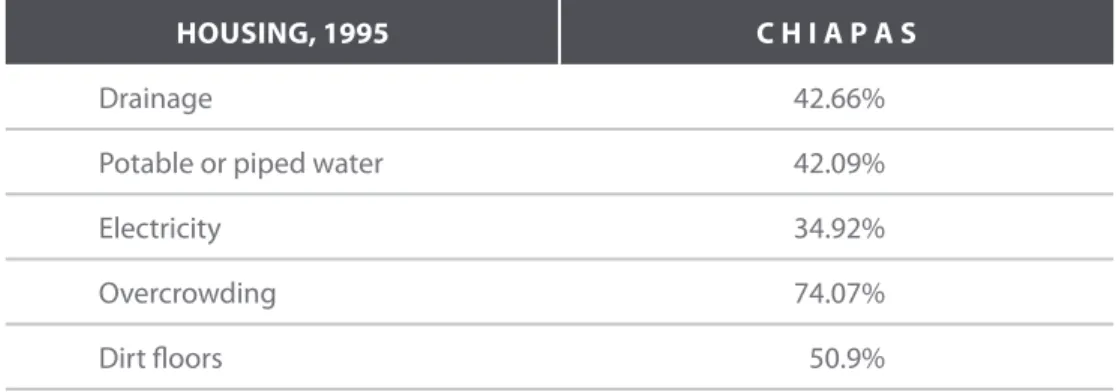
of the population and a coverage of treated wastewater of 47.2% . Other sources indicate that 41% of the population lacks piped po- table water and 55.7% lacks sewage connections (It is difficult to precisely quantify the amounts, which is why the sources have dif- ferent data, as can be seen in Table 2).
Table 1. Number of urban and rural locations in Mexico (INEGI, 2010).
SIZE OF LOCATION NATIONAL CHIAPAS
Localities Population Locality Population
Total 192 244 112 336 538 20 047 4 796 580
From 1 a 499
inhabitants 182 335 10 622 618 18 160 1 061 545
From 1 to 2,499
inhabitants 188 591 26 062 076 19 886 2 460 645
From 2,500 to 14,999
inhabitants 3 076 16 064 124 140 748 266
From 15,000 to 49,999
inhabitants 384 10 559 634 20 594 776
Table 2. Coverage of basic public services, dirt floors and overcrowded housing
HOUSING, 1995 C H I A P A S
Drainage 42.66%
Potable or piped water 42.09%
Electricity 34.92%
Overcrowding 74.07%
Dirt floors 50.9%
Clearly, the data in Table 2 are multiplied by the poverty of hundreds of communities in this entity. Therefore under these circumstances the Zapatista movement called forth for the need to dignify indigenous societies through public services that every Mexican citizen has the right to enjoy. In this historical context, through the Mexican Institute of Water Technology (IMTA) and the Food Agricultural Organization (FAO) a technical delegation traveled to Chiapas was organized in 1995 to analyze the problems of indigenous communities in relation to water supply. The first meeting was held in the library of the Faculty of Engineering of the UNACH with a group of international, national and regional experts who analyzed the problems related to the theme of water and indigenous communities. From this meeting a small research group gave rise to a line of work in the IMTA on “Alternative Hydraulic Technologies “ whose first product was the publication of a book entitled “Alternative Hydraulic Technologies: Technical Selection Guide” (Tecnologías Alternativas en Hidráulica: Guía técnica para la selección, Mundo et. al, 1997) that the institute published and distributed to various institutions in the country2.
In this manner, motivated by this work starting from the ideas proposed in the before mentioned book, a research project analyzing the intent or ability to collect water from fog to supply drinking water was derived for small rural communities of the Highlands of Chiapas, taking advantage of low cloud banks (fog) that occur in that region. Two experimental models were built called fog water collectors (Colectores de Agua de Niebla -CAN), one of them in the indigenous community of Chainatic the Highlands of Chiapas (photo 1) and the other near the Llano San Juan airport in the municipality of Ocozoc uautla (Photo 2).
2 In the following years, supported by the work, publications and projects done by this small group of investiga- tors and due to the awakening interest in this sector, the IMTA created the Sub Coordination of Appropriate and Industrial Technologies.
Photo 1. CAN experiment in Chainatic, Chiapas.
Photo 2. CAN experiment outside of the Llano San Juan Airport, Ocozocuautla, Chiapas
It was concluded that due to the low presence of fog banks in the study sites (compared to coastal fogs) and the short duration of the event, it was not possible in practice to obtain good results (Mundo et., al 1998). So the project was moved to the small fishing community of Punta Baja, in the Baja California coastal region of Mexico, where CAN fulfilled its objective. The average volume of fog water collection in Punta Baja was significantly higher than the volumes collected in Chiapas.
However, there is still pending a search for viable and economic alternatives to provide drinking water with unconventional technologies to small rural communities in Chiapas. For these reasons we continue with the research to provide water to these communities despite adverse technical conditions, among the most relevant are: scattered villages situated in locations with difficult access due to irregular topography, remote communities without significant surface water (rivers, streams) or natural reservoirs (lakes, ponds) and few springs with minimum flows. Thus, in this search and based on the book published in 1997, the Rainwater Collection System (Sistema de Colección de Agua de Lluvia -CALL) was designed, which under a tripartite agreement between the Mexican Institute of Water Technology, the Spanish Agency for International Cooperation (which granted the financial resources for construction) and the Faculty of Engineering at the U NACH advised and guided the construction of a CALL system in Yalentay (photo 3), which in 2010 was awarded the World Prize of Engineering “Best Practices” by the United Nations (UN) and the Government of the United Arab Emirates city of Dubai.
Photo 3. Rainwater Collector, Yalentay, Zinacantán, Chiapas
Basics design aspects of CALL. In order to build a rainwater collection system described herein, it is necessary to consider the following studies: topography, soil mechanics, hydrology, hydraulics, structural design, construction, social issues and social framework for the transfer of the system (Mundo, et al., 1999). The topography determines the flatness of the terrain and its profiles, in order to estimate the cuts and plot the ground storage tank construction site, while studies of the soils provides two basic data. First, the resilience of the soil to the design of the type of footings that will support the columns and the structure of the collection roof; and secondly the type of soil and its infiltration capacity (in some cases this test is performed with a double ring infiltrometer). If the infiltration rate exceeds the allowed limit, the base of the tank will have to be covered with a synthetic rubber geo-membrane or thermoplastic polymer obtained by the polymerization of ethylene. For their part, the hydrological studies are essential to meet the intensities of rainfall in the area and the average annual precipitation. Rain intensities associated with
several return periods will enable a good design of the system of channels and determine the capacity and size of the CALL filters, so that the construction of the IDT curves are necessary. The annual average rainfall is used to size the storage tank volume which is a function of daily demand, population and storage time estimated with a volume version of the equation of conservation of mass:
V=f(vm.P.ta) Where:
V = Total storage volume in m 3
vm = Average volume delivered to each person each day (l / person / d)
P = Total number of people to supply
ta = Time that the water will remain stored (d)
The known maximum storage volume and with the data of average annual precipitation (it is important that this value is the standard according to the criteria of the World Meteorological Organization) can estimate the area (A) of collection required, taking into account a security coefficient of 20%, therefore:
A=f[V/(Px0.80)]
Where:
A = Surface of roof collector (m2) V = VTotal storage volume in m3 P = Total number of people to supply
On the other hand, once flow rates for different return periods are obtained, uniform flow equations for prismatic channels will allow to design the dimensions of the gutters. For the case described here, gutters with a slope of z = 0 and less than 1%, are
considered. Therefore, by using the Robert Manning equation the dimensions of the gutters (hydraulic area and wetted perimeter) will depend on the estimated flow according to RTD curves, the roughness of the material (n) of said channel and slope (S):
Rh=[v.n/ (S1/2)]3/2 Where:
v = average flow in the prismatic channel (ms-1)
n = Manning rigidity (dimensionless) Rh = Hydraulic radius (m)
S = Slope of the prismatic channel (dimensionless) For his part the structural design defines the dimensions and spacing of the collector roof beams ( fink type structure) as well as the number and size of the support columns. If the area is seis- mic and high wind speeds are present, it is necessary to consider to review the design for earthquakes and wind. The construction aspects are important because they can meet the requirements of design, quality of materials and compliance with correspond- ing regulations. Finally the social aspects and transfer scheme should be considered before construction of CALL and must be executed by a team of experts in sociology and communication to ensure the transfer of the system and make users take owner- ship of the project3.
This project generated multiple benefits to the community, raising the standard of living of its inhabitants. Among the most
3 The Yalentay project was achieved through excellent planning. All of the specifications of design and program- ming were achieved through the support of specialists, included experts in structures, hydrology, sociology and communication. In this manner, after more than 10 years the CALL continues to successfully function. It has resisted earthquakes, the largest of which was 5.5 on the Richter scale. But the most important is that it continues being useful in a society where for hundreds of years had lacked potable water
relevant results were: a) The reduction of diarrheal diseases, b) The decrease in skin diseases, c).Children consume drinking water at school that comes straight from the CALL, d). There is less absenteeism by decreasing the water-related diseases, e).
Women do not have to walk miles away on a steep topography to get water, most often of poor quality s, f). It strengthened the community actions by establishing the first “ indigenous hydrau- lic committee “ in Chiapas in that community (referred to small rural communities under 1,000 inhabitants), raising it to the rank of a “hierarchical responsibility” for two years the responsibility of distributing water through the CALL (this role is equivalent to the responsibility of “ecclesiastic steward”, a charge sought by various community members for the social distinction that this role carries, g) A generation of trust between the community and the researchers, and as a consequence opened the (previously denied) possibility to continue executing projects in Yalentay.
With this community welcome and support, works continues on appropriate projects to conserve soil, air, water, atmosphere and forest, with the idea of converting into a model community, understood as: “... a place where due to its easy accessibility, ac- ceptance of the community to develop projects and its proximity to the city (San Cristobal de Las Casas), you can plan, develop, execute and transfer projects of appropriate technology for the conservation of natural resources and diminish poverty, dignify- ing the individual and social being, with the goal that students, engineers, researchers and decision makers in the public and pri- vate sectors could see or develop specific practices with projects, for their promotion or transfer to other latitudes”.4
4 Internet links (SCHRT, 2005a y SCHRT, 2005b) : https://www.youtube.com/watch?v=zeIT2L0bEqQ, http://www.
youtube.com/watch?v=POSHGLwNPNo, http://www.youtube.com/watch?v=hxs3ledKHgw, http://www.youtube.
com/watch?v=dNhkPW2nYOU, where you can see the use of the CALL in Yalentay and the religious festival for the water in the Zinacantanian town. The following link describes the sustainable house in an interview which is men- tioned in this document: https://www.youtube.com/watch?v=37Ij7wURCSg
THE SUSTAINABLE HOME
Sustainability. It is a definition created to promote the main- taining of balance in the relationship between humans and the environment. It tries to promote economic development without damaging the dynamics of the environment, using scientific and technological breakthroughs from society. Sustainability intends to meet the needs of the current generation of humans using natu- ral resources provided by the Earth without sacrificing the future capabilities of the next generations. It is a concept that is still not completed. It is promoted by the Mexican State as a political ac- tion, as a slogan for its social promotion and individual or group interests, but without positive results in practice. Society “waits”
for sustainable action by the state in a passive and irresponsible manner, because individually and as a whole is not fully aware of the magnitude of the problem. On the other hand there is the science and technology that is blamed for its “actions and conse- quences” on the environment. It is neither science nor technol- ogy to blame, nor the economy or politics. They are not because none of them, from the point of view of the theory of knowledge, are subjects but rather objects. The subject is active, the object is passive. In the social becoming a group of men (subjects) develop science and technology (objects) and others choose to apply it. The man (subject “I”) may decide, can trigger, therefore is responsi- ble, alone or in small groups because their actions plunders the environment without preserving it. It is man with his unethical actions, in his economic efforts or zone of comfort who has not found the necessary balance between desires and conservation of the nature that surrounds him, and that provides life: water, air, soil, food, and material goods.
Therefore, the concept of sustainability must be rethought- not as a concept that only a evokes a multiplicity of processes that compose it- leaving only the social and political as imaginary con- cepts. Sustainability must be restated as a “measurable action”,
as a new way of thinking rooted from childhood in formal and non-formal education (civics). But mainly it must be restated as a new form of behaving, where the relations of its three main en- tities- environment, society and economy- have measurable and practical effects. The bad individual or group actions that have negative results with nature, rural or urban areas, must be res- tituted and / or restored by the “actors of such action.” These ac- tions must have political, economic or social consequences, with the pedestal body and Adjudicating of the facts, independent of the state, constituted by civil society, supported by the laws for the preservation of the natural environment, where even the lack of promoting sustainability by the state is evaluated and judged by the citizen committees.
In this manner, politicians, scientists, technicians have roles to play with ethics and responsibility in relation to the environ- ment. It is crucial that the state not only increase the budget for research on these issues but promotes the preparation and formal awareness of citizens from childhood. On its part, universities and research centers should increase its research and techno- logical development in environmental topics for conservation and restoration. Within the jurisdiction of Earth Sciences and associ- ated technological fields, it is necessary to turn our eyes towards poor rural communities, especially indigenous communities, worldwide to address and rethink these issues: modeling climate to analyze the impacts on the hydrological cycle under various climate change scenarios; develop techniques for downscaling to model climate at regional or local levels; develop and implement methods to provide potable water to rural communities; develop methods to purify water without the use of fossil fuels; imple- ment methods to save and preserve water resources; develop new methods to clean wastewater using eco -technologies; develop methods and technologies for the conservation of forests, rivers, streams, and springs; implement methods for soil conservation and maintain air quality; implementing economic methods to
bring electricity to rural communities with “clean technologies”;
develop new models of sustainable housing that also contemplate the architectural design for the weather and local environment, use of space, thermal building materials that are economic and resistant and equipped with technologies that allow better use of water, air, soil and the natural environment .
In this context and through taking up this set of ideas, a sus- tainable house was designed with the idea of transferring it to the indigenous community of Yalentay. Thus, the Research Center of the School of Engineering of the UNACH with the support of an architect and alumni from this university, have integrated the ex- perience gained in the CALL- taking into consideration customs, values and indigenous cosmogony- to propose a “SH” associated with nearly a dozen AT’s, based on four elements: water, soil, fire and air5. Therefore based on their cosmogony, one of the first fac- tors taken into account in the design project of the SH and AT’s was the soil. For these reasons the design of the SH was adapted and the AT’s to the average space (ground) that a normally large indigenous family for accommodation. Another was adapting to their requirements according to their customs. For example, they are not interested in Western vision of a “big” house, because the ground is communal-it belongs to everyone. In their words: “...
the tiny earth if of the community, of men, and the smallest is of the dead. The largest land (the majority), is the forest where the air that gives life comes from, the firewood for heating the home;
this, the largest land, also belongs to corn from where the family exists. “ The soil gives them the sense of belonging “... it is my land, it is everyone’s, it is my heritage, I am from here, here were born my grandparents and my parents and here I will die.” Soil is fun- damental in its cosmic vision. In this small area it is necessary to
5 The sustainable house has a patent pending with registry number MX/a/2014/004491 with the Mexican Institu- te of Industrial Property ( Instituto Mexicano de Propiedad Industrial -IMPI).
shelter them with dignity, helping them to improve and maintain their health. In the same “ground” there is also a healthy relation- ship that determines the family morbidity: a firm anti-bacterial floor means less biological vectors that generate diseases with that combined with the biological vectors found in water are the major causes of illness and death in these communities.
Moreover its relationship with water is basic not only to eradicate certain diseases of poverty such as dermatitis, diarrhea, trachoma, or to raise their standard of living, but also for its reli- gious character shown in syncretic acts every April 15, when the whole community participates in the water festival in the CALL and executes the cleaning of the holy wells, acts of pre-Hispanic origin for “vo”6 honoring Tlaloc mixed with the liturgy in honor of Christ. This link with water is achieved in the SH through four as- sociated AT’s, one of which is a replica of CALL but now in a house called the CALLD, which can store more than 35,000 liters of water if the design requires. The three other appropriate technolo- gies are: a tank with a laminated siphon for irrigation, an ecologi- cal sink, and the bike-pump. The SH also has a system called an intermittent irrigation siphon tank used for growing flowers and vegetables that saves 50 out of every 100 liters of water used. The ecological sink is made of several deposits made from brick that cleans the soap or oil from domestic water for re-use. Finally, the bike-pump is a device composed of a stationary bike attached to a horizontal pump “charm” that raises the water from the rain wa- ter collector and sends it to the elevated water tank.
Moreover, in indigenous cosmogony fire (represented by the Sun) is one of their most important gods, who every morning peeks over the mountains in the dawn and then emerges victori- ous in its struggle against death (represented by darkness), soar- ing through the sky to complete its cycle-circular- just like the
5 “Water” in tzotzil zinacanteco.
indigenous cosmogony. The ground fire “detached” from the sun, provides hot food, cooks the food that gives life, represents the
“home”, in the center of which the family is based. It is a source of light and heat, which in high and mountainous areas serves to shelter the family from the intense cold. The ecological stove (ES) is the metaphor of this myth. . The ES is the source of heat in the SH and is the means to cook food. The ES has a chimney to evacu- ate smoke for the SH and thus helps reduce respiratory illness in the family. The ES also contributes to forest conservation by ef- ficiently using firewood. The SH obtained a “Global Energy Award 2013” in May of 2013, one of the most prestigious awards in en- vironmental issues in the world awarded by the “Energy Globe”
foundation based in Austria. The following is a brief description of the technologies associated with the SH.
Figure 1. View of sustainable house
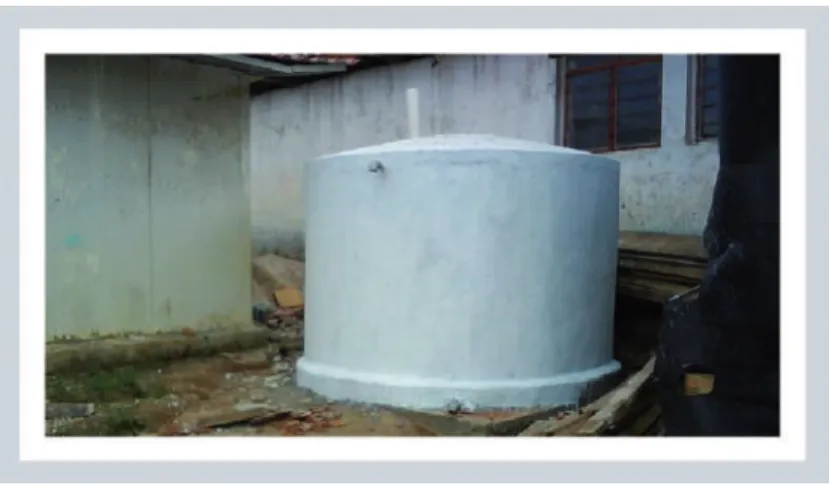
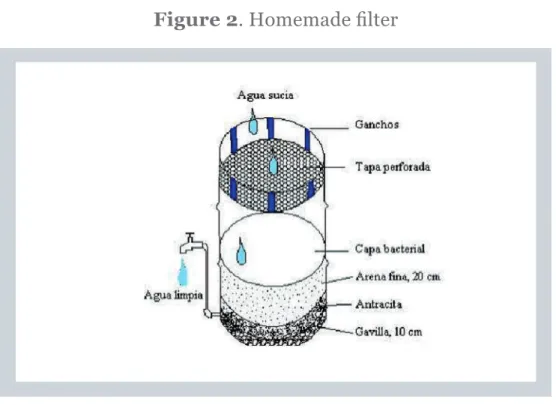
Household rain water collector (CALLD). The CALLD is a circular tank, made of reinforced cappuccino brick with electro – welded metal mesh, plastered inside and outside. It has a filter that cleans the water of impurities and where you can chlorinate if necessary (Figure 2). It is economical because the cost is equiva- lent to $ 0.10 USD per liter and tanks over 35, 000 liters can be built. It competes with the cost of companies that sell plastic tanks (PVC or HDPE), but the CALLD is outstanding for its durability
and storage capacity. The laws of design are the same design as the CALL (equations 1-3).
Photo 4. CALLD in Yalentay, Chiapas
Hydraulic ram pump (HRP). The HRP operates continuously for 24 hours using only hydropower. It is powered by a natural or ar- tificial drop of at least 1 meter high. There must be a constant flow of the supply source, which can be a stream, river, small dam or tank. The recommended minimum flow of the source must be 2 l/sec and the minimum hydraulic load should be 1 m high. If the minimum height between the source and the entrance to the HRP is 1 m, it can push water up to 10 m in height.
Foto 5. Hydraulic ram pump, Research Center, School of Engineering
The bike-pump (BP). The BP operates with the simple pedal- ing of a stationary bike that converts mechanical energy into hy- draulic energy. The operating range of the BP (Figure 6) is up to a 8m depth in the suction and up to 20m high in the discharge. The pumping rate can be from 0.8 l/s for 1m of elevation with a 1 inch hose, up to 0.2 l/s to 20m in height.
Photo 6. Bike pump in Yalentay
Gravel and sand quick filters (GSF). GSF’s are used for the treat- ment of turbid water, with sediment or suspended particles in suspension and that generally have no prior coagulation and sedi- mentation. They are used to clean water before sending it to a res- ervoir. It consists of an upper layer of 40 cm sand sifted through No 8 and 16 mesh. Below this layer a layer of 40 cm gravel is placed
½ of Θ and finished with a bottom layer of 40 cm of gravel ¾ ¨ of Θ. In the inter-face layer of mesh is placed a layer of screen with a smaller diameter than the upper particles to avoid heterogeneity in the filter layers.
Photo 7. Sand and gravel filters in Yalentay
Slow home filter ( SHF). The SHF consists of a vertical 200 liter plastic container, with an upper layer of prepared sand 60 cm thick placed between the mesh openings of 0. 42 and 1. 19 or 1.
41 mm, with an effective size ranging from 0. 50 and 0. 60 mm and a coefficient of uniformity of less than 1.5. Below the sand layer should be placed a layer of 40 cm of charcoal, prepared be- tween the Tyler series meshes with openings of 0.59 and 1.68 to 2.
00mm, with an effective size ranging from 0.80, one 10mm and a coefficient of uniformity less than 1.5. A drain is located under the charcoal layer, which serves as a collector of filtered water, con- nected in turn to a faucet.
Ecological Bathroom (EB). The EB has two brick structures with reinforced mesh. The first is a septic tank for the sedimenta- tion of solids; the second consists of two chambers formed by an anaerobic filter followed by a filter of graded materials. The anaer- obic filter is filled with plastic rings (PET) which serve to distrib- ute the water evenly and that the bacteria feed on contaminants in the water. The second chamber is formed by layers of graded materials (sand, pea gravel, gravel and round stones) placed in that order (from top to bottom).
Figure 2. Homemade filter
Photo 8. Ecological Bath in Yalenyay, Chiapas
Ecological sink (ES). The ES is an appropriate technology that is used to treat through a biological system using water from the laundry, dishes and washing hands. The ES is a five-chamber structure of brick with reinforced mesh: 1. A grease trap with a drain colander to trap solids; 2. Two sealed chambers for anaero- bic treatment of rings from plastic bottles (PET), to increase the area available for the development of bacteria and; 3. Two cham- bers with graded materials. Next to the first chamber is located the laundry area (photo 9).
Photo 9. ES in Yalentay Chiapas
Tank with laminated siphon (TLS). The TLS is a hydrau- lic structure (tank) used to supply water intermittently to agri- cultural parcels (up to one hectare) small home gardens. This system has a discharge tube in the shape of a laminated siphon, which can save large amounts of water (up to 50 out of every 100 liters used) compared to continuous surface irrigation. The fundamental equation governing its intermittency for a con- stant flow input is:
Qs>Qe Donde:
Qs = Inflow (l/s) Qs = Outflow (l/s)
Photo 10. Laminate siphon tank
Ecological stove (ES). The EE is a small rural stove or fireplace made of brick that has a “furnace” at atmospheric pressure whose energy source is the internal combustion of wood. The upper sur- face of the ES is constituted by a metal plate of 10 gauge steel (40.5 cm wide by 61 cm long) that is used for cooking or heating food.
The ES saves a lot of wood and prevents pollution inside the home by removing smoke through a metal chimney (photo 11).
Foto 11. Estufa ecológica en Yalentay, Chiapas.
CONCLUSIONS
Thousands of indigenous communities in Latin America and Mexico are living in poverty. They lack basic public services such as water, sewage, electricity, health services and decent homes.
This paper presented a sustainable house and a set of appropri- ate technologies for poor communities that permit them to dig- nify their life and live decently. One of these technologies (which was also the solid precedent for future developments) is the rain- water collector built in the indigenous community of Yalentay in Zinacatán, Chiapas. Built in 1999, it has produced many benefits regarding health, dignity and community social relations. From this point it is planned to constitute this population as a model community, where they have developed and in this case validated nearly a dozen suitable appropriate technologies for the provision of potable water- raising the standard of living of its inhabitants and conserve the natural environment such as soil, air, water and
forest. From these projects have developed the idea of designing and building a sustainable house that saves energy, prevents the emission of greenhouse gases into the atmosphere and conserves natural resources. The sustainable house was designed incorporat- ing elements of the customs and indigenous beliefs based on the four elements: soil, water, fire and air. The sustainable house can be built of adobe, brick, or cement block depending on the material available in the area. It was designed in modular form and is com- posed of: Two or three bedrooms (depending on number of fam- ily members); living room; ecological bathroom; ecological kitchen with stove and water tank (a part in the kitchen and elsewhere in the courtyard), and an entrance porch. The construction surface can be up to 50 m 2 . The sustainable technologies in the home are:
a). Household rainwater collector(CALLD) with attached filter, b).
Ecological bathroom (does not use water), c). Bike-pump (system that uses only the mechanical energy of pedaling a bicycle to raise water from the CALLD water tank calld), d). Ecological sink (cleans soapy water and oil for reuse), e). Ecological stove (saves fuel and prevents smoke pollution in the house), f). Intermittent irrigation system (saves up to 50% of water for irrigation of vegetables and flowers). The SH also includes: anti-bacterial solid floor; 3 kits for supplying photovoltaic power in areas where needed via solar pan- els; fluorescent lighting, low consumption toilets in the case of wet composting toilets, and shower and kitchen sink with water-saving devices. The SH obtained the “Global Energy Award 2013”in May 2013 awarded by the “Energy Globe” foundation based on Austria.
This year it plans to build the first functional sustainable house in indigenous communities in Mexico, which will be donated to a fam- ily of 10 people. This family was selected by the community accord- ing to their criteria and customs.
REFERENCES
Cisneros, S. M., Mejía, R.I., Castellanos, H.E., Olamendi, P.
M., García, C.S. (2013). Prevalencia y factores de riesgo para la infección ocular por Chlamydia trachomatis. Enf.
Inf. Microbiol. 33 (2): 54-60.
CONAGUA. (2009). Situación del subsector agua potable, al- cantarillado y saneamiento 2009. Subdirección General de Agua Potable, Drenaje y Saneamiento. .Coordinación Gene- ral de Atención Institucional. Comunicación y Cultura del Agua de la Comisión Nacional del Agua. México, D.F.
Gelles, P. (2002). Andean Culture, Peasant Communities and Indigenous Identity. In WALIR studies (Wageningen: Wage- ningen University/IWE-United Nations/CEPAL) Vol. II.
Gentes, I. (2002). Water Law and Indigenous Rights in the An- dean Countries: conceptual elements. In WALIR studies (Wageningen: Wageningen University/IWE-United Na- tions/CEPAL) Vol. II.
Guevara, G.A. (2002). Water Legislation and Indigenous Water Management in Peru. In WALIR studies (Wage- ningen: Wageningen University/IWE-United Nations/
CEPAL) Vol. II.
INEGI. (2000). Censo general de población y vivienda 2000.
Instituto Nacional de Geografía e Informática (INEGI).
http//inegi.com.mx.
——(2010). Perspectivas estadísticas Chiapas. Instituto Nacional de Geografía e Informática (INEGI). http//inegi.com.mx.
INI. (1993). Indicadores socioeconómicos de los pueblos indíge- nas de México, 1990. Subdirección de Investigación, Institu- to Nacional Indigenista.
——(1999). Información básica sobre los pueblos indígenas de México. Instituto Nacional Indigenista.
Mundo M.M., Martínez Austria P., Hernández Barrios L., Del- gado Bocanegra A. (1997). Tecnologías alternativas en Hi-
dráulica. Guía técnica para la selección. Instituto Mexicano de Tecnología del Agua. México.
Mundo Molina, M., Martínez, A.P., Figueroa, G. A., Muciño, P.J., Ballinas, A. R. (1998). Fog collection as a water source for small rural communities in Chiapas, Mexico. First In- ternational Conference on Fog & Fog Collection, 405-408.
Vancouver, Canada.
Mundo Molina, M., Ballinas, A.R., Martínez, A.P., Hernández, B.L., Ponce, M.M., Ferrer, P.R. (1998). Colección de agua de lluvia: una alternativa para la dotación de pequeñas comunidades rurales menores de 500 habitantes. Quinta Reunión Nacional sobre Sistemas de Captación de Agua de Lluvia. Oaxaca, Oaxaca, México.
Mundo Molina, M., Martínez, A.P. Ballinas, A.R., Rodríguez, L.M. (1999). La importancia de las ciencias sociales y de comunicación en la transferencia de tecnología, caso de estudio: construcción de un colector de agua de lluvia en la comunidad indígena Tzotzil de Yalentay, Chiapas. Sexta Reunión Nacional sobre Sistemas de Captación de Agua de Lluvia. Jalapa, Veracruz, México.
Peña, F. (2004). Pueblos indígenas y recursos hídricos de Mé- xico. Revista Mad. No.11. Departamento de Antropología.
Universidad de Chile.
——(2005). La lucha por el agua. Reflexiones para México y Amé- rica Latina. En P. Dávalos (Comp.), Pueblos indígenas, es- tado y democracia (pp. 217-238). Buenos Aires: CLACSO.
Psacharopoulos, G., Patrinos, H. (1994). Indigenous peo- ple and poverty in Latin America: an empirical analysis.
Washington, D. C., The World Bank.
SS. (2010). Guía práctica clínica diagnóstico y tratamiento de tracoma. Secretaría de Salud (SS), México.
SSA-INI. (1992). La salud de los pueblos indígenas en México.
Secretaría de Salubridad y Asistencia. Instituto Nacional Indigenista. México.
Salas, S.J. (2002). Latinoamérica: hambre de vivienda. Revista INVI, vol. 17, núm. 45, pp. 58-69, Universidad de Chile, Chile.
SEDATU. (2014). Reglas de Operación del Programa Vivienda Rural, para el ejercicio fiscal 2014 de la Secretaría de Desa- rrollo Agrario Territorial y Urbano. Acuerdo por el que se emiten las Reglas de Operación del Programa Vivienda Ru- ral, para el ejercicio fiscal 2014. Diario Oficial de la Federa- ción. Novena seccón del 30 de diciembre de 2014.
Torres, J.L., Villoro, R., Ramírez, T., Zurita, B., Hernández, P., Lozano, R., Franco, F. (2003). La salud de la población indígena en México. Revista Caleidoscopio de la salud.
FUNSALUD; 41.54.
Internet sources consulted:
La Jornada. (2012). Sufren tracoma 5 mil indígenas que ha- bitan comunidades de Chiapas en pobreza extrema, 30 de septiembre de 2012, de http://www.jornada.unam.
mx/2012/09/09/estados/027n2est.
Canal 10 de Chiapas. (2005). Colección de agua de lluvia en Zinacantán, Chiapas. Programa Biosfera 10. Gobierno del Estado. Sistema Chiapaneco de Radio y Televisión. Tuxtla Gutiérrez, Chiapas.
http://www.youtube.com/watch?v=POSHGLwNPNo, http://www.youtube.com/watch?v=hxs3ledKHgw
——(2005). La fiesta del agua en Yalentay, Zinacantán, Chiapas.
Programa Niluyarilu. Gobierno del Estado. Sistema Chia- paneco de Radio y Televisión. Tuxtla Gutiérrez, Chiapas.
http://www.youtube.com/watch?v=dNhkPW2nYOU
Jaguar71217. (2011). Premio mundial de ingeniería ONU 2010.
https://www.youtube.com/watch?v=zeIT2L0bEqQ
——(2013). Energy Globe Award 2013.
https://www.youtube.com/watch?v=37Ij7wURCSg