PRACTICES OF TEACHERS FROM THE CITY OF ESMERALDAS REGARDING
INCLUSIVE EDUCATION: AN EXPLORATORY STUDY
Maria Luisa Torres Montánchez
Pontificia Universidad Católica de Esmeraldas
MARIA LUISA TORRES MONTÁNCHEZ Professor-investigator at the School of Education, and coordinator of the Line of Educational Inclusion at the
Pontificate Catholic University of Esmeraldas, Ecuador.
Contact: [email protected]@pucese.net [email protected]
ABSTRAC
This article presents part of the study of a doctoral thesis developed in Esmeraldas, in collaboration with the Pontificia Universidad Católica del Ecuador (Esmeraldas Campus) and the University of Valencia. The objective of the analysis is to understand the attitudes, knowledge and practices of teachers to inclusive education in the province of Esmeraldas to explore the position in which they find themselves in their educational work. The main findings of this investigation relate to positive attitudes and practices towards inclusionthat teachers claim to possess and the self-assessment of their ownknowledge as well as deficiencies.
Keywords: Educational inclusion, attitude, knowledge and teaching practice.
T
he purpose of this exploratory analysis focuses on the collection of information on the attitudes, knowledge and practices of teachers in the city of Esmeraldas to inclusive education. For this purpose a self-developed questionnaire was applied which allowed for the collection of relevant information.The question of investigating this issue was induced after confirming the lack of studies on inclusive education in the province of Esmeraldas, focusing on the evaluation of teachers as key players, which means that no previous work is evident with the characteristics of this investigation. It is considered that professionals are the cornerstone in the inclusive movement -those doing the daily work in the classroom, planning the process of teaching & learning. Teachers are the fundamental protagonists and should be the first to report of the situation in which they find themselves before inclusive education.
A first approach to the understanding of inclusive education, which study focuses on the attitudes, knowledge and practices of teachers, offers new lines of investigation, creating new hypotheses and questions in the study of the formation of such professionals in the field of inclusion in the indicated context. It may be noted that this is an initial approach to this specific and little studied field in Esmeraldas. For this reason, it is advantageous to work on an issue like this -the ability to investigate an emerging field which aims to describe new perspectives and concepts. Therefore, this research is, first, an exploratory matrix of its realization since it is considered that it first precedes the descriptive or explanatory studies, and can be used to identify trends and areas.
Given thatit is the professionals who build their work daily and who know the reality of the classroom, the overall goal is to know what are the attitudes, knowledge and practices about educational inclusion of teachers. Therefore it is considered appropriate and convenient to investigate it through a questionnaire. It was seen fit to build a specifically designed questionnaire to collect information that would allow a large number of people and allow, in turn, the estimating conclusions from the representative sample of teachers in the city of Esmeraldas. While developing the questionnaire, particular relevance
to the content of the items is given, taking care not to apply great efforts and demands for attention from the respondents at the time of its completion, thus ensuring the response of those involved in the study.
This questionnaire is to take the first step to encourage new lines of study that will help the growth and exchange of materials to help promote inclusive education by teachers in schools in the city of Esmeraldas.
Its design followed the steps mentioned by Fernández, Pérez and Rojas (1998) adapted to our interest. The questionnaire is divided into:
A) Demographics: The population data that refer to sex, age, address, facility where they teach classes, grade, years of teaching, college where they graduated for both undergraduate, graduate and specialization, and an b) Analysis of Scales: the 79 items of the questionnaire, divided into attitudes, knowledge, practices.
The scaled questions are in all 3 dimensions from “nothing”, “little”,
“quite” and “very much” (Likert scale). The items were constructed trying so they had a simple formulation according to Ecuadorian vocabulary and terminology and a similar extension.
Prior to execution, an analysis of the metric properties and the validation by expert judges was made with a group of five experts in Research Methods and Diagnosis in Education (MEAS) and Dr. Magaly Robalino Campos, responsible for educational programs of UNESCO in Ecuador.
Subsequently, through a statistical program for Social Sciences -SPSS- data were collected from the questionnaire. These data were entered into the system chosen for analysis that allowed a quick, simple and visual way to obtain statistical resultswhich were considered in the development of an assessment of the attitudes and practices of teachers before inclusion.
In order to facilitate the collection of information a previously authorized invitation by the Ministry of Education and its representative in Esmeraldas, Iliana Chiriboga, on part of the University for all
day was December 13, 2012 during the hours of 11 am to 12:30 pm for the afternoon session schools, and from 13:30 to 15:00 for the day session schools, with the aim of reflecting on existing training needs in the theme of educational inclusion and completion of the questionnaire.
Following this, the Chief of the Division of Educational Supervision of the Ministry, Ms. Noemi Rubio Pita, attached a letter signed by herself from the district address number 3 of intercultural education ofEsmeraldasin order to get as much assistance from teachers as possible. Finally, invitations to the 166 elementary schools in the city were sent personally and by telephone. On December 13, 2012, there were 321 teachers who attended the University who made up our study sample.
Regarding the control of the application, special care was given so that the respondents understood the questionnaire welland it was specifically attended to by encouraging teachers to consult me with queries. Once the collection stage was finished–with questionnaires from 321 teachers- the responses were analyzed and a methodological process was used and significance was given.
The first dimension of attitudes contains 19 items which refer to the qualities of teachers to the inclusion, analyzing what position they have in their daily activities with questions about the importance of working with inclusion in the classroom, equality among all students, inclusive training materials, etc.
On one hand, the word attitude is conceived asthe positive/
inclusive individual predisposition that teachers have to treat children with special educational needs and minority groups. In other words, the attitudes of teachers represent the will, way of being or particular posture in order to manifest positively or negatively the inclusive movement. There have been several studies (Fennel, Fernandez and Aznar, 2002, Cervantes, Capello and Castro, 2009 and Ocampo and Cid, 2012) that deal with the attitudes of professionals in various fields, highlighting the importance of developing positive attitudes. In our case, it is the teacher’sattitudes towards special needs education and
inclusive education in existing schools and in Esmeraldasociety which are ways to encourage commitment to quality education.
The second dimension refers toknowledge, and they are 19 items that deal with the strategies, skills and expertise to address inclusivity in the classroom and which cases of children with special educational needs have had the opportunity to work. Knowledge is understood as scientific and common preparedness for inclusive education and its management / treatment. If knowledge is not adequate, the care for such children will not be adequate. Bothscientific and common knowledge do not cancel each other nor are independent, because each has a meaning and a function. It is essential to know both types of knowledge as one focuses on the theoretical / scientific and daily life which is one that purifies the educational experience, develop lesson plans, make decisions or develop alternative action strategies. The questionnaire refers to both types.
The third dimension concerns practices. It has 15 items that question the inclusive practices that teachers build in their classrooms with questions about the development of specific plans, the promotion of equality in the classroom, and the support given to students who demand special treatment among others. Practices are seen as tasks, assignments and exercises used by teachers in their inclusive educational actions, i.e. they reflect the activities and actions that promote educational equity, taking into account the special educational needs of each student in the classroom. Practices relate to those skills that give coverage to the fundamental right to a quality education.
It is important to question and reflect on these practices to provide quality attention to the diversity of students, and adapting to the pace of development of each student. The social and relational skills are those that derive an effective inclusive treatment. It is necessary to promote practices, strategies and teaching skills that reflect inclusive educational attention designed for diversity. Based upon this, you may say that changes at the educational and cultural level, are needed in the education system in the province.
This research stems from the link between attitudinal, cognitive and practical teaching training of staff about educational inclusion.
Inclusive education is conceived as an educational movement that is increasingly permeating in educational systems all over the world.
For several years it has been trying to improve the situation to include student diversity in classrooms through quality and welcoming education. Inclusive education should be understood from a holistic perspective that is intended to improve educational institutions, seeking todiminish the level of social segregation.
Many authors define, and defend, the sense of inclusive education in its global sense, such as Ainscow or Arnaiz, among others. From all of the readings on this interesting subject, it is thought of as a kind of education that guarantees the right to quality education for everyone seeking equal opportunities, possibilities and results, including all of social actors in their entirety – neighborhoods, families , school, mass media.
In the legal context of education in Ecuador and from some socio- political initiatives,action is suggested to achieve equal opportunities in education and real inclusion for all. Another aspect that is currently being developed by the Government and Ministries is to train quality teachers. In this case, this refers to those who are trained to deal specifically with cases of children with special needs in schools.
PRESENTATION AND JUSTIFICATION OF THE STUDY
Latin America, characterized as being the most ethnically diversepart of the world, is immersed in this educational change. Diversity is very evident in educational systems where there is a large range of ethnicity- creoles, African descent, indigenous, gypsies, etc. among children and young people in schools. As the Social Forum of the Americas states “diversity is one of the principles of the present and future and in all of its expressions.”Therefore, in the context of Latin America, inclusion has the potential to act in support of the transformation of
school systems as themost effective mechanism for equal treatment for everyone.
Many countries pick up what is collected as a determining factor in the development of societies and equitable education systems. Many reforms are germinating a result of this movement, which is expected to play not only an important, but a crucial role. From a political view, the governments of this region and other national and international institutions agree on the fact of developing inclusive education in order to combat discrimination and social and school exclusion, primarily contributing to all Latin American educational policies. It should be noted that it is the governments that must match the development of their policies for inclusion, innovation and progress.
Education is the link to growth, equity and justice in society.
Meanwhile, the UN is its document “Progress in Latin America and the Caribbean towards the Millennium Development Goals. Challenges to achieve equality “(2013, pp.19-20) , regarding education, states:
“Latin America and the Caribbean have made significant progress in expanding coverage and access to education. In relation to the second Millennium Development Goal, the region began in the early 1990s and has virtually achieved universal access to primary education. By 2007 and 2008, a large majority of countries exhibited net rates near or above 90% and enrollments in practically each with regards to gender equality had been achieved. Despite this achievement, progression and completion of primary education was far from optimal. Two decades later the region scored tremendous achievements in this area, but it does not seem to be capable of achieving universal completion of primary education, although some countries are likely to succeed. Indeed, the simple average of 18 Latin American countries indicates that 89.6% of young people aged 15 to 19 had completed their primary education, a figure that rises to 93.1%
when considering the weighted average mainly due to the high completion rates that occur in Brazil and Mexico. Although in 5 of these 18 countries between 12% and 38% of children does not end the primary cycle, the regional situation regarding primary education is good although the rate of progress towards universality between 1990 and 2007-2008 was
83%, lower than expected for the region to achieve the goal of universal primary education.”
Although great progress has been achieved, the results are insufficient to meet the minimum educational level. Additional challenges have been added, as cited by the UN (2013, p.12) :
“The low coverage of preschool education, low pay and little recognition of the teaching profession, the gaps in the introduction and use of information technology and communications (ICT), and in a large part as a consequence of the above-the lack of linking secondary and postsecondary education and the labor market- is reinforced by the slow growth in the supply of productive good quality jobs.”
The Ecuadorian education system has been improving in recent years.
Many of the developments include: the expansion of coverage up to 6 years, the evaluation of educational services, assessment for students and teachers, higher salaries and educational investment.
The majority of students will finish primary their education. On the other hand, a solid foundation is being created in assessment in order to identify and correct problems and to solve them quickly and efficiently, enhancing the quality of teachers through training and education along with an improvement in wages which will result in improved student achievement. However, these advances are not enough. Ecuador is initiating reforms and changes in the education system but there are still significant challenges, such as access to education both at the primary and secondary levels, and a balance the economic inequalities among children in rural and urban areas- education for all. In the Constitution of the Republic of Ecuador, Article 27 which is effective to todayprovides “access to education for all citizens without discrimination.”
It is important to explain how and what progress there has been in special education in the country. Special education in Ecuador began in the 40´s through partnerships between parents and mothers and private organizations. Between 1990 and 1997, the development of special education in the country was promoted through a series of ministerial agreements that facilitated the processes in this subsystem, with an
apparently coherent legal framework. The Ministry of Education and Culture of Ecuador (2005) indicated that the greatest progress has been made in this area from 2002 to 2009. Since the first Regulations on Special Education was published in the Official Journal No. 496, a model was developed with attention to Special Education and the first guidelines for inclusion in secondary and vocational education were established. In these years the process of training for teachersbegan in regular education, as well as special education. Advances of inclusion in Ecuador are very recent, which is why more support from government institutions and organizations is required in order to continue making progress towards an inclusive society for all.
Education remains uneven in terms of access and even more so in results. Several factors affect this situation: poor children, rural areas, political instability, poverty, low education, little recognition of teachers, weaknesses in their training, traditional approaches to education, marginalization of what is different, etc. A changeand social cohesionis needed with the support and joint participation of civil society and local organizations.
In Esmeraldas, social inequality and poverty levels directly affect the implementation of inclusive education in terms of social justice.
Students cannot take advantage of the educational opportunities when they do not enjoy a minimum level of human development and quality in their lives. It is necessary to promote systematic experiences of interaction with “others” which permits the revelation of their world through dialogue and social construction, and in this manner reinvent school based education. Education in Esmeraldas, in terms of teacher training, is in flux, which is why there continues to be better training.
In order to achieve quality education, it is essential to have greater involvement of the actors at the national and provincial levels of the education system. The authorities should implement policies according to the reality of the province.
POPULATION AND STUDY SAMPLE
The reference population and the study sample are teachers inpre- university education from Esmeralda. The inclusion criterions that were thought appropriate for this research were:
• Teachers from the pre university schools from the city- General Basic Education, the most suitable school stage for the detection of special education needs.
• Teachers in urban schools.
According to the Master Archive of Educational Institutions (AMIE, 2012), the total number of teachers in all of the schools in Esmeraldas is 1027 in total.Information was collected via questionnaire from 321 respondents.
From the sample population, some representative data are: almost 80% are women, compared to 20% men. The average age of the reference population is 49.94 years. The 70.6% of the respondents are graduates in Education Science. 140 subjects said they graduated from the University Luis Vargas Torres, 26 from the University of Guayaquil and 17 from the PUCESE. It is notable that 80% -257 subjects- of respondents did not answer whether they possess postgraduate qualification for teaching.
64 said they have a graduate degree.
RESULTS AND DISCUSSION
After explaining the above, it can be noted that the basic requirements to be met by any data collection instrument are reliability and validity.
According to Hernández, Fernández and Baptista (2006, p.
200) reliability is referred to as “the degree to which an instrument produces consistent results.” Meanwhile Kerlinger (1981, p. 132) says it means “stability, ability to be predicted, that can be confided in, that which is consistent, that which is consequent”. As for validity, the first authors note that “the degree to which an instrument actually measures the variable that is to be measured” (2006, p. 201) , or
Kerlinger (1981, p. 138) that defines validity by raising the question
“are you measuring what you think you are measuring?”. Finally, according to Hernández, Fernández and Baptista (., 2006, p 207), we find a specific feature: objectivity. These authors define this as
“the extent to which the instrument is permeable to the influence of bias and trends of the researchers who administer it, interpret it, and qualify it.” However, this feature refers to the validity of the instrument and, in short, is evidence of the same concept (Jornet and Suarez, 1990).
Following the above reasoning, it can be indicated that this exploratory study meets both requirements, and specifically regarding objectivity (in terms of Hernández, Fernández and Baptista, 2006).
On one hand, the validity of our questionnaire is true because it has been approved by outside judges or “qualified voices” (2006, p. 204) as a means of collecting appropriate data, which aims to explore and become familiar with the object of study in order to obtain the information it seeks to explore. On the other hand, objectivity is also true because the measuring instrument that was developed is transparent to the predispositions of any investigator who uses it.
In any case, it is not always possible to require these features of goodwill in a questionnaire, since they are brought together in the same format the collection of data is nominal or categoricalwith others on the scale.We can estimate reliabilitywith only those on the scale, and it is that aspect which has been attempted in this study to control. Therefore, the questionnaire focuses on the analysis of the same feature, only referring to the clusters that can be considered scalar dimensions of assessment. This is why only specific reliable information regarding those areas of the questionnaire is provided.
In first place, in order to demonstrate the quality of the instrument that was used, the information from the analysis of the metric properties of the same that refers to the studied scalesare collected: attitudes, knowledge and practices with the objective of observing its own reliability, and the functioning of the elements.
An analysis is performed for each of the three scales included in the
questionnaire, taking into account the value of Cronbach’s alpha and the homogeneity index of each of the items.
On the one hand, for the analysis we focus on theCronbach Alpha reliability coefficient being:
“A model of internal consistency, based on the average of the correlations between items. Among the advantages of this measure is the possibility of evaluating how much better (or worse) the reliability of the test is if a particular item is excluded. (Garcia, Gonzalez and Jornet, 2013).
Regarding the metric properties of the “Attitudes” scale, the Cronbach alpha coefficient is 0.824, which is a good level of overall reliability.
Generally, all of the reviews on this scale are similar- the question presented and is based on the average, with the lower middle average of 14 with 2.08 and it those with the higher average ratingis the item 8 with 3.56. As shown below, each of the items contribute significantly to the reliability of the scale. Although there is a slight difference, we must realize that there are three faulty items and a low coefficient of homogeneity. These are: Item 10 “I believe that indigenous children require special treatment in the classroom because of their problems of marginalization, they are slow learners and other” has a value of Cronbach’s alpha of 0.827 with a coefficient of uniformity of 0.247 . Item 18-”I think refugees children require special treatment in the classroom because of their problems of marginalization, slow learning or other” gets a Cronbach’s alpha value of 0.826 with a coefficient of uniformity of 0.236, and item 77 “I think the issue of violence in the classroom is important to work on in the school” has a value of 0.825 Cronbach’s alpha coefficient with a level of homogeneity of 0.247. In all three cases the increase is very small but instrument reliability remains and so their removal would increase the scale reliability.
Regarding the metric properties of the “Skills” scale, the Cronbach Alpha coefficient is 0.783, which is a good level of overall reliability. Generally all of the average scores are rather dispersed, wherein the lowest average isitem 30 with 1.13 ,and that which has a higher average rating is item 20 at 3.10. As will be seen, each of the
items contributes significantly to the reliability scale. Although there is little difference, one must realize that there are three faulty items and a low coefficient of homogeneity: Item 19 “Inclusive education is only for working with children with sensory or physical hardships and psychological limitations” has a Cronbachalpha value of 0.786 with a coefficient of uniformity of 0.234. Item 20 “Inclusive education means rethinking the attitudes and actions in society” gets aCronbach’s alpha coefficient value of 0.786 and a homogeneity coefficient of 0.171.Item 21 -”Students with and without special educational needs should have the same curriculum in the classroom “has a Cronbach’s alpha value of 0.784 with a level of uniformity coefficient of 0.247.
We can observe that in the three cases the increase is reduced but the instrument reliability is subtracted.
Regarding the metric properties of the “practice” scale, we found a Cronbach alpha coefficient of 0.868,again constituting a good level of overall reliability. Generally all the average ratings that are displayed here are similar and rather high, with Item 38 having a lower level with a mean value of 2.04, and item 49 having a greater value with a mean of 3.65. Each of the items contributes significantly to the reliability scale. On this scale, there are no defective items that do not provide reliability.
In the three scales the Cronbach’s alpha coefficient represents a good level of overall reliability of the construct, which was found above 0.7 (Gonzalez and Jornet, 2013). The scale of “practice” had the highest level of reliability, followed by “attitudes” and, finally, the scale of “knowledge.”
Some results of our study are presented in the following.
1.ANALYSIS: DESCRIPTIVE SCALES
The procedure is designed only for descriptive quantitative scale variables. It contains some descriptive statistics, central tendencies, dispersion and distribution shape ,which also includes the frequency
variability through standard deviations or any other indicator, such as the variance.
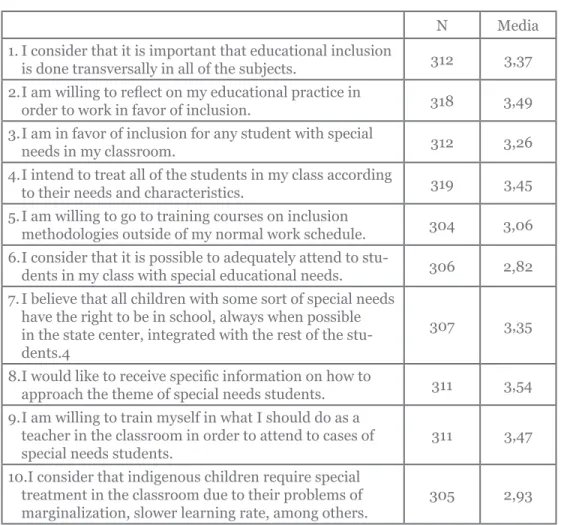
In this analysis the focus is on the average, since the responses of teachers are positioned through it in addition to information on the standard deviation, minimum and maximum. The items which comprise the questionnaire were analyzed globally through its 3 main dimensions.In the following the scale of attitudes is presented through Table 1, reflecting the number of cases that responded to the item, as well as the averages.
1.1 Attitudes
Tabla Ia. Description of attitudes.
N Media
1. I consider that it is important that educational inclusion
is done transversally in all of the subjects. 312 3,37 2. I am willing to reflect on my educational practice in
order to work in favor of inclusion. 318 3,49
3. I am in favor of inclusion for any student with special
needs in my classroom. 312 3,26
4. I intend to treat all of the students in my class according
to their needs and characteristics. 319 3,45
5. I am willing to go to training courses on inclusion
methodologies outside of my normal work schedule. 304 3,06 6. I consider that it is possible to adequately attend to stu-
dents in my class with special educational needs. 306 2,82 7. I believe that all children with some sort of special needs
have the right to be in school, always when possible in the state center, integrated with the rest of the stu- dents.4
307 3,35
8. I would like to receive specific information on how to
approach the theme of special needs students. 311 3,54 9. I am willing to train myself in what I should do as a
teacher in the classroom in order to attend to cases of
special needs students. 311 3,47
10.I consider that indigenous children require special treatment in the classroom due to their problems of
marginalization, slower learning rate, among others. 305 2,93
11.I believe that it is positive for everyone ( students and teachers) that the student body with special educational needs attend the same classes as those that do not have difficulties.
303 3,01
12.I believe that the fact that there are students with spe- cial educational needs in the classroom can improve the
development of values for the rest of the students. 306 3,22 13.In my daily classroom work, I believe that it is necessary
to work the same way with every student. 300 2,91
14.I consider myself sufficiently trained to work in clas- srooms that have children with difficulties together with
others with special needs. 307 2,03
15.My function as a teacher is to guide my students about the special cases that exist in the classroom so that they
are made aware of the topic. 306 3,39
16.In order to be a good, quality teacher I have to know how to adapt the work methods to the characteristics
and needs of my students. 284 3,50
17.I support the manner of being of those children with a different sexual orientation that that which is expected
for their sex. 298 2,88
18.I think that refugee children require a special treatment in the classroom due to their problems of marginaliza-
tion, slower learning, among others. 307 2,97
77. I consider that the theme of violence in the classroom
is important to work on at the school. 313 3,30
Valid N (according to the list) 222
Si observamos las medias, los docentes de la ciudad de Esmeraldas dicen tener actitud inclusiva ante los niños/as con necesidades educativas especiales en sus aulas, ya que muestran una atención positiva en la respuesta a las demandas de aquellos que lo necesitan. Es resaltable, la diferencia existente entre aquellas preguntas formuladas generalmente – por ejemplo la 1,2, 3 o7- y aquellas que apelan a lo específico -13 o 14-, habiendo una diferenciación de porcentajes entre ambas. Las preguntas generales obtienen valoraciones altas frente a las específicas donde las puntuaciones son más bajas. Esto hace vislumbrar, que los docentes dicen mostrar una actitud positiva en asuntos generales acerca de la inclusión mientras que, es “menos inclusiva” cuando se hace referencia al propio trabajo de los/as mismos/as.
Los encuestados dicen no considerarse suficientemente capacitados para trabajar con niños con Necesidades Educativas Especiales (NEE) demostrando, a su vez, una falta de habilidades en el trabajo con todo tipo de estudiantes
En este plano sería interesante trabajar las fortalezas que los docentes dicen tener en su forma actitudinal, y las debilidades trabajarlas, ya que hacen referencia a la actitud específica “dentro del aula”.
Seguidamente se expone la tabla 1b referente a la escala de conocimientos.
1.2 Knowledge
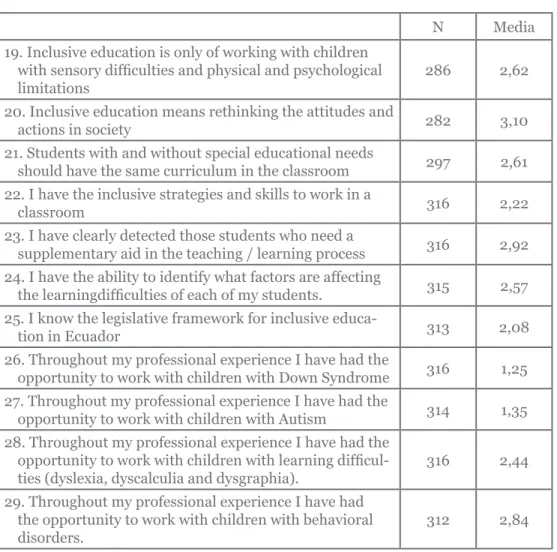
Tabla Ib. Description of knowledge.
N Media
19. Inclusive education is only of working with children with sensory difficulties and physical and psychological
limitations 286 2,62
20. Inclusive education means rethinking the attitudes and
actions in society 282 3,10
21. Students with and without special educational needs
should have the same curriculum in the classroom 297 2,61 22. I have the inclusive strategies and skills to work in a
classroom 316 2,22
23. I have clearly detected those students who need a
supplementary aid in the teaching / learning process 316 2,92 24. I have the ability to identify what factors are affecting
the learningdifficulties of each of my students. 315 2,57 25. I know the legislative framework for inclusive educa-
tion in Ecuador 313 2,08
26. Throughout my professional experience I have had the
opportunity to work with children with Down Syndrome 316 1,25 27. Throughout my professional experience I have had the
opportunity to work with children with Autism 314 1,35 28. Throughout my professional experience I have had the
opportunity to work with children with learning difficul-
ties (dyslexia, dyscalculia and dysgraphia). 316 2,44 29. Throughout my professional experience I have had
the opportunity to work with children with behavioral
disorders. 312 2,84
30. Throughout my professional experience I have had the
opportunity to work with children with cerebral palsy 314 1,13 31. I have specific skills to work with children in school
with Down Syndrome 313 1,19
32. I have specific skills to work with children in school
with Autism 316 1,25
33. I havethe expertise to work in schools with children with learning difficulties (dyslexia, dyscalculia, dysgra-
phia) 317 1,86
34. I have the expertise to work in schools with children
with behavioral disorders 315 2,13
35. I have the expertise to work in schools with children
with cerebral palsy 312 1,16
36. I have experience to address the special educational
needs of indigenouschildren 312 1,64
76. I have worked with issues of violence in the classroom 304 2,48
Valid N (according to the list) 213
The knowledge of teachers in the city is basic because they say they do not know how to attend to the different special needs described in the questionnaire. There is a lack of training and specific knowledge about these topics.
Some qualitative data about training in Ecuador / Esmeraldas suggest that there are two reasons for this cause. First, there does not exist within the Bachelor of Science in Education in Esmeraldas a specialty of Special Education and Inclusive Schooling, which would produce professionals with specific training in the understanding and treatment of different cases of special educational needs that can be found in classrooms. Second, the almost exclusive-treatment these children receive is derived from special schools - for a total of 12,662 peoplewith disabilities (CONADIS, 2013), not including special educational needs not associated with a disability such as indigenous children, refugees, victims of abuse, those with learning difficulties, behavioral or socio-affective behavior, among others.
Unfortunately, this group does not have medical, therapeutic and educational treatment.
Most responses and considering the average value, which shows the lack of knowledge –scientific and colloquial- on part of the teachers.
An ambivalent perception of themselves regarding their own knowledge about inclusive education is highlighted. On the one hand, they know that inclusive education is not just about addressing sensory, physical and psychological difficulties. 2.62 on average do not have inclusive work and classroom strategies, 2,22 are not familiar with the factors that affect learning difficulties of students, 2,57 do not know the legislative framework for inclusive education in Ecuador, 2,08. Considering the low average, teachers say they have not had the opportunity to work with most groups of students with special educational needs that were specified – DownSyndrome, autism, Cerebral palsy, or with indigenous minority groups, refugees or homosexuals.
Specific expertise in addressing these students is equally deficient.
They have more knowledge about learning difficulties and to a lesser extent knowledge about violent behavior in the classroom.
On the other hand, they do know that inclusive education means rethinking the attitudes and actions of society. 3.10 detect those students who need help, 2.92 have also worked with children with learning difficulties or violence in the classroom and have specific knowledge to address these issues.
The area of knowledge should be a key in order to focus efforts and enhance the understanding of the reality of diversity and inclusiveness in the classroom.
Finally, Table 1c shows the Practice scale.
1.2 Practices
Tabla Ic. Description of practices.
N Media
37. I intend to build equity in the classroom regardless of
student characteristics 308 2,62
38. I prepare specific schedules for students with special
educational needs 305 3,10
39. I as a teacher adapt learning content of the students 306 2,61 40. In my classroom I have in mind the different rates of
student learning 311 2,22
41. I coordinate with other teachers in solving problems
together when a student is concerned 312 2,92
42. I foment activities that promote the development of
empathy among students. 307 2,57
43. We perform custom reports reflecting the progress of
all students, adapted to their needs 301 2,08
44. My educational practice focuses on equality and inclusion 305 1,25 45. I develop materials for those children who need ad-
justments to their teaching / learning 307 1,35
46. I consider that I offer sufficient support for students
with some kind of need 309 2,44
47. I look for information when I need it to work when a
special educational need in the classroom 307 2,84 48. I work in coordination with the families of the students 299 1,13 49. I demonstrate respect for all students without distinc-
tion of any kind 310 1,19
50. I attend to the needs presented by refugeechildren in
the classroom 295 1,25
78. I am able to work positively to eliminate violence in the
classroom 311 1,86
Valid N (according to the list) 234
Based on these average measures, positive scores for most of the items discussed in this section are highlighted. Teachers state that they possess and display a series of inclusive practices in classrooms, such as: building equality and inclusion regardless of the characteristics of the students, making custom reports for each student while respecting their differences in the classroom, creating adapted materials, jointly coordinate with the various stakeholders in the teaching / learning of the students, promote the development of empathy, and offer to support students who require it.
This analysis may indicate that, generally, the attitudes of teachers are tied to their practices, for example a high number of subjects say they possess a positive attitude, and in turn, that they have inclusive practices in the classroom. There are small discrepancies between what they say and what they do, but there is a link between attitude and practice.
Just like with attitudes, it is recommended to follow the line to reinforce the strengths in terms of inclusive practices that teachers say they have, and focus on overcoming the weaknesses that are hindering their work in the classroom.
BY WAY OF CONCLUSION
This study has permitted the test of the quality of the instrument that was used. The analyzed results, suggest an adequate internal consistency of the instrument that was used. The analysis of the psychometric properties and the quality of the questionnaire was done through the analysis of Cronbach’s alpha coefficient and Classical Test Theory.
Finally, the analysis allows us to say that all of the scales have a medium-high level of reliabilityand the analysis of the psychometric properties of the instrument as a unit shows a medium-high coefficient being greater than 0.7 Alfa, considered satisfactory and sufficient. Thus, the overall quality of the instrument is confirmed, with the scale of
“practices” which has the highest reliability factor of 0.868. The lowest coefficient was “knowledge”, with a 0.783 coefficient.
Regarding the three scales that were studied, and remembering that the final analysis is in process, we can glimpse some findings that concern the two major features that teachers have in Esmeraldas:
attitudes and practices. There is a divergence in responses between what they say and do, but generally the data found that they have a positive attitude toward inclusion, as well as conducting practices that made this process positive. Both scales would relate since most percentage of teachers who have an inclusive predispositionpractice inclusion in the classroom. The recommendation is to pay attention to
the attitudinal and practical deficits with the aim that teachers have the greatest number of strategies, tools and willingness necessary to achieve an inclusive quality education.
Knowledge, however, is a formativeweakness that teachers from Esmeraldas have. This lack of knowledge prevents inclusivity for all students. Again, there is a divergence between their knowledge. A future proposal would be to perform specific skills that relate to working from the diversity in the classroom, such as thinking about educational diversity within and focusing on the different special abilities that can be presented in schools.
It is necessary for teachers on one hand to strengthen inclusive attitudes and practices that they claim to possess in order to achieve that educational inclusion is present in institutions and in Esmeralda’s classrooms; and on the other hand develop training / instruction in order teach specific knowledge about treatment for all types of students with SEN, associated or not with a disability, minority groups, etc., attendingto schools from an educational perspective of quality and warmth.
This study reinforces and supports the development of ateacher training diagnosticin Esmeraldas. It is considered essential to begin with an investigation of this nature as a starting point for future interventions in education. It is necessary to enhance the strengths thatEsmeralda’s teachers have, and this is a big step towards generating changes in both schools and society. In turn, it becomes apparent that there is a demand for specific training in this area, as seen through investigation, that teachers do not have quality colloquial and scientific knowledge in order to attend to all of the diversity of the students.
There is a clear need for academic and day to day training for teachers from Esmeralda, as well as progress and improvement of both the school and the social context in which they live and give sense to their educational experience regarding the context structure of the institutions and the subculture of teachers (González Sanmamed, Fuentes, Raposo, 2006, p. 279) in a study of this nature.
It is worthwhile to mention that the majority of respondents expressed attitudes and inclusive practices as being very important features in the attention of plurality which requires further promotion and strengthening. Attitudes are not considered immutable and fixed, but are dynamic and can change or be modified in such a manner that they can be identified in order to reconstruct them in this case of less inclusive attitudes and practices in the classroom.
Salinas, Beltrán, San Martin et at (1996, p.26) indicate that there is no doubt that the inclusion of students with no obvious differences in unspecific classrooms must assume that teachers rearrange its ordinary patterns of life management of their classrooms, as well as their teaching assumptions on which they base their teaching.
Therefore, it is necessary to continue work on thisyet unknown field in this context, delving deeper intoteacher’s pedagogical and contextual deficits to include inclusive education and to have more studies done on this subject. Finally, we must emphasize the importance of corroborating that Esmeralda teachers are professionals with a predisposition of inclusiveness but a contextual reality that actually hinders them to fully develop inclusion in their classrooms.
After the theoretical review and analysis, it is considered that the most critical points regarding inclusive and educational material is to optimize and improve in Ecuador and more specifically in Esmeraldas the following points:
• Low pedagogical training of teachers.
• Weak educational programs and teacher training.
• Little national research on teacher training.
• Lack of adequate training on inclusive education and content to cater to disadvantaged and marginalized groups of society (children with special needs, those in poverty or extreme poverty, rural populations, etc.)
REFERENCES
Ainscow, M., & cols. (2000). Guía para la evaluación y mejora de la educación inclusiva. Desarrollando el aprendizaje y la participación en las escuelas. Indexforinclusion. Bristol: CSIE.
Archivo maestro de instituciones educativas (AMIE). (2012).
Registros administrativos 2011-2012. Ecuador: Ministerio de Educación del Ecuador.
CONADIS. (2013). Datos generales por provincia Esmeraldas.
Consulted from http://www.conadis.gob.ec/index.
php?option=com_wrapper&view=wrapper&Itemid=69 (25.07.2013)
Fernández Prados, J. S., Pérez Meléndez, C., y Rojas Tejada, A. J.
(1998). Investigar mediante encuestas: Fundamentos teóricos y aspectos prácticos. Madrid: Síntesis.
González, J and Jornet, J. (2013). InnovaMIDE. Universidad de Valencia: Valencia.
González Sanmamed, M., Fuentes, E. J., and Raposo, M. (2006). De alumno a profesor. Análisis de las tareas realizadas durante las prácticas escolares. Revista Galego-Portugues De Psicología De La Educación, 13(11/12), 277-292.
Hernández, R.; Fernández, C. and Baptista, P. (2006). Metodología de la investigación. México: McGraw Hill.
Jornet, J. y Suárez, J.M. (1990). InnovaMIDE. Universidad de Valencia: Valencia.
Kerlinger, F. (1984). Enfoque conceptual de la investigación del comportamiento. México: Interamericana.
García, R., González, J. and Jornet, J.M. (2010). InnovaMIDE.
Universidad de Valencia: Valencia. Consulted from http://www.
uv.es/innovamide/spss/pruebat.wiki (18.10.2013).
ONU (2013). Objetivos de desarrollo del milenio y más allá del 2015.
Taken from http://www.un.org/es/millenniumgoals/poverty.
shtml. (15.12.2012)
Salinas, B., Beltrán, I., San Martín, A., and Salinas, C. (1996).
Condiciones y actitudes hacia la integración escolar de niños ciegos y deficientes visuales. (21), 21-32.