Suggested citation: EFSA ANS Panel (EFSA Panel on Food Additives and Nutrient Sources Added to Food), 2014. Scientific Opinion on the re-evaluation of Indigo Carmine (E 132) as a food additive. EFSA Journal 2014;12(7):3768, 51 pp.
doi:10.2903/j.efsa.2014.3768
Available online: www.efsa.europa.eu/efsajournal
SCIENTIFIC OPINION
Scientific Opinion on the re-evaluation of Indigo Carmine (E 132) as a food additive
1EFSA Panel on Food additives and Nutrient Sources added to Food (ANS)2, 3 European Food Safety Authority (EFSA), Parma, Italy
ABSTRACT
The ANS Panel provides a scientific opinion re-evaluating the safety of Indigo Carmine (E132). The Panel observed that Indigo Carmine was poorly absorbed and does not raise concern for genotoxicity. No adverse effects in subacute, chronic, reproduction and developmental toxicity studies, and no modifications of haematological and biological parameters in chronic toxicity studies have been identified at doses less than or equal to 500 mg/kg bw/day. The only report of an adverse effect was in testis with a LOAEL of 17 mg/kg bw/day which would give rise to a safety concern if confirmed. The Panel considered that this study has shortcomings since it is not clear to the Panel whether the adverse effects observed were due to the food additive itself or to impurities and/or contaminants present in the material tested and/or to the conduct of the study. The Panel considered that the current ADI of 5 mg/kg bw/day for Indigo Carmine was applicable to a material with the same purity and manufacturing process as material used in studies without adverse effects on testis (93%
pure colouring and 7% volatile matter) and concluded that any extension of this ADI to Indigo Carmine of lower purity and/or manufactured using a different process would require new data which would need to address the adverse effects on testis. The Panel noted that at the MPL, exposure estimates of Indigo Carmine would exceed the ADI for toddlers and children at the high level. Exposure estimates using the available usage and analytical data did not show an exceedance of the ADI for any population groups.
© European Food Safety Authority, 2014
KEY WORDS
Indigo Carmine, Indigotine, E 132, disodium 3,3‟dioxo-2,2‟-bi-indolylidene-5,5‟-disulphonate, food additive, EINECS 212-728-8, FD&C Blue No. 2
1 On request from the European Commission, Question No EFSA-Q-2011-00358, adopted on 4 July 2014.
2 Panel members: Fernando Aguilar, Riccardo Crebelli, Alessandro Di Domenico, Birgit Dusemund, Maria Jose Frutos, Pierre Galtier, David Gott, Ursula Gundert-Remy, Claude Lambré, Jean-Charles Leblanc, Oliver Lindtner, Peter Moldeus, Alicja Mortensen, Pasquale Mosesso, Dominique Parent-Massin, Agneta Oskarsson, Ivan Stankovic, Ine Waalkens- Berendsen, Rudolf Antonius Woutersen, Matthew Wright and Maged Younes. Correspondence: [email protected]
3 Acknowledgement: The Panel wishes to thank the members of the Working Group “A” Food Additives and Nutrient Sources (2011-2014): Pierre Galtier, Rainer Gürtler, Ursula Gundert-Remy, Claude Lambré, Jean-Charles Leblanc, Pasquale Mosesso, Dominique Parent-Massin, Ivan Stankovic, Christina Tlustos and Matthew Wright for the preparatory work on this scientific opinion and, EFSA staff: Ana Rincon, Stavroula Tasiopoulou and Alexandra Tard for the support provided to this scientific opinion.
SUMMARY
Following a request from the European Commission to the European Food Safety Authority (EFSA), the Panel on Food Additives and Nutrient Sources added to Food (ANS) was asked to deliver a scientific opinion re-evaluating the safety of Indigo Carmine (E 132) when used as a food additive. In this re-evaluation, only studies with Indigo Carmine and Indigotine were taken into consideration, provided that the identity of the test material was clear. However, only the term Indigo Carmine is used in this opinion.
Joint FAO/WHO Expert Committee on Food Additives (JECFA) established a temporary Acceptable Daily Intake (ADI) of 0-2.5 mg/kg bw/day in 1969 that was increased to a full ADI of 0-5 mg/kg bw/day in 1975. These ADIs were probably based on the long-term rat study by Hansen et al. (1966) in which a significantly inhibited growth of male rats was observed at dietary doses of 1000 and 2500 mg/kg bw/day. In this study, the no observed adverse effect level (NOAEL) was determined to be equivalent to 500 mg/kg bw/day. JEFCA established a temporary ADI in 1969 probably by applying an uncertainty factor of 200 to the above NOAEL. In 1975, JECFA applied an uncertainty factor of 100 to the NOAEL of 500 mg/kg bw/day to derive an ADI of 0-5 mg/kg bw/day for Indigo Carmine. In 1975, the EU Scientific Committee for Food (SCF) endorsed the ADI of 5 mg/kg bw/day as established by JECFA. In the latest evaluation of 1984, taking into consideration more recent studies, the SCF agreed to retain this ADI. JECFA and the SCF in their evaluations used the term of Indigotine to design Indigo Carmine.
In vivo studies demonstrated that radioactivity from 35S-Indigo Carmine was poorly detected in urine (1.6 to 2.1 % of the radioactivity) after oral administration in rats. Moreover, incubation of 35S-Indigo Carmine with intestinal contents of rats for 48 hours suggested that isatin-5-sulphonic acid and 5- sulphoanthranilic acid might be metabolites formed by intestinal bacteria. By comparison to the data obtained after intravenous administration, the Panel considered that the data available on the absorption, metabolism and excretion indicated that Indigo Carmine or its metabolites were poorly absorbed. However, the Panel noted that both identification of faecal metabolites and tissue distribution of radioactivity were not investigated in these studies.
Overall the Panel considered that based on the available data including a newly performed in vivo study on micronuclei induction, Indigo Carmine does not raise concern for genotoxicity.
In a subacute toxicity study (45-day) performed with adult male Swiss albino mice of B-6 strain (5 animals/group) at oral doses of 0, 17 and 39 mg Indigo Carmine/kg bw/day, statistically significant severe adverse effects on the testis were characterised by Dixit and Goyal, 2013. The Panel noted that no NOAEL could be identified in this study and the lowest observed adverse effect level (LOAEL) was 17 mg/kg bw/day, the lowest dose level tested. The Panel noted limitations in the design of the study and lack of information on the specifications of the test material used in the study.
Several chronic toxicity studies were available when JECFA allocated the ADI (1975). Two chronic and carcinogenicity studies, one in rats and one in mice, were published since the latest evaluation of Indigo Carmine by JECFA in 1975.
In a long-term toxicity study in mice, microscopical evaluation of selected tissues revealed a variety of randomly distributed neoplastic, degenerative, hyperplastic and inflammatory changes usually encountered in ageing mice (Borzelleca and Hogan, 1985). These changes occurred without relationship to dose and were considered to be unrelated to the dietary administration of Indigo Carmine. It was, therefore, concluded that this lifetime exposure of mice to Indigo Carmine did not demonstrate carcinogenic or toxic effects. The Panel agreed with the authors that the NOAEL identified in this study was 5 % in the diet providing an average intake of 8259 mg Indigo Carmine/kg bw/day for males and 9456 mg Indigo Carmine/kg bw/day for females.
In a chronic/carcinogenicity study, a statistically significant increased incidence of gliomas and malignant mammary glands tumours was seen in the male rats at the highest dose level of 1282 mg Indigo Carmine/kg bw/day. Overall, the Panel identified a NOAEL in this study of 632 mg/kg bw/day for male rats, the mid-dose, based on these carcinogenic effects. In the absence of any genotoxic activity, the Panel considered that Indigo carmine was acting as a non-genotoxic carcinogen and therefore, that there would be a threshold for this effect.
In a multigeneration reproductive toxicity study no test substance related effects were observed up to doses of 250 mg/kg bw/day. No adverse effects have been detected in developmental studies in rats and rabbits at tested doses (0, 25, 75 or 250 mg/kg bw/day). The Panel noted that the concentrations tested in the developmental toxicity studies were lower than the dose levels up to 2000 mg/kg bw/day used in several subacute or long-term toxicity studies but close to the NOAEL of 500 mg/kg bw/day on which JECFA and SCF based the ADI.
No cases of Indigo Carmine intolerance or allergy have been reported after ingestion.
Overall, the Panel noted that no adverse effects in subacute, chronic, reproduction and developmental toxicity studies, and no modifications of haematological and biological parameters in chronic toxicity studies have been identified at doses less than or equal to 500 mg/kg bw/day. The only report of an adverse effect was in testis with a LOAEL of 17 mg/kg bw/day which would give rise to a safety concern if confirmed. The Panel considered that this study has shortcomings since it is not clear to the Panel whether the adverse effects observed were due to the food additive itself or to impurities and/or contaminants present in the material tested and/or to the conduct of the study. However no effects on the testes or reproductive function were observed in chronic toxicity studies and in a 3-generation reproduction toxicity study undertaken with Indigo Carmine (FD&C Blue No 2) containing approximately 93% pure colouring and 7% volatile matter (Borzelleca et al., 1985, 1986; Borzelleca and Hogan 1985). The Panel noted that the material as described in the Dixit and Goyal study (2013) is presumed to meet the current EU specifications and it cannot be excluded that such material could be legally used as a food additive in the EU market.
The Panel confirmed the ADI of 5 mg/kg bw/day for Indigo Carmine. The Panel considered that the current ADI was applicable to a material with a purity of 93% pure colouring and manufactured using processes resulting in comparable residuals as material used in the Borzelleca et al. studies (1985, 1986) and Borzelleca and Hogan (1985). Given the uncertainties in the database, the Panel was not able to conclude whether this ADI should apply to Indigo Carmine with lower purity manufactured using these same processes or material manufactured using a different but not equivalent process.
The Panel considered that any extension of this ADI to Indigo Carmine of lower purity and/or manufactured using a different process would require new data which would need to address the adverse effects on testis observed in the Dixit and Goyal (2013) study. The chemical identity of the tested food additive, including the presence of possible impurities and/or contaminants, should be investigated and reported. The EFSA Guidance for submission for food additives evaluation (EFSA ANS Panel, 2012) requires information on the manufacturing process to identify hazards which may need to be controlled in the specifications.
Furthermore, the Panel considered that the current specifications should be revised in order to restrict the Indigo Carmine (E 132) permitted as food additive to that for which the ADI is applicable.
Exposure assessment for food additives under re-evaluation was carried out by the ANS Panel based on (1) MPLs set down in the EU legislation (defined as the regulatory maximum level exposure assessment scenario) and (2) the availability of adequate usage or analytical data (defined as the refined exposure assessment scenario).
To date, the ANS Panel has used the maximum concentration value (maximum reported use level or maximum value from the analytical results) available for each authorised food category. However,
given the extensive range of analytical data that have been made available through the most recent calls, the ANS Panel considered that this should also be used in additional scenarios of the exposure assessment approach intended to provide more realistic exposure estimates.
Overall, the Panel considered the regulatory maximum level exposure assessment scenario as being conservative since it assumes that all processed foods and beverages contain the food additive Indigo Carmine at the MPLs. The Panel considered that exposure assessment approach that uses reported use levels and analytical data was a more realistic scenario, since it was based on the extensive range of analytical data and assumes that the processed foods and beverages contain the additive at the mean concentration level for all products (non-brand-loyal consumer scenario) and considers one product containing Indigo Carmine at the maximum concentration level (brand-loyal consumer scenario).
Using the regulatory maximum level exposure assessment scenario, exposure estimates of Indigo Carmine (E 132) exceed the ADI for toddlers and children at the high level (95th percentile). The main contributing food categories to the total mean exposure estimates for adolescents, adults and the elderly in this scenario were flavoured drinks and fine bakery wares. For children, the main contributing food categories were flavoured drinks, fine bakery wares and flavoured fermented milk products, while for toddlers, the main contributing food categories were flavoured fermented milk products and fine bakery wares.
For the refined exposure assessment scenarios (brand-loyal and non-brand-loyal), none of the population groups exceeded the ADI of 5 mg/kg bw/day, neither at the mean nor at the high level (95th percentile). However, the Panel noted that this scenario was calculated using limited data provided by industry. The Panel further noted that for the food categories where both usage levels and analytical results were available, the analytical results were much lower than the use levels reported by industry.
The Panel noted that both reported use levels and quantified analytical results were reported only for the food categories of chewing gum, flavoured drinks and desserts. For several food products for which the use of Indigo Carmine is authorised e.g. flavoured fermented milk products, seasonings and condiments, mustard, soups and broths, sauces, cider and perry, aromatised wine based-products and other alcoholic drinks, no usage data nor quantified positive analytical results were reported. In addition, the Panel further noted that for some other authorised food categories such as edible ices, fine bakery wares, fish roe, spirit drinks, potato-, cereal, flour-, or starch-based snacks and processed nuts, no usage data had been reported while positive analytical results were obtained from analytical data.
The Panel concluded that at the maximum permitted level of use, exposure estimates of Indigo Carmine (E 132) would exceed the ADI for toddlers and children at the high level. Exposure estimates using the available usage and analytical data did not show an exceedance of the ADI for any population groups.
The Panel noted that the three main contributing food categories for age-groups where MPL scenario estimates exceeded the ADI showed high number of analytical data far below MPL or had no use level reported combined with no detection in limited analytical data. The Panel therefore considered that it is not likely that the ADI will be exceeded.
TABLE OF CONTENTS
Abstract ... 1
Summary ... 2
Table of contents ... 5
Background as provided by the European Commission ... 6
Terms of reference as provided by the European Commission ... 6
Assessment ... 7
1. Introduction ... 7
2. Technical data ... 7
2.1. Identity of the substance ... 7
2.2. Specifications ... 8
2.3. Manufacturing process ... 9
2.4. Methods of analysis in food ... 9
2.5. Reaction and fate in food ... 10
2.6. Case of need and proposed uses ... 10
2.7. Reported use levels or data on analytical levels of Indigo Carmine (E 132) in food ... 12
2.7.1. Summarised data on reported use levels in foods provided by industry... 12
2.7.2. Summarised data on concentration levels in foods from Member States ... 13
2.8. Information on existing authorisations and evaluations... 13
2.9. Exposure assessment ... 14
2.9.1. Food consumption data used for exposure assessment ... 14
2.9.2. Exposure to Indigo Carmine (E 132) from its use as a food additive ... 16
2.9.3. Main food categories contributing to exposure to Indigo Carmine (E 132) using the regulatory maximum level exposure assessment scenario... 18
2.9.4. Main food categories contributing to exposure to Indigo Carmine (E 132) using the refined exposure assessment scenarios ... 18
2.9.5. Uncertainty analysis ... 21
3. Biological and toxicological data ... 21
3.1. Absorption, distribution, metabolism and excretion ... 21
3.1.1. In vitro ... 21
3.1.2. In vivo ... 21
3.2. Toxicological data ... 23
3.2.1. Acute oral toxicity ... 23
3.2.2. Short-term and subchronic toxicity ... 23
3.2.3. Genotoxicity ... 24
3.2.4. Chronic toxicity and carcinogenicity ... 27
3.2.5. Reproductive and developmental toxicity ... 30
3.2.6. Hypersensitivity, allergenicity and intolerance ... 31
4. Discussion ... 31
Conclusions ... 35
Documentation provided to EFSA ... 36
References ... 36
Appendices ... 41
Appendix A. Summary of reported use levels (mg/kg) of Indigo Carmine (E 132) provided by industry 41 Appendix B. Summary of analytical results (mg/kg) of Indigo Carmine (E 132) provided by Members States 42 Appendix C. Concentration levels of Indigo Carmine (E 132) used in the refined exposure scenarios (mg/kg) ... 46
Appendix D. Summary of total estimated exposure of indigo carmine (E 132) from its use as a food additive for MPL scenario and refined exposure scenarios per population group and survey: mean and high level (mg/kg bw/day) ... 48
Glossary and abbreviations ... 50
BACKGROUND AS PROVIDED BY THE EUROPEAN COMMISSION
Regulation (EC) No 1333/20084 of the European Parliament and of the Council on food additives requires that food additives are subject to a safety evaluation by the European Food Safety Authority (EFSA) before they are permitted for use in the European Union. In addition, it is foreseen that food additives must be kept under continuous observation and must be re-evaluated by EFSA.
For this purpose, a programme for the re-evaluation of food additives that were already permitted in the European Union before 20 January 2009 has been set up under Regulation (EU) No 257/20105. This Regulation also foresees that food additives are re-evaluated whenever necessary in light of changing conditions of use and new scientific information. For efficiency and practical purposes, the re-evaluation should, as far as possible, be conducted by group of food additives according to the main functional class to which they belong.
The order of priorities for the re-evaluation of the currently approved food additives should be set on the basis of the following criteria: the time since the last evaluation of a food additive by the Scientific Committee on Food (SCF) or by EFSA, the availability of new scientific evidence, the extent of use of a food additive in food and the human exposure to the food additive taking also into account the outcome of the Report from the Commission on Dietary Food Additive Intake in the EU6 of 2001. The report “Food additives in Europe 20007” submitted by the Nordic Council of Ministers to the Commission, provides additional information for the prioritisation of additives for re-evaluation. As colours were among the first additives to be evaluated, these food additives should be re-evaluated with a highest priority.
In 2003, the Commission already requested EFSA to start a systematic re-evaluation of authorised food additives. However, as a result of adoption of Regulation (EU) 257/2010 the 2003 Terms of References are replaced by those below.
TERMS OF REFERENCE AS PROVIDED BY THE EUROPEAN COMMISSION
The Commission asks the European Food Safety Authority to re-evaluate the safety of food additives already permitted in the Union before 2009 and to issue scientific opinions on these additives, taking especially into account the priorities, procedures and deadlines that are enshrined in the Regulation (EU) No 257/2010 of 25 March 2010 setting up a programme for the re-evaluation of approved food additives in accordance with the Regulation (EC) No 1333/2008 of the European Parliament and of the Council on food additives.
4 OJ L 354, 31.12.2008, p.16.
5 OJ L 80, 26.03.2010, p. 19
6 COM(2001) 542 final.
7 Food Additives in Europe 2000, Status of safety assessments of food additives presently permitted in the EU, Nordic Council of Ministers, TemaNord 2002:560.
ASSESSMENT
1. Introduction
The present opinion deals with the re-evaluation of the safety of Indigo Carmine/Indigotine (E 132) when used as a food additive. The Panel noted that the term Indigotin is sometimes used to indicate Indigo while Indigotine is a synonym of Indigo Carmine (Regulation (EC) No 1333/20088). In this re- evaluation, only studies with Indigo Carmine and Indigotine were taken into consideration, provided that the identity of the test material was clear. However, only the term Indigo Carmine is used in this opinion.
Indigo Carmine (E 132) is an indigoid colour authorised as a food additive in the EU in accordance with Annex II to Regulation (EC) No 1333/2008 and has been previously evaluated by the Joint FAO/WHO Expert Committee on Food Additives (JECFA) in 1969 and 1975, and the EU Scientific Committee for Food (SCF) in 1975 and 1984.
The Panel on Food Additives and Nutrient Sources added to Food (ANS) was not provided with a newly submitted dossier and based its evaluation on previous evaluations, additional literature that became available since then and the data available following an EFSA public call for data.9,10,11 The Panel noted that not all original studies on which previous evaluations were based were available to the Panel.
2. Technical data
2.1. Identity of the substance
Indigo Carmine is an indigoid colouring substance. Its systematic name (IUPAC) is disodium (2E)-3- oxo-2-(3-oxo-5-sulphonato-2,3-dihydro-1H-indol-2-ylidene)-2,3-dihydro-1H-indole-5-sulphonate, the CAS Registry Number is 860-22-0, the EINECS number is 212-728-8, the Colour Index number is 73015. The molecular formula is C16H8Na2N2O8S2 and the molecular weight is 466.36 g/mol. The structural formula is given in Figure 1.
Figure 1: Structural formula of Indigo Carmine (disodium 3,3′-dioxo-2,2′-bi-indo-lylidene-5,5′- disulphonate)
Indigo Carmine takes the form of a dark-blue powder or granules, is soluble in water (1.6 % at 20 0C in water (Sensiet Colours Group, 2011)) and sparingly soluble in ethanol (JECFA, 2010).
8 Regulation (EC) No 1333/2008 of the European Parliament and of the Council of 16 December 2008 on food additives.
OJ L 354, 31.12.2008.
9 Call for scientific data on food colours to support re-evaluation of all food colours authorised under the EU legislation.
Published: 8 December 2006. Available online: http://www.efsa.europa.eu/en/dataclosed/call/afc061208.htm
10 Call for scientific data on Indigo Carmine (E 132). Published: 26 June 2011. Available online:
http://www.efsa.europa.eu/en/data/call/ans110126.htm .
11 Call for food additives usages level and/or concentration data in food and beverages intended to human consumption.
Published: 27 March 2013. Available online: http://www.efsa.europa.eu/en/dataclosed/call/130327.htm
At least more than 100 synonyms are known (ChemIdplusAdvances, online); the most commonly used names are: CI natural blue II, FD&C Blue No. 2, Indigotine and Acid blue 74.
2.2. Specifications
Specifications for Indigo Carmine (E 132) have been defined in Commission Regulation (EU) No 231/201212 and by JECFA (JECFA, 2010) (Table 1).
According to Commission Regulation (EU) No 231/2012, Indigo Carmine consists essentially of a mixture of disodium 3,3′-dioxo-2,2′-bi-indo-lylidene-5,5′-disulphonate and disodium 3,3′-dioxo-2,2′- bi-indolylidene-5,7′-disulphonate and subsidiary colouring matters together with sodium chloride and/or sodium sulphate as the principal uncoloured components. Indigo Carmine is described as the sodium salt.
The purity of Indigo Carmine is specified as to be not less than 85 % total colouring matters, calculated as the sodium salt, with disodium 3,3‟-dioxo-2,2‟-bi-indolylidene-5,7‟-disulphonate not more than 18 %.
The remainder is 0.2 % water insoluble matter, 1.0 % subsidiary colouring matters (excluding disodium 3,3′-dioxo-2,2′-bi-indolylidene-5,7′-disulphonate), a total of 0.5 % organic compounds other than colouring matters (e.g. of isatin-5-sulphonic acid or 5-sulphoanthranilic acid or anthranilic acid), 0.01 % unsulphonated primary aromatic amines (calculated as aniline) and 0.2 % of ether extractable matter under neutral conditions (Commission Regulation (EU) No 231/2012).
The Panel noted that if the existing specifications were extended to include < 15 % of sodium chloride and/or sodium sulphate as the principal uncoloured components, most of the material would be accounted for.
Table 1: Specifications for Indigo Carmine according to Commission Regulation (EU) No 231/2012 and JECFA (2010)
Purity Commission Regulation (EU) No
231/2012 JECFA (2010)
Assay
≥ 85 % (calculated as sodium salt)
≤ 18 % disodium 3,3‟-dioxo-2,2‟- bi-indolylidene-5,7‟-disulphonate
85 % total colouring matters.
18 % of disodium 3,3' dioxo- [delta-2,2‟-biindoline]-5,7'-
disulphonate
Water insoluble matter ≤ 0.2 % ≤ 0.2 %
Subsidiary colouring matters ≤ 1.0 % (excluding disodium 3,3‟- dioxo-2,2‟-bi-indolylidene-5,7‟-
disulphonate)
≤ 1.0 %
(except disodium 3,3'-dioxo-[delta- 2,2‟-biindoline]- 5,7'-disulphonate) Organic compounds other than
colouring matters - Isatin-5-sulphonic acid - 5-sulphoanthranilic acid - Anthranilic acid
≤ 0.5 % ≤ 0.5 %
Unsulphonated primary aromatic
amines ≤ 0.01 % (calculated as aniline) ≤ 0.01 % (calculated as aniline) Ether extractable matter ≤ 0.2 % (under neutral conditions) ≤ 0.2 %
Arsenic ≤ 3 mg/kg -
Lead ≤ 2 mg/kg ≤ 2 mg/kg
Mercury ≤ 1 mg/kg -
Cadmium ≤ 1 mg/kg -
12 Commission Regulation (EU) No 231/2012 of 9 March 2012 laying down specifications for food additives listed in Annexes II and III to Regulation (EC) No 1333/2008 of the European Parliament and of the Council. OJ L 83, 22.3.2012.
The Panel noted that the specifications for the purity of Indigo Carmine would permit concentrations of unsulphonated aromatic amines to be present in concentrations of up to 100 mg/kg Indigo Carmine (calculated as aniline). Given the maximum allowed concentration of Indigo Carmine that can be added to food (500 mg/kg food), the concentration of these unidentified unsulphonated primary aromatic amines in food could be up to 50 μg/kg food.
According to Commission Regulation (EU) No 231/2012, the above purity criteria also apply to the raw material from which the aluminium lake is produced. In addition, under neutral conditions, the aluminium lake should contain 0.5 % HCl-insoluble material and 0.2 % ether-extractable material.
There are no additional specification requirements for the aluminium lake.
The Panel noted that the aluminium lake of the food additive could add to the daily intake of aluminium for which a Tolerable Weekly Intake (TWI) of 1 mg aluminium/kg bw/week has been established (EFSA, 2008) and that therefore specifications for the maximum level of aluminium in the lakes may be required.
2.3. Manufacturing process
Indigo Carmine is prepared by the sulphonation of Indigo (2,2'-bindoline-3,3'-dione; CAS No: 482-89- 3) that is one of the earliest known naturally occurring dyes. Originally, it was obtained from the leaves of plants Indigofera tinctoria, Indigofera suifruticosa or Isatis tinctoria where it occurs as indican, a glycoside of indoxyl. An enzyme known as indimulsin is added to hydrolyze the indican into indoxyl and glucose. Oxidation by exposure to air converts indoxyl to indigo (Steingruber, 2004).
At the beginning of the 20th century the production by chemical synthesis superseded the extraction from plants. Reactants such as N-phenylglycine or N-(2-carboxyphenyl)glycine are heated with alkali under controlled conditions to produce indoxyl which is subsequently oxidized in air to form Indigo (Steingruber, 2004).
According to US Code of Federal Regulations (CFR, 1983) and information provided by industry (Sensiet Colours Group, 2011), the indigo (or indigo paste) is manufactured by the fusion of N- phenylglycine (prepared from aniline and formaldehyde) in a molten mixture of sodamide and sodium and potassium hydroxides under ammonia pressure. The indigo is isolated and subjected to purification procedures. Indigo Carmine is obtained by sulphonation of indigo. This is accomplished by heating indigo (or indigo paste) in the presence of sulphuric acid. The dye is isolated and subjected to purification procedures.
Indigo Carmine may be converted to the corresponding aluminium lake under aqueous conditions by reacting aluminium oxide with the colouring matter. Aluminium oxide is usually freshly prepared by reacting aluminium sulphate or aluminium chloride with sodium carbonate or sodium bicarbonate or aqueous ammonia. Following lake formation, the product is filtered, washed with water and dried (JECFA, 2004).
2.4. Methods of analysis in food
Various analytical methods for the determination of synthetic food colours have been reported in the literature. Thin layer chromatography (TLC) permits a qualitative analysis (IRMM, 2013).
International Standard ISO 1346913 is a TLC method for the detection of 12 synthetic colours including Indigo Carmine in meat and meat products. Methods for the determination of Indigo Carmine together with other synthetic colours in alcoholic beverages (Prado et al., 2006) or milk beverage (Huang et al., 2002) have been developed using capillary electrophoresis. Other methods proposed for the analysis of Indigo Carmine and other synthetic colours in commercial products are based on high-performance liquid chromatography (HPLC) combined with multivariate analysis (Chen et al., 1998; Berzas et al., 1999, Nevado et al., 1999; Kiseleva et al., 2003; Minioti et al., 2007;
Yoshioka and Ichihashi, 2008; Mahnaz et al., 2012; Suh and Choi, 2012) and in the recent years more
13 Available online: https://www.iso.org/obp/ui/#iso:std:iso:13496:ed-1:v1:en
sophisticated analytical techniques combining liquid chromatography with mass spectroscopy have been reported (Chao et al., 2011; Feng et al., 2011). Recently, a method based on liquid chromatography (LC) with photodiode array (PDA) detection have been used for the determination of seven food colours including Indigo Carmine in a small survey of 44 food products (Harp et al., 2013).
2.5. Reaction and fate in food
An aqueous 0.1 % solution of radiochemically pure 35S-labelled Indigo Carmine was allowed to stand at room temperature for periods ranging from one day to six months. After one week 5 % of the radioactivity was identified as isatin-5-sulphonic acid. After six months 50 % of the radioactivity was present as the parent compound, 12 % was isatin-5-sulphonic acid and 38 % was 5-sulphoanthranilic acid (Lethco and Webb, 1966).
In general, the majority of colour additives are unstable in combination with oxidising and reducing agents in food. Since colour depends on the existence of a conjugated unsaturated system within the dye molecule, any substance which modifies this system (e.g. oxidising or reducing agents, sugars, acids, and salts) will affect the colour (Scotter and Castle, 2004).
According to industry (Sensiet Colours Group, 2011), the conjugated unsaturated system which forms part of the structure of Indigo Carmine is responsible for the dye colour; any substance which interacts or alters this unit of the molecule will affect the colour. As a result, Indigo Carmine will generally be unstable in the presence of oxidising or reducing agents, sugars, acids, salts etc. The recommended shelf-life of Indigo Carmine by industry is 4 to 6 years, depending on the manufacturer, stored in its original container in a dry, cool and well ventilated place (Sensiet Colours Group, 2011).
2.6. Case of need and proposed uses
Maximum permitted levels (MPLs) of Indigo Carmine (E 132) have been defined in Annex II to Regulation (EC) No 1333/2008 on food additives.
Currently, Indigo Carmine (E 132) is an authorised food colour in the EU with MPLs ranging from 50 to 500 mg/kg in foods. Indigo Carmine is included in Group III of food colours with a combined maximum limit.
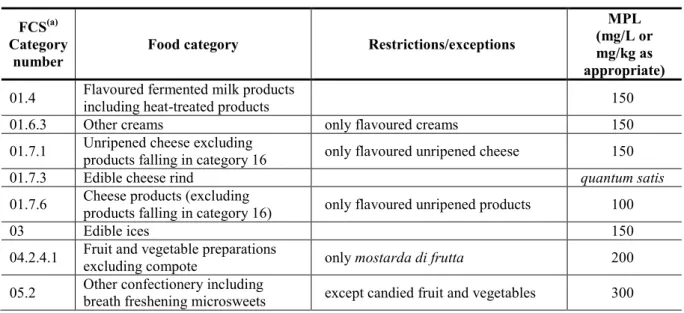
Table 2 summarises foods that are permitted to contain Indigo Carmine (E 132) and the corresponding MPLs as set by Annex II to Regulation (EC) No 1333/2008.
Table 2: MPLs of Indigo Carmine (E 132) in foods according to the Annex II to Regulation (EC) No 1333/2008
FCS(a) Category
number Food category Restrictions/exceptions
MPL (mg/L or mg/kg as appropriate) 01.4 Flavoured fermented milk products
including heat-treated products 150
01.6.3 Other creams only flavoured creams 150
01.7.1 Unripened cheese excluding
products falling in category 16 only flavoured unripened cheese 150
01.7.3 Edible cheese rind quantum satis
01.7.6 Cheese products (excluding
products falling in category 16) only flavoured unripened products 100
03 Edible ices 150
04.2.4.1 Fruit and vegetable preparations
excluding compote only mostarda di frutta 200
05.2 Other confectionery including
breath freshening microsweets except candied fruit and vegetables 300
FCS(a) Category
number
Food category Restrictions/exceptions
MPL (mg/L or mg/kg as appropriate) 05.2 Other confectionery including
breath freshening microsweets only candied fruit and vegetables 200
05.3 Chewing gum 300
05.4 Decorations, coatings and fillings, except fruit-based fillings covered by category 04.2.4
only decorations, coatings and sauces,
except fillings 500
05.4 Decorations, coatings and fillings, except fruit-based fillings covered by category 04.2.4
only fillings 300
06.6 Batters only batters for coating 500
07.2 Fine bakery wares 200
08.2.3 Casings and coatings and
decorations for meat only decorations and coatings except
edible external coating of pasturmas 500 08.2.3 Casings and coatings and
decorations for meat only edible casings quantum satis
09.2 Processed fish and fishery products
including molluscs and crustaceans only surimi and similar products and
salmon substitutes 500
09.3 Fish roe except Sturgeons´ eggs (Caviar) 300
12.2.2 Seasonings and condiments Only seasonings, for example curry
powder, tandoori 500
12.4 Mustard 300
12.5 Soups and broths 50
12.6 Sauces
including pickles, relishes, chutney and piccalilli; excluding tomato-based
sauces 500
12.9 Protein products, excluding
products covered in category 01.8 only meat and fish analogues based on
vegetable proteins 100
13.2
Dietary foods for special medical purposes defined in Directive 1999/21/EC (excluding products from food category 13.1.5)
50
13.3
Dietary foods for weight control diets intended to replace total daily food intake or an individual meal (the whole or part of the total daily diet)
50
14.1.4 Flavoured drinks excluding chocolate milk and malt
products 100
14.2.3 Cider and perry excluding cidre bouché 200
14.2.4 Fruit wine and made wine excluding wino owocowe markowe 200
14.2.6 Spirit drinks as defined in Regulation (EC) No 110/2008
except: spirit drinks as defined in Article 5(1) and sales denominations listed in Annex II, paragraphs 1-14 of Regulation (EC) No 110/2008 and spirits (preceded by the name of the fruit) obtained by maceration and distillation, Geist (with the name of the fruit or the raw material used), London Gin, Sambuca, Maraschino, Marrasquino or Maraskino and Mistrà
200
14.2.7.1 Aromatised wines except americano, bitter vino 200
14.2.7.2 Aromatised wine-based drinks except bitter soda, sangria, claria,
zurra 200
14.2.7.3 Aromatised wine-product cocktails 200
14.2.8 Other alcoholic drinks including only alcoholic drinks with less than 200
FCS(a) Category
number
Food category Restrictions/exceptions
MPL (mg/L or mg/kg as appropriate) mixtures of alcoholic drinks with
non-alcoholic drinks and spirits with less than 15 % of alcohol
15% of alcohol and nalewka na winie owocowym, aromatyzowana nalewka na winie owocowym, nalewka na winie z soku winogronowego,
aromatyzowana nalewka na winie z soku winogronowego, napój winny owocowy lub miodowy,
aromatyzowany napój winny owocowy lub miodowy, wino owocowe
niskoalkoholowe and aromatyzowane wino owocowe niskoalkoholowe 15.1 Potato-, cereal-, flour- or starch-
based snacks excluding extruded or expanded
savoury snack products 100
15.1 Potato-, cereal-, flour- or starch-
based snacks only extruded or expanded savoury
snack products 200
15.2 Processed nuts only savoury-coated nuts 100
16 Desserts excluding products covered
in categories 01, 03 and 04 150
17.1
Food supplements supplied in a solid form including capsules and tablets and similar forms, excluding chewable forms
300
17.2 Food supplements supplied in a
liquid form 100
17.3 Food supplements supplied in a
syrup-type or chewable form only solid food supplements 300 17.3 Food supplements supplied in a
syrup-type or chewable form only liquid food supplements 100
(a) FCS : Food Categorisation System (food nomenclature) presented in the Annex II to Regulation (EC) No 1333/2008.
2.7. Reported use levels or data on analytical levels of Indigo Carmine (E 132) in food Most food additives in the EU are authorised at a specific MPL. However, a food additive may be used at a lower level than the MPL. Therefore information on actual use levels is required for performing a more realistic exposure assessment, especially for those food additives for which no MPL is set and which are authorised according to quantum satis (QS).
In the framework of Regulation (EC) No 1333/2008 on food additives and of Commission Regulation (EU) No 257/201014 regarding the re-evaluation of approved food additives, EFSA issued a public call15 for concentration data (usage and/or analytical data) on Indigo Carmine (E 132).
In response to this public call, updated information on the actual use levels of Indigo Carmine (E 132) in foods was made available to EFSA by industry and Member States.
2.7.1. Summarised data on reported use levels in foods provided by industry
Industry provided EFSA with data on use levels (n = 7) of Indigo Carmine (E 132) in foods for five out of the 35 food categories in which Indigo Carmine is authorised.
14 Commission Regulation (EU) No 257/2010 of 25 March 2010 setting up a programme for the re-evaluation of approved food additives in accordance with Regulation (EC) No 1333/2008 of the European Parliament and of the Council on food additives. OJ L 80, 26.3.2010, p. 19.
15 Call for food additives usage level and/or concentration data in food and beverages intended for human consumption.
Published: 27 March 2013. Available online: http://www.efsa.europa.eu/en/data/call/130327.htm
Updated information on the actual use levels of Indigo Carmine in foods was made available to EFSA by FoodDrinkEurope (FDE), the International Chewing Gum Association (ICGA), the Association of the European Self-Medication Industry (AESGP) and Capsugel for the following food categories of finished products: chewing gum (FCS Category 05.3), decorations, coatings of confectionary (FCS Category 05.4), non-alcoholic beverages (FCS Category 14.1.4), desserts (FCS Category 16) and food supplements (FCS Category 17).
Appendix A provides data on the use levels of Indigo Carmine (E 132) in foods as reported by industry.
2.7.2. Summarised data on concentration levels in foods from Member States
Additionally, analytical results from Member States were collected through the EFSA call for concentration data. The Panel noted that complete information on the methods of analysis was not made available to EFSA. In total, 4634 analytical results were reported to EFSA by 6 countries:
Germany (n = 2843), Austria (n = 994), Czech Republic (n = 316), Slovakia (n = 289), Hungary (n = 155) and Ireland (n = 37). The data were mainly on flavoured drinks (FCS Category 14.1.4), fine bakery wares (FCS Category 07.2) and other confectionary16 including breath freshening microsweets (FCS Category 05.1). Foods were sampled between 2002 and 2013 and analysed the same year of collection. Out of this dataset, analytical results of Indigo Carmine were not quantified (< LOQ) in 740 samples, not detected (< LOD) in 2926 samples, 247 were numerical values (quantified) and 721 were expressed as qualitative results. Only 22 of these samples are coming from a non-accredited laboratory.
Data resulting from non-authorised uses17 (n = 593, in fruit and vegetables (FCS 04) other than mostarda di frutta, cocoa and chocolate products (FCS 05.1), cereal and cereal products (FCS 06) other than batters, non-alcoholic beverages (FCS 14.1) others than flavoured drinks) and above the MPL set for authorised uses of Indigo Carmine (E 132) (one sample of confectionary (FCS 05.2) above the MPL of 300 mg/kg allocated for this food group) were not considered in the exposure assessment. The 721 samples expressed as qualitative results could also not be used in the exposure assessment as they only give binary results (i.e. indication of presence or absence of the food additive in the food analysed).
Overall, 3319 out of the 4634 total analytical results reported for Indigo Carmine in foods were included by Panel for use in the exposure estimates after discarding: the provided analytical results on foods in which Indigo Carmine is not authorised; a sample exceeding the MPL of authorised use; and values expressed as qualitative results.
Appendix B shows the analytical results of Indigo Carmine (E 132) in foods as reported by Member States (whole set of analytical data reported and positive samples only).
2.8. Information on existing authorisations and evaluations
Indigo Carmine (E 132) is authorised as a food additive in the EU in accordance with Annex II to Regulation (EC) No 1333/2008 on food additives. Specific purity criteria on Indigo Carmine (E 132) have been defined in the Commission Regulation (EU) No 231/2012. The calcium and the potassium salts are also permitted.
JECFA established a temporary Acceptable Daily Intake (tADI) of 0-2.5 mg/kg bw/day in 1969 that was increased to a full ADI of 0-5 mg/kg bw/day in 1975.
16 Confectionary (FCS category 05) except cocoa and chocolate products (FCS category 05.1), chewing gum (FCS category 05.3) and decorations, coatings and fillings (FCS category 05.4).
17 Such result might be due to the use of multi-screen methods covering a large range of compounds from food control laboratories analysing the food samples and/or due to errors in the classification of the foods sampled.
In 1975 the SCF established an ADI of 5 mg/kg bw/day. In its latest evaluation in 1984, the SCF agreed to retain this ADI after taking into consideration more recent studies.
JECFA and the SCF in their evaluations used the term Indigotine in place of Indigo Carmine.
Indigo Carmine has also been reviewed by TemaNord (2002).
2.9. Exposure assessment
2.9.1. Food consumption data used for exposure assessment 2.9.1.1. EFSA Comprehensive European Food Consumption Database
Since 2010, the EFSA Comprehensive European Food Consumption Database (Comprehensive Database) has been populated with data from national information on food consumption at a detailed level. Competent authorities in the European countries provide EFSA with data on the level of food consumption by the individual consumer from the most recent national dietary survey in their country (cf. Guidance of EFSA „Use of the EFSA Comprehensive European Food Consumption Database in Exposure Assessment‟ (EFSA, 2011a).
The food consumption data gathered at EFSA were collected by different methodologies and thus direct country-to-country comparisons should be interpreted with caution. Depending on the food category and the level of detail used for exposure calculations uncertainties could be introduced due to possible subjects‟ underreporting and/or misreporting of the consumption amounts.
The Panel estimated chronic exposure for the following population groups: toddlers, children, adolescents, adults and the elderly. Calculations were performed using individual body weights. For calculation of chronic exposure, intake statistics have been calculated based on individual average consumption over the total survey period excluding surveys with only one day per subject considered as not adequate to assess chronic dietary exposure. High percentile exposure was only calculated for those foods and population groups where the sample size was sufficiently large to allow calculation of the 95th percentile of exposure (EFSA, 2011a). Therefore, in the present assessment, high levels of exposure for toddlers from Belgium, Italy and Spain were not included.
Thus, for the present assessment, food consumption data were available from 26 different dietary surveys carried out in 17 European countries, as mentioned in Table 3:
Table 3: Population groups considered for the exposure estimates of Indigo Carmine (E 132) Population Age range Countries with food consumption surveys
covering more than one day Toddlers from 12 up to and including
35 months of age
Belgium, Bulgaria, Finland, Germany, Italy, the Netherlands, Spain
Children18 from 36 months up to and
including 9 years of age Belgium, Bulgaria, Czech Republic, Denmark, Finland, France, Germany, Greece, Italy, Latvia, Netherlands, Spain, Sweden
Adolescents from 10 up to and including
17 years of age Belgium, Cyprus, Czech Republic, Denmark, France, Germany, Italy, Latvia, Spain, Sweden
Adults from 18 up to and including
64 years of age Belgium, Czech Republic, Denmark, Finland, France, Germany, Hungary, Ireland, Italy, Latvia, Netherlands, Spain, Sweden, UK
The elderly18 from 65 years of age and
older Belgium, Denmark, Finland, France, Germany,
Hungary, Italy
18 The terms “children” and “the elderly” correspond respectively to “other children” and the merge of “elderly” and “very elderly” in the Guidance of EFSA on the „Use of the EFSA Comprehensive European Food Consumption Database in Exposure Assessment‟ (EFSA, 2011a).
Consumption records were codified according to the FoodEx classification system (EFSA, 2011b).
Nomenclature from the FoodEx classification system has been linked to the Food Classification System (FCS) as presented in the Annex II to Regulation (EC) No 1333/2008, part D, to perform exposure estimates. In practice, FoodEx food codes were matched to the FCS food categories and the exposure was calculated by multiplying MPLs and values reported in Appendix C for each food group with their respective consumption amount per kg bw separately for each individual in the database, calculating the sum of exposure for each survey day for the individual and then deriving the daily mean for the survey period. Based on the individual exposures, the mean and 95th percentile exposure was calculated for the total survey population separately for each survey and for the five population groups described in Table 3.
2.9.1.2. Food categories selected for the exposure assessment of Indigo Carmine
The food categories in which the use of indigo carmine (E 132) is authorised were selected from the nomenclature of the EFSA Comprehensive Database (FoodEx classification system food codes), at a detailed level (up to FoodEx Level 4) (EFSA, 2011b).
Some food categories are not referenced in the EFSA Comprehensive Database and therefore could not be taken into account in the present estimate. This might result in an underestimation of the exposure. The food categories which were not taken into account are described below (in ascending order of the FCS codes):
- 01.7.3. Edible cheese rind
- 01.7.6. Cheese products (excluding products falling in category 16), only flavoured unripened products
- 04.2.4.1. Fruit and vegetable preparations excluding compote, only mostarda di frutta
- 05.4. Decorations, coatings and fillings, except fruit-based fillings covered by category 04.2.4, only decorations, coatings and sauces, except fillings and only fillings
- 06.6. Batters
- 08.2.3. Casings and coatings and decorations for meat - 14.2.4. Fruit wine and made wine
For the following food categories, the restrictions which apply to the use of Indigo Carmine could not be taken into account, and therefore the whole food category was considered for the exposure estimates. This results in an overestimation of the exposure:
- 01.7.1 Unripened cheese excluding products falling in category 16, only flavoured unripened products
- 09.3. Fish roe, except Sturgeons' eggs (Caviar) - 14.2.3. Cider and perry, excluding cidre bouché
- 14.2.7.1. Aromatised wines, except americano, bitter vino
- 14.2.7.2. Aromatised wine-based drinks, except bitter soda, sangria, claria, zurra
- 15.1. Potato-, cereal-, flour-, starch-based snacks, excluding extruded or expanded savoury snack products or only extruded or expanded savoury snack products
- 17.1/17.2/17.3. Food supplements, in solid or liquid form.
The food category 01.6.3 (other creams19 - only flavoured creams) cannot be not distinguished from the food category 01.6 (Cream and cream powder); the same applies in differentiating flavoured cream from plain cream. Therefore, taking into account that the whole food group 01.6 (Cream and cream powder) would result in a large overestimate, this food category (01.6.3) was not considered in the present estimate.
Overall, 8 food categories were not taken into account in the exposure assessment because are not referenced in the EFSA Comprehensive Database and 7 food categories were included in the exposure assessment without considering the restrictions as set in Annex II to Regulation No 1333/2008.
2.9.2. Exposure to Indigo Carmine (E 132) from its use as a food additive
Exposure assessment for food additives under re-evaluation is carried out by the ANS Panel based on:
(1) MPLs set down in the EU legislation (defined as the regulatory maximum level exposure assessment scenario); and (2) the availability of adequate use levels or analytical data (defined as the refined exposure assessment scenario).
2.9.2.1. Regulatory maximum level exposure assessment scenario
The regulatory maximum level exposure assessment scenario is based on the MPLs as set in Annex II to Regulation No 1333/2008 and listed in Table 2.
The exposure estimates derived following this scenario should be considered as the most conservative since it assumes that the consumer will be continuously (over a lifetime) exposed to Indigo Carmine present in the food at the MPLs.
2.9.2.2. Refined exposure assessment scenario
The refined exposure assessment scenario is based on information on reported use levels by industry and analytical results submitted to EFSA by Member States. This exposure scenario can only consider food categories where the above data were available to the Panel.
Appendix C summarises the concentration levels of Indigo Carmine used in the refined exposure assessment scenario. Based on the available dataset, the Panel calculated two estimates based on different model populations:
(1) The brand-loyal consumer scenario: It was assumed that a consumer is exposed long-term to the food additive present at the maximum reported use/analytical levels for one food category.
This exposure estimate is calculated as follows:
Combining food consumption with the maximum of the maximum reported use levels or the maximum of the analytical results for the main contributing food category at the individual level.
Using the mean of the typical reported use levels or the mean of analytical results for the remaining food categories.
(2) The non-brand-loyal consumer scenario: It was assumed that the population is exposed long- term to the food additive present at the mean reported use/analytical levels in food. This exposure estimate is calculated using the mean of the typical reported use levels or the mean of analytical results for all food categories.
19 Within the FCS category 01.6 cream and cream powder, „other creams‟ are creams other than unflavoured pasteurised creams (FCS category 01.6.1) and unflavoured live fermented cream products and substitute products with a fat content of less than 20 % (FCS category 01.6.2).
In the refined exposure assessment scenarios, the concentration levels considered by the Panel were extracted from the whole dataset received (i.e. reported use levels and analytical results). For analytical results, for each food category the mean medium-bound (<LOD/LOQ = ½ LOD/LOQ) is used, which takes into consideration left censored data (i.e. analytical results < LOD or < LOQ). For the reported use levels, the mean typical reported use level for each food category is used.
If both reported use levels and analytical results were available for the same food category, the most reliable value was used.
Food categories for which none or inadequate reported use/analytical levels were available were not considered in the exposure assessment. This concerns the following food categories:
- Processed fish and fishery products, only surimi and similar products and salmon substitutes (FCS 09.2),
- Protein products, only meat and fish analogues based on vegetables proteins (FCS 12.9) - Dietary foods for special medical purposes (FCS 13.2)
- Dietary foods for weight control diets (FCS 13.3)
The Panel noted that if Indigo Carmine is nevertheless used in those food categories for which reported use/analytical levels were not available, the calculated refined exposure assessment might result in underestimation of exposure to Indigo Carmine.
2.9.2.3. Anticipated exposure to Indigo Carmine (E 132)
Table 4 summarises the estimated exposure to Indigo Carmine (E 132) from its use as a food additive of all five population groups (Table 3). Detailed results by population group and survey are presented in Appendix D.
Table 4: Summary of anticipated exposure to Indigo Carmine (E 132) from its use as a food additive using the regulatory maximum level exposure assessment scenario and refined exposure scenarios, in five population groups (min-max across the dietary surveys in mg/kg bw/day)
Toddlers Children Adolescents Adults The elderly (12-35 months) (3-9 years) (10-17 years) (18-64 years) (>65 years) Regulatory maximum level
exposure assessment scenario
Mean High level20
0.9-3.8
2.8-7.1 0.8-3.2
1.8-6.7 0.3-1.5
1.0-3.2 0.3-1.0
0.7-2.3 0.1-0.6 0.5-1.4 Refined estimated exposure
scenario
Brand-loyal scenario Mean
High level20
0.1-0.4
0.3-0.8 0.1-0.3
0.2-0.8 0.04-0.2
0.1-0.5 0.02-0.1
0.1-0.3 0.02-0.1 0.1-0.2 Non-brand-loyal scenario
Mean High level20
0.02-0.2
0.1-0.3 0.02-0.1
0.1-0.3 0.01-0.1
0.03-0.1 0.01-0.04
0.02-0.1 0.003-0.03 0.01-0.1
20 typically 95th percentile of consumers only
2.9.3. Main food categories contributing to exposure to Indigo Carmine (E 132) using the regulatory maximum level exposure assessment scenario
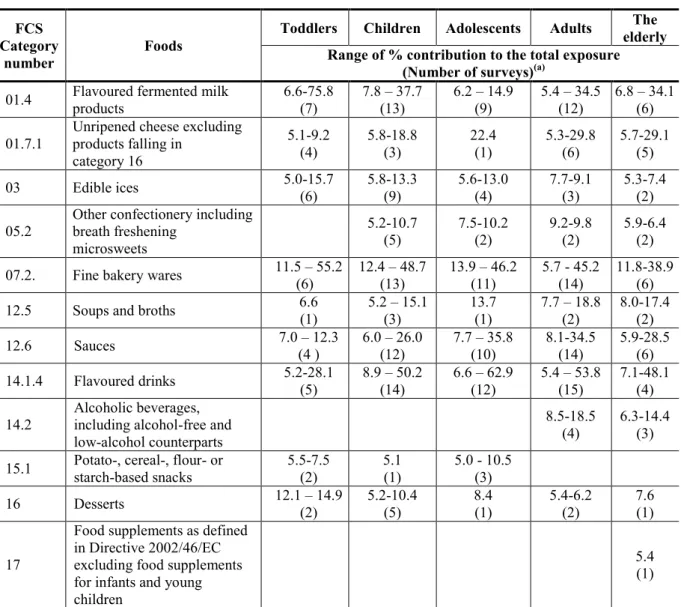
Table 5: Main food categories contributing to exposure to Indigo Carmine (E 132) using MPLs (> 5 % to the total mean exposure) and number of surveys in which each food category is contributing
FCS Category
number Foods
Toddlers Children Adolescents Adults The elderly Range of % contribution to the total exposure
(Number of surveys)(a) 01.4 Flavoured fermented milk
products 6.6-75.8
(7) 7.8 – 37.7
(13) 6.2 – 14.9
(9) 5.4 – 34.5
(12) 6.8 – 34.1 (6) 01.7.1
Unripened cheese excluding products falling in
category 16
5.1-9.2
(4) 5.8-18.8
(3) 22.4
(1) 5.3-29.8
(6) 5.7-29.1 (5)
03 Edible ices 5.0-15.7
(6) 5.8-13.3
(9) 5.6-13.0
(4) 7.7-9.1
(3) 5.3-7.4 (2) 05.2 Other confectionery including
breath freshening microsweets
5.2-10.7
(5) 7.5-10.2
(2) 9.2-9.8
(2) 5.9-6.4 (2) 07.2. Fine bakery wares 11.5 – 55.2
(6)
12.4 – 48.7 (13)
13.9 – 46.2 (11)
5.7 - 45.2 (14)
11.8-38.9 (6)
12.5 Soups and broths 6.6
(1) 5.2 – 15.1
(3) 13.7
(1) 7.7 – 18.8
(2) 8.0-17.4 (2)
12.6 Sauces 7.0 – 12.3
(4 ) 6.0 – 26.0
(12) 7.7 – 35.8
(10) 8.1-34.5
(14) 5.9-28.5 (6)
14.1.4 Flavoured drinks 5.2-28.1
(5)
8.9 – 50.2 (14)
6.6 – 62.9 (12)
5.4 – 53.8 (15)
7.1-48.1 (4) 14.2 Alcoholic beverages,
including alcohol-free and low-alcohol counterparts
8.5-18.5
(4) 6.3-14.4 (3) 15.1 Potato-, cereal-, flour- or
starch-based snacks 5.5-7.5
(2) 5.1
(1) 5.0 - 10.5 (3)
16 Desserts 12.1 – 14.9
(2)
5.2-10.4 (5)
8.4 (1)
5.4-6.2 (2)
7.6 (1)
17
Food supplements as defined in Directive 2002/46/EC excluding food supplements for infants and young children
5.4 (1)
(a): The total number of surveys may be greater than the total number of countries as listed in Table 3, as some countries submitted more than one survey for a specific population.
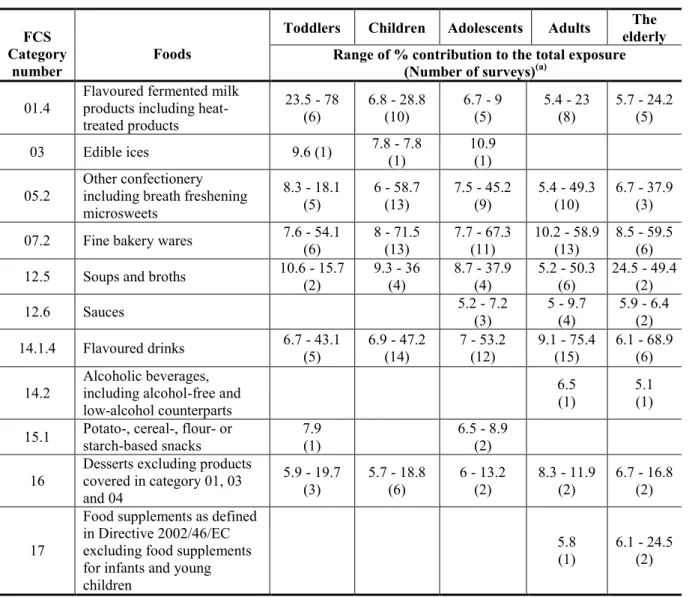
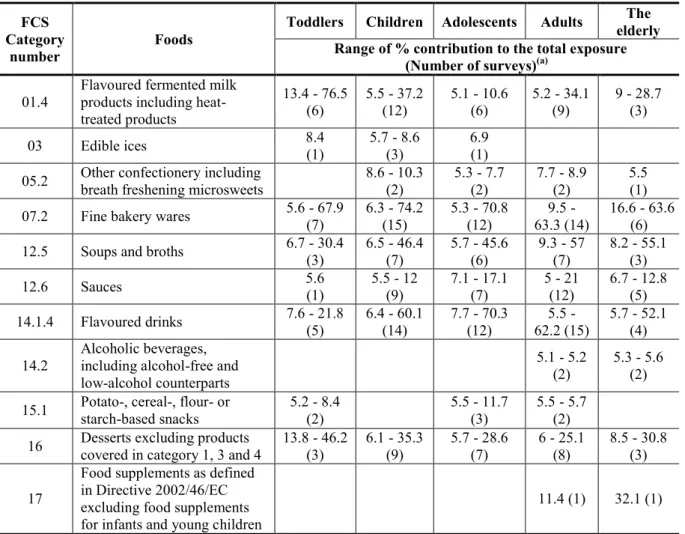
2.9.4. Main food categories contributing to exposure to Indigo Carmine (E 132) using the refined exposure assessment scenarios