Benemérita Universidad Autónoma de Puebla
FACULTAD DE LENGUAS
2ND LANGUAGE ACQUISITION IN A 2-YEAR-OLD GIRL TAUGHT BY HER MEXICAN MOTHER
(A CASE STUDY)
A THESIS SUBMITTED TO THE LANGUAGES FOR THE DEGREE OF
LICENCIATURA EN LA ENSEÑANZA DEL INGLÉS
BY:
SOCORRO MALDONADO ALARCÓN
THESIS DIRECTOR:
M.E.I. RUBÉN ZÁRATE SORIANO
MAY 2018
2ND LANGUAGE ACQUISITION IN A 2 -YEAR-OLD GIRL TAUGHT BY HER MEXICAN MOTHER
(A CASE STUDY)
This Thesis has been read by the members of the committee of
SOCORRO MALDONADO ALARCÓN
And it is considered worthy of approval in partial fulfilment of the requirement for the degree of
LICENCIATURA DE LA ENSEÑANZA DEL INGLÉS
Thesis Director
M.E.I. Rubén Zárate Soriano
Committee Member Committee Member
M.A. Roberto Criollo Avendaño M.E.I Aurea M. Rivera Mendoza
Benemérita Universidad Autónoma de Puebla Puebla, Pue. May 2018
INDICE
DEDICATIONS i
ACKNOWLEDGMENT ii
ABSTRACT iv
CHAPTER ONE: INTRODUCTION TO THE PROBLEM 1
1.1 Introduction to the Problem 1
1.2 Purpose of the Study 4
1.3 Research Questions 4
1.4 Significance of the Study 5
1.5 The Process 5
1.6 Definition of Terms 7
CHAPTER TWO: LITERATURE REVIEW 9
2.1 Communication 9
2.2 Language 11
2.2.1 Language Acquisition 13
2.2.2 Second Language Acquisition 14
2.2.2.1 Factors that Influence Language Acquisition 14
2.2.2.1.1 Individual Characteristics 15
2.2.2.1 .2 Age 15
2.2.2.1 .3 Motivation 17
2.2.2.1.4 Socio-Economic and Cultural Background. 18
2.2.2.1.5 Language Learning 18
2.2.2.1.5.1 The ‗Organizer' 19
2.2.2.1.5.2 The ‗Filter' 19
2.2.2.1.5.3 The ‗Monitor' 19
2.2.2.2 Factors that Affect Language Learning 19
2.2.2.2 .1 Social 19
2.2.2.2.2 The Verbal Environment 19
2.2.2.2.3 Perceptual 20
2.2.2.2.4 Cognitive Process 20
2.2.2.2.5 Conceptual 20
2.2.2.2.6 Deafness 21
2.2.2.2.7 Linguistic 22
2.2.2.2.8 Attitudes 23
2.3 English as a Foreign Language 24
2.4 Bilingualism 26
2.5 Childhood 28
2.5.1 Roles of the Parents 30
2.5.2 The Child´s Brain 31
2.5.3 Stages of Cognitive Development 32
CHAPTER III: METHODOLOGY 36
3.1 Research Design 36
3.2 Research Setting 37
3.3 Participants 37
3.4 Instrument 39
3.5 Procedures and Data Analysis 40
CHAPTER FOUR: RESULTS 43
4.1 Research questions. 43
4.2 Journal and Output Identification 44
4.3 Produced Output. 45
4.3.1 Utterance‘s Analysis 46
4.4 The Importance of Learning Environment 47
4.5 The Role of the Mother in the Process of Language Acquisition 49
4.6.Vocabulary inventory 50
4.6.1 The Vocabulary at the beginning of this study with 3-year-old girl
50
4.6.2 The Vocabulary Inventory at the end of this study with 3-year- old girl
50
CHAPTER V: CONCLUSIONS 56
5.1 Limitations 57
5.2 Recommendations 58
5.3 Further Research 58
5.3.1 Pedagogical Implications 59
5.4 Personal Experiences in the Researcher Words 59
5.5 The Dairy Summary of Advances 60
REFERENCES 126
DEDICATIONS
TO GOD
TO MY FAMILY.
Today I am so excited writing this dedication because I was dreaming with this moment and all of you are the best people for me.
The first person that contributed in my professional academic studies.
Is my sister Juanita of whom I am really proud, she knows the reasons, I love you! Thank you so much!
All my brothers and sisters are really important in my life and each one is special for me, thanks.
Alejandro Oscar Juan Edit Eva Eloisa
Thank you so much to be my family I love you with all my heart forever!
Thank you so much for my mommy and daddy. For your support, for the effort you made for me, my heart, respect and gratitude belongs to you.
To my daughter Britkey, you are the main person on this project I love you my beautiful girl!
My little Dani… My beautiful son!! Thank you for being my son, for existing in my life and for the most beautiful contagious smile.
Daney you are brilliant. Thank you baby to make me so happy!
My dear husband, thank you for supporting me and existing in my life!
All of you I LOVE YOU!! Thanks
To Socorro, for being so strong, positive, kind and lovely. You can do it!
This is the evidence… That means me!!
To my best friends. I love you, family Palafox Rivera. In my life there not exist anybody like you! You know I love you, you are in my heart forever and ever!!
ACKNOWLEDGMENT
The acknowledgment is to my thesis readers M.A. Roberto Criollo Avendaño and M.E.I. Aurea Marcela Rivera Mendoza. I am grateful to each one of you, for your hard work and your professionalism for the correction and development of this project. I have had the pleasure of working during this thesis. Thank you for your help, you are the best.
This work would not have been possible without your help, thesis director M.E.I Rubén Zárate Soriano for your support, time and help.
ABSTRACT
The purpose of this study is to investigate the process of English language acquisition carrying out an observation in the type of utterances. According to this research goal, this study intends to answer three major research questions:
1. Does the environment interfere with the process of English as a second language acquisition in a 2-year-old girl?
2. If so, what are the elements that interfere with this process?
3. What is the impact that parents have in the process of English as a second language acquisition in a 3 years old girl?
Therefore, in order to correspond with the research goal and research questions, this investigation was carried out with a qualitative method using a journal and observation to conduct this project.
CHAPTER ONE: INTRODUCTION TO THE PROBLEM
1.1 Introduction to the Problem
English has become a very useful language around the world. With attention to, English has become the modern lingua franca as it is used in the whole world.
About this language Santillana (2013, p. 1) mentioned that ―English is the most commonly spoken language and also is an official language in a large number of countries; as a result, it is the most used to communicate in the world‖ at the same time, learning English in countries as a second language is used for communication, to know about another culture, to develop in a professional way, as a tool or for academic studies and, finally, for many other reasons. For example, in Mexico the necessity of learning English becomes increasingly important, and this has achieved a high competitive demand as a second language‖
The selection of this topic of obeys a personal interest to learn English as a foreign language in an adult age. In addition ―the necessity to create associations between syntax and vocabulary in a foreign language‖ in accord with Mapou, (2009, p.120). Language acquisition is one of the most important developmental tasks faced by people. However the acquisition differs from learning as both involve different kind of processes. Such differences will be explained later in Chapter Two.
It is believed that for students it is better to acquire foreign language from very young age because adults, during the process of learning English way face more difficulties to learn compared with children. Children are able to learn or acquire
many languages in an easier way than adults do, so the older one starts to learn a language, the smaller the odds of reaching native like proficiency are. Pallier (2007, p. 1) explains that ―Many children can learn a second or even multiple languages.
Taking into account these aspects, people in Mexico would like to have bilingual children, starting this process in the language acquisition age is in order to avoid dealing with many issues when learning English in an adult stage‖
In other words, children acquire English in a plain way because language is a tool to communicate them, first produce vocabulary listening and speaking after this children learn to write and to read. Children do not feel ashamed of speaking in a different way, they acquire the language without caring about mistakes, and with time and practice they improve it. Penfield (as cited by Dechert 1995, p.792).Says that ―the child begins to speak and to perceive, the uncommitted cortex is a blank slate on which nothing has been written. In the ensuing years much is written, and the writing is normally never erased. After the age of ten or twelve, the general functional connections have been established and fixed for the speech cortex‖.
Another example of the advantages of leaning as a child is explained by Szubko- Sitarek, (2015, p. 15), who says that ―It is easy to produce the same sounds “t” by the previously given reason. If children have an enjoyable experience learning languages at this age, it would be a wonderful memory. It helps to have many benefits to learn English at an early age‖.
Other authors also mention the advantages that learning a language when the person is a child brings about the same language such as:
a) It enhances their skillset b) It makes them smarter
c) Better cognitive development d) Better communication skills e) Brain creative and flexible f) Solve problems easy.
g) Selective attention.
h) Better concentration i) Cultural enrichment.
(Carre, 2016, p. 1) This research followed the process of the language acquisition in a 3-year- old girl through the use of a journal that will show a toddler´s interaction in English with the researcher, in this case her mother. When this little girl was born, her mother was studying the major in English teaching starting some years ago with very low English level, having many difficulties to learn it.
According with this situation the mother took into account the advantages of acquiring a language from an early age. It was the cause that motivated the mother to start to speak in English with the girl as much as possible. The girl´s name is Britkey she was born on June 16th 2013 in Puebla city. Both Britkey‘s parents speak Spanish and English. In a common day the girl spend the time at home with her mother and her little baby brother, they are together in the morning from 7:00 to 8:00 and after 4 p.m. the rest of the day, in the morning the girl is at school (pre- kindergarten) the father works out of Puebla city and he comes once a week.
At 2.8-year-old, Britkey did not say one word neither in Spanish nor in English.
She is self-sufficient because since she was born her mother attends to the university, and she is kept alone at home, For this reason, when Britkey wanted something, she went and took it by herself, (she did not speak but she acted) she
did not have the necessity to speak to ask for anything. In this case the most appropriate way to conduct this research was the observation of natural conversations between the girl and the mother taking notes of each interaction in a journal. (Britkey was attending the pre- kinder garden school where there were not English classes)
1.2 Purpose of the Study
The purpose of this research is to follow a case study to describe, document, and analyze the process of development of English as a second language acquisition in a 3-year-old girl in order to determine the advantages acquiring English as a foreign language in the childhood period.
1.3 Research Questions
This project addresses the following research questions:
4. Does the environment interfere with the process of English as a second language acquisition in a 3-year-old girl?
5. If so, what are the elements that interfere with this process?
6. What is the impact that parents have in the process of English as a second language acquisition in a three-year-old girl?
1.4 Significance of the Study
The purpose of this research is to follow the English as a second language acquisition for children younger than 3 years old in Mexico, to observe the way in
which the participant acquires and develops English vocabulary. This research might be useful for Mexican people who are in a similar situation and context in order to be aware about of language acquisition process and children advantages. It is known that there have been many studies carried out concerning the importance about learning English in a young age; and also studies on how to learn vocabulary focused on the appropriate level and way for children.
For example, Gomleksiz, (2001, p. 33) writes that ―this aged is the excellent period to teach or give to children information as much as possible, taking advantage about the children brain developing‖. Nnicola (2008) suggests that the sooner the better; being bilingual since an early age. So it is also hoped that helping children who learn a second language at an early age have many advantages. For example, developing the second language similar as a native speaker. In the meantime the study can be useful for more people who want to know the second language acquisition process.
1.5 The Process
The process of this study started at the end of 2015 when Britkey, the subject under study was 2 years old. As the mother attended the classes in the
Languages Department, the interest to speak with the girl in English just to observe and have the experience with the language acquisition at home born. Some
months later the researcher started to define her degree thesis and continued developing the idea of have a bilingual kid at home, thinking about the benefits for
her in the future and taking into account the researcher personal difficulties in learning English.
At the beginning, the researcher was not sure about how to teach English to a 3-year-old child, the design for this project, it was a meaningful process to define and know the steps to follow in this, the researcher understood the way to teach Britkey, because she was convinced that one of the limitations of teaching English to her own 3-year-old daughter at home could be not the same as teaching English to children older than 3 years old in a classroom with different individual learning styles. So, one of the main objectives of this research was that Britkey could acquire English as a second language in a natural way as possible.
During the process of the development of this investigation some important points to carry out a better process to teach English to Britkey were discovered. One of the main problems was that Britkey did not speak any word at that time. Many people told the researcher that she must not speak in English to her because that could be the reason that she did not speak any word. Those words were the reason and motivation to continue with this research.
1.6 Definition of Terms
Acquisition: Is used to refer to picking up language through exposure(Ellis, The Study of Second Language Acquisition, 2003, p. 14).
Bilingualism: 1: The ability to speak two languages, 2: the frequent use (as by a community) of two languages, 3: the political or institutional recognition of two languages (Merriam-Webster Online Dictionary, 2017).
Communication: According to (Wood, 2005, p. 12) Communication is a ―systemic process in which individuals interact with and trough symbols to create and interpret meanings. Transmission of signal(s) between 2 or more organisms where selection has favoured both the production and the reception of the signal(s) (Lewis & Gower, 1980, p. 2) 2) The process of transmitting information and common understanding from one person to another‖ (Clark, 2003, p. 1).
Language: ―grammar governed representational system‖ (Clark, 2003, p. 27) it is a system of arbitrary Vocal symbols which permit all people in a given culture, or other people who have learned the system of that culture, to communicate or to interact.
Finocchiaro (1964, p. 8) ―It is s an essential tool enabling the children to learn about the world ―(A Resource Guide , 2009).
Learning: ―a change in an individual caused by experience‖ (Slaving, 2003, p.138).
Second Language acquisition (SLA): ―it is the study of how learners learn an additional language after they have acquired their mother tongue‖ Ellis (1995, p. 5).
―It is s an official or societally dominant language needed for education, employment and other many purposes?‖ (Saville and Troike, 2012, p. 4).
CHAPTER TWO: LITERATURE REVIEW
In this chapter, the topics related to second language acquisition will be described and commented in order to have a deeper perspective and understanding of the topic, in this way the awareness and familiarity with such topics will help to answer the research questions previously presented in Chapter 1.
2.1 Communication
Communication is defined by Keyton (cited in Lunenburg, 2010, p. 1) as the
"process of transmitting information and common understanding from one person to another". Means speak language every day (Clark, 2003, p. 1). Communication is the main characteristic and requirement to live in a community.
"Communication is central to the success of human beings and organizations;
consequently, each one is a social member that has to develop this important skill to live in this group also called ―society‖ ―whose almost actions implicate communication no mattering the species.‖ (Akilandeswari, 2015, p. 154) Although it is known that communication does not belong just to humans because every specie has their own way of communication and this level of communication is called
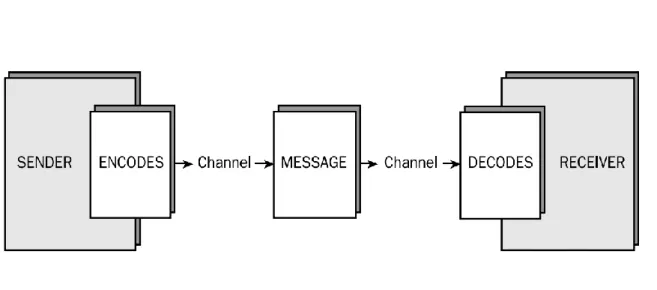
―encoding "(Bass & Pfeiffer, 1998, p. 1) Such process of communication is show in the Figure 1.
Figure number 1. Level of Communication known as “Encoding and Decoding” as found in (Bass & Pfeiffer, 1998, p. 1)
According to Bass & Pfeiffer (1998) the above table is explained as follows:
a) “Sender is who communicate, to transfer an image to another person; the sender first must translate the images into symbols that receivers can understand. Symbols often are words but can be pictures, sounds, or sense information (e.g., touch or smell). Only through symbols can the mental images of a sender have meaning for others.
b) The process of translating images into symbols is called encoding once a message has been encoded, the next level in the communication process is to transmit or communicate the message to a receiver. This can be done in
many ways: during face-to-face verbal interaction, over the telephone, through printed materials (letters, newspapers, etc.), or through visual media (television, photographs).
c) Verbal, written, and visual media are three examples of possible communication channels used to transmit messages between senders and receivers. Other transmission channels include touch, gestures, clothing, and physical distances between sender and receiver (proxemics).
d) When a message is received by another person, a decoding process occurs.
e) Just as a sender must encode messages in preparation for transmission through communication channels, receivers must sense and interpret the symbols and then decode the information back into images, emotions, and thoughts that make sense to them. When messages are decoded exactly as the sender has intended, the images of the sender and the images of the receiver match, and effective communication occurs‖
(p. 1)
2.2 Language
Language is crucial to survive in a society mainly to communicate with others, for that reason to start with language‘s definition it can be said that ―language is a uniquely human, biologically based capacity and the potential to learn language depends on the language environment‖ (Ball, 2011, p. 16)
Clark (2009 in (Khalifa, 2016, p. 2) adds that, that it is ―supplemented by gesture, gaze, stance, facial expression, voice in the full options people can use for
communicating". In other words, ―language is a group of signs, gestures, and figures‘ system to communicate a settled down message in a community of individuals for interacting among themselves‖ (Camacho & Chores, 2001, p. 18).
Some characteristics of the language are exemplified in Chomsky‘s theory called ―Universal Grammar‖ where all the individuals born with the ability to learn a language (Ellis, 2003, p. 15). Another characteristic of the language is explained by Camacho & Chores (2001, P.18) who mentions that the ―production and comprehension are controlled by the brain‖ that at the same time presents two main characteristics;.
a) A specific language‘s characteristic is to be creative; this means to create different styles to infer each one of this, using the same symbols, codes properly of a specific place to communicate.
b) Another point is that many experts claim that language in the humans is a communication linguistic strategy created with specific symbols and sounds with particular meaning having the purpose to communicate thinking feelings situations etc. etc.
Philips & C. (2007 p. 742) comments that ―these days we said that language is the human ability to communicate, and it is true because we use the language to communicate infinity of ideas, information, emotions, thoughts, and feelings as a consequence, language is a social evolution‖. On the other hand, Ginsborg (2006, p. 15) says that ―language is used not only to communicate information but also to
establish position social relationships – within the family, at school, at work – and, more broadly, within the class structure of our society‖.
2.2.1 Language Acquisition
It is effortless to observe the ability of the kids to acquire the language. By the same token, Gardner-Neblett & Cranley Gallagher (2013, p. 5) claim that "During the first years of life, children's brains are developing rapidly and laying the foundation for learning‖. On the other hand, it is so difficult to find the responsible brain workings about the language acquisition.
Chomsky (cited in Ward 2001, p. 16) says that kids born with the ability to acquire the language. Apart from Brown et. al. cited in (Navarro, 2003, p. 32) says that ―it is an innate practice developed as a consequence of external motivation and is the responsible of the mastering in the language acquisition is a short duration of time‖. The child can register of all the languages spoken to him, but he will save only those that are used more according to with his context (Zambrana, 2008, p. 8). So, it is difficult to understand exactly how language development occurs in the brain because it is so marvelous. Ellis (2003, p. 14) claims that ―language acquisition is a subconscious process of picking up a language‖. Piaget (as cited in Navarro, 2003, p. 322) adds that ―language is a general cognitive ability or the use of symbols for the development of language‖.
In conclusion, language acquisition is assumed to be a mental process which guides to fluency (Hanak & Newby, 2003, p. 8) and ―it can start at childhood or during the adult age‖ Krashen, (cited in Gomleksiz, 2001, p. 218).
2.2.2 Second Language Acquisition
Ellis (2003, p. 11) explains that ―the term Second Language Acquisition is used for acquiring any other language than the first‖. Gomleksiz (2001, p.18) adds about S.L.A. that ―This process can be developed in a natural setting or through formal classroom instruction‖ Many people believe that the kids are born with the skill to acquire language (Littlewood, 2006, p. 6) and it is better at an early age the second language acquisition because the young children acquire the second language with little trouble. On the contrary, ―adults seem to struggle ineffectively with a new language and to impose the phonology of their mother tongue on the new language‖ in (Singleton & Ryan, 2004, p. 2).
2.2.2.1 Factors that Influence Language Acquisition
If there is an innate language skill, ―it must be constituted in such a way as to be able to cope with a human language to which it is exposed and conversely, all humans‘ languages must be amenable to its operations‖ (Singleton & Ryan, 2004, p. 3). Second language acquisition is considered ―subconscious or conscious processes in picking up other language beside the mother tongue‖ (Fidalla, 2009, p.
99).The factors that affect language acquisition are:
2.2.2.1.1 Individual Characteristics
At first, individual characteristics have to do internal factors that are from the individual‘s personality (Jane, 2005, p. 8).So, when the linguistic develop is not according with the kid's age have a high risk to get educational, social, and emotional problems (Ward, 2001, p. 16). The characteristics are essential considering that they intervened in how the child behaves, how the child is cared by his parents and the parents' behaviors affect the child too.
In the first years when the kids are acquiring the language, the kids pay attention in the adult language and this particular aspect modify the kid´s world conception (Harr, 2012, p. 41).
2.2.2.1 .2 Age
Age is a fundamental aspect in the second language acquisition and there have been many researchers that investigate about this human period. For example, Gomleksiz (2001, p. 33) states that ―Age has been regarded as an important factor in acquiring second languages successfully, as well as in acquiring first languages‖. In addition, Schuele, (2001, p. 218) says that
―language acquisition depends of the learner‘s age‖. Respect to age Lenneberg (cited in Dong & Ren, 2013, p. 1) affirms that ―critical period hypothesis holds that human beings are predilection to acquire language in the early years of life, and that this option is lost at the onset of puberty around the age of twelve that is way it is vital the interaction mother-child in the first 2 years. Owing to the fact that
―children learn languages easily than the adults, because of ―their plasticity‖
(Gomleksiz 2001, p. 33).
Lenneberg‘s cited in Gomleksiz, (2001, p, 218) says that ―the period is from roughly two years of age to puberty because after this age their brain loses plasticity, making post-adolescent language acquisition difficult.‖ Ginsborg, (2006, p. 11) proposes that children are affected physiologically and physically by puberty as it may generate higher possibilities to present a moderate or severe expressive language delay.
So, children learn easily and quick; however when humans grow up, this process starts to be more difficult in countless areas, especially language acquisition. According to Nikolov, (2008, P.p. 1-3) ―a two operating system exist specifically in language acquisition at this age, the first one takes care of generating perfect sentences. The second one memory system takes care of unanalyzed rules. Besides, young learners use memory process and adults use rules to learn. Birdsong, et. al. (cited in Gomleksiz 200, p.34) claim that:
―The cutting-off age should be at puberty or at 12 years of age, the same as in first language acquisition. However, others postulate a younger age such as six years old (e.g. Long, 1990) or an older one such as 18 years old (e.g. Bialystok & Hakuta, 1994) as the terminal point of the critical period/ sensitive period, depending on the focal area of acquisition, i.e., whether in phonology/pronunciation (in the younger case) or morph syntax / grammar) in the older case)‖
Nikolov, (2008 p.p. 1-3) also says that two aspects where the age interferes in language acquisition are:
First: biologically because the plasticity (neuronal connections) is better about age five.
Second: cognitively conscious memory increase about aged seven
2.2.2.1 .3 Motivation
It is believed that motivation is an important factor for the second language acquisition because motivation is the passion, the love, the desire that moves you to learn (on this case other language). Fernandez (2013, p.12) defines motivation as ―a combination of the learner‘s desires, attitudes, and willingness to expend effort in order to achieve a goal on these case in order to learn a second language‖ Reece & Walker (cited in Gomleksiz, 2001, p. 220) say that teachers and situations stress ―a less able student who is highly motivated, and who can achieve greater success than the more intelligent student who is not well motivated‖. For this reason, ―motivation of learners can be expressed as the factor affecting second language acquisition‖ (Gomleksiz, 2001, p.17).
2.2.2.1.4 Socio-Economic and Cultural Background.
Another important aspect in the language acquisition is the socio-economic level because being in a high socioeconomic level implies more advantages to learn a language, having as a consequence the socioeconomic status on children‘s language acquisition and use. For example, Hart and Risley's (cited by
Schuele, 2001, p. 83) say "We saw that these differences between families in amount of talk were so persistently characteristic of ongoing family life that they added up to massive differences in children's cumulative experience with language".
2.2.2.1.5 Language Learning
Language learning is developed through practice and memorization of knowledge. Language learning, moreover, is a concise process which emerges in the condition of learning, rules, and structures (Hanak-Hammerl & Newby, 2003, p.8). On the other hand, Krashen (as cited in Dulay, Burt, & Krashen, 2008 p.p.11-45) claims that there exists 3 internal processes that are performed when the students learn a second language: "The subconscious ‗filter' and the
‗organizer' as well as the conscious ‗monitor'.
2.2.2.1.5.1 The „Organizer' determines the organization of the learner's language system, the usage of incorrect grammatical constructions as provisional precursors of grammatical structures, the systematical occurrence of errors in the learner's utterances as well as a common order in which structures are learned.
2.2.2.1.5.2 The „Filter' is responsible for the extent to which the learner's acquisition is influenced by social circumstances such as motivation and affective factors such as anger or anxiety.
2.2.2.1.5.3 The „Monitor' is responsible for conscious learning. The learners correct mistakes in their speech according to their age and self- consciousness.
2.2.2.2 Factors that Affect Language Learning
There exists much research about language learning influenced by many aspects of human experience and capability such as:
2.2.2.2 .1 Social. Toddlers infers a speaker‘s communicative intent and use
that information to guide their language learning. For example, as early as 24 months, they are able to infer solely from an adult‘s excited tone of voice and from the physical setting that a new word must refer to an object that has been placed on the table while the adult was away.
2.2.2.2.2 The Verbal Environment. The second language environment as we know it is so important influencer factor in the language acquisition, as it influences language learning. The different verbal situations around the learner every day, for example, the people, socio-economic status, are important aspects in the foreign language acquisition by the influence directly in what and how a child is acquiring language. Because language acquisition is a natural brain mechanism. It means that if the child is evolving from ages
one to three, children from highly verbal ―professional‖ families heard nearly three times as many words per week as children from low verbal ―welfare‖
families. Longitudinal data show that aspects of this early language predict language scores at age nine. (Johnston, 2010, p. 2)
2.2.2.2.3 Perceptual
a) Infant Perception sets the stage. Auditory perceptual skills at six or 12 months of age can predict vocabulary size and syntactic complexity at 23 months of age.
b) Perceptibility Matters. In English, the forms that are challenging for impaired learners are forms with reduced perceptual salience.
2.2.2.2.4 Cognitive Process
a) - Frequency affects rate of learning. Children who hear an unusually high proportion of examples of a language form learn that form faster than children who receive ordinary input.
b) “Trade-offs” among the different domains of language can occur when the total targeted sentence requires more mental resources than the child has available. For example, children make more errors on small grammatical forms such as verb endings and prepositions in sentences with complex syntax than in sentences with simple syntax.
2.2.2.2.5 Conceptual
a) Relational Terms are linked to mental age. Words that express notions of time, causality, location, size and order are correlated with mental age much more than words that simply refer to objects and events. Moreover, children learning different languages learn to talk about spatial locations such as or in much the same order, regardless of the grammatical devices of their particular language (Johnston, 2010, p. 3).
b) Language Skills are affected by world knowledge. Children who have difficulty recalling a word also know less about the objects to which the word refers. According to Lightbown & Spada (2006, p. 23) ―the kids‘ brain make connections between words or phrases and the situation where it was produced. This means that the brain relate the word or phrase with it is represent and vice versa when the children see someone object brings to main the word or phrase‖.
2.2.2.2.6 Deafness
Hearing is the ability to perceive sound (Department of Health, 2008, p.1) Deafness is the contrary to that; although hearing is of vital importance in childhood, we know less about hearing that about vision, partly because of the special troubles methodologies for checking the auditory functioning of the baby. Hearing is really an important aspect to learning spoken language and for the cognitive development of children,
so hearing loss is difficult develop education and social integration (Krug,
& et.al, 2016, p. 4). It is for that reason that deafness is a challenge the language acquisition because ―Deaf individuals are incapable of perceiving any auditory input‖ (Vanek, 2009, p. 7).
The Department of Health (2008, p.3) advises that parents can help their child with hearing impairment
a) Understand and accept the developmental progress of the child
b) Provide timely fitting of hearing aids or cochlear implants as appropriate
c) Train the child to make good use of his/her residual hearing d) Allow more time when communicating with the child.
2.2.2.2.7 Linguistic
a) Verb Endings are cues to verb meaning. If a verb ends in –ing, three- year-olds will decide that it refers to an activity, as such as, swim rather than to a completed chanced of state such as push off.
b) Current Vocabulary influences new learning. Toddlers usually decide that a new word refers to the object for which they do not already have a label, e.g. those that are unstressed or lie united within a consonant cluster"
(Johnston, 2010, p. 2)
2.2.2.2.8 Attitudes
Attitudes can also play a significant role in the language-learning classroom. They have a close relationship with motivation. Krashen (cited in, (Gomleksiz 2001, p.221) explains that ―attitude can be a tool or a barrier in learning languages‖. in addition, Environment surrounding children can enhance or not the development of language. Ribes et. al. notes that (2003, p.442) notes that
―Language as a form of life is a notion that involves individual practices with objects and people as an integrated totality, to the extent that language is present and articulates every kind of imaginable social activity. The human environment, in the form of culture and social relations, is built through language, and no human behavioral practice could be understood apart from language. We usually describe human behavior as verbal or non-verbal. But this is a misleading distinction, since language behavior (which is not necessarily reducible to speech) never occurs. Isolated from the overall behavior or activity of the individual. Even more, language behavior is learned and becomes functional through its integration and correlation with motor, visceral and sensory forms of activity, and its occurrence in different modes always consists in some kind of activity such as reading, writing, speaking, pointing, gesturing, or listening. The socialization and adjustment of individual behavior is promoted, taught, and regulated by language behavior from the significant others in the culture and social environment. The development of language behavior allows the individual to fully adjust to, modify, and participate in the social environment‖.
As a summary, the teacher has an important part in the educational process as he or she should influence and motivate the student to learn
―creating an effective learning environment‖ (Gomleksiz 2001, p. 220). After that, motivation influences learner‘s achievement (successful) in acquiring second language. (Fadillah, 2009, p. 109)
2.3 English as a Foreign Language
English has studied around the world even in countries that do not speak English. Maxon (2009, p.9) ―Many factors contribute to the market for Teaching English as a Foreign Language The historical factor offers the legacy of the old British Empire that took the language around the world. The political factor gives the current dominance of the USA. Science and technology have developed with English at the forefront‖.
English as a Foreign Language is also misunderstood, as people believe that this concept has the same meaning and purpose than English as a second language or bilingualism, however, this distinction is explained by Broughton et. al. (1980, p.6) who explains that:
―English as a foreign language So far we have been considering English as a second language. But in the rest of the world, English is a foreign language.
That is, it is taught in schools, often widely, but it does not play an essential role in national or social life. In Spain, Brazil and Japan, for example, Spanish, Portuguese and Japanese are the normal medium of communication and instruction: the average citizen does not need English or any other foreign language to live his daily life or even for social or professional advancement‖.
So, there are different purposes for studying a language that does not take crucial part in society neither is involved in every aspect that a mother tongue or a second language imply such as the identity, the folklore, neither an authentic demand to communicate with this language in the country where it is learned. West (as cited in Broughton et. al. 1980, p.8) explains that ―the foreigner is learning
English to express ideas rather than emotion: for his emotional expression he has the mother tongue…. It is a useful general rule that intensive words and items are of secondary importance to a foreign learner, however common they may be‖.
Hui-chin Lin and Shih-Chieh Chien (2010, p.3) Teaching English as a Foreign Language implies that English is taught in an area where it is not ruled by English people, colonized by England, or culturally and ethnically influenced by The great British for a great deal. Both learners and teachers‘ studies for learning and teaching different language besides mother tongue are allowed to occur in a student's home, as well as an important part of the normal school curriculum, or as an alternative communicative approach in governmental conferences. Broughton et. al. (1980) suggests that for learning EFL most learners of English tend to have an instrumental motivation. In other words, people have different purposes and future rewards when learning English. For example, Hui Chin and Shih-Chieh (2010) assume that the purposes of learning English as a foreign language just for passing admission exams in educational institution, or for future career improvements, such as working for a governmental or foreign commercial institutions that view English as a language of priority. Maxon (2009, p.9) says that:
―There‘s a need for a global language to make international communication smother, and tools such as the worldwide web truly accessible around the planet. These days English is viewed as a language which gives you access to the world. Some want to study at prestigious English-speaking universities;
some want a high flying career with international connections. Others just want a better chance in life and move to wherever the money seems to be, and then again, some just love Hollywood, international rock stars or their English girlfriend. Even the free-spirited backpackers need English to get by in far-flung lands‖.
2.4 Bilingualism
According to the Merryam Webster Dictionary (2018) the definition of bilingualism is: 1: the ability to speak two languages, 2: the frequent use (as by a community) of two languages, 3: the political or institutional recognition of two languages. Adams (2003, p.3) define the bilingualism as ―The practice of alternately using two languages‖. This phenomenon is common around the world; for this reason, the language many times can suffer modifications for example lexical or morphological, according to the region or place. Also, Haugen (as cited in Liddicoat 1991, p.2) says that ―bilingualism begins 'at the point where a speaker of one language can produce complete, meaningful utterances in the other language‖. In other words, the term refers to a person who has learned and uses two languages to communicate.
Liddicoat (1991, p.p.3-4) notices that ―Bilingualism is present in most countries throughout the world, in all classes of society and in all age groups.
However, the importance of bilingualism in the world is not widely recognized, particularly in countries which view themselves as monolingual‖. The possible reason is because there is recognized only an official language of a country; however in the same country different indigenous languages are spoken. To this idea Liddicoat (1991) suggests bilingualism is normal only in the minority community in countries with indigenous linguistic minorities.
Valdés and Figueroa (as mentioned in Baker 2001, p.3) classified bilinguals by:
1. Age (simultaneous/sequential/late) 2. Ability (incipient/receptive/productive).
3. Balance of two languages.
4. Development (ascendant – second language is developing;
recessive – one language is decreasing).
5. Contexts where each language is acquired and used (e.g. home, school).
6. Circumstantial and elective bilingualism.
a. Elective bilingualism is a characteristic of individuals who choose to learn a language, for example in the classroom.
b. Circumstantial bilinguals learn another language to survive.
Because of their circumstances (e.g. as immigrants)
Also, Bhatia and Ritchie (cited in Ritchie, 2006, pp. 10-11) add an important distinction dividing in primary and secondary bilingualism. ―The first regularly occurs in a place where both languages are appreciated and both are in use. On the other hand the secondary exist where just one language is the principal, the second one is not so important or in use like the first. However the mentioned that such citations depends of the needs in the society, the environment of the speakers and as a recommendation for both bilingual competence are much better to acquire in an early
age because the pronunciation skills, vocabulary, fluency take advantage over the older one‖
2.5 Childhood
Palacios and Castañeda (2008, p. 7) define childhood as the main evolutionary stage of human whose experiences lived by they in these years are essential to their life cycle. Also, Raheb (2017, p. 1) declares that ―childhood is interpreted as the time between 1, 2–year-old that is around when the language is originated. In other words, since they are born until the language appears‖. The United Nations Convention on the Rights of the Child (2010) suggest that unless the laws of a particular nation state place the legal age for adulthood younger, a 'child' as a person below the age of 18-year-old.
The world that children live in these years is very important to their development on their initial years of life because these support the growing and neurological basis of growth because children learn through experiences they live every day. The UNICEF (2015, p.1) states that ―the first years in the life kids are fundamental because if they care to give the kids attention feed they have more opportunities to survive because they have more health and they can develop and acquire language, thinking, feelings and better social relationships‖.
Schaffer (cited in Ribes et.al, 2003, p. 443) identifies five successive interactive tasks considered to be critical for the child's socio-communicative development during the first two years of children‘s development:
1) The first mother-child interactions, from the birth to around two months of life, center on the regulation of the infant‘s basic physiological processes such as feeding, sleeping, and hygienic care.
2) During the following months (2 to 5 months of age) most interactions deal with maintaining the infant‘s attentiveness and positive affect in face to face exchanges.
3) From this point, during the first two years, joint attention is extended to objects and events beyond the mother and the child.
4) Beginning at 8 months of age, the child becomes a competent partner of the mother, participating in intentional interactions and showing reciprocity.
5) Later, after 12 months of age, mother-child interactions progressively integrate the child's utterances and speech into the existing nonverbal modes of effective communication.
2.5.1 Roles of the Parents
In the whole the world in almost any society, babies are cared by the parents.
The parents are the main responsible to give solution for the all the necessities of the child and of his or her education. For those reasons, it is essential to spend the first years of life with him or her, becoming in this way the principal model from who the baby receives crucial information and determine relevant aspects for the rest of his life, specifically the language (Lamb, 2010, p. 3).
Parents interfere in the development of children‘s‘ language. In the same way it is recommendable for the parents to being the master language. According to Colin
(2005, p.24) for being bilingual it is important to expose the baby to a lot of vocabulary as much as possible. Stimulate speaking a lot with him a great deal of time giving excellent input to have the best results. Being bilingual or no to be influenced for the rest of the life in general for the baby it will affect the identity, employment culture, knowledge , marriage, in general be bilingual change all giving a lot of advantages in the life. This important decision belongs to the parents.
2.5.2 The Child´s Brain
The human development starts inside the brain when humans start to live.
David and Schmid, (2007 p. 1) ―Recent advances in neuro-science have helped crystallize earlier findings, bring new clarity and understanding to the field of early childhood brain development. Children are born ready to learn. They cultivate 85 percent of their intellect, personality and skills by age five‖.
About the functions of the brain Perry, et.al. (cited in Child Welfare Information Gateway 2015, p.2)
―The raw material of the brain is the nerve cell, called the neuron. During fetal development, neurons are created and migrate to form the various parts of the brain. As neurons migrate, they also differentiate, or specialize, to govern specific functions in the body in response to chemical signals. This process of development occurs sequentially from the ―bottom up,‖ that is, from areas of the brain controlling the most primitive functions of the body (e.g., heart rate, breathing) to the most sophisticated functions (e.g., complex thought).The first areas of the brain to fully develop are the brainstem and midbrain; they govern the bodily functions necessary for life, called the autonomic functions. At birth, these lower portions of the nervous system are very well developed, whereas the higher regions (the limbic system and cerebral cortex) are still rather primitive. Higher function brain regions involved in regulating emotions, language, and abstract thought Brain
development, or learning, is actually the process of creating, strengthening, and discarding connections among the neurons; these connections are called synapses. Synapses organize the brain by forming pathways that connect the parts of the brain governing everything we do—from breathing and sleeping to thinking and feeling. This is the essence of postnatal brain development, because at birth, very few synapses have been formed. The synapses present at birth are primarily those that govern our bodily functions such as heart rate, breathing, eating, and sleeping. The development of synapses occurs at an astounding rate during a child‘s early years in response to that child‘s experiences. At its peak, the cerebral cortex of a healthy toddler may create 2 million synapses per second (ZERO TO THREE, 2012). By the time children are 2 years old, their brains have approximately 100 trillion synapses, many more than they will ever need. Based on the child‘s experiences, some synapses are strengthened and remain intact, but many are gradually discarded. This process of synapse elimination—or pruning-isa normal part of development By the time children reach adolescence, about half of their synapses have been discarded; leaving the number they will have for most of the rest of their lives‖.
Taking into account the above investigation about how the brain works in an early age for many people language acquisition has been a fascinating process for investigation. Kuhl (2002, p. 9) says that ―infants learn a great deal in the first year of life before they do not speak‖ However the brain is so marvelous that even before we are born we are learning, we are as a sponge absorbing knew knowledge.
In other words, there exist studies confirming that when we born the brains take all the information that we are exposed to: touch, see, smell, and hear absolutely all around give new information during the first year of life, so all this information in the brain is defining who we are by the experiences and this happens during all the life. For this reason it can be concluded according to the neuroscience, recent investigations that the brain is adaptable or moldable according with the
experiences, specifically because each one experience influence in our brain development.
2.5.3 Stages of Cognitive Development
The stages of cognitive development in human are related to inner processes of the mind and the way in which such activities are developed during different phases in the human life. Oakley (2004, p.2) advises that:
―The Word cognitive originally comes from a Latin Word cognocere, which means to know. Therefore cognitive activities include all the psychological processes and activities involved in thinking and knowing. These include how information is acquired, processed and organized. Cognitive development is the study of how these processes develop in children and Young people and how they become more efficient and effective in their understanding of the world and in their mental processes.‖
Piaget studied such mind processes in each of the children stages that deal with the thinking and learning processes. According to Barnardos‘ Training &
Resource Service (2012, p.3) ―Piaget arrived at his theories through a series of clinical interviews.‘ These interviews were based on open ended questions and conversations with children, which were used to study children‘s thinking processes‖.
Piaget (also mentioned in Driscoll and Nagel 2008, p.70) explained that ―children undergo four stages of cognitive development, proceeding sequentially, through each stage although at individual rates.
Children add new experiences to their knowledge and gradually gain the capacity to achieve higher order thinking‖. In other words there is a sequence of elements and abilities that are related to age and development related to the children
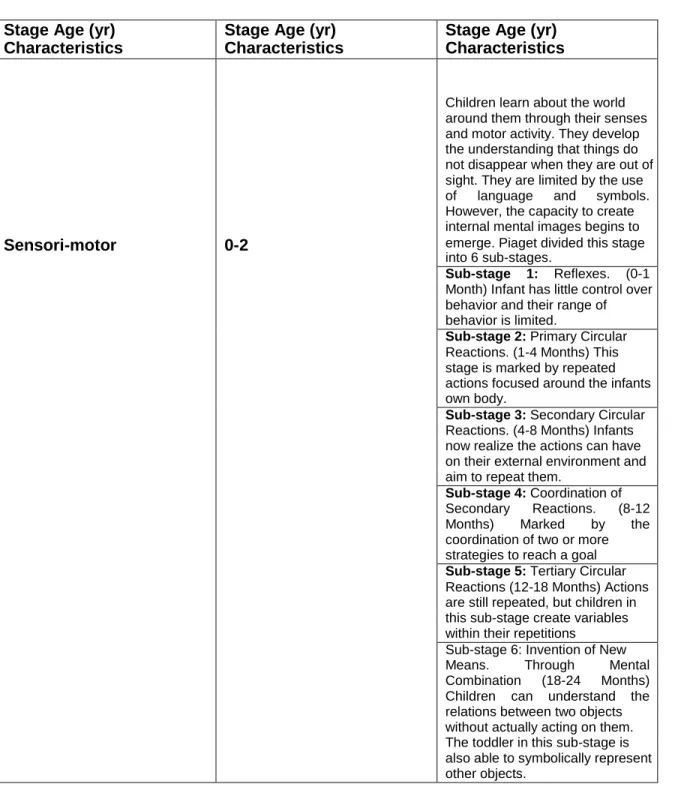
brain and motor capacity. The different stages of childhood development from 0 to 15 years old can be seen in table 2 which summarizes the characteristics of each stage of cognitive development from 0 to 15 years old.
Table 1. Summary of characteristics of cognitive development stages (the correlation between children's cognitive development and age) (Taken from Barnardos‟ Training & Resource Service, 2012, p.3).
Stage Age (yr) Characteristics
Stage Age (yr) Characteristics
Stage Age (yr) Characteristics
Children learn about the world around them through their senses and motor activity. They develop the understanding that things do not disappear when they are out of sight. They are limited by the use of language and symbols.
However, the capacity to create internal mental images begins to
Sensori-motor 0-2 emerge. Piaget divided this stage into 6 sub-stages.
Sub-stage 1: Reflexes. (0-1 Month) Infant has little control over behavior and their range of behavior is limited.
Sub-stage 2: Primary Circular Reactions. (1-4 Months) This stage is marked by repeated actions focused around the infants own body.
Sub-stage 3: Secondary Circular Reactions. (4-8 Months) Infants now realize the actions can have on their external environment and aim to repeat them.
Sub-stage 4: Coordination of Secondary Reactions. (8-12 Months) Marked by the coordination of two or more strategies to reach a goal Sub-stage 5: Tertiary Circular Reactions (12-18 Months) Actions are still repeated, but children in this sub-stage create variables within their repetitions
Sub-stage 6: Invention of New Means. Through Mental Combination (18-24 Months) Children can understand the relations between two objects without actually acting on them.
The toddler in this sub-stage is also able to symbolically represent other objects.
Children in this stage can use language and symbols, but their understanding of the world is
Pre-operational 2-7 limited. This stage is classified by egocentrism; the child believes that everyone sees the world the way they do. A child in this stage will also have trouble understanding conservation—the idea that the quantity of something may remain the same even though the appearance has changed. For example, they would not comprehend that at all, slim glass could hold as much water as a short, wide glass. Piaget divided this stage into two sub-stages:
Sub-stage 1: Pre-conceptual stage. (2-4 Years) Rapid advancement in language occur.
Symbolic through begins to emerge through imaginative play.
The child will have difficulty understanding the idea of another persona perspective
Sub-stage 2: Intuitive period. (4-7 Years). Ordering, classifying, and quantifying skills improve dramatically during this period.
Concrete operational 7-12 7-12 Concrete operational 7-12 Children in this stage become less egocentric and can see.
Formal operational 12+ Formal operational 12 + The adolescent develops the ability to communicate opinions on.
According to the above table 1, it can be seen that Piaget believed that young children think different to adults, because human mental structure evolves progressively since they are children to the start their adolescence, as they experience and construct his or her new world as a result of biological maturation and environmental experience.
The following chapter, Chapter 3 presents the setting, the methodology, the instrument, the subject under study investigated during the present research.
CHAPTER III: METHODOLOGY
This chapter provides specific information about the design, the setting, the participants and the instruments. A step by step description of data collecting and analysis procedures followed to develop this research is also provided. First of all, this study was carried out using journals, which involves collecting data by means of observations; in this case 9 months of interactions with Britkey were taken into consideration by the researcher for the purposes of this study.
3.1 Research Design
The aim of this study is to document the English language acquisition as a second language in a 3-year-old baby during nine months. To conduct this research, it was necessary to observe and take notes about every part of the infant language production. Therefore, it was necessary to take into consideration the schedule to practice English.
During the day the mother and the infant were together in the morning from 7:00 to 800 after this hour the infant attended kindergarten and at 4 p.m. she retook the practice with her mother. Then Britkey went to bed. Then, as the subject under research usually reacted in a restless way when she saw a camera, it was considered to maintain a natural environment without the use of a camera.
Consequently, the most appropriate way to conduct this research was just through observations and taking notes by the use of a diary about Britkey‘s speaking
interaction (e.g. when having common conversations and when the participant says some words).
For the purposes of this study, the researcher (in this case the mother) made corrections in pronunciation to the girl, when necessary and took notes about all the infant words‘ production in English and in Spanish.
3.2 Research Setting
The context in which this research takes place is in the city of Puebla Pue., Mexico. This is a setting where the English language plays no major role in the community as it is considered a foreign language and, in this case, is learned at home just with Britkey‘s‘ mother. The participant is prepared to be able to communicate a few speaking ideas and requests in English. However, Bowen, (2015, p. 74) declares about similar cases that ―it would be possible to observe a little bit more tendency about Spanish words used‖, in this case by the little Britkey.
Britkey´s mother is from Zacatlán Puebla, and her father is from Puebla Mexico, but this family lives alone in Puebla City, without relatives, so they are isolated in certain way.
3.3 Participants
During this research, the subject under study is 3-year-old. The participant is female. She was born on June 16th of 2013 in Puebla City. She is very healthy, her cognitive and physical status are in good conditions, she is in movement all the time.
Britkey attends the kinder garden since 5 months before this investigation started.
She is at school from 8 a.m. to 4 p.m. after that she is at home, she spends the time just with her mother (researcher and participant) and her little brother who is 18 months. She lives with her mother and her father, but her father works out of the city, he is absent almost all the time.
In Britkey‘s daily routine she usually takes a break to sleep from 5:00 to 6:00 p.m. in the afternoon. Finally she goes to bed at 9:00 or sometimes at 10:00 p.m.
She is from Puebla Mexico and now she is living in this place too.
The mother is a researcher participant, she is 25 years old, and she lives in Puebla since 7 years ago. She is a Spanish native speaker and she is also studying English Language Teaching at the Licenciatura en la Enseñanza del Inglés as a major and Italian language at the Benemérita Universidad Autónoma de Puebla. She is the main care provider and also the main language provider of Britkey. The researcher speaks in English with the subject under study since Britkey was 2-years- old. Britkey‘s father is a native Spanish speaker but he speaks English too, he is an economist and he lived in U.S.A. for 5 years.
The period of observations for this study was conducted from September 2016 until the end of May of 2017, being a total of 9 months of observation. This study was carried out in every place because is wherever and everywhere where the infant acquired language. Most of Britkey‘s child context is in Spanish. The researcher is with the participant practicing during six hours without counting
sleeping time from 9:00 p.m. to 6 a.m. The mother is the main care provider because the mother does not care her all the time after the school at 4 p.m.
3.4 Instrument
It was necessary to consider the best way and instrument that could enhance the things happen in a natural setting without manipulating the results or that other variables that could appear interfere in the validity and reliability of the results of this study. Golafashani (referred by Pandey and Patnaik, (2014, p.p.5744-5745) explains that:
―Qualitative reliability: demonstrating that the operations of a study -such as the research uses a naturalistic approach that seeks to understand phenomena in context-specific settings, such as real world setting in which researcher do not attempt to manipulate the phenomenon of interestingly try to unveil the ultimate truth. The researcher builds a complex, holistic picture, analyzes words, reports detailed on the findings. Views of informants, and conducts the study in a natural setting‖.
So the instrument chosen for the purposes of this research was then a Journal, in order collect information about the language acquisition process and compare with previous theories, articles related to this topic, where everything related to Britkey‘s interactions. The observations made by the researcher and her reflections that could be collected every day, and after nine months of interaction, it could be possible to analyze such information to review the results of the study to answer the research questions and in this way to draw up some conclusions.
Thomas (as cited in Borg 2001, p. 157) declares that ―Research journal is a form of reflective writing which researchers engage in during a project and through which they document their personal experience of the research process‖.
3.5 Procedures and Data Analysis
For the purposes of this research, it was necessary to research about information that could guide to adopt the specific methodology and instrument used for the purposes of this specific case. Nevertheless, there was a disadvantage because every day children improve many things as they learn easily but they can forget that things very easy. ―Children who learn languages in early childhood – whether in school or elsewhere may also forget these languages if they are not sustained as they grow older‖. (Lightbown, p. 25)
As a result, of the information Britkey‘s mother decided to speak every day to the girl in English just in the morning one hour and in the afternoons they spend the time together after 4:00 pm. Sometimes the researcher (mother) felt frustrated because she was the only one who speak in English with the subject under study, while all the people around in Spanish. The result of the situation demotivated and worried the researcher, because the little girl said more Spanish than English words, that meant that she was acquiring more Spanish than English. However when the girl answered to the researcher questions or say some English words she felt better, especially when the subject under study spoke spontaneously. For example when they were walking by the street, and this was motivating for the researcher. Another
difficult point was the way to correct the subject pronunciation mistakes because she did not like to repeat words.
When the researcher tried to help her to repeat some word after her, the child was uncomfortable and angry, saying ―No, no‖. That experience was necessary to research some strategies to teach her the correct pronunciation. One strategy was in a role-play (Burnett & Myers, 2004, p. 37) and repeating (Donoghue, 2009, p. 386) many times the word that was difficult for her to pronounce it has good results because she tried to do an effort with the word. At the beginning, the researcher thought about collecting the language acquisition using video recording but when the girl saw the camera, she behaved shyly; she did not want to participate.
So, as these techniques were not efficient, the following steps were used;
firstly, it was decided to take notes about everything and write everything about behavior and interactions, and evidence Britkey‘s language acquisition. In other words, a Journal was used in order to fulfill the requirements and to accomplish with the purpose of this study. About Journals‘ advantages for research Janesick (1988, p. p. 25, 26) says that:
―Journal writing is a powerful research technique for the researcher and the participants in a given study. The definition of the role of the researcher and participants in a study are clarified through the reflection and the writing process involved in journal writing. Since the researcher is the research instrument, keeping a journal is a check and balance in the entire course of a qualitative research project‖