
Capture of dark matter particles through the evolution of low-mass stars (Paper III). A brief review of the dark matter candidates, which are relevant to the scope of this thesis, is presented in section 1.1.2.
Introduction to the Dark Matter problem
Evidence for the existence of Dark Matter
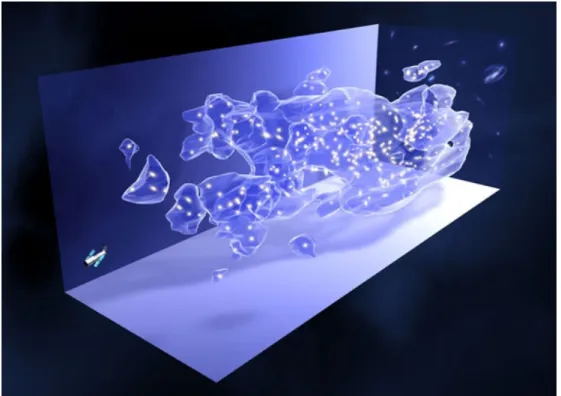
In addition, gravitational lensing has been used to create impressive 3D maps of the large-scale distribution of dark matter. In addition, the large structure provides a measurement of the total (dark + baryonic) mass density of the Universe.
![Figure 1.1: The Coma cluster observed by the X-ray telescope ROSAT [6]. The temperature of the intracluster gas is used to infer the total mass of the cluster, revealing the existence of large amounts of invisible mass.](https://thumb-us.123doks.com/thumbv2/123dok_es/12435572.0/19.892.287.629.107.449/figure-observed-telescope-temperature-intracluster-revealing-existence-invisible.webp)
Dark Matter particle candidates
In this thesis we focused on the study of the effects of classical WIMP dark matter candidates in stellar evolution. It is worth noting that warm dark matter candidates are severely constrained by cosmological data [35].
Searches for Dark Matter
Indirect detection experiments are looking for the annihilation products of dark matter particles, focusing primarily on gamma rays and neutrinos. Gamma-ray searches from these sites have been used to put constraints on the self-annihilating cross section of dark matter particles.
![Figure 1.10: Exclusion contours on the spin-independent elastic WIMP-nucleon cross- cross-section,from [37] (top), and on the spin-dependent WIMP-proton cross section, from [38]](https://thumb-us.123doks.com/thumbv2/123dok_es/12435572.0/30.892.256.647.101.693/figure-exclusion-contours-independent-elastic-nucleon-section-dependent.webp)
Stellar evolution and seismology
For example, measuring the origin neutrinos in solar thermonuclear reactions provides a unique window into the solar core. The frequencies of thousands of normal modes of solar oscillations have already been determined with high precision (see Figure 1.13.a).
Using stars to investigate Dark Matter
Once the dark matter particles are captured, they accumulate in a very small area in the star's core. More recently (see [108]), the code was upgraded with the full formalism for the capture rate calculation, thanks to the implementation of modified subroutines of the DarkSUSY code [109], allowing the calculation of the capture of dark matter by other stars .
![Figure 1.14: (a) Solar gravity mode period dierences between GOLF measurements (cir- (cir-cles with error bars) or the standard solar model [120] (crosses) and a DM-modied solar model [118] or between GOLF and the standard solar model (stars)](https://thumb-us.123doks.com/thumbv2/123dok_es/12435572.0/40.892.140.763.106.485/figure-solar-gravity-dierences-measurements-standard-crosses-standard.webp)
Towards the use of asteroseismology to investigate the nature of dark matter
The capture of dark matter particles through the evolution of low-mass stars
Signatures of dark matter burning in nuclear star clusters (Paper IV)
We considered DM particles with a mass mχ = 100 GeV and a spin-dependent scattering cross section with protons σχ, SD = 10−38 cm2. We have considered DM particles with the special characteristics that t observations and DAMA constraints from direct detection experiments: a mass mχ = 8GeV and a spin-dependent scattering cross section with protons σχ, SD = 10−36 cm2.
First asteroseismic limits on the nature of dark matter (Paper V)
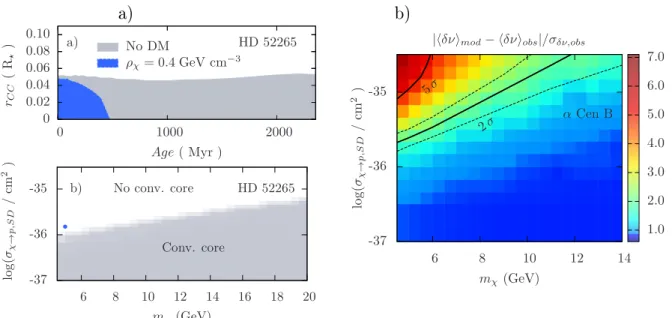
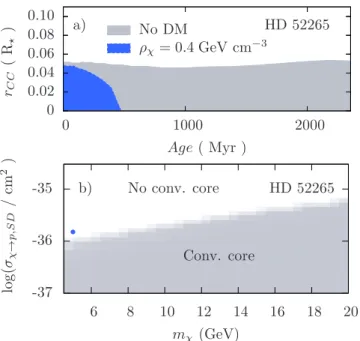
The presence of a convective core in HD 52265 depends on the mass and SD scattering cross section of the DM particles. The dashed black lines around the 2σ line show the theoretical uncertainty in the modeling that arises from the uncertainties in the properties of the stars. Thus, the existence of DM particles with properties above the 2σ line can be excluded with a 95% confidence level by the asteroseismic analysis of α Cen B.
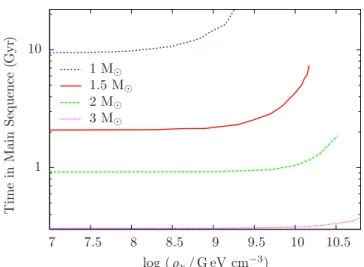
The limits set with this approach are comparable to the limits of direct detection experiments, especially for mχ = 5GeV, when the sensitivity of the detectors drops. Compared to helioseismic DM searches, asteroseismology allows the study of stars with masses lower than that of the Sun, which are more strongly influenced by the trapped DM, and thus with the potential to provide stronger constraints on the DM characteristics. An asteroseismic determination of the presence or absence of a convective core in these types of low-mass stars could provide further constraints on the DM properties.
If the small frequency spacings are identified in the oscillations of stars located in environments with high expected DM densities, such as globular clusters, then the sensitivity of the approach we proposed will reach much smaller WIMP baryon scattering cross sections and larger WIMP masses.
Testing alternative theories of gravity using the Sun (Paper VI)
In this thesis we have developed a new approach to investigate the nature of dark matter. The dark matter particles of the galactic halo are efficiently captured by low-mass stars and accumulate in their cores. We have shown that the observation of the presence/absence of dark matter's influence on stars can be used to learn more about the characteristics of dark matter.
We evaluated the error on the capture rate, as well as on the weight of the destruction of dark matter left. We have also characterized the impact of the stellar capture and annihilation of dark matter particles on the global properties of a cluster of stars. Stars with masses lower than that of the Sun and stars that theoretically lose their convective core to dark matter are particularly promising targets.
In this thesis, we have demonstrated that Stellaris' searches for dark matter provide constraints on dark matter properties that are comparable to current direct detection experiments.
![Figure 2.6: (a.a) Relative dierences between the sound speed proles of our modied solar models and the solar sound speed from helioseismic data [165]](https://thumb-us.123doks.com/thumbv2/123dok_es/12435572.0/56.892.107.779.102.433/figure-relative-dierences-sound-proles-modied-models-helioseismic.webp)
Paper I
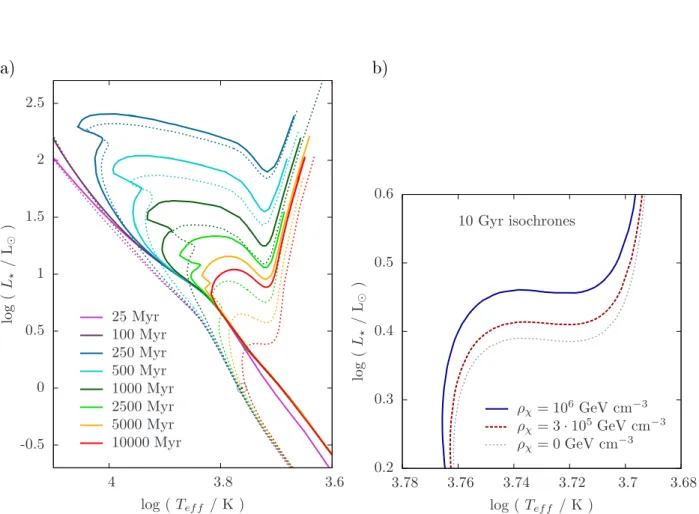
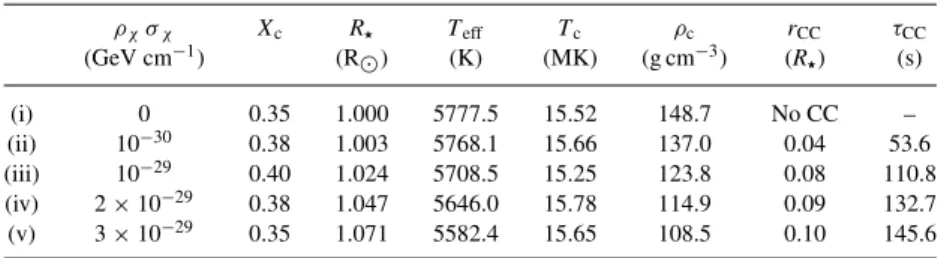
In this paper, we investigate the influence of the DM component on stellar evolution. The capture rate is proportional to the WIMP scattering cross section on the nucleiσχ and the density of the DM haloρχ. Energy from the core is easily transferred through this radiative region to the surface of the star.
Stars evolving in low-density DM haloes (Weak scenario) are in equilibrium in the early MS. One of the consequences of the formation of structures in the universe is the creation of localized areas of high concentrations of DM. We found that the evolution of a young star can be slightly, moderately or strongly affected depending on the DM density of the host halo.
The evolution of the star also depends on the scattering cross section of the DM particles.
Paper II
This convective core leaves a discontinuity in the density and sound speed profiles that can be detected by analyzing stellar oscillations. Once DM particles are trapped, they accumulate in a small region in the core of the star (rχ0.01Rformχ=100 GeV). Bedding, etc. 2010) driven by turbulence in the surface layers of the star.
The last two columns are the radius and acoustic radius (τ =r . 0dr/c) of the convective core (CC). The accretion and annihilation of DM particles in the core of stars can significantly change their properties. This is almost twice that of the star with differentMandZ (δνn,0 =4μHz in that case).
This convective core leaves a discontinuity signature in the sound speed and density profiles that can be detected by analyzing the stellar oscillations.
Paper III
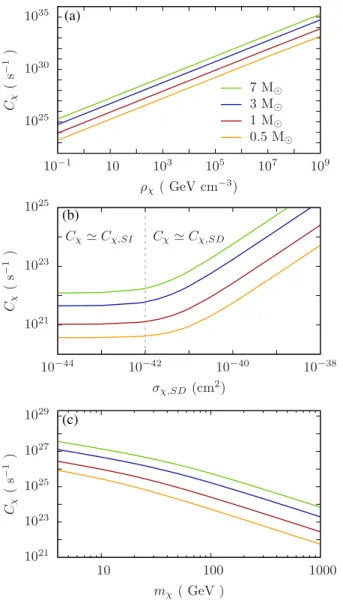
We found that the capture rate characteristics are very different in the two scenarios. In these cases, the uncertainties in knowing the typical parameters governing the capture rate are much larger. Thus, we also investigate how different stellar and DM physics change the role of dominant elements in the capture rate.
CAPTURE OF DM PARTICLE STARS To study the different dependences of the capture rate, some routines of the DARKSUSY [41] code have been adapted to be included in a modified version of the CESAM star evolution code [42]. The accretion rate is approximately inversely proportional to the mass of DM particles, as it is proportional to the number density of SS particles in the halo. This is due to capture due to collisions of DM particles with heavier elements.
The evolution of the capture rate during the lifetime of the star is studied in this section.
Paper IV
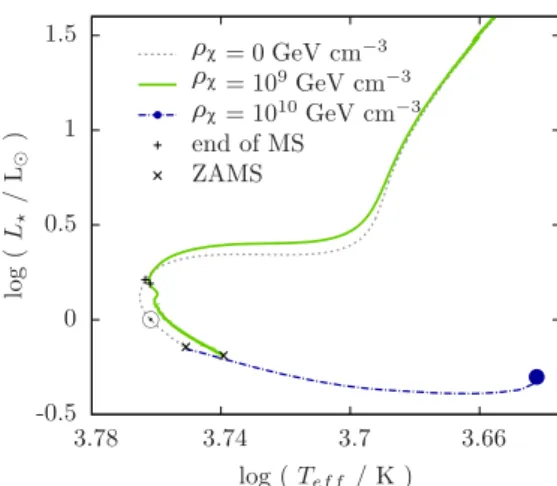
We argue that this signature can be used to indirectly probe the presence of DM particles at the location of a cluster. After a few scatterings, the DM particles sink into the star's core and rapidly thermalize with the stellar matter. The number of DM particles in the stellar core increases until their self-annihilation rate balances the capture rate.
Thus, annihilation of DM particles provides a new source of energy which contributes to the total luminosity of the star according to (Salati & Silk1989). Lχ=fχ mχCχ, (1) whereχ is the mass of the DM particles andfχ = 2/3 to take into account that one third of the energy can escape the star in the form of neutrinos (Iocco et al.2008). In addition to the previously described effect (which will now be visible for younger clusters because at higher DM densities more massive stars will be affected), another strong signature of the presence of DM in the halo emerges when looking at stars position with lower masses.
This special signature is a strong indication of the presence of high concentrations of DM in a stellar cluster.
Paper V
The identification of the dark matter (DM) nature of the universe is a major open problem in modern physics (Bertone 2010). The DM particles captured in the star's core provide a new energy transport mechanism that removes energy from the center of the star. In the case of the sun, the results of our modified solar model (see e.g.
1.—Central temperatures (top) and densities (bottom) of DM-modified stellar models that reproduce the observed properties of the star KIC 8006161. 2.—(a) Size and duration of the convective core when modeling the star HD 52265 in the classic image (gray) and considering energy transport due to translation of ADM particles with mχ = 5 GeV and σχ,SD cm2 (blue). b) The presence of a convective core in HD 52265 depends on the mass and the SD scattering cross section of the DM particles. Interestingly, hints of convective core signatures in HD 52265 were reported in Ballot et al.
The characteristic signatures listed in the last section can be detected by analyzing stellar fluctuations.
Paper VI
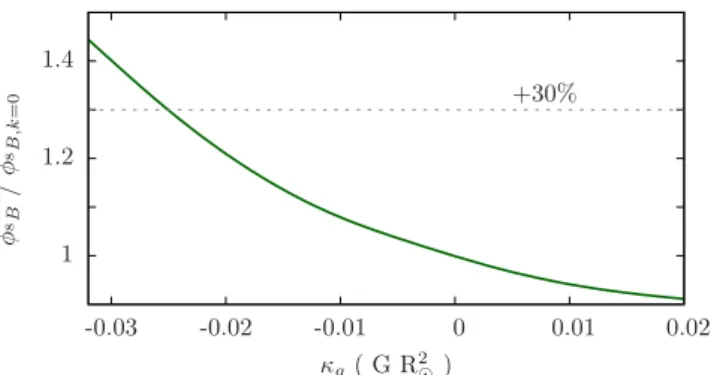
Here we explore how this theory will change the interior and the evolution of the Sun. Alternative theories would affect the evolution and equilibrium structure of the Sun, giving different core temperature profiles and deviations in the observed acoustic modes and in solar neutrino fluxes. These processes take place on a much shorter timescale than the evolutionary timescale of the Sun and their inclusion leads to minor structural changes in the Sun's interior (see e.g. Turck-Chi`eze et al.2010).
In addition, we also take into account the deviation of 20% in the predicted 8B flux when different estimates of the solar fluxes are implemented (see e.g. Serenelli et al. 2009). Towards a unified classical model of the sun - On the sensitivity of neutrinos and helioseismology to the microscopic physics. Measurement of the solar 8B neutrino rate with a liquid scintillator target and 3 MeV energy threshold in the Borexino detector.
The problem of the solar model solved by the abundance of neon in stars of the local cosmos.

![Figure 1.4: Composite image of the galaxy cluster 1E 0657-56, also known as the "Bullet cluster", joining Chandra X-rays observations of the intracluster hot gas ([13], in red), optical observations from the Magellan telescopes and the Hubble Space](https://thumb-us.123doks.com/thumbv2/123dok_es/12435572.0/22.892.215.710.105.493/figure-composite-chandra-observations-intracluster-observations-magellan-telescopes.webp)


![Figure 1.13: a) Power spectrum of the solar acoustic modes as measured by SOHO/MDI [68].](https://thumb-us.123doks.com/thumbv2/123dok_es/12435572.0/34.892.116.814.105.528/figure-power-spectrum-solar-acoustic-modes-measured-soho.webp)

