STERILE NEUTRINO
PORTAL TO DARK MATTER
N. Rius
IFIC, Univ. Valencia - CSIC
In collaboration with Miguel Escudero, Verónica Sanz, to appear SOON
PLANCK 2016, Valencia
Outline
• Introduction
• Phenomenology:
- Higgs invisible decay width - Relic abundance
- DM direct detection
- Prospects for DM indirect detection and CMB
• Summary and outlook
1. INTRODUCTION
• Evidences for dark matter: CMB, galaxy rotation curves, galaxy clusters
• Evidence for neutrino masses: neutrino oscillations
• Are they related ?
• Many models link (mostly WIMP) DM and
neutrino mass generation, but the DM freeze-
out annihilation modes are still SM particles
Sterile neutrino portal to DM
• Neutrino masses generated by type I seesaw mechanism (or variations) è N R , SM singlet
• Stability of DM follows from a (global or local) symmetry G
• Renormalizable interactions between DM and
N R
• G U(1) B-L , spontaneoulsy broken by a SM singlet scalar Φ
- DM charged under lepton number
- DM and N Majorana masses generated by Φ - DM – N interactions mediated by Φ
- Φ mixing with the SM doublet Higgs
- very interesting phenomenology è
Miguel Escudero talk tomorrow
⊃
• G = G Dark
- Global or local exact dark symmetry
- Minimal Dark sector: ϕ (scalar), χ (fermion) χ Φ singlet under G Dark
- N R singlet under G Dark and G SM
SM
H L
N R Dark
• DM is the lightest of χ , ϕ
• Relevant interaction terms:
- Sterile neutrino portal:
è t,u channel DM annihilation into N N
- Standard Higgs portal if DM is ϕ :
- Yukawa couplings :
è generate light neutrino masses
H (H † H )( † )
Y ↵i ` ¯ ↵ N i H
¯( s + p 5 )N
Neutrino masses
• In the basis ( ν α , N )
• Upon diagonalization:
with
M ⌫ =
✓ 0 m D m T D M N
◆
m D = Y v H p 2
M ⌫ = U ⇤ Diag(m ⌫ , M )U †
U ↵N ⇤ = m D M N 1
• Many possibilities: χ Dirac or Majorana, ϕ
real or complex è most constrainable, s vawe DM annihilation
è indirect detection and CMB
• If m N >> m χ ,m ϕ : N can be integrated out
è Neutrino portal to DM
Gonzalez-Macias, Illana, Wudka, 2016
O d=5 = ( ¯ )(H † `) = ) v H
m N ¯ ⌫
2. PHENOMENOLOGY
- Higgs invisible decay width - Relic abundance
- DM direct detection
- Prospects for DM indirect detection
and CMB
Parameter space analysis
• Monte Carlo scan over the mass parameters in log scale: N, DM [1 GeV, 2 TeV]; mediator [1 GeV, 10 TeV]
• Perturbative limit g = λ s ≤ 4π
• g determined by the Planck constraint on the DM relic abundance at 3 σ (LanHep and micrOMEGAs)
Ω h 2 = 0.1198 ± 0.0026
Planck coll., 2015
Sterile neutrino portal to DM N. Rius Planck 2016 11Invisible Higgs decay width
• ATLAS & CMS:
• m h > 2 m ϕ :
• m h > m N :
From neutrino oscillations, direct sterile neutrino searches, LFV, 0 νββ decay:
A. Gago et al., 2015
(h ! ) = H v H 2 32⇡m h
s
1 4m 2 m 2 h BR inv = inv
inv + SM < 0.23 (95%CL)
(h ! ⌫ N ) = m 2 N 8⇡v H 2
✓
1 m 2 N m 2 h
◆ 2
m h | C ⌫ N | 2
BR(h ! ⌫ N ) < 10 2
DM relic abundance
• Real scalar DM, ϕ :
Higgs portal very constrained
Alternative annihilation mode ϕϕ è N N
• Majorana fermion DM, χ :
! N N v rel = g 4
⇡
(m N + m ) 2
(m 2 m 2 N + m 2 ) 2 1 m 2 N /m 2 3 /2 + O (v rel 2 )
! N N v rel = g 4 8⇡
(m N + m ) 2 (m 2 m 2 N + m 2 ) 2
q
1 m 2 N /m 2 + O (v rel 2 )
Real scalar DM, ϕ
Majorana DM, χ
DM Direct searches
• Scalar DM, ϕ :
In the region where the correct relic abundance is determined by ϕϕ è N N , direct DM searches still constraint the Higgs portal coupling λ H ϕ
h
q q
---- invisible Higgs width direct detection
• Fermion DM, χ :
DM – nucleon cross section at one loop è
no significant bounds on λ H ϕ
q
h
q
N
DM indirect detection and CMB
• DM annihilation in dense regions of the
Universe (galactic center, dwarf spheroidals) è SM final states ( ν , γ rays …)
• CMB sensitive to DM annihilation during cosmic dark ages due to the injection of ionizing
particles
• s-wave annihilation: DM DM è N N è SM
Sterile neutrino portal to DM N. Rius Planck 2016 19Sterile neutrino decay modes
• m N < m W : decay via virtual V=W,Z,h
M.C. Gonzalez-Garcia, A. Santamaria, J.W.F. Valle, 1990
N ! ⌫ q q, ¯ 3⌫, `q q, ¯ ⌫` ` ¯
/ G 2 F m 5 N
192 ⇡ 3 C N N f ((m N /m V ) 2 )
C ij =
X 3
↵=1
U ↵i U ↵j ⇤
• m N > m W , m Z , m h : 2 body decay
Pilaftsis, 1992
Expected signals from indirect searches !
N ! W ± ` ⌥ , Z ⌫, h ⌫
(N ! W ± ` ⌥ ↵ ) = g 2
64⇡ | U ↵N | 2 m 3 N m 2 W
✓
1 m 2 W m 2 N
◆ 2 ✓
1 + 2m 2 W m 2 N
◆
(N ! h ⌫ ↵ ) = g 2
64⇡ | C ↵N | 2 m 3 N m 2 W
✓
1 m 2 h m 2 N
◆ 2 (N ! Z ⌫ ↵ ) = g 2
64⇡c 2 W | C ↵N | 2 m 3 N m 2 Z
✓
1 m 2 Z m 2 N
◆ 2 ✓
1 + 2m 2 Z m 2 N
◆
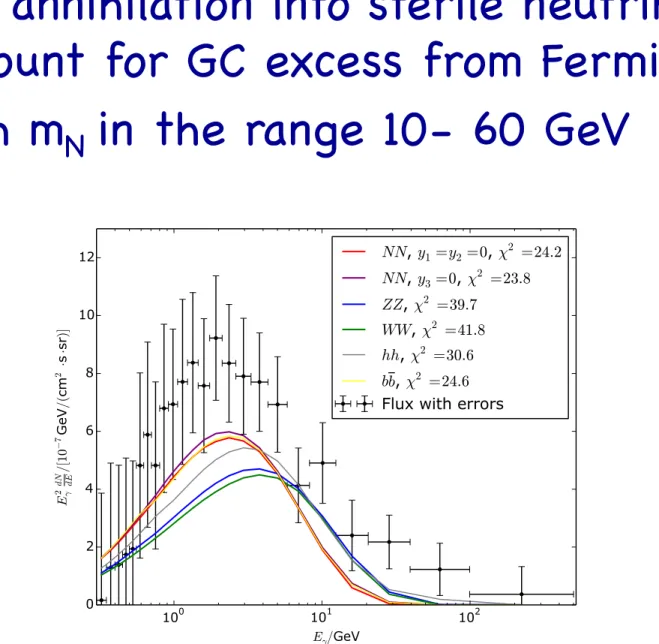
• DM annihilation into sterile neutrinos N can account for GC excess from Fermi-LAT data, with m N in the range 10- 60 GeV
Tang, Zhu, 2015
Sterile neutrino portal to DM N. Rius Planck 2016
FIG. 3: The best-fitted gamma-ray spectrum together with the observed central values and the errorbars. In the case of y
1= y
2= 0, y
3̸ = 0, χ
2= 24.22, with the p-value 0.336. In the case of y
3= 0, y
21+ y
22̸ = 0, χ
2= 23.81, with p-value 0.357. The data together with the error bars are from Ref. [12]. We also plot the gamma-ray spectrum and list the χ
2value of the best-fitted ZZ, W W , hh, and bb channels for comparison. All these curves and values are calculated by a similar MadGraph5 [email protected]+PYTHIA 8.212 process.
Acknowledgments
We would like to thank Ran Ding, Jia-Shu Lu, Weicong Huang, Chen Zhang, Weihong Zhang, Yu-Feng Zhou for helpful discussions. This work was supported in part by the Natural Science Foundation of China (Grants No. 11135003 and No. 11375014).
8
22
mN/GeV
10 20 30 40 50 60 70
mχ/GeV
10 20 30 40 50 60 70
mN/GeV
10 20 30 40 50 60 70
mχ/GeV
10 20 30 40 50 60 70
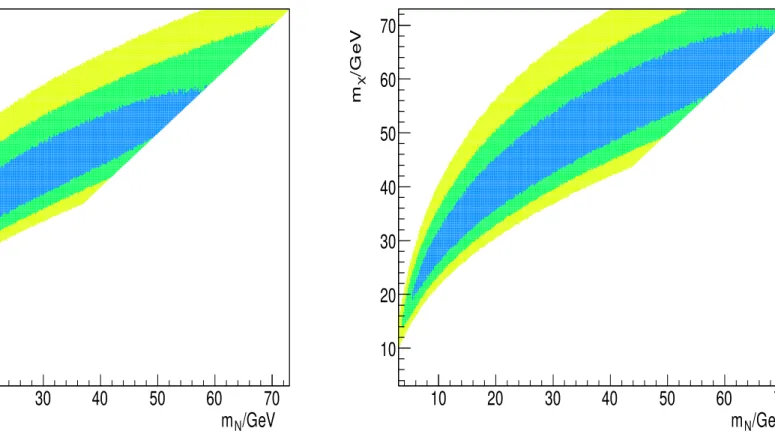
FIG. 1: ∆χ 2 figures, corresponding to 1,2 and 3 σ . ⟨ σ v ⟩ is adjusted in order to acquire the best- fitted result. The left panel indicates the y 1 = y 2 = 0, y 3 ̸ = 0 case. The right-panel indicates the y 3 = 0, y 1 2 + y 2 2 ̸ = 0 case.
Since there are large correlations among the systematic errors of different bins in the CCW fit from Ref. [12], the χ 2 should be defined as
χ 2 =
! dN
dE −
"
dN dE
#
obs
$
· Σ −1 ·
"
dN dE −
"
dN dE
#
obs
$
. (10)
We scan the m N -m χ parameter space by a 0.2 GeV interval. For each point in the parameter space, we used MadGraph5 [email protected] to generate an one-million-event sample file. Then we sent these events to PYTHIA 8.212 in order to acquire the photon spectrum. This process took most of the time during the calculation. We List the 1,2 and 3σ area in the Fig. 1. The best-fitted points are m N = 32.0 GeV, m χ = 44.2 GeV, with χ 2 = 24.22 and the best-fitted ⟨ σv ⟩ = 2.63 × 10 −26 cm 3 /s for the y 1 = y 2 = 0, y 3 ̸ = 0 case, and m N = 27.0 GeV, m χ = 45.4 GeV, with χ 2 = 23.81 and the best-fitted ⟨ σv ⟩ = 3.37 × 10 −26 cm 3 /s for the y 3 = 0, y 1 2 + y 2 2 ̸ = 0 case. Note that for m N < 10 GeV, which is too near to the Λ QCD scale, the showering and hadronization process from PYTHIA is suspectable. In Fig. 1, 2, we still show our numerical results in this area. However, since the “1-σ” area is such a long belt ranging from 10 GeV to 60 GeV, the main features of our conclusions should not be affected severely by the uncertainty of the QCD calculations.
In Fig. 2, we also plot the best-fitted ⟨ σv ⟩ for each m N and m χ .
From the Fig. 1, 2, and 3 we can learn that m N approximately ranges from 10 GeV to 60 GeV within 1 σ level and necessary boost is needed for the best-fitting with the observed excess. Both the y 1 = y 2 = 0, y 3 ̸ = 0, and y 3 = 0, y 1 2 + y 2 2 ̸ = 0 show us no significant difference between them. However, a slightly larger ⟨ σv ⟩ is needed in the y 3 = 0, y 1 2 + y 2 2 ̸ = 0
6
Sterile neutrino portal to DM N. Rius Planck 2016
Y τ ≠ 0 Y τ = 0
23
• Bounds from dwarf spheroidals and CMB: need detailed study of the spectrum
DM DM è N N è W W + charged leptons Z Z ν ν , h h ν ν
è leptons, quarks
• Estimate from 2-body decay limits rescaled by a factor 2
Real scalar DM, ϕ
Majorana DM, χ
3. SUMMARY AND OUTLOOK
• Sterile neutrino portal to DM can be
constrained: relic abundance, direct detection, Higgs decays
• Indirect detection and CMB limits need
dedicated study, but seem to rule out the low DM mass region, m DM ≤ 30 GeV
• Prospects for lepton colliders deserve further
investigation
Back up slides
DD loop:
• generated at one loop: ¯ h
H m N g 2 v H 16⇡
m 2 m 2 N + m 2 N log( m m 2 N 2 )
(m 2 m 2 N ) 2