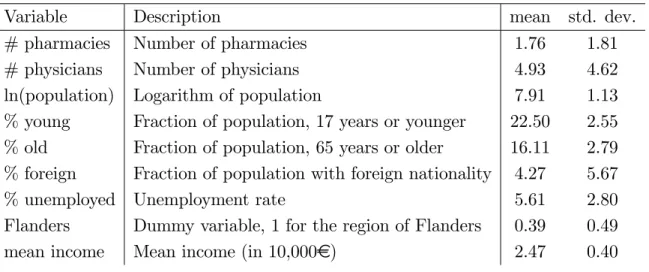
In addition, it can be used to make inferences about the nature and extent of competitive interaction between occupations of the same type, and between occupations of different types. In this section, we provide a selective overview of the healthcare markets in which the pharmacies and doctors in Belgium operate, focusing on those elements that motivate our econometric model. We begin with a discussion of the access process, including the presence of access restrictions on pharmacies as imposed by the Belgian government.
In practice, only a minority of students (around 25%) with a medical degree choose to become a doctor, in the sense of a general practitioner. First, we take into account that entry is regulated, in the sense of binding access restrictions for one of the two types of …rms.
Payo¤s
Second, we consider the possibility that the entry decisions of …firms of different types are strategic complements or strategic substitutes, since both possibilities cannot be ruled out a priori in our case9. In the appendix we describe the case where accession decisions of different types are strategic substitutes. The case where entry decisions by …companies of different types are strategic additions or are independent can be summarized as follows.
Equilibrium with nonbinding entry restrictions
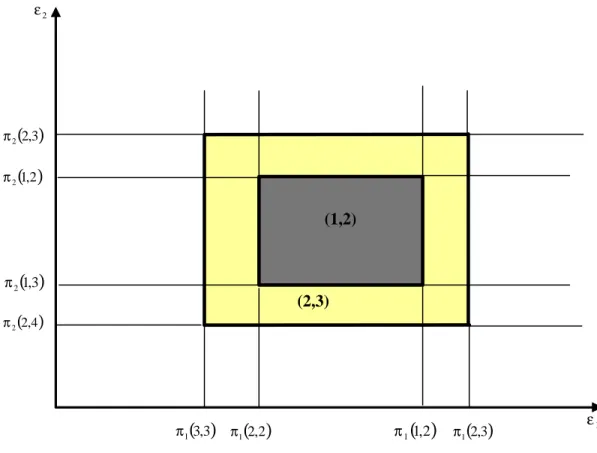
On the other hand, the services of …rms of different types can be either complementary or substitutes, as evidenced by qualitative evidence of recent rivalry between both industries. Based on these assumptions, we can now derive the equilibrium number of …rms and the implicit likelihood function to be taken for the data. The bold lines delimit the regions of “ for which the market configurations (1;2) and (2;3) are the Nash equilibrium outcomes.
Assumption 2(a) holds with equality, then the market configuration (n1; n2) is the unique Nash equilibrium outcome of "satisfy (2). Conversely, if the entry decisions of ...rms are of different types strategic complements, i.e. assumption 2(a) holds with strict inequality, then (n1; n2) can show multiplicity with other Nash equilibrium outcomes for some realizations of".
The outcome with the smallest number of …rms cannot be perfect in the subgame, since then there would always be an additional …rm of some kind with an incentive to enter, pending further entry by a …rm of the other kind as well. Therefore, when there are multiple Nash equilibrium outcomes, the one with the largest number of. Using our earlier characterization of the multiplicity of Nash equilibrium outcomes, it follows immediately that (n1; n2) will be a subgame perfect equilibrium outcome if and only if (i) " satisfies conditions (2) and (ii ) "Does not meet conditions (3).
The market configuration (1;2) is a perfect subset Nash equilibrium outcome if and only if “ falls in the corresponding area bounded by the bold lines, minus the shaded area in the lower left corner.
Equilibrium with binding entry restrictions
The multiplicity problem follows from the weak structure implied by the Nash equilibrium concept. This additional structure makes it possible to assign a unique subgame perfect equilibrium outcome to each realization of ". From the market con...guration(n1; n2) it is no longer possible to deduce that entry with n1 + 1 ...rms would be upro... table.
For ... rms of type 1 are different, since it is no longer possible to infer the lower bound of pro ... from observation (n1; n2). Using nonbinding input constraints, we have shown that (n1; n2) can only denote the set with Nash equilibrium outcomes of the form (n1+m; n2 +m), where m is either a positive or negative integer. When the input constraints are binding, it is immediately obvious that there can no longer be such a multiplicity for positive integers.
However, similar to the case of nonbinding entry restrictions, the equilibrium with the smaller number of ... rms cannot be chosen as the perfect subgame Nash equilibrium. Therefore, with binding entry restrictions on … rms of type 1, the market configuration (n1; n2) is a unique perfect Nash equilibrium in the subgame if and only if " satisfies … (5). The probability of observing the market con… guration (n1; n2) as perfect Nash the balance is tipped when entry restrictions are binding, i.e.
Econometric speci…cation
There are two economic interpretations of payo¤s i(n1; n2), both with the required property that a …rm would enter if and only if i(n1; n2) 0. Therefore, we can interpret a …rm's payo¤s i (n1; n2) as the log of the variable pro…ts to …xed cost ratio. The parameters ji and ki are …xed e¤ects for type i when there are respectively j …rms of the own type and k …rms of the other type.
The ...xed e¤ects ji resemble "cut-values" in simple ordered probit models and measure the e¤ect ofj …rms of the own type on payo¤s. One can reasonably expect that the complementarity effect is stronger when there are few …rms of one's own type. We incorporate this by dividing ki by the number of …rms of the own type j.
A more general approach would be to specify the full set of …fixed effects jki for each market configuration, rather than an additive specification. Let J be the largest number of ... rms observed in any market of its own type and let K be the largest number of ... rms of the other type. 13This is similar to the intercept requirement in traditional ordered probit models.
The entry threshold Sij;k is the market size at which the j-th …rm would just be willing to enter when there are k …rms of the other type, i.e.
Strategic complements or substitutes
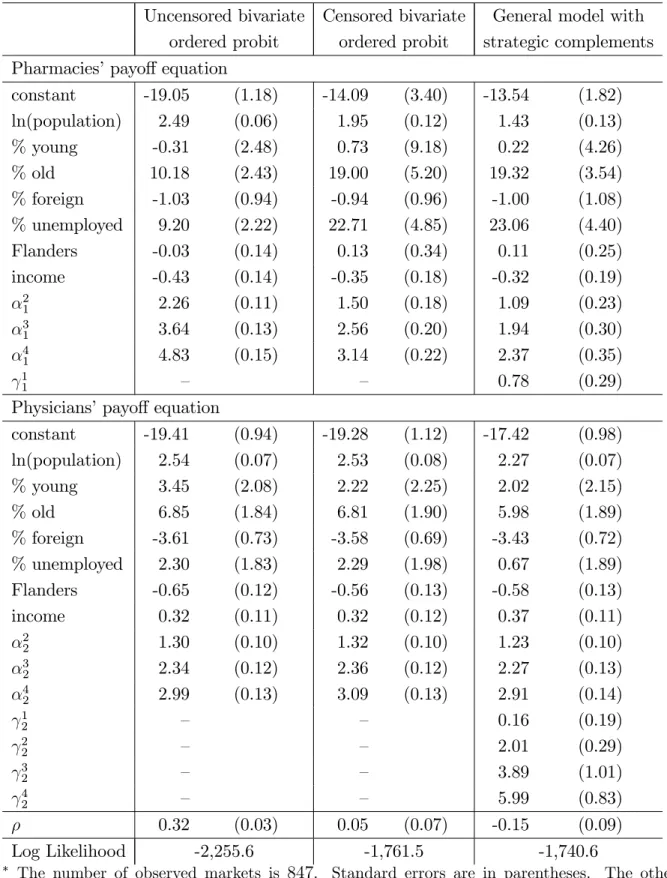
Parameter estimates
The other estimated k2 are not shown; limitations on the second k1 and ki are discussed in the text. The percentage of foreigners has a negative effect on wages, but the effect is only significant for doctors. Finally, there are some regional differences: payments to doctors are significantly lower in the Flanders region than in the other two regions (Brussels and Wallonia).
Conversely, the size of the market required to support a physician is not significantly lower in the presence than in the absence of a pharmacy (93% ratio with a standard error of 8%). However, the market size required to support a physician in the presence of two pharmacies is only 45% of the required market size in the presence of one pharmacy (standard error of 10%). Further insights into the magnitude of own-type …xed effects can be obtained from.
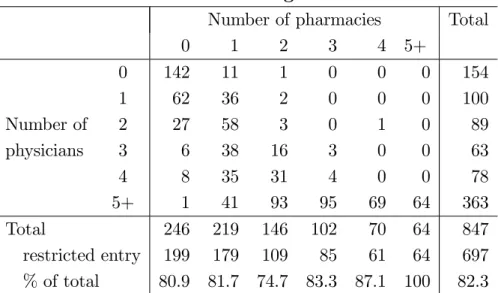
But in the presence of other types, they also capture the extent to which the beneficial effects of complementarity must be shared with an additional …rm. We therefore concentrate our discussion of Table 4 on the entry threshold ratios in the … first column (k = 0), which are interpreted to capture the competitive effect of entry. As Table 1 showed, the entry restrictions resulting from the law of establishment are binding in the majority of markets, so that most monopoly pharmacies are effectively protected from the threat of new entry.
As a final ...point, we discuss the entry threshold ratios in the second and third columns of Table 4, which refer to markets in which there are one or two ...rms of the other type.
Approach
If = 1, we obtain the status quo forecasts of the expected number of …rms under the current regime; if is arbitrarily large, we get the predictions when access becomes completely free. The calculation of the entry effects of the lowering of the pharmacies' regulated gross profit margin 1, which is currently set at 28%, usually requires information on the pharmacies' variable retail costs in addition to wholesale costs. First, variable benefits move proportionally with the number of consumers S; it seems natural to our professions that variable benefits per consumer are independent of the number of consumers.
With this additional structure, a reduction in the net variable comments 1 by a given factor 1 (between 1 and 0) to 1(1 + 1) can be modeled by adjusting the intercept 01 in the payo¤ specification (8) with the constant amount of. To obtain the reduction in the regulated gross mark-up corresponding to a net mark-up reduction by the factor 1, additional information on the variable retail costs other than wholesale costs is required. A reasonable starting point is to assume that the other variable retail costs are zero, so that 1 = 118.
The absolute reduction in gross regulated mark-ups is therefore simply 28% at the current gross mark-ups. As a robustness check, we will also consider the possibility that there are other variable retail costs, i.e. As a robustness check, we will use this formula to examine the possibility that other variable retail costs cause net variable markups to be 10% less than the regulated gross markup of 28%, i.e.
18 The most important other retail costs of pharmacies are labor costs and it makes sense to treat these as ...fixed, since the time spent on patient care is essentially ...fixed during working hours (as opposed to doctors who spend a variable amount of their time for patient care).
Findings
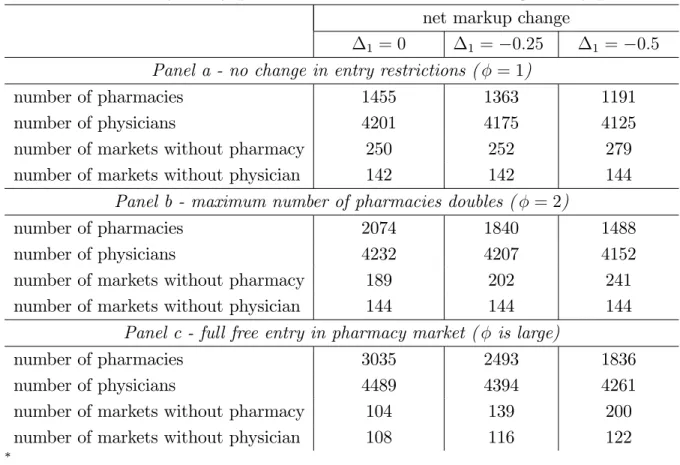
For example, the number of pharmacies increases from 1455 to 1836 when a 50% net markup discount is combined with full free access. In addition, the geographic coverage of these combined policies is not a concern: the total number of markets without a pharmacy is always declining. Even if a 50% net markup reduction is combined with partial entry liberalization, the number of markets without a pharmacy would drop from 250 to 241.
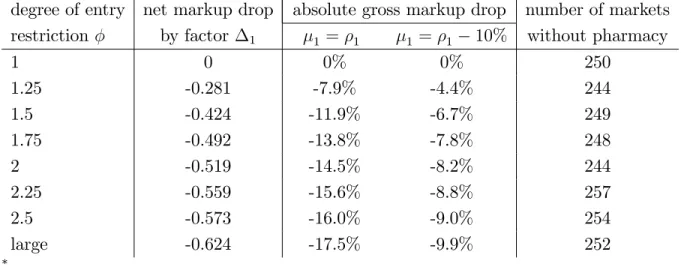
We ask how the access restrictions can be liberalized (through ) and the net markup can be reduced in such a way that the total number of pharmacies in the country remains constant at the current predicted level of 1454. We also calculate the associated reductions in absolute gross profits and the number of markets without a pharmacy. The ... first and second columns show the combinations of access restrictions and net markups so that the total number of pharmacies in the country remains constant.
As an illustration, increasing the maximum allowable number of pharmacies with requires net markups to decrease by 49:2%. As access restrictions are liberalised, net surcharges should generally decrease to keep the total number of pharmacies constant. If access were to become completely free, regulated gross surcharges could fall in absolute terms by between 9.9% and 17.5% without changing the total number of pharmacies.
The last column shows that the number of markets without any pharmacy remains essentially similar to the status quo level of 250.
Characterization of multiplicity of Nash equilibria
Strategic substitutes
When entry restrictions are binding, one can follow the same reasoning as under strategic complements to obtain the same probability of observing (n1; n2) as the unique subgame perfect equilibrium outcome, given by (6).