Rather frequently, these studies considered one of these activities as a determinant of the other. It is important to bear in mind that the dynamics of the relationship between innovation and internationalization can be complex. These studies differ both in the proxies used for innovation and in the characteristics of the samples of firms investigated (innovators, exporters...).
Recently, a number of firm-level (and plant-level) studies have resumed the investigation of the relationship between innovation and internationalization.
Preliminary evidence
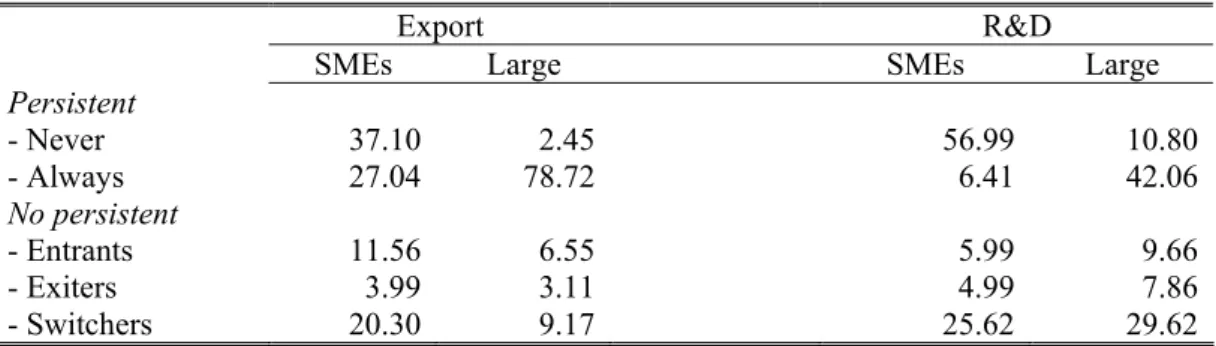
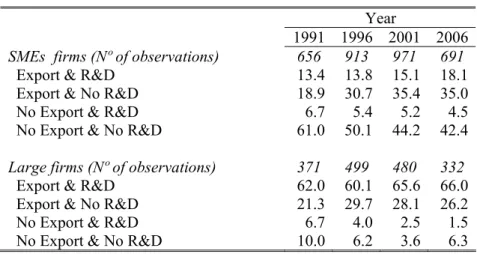
Some econometric methods used to analyze the dynamics of innovation and export behavior of firms require the use of a sample without missing data (gaps) over time for each firm. Furthermore, Table 2 reveals that large exporting firms are much more likely to innovate than not, by almost 40 percentage points. However, the overall picture hinders the dynamics of individual innovation and export behavior of firms over time.
For SMEs, this percentage is similar in both activities (around 64%), but the distribution between the two persistent states (never and always) is opposite to that of large companies.
Determinants of export market and innovation participation
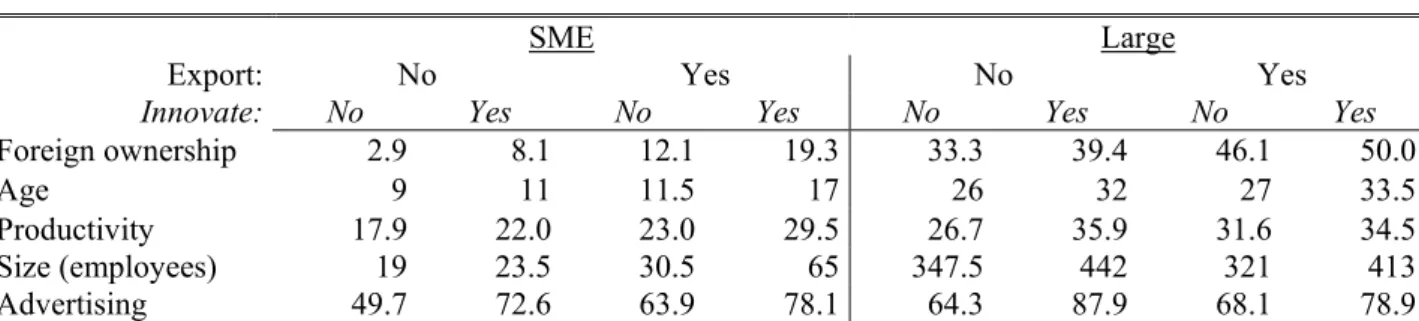
Some or even all of the persistence shown in the first row of the two panels of Table 6 may be due to heterogeneity. Interestingly, for the SME sub-sample, exporters/innovators are clearly more productive, larger and older than exporters/non-innovators and non-exporters/innovators. In summary, there appears to be a positive relationship between innovative activity and exporter status, although the direction of the relationship between the two activities is not evident from the above results.
The regression analysis examines whether, and to what extent, the observed persistence is due to underlying differences in individual characteristics or due to a true causal effect of past on future status of the two decisions.
Model specification and estimation
In random effects modeling, due to the correlation between the individual specific error and the initial conditions, treating these endogenous initial conditions as exogenous results in inconsistent estimates. In the first step, we need to add a reduced-form equation for the initial value of the latent variable y*i1, excluding the lagged dependent variable but including a set of exogenous instruments. Then, in a second step, maximum likelihood estimates of the entire model are produced.
Since both export status and innovation activity are highly serially correlated and their interdependence on the two decisions (since they are both dependent and explanatory variables in equation (1)), it is likely that the error terms of the two participation equations are correlated. To deal with this, we estimate the two participation decisions simultaneously by estimating a dynamic bivariate binary choice model. As in the univariate case, the same independent variables are used in the two participation equations, while (1, 2) is assumed to be bivariate normal with variances 21 and 22 and covariance.
Finally, error terms (u1t,u2t) are assumed to be bivariate standard normal with covariance and independent over time. The corresponding coefficient indicates whether innovative firms are more or less likely to be exporters. The explanatory variable of particular importance in the innovation equation is the delayed export status.
Second, if y2, 1t enter equation (4), but error terms and random effects in the fourth equation are independent of error terms and random effects in the fifth equation, then y2, 1t is weakly exogenous in the equation fory1t. In this paper, we estimate a dynamic bivariate probit model in which the two components of the error terms are pooled.
Results
Univariate results
The results of column 1 indicate that companies that innovated at t-1 have a 23.8% higher probability of exporting at t than non-innovators in the previous period, depending on the mean values of the other variables. The main difference between the two decisions concerns the effect of foreign ownership, which is not significant in the innovation decision. The results are quite similar to those in the previous column, except for the marginal effect of lagging productivity that loses its significance in the export decision.
Differences in productivity between companies are greater than within companies, which is probably the reason for the observed decrease in the productivity coefficient. This means that a high percentage of the unexplained variation in exports and innovation is attributed to the single effect, suggesting that it could explain a significant part of the persistence in both decisions. The partial effect of the lagged dependent variable is slightly reduced when adjustment for initial conditions is included.
In short, previous results indicate that the partial effect of the delayed dependent variable is large; In the reduced form for the initial period, we included a binary variable that takes on a value of one when the company belongs to a group. Carrying out innovative activities also has a positive effect on the predicted export probability, regardless of the previous export status, although the effect is relatively larger for non-exporters in t-1 (the predicted value increases from 30.3% to 42.7%) than for exporters (it rises from 93.2% to 96.6%).
It is worth noting that the increase in predicted probability with respect to the distribution of the permanent firm component is greater than that corresponding to state dependence for firms with similar characteristics and μi=0. This increase of 55.4 percentage points is smaller than the variation in the probability of innovation at t for a firm that moves to the right from the lower tail of the unobserved distribution (−2σ) to the upper tail (+2σ).

Bivariate results
That is, the probability of exporting (innovating) at t is higher when the firm innovated (exported) at t-1 than when it did not innovate (exported), regardless of export (innovation) status at t-1. For example, the probability of exporting to t when the firm innovated at t-1 is 16.8%, whereas this probability drops to 9.6% when the firm did not innovate at t-1. Finally, Panel C shows the average treatment effect of past export and innovation status on current export and innovation probabilities.
For example, the effect of exporting at t-1 for a non-exporter is an 83.8% increase in the probability of exporting at t. Similarly, if he had not exported, the reduction in the probability of exporting at t for an exporter at t-1 would have been 77.1%. The results of Table 10 reinforce the findings of strong effects of past behavior on current status and interdependence between the two decisions.
Alternative measures of internationalization and innovation
This correlation is particularly high for large firms: only about 10% of them exported but did not import, or vice versa, for certain years. The increase in the percentage of firms involved in both exports and imports is parallel to the decrease in the corresponding percentage of firms involved in neither exports nor imports. The percentage of switchers in imports varies between 13.7 and 28.9 for large firms and SMEs respectively, which exceeds the corresponding figures for exports at 4 and 8.
The difference is larger for large firms: 67.4% and 74.3% for exports and imports, respectively, suggesting that the substitution pattern corresponds to a more intensive import activity (relative to exports) for large firms (and in both cases more intensive than for SMEs) . This variable has been used quite often in the literature (see for example Aw et al., 2007). In this sense, Roper (1998) pointed out that large firms carry out frequent research activities that require a greater degree of formality (ie, laboratories) in which cost accounting may be simpler.
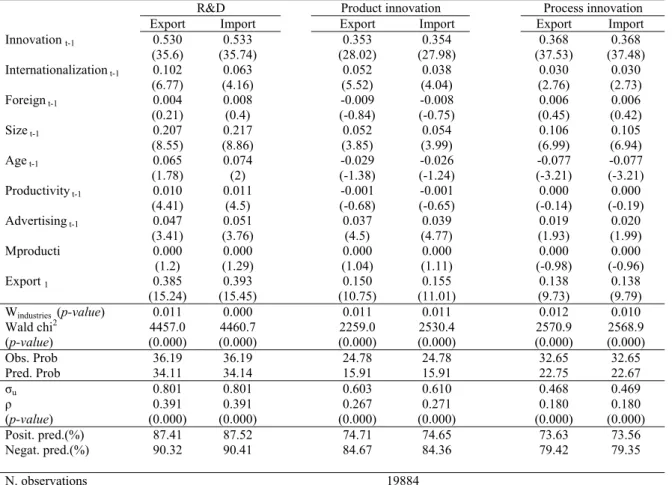
An open question remains whether alternative indicators can lead to different outcomes of the dynamic relationship between internationalization and innovation. The results obtained from estimating dynamic random effects probit models using Wooldridge (2005) for alternative measures of internationalization and innovation are presented in Table 11. The positive correlation between innovation and internization appears to be a strong result, regardless of the proxies of used to measure these activities.
Moreover, the effect of the explanatory variables is quantitatively quite similar in the export equation (panel A), while some differences arise in the innovation equation (panel B) when alternative proxies of acquisition and innovation are considered. This result provides support for the argument that R&D spending increases productivity, which is a key driver of the relationship between innovation and internationalization activities.
Conclusions
190/2004 Una aproximación al análisis de los costes de la esquizofrenia en España: Modelos jerárquicos bayesianos. 241/2006 Evaluación de la depreciación del capital humano por sector, ocupación ya lo largo del tiempo. 263/2006 Análisis de la presencia de mujeres en los consejos de administración de las mil mayores empresas españolas.
Ana Rosa Martínez-Cañete, Elena Márquez de la Cruz, Alfonso Palacio-Vera e Inés Pérez-Soba Aguilar. 290/2006 Producción de energía eléctrica en España: Análisis económico de la actividad tras la liberalización del sector eléctrico. 319/2007 El impacto del coste de oportunidad de la actividad emprendedora en la intención de los ciudadanos europeos de crear empresas.
342/2007 Análisis de las consecuencias de la decisión de diversificar: un contraste del marco teórico "Agencia-Ventmastership". 370/2008 El desarrollo de la sociedad de la información en España: un análisis por comunidades autónomas María Concepción García Jiménez y José Luis Gómez Barroso. 393/2008 Una visión cooperativa de las medidas frente a los posibles daños ambientales de la desalinización Borja Montaño Sanz.
406/2008 El papel de la orientación emprendedora y la orientación al mercado en el éxito de las empresas Óscar González-Benito, Javier González-Benito y Pablo A. 419/2008 Piedras en el camino de Bolonia: los efectos de la implantación del EEES en los resultados académicos. 425/2008 Medición del cambio de eficiencia y productividad de las empresas distribuidoras de energía eléctrica en el Perú después de las reformas.
446/2009 Comercio intra e interregional en el sector turístico en España Carlos Llano y Tamara de la Mata.