Nevertheless, the indicators presented and the resulting conclusions are the sole responsibility of the Ivie team. Taking into account the diverse perspectives and interests that potential users of the data have when using the rankings. The Spanish university system currently has 33 private universities3, representing 40% of the total.
Methodology
- ACTIVITIES STUDIED
- DISAGGREGATION OF ACTIVITIES
- INDICATORS, AREAS AND DIMENSIONS
- TIME COVERED BY THE DATA University rankings, though they aspire to offer an
- CRITERIA FOR THE
- Allocation of missing data
- Standardization of indicators One of the pillars upon which the construction of
- Weighting and aggregation of indicators within an area
- Weighting and aggregation of the area indicators within each dimension
- Weighting and aggregation of the dimensions to obtain the rankings
- RANKINGS OF VOLUME OF RESULTS VS. RANKINGS OF
- Interest of the two approaches The existing rankings adopt on occasions an
- Treatment of the size of universities
- PRIVATE UNIVERSITIES
The quality of research is reflected in the impact that publications have and the citations these articles generate. The basic process of compiling any composite university ranking is structured according to the following steps - the fifth step is unnecessary in the case of a partial one. This happens, for example, with the average impact of the index of posts and their share in the first quartile.
Weight and aggregation of the dimensions to obtain the ranking dimensions to obtain the ranking. Mondragón University publishes on its website the cut-off points for each of the degrees offered.
Rankings personalized by the user
EXAMPLES OF PERSONALIZED RANKINGS
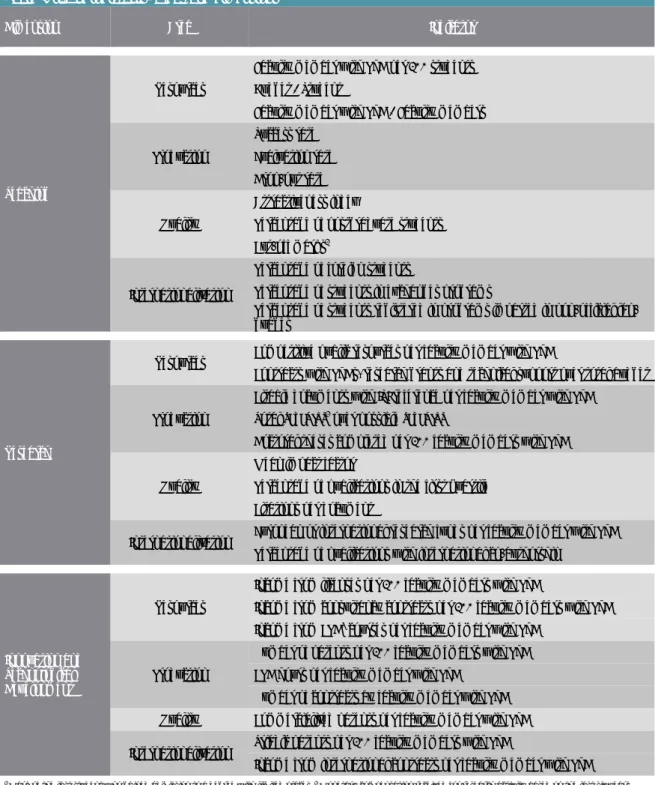
In this case, the student who wants to choose a degree must select the subject he/she wants to study, the type of course that interests him/her and the aspects that he/she considers most important (the education, subsequent employment opportunities). , research, etc.).
DESCRIPTION OF THE WEB TOOL FOR GENERATING PERSONALIZED
Based on these tests, the necessary corrections were made to the tool to better adapt it to the students and to make it easier to understand the results. Importance to users of teaching, research and technological innovation and development activities. The degree names displayed in the drop-down list are neither exhaustive nor verbatim, as those Bachelor degrees with very similar names are grouped together, such as
However, despite this initial reduction, the final results show the full degree title, as well as the center where it is taught in case there are different options. For this, the user needs to mark the selected ones in the table below, one of the options is "Any region". In this case, their interest will be to know which of the studies offered are best rated in the territories he/she is considering.
In any case, additional information is offered so that they can place their options in relation to the remaining offers from the Spanish university system. When you click on this button, the personal ranking corresponding to the introduced selection criteria will be displayed, showing in order the corresponding bachelor's degrees from the universities that offer these studies in the relevant fields. Along with the names of the bachelor's programmes, a link to each university's web address is displayed.
Then the cut-off value of the final year and the price of the credit at the time of first registration are indicated, information that is filled in when different centers of the university award the same degree, if it is offered in one center or there is any comment regarding the cost of the degree.
COMPLEMENTARY INFORMATION ON THE
In order to determine the size of the corresponding icons, a synthetic indicator13 was calculated for each of them based on the available data, which is generally by province. After arranging the universities in the order of these indices, a large icon is assigned to those located in the tertile with the highest value in the distribution (best climate, highest costs, greatest connectivity, most socio-cultural opportunities) and the same but smaller icon to universities those in the second tertile (between 33% and 66%); finally, those in the third tercile are marked with even smaller icons. It should be noted that three of the four environmental characteristics are more favorable the bigger the icon (climate, transport and socio-cultural opportunities), and the higher cost of living should be seen as less attractive.
As in the previous edition, the 2015 edition also includes the price per credit for over 2,700 bachelor's degrees analyzed by U-Ranking, based on information from the Spanish Ministry of Education, Culture and Sports. These prices, despite the maximum limit established by the Spanish Ministry, may vary depending on the autonomous community, the university, the cycle – bachelor, master, doctorate – the degree of experimental degree and the ownership of the center14 that offers that degree. 13 The synthetic indicators were constructed for those environmental variables with more than one indicator by first standardizing each indicator in terms of its distance (ratio) from the median and then applying a geometric mean to these indicators.
Next, each sample was divided into three sets bounded by the tertiles of each distribution to subsequently assign them to each group. For this reason, it can be considered relevant that the user of U-Ranking will be able to know the price per credit upon first registration for each bachelor's degree. Costs were also included for courses offered by private universities when this information was available on their websites.

Main results
- ISSUE RANKING OF PRODUCTIVITY (ISSUE-P)
- ISSUE RANKING OF VOLUME OF RESULTS (ISSUE-V)
- VOLUME RANKING VS
- ISSUE RANKING VS. SHANGHAI RANKING
- COMPARISON OF RESULTS OF OTHER INTERNATIONAL RANKINGS
- RESEARCH VS. TEACHING
- RANKINGS OF TEACHING, RESEARCH, AND INNOVATION AND
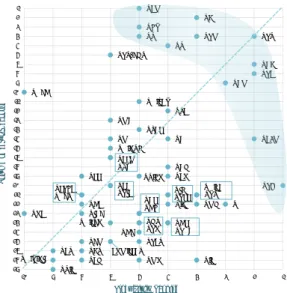
As in Table 6, each column contains one-third of Spanish universities according to their ranking order. The differences in the values of the indicators are much greater with the scale due to the importance of size. The first of them (Figure 5) represents the position of Spanish universities on the ISSUE-V scale on the horizontal axis, while the Shanghai scale represents it on the vertical axis.
The case of UNED stands out and occupies a clearly better position in the ISSUE-V rankings than in Shanghai. In contrast, the universities in area IV are relatively better placed when adapting the Shanghai Ranking to Spain. The remaining one is the Universitat Pompeu Fabra, located in the second tertile of the ISSUE-V Ranking.
The results correspond to our adaptation of the Shanghai scale carried out by Docampo (2014) for Spanish universities (‘Shanghai scale extended’). Of the universities that appear in Docamp's ranking, 14 private universities were excluded and are not analyzed in the ISSUE Ranking. In the middle of the diagram (Figure 7), eight universities are shown, which are located in the first tercile on three scales.
Given the total weight of public universities in the university system, this model applies to the average of the system. If we did, it could lead to biases in the analysis of the reality of the university system. In the case of public universities, on the other hand, in most cases the opposite happens.
Conclusions
Differences between universities in terms of the volume of results are much higher, as they are affected by productivity and different sizes of universities. The teaching specialization of private universities has its counterpart in a worse position in relation to the public system in terms of scientific research productivity: on average 40% less than the university system. The superiority of public universities in research orientation and productivity is therefore very clear, holding the first fourteen positions in the ranking.
The integration of private universities further softens the relationship between both dimensions and confirms the need to recognize the heterogeneity of the Spanish university system. Differences in the productivity level of universities can also be seen at the regional level. The evolution of the results of the university system compared to the 2014 edition can only be analyzed for public universities, as they were the only ones included in the previous edition.
The productivity rates of the public university system have remained constant, and the same is happening for most universities in terms of output. The role of the developed web tool is to provide students with quality and ranking information that is very easy to obtain. One general conclusion from the project's results is that it confirms a remarkable diversity among Spanish public universities in terms of their ability to generate results and their productivity.
The wide data set on the universities offered by U-Rankings allows us to outline very relevant features of the diversity of the Spanish university system and within each of the universities.
Glossary of Indicators
Competitive public resources per faculty member with PhD: Competitive public resources for non-targeted research projects, including both projects and complementary actions and ERDF funds, on the total number of faculty members with PhD equal to full-time. Citable ISI-referenced documents per faculty member with PhD: ISI-referenced documents published per 100 faculty members with PhD equivalent to full-time. CRUE 2008-2013 Branch of knowledge Total sexenios² about possible sexenios: Sexenios obtained about the total possible sexenios for.
Average Impact Factor: The average impact factor of publications with at least one author associated with. IUNE (Thom- . Son Reuters Bachelor's degree group Citations per paper: Citations received by each paper from date of publication to. Income from Continuing Professional Development (CPD) courses per PhD faculty member³: Fees received from CPD registration and for the university's own postgraduate programs (master's, specialist and professional) per teacher with a PhD.
Number of patents per 100 faculty members with PhD³: Number of national patents granted to each Spanish university by the Spanish Patent and Trademark Office per 100 faculty members with PhD. Triadic patents per 100 faculty members with PhDs: Number of simultaneous protections of inventions in different countries obtained through an international patent application, per 100 faculty members with PhDs. ³ The faculty members with doctoral degrees used to calculate the indicators of innovation and technological development are those in the following categories: professor, associate professor, associate professor, associate professor and assistant.
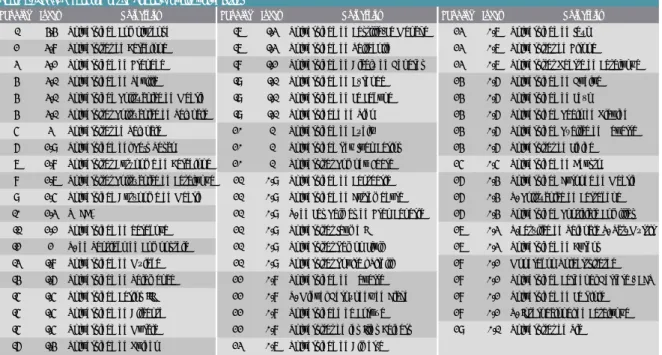
List of University Abbreviations
El efecto de la fusión de universidades españolas en el Ranking de Shanghai (ARWU): el caso de las comunidades autónomas y los campus de excelencia. Ranking de la producción investigadora de las universidades en función del prestigio multidimensional de campos influyentes: las universidades españolas como estudio de caso.