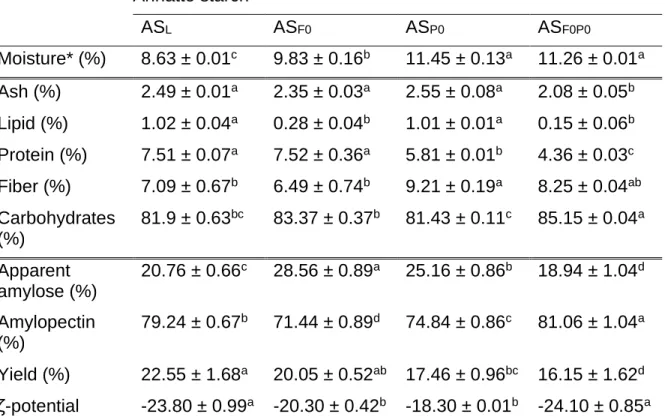
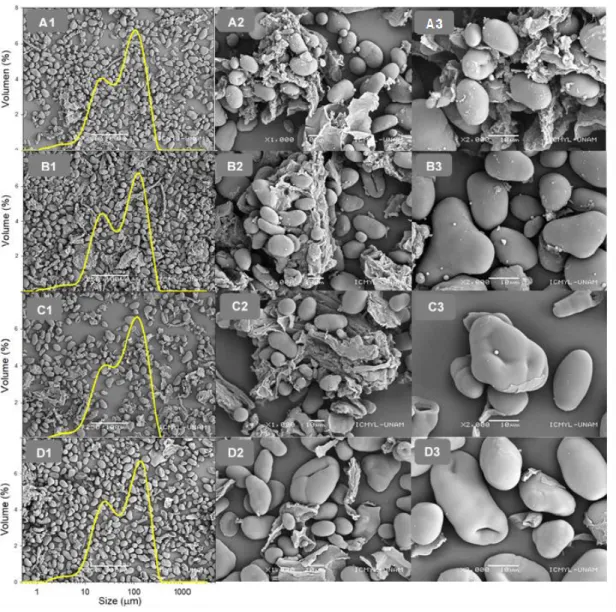
ASF0 Almidón de achiote a partir de harina desgrasada (pureza media) ASP0 Almidón de achiote a partir de harina desproteinizada (pureza media) ASF0P0 Almidón de achiote a partir de harina desgrasada y desproteinizada (pureza alta). En este trabajo estudiamos los efectos del grado de pureza del almidón de achiote (Bixa orellana L.) (AS) sobre sus propiedades fisicoquímicas, antioxidantes, microestructurales, funcionales y digestibles.
INTRODUCCIÓN GENERAL
- Objetivo general
- Objetivos específicos
- Hipótesis
- Capítulos de tesis
- Literatura citada
3 antioxidantes, microestructurales (microscopía electrónica de línea, FTIR, Determinar la composición química de las variantes de almidón obtenidas para verificar el grado de pureza alcanzado después de aplicar los procedimientos de purificación.
REVISIÓN DE LITERATURA
Achiote (Bixa orellana L.)
Producción mundial y nacional de semillas de achiote
Usos y propiedades del achiote
Se ha demostrado que las tinturas de la raíz y las hojas de achiote inhiben el crecimiento in vitro de cepas de Neisseria gonorrhoeae resistentes a la penicilina (Cáceres et al., 1995). La actividad antiespasmódica de las hojas de achiote se evaluó en íleon aislado de cobayas.
Composición de las semillas de achiote
Dentro de la fracción lipídica de las semillas de achiote, también se identificó una concentración considerable de δ-tocotrienol (mg 100 g-1 de semilla seca) y trazas de β-tocotrienol (Frega et al., 1998). Por otro lado, se ha identificado que ejercen un efecto osteoprotector y homeostático de la glucosa (Shen et al., 2018).

Extracción de pigmentos de semillas de achiote
Residuos vegetales de semillas de achiote
2018) caracterizaron la biomasa generada a partir de semillas de achiote sometidas a un proceso integrado de extracción de tocotrienol con fluido supercrítico y extracción de bixina con solventes de baja presión. Debido al interés en valorizar los residuos agroindustriales y tomando como referencia el alto contenido de carbohidratos característico de los residuos de semillas de achiote, se han reportado algunos trabajos de investigación enfocados en su aprovechamiento.
Almidón
- Métodos de extracción y purificación
- Características microestructurales
- Propiedades funcionales
- Propiedades térmicas
- Propiedades reológicas
- Digestibilidad
- Aplicaciones
Las cadenas de amilosa forman estas laminillas amorfas y tienen un grado de orden menor que la amilopectina (Waterschoot et al., 2015). Considerando un diámetro esférico equivalente promedio, los gránulos de almidón se pueden clasificar en muy pequeños (menos de 5 µm), pequeños (5 – 10 µm), medianos (10 – 25 µm) y grandes (tamaño mayor a 25 µm) (Lindeboom et al. . ., 2004). Se ha demostrado una concentración crítica de ≥1% de amilosa para la formación de una red de gel tridimensional (Richardson et al., 2000).
Este efecto permite una rápida hidratación del gránulo de almidón y, en consecuencia, una mayor hinchazón (Waterschoot et al., 2015). La calorimetría diferencial de barrido (DSC) determina el cambio de energía de un material y proporciona una medición cuantitativa de este cambio relacionado con las temperaturas de transición (inicio [T0], punto medio [Tp], terminación [Tc]) así como las entalpías de fusión (ΔH) ( Hoover et al., 2010). La reología estudia el flujo y la deformación de la materia durante el procesamiento y manipulación de alimentos (Bangar et al., 2021).
La fase continua corresponde a las moléculas de amilosa y amilopectina que se encuentran disueltas, mientras que la fase discontinua está formada por los gránulos de almidón restantes (Xie et al., 2012). Los almidones con alto contenido de amilosa tienen mayor capacidad gelificante y pueden ser utilizados en la producción de mermeladas, jaleas y jaleas (Bangar et al., 2021).

Literatura citada
Effect of corn starch type on the rheological properties of a white sauce after heating and freezing. Medina-Flores, D., Ulloa-Urizar, G., Camere-Colarossi, R., Caballero-García, S., Mayta-Tovalino, F., & del Valle-Mendoza, J. Antibacterial activity of Bixa orellana L. achiote) against Streptococcus mutans and Streptococcus. Efficacy of different oils used to extract anatto color from Bixa orellana L. seeds.
The effect of modified cashew starch as a fat substitute on the quality and quality characteristics of muffins. Effects of different isolation methods on physicochemical properties of pea starch and textural properties of vermicelli. Effect of modified sweet potato starch as a fat replacer on the quality of reduced-fat ice creams.
In vitro antioxidant and antibacterial activities of extracts from Annatto (Bixa orellana L.) leaves and seeds. Effect of annealing on the physicochemical properties of rice starch and the quality of rice noodles.
Achiote (Bixa orellana L.), una nueva fuente potencial de almidón
Abstract
Bixin and norbixin are extracted from annatto seeds and the remaining seed waste can be used as a potential source of annatto starch (AS), contributing to the circular economy of the regional communities where the resource is grown/processed. To assess the suitability of AS as a food ingredient, its physicochemical, antioxidant, microstructural and functional properties were evaluated after being purified by: soaking in sodium metabisulphite solution (low purity), degreasing for lipid removal (medium purity), alkaline protein extraction treatment (medium purity) and combined degreasing/alkaline treatments (high purity). AS showed a heterogeneous morphology with grains tending to agglomerate, and the average Sauter diameter ranged from 26.8 to 31.1 µm.
In vitro digestibility analysis showed that AS presented a higher slowly digestible starch fraction than rapidly digestible and resistant starch fractions. This paper shows that AS has suitable functional properties that open the possibility of its use in the food industry.
Introduction
37 the importance of investigating changes in starch associated with the presence or absence of native lipids and proteins is obvious. The wide applicability of starches in the food industry depends on their ability to change the viscoelastic, culinary and sensory properties of processed foods [15,16]. Some studies have shown that starches obtained from non-conventional sources have antioxidant activity, distinguishing them from conventional starches [7,17,18].
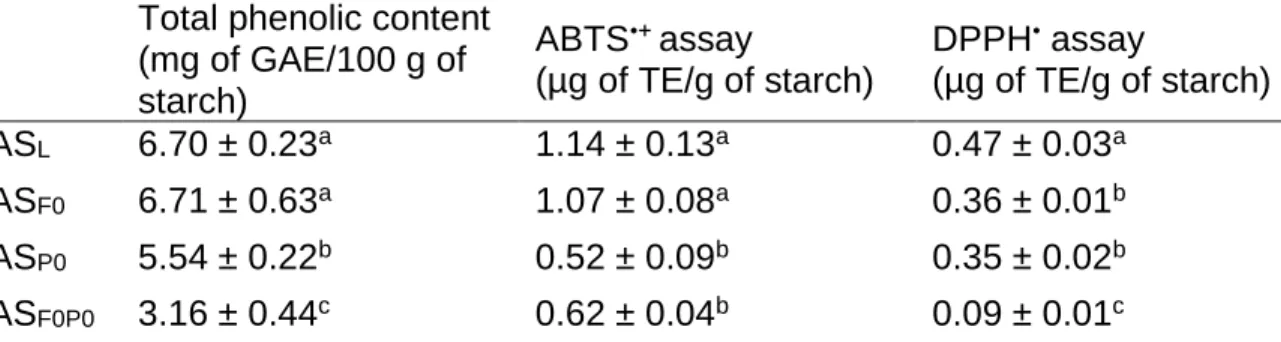
Therefore, it is important to identify whether the starch obtained from the seeds preserves phenolic compounds with antioxidant activity. Several works have focused on the morphological, thermal and pasting properties of annatto starch [7,8], but none on its functional properties (e.g. swelling power, solubility and absorbency) and in vitro digestibility. This study aimed to evaluate the physicochemical (particle size, rheology), phenolic content and antioxidant activity, microstructural (scanning electron microscopy, FTIR, XRD), functional properties (swelling, solubility, water and oil absorption) and the in vitro digestibility of annatto -starch, as affected by different purification methods.
It is hoped that this study can promote the use of annatto starch for specific applications in the food industry.
Material and methods
- Materials
- Starch extraction
- Proximal chemical composition
- ζ-potential
- Total phenolic content
- Antioxidant activity by ABTS •+ assay
- Antioxidant activity by DPPH • assay
- Scanning electron microscopy (SEM)
- Particle size distribution
- Fourier Transform Infrared (FTIR) spectroscopy
- X-ray diffraction (XRD)
- Gelatinized starch dispersions rheology
- GASD optical microscopy
- Swelling power and solubility index
- Water and oil absorption capacities
- In vitro digestibility
- Statistical analysis
The ABTS•+ assay was used to determine antioxidant activity (Garcia Silveira & Tapia-Blácido, 2018). A 30 µl portion of the methanolic extract was mixed with 3 µl ABTS+ radical, and after 6 min the absorbance was measured at 734 nm using a spectrophotometer. Antioxidant activity was expressed as µg Trolox equivalents (TE)/g starch (db), using a Trolox standard curve.
The absorbance of the remaining DPPH• was measured on a spectrophotometer at 517 nm (Hashemi & Jafarpour, 2020a, 2021b). The spectra of the samples were obtained on an infrared spectrometer (Cary 630, Agilent Technologies, Santa Clara, CA, USA) equipped with an attenuated total reflectance accessory. 32 scans per sample was integrated to obtain the mean values of the spectrum (Sukhija et al., 2016).
The relative crystallinity of the samples was calculated using Jade PRO software (version 7.2, Livermore, CA, USA). In vitro digestion of purified AS starch variants was performed according to the method of Englyst et al.
Results and discussion
- Yield and chemical composition
- ζ-potential
- Total phenolic content and antioxidant activity
- Morphology of starch granules
- Particle size distribution
- FTIR spectroscopy
- XRD analysis
- Rheological measurements
- Functional properties
- In vitro digestibility
Debris generation can be attributed to the dissolution of AS granules due to purification treatment (Punia et al., 2020). A similar trend was found for wheat starch treated with 0.25% NaOH, which showed a significant increase in the average granule, attributed to a partial gelatinization of the starch granule (S. Wang et al., 2014). The disagreements in the distribution pattern reported by these authors and by us may be due to the intensity of the treatments used in each case.
Other signals were present at 2925 cm-1 and 1412 cm-1, which could be attributed to asymmetric stretching and angular deformation of the C-H bond of the glucose ring (Dankar et al., 2018). They attributed the change to the internal structure, which was physically observed as a depression in the center of the starch granule. Defatting and deproteinization caused a decrease in the flow resistance of ASF0 and ASP0, which may be due to the breakdown of protein-starch and lipid-starch bonds, resulting in a more fragile structure (Ding et al., 2021).
The drop in the G' modulus corresponds to a breakdown of the three-dimensional gel structure with an alignment of the polymeric chains in the direction of the flow field (Alvarez-Ramirez et al., 2019). The swelling power (SP) and solubility index (SI) values provide information about the degree of interaction between the chains present in the crystalline and amorphous regions of the starch granule (S. Singh et al., 2010). As expected, AS subjected to deproteinization treatment presented a higher SP due to ionization of the hydroxyl groups that negatively charge the starch molecules (Karim et al., 2008).
Our results are consistent with studies on the in vitro digestion of rice starch subjected to defatting and deproteinization (Ye et al., 2018).
Conclusion
66 These results can be attributed to the access of the enzyme to limited substrate sites, such as removal of lipids and proteins, which allowed easier migration of pancreatic α-amylase into starch granules. Thus, susceptibility to hydrolysis by amylose and amylopectin digestive enzymes increased (Sui et al., 2017). The short branched chains of amylopectin are weak points in the crystal structure, resulting in increased sensitivity to hydrolysis, which increases the percentage of RDS (Ding et al., 2021; Lin et al., 2016).
Also, AS can be included in the preparation of bread to improve antioxidant properties and textural characteristics.
Acknowledgments
Conflict of interest
Data availability
Author contributions
CONCLUSIONES GENERALES
73 La capacidad de hinchamiento, el índice de solubilidad y la capacidad de absorción de agua y aceite mejoraron al reducir el contenido de lípidos y proteínas en el almidón. Los resultados obtenidos en este trabajo muestran que los residuos de semillas de achiote son aptos para la obtención de un almidón no convencional. Las características del almidón de achiote indican que puede incluirse en formulaciones alimentarias que requieran una alta capacidad de retención de agua y aceite, así como para mejorar sus características texturales y antioxidantes.
APÉNDICE
Artículo publicado