As noted in the Global Compendium of National Educational Technology Agencies, there are important examples to consider in the Latin American region (Plan Ceibal in Uruguay is usually cited as a positive example), but overall the focus has been much more on infrastructure than on transformation the role of education in the 21st century (Trucano & Dykes, 2017). Innovations in the region must be supported by cutting-edge scientific research to develop evidence-based guidelines.
WHAT’S NEW ABOUT ‘FAKE NEWS’? CRITICAL DIGITAL LITERACIES IN AN ERA OF FAKE NEWS, POST-TRUTH AND CLICKBAIT
- Platforms produce and rely upon network effects
- Platforms work as a framing device
- Users can modify and manipulate the structure of the platform to suit their needs
- Platforms ensure every user's experience of the platform is different
- Platform architecture facilitates frictionless sharing of digital content
- Platforms depend on data extraction and monetisation
- User input on platforms results in an increase in value of that information to the user
- Identify the changing nature of news reading practices
- Knowledge of platform architecture
- Understand digital platforms as part of broader social and technical networks It is also important to build an understanding of how digital platforms fit into a broader
- Identify and critique the ideologies implicit to digital platforms
- Explore how affect circulates and condenses across digital platforms
In considering the complex features of digital platforms, the sophisticated nature of Macedonian teenagers' digital literacy is evident. These require sophisticated digital knowledge due to the ambiguity of the architecture behind digital platforms.
WIKIPEDIA EDUCATION PROGRAM IN HIGHER EDUCATION SETTINGS: ACTIONS AND LESSONS LEARNED
FROM FOUR SPECIFIC CASES IN MEXICO AND ARGENTINA
- Project at the School of Architecture (UBA)
- Wikilesa project at University Level
- Wikipedia in Language and Hispanic Literature Studies
- Chemistry and molecular biology with the use of Wikipedia
Since Wikipedia is in any case a central part in the two lines of inquiry, this article aims to identify the lessons learned and challenges of certain specific initiatives of the Wikipedia education programs in both contexts. In the research discussed below, we examine some evidence of the benefits of getting students actively involved in the tasks of editing and improving Wikipedia articles. These cases were selected based on the following criteria: they are recent, successful and represent milestones in the work with higher education institutions.
With this project, both teachers and students created a new way of acting and being in the classroom. In another example, #Wikilesa, students and university teachers became aware of the need to write and evaluate the restoration of historical memory. The four cases described are milestones in the relationship between local Wikimedia affiliates and higher education institutions.
In both contexts (Argentina and Mexico) in the university culture, the teacher is the leader of the classroom. This could be a fruitful experience between the chapters and also in connection with the Iberocoop initiative.
THE STUDENT-TEACHER RELATIONSHIP IN THE ONE-TO-ONE COMPUTING CLASSROOM
Classroom Dynamics
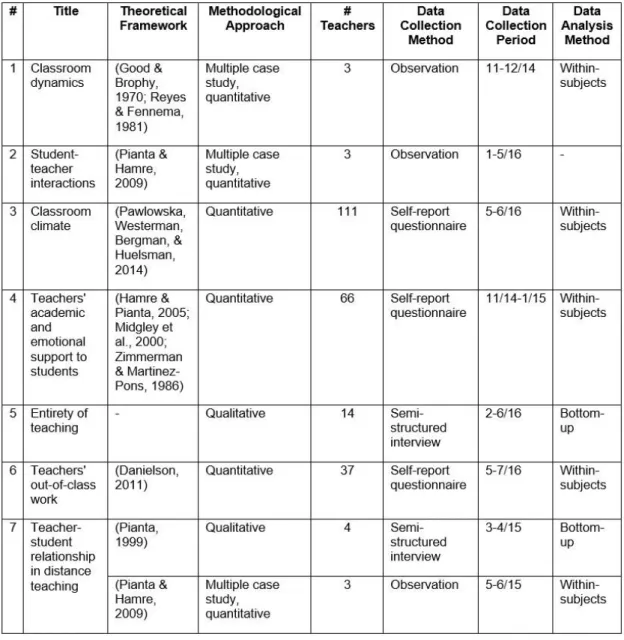
The main purpose of this study was to analyze classroom dynamics—specifically, teaching strategy, teacher placement, and teacher-student interactions—in the one-to-one classroom. We developed a mobile app for data collection that allowed us to easily record fine-grained data in the field and have it ready for analysis when the observation was over. Based on these, we defined an observation protocol for coding any interaction between the teacher and a student or group of students in the context of the technology-enriched classroom.
The observer was located in the back of the classroom, from where he could view the entire class. Participants were three female 5th and 6th grade English teachers in a Druze village in northern Israel, and their students. Interestingly, each of the teachers had significantly changed the way they handled 1:1 lessons compared to traditional lessons, but these changes manifested themselves in different ways.
In general, the teachers spent most of the class time at their desks and whiteboards. AM had suggested far fewer response opportunities and more non-public interactions in the 1:1 lessons compared to the traditional lessons (the latter being consistent with her being physically closer to more students during 1:1 activities compared to traditional lessons , as mentioned above ), while RI shows an opposite pattern, indicating more response opportunities and fewer non-public interactions during 1:1 lessons compared to traditional lessons.

Teacher-Student Interactions
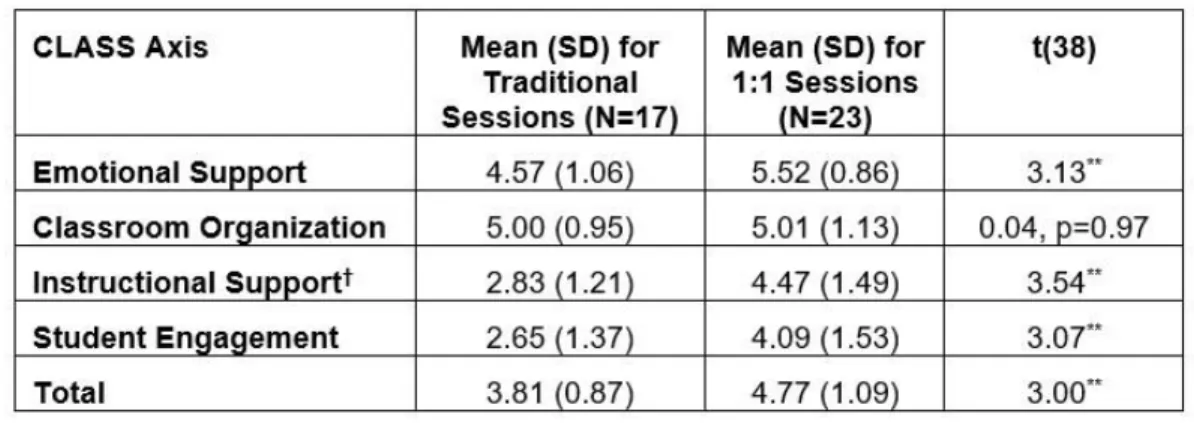
This means that emotional support, learning support and student engagement were higher in 1:1 sessions compared to traditional ones. The first two dimensions related to support are related to the very definitions of the teacher-student relationship (Ang, 2005; Pianta, 1992), and the third is related to the teacher-student relationship (Roorda et al., 2011). Findings from this study suggest that during 1:1 sessions, learning was more student-centered and the overall teacher-student relationship was more positive than during traditional sessions.

Classroom Climate
One of the components of the CES (student competition) was found to be unreliable (testing using Cronbach's alpha), therefore it was removed from the analysis. Of the remaining components, when we compared 1:1 with traditional lessons, we found that participatory learning and classroom engagement were significantly higher in 1:1 lessons, with medium-high effect sizes, and that no differences were found in structure and focus and in instructor support. As the findings from this study suggest, most teachers in schools that implemented 1:1 computer programs used computers frequently and extensively, however, they did not necessarily promote meaningful learning using computers.
Participatory learning and classroom engagement were reported as higher in the 1:1 lessons, and structure and focus were reported higher for teachers who used computers most often.
Teachers' Academic and Emotional Support to Students
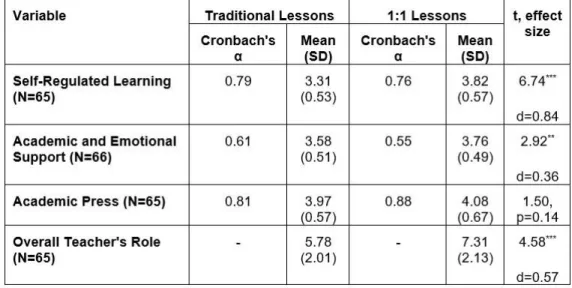
Finally, we measured the teachers' perception of academic pressure, i.e. how they pressure their students to understand. Academic Press scale of the student version of the Patterns of Adaptive Learning Scales (PALS, Midgley et al. [2000]), with 7 items; Examples: “I encourage my students to do thoughtful work When my students are working on a problem, I tell them to keep thinking until they really understand”. Data were collected during November 2014–January 2015 via both pen-and-pencil and computer-completed self-report questionnaires.
The research questionnaire was designed so that first the participant selected a subject that she or he is teaching, and then each item was listed twice - in relation to 1:1 lessons and traditional lessons on the subject. Therefore, we compare the values of the variables of the lessons 1:1 with traditional lessons (for the same subject taught). Findings suggest that participating teachers rated their own academic and emotional support and their students' self-regulated learning significantly higher in 1:1 instruction compared to traditional instruction, with high effect sizes and medium.
34;guide on the side" axis in 1:1 lessons compared to traditional lessons with a medium-high effect size. One-to-one lessons facilitated student-centered learning compared to traditional lessons, including better academic and emotional support.
Entirety of Teaching
1:1 lessons present fewer discipline problems than traditional lessons; . this is the result of: a) enforcing the non-use of computers during class discussions; and b) Screens that captivate children when used. Overall, the narrative identified in this study is one that characterizes 1:1 lessons as catalysts for enjoyable, engaging, and active learner-centered activities that allow the teacher to successfully interact with students—more so than traditional lessons.
Teachers' Out-of-Class Work
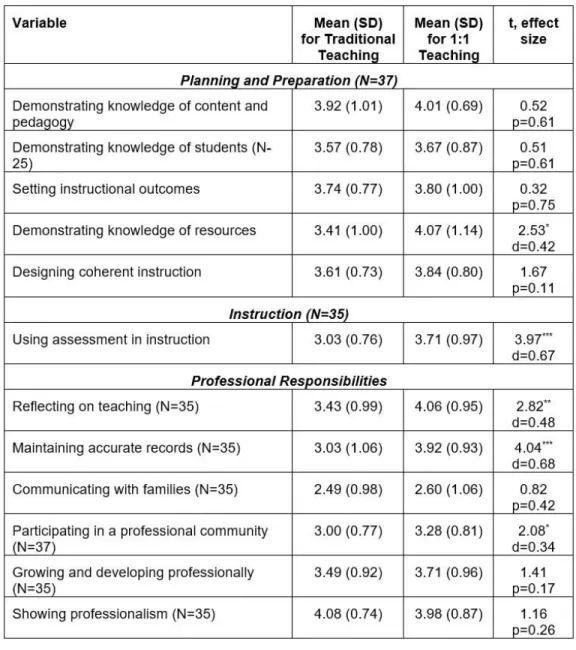
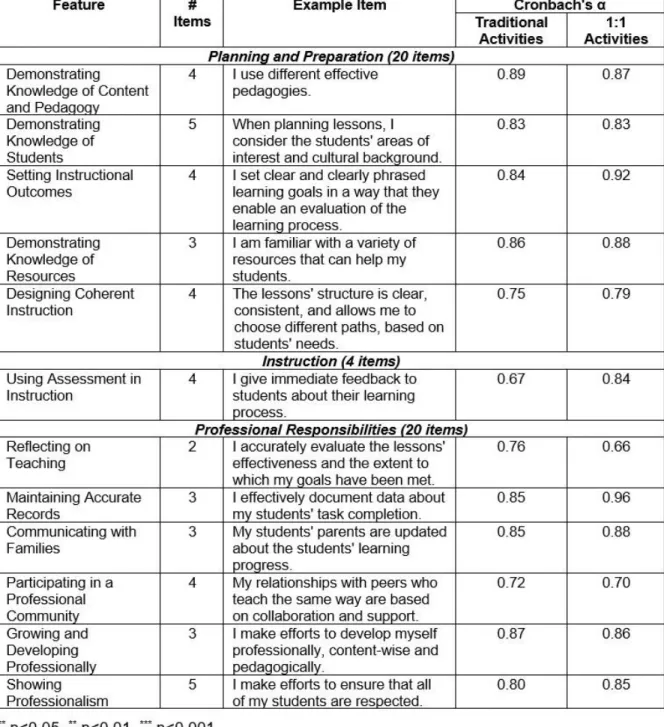
The participants were teachers who taught in traditional settings and 1:1 settings in the 2015/6 school year; First, they were asked to consider both teaching settings and then to rank each item twice – against 1:1 lessons and traditional lessons. In the domain of planning and preparation, the demonstration of resource knowledge was found to be significantly higher in 1:1 instruction than in traditional instruction, with medium to high effect sizes. Other characteristics—regarding teachers' knowledge of teaching and their students—did not differ between the two learning environments.
The only characteristic of the teaching domain, namely the use of assessment in teaching, was found to be significantly higher in 1:1 teaching than in traditional teaching, with a high effect size. For professional responsibilities, use of assessment in teaching, maintenance of accurate records, and participation in the professional community were found to be significantly higher in 1:1 teaching than in traditional teaching, with large effect sizes. This means that differences were found in the ways in which teachers manage their teaching and participate in the professional community; no differences were found in the way teachers communicate with students' families and in their general professionalism.
Findings from this study indicate that in relation to 1:1 teaching, compared to traditional teaching, teachers see themselves benefiting from a wealth of resources, but do not prepare themselves differently for classes; they also benefit from having more ways to assess their students. They manage their teaching better, and develop better professionally, mostly in the community-related sense.
Teacher-Student Relationship in Distance Teaching
This paper presents six studies of the impact of one-to-one computer programs on various aspects of teaching closely related to teacher-student relationships. A first possible answer to that question may have to do with the stage of implementation of the one-to-one programs examined. Nevertheless, the improvement in teacher-pupil relations – mediated by the change in teaching – is not only a by-product of the introduction of one-to-one computer programs to schools.
Some of the studies reported here were (fully or partially) funded by the European Commission's Marie Curie Career Integration Grant (CIG) 618511/ARTIAC. Teacher-student interactions as predicted by teaching stress and the perceived quality of the student-teacher relationship. Development and validation of the teacher-student relationship inventory using exploratory and confirmatory factor analysis.
One-to-One Computing: Summary of Quantitative Results of the Berkshire Wireless Learning Initiative. When technology meets beliefs: Beginning teachers' perceptions of the teacher's role in the computer-based classroom. In the second phase of the project, we conducted case studies in seven virtual communities selected from the first sample.
Below are descriptions of the virtual communities in which the case studies were conducted.
LA PRIMERA EDTECH WINTER SCHOOL
APORTES METODOLÓGICOS PARA UNA INCLUSIÓN DIGITAL CON SENTIDO PEDAGÓGICO ASCENDENTE
La segunda parte profundiza en las características y principios del PM, a partir de la exploración de las principales líneas desarrolladas por Pangrazio (2016). Muchos de ellos se han centrado en el alcance cuantitativo de la oferta de equipos tecnológicos tras una huella visible en otras regiones (Cuban, 2009). A través de las discusiones grupales de la EdTech Winter School, se asumió este diagnóstico de los procesos de innovación en la escuela desde el rol de formadores de docentes e investigadores.
De manera general y regional, la investigación no suele formar parte de la formación inicial docente. Ante este escenario problemático, la metodología de la provocación busca interpelar al docente como investigador. En lugar de descartar las prácticas cotidianas y los conocimientos teórico-metodológicos de los docentes, MP nos permite partir de ellos para emprender un proceso de reflexión sobre la práctica docente y las formas de producir conocimientos de la cultura digital que la cuestionan en el presente.
Reflexionar sobre los aportes de la MP a la práctica y la investigación educativa permite repensar el rol docente en las aulas y en las propuestas formativas actuales. La articulación de la LP con los problemas inherentes a las tradiciones de reforma educativa y formación docente en Argentina y Uruguay abre una nueva puerta de investigación metodológica.
![Table 2. Average time [sec] for each learning configuration in traditional and 1:1 classes](https://thumb-us.123doks.com/thumbv2/123dok_es/12364452.0/49.918.166.745.144.658/table-average-time-sec-learning-configuration-traditional-classes.webp)