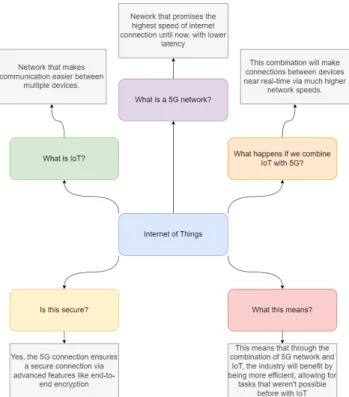
The success of IoT services on 5G networks depends on the ability of these networks to effectively manage interference. By implementing interference management techniques and optimizing network performance, businesses can take full advantage of the benefits of 5G networks and IoT services. Several studies have also investigated the impact of interference on the energy consumption of IoT devices connected to 5G networks.
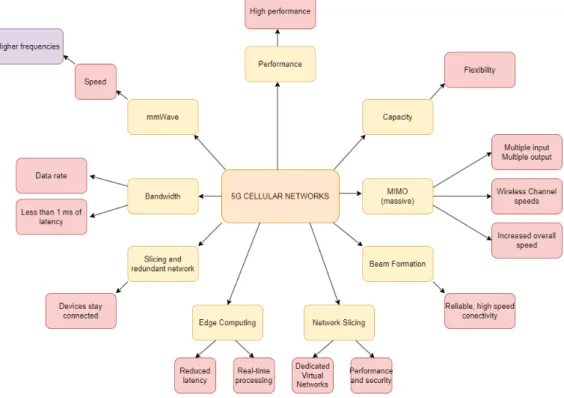
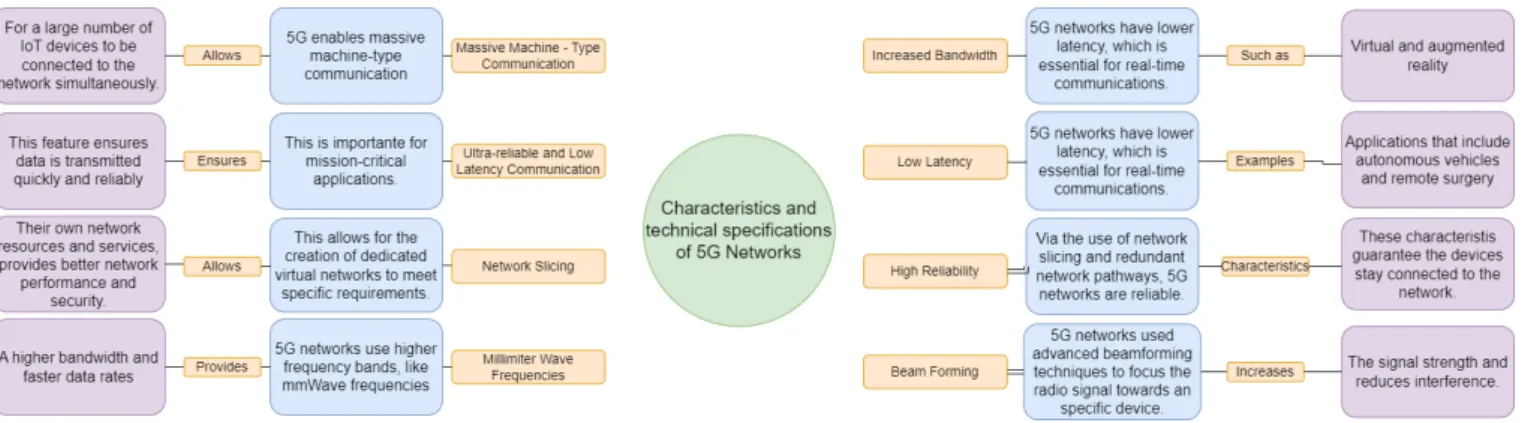
The study recommended the use of interference management techniques such as energy-efficient channel allocation and scheduling to reduce interference and improve the energy efficiency of IoT devices in 5G networks. Figure 4 summarizes this section, where the main concepts related to the impact of 5G networks on IoT services are observed. Low latency is another characteristic of 5G networks that is important for applications that require real-time communication and response, such as autonomous vehicles and remote operations.
The combination of these technologies in 5G networks can enable a wide range of applications, from IoT services to high-bandwidth applications, such as virtual reality and augmented reality. The implementation of 5G networks is expected to have a significant impact on the evolution of IoT services. Another important change brought about by the implementation of 5G networks is the increased scalability of IoT services.
This can be particularly useful for applications, such as smart homes, where multiple IoT devices need to communicate with each other in real time. 5G networks and IoT sensors can provide the necessary bandwidth and low latency for this type of application. 5G networks have lower latency, which can be a problem for certain IoT applications that require real-time response.
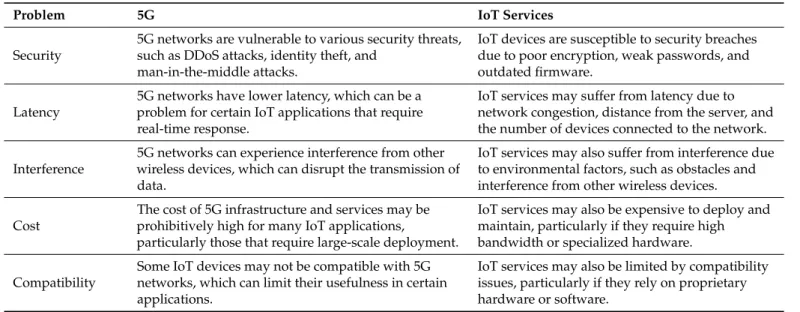
However, the coexistence of 5G networks and IoT applications also presents several challenges, such as security, interference, compatibility and cost [35]. The interference in 5G networks can cause delays or interruptions in the transfer of data between IoT devices and the cloud-based systems they rely on. Table4 outlines some of the main types of interference that can affect 5G networks and the IoT.
This delay can be especially problematic for real-time applications, such as gaming or videoconferencing. This can be especially problematic in areas with high device density, such as urban environments. Device-to-device networks are one of the candidates to shape the future of 5G networks.
With 5G, IoT devices can connect to the cloud more efficiently, and each device can use all of the cloud's resources, such as storage and processing power.
Results and Discussions
The emergence of 5G networks and Internet of Things services has ushered in a new era of connectivity and transformation in various industries. The convergence of 5G networks and IoT services is expected to revolutionize the way devices communicate with each other and the Internet. In this section, we will critically discuss the interrelated impact of network and service convergence between 5G networks and IoT services.
One of the key benefits of the convergence of 5G networks and IoT services is the ability to support massive machine-to-machine communication. The integration of 5G networks with IoT devices creates a seamless connection, enabling devices to communicate with each other and the Internet at high speed and low latency. Another impact of the convergence of 5G networks and IoT services is the creation of new business models and revenue streams.
However, the convergence of 5G networks and IoT services also brings some challenges that need to be addressed. Furthermore, the convergence of 5G networks and IoT services requires significant investments in infrastructure and technology. The convergence of 5G networks and IoT services has the potential to revolutionize the way devices communicate with each other and with the internet.
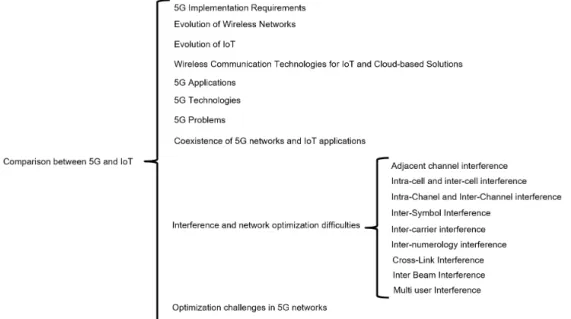
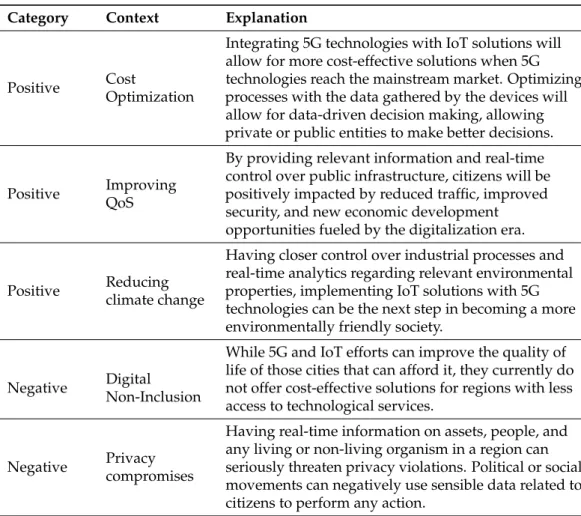
Therefore, service providers and device manufacturers must work together to address these challenges and ensure that the convergence of 5G networks and IoT services leads to a safer, more efficient and connected world. One of the main challenges of 5G networks regarding interference, IoT devices and network optimization is the high demand for wireless connectivity and data transmission. The design of low-power wireless communication protocols and efficient resource allocation techniques is necessary to optimize the performance of IoT devices in 5G networks.
The Interoperability column lists the key interoperability issues that need to be addressed to ensure that different 5G networks and IoT devices can work together seamlessly, for example standardization, integration with existing systems, compatibility with different technologies and interoperability between networks. slices. One of the critical responses to interference in 5G networks is to use advanced signal processing techniques to mitigate the effects of interference. For example, beamforming and advanced receiver algorithms can help reduce interference on 5G networks.
Conclusions
Computing, caching and communication at the edge: the foundation for building a versatile 5G ecosystem. IEEE Commun. Research on the development of 5G technology, standards and infrastructure related to communication between vehicles and everything via the Internet of Vehicles. IEEE Access. In Proceedings of the 2021 5th International Conference on Computational Methodology and Communication (ICCMC), Erode, India, 8–10 April 2021; IEEE: Piscataway, NJ, USA, 2021; p.
In Proceedings of the 2020 International Conference on Advances in Computing, Communication & Materials (ICACCM), Dehradun, India, August 21-22, 2020; IEEE: Piscataway, NJ, USA, 2020; pp. Low-pass filter-based integrated 5G smartphone antenna for sub-6 GHz and mm wave bands.IEEE Trans. Cellular, Large-Scale, and Non-Terrestrial IoT: A Survey of the Advances of 5G and the Road to 6G.IEEE Commun.
Cooperative fog computing for handling big data in the Internet of Vehicles: Architecture and hierarchical resource management.IEEE Commun. Joint beamforming and power allocation for satellite-ground integrated networks with nonorthogonal multiple access.IEEE J. A method for optimized deployment of unmanned aerial vehicles for maximum coverage and minimum interference in cellular networks.IEEE Trans.
In Proceedings of the 2022 Workshop on Benchmarking Cyber-Physical Systems and Internet of Things (CPS-IoTBench), Milan, Italy, 3–6 May 2022; IEEE: Piscataway, NJ, USA, 2022; pp. In Proceedings of the 2018 IEEE 9th annual information technology, electronics and mobile communication conference (IEMCON), Vancouver, BC, Canada, 1–3 November 2018; IEEE: Piscataway, NJ, USA, 2018; p. 5G slice-enabled scalable SDN core network: Toward an ultra-low latency of autonomous driving service.IEEE J.
In the course of the 2022 2nd International Conference on Emerging Smart Technologies and Applications (eSmarTA), Ibb, Yemen, 25-26. October 2022; IEEE: Piscataway, NJ, USA, 2022; pp. Accurate performance evaluation of time-hopping and direct-sequence UWB systems in multi-user interference.IEEE Trans. In conjunction with the 2020 3rd International Conference on Intelligent Sustainable Systems (ICISS), Thoothukudi, India, 3-5 December 2020; IEEE: Piscataway, NJ, USA, 2020;.