A Little Caribbean in Madrid:
analysis of the Dominican identity in the public space
Alba Arias Álvarez
According to the field of sociolinguistics of globalization, migrants resettle in new countries through deterritorialization and reterritori- alization processes, which entail changes in the perception of the language and symbols of the homeland and those of the communi- ties that migrants establish themselves in. Given that this contextual relation is expressed in the public space, the present study analyzes how Dominican resources are used in the linguistic and semiotic landscape of Tetuán, a well-known Dominican neighborhood of Madrid. Using both quantitative and qualitative methodologies, results show both the presence of the Dominican Spanish as well as Dominican symbols in the public space. Findings suggest that the Dominican community in Madrid has adapted their new place to make it more similar to their homeland, the Dominican Republic, reterritorializing the linguistic and semiotic landscape of Tetuán while building and shaping new identities. This study contributes to the body of research on linguistic landscape and linguistic attitudes in multilingual settings.
Keywords: linguistic landscape, minority voices, Dominican diaspo- ra in Madrid, transnational communities, sociolinguistics of global- ization.
Un Pequeño Caribe en Madrid: análisis de la identidad dominicana en el espacio público. Según la sociolingüística de la globalización, los migrantes se establecen en nuevos países mediante procesos de dete- rritorialización y reterritorialización, los cuales conllevan cambios en la percepción del idioma y los símbolos de la tierra natal, así como de las comunidades donde se establecen. Dado que esta relación con- textual se refleja en el espacio público, este estudio examina cómo se emplean los recursos dominicanos en el paisaje lingüístico y semió- tico de Tetuán, un reconocido barrio dominicano en Madrid. Al uti- lizar metodologías tanto cuantitativas como cualitativas, los resulta- dos revelan la presencia tanto del español dominicano como de sím-
bolos dominicanos en el espacio público. Los hallazgos sugieren que 105
106
la comunidad dominicana en Madrid ha adaptado su nuevo entorno para que se asemeje más a su tierra natal, la República Dominicana, reterritorializando el paisaje lingüístico y semiótico de Tetuán a la vez que construye y da forma a nuevas identidades. Este estudio aporta al cuerpo de investigación sobre el paisaje lingüístico y las actitudes lingüísticas en entornos multilingües.
Palabras clave: paisaje lingüístico, voces minoritarias, diáspora dominicana en Madrid, comunidades transnacionales, sociolingüísti- ca de la globalización.
1. Introduction
The term diaspora refers to displacement and dispersion practices in which individuals get settled in a different place and create a new imag- ined community (Anderson 1991) far from their original home, reinforc- ing “the symbolic bonds with their native land, to which diasporic groups pledge their allegiance” (Gubitosi, Puma and Narváez 2020: 214).
Recent diaspora research has revealed that migrant, transnational communities get established in the new country through deterritorial- ization and reterritorialization processes (Rosa 2015) which imply a reinterpretation of the ties between the linguistic variety(es) spoken in the new home and those of the diaspora group (Gubitosi, Puma and Narváez 2020). This contextual relation can be negotiated in the public space, where identity, language, and culture interweave (Blackwood et al.2016). The linguistic landscape, as will be explained in the following section, implies “the symbolic construction of the public space”
(Shohami 2015) where individuals, especially migrants, struggle to sur- vive or disappear as a group in the new ideologized world in which they settle. Furthermore, Vertovec (2007: 1024) proposed that this global immigration settle and get transnationally connected in superdiverse areas where individuals have different origins, traditions, cultures and backgrounds. Consequently, diaspora groups are complex, layered, and dynamic; and they express difference instead of similarity (Canagarajah and Silberstein 2012).
One example of a multicultural and multidiverse city is the capital of Spain, Madrid. The present study focuses on the Tetuán neighborhood, which in July 2021 had a total of 158, 574 inhabitants and 31,692 immi- grants (19.99% of its total population) (Ayuntamiento de Madrid 2021).
Tetuán was chosen given that it is one of the Madrid neighborhoods with a larger Dominican population (1944 inhabitants), along with Puente de Vallecas and Villaverde (Ayuntamiento de Madrid 2021).
Lengua y migración / Language and Migration15:1 (2023), 105-131 https://doi.org/10.37536/LYM.15.2.2023.xxxx / Edición en línea: ISSN 2660-7166
© Universidad de Alcalá
This paper examines the linguistic and semiotic landscape of the Dominican community in Tetuán, Madrid, where Dominicans share space with other immigrant groups, such as Philippines, Ecuatorians, Paraguayans, and Venezuelans. This study is part of an interdisciplinary project called INMIGRA3-CM. Its mission is to analyze the linguistic, communicative, cultural, and social aspects that play a role in the inte- gration process of migrant communities in the Community of Madrid.
Therefore, the goal of the present paper is to analyze the perception that Dominicans have on the way their identity is represented in the public sphere of the Madrid diaspora and to analyze how Dominicans build their transnational identities by using the public sphere to represent their allegiances to Spain and the Dominican Republic. Consequently, this study aims to contribute to the body of research on diaspora and multicultural communities.
In the section that follows, we discuss the sociolinguistic situation of the Dominican diaspora in Madrid.
2. Dominicans in Madrid: sociolinguistic context
In recent decades, the population in Madrid has multiplied through the influx of immigrants from different countries of Eastern Europe, Africa, Asia and, mainly, Latin America. In fact, almost half of the Madrid immigrant population has Latin American origin, among the conse- quences of which is the emergence of linguistic innovations in the Spanish language spoken in Madrid (Molina Martos 2010)
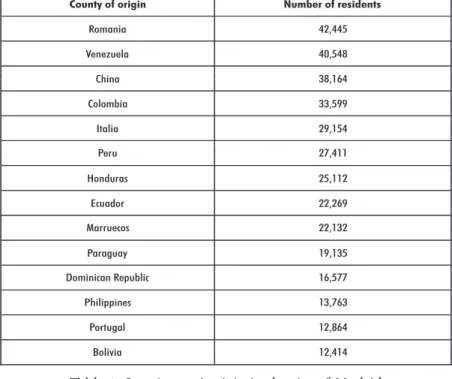
As of July 2021, the city of Madrid had a total of 3,304, 343 inhabi- tants, from which 511,067 are immigrants, a 15,43% of the total popu- lation. As seen in Table 1, the main provenances are Romania, Venezuela and China; the Dominican Republic comes in eleventh place with a total of 16,577 Dominicans (Ayuntamiento de Madrid 2021).
107
Table 1. Immigrants’ origin in the city of Madrid.
One of the neighborhoods where Dominicans have settled is Tetuán, which previous scholars have referred to it as Pequeño Caribe (Sáez Rivera 2015: 178) or “epicenter of Dominican activity” (Dixon 2021:
81). As of July 2021, there were a total of 1,944 Dominicans living in Tetuán (Ayuntamiento de Madrid 2021), as seen in Table 2:
Table 2. Madrid neighborhoods with the largest Dominican population
County of origin Number of residents
Romania 42,445
Venezuela 40,548
China 38,164
Colombia 33,599
Italia 29,154
Peru 27,411
Honduras 25,112
Ecuador 22,269
Marruecos 22,132
Paraguay 19,135
Dominican Republic 16,577
Philippines 13,763
Portugal 12,864
Bolivia 12,414
Madrid’s neighborhoods Number of Dominican inhabitants
Puente de Vallecas 2,098
Villaverde 1,993
Tetuán 1,944
Carabanchel 1,513
Latina 1,463
Ciudad Lineal 1,425
Usera 1,165
108
Lengua y migración / Language and Migration15:1 (2023), 105-131 https://doi.org/10.37536/LYM.15.2.2023.xxxx / Edición en línea: ISSN 2660-7166
© Universidad de Alcalá
Given its large Dominican population, the Pequeño Caribe is an example of the Dominican vitality as a collective in the diaspora. As Sáez de Rivera states (2015: 178):
The strength of the Dominican collective in Madrid leaves an impor- tant mark in various ways on the Linguistic Landscape of Madrid, especially in the areas of greatest concentration such as the “Little Caribbean” of the Tetuán district, and is an example of the mainte- nance of its own variety and its ethnolinguistic vitality as a collective (translation made by the author).
Along those lines, an article from a national newspaper declares (La Razón 2006): “They call it «the little Caribbean», «the Dominican Manhattan in Madrid», and they say that if you come from the island and don’t go through the neighborhood you can say you’ve been to the cap- ital” (translation made by the author). In line with those statements, while doing ethnographic observations in Little Caribbean, the researcher was able to hear salsa and other Dominican rhythms, to observe Dominican flags in stores and other establishments, to find groups of male Domicans socializing outside barbershops, and to recog- nize the sale of Dominican products. By entering Little Caribbean, one feels that some parts of the Dominican Republic have been transported.
Dominican Spanish is also heard in the streets of this neighborhood which, in contrast to normative Peninsular and Latin American Spanish varieties, exhibits phonetic and morpho-syntactic features such as wea- kening of /s/ in coda position, lenition of /n/, neutralization of liquids, double negation, preverbal subject pronouns in interrogative sentences, and increased use of overt pronouns. Dominican Spanish is also charac- terized by lexical items that pertain to body parts, food items, clothing, or body parts. Some examples include chivo‘goat’, and chinola‘passion fruit’, and traditional Dominican dishes, such as chimi and locrio (Suárez Büdenbender 2010; Dixon 2021).
However, although Dominican Spanish is heard throughout and is visible in the public space (Saez de Rivera 2015), this Spanish variety is stigmatized not only in Madrid, but also in the rest of the Spanish speaking world. Previous research has shown that a) this vernacular variety is frequently undervalued; b) Dominican Spanish speakers themselves believe that it is less “correct” than other varieties of Spanish spoken both in Latin America and Spain (Toribio 2000, Suárez Büdenbender 2010), giving rise to linguistic insecurity (Demirci and Kleiner 2002); and c) Dominican Spanish is disparaged in Madrid class- rooms (Martín Rojo 2003: 76). In fact, as Martín Rojo states (2003),
seseo and Dominican lexical items are considered “incorrected” by 109
Madrilian teachers. Salient features, such as seseo in this case, mark a specific language variety, and when they are associated with communi- ties of lower prestige, it leads to teaching correction and the stigmatiza- tion of its use. Dominicans, then, suffer from linguistic discrimination since their variety does not have overt prestige, in contrast to the castel- lano-norteña variety.
3. Linguistic landscape in Multiculturalcommunities
In multilingual settings, the analysis of the linguistic landscape (hence- forth LL) has an essential role in analyzing identities, attitudes and per- ceptions (Gubitosi and Ramos Pellicia 2021), and
exposing the struggles of minoritized groups within globalized and superdiverse cities (Vertovec 2007).
Since the initial work by Landry and Bourhnis (1997), the LL has evolved and expanded, becoming an important and well-known soci- olinguistics field. Currently, the LL not only refers to written signage, but to the symbolic construction of the public sphere (Shohami 2015).
The LL, then, is a crucial tool to examine the complex reality of sym- bolic and linguistic display in the public sphere (Gubitosi and Ramos Pellicia 2021).
The analysis of the public sphere reveals the dynamic negotiation between inhabitants of a multicultural, globalized setting, where its inhabitants, through space and time, are always in movement (Gubitosi and Ramos Pellicia 2021). In this view, Lado (2011) states that the pres- ence of languages in the LL unveils the possible ideological conflicts that happen within a specific community. We believe that not only lan- guages but also symbols reflect those struggles, since the LL not only examines the geography of a space, as will be detailed in the next sec- tion. It also includes its politics, history, culture, and the relationships of its inhabitants (Shohamy and Waksman 2009). Consequently, the LL provides a better interpretation of the data and allows for contestation of homogeneity, since LL research “provides a deeper realization of the current diverse and superdiverse societies and their unique feature”
(Shohamy 2017: 62).
This multilingual and multicultural context explains, then, the pres- ence of translanguaging practices, not only in the inhabitants’ discourse but also in the public sphere. We understand translanguaging as “new language practices that make visible the complexity of language exchanges among people with different histories” (García and Li Wei
110
Lengua y migración / Language and Migration15:1 (2023), 105-131 https://doi.org/10.37536/LYM.15.2.2023.xxxx / Edición en línea: ISSN 2660-7166
© Universidad de Alcalá
2014: 21). Bi-/multilingual speakers do not “switch” between languages.
Instead, they use all their linguistic material as one semiotic repertoire (Arias Álvarez and Gubitosi 2021, Arias Álvarez and Bernardo- Hinesley 2023).
3.1. Language ideologies and semiotic landscape
The LL of a specific community can be only fully understood if it is studied in its multilayered complexity (Blommaert 2013). Social space is
“always, and simultaneously, both a field of action (...) and a basis of action” (2013: 191), it is the sphere where people, objects, signs, and symbols relate and intertwine. This idea is related to the principle of dialogicality, which, according to Scollon and Scollon (2003: 205), “all signs operate in aggregate”, that is to say, “there is a double indexicali- ty with respect to the meaning attached to the sign by its placement and its interaction with other signs”.
Many scholars have stated the importance of analyzing people’s per- ceptions and attitudes towards the LL of their communities with the goal of understanding the heterogeneous and complex facts of LL (Blommaert 2010; Arias Álvarez and Gubitosi 2021; among others). In view of this, not only people’s opinions need to be contemplated, but also their language ideologies, which, according to Kroskrity (2000: 5)
“is the offspring of a union of two neglected forces: the linguistic
‘awareness’ of speakers and the (nonreferential) functions of language.”
Language ideologies are crucial to better understand how individuals build meaning in the public sphere, why they use some language vari- eties and reject others, and how they choose specific symbols over oth- ers (Arias Álvarez and Gubitosi 2021). They are essential “to under- standing people’s perceptions of their own surroundings as the linguis- tic landscape is not neutral” (Arias Álvarez and Gubitosi 2021: 9).
Language ideologies, then, affect public discourses (Hill 2008).
As for Madrid, we believe that language ideologies as well as other ideologies that interweave, such as social, power, or political ideologies, affect how LL is understood and perceived by Dominicans and how those perceptions also affect the display of languages and identity sym- bols to contest the LL. Following Shohamy (2015: 168), “the term ‘lan- guage’ needs to be expanded to all these other devices which take place in the ‘practiced’, ‘conceived’ and ‘lived’ spaces”. In this view, the pres- ent paper analyzes ideologies regarding the use of Dominican Spanish and its presence in the public sphere.
Following Jaworski and Thurlow (2010), semiotic landscapes are discursively constructed, and they represent and reflect values of differ-
ent types: social, political or cultural. Communication is much more 111
than languages; it also involves semiotic and rhetoric resources that are also present in the public sphere (Canagarajah 2013). Following Pennycook (2007: 269), the LL:
allows for an understanding of how different trajectories of people, semiotic resources and objects meet at particular moments and places, and this helps us to see the importance of things, the conse- quences of the body and the significance of place alongside the meanings of linguistic resources.
We believe that this statement is important to the current analysis, since the Dominican symbols displayed in the public sphere are crucial in the construction of meaning and identity among Dominicans in the diaspora. Dominican symbols, such as the Dominican flag and its colors (blue stands for liberty, white for salvation and red for the blood of heroes), as well as the coat of arms, convey a semiotic assemblage in the public sphere that provides significance to the LL of Madrid (Pennycook 2019).
3.2. The Dominican Linguistic Landscape in Madrid
Among the research that examines the LL in Madrid, one of the pioneer studies is that of Saéz Rivera and Castillo Lluch (2012), who analyze multilingual or multi-dialect fixed signs under the theoretical frame- work of the LL sociolinguistic theory and migration linguistics.
Findings show that, besides Spanish, the most frequent languages are Chinese and English. The authors state that in some immigrant neigh- borhoods, “a great density of non-Spanish LL is found across several blocks like a dense web and (social) network from which it would not be easy for the inhabitants living there to “escape” or in which outsiders may not be particularly welcome” (2012: 322). Examples of those “spi- der webs” are Little Caribbean, in Cuatro Caminos (Tetuán);
Chinatown, in Usera; and the multiethnic neighborhood of Lavapies, with populations from Africa, India and China.
Given the vitality of Dominican Spanish in the city as well as the vitality of Dominicans as a group, in a posterior study, Sáez de Rivera (2015) analyzes Dominican Spanish and its visibility in the Little Caribbean LL, neighborhood under analysis in the present research.
Dominican signage is examined considering the phonetic, morpho-syn- tactic and lexical levels. Findings reveal cases of “seseo”, the archaichic structure “los días + día de la semana” (Kany 1970: 74) as, for example,
“los días lunes” or dominican lexical items such as chimiand locrio, in Dominican establishments. The author also finds English signage used
112
Lengua y migración / Language and Migration15:1 (2023), 105-131 https://doi.org/10.37536/LYM.15.2.2023.xxxx / Edición en línea: ISSN 2660-7166
© Universidad de Alcalá
when showing a store schedule or to describe hairstyles in Dominican hairdressers and barber shops. Sáez de Rivera also recalls the Ecuadorian community living in Madrid (the largest immigrant group) and, consequently, the presence of Dominican-Ecuadorian signage in the public sphere, especially in restaurants. As Landry and Bourhis (1997: 23), the LL “may serve important informational and symbolic functions as a marker of the relative power and status of the linguistic communities inhabiting the territory [...].”
Previous studies, then, have analyzed the presence of Dominican Spanish in the public space of Tetuán. The present paper, however, aims to fill a gap in the prior literature by examining the linguistic attitudes and perceptions of the presence of Dominican Spanish as well as the Dominican symbols that convey Dominicaness in the Little Caribbean neighborhood of Madrid.
4. Goal and Research Questions
This research aims to contribute to the ongoing discussion on the role of linguistic and semiotic landscape in diasporic settings. Given that
“identity acts affect the public arena, and how people perceive them will have an effect on their attitudes and actions” (Arias Álvarez and Gubitosi 2021: 18), this study analyzes the presence and significance of the Dominican Spanish variety and Dominican symbols in the Madrid LL, as well as the factors that condition them. Special emphasis is put on better understanding how Dominicans build their transnational identities by using the public sphere to represent their allegiances to Spain and the Dominican Republic. Furthermore, it examines the per- ception that Dominicans have of the way their language and identity are represented in the public sphere of Madrid. Consequently, the research questions are 1) What is the nature of the Dominican signs in the Madrid LL?; 2) How is the Dominican identity expressed through the LL?; 3) What are the perceptions towards the presence of Dominican symbols in the Madrid LL?, and 4) What are the linguistic attitudes towards the use of the Dominican Spanish variety?
5. Methodology
This section details the methodology used to analyze the degree of vis- ibility of the Dominican Spanish variety in the Madrid LL and how
Dominicans living in Madrid perceive their linguistic landscape, specif- 113
ically the perception and attitudes towards Dominican Spanish and Dominican symbols encoded in this public space. Consequently, this research was conducted in two stages. The first phase documented the Madrid LL, where pictures were taken using an Iphone XS, in May and June 2022. The second stage involved the creation of a survey distrib- uted amongst Dominicans living in Madrid.
5.1. First stage. Dominican linguistic and semiotic landscape
With regards to data collection, the first consideration was to decide the geographic perimeter of analysis. The two questions raised were: What is the most relevant focal geographical area?, and how to choose it?
(Gubitosi, Puma and Narváez 2020). Huebner (2006: 32) highlights the importance of considering a specific neighborhood as a survey area, given that, in his research focused on Bangkok, he finds “separate and identifiable neighborhoods each with its own linguistic culture”.
Similarly, in their study on the Ecuadorian LL in New York, Gubitosi, Puma and Narváez (2020) focus on Queens given the high population number of Latin American people since the 1960s. Likewise, we identi- fied the Little Carribeanof Tetuán as our area of study given the pres- ence of numerous Dominican inhabitants, as well as the high Dominican signage in this Latino/Caribbean neighborhood (Saéz Rivera and Castillo Lluch 2012; Saéz Rivera 2015).
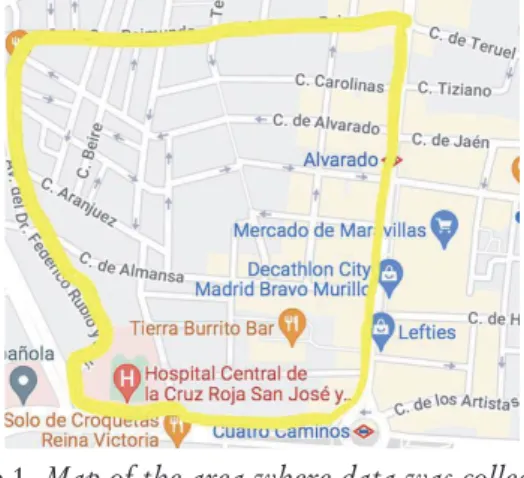
The data examined, then, comprises signs located on the Little Caribbeanneighborhood, as illustrated in Figure 1 below. This area includes the well-known Dominican streets of Alvarado, Almansa, and Tenerife.
Figure 1. Map of the area where data was collected.
114
Lengua y migración / Language and Migration15:1 (2023), 105-131 https://doi.org/10.37536/LYM.15.2.2023.xxxx / Edición en línea: ISSN 2660-7166
© Universidad de Alcalá
The present study follows the methodology established by Cenoz and Gorter (2006), meaning our approach includes pictures of all fixed signage found on the street. Moving texts, such as the signage found on taxis, buses, or the subway, were not included in this study, since the focus was on the signage placed by individuals and private businesses, such as restaurants and stores. Handwritten signs and graffiti, written or painted, were also added to the analysis. Therefore, all signage included in the analysis belong to the bottom-up domain (Ben-Rafael et al.2006).
Furthermore, signs were analyzed as monolingual and bilingual, which included instances of translanguaging, which, according to García and Li Wei (2014: 21), “make visible the complexity of language exchanges among people with different histories”. It is important to highlight that in our analysis, we focused exclusively on Dominican Spanish signs that exhibited linguistic elements distinct from those found in Peninsular Spanish varieties. As a result, this study does not encompass signs that display shared linguistic features with various Spanish varieties.
Given the complexity of assemblages of semiotic resources that con- stitute the LL (Machin and Mayr 2012), the visual grammar was also examined, such as the colors employed on the signs, or the typography used.
The corpus consists of a total of 267 button-up signs located in Little Caribbean, a Tetuán neighborhood characterized by a high Dominican population, alongside Dominican signage in its LL (Sáez de Rivera 2015). Only fixed signage (Cenoz and Gorter 2006) of the bottom-up domain (Ben-Rafael et al.2006), that is, signage established by commer- cial businesses and the community, were included in the analysis. Signs are monolingual or bi-/multilingual (translanguaging practices) (García and Li Wei 2014) and can include visual grammar.
5.2. Second stage. Online Survey: Perceptions and Attitudes Towards the Use of Dominican
Symbols
After examining the semiotic landscape of the Little Carribbean in Madrid, and with the secondary goal of analyzing the perception towards the use of Dominican linguistic and semiotic resources in the Madrid LL, an anonymous survey was designed and created through Responster. This online survey tool has been optimal in previous stud- ies that analyze perceptions and attitudes in the LL (Arias Álvarez and
Gubitosi 2021). Participants were recruited via snowball sampling, and 115
the survey was administered through social media such as Facebook, Instagram and Whatsapp. Participants were able to complete it in less than five minutes.
The first two questions of the survey allowed us to identify the members of the Dominican Diaspora living in Madrid. The first ques- tion was Do you consider yourself Dominican?, and the second one was Do you live in Madrid? Only if participants answered yes to both ques- tions, data was included in our analysis. Afterwards, the survey includ- ed questions to gather demographic information about participants such as gender identity, place of birth, generation, and age (less than 18 years old, 18-25, 26-40, 41-65 and 66 years and above). Lastly, partici- pants were shown some of the signs collected from the Madrid LL that included the Dominican flag and other symbols and visual materials related to the Dominican identity. Figures 2 and 3 show the question Why do you think that the Dominican flag appears in stores, restaurants and bars?. Participants had to choose among the following possible options: “for touristic reasons”, “to seem more local and welcoming”,
“to reinforce our identity”, or “it does not make any sense”.
Figures 2 and 3. Perception Survey Questions.
Besides three follow-up questions that required participants to give a reason for the previous inquiry, and an inquiry about participants’
place of residence, the survey did not include any other questions that instructed participants to write their answers. Questions asked for either a “thumbs up” or “thumbs down” to indicate a yes or no answer or for an answer that was part of a list of predetermined responses.
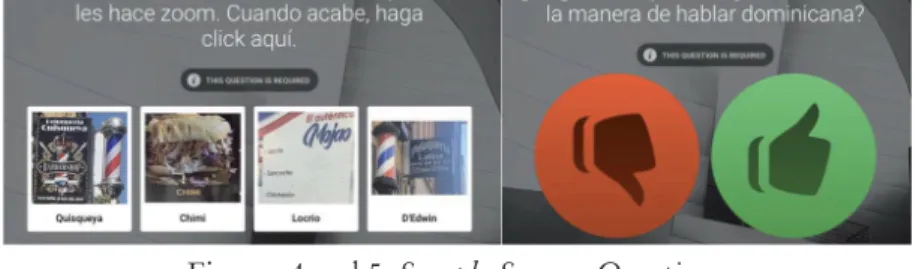
Figures 4 and 5 show a survey question in which participants, after see- ing some images of the presence of Dominican Spanish in the Madrid public space, have to answer the question, Would you like your children to continue talking as Dominicans do?
116
Lengua y migración / Language and Migration15:1 (2023), 105-131 https://doi.org/10.37536/LYM.15.2.2023.xxxx / Edición en línea: ISSN 2660-7166
© Universidad de Alcalá
Figures 4 and 5. Sample Survey Questions.
5.2.1. Participants
A total of 62 participants completed the survey. However, after discard- ing participants who do not have a sense of being Dominican and/or live outside Madrid, only data regarding 53 participants were included in the analysis. As for gender, 45.2% (=24) are men and 54.7% (=29) are women. Table 3 illustrates the age range of the study participants.
Table 3. Participant Age Range.
6. Discussion of Results
The discussion of the results is divided into two sections. The first one documents the Little CaribbeanLL and the second one reports findings concerning Dominican inhabitants’ responses related to perceptions of the presence of Dominican linguistic and semiotic resources in the Madrid LL, as well as the linguistic attitudes towards the use of Dominican Spanish.
6.1. Dominican Linguistic and Semiotic Landscape
As soon as someone enters the Little Caribbean neighborhood, one feels like they are in the Dominican Republic. Merengue, bachata and salsa are musical rhythms that one can hear in the streets of this ethnic area of Madrid. Dominican food products are for sale in the corner
Age Range Percentage Respondents
18 to 25 years old 11.3% 6
26 to 40 years old 37.7% 20
41 to 65 years old 50.9% 27
66 years old and above 0% 0
117 Alba Arias Álvarez
shops; Dominican brands such as President beer are advertised; restau- rants offer Dominican/Caribbean food; hairdressers promote Dominican hairstyles; businesses that maintain close ties between Madrid and the Caribbean, such as shipping companies and locutorios (phone booths), are frequent throughout the neighborhood. All those establishments reveal how the Dominican community in Tetuán has reterritorialized this space and made it very similar to the space of their home country: the Dominican Republic.
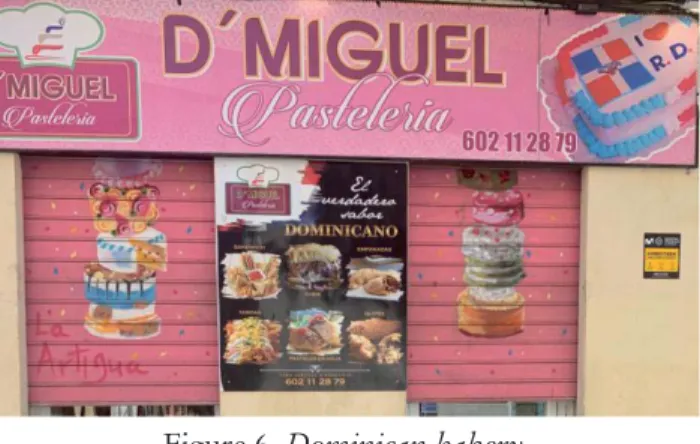
Figure 6 is an example of a bakery that sells Dominican pastries such as yaroas, chimis and quipes. The front store sign says “D’ Miguel”.
According to Sáez Rivera (2015) the number of restaurants and estab- lishments that use the Italian construction D’ in the Little Caribbean is very frequent, not only before vowel (the expected result) but before consonant (as Figure 6 shows). The Dominican flag is also present in the signage of this establishment. It appears on the picture of the cake on the sign above the store’s entrance, along with “I [heart] R.D.”. The flag’s colors (blue, red, and white) are also displayed inside the chef’s hat, on the left of the sign.
Figure 6. Dominican bakery.
The Dominican flag is, in fact, very often displayed as a semiotic resource in the public sphere of this neighborhood. It can appear incor- porated into the design of products, as Figure 6, hung in balconies, or displayed in stores like in Figure 7, where the flag appears in a clothing repair store, around a manikin. These results might suggest that, for members of the Dominican community, the Dominican flag is a symbol of their identity and their sense of kinship. Results from the following section, where perception data from Dominican residents in Madrid are analyzed, will be crucial to verify this hypothesis. Figure 8 shows a sign outside of a shipping and moving company specializing in trips to the
A
118
A Little Caribbeanin Madrid: analysis of the Dominican identity in the public space
Lengua y migración / Language and Migration15:1 (2023), 105-131 https://doi.org/10.37536/LYM.15.2.2023.xxxx / Edición en línea: ISSN 2660-7166
© Universidad de Alcalá
Dominican Republic, in which the flag appears within the outline of the Dominican Republic’s borders/territory. Figure 9 shows a restaurant in Topete street. The main sign says Restaurante Aroma Latino ‘Latin Aroma Restaurant’ accompanied by the Dominican flag in the corner.
This restaurant has secondary signs with the menu and pictures of Dominican dishes. As Figure 6, the Italian initial construction D’is also present in D’Charles. All those semiotic and linguistic resources rein- force the symbolic ties with the Dominican Republic, the motherland, to which the diasporic group living in Madrid pledge their loyalty.
Figures 7, 8 and 9. Dominican flag as a semiotic resource in Little Caribbean.
Hairdressers and barber shops that offer Caribbean products and hairstyles are frequently found in this neighborhood. Figure 10 shows an example of an establishment that sells hair extensions and wigs. In the main storefront sign, we can read Pelo Indio‘Indian hair’, which, in the Dominican Republic, refers to natural hair. The adjective indio
‘Indian’ alludes to the Afro-descendant heritage of many Dominicans.
This is supported by the results of a recent survey carried out in the Dominican Republic, which shows that 45% of Dominicans consider themselves Indian, 18% as white, 16% as brown, 9% as mulatto, and 8% as negro (UNFPA 2022). The main storefront sign includes the map of the Dominican Republic filled with the Dominican flag and it refers to the buyers of this store as Latino and Africans.
119 Alba Arias Álvarez
Figure 10. Dominican Hairdresser.
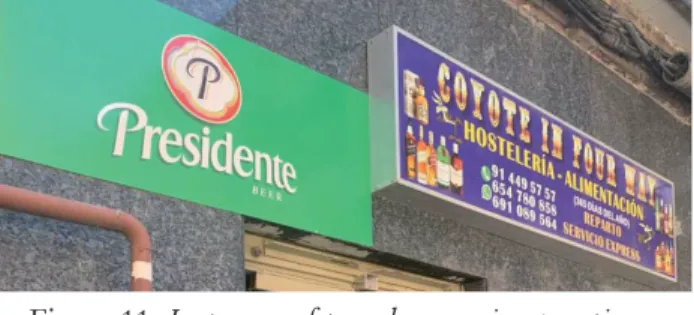
Figure 11 presents an example of translanguaging, a very common strategy in multilingual communities. It shows a food store named Coyote in four way, “four way” being a literal English translation of
‘Cuatro Caminos’, the neighborhood in which Little Caribbean is located. Underneath, it states in Spanish that it is a food establishment, hostelería-alimentación ‘hospitality-food’, with delivery options. The sign to the left advertises a well-known Dominican beer called Presidente, made by the primary beer producer in the Dominican Republic: Cervecería Nacional Dominicana ‘National Dominican Brewery’.
Figure 11. Instances of translanguaging practices.
Besides English, and in addition to the use of Dominican semiotic elements to build the LL, Dominican Spanish and regionalisms are also present in the public sphere, especially in restaurants and food stores (Sáez Rivera 2015), to attract the Dominican community and reinforce the idea of territorializing the Little Caribbeanas their new home com- munity. Figure 9 presented secondary signs with the menu and pictures of Dominican dishes, such as chimi, yaroas, quipes, and locrio. Figure 12
120
A Little Caribbeanin Madrid: analysis of the Dominican identity in the public space
Lengua y migración / Language and Migration15:1 (2023), 105-131 https://doi.org/10.37536/LYM.15.2.2023.xxxx / Edición en línea: ISSN 2660-7166
© Universidad de Alcalá
shows a secondary front sign of a Dominican restaurant featuring Dominican dishes (see Sáez Rivera 2015: 180 for a detailed description of those Dominican lexical items). Dominicans, then, combine the use of symbols and colloquial language that appeals to Dominican identity, such as regionalisms, in the names of their businesses, or the menu items, such as locrio, quisqueya, chimi, D’Edwin.
Figure 12. Dominican dishes.
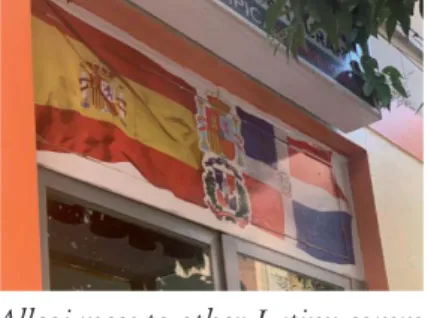
Figure 13 is an example in which Dominicans use the LL to exhibit their loyalty and adherence to Spain (the new home) and the Dominican Republic (motherland). The Dominican flag and crest along with the Spanish ones are displayed together in the main entrance of a store, pos- sibly suggesting unity and integration between these two communities.
Nevertheless, to verify this hypothesis and obtain solid conclusions, it is necessary to analyze perception data from Dominican residents in Madrid, as presented in the following section.
Figure 13. Spanish and Dominican flags.
It is important to note that Dominicans build their transnational identities by using the public sphere to represent their allegiances not
121 Lengua y migración / Language and Migration15:1 (2023), 105-131
https://doi.org/10.37536/LYM.15.2.2023.xxxx / Edición en línea: ISSN 2660-7166
only to the Dominican Republic and Spain, but also to the other Latinx communities they share the new space with, such as Peruvian, Venezuelan, Colombian, Cubans and Ecuadorians. This is exemplified in the LL by the presence of other Caribbean and Latin American flags (see Figure 14 to observe, from right to left, the Cuban, Peruvian, Dominican, Spanish, Colombian and Ecuadorian flags) or by establish- ments that sell products of specific countries, such as Colombian trousers, or Ecuadorian food items (Figure 15). Such signage reflects, as Bernardo-Hinesley and Gubitosi (2022) state, that the LL is not static, but a dynamic activity that reflects the interaction between the LLs and the community members. It is not only relevant for the Dominican or Spanish communities, but it also accommodates the new space that is used in common with other Latinx groups. The LL reflects the multiple connections that diasporic communities establish beyond the ties of their homeland. Ultimately, as Canagarajah and Silberstein (2012: 82) state, “diaspora has to be treated as a ‘community’ that embodies differ- ence, not similarity”.
Figures 14 and 15. Allegiances to other Latinx communities represented in the LL.
Figure 16. Chévere & Olé.
Figure 16 displays a sign that says, Chévere & Olé, popular words for “cool”. Chevereis heard throughout Colombia, although it is not exclusive to that country; Venezuelans, Mexicans and other Hispanoamericans use this expression. Olé, on the other hand, is an interjection commonly heard in Spain, associated with the audience of
122
A Little Caribbeanin Madrid: analysis of the Dominican identity in the public space
Lengua y migración / Language and Migration15:1 (2023), 105-131 https://doi.org/10.37536/LYM.15.2.2023.xxxx / Edición en línea: ISSN 2660-7166
© Universidad de Alcalá
bullfighting and flamenco. These two expressions, one Spanish and one Colombian, displayed together in a bar suggest that the Dominican population not only accommodates their new space in Madrid that is shared with Spaniards, but also with other groups: Ecuadorians, Cubans, Colombians, etc.
The LL in the streets along Topete, Almansa and Tenerife that con- stitute the Little Carribeanis defined not only using Dominican region- alisms, but also by the Dominican symbols that highlight the character- istics of this diasporic community. As with the Ecuadorian community in New York (Gubitosi, Puma and Narváez 2020), the Dominican com- munity in Tetuán have built their transnational identity using the lin- guistic and semiotic landscape as a resource to reveal the relationship with the motherland: the Dominican Republic.
6.2. Survey answers: attitudes and perceptions toward Dominican semiotic and linguistic signage in the LL
This subsection is further divided into two parts. Survey participant responses related to linguistic attitudes towards Dominican Spanish are discussed first. Later, responses concerning the perception of Dominican linguistic and semiotic resources in the LL are analyzed.
6.2.2. Linguistic attitudes towards Dominican Spanish
Given the superdiverse (Vertovec 2007) and multilingual character of Madrid, many Spanish varieties and other languages are spoken daily in Madrid, and Dominican Spanish is not an exception. Analyzing linguis- tic attitudes towards Dominican Spanish allows for an optimal exami- nation of the value placed by Dominicans towards this variety.
Consequently, five questions related to the use of Dominican Spanish were included in the survey.
To the question, Do you think that speaking Dominican Spanish is an essential part of being Dominican?, the majority answered yes (83%=44), whereas 19,9% (=9) said that speaking this Caribbean Spanish variety is not an intrinsic part of being Dominican. This finding suggests that, in the Dominican diaspora of Madrid, speaking Dominican Spanish is a key element to be identified as Dominican. This high degree of language loyalty among Dominicans living in Madrid has been found in other diasporic settings, such as the Dominican commu- nity living in Puerto Rico (Suárez Büdenbender 2010) or in continental US (Toribio 2000). As seen in the previous section, this Spanish variety
is also present in the LL of Little Caribbean, where regionalisms such as 123
locrioand chimiare found. The use of Dominican Spanish in the dias- pora reflects its intra-community significance as an identity marker (Tabouret-Keller 1997).
Two questions related to the perceptions Dominicans in the Madrid diaspora have on their speech variety in relation to other Caribbean, Latin American and Madrid Spanish varieties. As to Are there many dif- ferences between my way of speaking and that of other Caribbean and Latin American Spanish speakers?, the majority answered affirmatively (90.5%=48), whereas 9.4% (=5) did not find differences among Caribbean Spanish varieties. Future studies should better understand the factors that explain those findings, such as other public perceptions Dominicans are exposed to in Madrid. Along those lines, Dominicans in Puerto Rico are exposed to perceived racial differences in addition to their low socioeconomic status, factors that have an impact on negative linguistic attitudes towards Dominican Spanish. Although Puerto Rican Spanish and Dominican Spanish are both Caribbean varieties with a high degree of similarity that only differ in a small number of linguistic features, such as complete erosion of /s/ in coda position in Dominican Spanish (Toribio 2002) or the velar articulation of the /r/ in syllable-ini- tial position in Puerto Rican Spanish (Arias Álvarez 2020, 2022), nega- tive attitudes allow Puerto Ricans to perceive Dominican Spanish as
“incomprehensible” and stigmatize its use (Duany 1998, Suárez Büdenbender 2010). To the question, Are there many differences between my way of speaking and that of other Madrilian inhabitants?, the majority of participants (88.6%=47) again responded affirmatively, whereas 11.3% (=6) did not find disparities between Dominican and Madrid Spanish varieties. That is, Dominican Spanish speakers living in Madrid are aware of their own language variety’s idiosyncratic features in comparison to other American Spanish varieties.
Finally, regarding Among all Spanishes, is Dominican Spanish the most correct variety?, a minority reported that Dominican is the most
“correct” Spanish variety (30.1%, =16), in contrast to those who answered affirmatively (69.8%, =37). Those results reflect the fact that this variety continues to be heavily stigmatized within the Spanish- speaking world (Suárez Büdenbender 2009). Similarly, Suárez Büdenbender (2010) finds that Dominicans living in Puerto Rico do not believe that their variety is better than other Spanish dialects. In line with previous research, Dominican Spanish Speakers living in Madrid continue perceiving their own variety as less “correct” than other Spanishes spoken in Latin America and Spain (Toribio 2000).
To conclude this section, participants were asked about the conser- vation and maintenance of Dominican Spanish. To the question, Would you like your children to speak in the way that Dominican inhabitants
124
Lengua y migración / Language and Migration15:1 (2023), 105-131 https://doi.org/10.37536/LYM.15.2.2023.xxxx / Edición en línea: ISSN 2660-7166
© Universidad de Alcalá
speak?,the majority reported that they would (54.7%, =29), in contrast to those who answered negatively (45.2%, =24). Those findings illus- trate that Dominican Spanish speakers residents in Madrid have oppos- ing points of view. Half of our participants value the maintenance of their speech variety and are interested in transmitting Dominican Spanish to future generations, suggesting that Dominicans perceive their vernacular variety as a highly salient aspect of the Dominican iden- tity, in line with Suárez Büdenbender’s (2009) results on Dominican Spanish in Puerto Rico. The other half of participants included in the present study might be influenced by negative language attitudes towards their own speech variety. As said above, Caribbean Spanish is one of the most stigmatized varieties in the Spanish speaking world (Suárez Büdenbender 2009), in addition to the fact that Dominicans liv- ing in Madrid are in contact with a prestigious Spanish variety, resulting in a high level of linguistic pressure and affecting the linguistic insecuri- ty among the diasporic community.
6.2.1. Perceptions of Dominicaness in the LL of Madrid
The next series of questions asked inquiries related to the perception towards the use of linguistic and semiotic Dominican resources, such as the Dominican flag and Dominican lexicon, in the Little CaribbeanLL.
Survey participants were presented with pictures of different stores and restaurants in which the Dominican Spanish terms or Dominican sym- bols were displayed.
To the question, Why does the Dominican flag appear in stores and restaurants?, the majority of the participants (84.9%, =45) said that it is used because reinforces their identity. Three participants opted for “touris- tic reasons” and another three subjects selected “to look more local and welcoming”. Two participants selected “it doesn’t make any sense”; they were then presented with a follow-up question prompting them for an explanation for their response. One of them answered: Porque estamos en España‘because we are in Spain’. Along these lines, participants next had to answer the question, Why are Dominican and Spanish flags displayed together in stores and restaurants?after seeing some examples in the sur- vey. Excerpts 1-6 show some of the participants’ responses.
(1) Porque que somos hermanos y nos sentimos de las dos patria
‘because we are brothers and we feel from both countries’
(2) Para reforzar la convivencia y la integración ‘to reinforce coexis- tance and integration’
(3) Es la unión de los dos países ‘it is the union of the two countries’
(4) Hispanidad ‘Spanishness’ 125
(5) Eramos gobernado ‘because we were ruled’
(6) Por que lo españoles y los dominicanos nos llevamos bien, aparte de la colonizacion ‘because the Spanish and the Dominicans get along well, apart from colonization’
Examples 1-4 reflect the fact that diasporas are communities with a close relationship with the birthplace. The Dominican and Spanish flags and coats of arms are displayed together to show union and reinforce the symbolic ties between the new place where the community settled (Spain) and their motherland (Dominican Republic), to which the dias- poric group pledges its loyalty. Examples 5-6 allude to Spanish colonial history. In 1492 Christopher Columbus arrived at the island, which he named Hispaniola. Soon after, in 1496, the Spaniards set up their first colony of the New World in Santo Domingo, serving as capital of all their colonies in America. Dominicans living in Madrid do not ignore the negative impact of Spanish colonization in their country, creating more poverty and discrimination toward the native people.
As to the question, Why do Dominican Spanish words (e.g., chimi, locrio, quisqueya) appear in stores, restaurants and bars?, the majority answered that it is used to reinforce their identity (71.6%, =38). Three percent (=2) of participants believed that it was used to make the store/restaurant look more welcoming, while 16.9% (=9) of the subjects chose the option “it is our language, how we speak”. Only a small 5.6%
(=3) believed that Dominican Spanish lexicon is used due to touristic reasons. One participant indicated that the presence of Dominican regionalisms in the Madrid LL do not make sense. These results exem- plify that the use of the language is an intrinsic part of the Dominican identity and their sense of belonging. This use of Dominican Spanish in a diasporic setting reflects the intra-community significance of a linguis- tic variety as an identity marker (Tabouret-Keller 1997). As Suárez Büdenbender 2010: 149) states: “Language loyalty among Dominican immigrants reflect a strong loyalty to the Dominican homeland and the speakers’ need to identify as Dominican and distinguish themselves from other Spanish speakers”.
6. Conclusion
Transnational communities get established in the new country through reterritorialization processes (Rosa 2015) which involve the reinterpre- tation of the ties between the linguistic variety(es) spoken in the new home and those of the diaspora group. Given that identity acts affect the public sphere and the people’s perceptions of them have an impact on
126
Lengua y migración / Language and Migration15:1 (2023), 105-131 https://doi.org/10.37536/LYM.15.2.2023.xxxx / Edición en línea: ISSN 2660-7166
© Universidad de Alcalá
their attitudes (Arias Álvarez and Gubitosi 2021), this study analyzes the presence of Dominican linguistic and semiotic resources in the pub- lic sphere of Little Caribbean, a Madrid neighborhood characterized by its Dominican diasporic community. The goals of this article were to examine how Dominicans build their transnational identities by using the public sphere to represent their allegiances to Spain and the Dominican Republic, and to examine the perceptions and attitudes that Dominicans have on the way their identity is represented in the public sphere.
In regards to the first research question, What is the nature of the Dominican signs in the Madrid LL?, findings show that the Little Carribean bottom-up signage is defined not only by the use of Dominican Spanish, but also by the Dominican symbols that highlight the characteristics of this diasporic community. They contribute to authenticating stores that might be imagined as originally Dominican (Anderson 1991). It is the new Dominican imagined community built by those who perceive themselves as part of the Dominican group. Like the Ecuadorian community in New York (Gubitosi, Puma and Narváez 2020), who also utilize those strategies, the Dominican community in Tetuán has built their transnational identity using the linguistic and semiotic landscape as a resource to reveal the relationship with the motherland. The Dominican community living in Little Caribbean have managed to replicate the images of their homeland, the Dominican Republic, and created a sense of inclusiveness in the Madrid diaspora.
Dominican businesses and shops use all the semiotic and linguistic resources, such as regionalisms, the Dominican flag and its colors (blue, red, white) and coat of arms, to show their allegiance to the Dominican Republic while still creating a new imagined community in Spain. This also confirms what Patiño-Santos’ (2015) findings revealed with her study on Colombians in Barcelona: the negotiation and creation of identity in a diasporic setting is mainly rooted in the homogenization of difference. As Woldemariam and Lanza (2015) ultimately state, diaspo- ra communities use their public space as a strategy to a) keep their transnational identity, and b) to build a singular distinctiveness in the new home country.
As to the second research question, How is the Dominican identity expressed through the LL?, Dominicans use Dominican Spanish region- alisms, as well as Dominican semiotic symbols, to convey Dominicaness. Importantly, Dominicans build their transnational iden- tities by using the LL to represent their allegiances not only to the Dominican Republic (motherland) and Spain (new home), but also to the other immigrant communities they share the new space with, such
as Peruvians, Colombians, Cubans and Ecuadorians. This is illustrated 127
in the public space by the display of other Latin American flags and the sale of typical foods and products of other countries. The LL reflects the multiple connections that diasporic communities establish beyond the ties of their homeland.
Regarding What are the perceptions towards the presence of Dominican Spanish & symbols in the Madrid LL?, findings show that the use of Dominican linguistic and semiotic resources are an intrinsic part of the identity of the Dominican diaspora in Madrid and their sense of belonging. As forWhat are the linguistic attitudes towards the use of the Dominican Spanish variety?, speaking Dominican Spanish is per- ceived as an essential part of being Dominican, and participants want their future generations to continue speaking it. However, negative lin- guistic attitudes towards Dominican Spanish are prevalent among the members of this Dominican diasporic setting, in line with previous research (Toribio 2000).
Besides apparent limitations (number of questionnaire participation, lack of statistical analysis), this study contributes to the ongoing discus- sion on the role of LL as a crucial tool to analyze attitudes towards lan- guage within a multidiverse community (Rubdy 2015) and to compre- hend how linguistic varieties and symbols are displayed in the public sphere to create community members’ sense of place and identity (Gubitosi, Puma and Narváez 2020). This process of identity negotia- tion and construction is decisive among Dominicans living in the Madrid diaspora, individuals who have resettled in Spain, deterritorial- izing themselves from the Dominican Republic and building a new sense of home far from their motherland.
Alba Arias Álvarez Universidad de Alcalá 5 Trinidad
Alcalá de Henares, Madrid 28801 Spain
ORCID: 0000-0002-8827-6823
Recepción: 26/05/2023; Aceptación: 10/07/2023
References
Anderson, Benedict. 1991. Imagined communities: reflections on the origin and. Spread of nationalism.London: Verso.
Ayuntamiento de Madrid. 2021. Población extranjera en la ciudad de Madrid (por nacionali- dad). Recuperado el día 15 de abril de 2023 en https://www.madrid.es/portales/munima- d r i d / e s / I n i c i o / E l - Ay u n t a m i e n t o / E s t a d i s t i c a / A r e a s - d e - i n f o r m a c i o n - estadistica/Demografia-y-poblacion/Poblacion-extranjera/Poblacion-extranjera-en-la- 128
Lengua y migración / Language and Migration15:1 (2023), 105-131 https://doi.org/10.37536/LYM.15.2.2023.xxxx / Edición en línea: ISSN 2660-7166
© Universidad de Alcalá
c i u d a d - d e - M a d r i d - p o r- n a c i o n a l i d a d - / ? v g n e x t f m t = d e f a u l t & v g n e x t o i d
=c289d54944580510VgnVCM2000000c205a0aRCRD&vgnextchannel=9ce23636b44b4 210VgnVCM2000000c205a0aRCRD
Arias Álvarez, Alba. 2020. “Rhotic realizations of the Puerto Rican community in Western Massachusetts and Puerto Rico.” In Dialects from Tropical Islands: Research on Caribbean Spanish in the United States, Wilfredo Valentín-Márquez, and Melvin González-Rivera (eds), 7-34.New York: Routledge.
Arias Álvarez, Alba, and Patricia Gubitosi. 2020. “Shaping of L1 & L2 linguistic identi- ties in a migrant family.” I-LanD Journal. Negotiation of L2 Identities in the age of transnational mobility: Enactment, perception, status, and language development, 1.
16-37.
Arias Álvarez, Alba, and Patricia Gubitosi. 2021. “Ideologies in the LL: the semiotic con- struction of the Puerto Rican identity.” In Linguistic Landscape in the Spanish- Speaking World, Michelle Ramos-Pellicia, and Patricia Gubitosi (eds), 105-131.
Amsterdam; John Benjamins Publishing Company.
Arias Álvarez, Alba. 2022. “Sociophonetic study of the backed /r/ in the Puerto Rican diaspora: the case of Holyoke, MA.” Bulleting of Hispanic Studies, 99(9). 815-834.
Arias Álvarez, Alba, and Sheryl Bernardo-Hinesley. 2023. “Unconvering minority voic- es: the linguistic landscape of Mieres, Asturias.” Open Linguistics, 9(1), 1- 17. https://doi.org/10.1515/opli-2022-023
Ben-Rafael, Eliezer, Elana Shohamy, Muhammad Hasan Amara, and Nira Trumper- Hecht. 2006. “Linguistic Landscape as Symbolic Construction of the Public Space:
The Case of Israel.” In Linguistic Landscape: A New Approach to Multilingualism, Durk Gorter (ed), 7-30. Bristol: Multilingual Matters.
Bernardo-Hinesley, Sheryl and Patricia Gubitosi. (2022). “Linguistic landscape and the struggle for survival: The case of Cavite Chabacano.” In Linguistic Landscape of Southeast Asia. Impact: Studies in Language, Culture and Society series, Hadi Mirvahedi (ed). Amsterdam: John Benjamins.
Blackwood, Robert, Elizabeth Lanza and Hirut Woldemariam. 2016. Negotiating and contesting identities in linguistic landscapes. London: Bloomsbury Publishing Plc.
Blommaert, Jan. 2010. The sociolinguistics of globalization. Cambridge: Cambridge University Press.
Blommaert, Jan. 2013. Ethnography, Superdiversity and Linguistic Landscapes: Chronicles of Complexity. Clevedon: Multilingual Matters.
Canagarajah, Suresh and Sandra Silberstein. 2012. “Diaspora Identities and Language.”
Journal of Language, Identity, and Education, 11. 81-84.
https://doi.org/10.1080/15348458.2012.667296
Canagarajah, Suresh. 2013. Translingual practice: Global Englishes and cosmopolitan rela- tions.New York: Routledge
Cenoz, Jasone and Durk Gorter. 2006. “Linguistic landscape and minority languages.”
The International Journal of Multilingualism, 3. 67-80.
https://doi.org/10.1080/14790710608668386
Demirci, Mahide and Brian Kleiner. 2002. “The perception of Turkish dialects.” In Handbook of Perceptual Dialectology, Dennis R. Preston (ed), 261-281. Philadelphia:
John Benjamins Publishing Company.
Dixon, Fiona. 2021. “We Can’t Understand Anything They Say: The Case of the Dominican Diaspora in Madrid.”Caribbean Studies, 49: 2. 75-100.
Duany, Jorge. 1998. “Ethnicity, color, and class among Dominicans in the United States and Puerto Rico.” Latin American Perspectives, 25:3. 147-172
García, Ofelia and Li Wei. 2014. Translanguaging: Language, Bilingualism and Education.
Basingstoke: Palgrave McMillan.
Gubitosi, Patricia, Christian Puma y Daniela Narváez. 2020. “Landscaping an Ecuadorian Neighborhood in Queens, NY.”Cuadernos de Lingu•ística Hispánica,36. 211-234
Gubitosi, Patricia, and Michelle Ramos Pellicia. 2021. “Introduction: Uncovering the 129