9.913 Pattern Recognition for Vision
Class 9 – Object Detection and Recognition Bernd Heisele
Overview
1. Detection
2. Recognition
3. Demo
General Problems of Detection and Recognition
Rotation/illumination invariance
Applicable to many classes
of objects Images removed due to copyright considerations.
Images removed due to copyright considerations.
Object Detection
Task
Given an input image, determine if there are
objects of a given class (e.g.
faces, people, cars..)
in the image and where they are located.
Photograph by MIT OCW.
Detection—Problems
1. Classifier must generalize over all exemplars of one class.
2. Negative class consists of everything else.
3. High accuracy (small FP rate) required for most applications.
Images removed due to copyright considerations.
Pattern Recognition for Vision Fall 2002
Face Detection
Feature Extraction
Feature vector (x1, x2 ,…, xn) Classifier
Off-line training Face examples
Non-face examples Pixel pattern
Classification Result
Search for faces at different resolutions and locations
Photograph by MIT OCW.
Photograph by MIT OCW.
Training and Testing
Training Set
Train Classifier
Labeled Test Set
Classify
Sensitivity
Photograph by MIT OCW. Photograph by MIT OCW.
False Positive Correct
Image Features
19x19
Histogram Equalization Gradient
x-y-Sobel Filtering
17x17 [0, 1]
Histogram
Equalization Masking
Gray 283 [0, 1]
Haar Wavelet Transform
1740 [0, 1]
Wavelets
Normalization
ROC Image Features
Classifiers
Positive Training Data
Real Synthetic
(T. Vetter, Univ. of Freiburg) 2900 faces + 2900 mirrored faces
Faces Illumination
Rotation
3D Morphing: + =
Photographs courtesy of CMU/VASC Image Database at http://vasc.ri.cmu.edu/idb/html/face/frontal_images/
Real vs. Synthetic
Negative Training Data
Problem: 1 face in 116.440 examined windows
Add to training set
Determine false-
positives on large set of non-face images Retrain
Classifier Initial set of
25.000 non- faces
Bootstrapping
Photographs courtesy of CMU/VASC Image Database at http://vasc.ri.cmu.edu/idb/html/face/frontal_images/
Bootstrapping
6.7 FP/image 0.9 FP/image
Performance of Global Face Detectors
Rotation
Rotation in the image plane
• Rotation invariant features
• Apply 2D rotation to image Rotation out of
image plane
• Component-based classification
• Train on rotated faces
Photographs courtesy of CMU/VASC Image Database at http://vasc.ri.cmu.edu/idb/html/face/frontal_images/
Global vs. Components
Single template
Component templates
Photographs courtesy of CMU/VASC Image Database at http://vasc.ri.cmu.edu/idb/html/face/frontal_images/
Component-based Detection
Eyes Nose Mouth
classify 1st Level:
Components
2nd Level:
Geometrical relation
between components
maximum response of each component classifier + x, y
location
classify
Photographs courtesy of CMU/VASC Image Database at http://vasc.ri.cmu.edu/idb/html/face/frontal_images/
Learning Components
Components:
• discriminatory
• robust against changes in pose and illumination
Synthetic faces:
• 7 different 3-D head models
• 2,500 faces
Rotation: -30o to + 30o
• 3-D correspondences for automatic location of components
Photographs courtesy of CMU/VASC Image Database at http://vasc.ri.cmu.edu/idb/html/face/frontal_images/
Learning Components—One Way To Do It
Start with small initial regions
Expand into one of four directions
Extract new components from images
Train SVM classifiers
Choose best expansion according to error bound of SVMs
Photographs courtesy of CMU/VASC Image Database at http://vasc.ri.cmu.edu/idb/html/face/frontal_images/
Margin, Radius and Expected Error
x
*1x
*2M
M R
Bound on error E < c(R / M)2
Feature Space
Cross Validation might be better
Some Examples
Photographs courtesy of CMU/VASC Image Database at http://vasc.ri.cmu.edu/idb/html/face/frontal_images/
Test on CMU PIE Database
Faces have been manually labeled (only –45o to 45o of rotation)
• About 40,000 faces
• 68 people
• 13 poses
• 43 illumination conditions
• 4 different expressions
Photographs courtesy of CMU/VASC Image Database at http://vasc.ri.cmu.edu/idb/html/face/frontal_images/
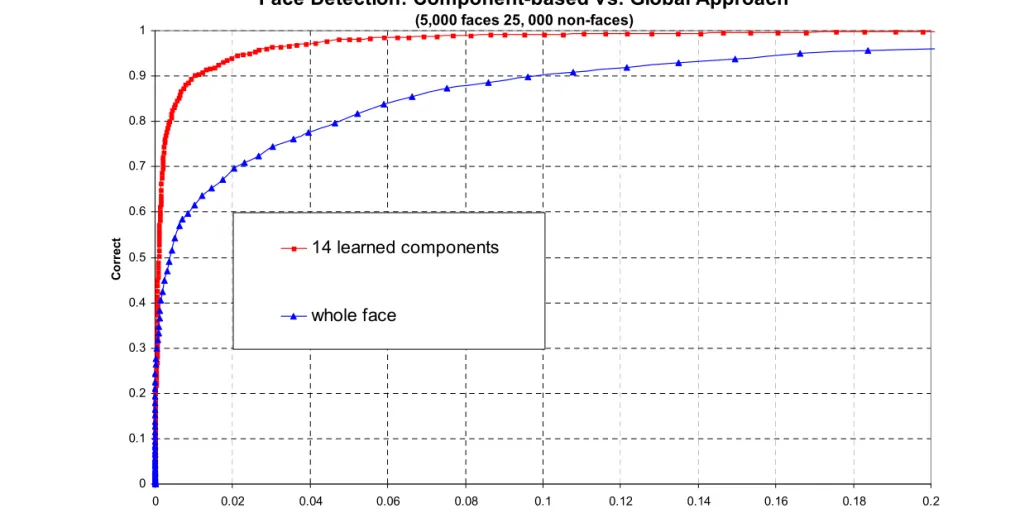
ROC Component vs. Global
Face Detection: Component-based vs. Global Approach
(5,000 faces 25, 000 non-faces)
0 0.1 0.2 0.3 0.4 0.5 0.6 0.7 0.8 0.9 1
0 0.02 0.04 0.06 0.08 0.1 0.12 0.14 0.16 0.18 0.2
FP / inspected window
Correct
14 learned components
whole face
Object Parts." In Advances in Neural Infrmation Processing Systems (NIPS'01), Vancouver, Canada.
Graph based on work in: Heisele, B., T. Serre, M. Pontil, T. Vetter, and T.Poggio. "Categorization by Learning and Combining
Pedestrian Detection
•Representation: dictionary of Haar wavelets;
high dimensional feature space (>1300 features)
•SVM classifier
Images removed due to copyright considerations. See Figure 4 in: Papageorgiou, C., and T. Poggio.
"A Trainable System for Object Detection." International Journal of Computer Vision 38, no. 1 (2000): 15-33.
Examples
Image removed due to copyright considerations. . See Fig. 7P in: Papageorgiou, C., and T. Poggio.
"A Trainable System for Object Detection." International Journal of Computer Vision 38, no.1 (2000): 15-33.
Components
•Haar wavelets
•5 components
•Can deal with partial occlusions
Mohan, A. "Robust Object Detection in Images by Components." Master's Thesis, MIT, 1999.
Advances on Component-base Face Detection Stan Bileschi
Components are small, and prone to false detection, even within the face.
Photos and figures from: Bileschi, Stan, and Bernd Heisele. "Advances in Component-Based Face Detection." IEEE International Workshop on Analysis and Modeling of Faces and Gestures (2003): 149. Courtesy of IEEE, Stan Bileschi, and Bernd Heisele. Copyright 2003 IEEE.
Courtesy of Stan Bileschi. Used with permission.
Used with Permission.
Training on Faces
Use the remainder of the face in the negative training set
Positive Negative
Photos and figures from: Bileschi, Stan, and Bernd Heisele. "Advances in Component-Based Face Detection." IEEE International Workshop on Analysis and Modeling of Faces and Gestures (2003): 149. Courtesy of IEEE, Stan Bileschi, and Bernd Heisele. Copyright 2003 IEEE.
Used with Permission.
Training on Faces Only
Red:
Trained only with faces.
Blue:
Trained on faces and non- faces.
Photos and figures from: Bileschi, Stan, and Bernd Heisele. "Advances in Component-Based Face Detection." IEEE International Workshop on Analysis and Modeling of Faces and Gestures (2003): 149. Courtesy of IEEE, Stan Bileschi, and Bernd Heisele. Copyright 2003 IEEE.
Courtesy of Stan Bileschi. Used with permission.
Used with Permission.
Often, many components classify correctly, with only a few errors
Errors
Photos and figures from: Bileschi, Stan, and Bernd Heisele. "Advances in Component-Based Face Detection." IEEE International Workshop on Analysis and Modeling of Faces and Gestures (2003): 149. Courtesy of IEEE, Stan Bileschi, and Bernd Heisele. Copyright 2003 IEEE.
Courtesy of Stan Bileschi. Used with permission.
Used with Permission.
Using Models of Pair-wise Positions
Photos and figures from: Bileschi, Stan, and Bernd Heisele. "Advances in Component-Based Face Detection." IEEE International Workshop on Analysis and Modeling of Faces and Gestures (2003): 149. Courtesy of IEEE, Stan Bileschi, and Bernd Heisele. Copyright 2003 IEEE.
Courtesy of Stan Bileschi. Used with permission.
Used with Permission.
Pair-wise Biasing Leads to Tightened Result Images
Photos and figures from: Bileschi, Stan, and Bernd Heisele. "Advances in Component-Based Face Detection." IEEE International Workshop on Analysis and Modeling of Faces and Gestures (2003): 149. Courtesy of IEEE, Stan Bileschi, and Bernd Heisele. Copyright 2003 IEEE.
Courtesy of Stan Bileschi. Used with permission.
Used with Permission.
Pair-wise Biasing
Photos and figures from: Bileschi, Stan, and Bernd Heisele. "Advances in Component-Based Face Detection." IEEE International Workshop on Analysis and Modeling of Faces and Gestures (2003): 149. Courtesy of IEEE, Stan Bileschi, and Bernd Heisele. Copyright 2003 IEEE.
Courtesy of Stan Bileschi. Used with permission.
Used with Permission.
Application: Eye Detection
Photos and figures from: Bileschi, Stan, and Bernd Heisele. "Advances in Component-Based Face Detection." IEEE International Workshop on Analysis and Modeling of Faces and Gestures (2003): 149. Courtesy of IEEE, Stan Bileschi, and Bernd Heisele. Copyright 2003 IEEE.
Used with Permission.
Recognition
B
B A
A
Task:
Given an image of an
object of a particular class (e.g. face) identify which exemplar it is.
D
D C
C
Photographs courtesy of CMU/VASC Image Database at http://vasc.ri.cmu.edu/idb/html/face/frontal_images/
Recognition—Problems
1. Multi-class problem
2. Classifier must distinguish between exemplars that might look very similar.
3. Classifier has to reject exemplars that were not in the training database.
Problems in Face Recognition
Images removed due to copyright considerations. See: Huang, Jennifer..
"Face Recognition Using Component-Based SVM Classification and Morphable Models."
SVM 2002, LNCS 2388, 2002, pp. 334-341.
System Architecture
Support Vector Machine,
….
Classifier A
Classification Result
Gray, Gradient, Wavelets, … Feature extraction
Training Data
Face Image
Photographs courtesy of CMU/VASC Image Database at http://vasc.ri.cmu.edu/idb/html/face/frontal_images/
Multi-class Classification with SVM
Bottom-Up 1vs1
A
B A,C,D
C A,B,D
D A,B,C
1 vs. All B,C,D
Training: L Classification : L A or B or C or D
A B
C or D C or D A or B
A or B
C D
Training: L (L-1) / 2 Classification : L-1
Global Approach
Detect and extract face Feed gray values into N SVMs
Classify based on maximum output
SVM A
SVM B
SVM C
SVM D
Max Operation
Recognition result
Photographs courtesy of CMU/VASC Image Database at http://vasc.ri.cmu.edu/idb/html/face/frontal_images/
Global Approach with Clustering
Partition training images of each person into viewpoint- specific
clusters
Train a linear SVM on each cluster
Take maximum over all SVM outputs
SVM C
SVM C
SVM C
SVM C
Max Operation
Recognition result
Photographs courtesy of CMU/VASC Image Database at http://vasc.ri.cmu.edu/idb/html/face/frontal_images/
Component-based Approach
Detect and extract components Feed gray values of
components to N SVMs
Take max. over all SVM outputs
SVM A
SVM B
SVM C
SVM D
Max Operation
Recognition result
Photographs courtesy of CMU/VASC Image Database at http://vasc.ri.cmu.edu/idb/html/face/frontal_images/
Pattern Recognition for Vision Fall 2002
Why Components for Recognition?
Component-based Face Recognition with 3D Morphable Models Images removed due to copyright considerations. See: Huang, Jennifer..
"Face Recognition Using Component-Based SVM Classification and Morphable Models."
SVM 2002, LNCS 2388, 2002, pp. 334-341.
More ROC Curves
"Face Recog nition with Su pport Vector Mach ines: Gl obal Versus Comp onent-based Approach."
Internatio nal Conference on Comp uter Visio n (ICCV'01). Vol. 2. Vancouver, Ca nada, 2001, pp. 688-694.
Image removed due to copyright considerations. See: Heisele, B., P. Ho, and T.Poggio.
Morphable Models for Face Recognition, Jennifer Huang
See: Blanz, V., and Vetter, T. "A Morphable Model for the
Synthesis of 3D Faces." SIGGRAPH'99 Conference Proceedings,
Images removed due to copyright considerations.
Based SVM Classification and Morphable Models." . SVM 2002, LNCS 2388, 2002, pp. 334-341.
See: Huang, Jennifer. "Face Recognition Using Component-
Images removed due to copyright considerations.
pp. 187-194.
Morphable Model
Images removed due to copyright considerations. See: Huang, Jennifer..
"Face Recognition Using Component-Based SVM Classification and Morphable Models."
SVM 2002, LNCS 2388, 2002, pp. 334-341.
Some Training Images
Images removed due to copyright considerations. See: Huang, Jennifer..
"Face Recognition Using Component-Based SVM Classification and Morphable Models."
SVM 2002, LNCS 2388, 2002, pp. 334-341.
Preliminary Results on Synthetic Images
Image removed due to copyright considerations. See: Huang, Jennifer..
"Face Recognition Using Component-Based SVM Classification and Morphable Models."
SVM 2002, LNCS 2388, 2002, pp. 334-341.
Current Work – Testing on Real Images
Problems Encountered:
Detection
Inaccurate Component detection
Recognition
Accuracy of 3D models
Choice of Illumination and Pose
Jennifer Huang
Literature
B. Heisele, A. Verri and T. Poggio: Learning and Vision Machines. Proceedings of the IEEE, Visual Perception: Technology and Tools, Vol. 90, No. 7, pp. 1164-1177, 2002.
See also CBCL Web page