The success of the RE model is attributed to the fact that traders learn from market conditions the equilibrium price and balance at the same time. They trade in a single share which pays a liquidation and sovereign conditional dividend at the end of the period. Each experiment has fifty periods, each of which is composed and independently maps a natural and private state.
There is a one-period stock that pays a state-contingent dividend at the end of the period. The deviations in traders' preferences are one of the incentives to trade in the market. Insiders and partially informed traders receive their private information at the beginning of each period of the experiment.
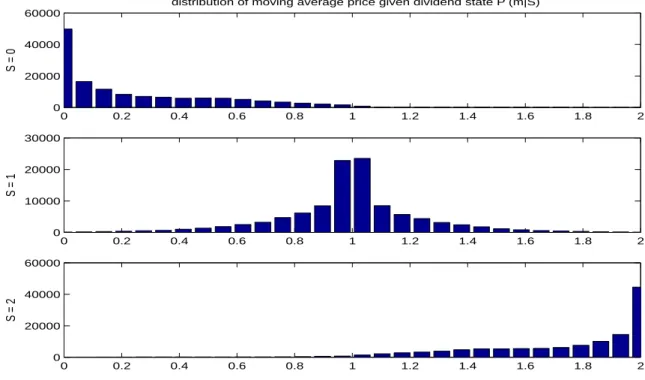
According to their beliefs, they form expectations about the price, which we call the base price. Empirically, we further assume that most of the relevant information is embedded in the transaction prices of the last k transactions. Consequently, in the case where D =fD0;D1;:::;Dng, given a price statistic m, the conditional expectation of the dividend is equal.
By participating in multiple periods, the empirical Bayesian traders obtain more accurate estimates of the conditional probability.
Homogeneous Preferences
In experiments that have a varied dividend structure, we define allocative efficiency, following Smith (1962), as the ratio of the total dividends earned by all traders to the total maximum dividends that can be extracted from the market. For example, 100% allocative efficiency means that all shares are owned by traders from the group that receives the highest dividend in the realized state. In general, we find convergence to REE in equal preferences, but difficult or unattainable in experiments involving different preferences.
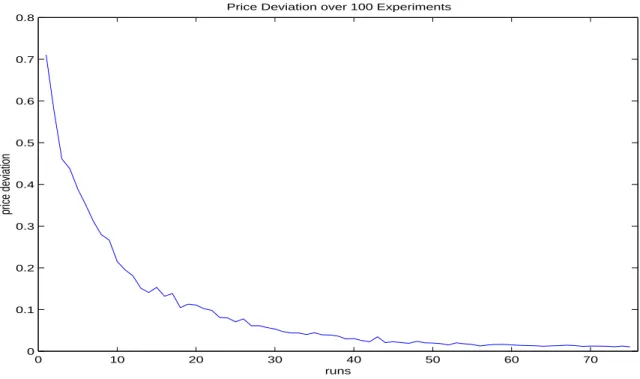
Most of the numbers and statistics presented in this section are either pooled or average measures taken from 100 trials of the same experiment. For example, the reported price deviations are averaged over 100 trials of the same experiment, and the frequencies presented in the empirical distributions are summed values. For example, there may be many more traders who receive the information that D =f$0;$1gt than those who receive D =f$1;$3g.
The difference in their wealth represents the value of the inside information and can be an estimate of the price traders would be willing to pay if the information signals were sold. Note that the value of insider information decreases across the periods as learning occurs. This result is consistent with that from markets in Sunder (1992), where information is sold in a sealed bid auction.
Heterogeneous Preferences
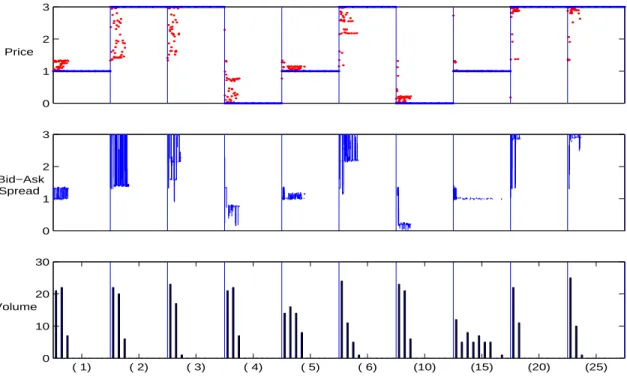
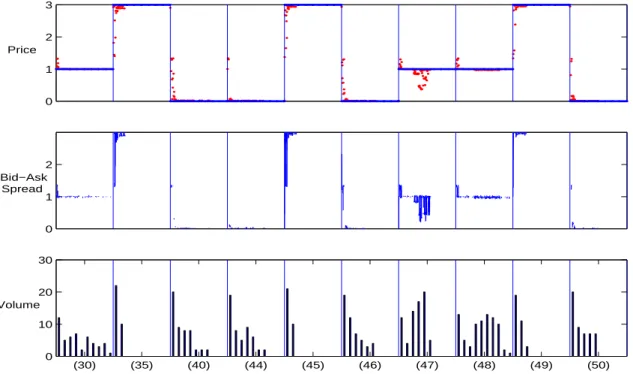
Traders in these markets lower their bids for information as they learn to make inferences about states with several periods of experience. Note that Type II insiders will bid the highest price (close to $3) and they will never sell the shares. The rest will try to buy or sell at roughly $1, but Type II insiders will be responsible for most of the buying.
This is in contrast to the laboratory markets studied by Plott and Sunder (1982), where after several iterations, insiders began to realize that the actual equilibrium price may be different from what their dividend properties say and adjust the strategy their trading accordingly. The main differences between these experimental markets and our simulation are human traders' knowledge of the existence of other dividend payments and their ability to learn about the relationship between the equilibrium price and the state-given price.8 The absence of these two makes convergence impossible in our simulation. In the market of different information and different dividends (Experiment 3), the end-of-period price does not approach the REE price.
We understand that a market with disparate information is a more difficult scenario than one with inside information. In similar experiments with human subjects, Plott and Sunder (1988) show that information gathering was unsuccessful in a market with varying dividends, attributing the failure to the complexity involved in inferring the state from market information. In two other sets of experiments, they found that the market aggregates information efficiently by having identical dividends for all traders (as in Experiment 1), or by replacing the single three-state security with three state-contingent claims.
In a separate study, Forsythe and Lundholm confirmed similar results and added that information gathering can be successful if the diverse dividend structure is made available to all traders. 8In the context of Experiment 3, uninformed traders in Group I pay as much as $1, for one share of stock. Given their dividend payments, they can make a profit of $1 and break even in states 1 and 3.
However, they will soon realize that the prices in both states are higher than $1, which they cannot afford. On the other hand, when the stock trades below $1, it will definitely be in state 2 when the stock pays no dividend. By going through this kind of thinking, human traders can associate the equilibrium price with price given the state.
Momentum Traders
On the Lower Bound of Agent Intelligence for Continuous Double Auction Markets, Technical Report HPL-97-141, Hewelett-Packard Laboratories, Bristol, UK. 1990), “Information Aggregation in an Experimental Market”, Econometrica. 1982), "Asset Valuation in an Experimental Market", Econometrica. 1993), `Allocative efficiency of markets with zero-intelligence traders', Journal of Political Economy Bayesian equilibrium in double auctions populated by biased heuristic traders', Journal of Economic Behavior and Organization forthcoming 1998), `Agent-based reading: early computational research' , Journal of Economic Dynamics and Control. 1992), Evolutionary Phenomena of Social Dynamics, inC. Rasmussen, ed., `Articial Life II', Addison-Wesley, Reading, MA, pp. 1991), ``Dynamic multi-asset equity markets'', Journal of Finance. 1982), "Efficiency of Experimental Security Markets with Insider Information: An Application of Rational Expectations Models", Journal of Political Economy.
1988), "Rational Expectations and the Aggregation of Disparate Information in Laboratory Settings", Econometrica Behavior in Auto Engine Trading in a Computerized Double Auction Market, inD. Rust, eds, `The double auction market: Institutions, Theories, and Evidence', Addison-Wesley, Reading, MA, p. 1995), Clustered volatility in multiagent dynamics, Technical report, Santa Fe Institute, Santa Fe, NM. The figure shows the differences in wealth between insiders and uninformed traders averaged over 100 experiments. Top: the graph shows the average difference in wealth between insiders and uninformed traders after 100 experiments.
The first panel compares the wealth of insiders and uninformed traders in both groups I and II; the second panel shows the wealth difference in group I; the third panel shows the wealth difference in group II.